It was a busy week and yet, I still found time to watch what was probably too much television. Here are my thoughts for this week:

Allo Allo (Sunday Night, PBS)
Trying to explain what happened on Sunday’s episode will not be easy but here goes. Having faked their deaths in the previous episode, the two British airmen were attempting to tunnel their way into a German POW camp. However, their tunnel ends up colliding with the tunnel of two other British airmen, who are attempting to dig their way out of the camp. In typical Allo Allo fashion, nearly every character on the show, whether British, German, or French, eventually ended up in the tunnel at the same time. When the tunnel collapses, everyone finds themselves in the POW camp. It was odd but funny, an enjoyably chaotic parody of movies like The Great Escape.

American Idol (Sunday Night, ABC)
I watched this week’s Final Four episode on the DVR and I have to admit that I fast forwarded through most of it. I just wanted to see who would make it into the top 3. Chayce, Willie, and Grace made it to the finale. Casey Bishop was eliminated. Because of the show’s weirdly rushed format, Casey didn’t get to say anything or even sing a goodbye song after being told that she had been rejected by America. Instead, the credits quickly flashed across the screen. It just didn’t feel right.
Of the final three …. well, I have no idea. In the past, it seems like Chayce would have won easily because of the whole country music thing but who knows? The judges seemed to really want the voters to pick Willie. Then again, the judges really just seemed to be going through the motions this season. There’s a real fear of being too negative. It’s not like the way it used to be when Simon hated everything and the other judges always seemed to be coming down from a coke binge.
Anyway, the finale is next week. I’m going to go ahead and predict that Chayce will win. I don’t know if I’m going to watch the finale or not. It’ll probably depend on what else is on at the time. (I refuse to set the DVR for the finale of a show that I know I’m going to forget about in two weeks.) It’s been a while since winning American Idol was really a big deal, to be honest. Maybe it would help if the show’s producers weren’t so determined to force everyone to sing sappy ballads.

Baywatch (Weekday Evenings, H&I)
The week in Baywatch got off to an extremely strange start on Sunday. The first episode featured Neely and Caroline competing for a modeling gig while Cody, Mitch, and Logan descended into the sewers to search for a mutant alligator. Neely got the gig and Mitch got the alligator. One thing that I did like about this episode is that the alligator was taken alive and donated to a zoo. The second episode featured a mysterious man trying to kill Logan, which led to Caroline wondering what it would be like if Charlie’s Angels were called in to save Logan’s life. Next thing you know, Caroline, Stephanie, and CJ were wearing wigs and bell bottoms and trying to solve the mystery of who was trying to kill Logan. Eventually, it was all revealed to be a dream. This was one of those meta episodes that Baywatch occasionally tried to do. Unfortunately, the show often struggled whenever it tried to be deliberately funny.
Monday was even stranger as the first episode opened with a bunch of lifeguard dragging a lifeless Hulk Hogan out of the ocean. Fortunately, they were able to bring Hogan back to life and, in order to thank them, Hogan and a bunch of wrestlers fought each other for charity. While that was going on, Stephanie was waiting to discover whether or not she had skin cancer. So, on the one hand, you had a very serious storyline about cancer and, on the other hand, you had a bunch of pro wrestlers yelling at each other on the beach. Fortunately, while Stephanie’s ultimate fate was left up in the air, the wrestlers raised enough money. Monday’s second episode featured Mitch sky-diving and this, of course, led to a lot of flashbacks to previous episodes, with some of the clips featured a totally different actor playing Mitch’s son because Baywatch was just like that. There were also some really weird green screen shots of David Hasselhoff with a bunch of fake clouds behind him. It also led to a lot of Hasselhoff voice over acting: “But if I’m unconscious, how can I know what’s happening? Am I dead?” (I may be remembering incorrectly but I thought this show already did a Mitch nearly dies while skydiving episode.) Fortunately, it turned out that Mitch’s death, much like the Charlie’s Angels episode, was just a dream.
On Tuesday, the first episode opened with Mitch trying to adopt a little girl who had never been on the show before. Eventually, I figured out that the episode was continuing a storyline that started on Baywatch Nights. In the end, Mitch did not go through the with the adoption and the little girl was sent to live with her grandparents in Iowa or Kansas or wherever it is that saintly grandparents tend to live. The second episode featured Mitch and Caroline trying to reunite a Vietnamese immigrant with her father. While they did that, CJ and Cody designed a special wheelchair so that a disabled friend would be able to roll across the sandy beach and experience the ocean firsthand. This led to a lot of shots of a sweaty, shirtless, and sexy David Chokachi handling a welding torch. Yum!
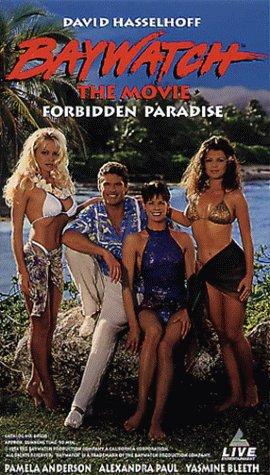
On Wednesday, the 1995 Baywatch “film,” Forbidden Paradise, was aired as a two-part episode. I reviewed it here.
Thursday started off with an odd episode, in which Stephanie discovered that she was cancer-free but, at the exact same moment she was getting her good news, a professional surfer was drowning and Logan was cheating on Caroline. It was a strangely philosophical episode but it did feature a surprisingly exciting rescue sequence. I think what made it work is that Michael Newman, who was an actual lifeguard, was the one doing the rescuing and you could tell that he actually knew what he was doing. The second episode featured Cody searching for Spanish gold and Newman, Logan, and Neely searching for a rat that was living in Baywatch headquarters.
Friday’s first episode started off with a new opening credits sequence that featured not only a bunch of new lifeguards but also the promotion of real-life lifeguard Michael Newman to the main cast. Yay, Newmie! The episode that followed featured Logan trying to make a movie about a killer shark and basically endangering everyone by filming with a real shark! At the end of the episode, Logan left Baywatch to become a director. Considering the number of people that Logan almost got killed during his time on the beach, I imagine the lifeguard were happy to see him go. The second episode found Mitch judging a beauty contest and having to deal with a new boss, Samantha Thomas (Nancy Valen).
Saturday’s episode featured an eccentric old man leaving CJ 4 millions dollars in his will and Hobie debating whether or not to get a tattoo. I have to admit that I didn’t pay much attention to it as I was preparing to host Saturday’s #ScarySocial live tweet.

The Brady Bunch (Sunday Morning, MTV)
I had this show playing in the background while I was cleaning around the house. I needed background noise to help me focus but I also needed something that I knew I would be in no danger of getting emotionally invested in. The adventures of America’s most annoying family fit the bill!

City Confidential (Thursday Night, Crime and Investigation)
The episode that I watched on Thursday night was about Boston and it told the story of a white man who claimed that two black carjackers had murdered his wife but who, it quickly became apparent, had actually committed the murder himself. With the city on the verge of a riot, he jumped off a bridge. It was a disturbing story and a far too common one.

Court Cam (Wednesday, A&E)
A&E’s stupidest reality show (and that’s saying something!) basically runs nonstop on Wednesdays. I watched two episodes on Wednesday afternoon and it was the typical collection of jocular judges, rude defendants, and teary-eyed victim statements, all breathlessly narrated by Dan Abrams. This show is basically like the 2021 version of those old “Totally Shocking Video” shows.

Fear Thy Neighbor (Saturday Afternoon, ID)
Fear Thy Neighbor is a true crime show that tells stories about neighbors who end up killing each other. On the one hand, it’s just as exploitive as it sounds. On the other hand, it does make you appreciate the neighbors who don’t try to kill each other. Whenever my neighbor gets on my nerves, I remind myself that at least he’s not one of the Fear Thy Neighbor neighbors.

Friends (Weeknights, Channel 33)
I watched Monday night’s episode. Monica was annoyed by Chandler’s fake laugh. Ross slept with the very annoying Janice. Chandler’s boss was played by the always-funny Sam McMurray. It was an okay episode, though I doubt it’s one they’ll discuss during the HBOMax reunion.

Gangs of London (Sunday nights, AMC)
I got caught up on Gangs of London this week, watching the three latest episodes (or, at least, the three latest episodes to be broadcast in the United States). I still struggle to follow the show and to keep track of who is working with who. That’s probably more due to me not watching on a regular basis than anything else. After watching the last three episodes, I’ve decided that Gangs of London works best as a parody of ultra-violent gangster epics. It’s all so over the top that it’s hard to believe that it was ever meant to be taken all that seriously.
One thing I did learn from watching the show is that Denmark apparently has a fearsome army. Who would have guessed?

Hill Street Blues (Weekday Mornings, H&I)
On Tuesday, the first episode of Hill Street Blues dealt with the aftermath of the murder of Officer Joe Coffey. Played by Ed Marinaro, Coffey had been a part of the show’s cast of characters since the first season and was at the center of many storylines. As such, you would think that the death of his character would be a big deal. Unfortunately, since Coffey had the misfortune of dying during the show’s sixth season, his death was mostly just an excuse for Lt. Norman Buntz to beat up a suspect and try to manipulate Coffey’s long-time partner into making an identification that she wasn’t sure about. The second of Tuesday’s episode featured more Norman Buntz drama as he found himself potentially being framed for the murder of another cop. Lindsay Crouse also joined the cast as a new police officer named Kate McBride who, in her first episode, got more screen time than people who had been there since the show began.
Wednesday’s first episode continued the trend of shining the spotlight on new characters as opposed to the old ones. Norman Buntz continued to threaten everyone he met. Kate McBride was accused of sexually harassing a prostitute and, though it turned out that the prostitute was lying, McBride did tell her partner, Lucy, that she was a lesbian. (The scene was so awkwardly handled that I was surprised McBride’s announcement wasn’t followed by a dramatic music cue.) Meanwhile, another new cop (played by a very young Chris Noth) tried to talk a man out of jumping off the ledge of a building. “Go ahead and jump but I don’t think you want to,” Noth said, right before the man jumped to his death. Whoops! The second episode of the morning found Detective Mick Belker reuniting with a former informant, Eddie, who died of AIDS at the end of the hour. The Belker/Eddie storyline was actually pretty effective and very well-acted by Bruce Weitz and Charles Levin. Unfortunately, it had to compete with space for scenes of Norman Buntz once again beating up suspects and Captain Furillo trying to decide whether or not to run for mayor. (The chief of police running for mayor makes sense and happens fairly frequently. But the captain of the city’s most notorious and troubled police precinct? It seems a bit less likely.)
The first of Thursday’s episodes featured Paul McCrane, who was suitable creepy as a serial killer who was captured by a group of angry citizens. This was also the last episode of season 6, as became obvious when the morning’s second episode featured completely different opening credits. (Jeff has warned me that Season 7 was even more Buntz-centric than Season 6. They probably should have renamed the show Hill Street Buntz.) The second episode featured an airplane crashing into the city, a briefcase full of cocaine getting stolen, and Buntz being held hostage. Buntz, it would seem, got held hostage quite frequently.
On Friday, the first episode featured Lt. Howard Hunter shooting a thief with a non-Department issued gun and being investigated by Internal Affairs as a result. As well, the public defenders office went on a work slow down to try to get better terms in a contract negotiation with the city. This led to Joyce Davenport getting into a physical altercation with a judge played by Jeffrey Tambor. It was actually a good episode, featuring a wonderful performance from James B. Sikking in the role of Hunter. The second episode, however, was a bit of a mess with the public defenders now on strike, Lucy introducing two new cops to life on the Hill, and Lt. Henry Goldblume abruptly going from being a bleeding heart liberal to being the type of cop who smirks while drawing a gun on a drug dealer. (The episode suggested that this was due to Buntz’s influence but Norman Buntz is exactly the type of cop that Goldblume hated just a few episodes ago. The real culprit was inconsistent writing.)
Finally, on Saturday, the first episode was another mixed bag. On the one hand, the episode featured a compelling storyline in which Capt. Furillio discovered that his recently-promoted, former second-in-command, Capt. Calletano, was struggling with running his new precinct. There was also a rather sweet moment where Assistant D.A. Irwin Bernstein admitted that he had a crush on Public Defender Joyce Davenport. However, there was also an incredibly icky storyline in which a new character, Officer Tina Russo, confessed that she had slept with a criminal (played by a youngish Chazz Palmenteri) while working undercover. And, of course, there was yet another largely pointless Norman Buntz storyline. The second episode was a mess. An old friend of Henry Goldblume’s got killed. (Doesn’t this happen every other episode?) Buntz glowered at everyone. Russo tried to defend her reputation even while the camera leered at her.
All in all, this show still has its moment but I’m glad that I’m nearly done with it.

Intervention (Mondays, A&E)
The first episode that I watched on Monday was a really old one, one that seems to get repeated rather frequently. Leslie is a soccer mom-turned-alcoholic whose children beg her to get help. As someone who grew up with an alcoholic parent, I have to admit that, whenever I see this episode, I have absolutely zero sympathy for Leslie. The episode aired in 2007 so her children are all adults now and I can only hope that they’ve managed to deal with the trauma that she put them through. Leslie did agree to go to rehab, though the show’s epilogue states that she relapsed a few times after getting treatment.
Leslie’s episode was followed by the story of Jason and Joy. Jason was a cocaine addict. His younger sister, Joy, was an alcoholic. As usual, I had more sympathy for the cocaine addict than I did for the alcoholic, which I guess suggests that I’m just biased against drunks. Fortunately, according to the episode’s epilogue, both Jason and Joy are now sober.
The third episode deal with hairstylist-turned-drug-addict Casey. To be honest, I cringed a bit when I saw that Ken Seeley was going to run her intervention because his interventions always seem to end in disaster. But, Casey actually agreed to get help for her addiction so yay! But the she left treatment early so boo! But then apparently, she got clean on her own so yay! As you can tell, the final three title cards were a real roller coater ride.
Later that night, I watched the two latest episodes of Intervention. Tim was a former MMA fighter turned addict. Shandra was an aspiring nurse turned addict. Both of them went to treatment, though Tim got kicked out after getting into a physical altercation with another patient. Let’s hope the best for them.

The Jetsons (Sunday Morning, MeTV)
I had this old cartoon playing in the background while I was cleaning the house on Sunday. George Jetson really was a whiny prick, wasn’t he?

Lauren Lake’s Paternity Court (Weekdays, Channel 33)
I watched two episodes on Tuesday because I’m a terrible person. Both episodes featured fairly trashy people so it was hard for me to really care about whether or not they stayed together.
Nobody drags out the relatively simple process of reading the results of a DNA test like Judge Lake.
Judge Lake: “Tell me about when you first got married….”
Actually, Judge Lake, why don’t you just open up the damn envelope and read the piece of paper inside?

Moone Boy (Sunday Night, PBS)
Sunday’s episode of Moone Boy centered around the Irish presidential election. It was nice to see that insane elections aren’t limited to the United States. At the end of the episode, Ireland elected it’s first woman president and Liam Moone helped to bathe the local fish monger. It’s a complicated story but the important thing is that everything worked out for the best.

The Office (All the Time, Comedy Central)
Product recall! Seriously, one of my favorite episodes ever. Michael calling that press conference is a classic Office moment. Angela’s inability to apologize is another great moment. I knew exactly what she was going through. I watched this episode of Thursday. It’s probably the 100th time I’ve seen this episode but I still laughed the whole time. It’s a classic.
On Friday, I watched three classic two-parters — Dunder Mifflin Infinity, Launch Party (“Lanch Party!?”), and Money. The scenes of Jim and Pam spending the weekend at Shrute Farms are some of my favorites from the entire series. (“Does Mose often have nightmares?” “Oh yes. Ever since …. the storm.”)

Open All Hours (Sunday Night, PBS)
On Sunday night’s episode, Arkwright was concerned that an old school chum named Chalky White was going to steal away Nurse Gladys Emmanuel. Arkwright’s worries turned out to be unfounded. He should have been more concerned about the fact that Granville is obviously only a few more insults away from snapping and blowing up the store.

Philly D.A. (Tuesday Night, PBS)
On Tuesday, I watched two episodes of the PBS docuseries, Philly D.A. This is a series that follows Philadelphia D.A. Larry Krasner over the course of his first term. The blandly smug Krasner is a progressive who is determined to reform the culture of Philadelphia law enforcement. The series follows not only him but also his critics and the prisoners he’s released and the families who have been effected by the crime of those prisoners. Like Parking Wars, this is a series whose main message seems to be, “For the Love of God, stay out of Philadelphia.”
And really, it should be interesting but the series is so extremely one-sided that it comes across as being propaganda. It’s so obvious that the series is on Krasner’s side that you never feel like you can trust it to give you the whole story and I say this as someone who strong believes that the criminal justice system does need to be reformed. I guess I shouldn’t be surprised, seeing as how this is a PBS production. Let’s just say that you’ll never see a similarly uncritical docuseries following the first term of a politician on the opposite side of the political divide.
(Interestingly enough, while I was watching this on Tuesday, Kraser was easily defeating a credible challenger in the city’s Democratic primary.)

Sabrina, The Teenage Witch (Sunday, Fuse)
Sabrina! Listen, I know that a lot of people enjoyed that Netflix series more than Case and I did but for me, the only true Sabrina is Melissa Joan Hart and the only true Salem is the one who could actually talk. I watched four episodes of Sabrina, The Teenage Witch on Sunday and they were all fun and, as opposed to the Netflix series, brightly lit.

Saved By The Bell (IFC, Monday Morning)
On Monday, I caught the infamous “All in the Mall” episode of Saved By The Bell. This is the episode in which the gang goes to the mall to buy tickets for the big U2 (?) concert but, because they’re stupid enough to trust Screech to be able to buy the tickets, everything gets screwed up. However, they do find a bag full of money. Unfortunately, two criminals want the money too! Or do they? It turns out that it’s all a set up for Totally Candid Video! The gang’s reward for appearing on the show? Tickets to the big U2 concert! Personally, I would have rather had the money.

Seinfeld (Channel 33, Weeknights)
On Monday’s episode, Elaine tried to put a clothing store out of business, Newman and Kramer competed to throw the bet millennium party (this episode was from the 90s, remember), and Jerry’s girlfriend of the week was played by Lauren Graham. It was a funny episode.

Upstart Crow (Sunday Night, PBS)
Alas poor William Shakespeare. All Shakespeare wants is a family coat of arms so that he and his father can be “posh” but the man who is in charge of handing out such honors is Robert Greene, who has always disliked the Shakespeares. Perhaps if Shakespeare can throw a successful dinner party for Kit Marlowe’s new best friend, a Moorish prince named Othello, he’ll be able to convince Greene that he deserves to be a gentleman. However, when Greene discovers that Othello has fallen in love with Kate, Greene plots to trick Othello into murdering (or, at the very least, attacking) Shakespeare. It’s all rather complicated (and, as usual, rather funny). Hopefully, someone will write a play about it.
Favorite moment from Sunday’s episode: Greene tricks Othello into thinking that Shakespeare has the handkerchief that Othello originally gave to Kate. Othello starts to lose his temper.
Greene: “Ah, the green-eyed monster….”
Othello: “Perhaps you’re right. Don’t want to jump to any conclusions.”
In the end, it’s revealed that Othello stole all of his amazing stories from Sir Walter Raleigh’s latest book and Kate breaks up with him. All’s well that ends well.

Yes, Minister (Sunday Night, PBS)
Even by the standards of Yes, Minster, Sunday’s episode was a dark and cynical one. Don’t get me wrong. It was funny but the laughter was somewhat uneasy. Jim Hacker discovered two things over the course of the episode. Number one, British-made weapons were being sold to Italian terrorists. Number two, there was nothing he could do about it. As Sir Humphrey explained it, telling the Prime Minister would lead to an inquiry and an inquiry would lead to the discovery of all sorts of government scandals and the end result would be the government falling, Jim losing his position, and the terrorists still receiving their weapons. In the end, even Jim decided that his career was more important than doing the right thing. At least in Jim’s case, he didn’t seem to be happy about it.
Halfway through this melancholy episode, Bernard asked Sir Humphrey if Jim was right about the civil service being amoral. Humphrey explained that, of course, Jim was right. The role of the civil service, Humphrey explained, was not to worry about right or wrong. The role of the civil service was to support whichever government happened to be in power. Having personal beliefs went against that. As I said, it was all pretty cynical but it was also definitely more believable than any of the good government propaganda that we tend to get here in the United States. Aaron Sorkin wishes he could have written something as effective as Sunday’s episode of Yes, Minister.

Zombie House Flipping (Saturday Morning, A&E)
No zombies. Not since The Floor is Lava have a I felt so deceived.