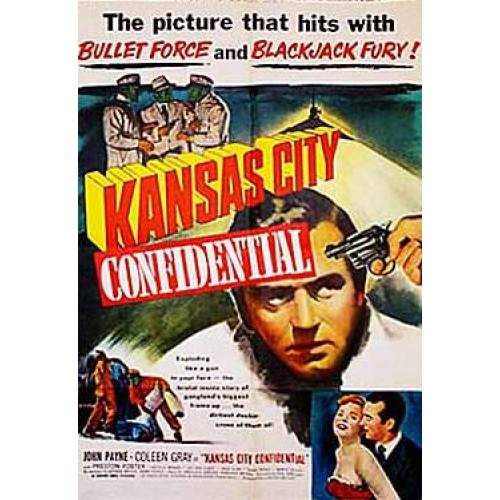
My friend Rob suggested I review KANSAS CITY CONFIDENTIAL awhile back, and I’m sorry I waited so long. This is a film noir lover’s delight, packed with tension, violence, double-crosses, and a head-turning performance by John Payne in the lead. Made on an economical budget like the same year’s THE NARROW MARGIN , director Phil Karlson and George Diskant create a shadowy, claustrophobic atmosphere brimming with danger at every turn.
I knew Payne mainly from his 40’s musicals and his idealistic lawyer opposite Maureen O’Hara in MIRACLE ON 34TH STREET, but he’s a revelation here as Joe Rolfe, a florist truck driver who’s set up as a patsy by a gang of armored car robbers. He can dish out (and take) beatings with the best them, and delivers the tough-talking dialog with aplomb. KANSAS CITY CONFIDENTIAL helped Payne shed his lightweight image, and he went on to do other dark crime films and rugged…
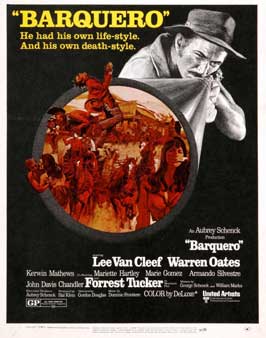
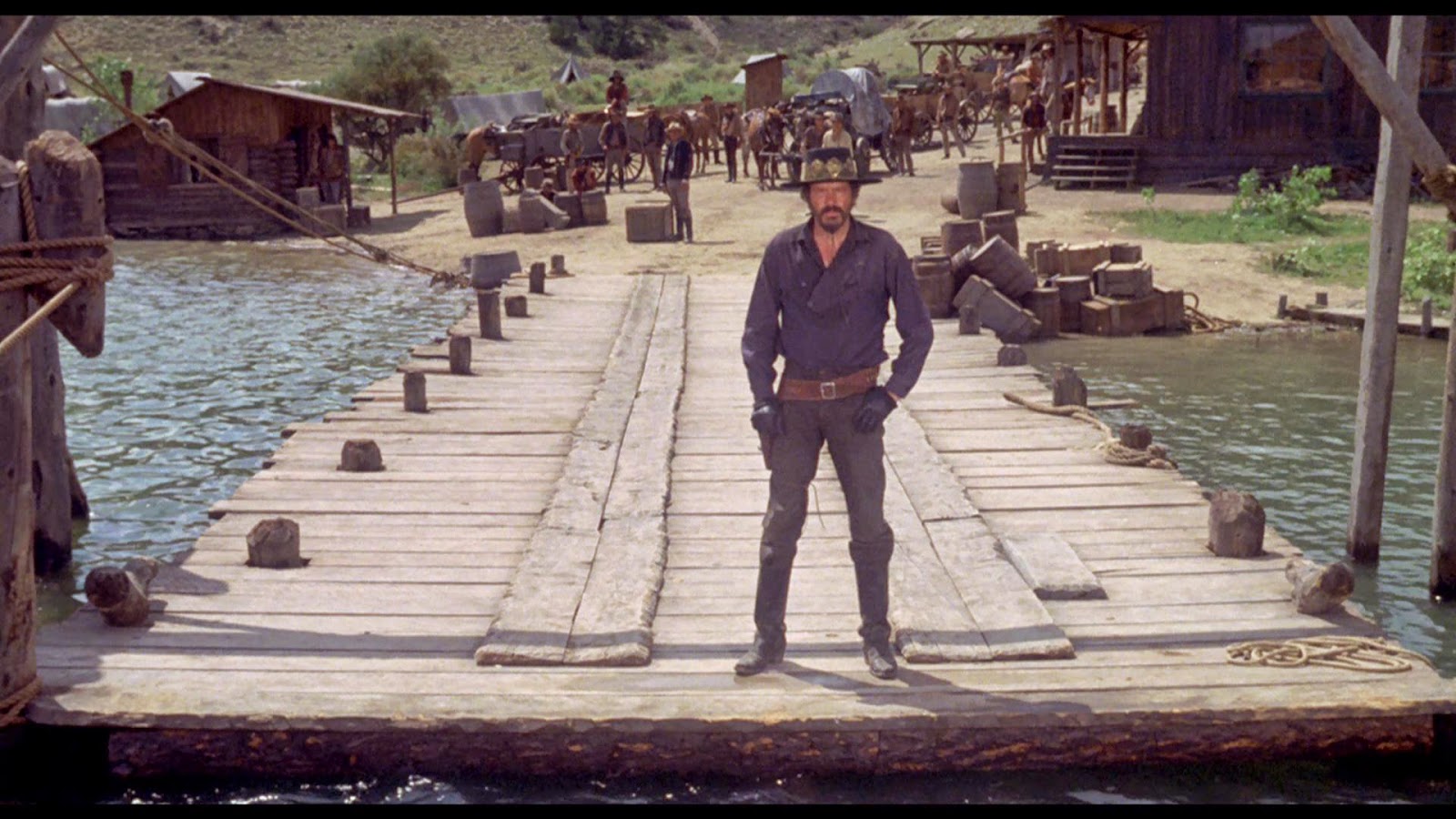
Travis (Lee Van Cleef) is a former gunslinger who now makes his living taking settlers across a river on his small barge. When we first meet him, he is telling a child to shut up and stop bothering him while he is guiding the barge. He depends on the settlers on the other side of the river for his livelihood and they depend on him for transportation but he doesn’t like them and they don’t like him. Travis only cares about two people, his Mexican lover, Nola (Maria Gomez) and an eccentric hunter named Mountain Phil (Forrest Tucker).
After stealing a shipment of silver, outlaw Jake Remy (Warren Oates) and his army of mercenaries need to cross the river to escape into Mexico. To prevent anyone from following, they plan to destroy the barge afterward. However, Travis and Phil find out that Remy is on the way and take the barge to the other side of the river. When Jake and his gang arrive, a tense stand-off ensues, with the outlaws on one side of the river and Travis and the settlers trapped on the other.
Though Barquero was directed by the veteran American director Gordon Douglas (Douglas’s best known film is the 1950s giant ant film, Them!), it was heavily influenced by contemporary Spaghetti Westerns and Sam Peckinpah’s The Wild Bunch. This can be seen in both its graphic violence and in the casting of Lee Van Cleef and Warren Oates in the leading roles.
Travis was a perfect role for Van Cleef, a talented actor who was ignored by Hollywood until he found fame playing ruthless villains in European westerns. Surly and unsmiling, Travis may seem like an unlikely hero but, like many of the best Spaghetti westerns, there are no traditional good guys in Barquero. Travis is more interested in saving his boat than protecting the settlers. He is a hero of circumstance.
As Jake, Warren Oates is a great villain. In his very first scene, he and a prostitute watch as his gang massacre the citizens of a small town. When the prostitute asks if she can come with them, Jake calmly replies, “I don’t think so” and shoots her dead. Stuck on his side of the river, Jake smokes the local weed and starts to have violent hallucinations. Soon, he is shooting bullets into the river.
Also doing good work are Forest Tucker as Mountain Phil and Kerwin Mathews. Mathews, who is best remembered for starring in The 7th Voyage of Sinbad, plays the Marquette, a disgraced French nobleman who has started a second life as Jake Remy’s right-hand man.
Barquero starts with a bang but it struggles to keep up the momentum over its entire running time. The opening shoot out is exciting but things slow down almost too much during the stand-off at the river. It is an interesting but flawed western that deserves to be better known than it is and worth watching to see Lee Van Cleef and Warren Oates at their best.
“When the legend become fact, print the legend.” — Maxwell Scott (Carleton Young) in The Man Who Shot Liberty Valance (1962)
Though I understand and respect their importance in the history of both American and Italian cinema, I have never really been a huge fan of westerns. Maybe its all the testosterone (“A man’s got to do what a man’s got to do…”) or maybe it’s all the dust but westerns have just never really been my thing.
However, I will always make an exception for The Man Who Shot Liberty Valance, which is not just a great western but a great film period.
But you already knew that. It’s a little bit intimidating to review a film that everyone already knows is great. I even opened this review with the exact same quote that everyone uses to open their reviews of The Man Who Shot Liberty Valance. To a certain extent, I feel like I should have found a quote that everyone hasn’t already heard a thousand times but then again, it’s a great quote from a great film and sometimes, there’s nothing wrong with agreeing with the critical consensus.
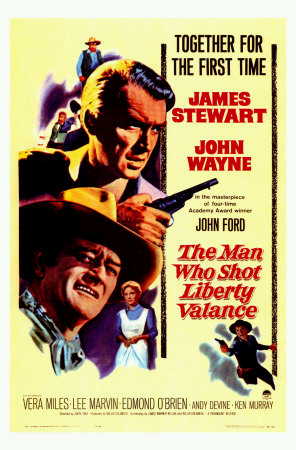
The Man Who Shot Liberty Valance opens with a train stopping in the small western town of Shinbone. The residents of the town — including newspaper editor Maxwell Scott (Carleton Young) — are shocked when Sen. Rance Stoddard (James Stewart) and his wife Hallie (Vera Miles) get off the train. Sen. Stoddard is considered to be a front-runner to become the next Vice President of the United States. Scott is even more shocked to discover why the Stoddards are in town. They’ve come to Shinbone to attend the funeral of an obscure rancher named Tom Doniphon (played, in flashback, by John Wayne).
Sitting in the funeral home with Doniphon’s coffin (and having reprimanded the local mortician for attempting to steal Tom’s boots), Rance tells Scott why he’s come to pay respect to Tom Doniphon. We see, in flashback, how Rance first came to Shinbone 25 years ago, an idealistic lawyer who — unlike most of the men in the west — refused to carry a gun. We see how Rance was robbed and assaulted by local outlaw Liberty Valance (a wonderfully intimidating and bullying Lee Marvin), we discover how Rance first met Hallie while working as a dishwasher and how he eventually taught her how to read, and we also see how he first met Tom Doniphon, the only man in town strong enough to intimidate Liberty Valance.
At first, Rance and Doniphon had an uneasy friendship, epitomized by the condescending way Doniphon would call Rance “pilgrim.” Doniphon was in love with Hallie and, when he attempted to teach Rance how to defend himself, he was largely did so for Hallie. Rance, meanwhile, was determined to bring law and society to the west.
And, eventually, Rance did just that. When Shinbone elected two delegates to the statehood convention in the territory’s capitol, Rance attempted to nominate Doniphon for the position but Doniphon refused it and nominated Rance instead, explaining that Rance understood “the law.” When Liberty Valance attempted to claim the other delegate spot, Rance and Doniphon worked together to make sure that it instead went to newspaper editor Dutton Peabody (Edmond O’Brien). And when Liberty Valance attempted to gun Rance down in the street, Rance shot him.
Or did he?
That’s the question that’s at the heart of The Man Who Shot Liberty Valance. However, as a film, The Man Who Shot Liberty Valance is far less interested in gunfights than it is in politics. Perhaps the most important scene in the film is not when Rance and Liberty meet out on that dark street. Instead, it’s the scene at the statehood convention where the reformers (represented by Rance) and the cattlemen (represented by John Carradine) battle over who will be the territory’s delegate to Washington. Between John Carradine orating, the horses riding in and out of the hall, Edmond O’Brien drinking, James Stewart looking humble, and John Wayne glowering in the background, this is one of the best political scenes ever put on film.
When Rance first arrives in the west, there is no political system in place. With the exception of the ineffectual town marshal (Andy Devine), there is no law. The peace is kept by men like Tom Doniphon and, oddly enough, by Liberty Valance as well. (Whether he realizes it or not, Shinbone’s fear of Liberty has caused the town to form into a community.) What little official law there is doesn’t matter because the majority of the Shinbone’s citizens can’t read.
When Rance arrives, he brings both education and the law. He makes Shinbone into a town that no longer needs Liberty Valance but, at the same time, it no longer need Tom Doniphon either. Hence, it’s Rance Stoddard who goes from dishwasher to U.S. Senator while Tom Doniphon dies forgotten. Rance represents progress and unfortunately, progress often means losing the good along with the bad things of the past.
(It’s no coincidence that when Rance and Hallie return to Shinbone, the first person that they see is the former town marshal, who no longer wears a star and who, we’re told, hasn’t for years. Time has passed by.)
It’s a bittersweet and beautiful film, one that features four great performances from Stewart, Wayne, Marvin, and Vera Miles. Personally, I like to think that maybe Sen. Stoddard had a daughter who married a man named Smith and maybe they had a son named Jefferson who later made his way to the Senate as well.
For today’s horror on the lens, we present a film from the legendary Roger Corman. First released in 1956, It Conquered The World tells the tragic story of what happens when it … well, conquers the world. It, by the way, is one of the most iconic of the 1950 sci-fi monsters. It is kind of a crab-like thing but … well, just watch the film. It’s kind of hard to describe.
The film also features future spaghetti western star Lee Van Cleef as the human scientist who foolishly helps It conquer the world. Van Cleef’s wife is played by one of the greatest B-movie actresses of all time, Beverly Garland. Hoping to thwart It is Peter Graves who spends the majority of the film riding around on a bicycle. Also keep an eye out for Dick Miller and Jonathan Haze, who both play soldiers here and who would later co-star in tomorrow’s horror on the lens.
I just heard that, earlier today, the legendary character actor Eli Wallach passed away at the age of 98. Wallach made his film debut in 1956’s Baby Doll and made his final film appearance 54 years later in Wall Street: Money Never Sleeps. I have to admit that I don’t really remember much about Wall Street or Wallach’s performance in the film. However, I do remember his wonderful cameo appearance in The Ghost Writer.
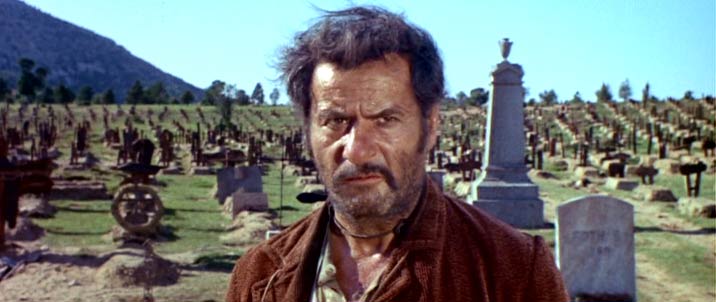
And, of course, everyone remembers Eli Wallach’s best role, that of Tuco inSergio Leone’s classic spaghetti western The Good, The Bad, and the Ugly. In the role of a comedic yet ruthless bandit, Wallach brought a lot of life to Leone’s epic portrait of greed in the west. His unabashedly flamboyant performance provided a wonderful (and much-needed) contrast to the more stoic performances of Clint Eastwood and Lee Van Cleef.
For me, the best scene in The Good, The Bad, and the Ugly is one in which not a single bullet is fired nor a word uttered. In this scene, Tuco has finally discovered the cemetery where a stolen shipment of gold has been buried. All he has to do is find Arch Stanton’s grave and he’ll be a very rich man. What Tuco did not take into consideration was just how many other graves there would be in the cemetery.
This is a rare moment in the film in which Tuco is not speaking but just watch Wallach’s performance here to see how much a great actor can do with just body language and facial expressions. (Needless to say, Ennio Morricone’s classic score helps out as well.)
In The Grave, old west outlaw Pinto Sykes is gunned down by a group of townspeople and buried in a lonely grave. However, before Sykes dies, he swears that if the bounty hunter Miller (Lee Marvin) ever comes near his grave, he’ll reach out of the ground and grab him. Needless to say, it’s not long before Miller is challenged to put Sykes’s dying words to the test.
This episode of The Twilight Zone was written and directed by Montgomery Pittman. It originally aired on October 27th, 1961. Classic western fans will immediately recognize the majority of the cast.