Guilty Horror Pleasure #87: The ‘Burbs (dir by Joe Dante)


1989’s The ‘Burbs takes place in …. well, it’s right there in the title.

Welcome to the suburbs!  It’s place with big houses, green lawns, and neighbors who often don’t have much to do other than watch each other and gossip.  Ray Peterson (Tom Hanks) lives with his wife, Carol (Carrie Fisher), and is friends with Art Weingartner (Rick Ducommun) and Mark Rumsfield (Bruce Dern).  Ricky Butler (Corey Feldman) is the local teenager.  It’s a nice neighborhood …. at least, until the Klopeks move in.

The Klopeks are viewed with suspicion from the minute they show up.  They’re from a different country, they always seem to be burying something in their backyard, and Dr. Werner Klopek (Henry Gibson) is oddly stand-offish.  When Walter Seznick (Gale Gordon) disappears and the the Klopeks are seen around Walter’s house and with Walter’s dog, Ray and his friends start to suspect that their new neighbors might be ritualistic murderers!

Oh, how I love The ‘Burbs.  The film’s portrait of the suburbs as being a hotbed of paranoia may be a familiar one but it doesn’t matter when you’ve got actors like Tom Hanks and Bruce Dern throwing themselves into their roles.  As always, Hanks is the glue that holds the film and its disparate parts together, giving a likable performance as a man who goes from being the voice of reason to being convinced that his neighbors are cannibals.  Bruce Dern gleefully sends up his own image as a paranoid Vietnam vet but there’s also a sweetness to Dern’s performance that really makes it stand out.  Dern’s character might be a little crazy but he does truly care about his neighbors.

Just as he did with Piranha and The Howling, Dante balances humor with suspense.  He does such a good job of telling the story and getting good performances from his cast, that even the film’s big twist works far better than one might expect.  It’s an 80s film so, of course, a few things explode towards the end of it.  The film’s character-based humor is replaced with some broader jokes but no matter.  The Burbs is an entertaining trip to the heart of suburban paranoia.

As the saying goes, just because you’re paranoid, that doesn’t mean that they aren’t out to get you.

Previous Guilty Pleasures

  1. Half-Baked
  2. Save The Last Dance
  3. Every Rose Has Its Thorns
  4. The Jeremy Kyle Show
  5. Invasion USA
  6. The Golden Child
  7. Final Destination 2
  8. Paparazzi
  9. The Principal
  10. The Substitute
  11. Terror In The Family
  12. Pandorum
  13. Lambada
  14. Fear
  15. Cocktail
  16. Keep Off The Grass
  17. Girls, Girls, Girls
  18. Class
  19. Tart
  20. King Kong vs. Godzilla
  21. Hawk the Slayer
  22. Battle Beyond the Stars
  23. Meridian
  24. Walk of Shame
  25. From Justin To Kelly
  26. Project Greenlight
  27. Sex Decoy: Love Stings
  28. Swimfan
  29. On the Line
  30. Wolfen
  31. Hail Caesar!
  32. It’s So Cold In The D
  33. In the Mix
  34. Healed By Grace
  35. Valley of the Dolls
  36. The Legend of Billie Jean
  37. Death Wish
  38. Shipping Wars
  39. Ghost Whisperer
  40. Parking Wars
  41. The Dead Are After Me
  42. Harper’s Island
  43. The Resurrection of Gavin Stone
  44. Paranormal State
  45. Utopia
  46. Bar Rescue
  47. The Powers of Matthew Star
  48. Spiker
  49. Heavenly Bodies
  50. Maid in Manhattan
  51. Rage and Honor
  52. Saved By The Bell 3. 21 “No Hope With Dope”
  53. Happy Gilmore
  54. Solarbabies
  55. The Dawn of Correction
  56. Once You Understand
  57. The Voyeurs 
  58. Robot Jox
  59. Teen Wolf
  60. The Running Man
  61. Double Dragon
  62. Backtrack
  63. Julie and Jack
  64. Karate Warrior
  65. Invaders From Mars
  66. Cloverfield
  67. Aerobicide 
  68. Blood Harvest
  69. Shocking Dark
  70. Face The Truth
  71. Submerged
  72. The Canyons
  73. Days of Thunder
  74. Van Helsing
  75. The Night Comes for Us
  76. Code of Silence
  77. Captain Ron
  78. Armageddon
  79. Kate’s Secret
  80. Point Break
  81. The Replacements
  82. The Shadow
  83. Meteor
  84. Last Action Hero
  85. Attack of the Killer Tomatoes
  86. The Horror At 37,000 Feet

The Unnominated #13: Heat (dir by Michael Mann)


Though the Academy of Motion Picture Arts and Sciences claim that the Oscars honor the best of the year, we all know that there are always worthy films and performances that end up getting overlooked.  Sometimes, it’s because the competition too fierce.  Sometimes, it’s because the film itself was too controversial.  Often, it’s just a case of a film’s quality not being fully recognized until years after its initial released.  This series of reviews takes a look at the films and performances that should have been nominated but were, for whatever reason, overlooked.  These are the Unnominated.

First released in 1995, Heat is one of the most influential and best-known films of the past 30 years.  It also received absolutely zero Oscar nominations.

Maybe we shouldn’t be too surprised that Academy — especially the Academy of the 1990s — didn’t shower the film with nominations.  For all of its many strengths, Heat is still a genre piece, an epic three-hour crime film from director Michael Mann.  It’s a film about obsessive cops and tightly-wound crooks and it’s based on a made-for-TV movie that Mann directed in the late 80s.  While the Academy had given a best picture nomination to The Fugitive just two years before, it still hadn’t fully come around to honoring genre films.

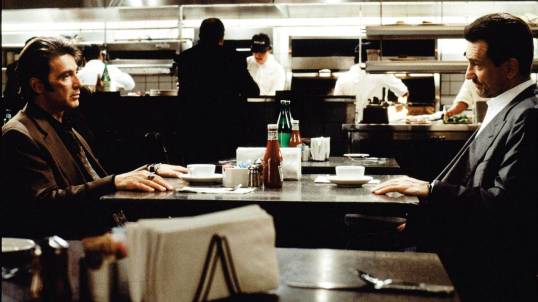
And yet one would think that the film could have at least picked up a nomination for its editing or maybe the sound design that helps to make the film’s signature 8-minute gun battle so unforgettable.  (Heat is a film that leaves you feeling as if you’re trapped in the middle of its gunfights, running for cover while the cops and the crooks fire on each other.)  The screenplay, featuring the scene where Al Pacino’s intense detective sits down for coffee with Robert De Niro’s career crook, also went unnominated.

Al Pacino was not nominated for playing Vincent Hanna and maybe we shouldn’t be too surprised at that.  Pacino yells a lot in this movie.  When people talk about Pacino having a reputation for bellowing his lines like a madman, they’re usually thinking about the scene where he confronts a weaselly executive (Hank Azaria) about the affair that he’s having with Charlene (Ashley Judd), the wife of criminal Chris Shiherlis (Val Kilmer).  And yet, I think that Pacino’s performance works in the context of the film and it’s often forgotten that Pacino has quite scenes in Heat as well.  Pacino’s intensity provides a contrast to Robert De Niro’s tightly controlled career criminal, Neil McCauley.  McCauley has done time in prison and he has no intention of ever going back.  But, as he admits during the famous diner scene, being a criminal is the only thing that he knows how to do and it’s also the only thing that he wants to do.  (“The action is the juice,” Tom Sizemore says in another scene.)  If any two actors deserved a joint Oscar nomination it was Pacino and De Niro.  In Heat, they’re the perfect team.  Pacino’s flamboyance and De Niro’s tightly-controlled emotions come together to form the heart of the picture.

No one from the film’s supporting cast was nominated either, despite there being a wealth of riches to choose from.  Ashley Judd and Val Kilmer come to mind as obvious contenders.  Kilmer is amazing in the shoot-out that occurs two hours into the film.  Ashley Judd has a killer scene where she helps her husband escape from the police.  Beyond Judd and Kilmer, I like the quiet menace of Tom Sizemore’s Michael Cheritto.  (Just check out the look he gives to an onlooker who is getting a little bit too curious.)  Kevin Gage’s sociopathic Waingro is one of the most loathsome characters to ever show up in a movie.  William Fichtner, Jon Voight, Danny Trejo, and Tom Noonan all make a definite impression and add to Michael Mann’s portrait of the Los Angeles underworld.  In an early role, Natalie Portman plays Hanna’s neglected stepdaughter and even Amy Brenneman has some good moments as Neil’s unsuspecting girlfriend, the one who Neil claims to be prepared to abandon if he sees “the heat coming.”

I have to mention the performance of Dennis Haysbert as Don Breedan, a man who has just been released from prison and who finds himself working as a cook in a diner.  (The owner of the diner is played by Bud Cort.)  Haysbert doesn’t have many scenes but he gives a poignant performance as a man struggling not to fall back into his old life of crime and what eventually happens to him still packs an emotional punch.  For much of the film’s running time, he’s on the fringes of the story.  It’s only by chance that he finds himself suddenly and briefly thrown into the middle of the action.

Heat is the ultimate Michael Mann film, a 3-hour crime epic that is full of amazing action sequences, powerful performances, and a moody atmosphere that leaves the viewer with no doubt that the film is actually about a lot more than just a bunch of crooks and the cops who try to stop them.  Hanna and McCauley both live by their own code and are equally obsessed with their work.  Their showdown is inevitable and, as directed by Michael Mann, it takes on almost mythological grandeur.  The film is a portrait of uncertainty and fear in Los Angeles but it’s also a portrait of two men destined to confront each other.  They’re both the best at what they do and, as a result, only one can remain alive at the end of the film.

I rewatched Heat yesterday and I was amazed at how well the film holds up.  It’s one of the best-paced three-hour films that I’ve ever seen and that epic gunfight is still powerful and frightening to watch.  Like Martin Scorsese’s Casino, it was a 1995 film that deserved more Oscar attention than it received.

Heat (1995, dir by Michael Mann, DP: Dante Spinotti)

Previous entries in The Unnominated:

  1. Auto Focus 
  2. Star 80
  3. Monty Python and The Holy Grail
  4. Johnny Got His Gun
  5. Saint Jack
  6. Office Space
  7. Play Misty For Me
  8. The Long Riders
  9. Mean Streets
  10. The Long Goodbye
  11. The General
  12. Tombstone


Late Night Retro Television Review: Highway to Heaven 2.23 “Children’s Children”


Welcome to Late Night Retro Television Reviews, a feature where we review some of our favorite and least favorite shows of the past!  On Thursdays, I will be reviewing Highway to Heaven, which aired on NBC from 1984 to 1989.  The entire show is currently streaming on Freevee and several other services!

This week, Jonathan and Mark find themselves in a Douglas Sirk-style melodrama.

Episode 2.23 “Children’s Children”

(Dir by Victor French, originally aired on April 30th, 1986)

When I watched this episode, I saw that the script was credited to David Thoreau and I immediately assumed that it had to be a pseudonym for the actual writer.  Fortunately, for once, I actually did some research and I discovered that the writer’s name actually was David Thoreau.  He wrote a few scripts that were produced in the 80s and 90s and, in fact, this was the first of seven scripts that he wrote for Highway to Heaven.  He’s also credited as writing the screenplay for the classic beach volleyball film, Side Out.

As for this episode, it finds Mark and Jonathan working at a home for unwed mothers.  Just the term “home for unwed mothers” brings to mind the 50s melodramas of Douglas Sirk and I found myself thinking about just how old-fashioned Highway to Heaven must have seemed even in the 80s.  I did a google search and I discovered that homes from unwed mothers do still exist, though they’re now called “maternity homes.”

The manager of the home for unwed mothers is Joyce Blair (Bibi Besch), who finds herself being hounded by a reporter named Dan Rivers (Robert Lipton).  Dan is determined to take Joyce down and, to do so, he brings up a past incident in which Joyce was arrested.  Dan twists the facts to make Joyce look like a criminal and soon, Joyce finds that she might not be able to keep the home open.  Why is Dan doing this?  Like most reporters on Highway to Heaven, he’s just plain evil.  But when one of the girls at the home suggests that Dan might be the father of her child, Dan learns what it’s like to be falsely accused.

Meanwhile, evil businessman Jack Brent (James T. Callahan) hopes for a chance to foreclose on the home so that he can bulldoze it and replace it with condominiums.  (Bad guys in the 80s always wanted to build condos.)  But how will he react when he discovers that his teenage son (Scott Coffey) is going to be a father and that the girl he impregnated in currently living at the home?

This episode is the type of episode that most people think of when they dismiss Highway to Heaven as just being an old-fashioned and slightly preachy melodrama.  There’s not a single subtle moment or particularly nuanced moment to be found in this particular episode.  It’s note quite as heavy-handed as that episode where Mark begged the President to talk to the Russians and reduce amount of nuclear missiles but it’s close.

October True Crime: Ricky 6 (dir by Peter Filardi)


Filmed in 2000 but never given an official release (though it can now be found on YouTube), Ricky 6 takes place in the town of Harmony, New York in the mid-80s.  Harmony is an upper class community, a place where the houses are big, the yards are pristine, and every father expects his son to try out for the high school football team.  It’s a place that celebrates winners and exiles losers to the nearby woods.  It’s the sort of town that seems like it exists primarily to give teenagers something to rebel against.

Tommy Pottelance (Chad Christ) and Ricky Cowen (Vincent Kartheiser) are two of those rebels.  They both have long hair.  They both listen to music that is designed to terrify their conservative parents.  They both smoke a lot of weed and spend a lot of time obsessing on how alienated they feel from everyone else around them.  Tommy and Ricky are best friends, bonded by their mutual feelings of isolation.  They often talk about running off to California together and they’re not above committing a few minor crimes in order to do it.

Bullied by his father and laughed at by the local drug dealers, Ricky spends his time hiding out at the library and reading books on demons and magic.  He meets Pat Pagan (Kevin Gage), a self-styled Satanist who appears to live in the woods and who, despite being middle-aged, spends all of his time hanging out with teenagers.  Ricky starts to describe himself as being a Satanist, begging his friends to announce that they love Satan as a part of a ritual that he wants to perform.  Most of his friends humor him, not knowing that Ricky hears voice and has frequent hallucinations.  (The fact that his dealer keeps selling him dusted joints definitely doesn’t help as far as that’s concerned.)  Ricky starts out the film as somewhat passive and very much in Tommy’s shadow but, as his interest in Satanism grows, so does Ricky’s confidence and, soon, Ricky is the one giving orders.  Ricky goes from looking up to Tommy to being the one who issues the commands.  When Ricky becomes convinced that one of his friends stole some drugs from him, he decides to get a very violent and bloody revenge….

Ricky 6 is based on a true story, one that was examined in a documentary that Jeff reviewed earlier this year, The Acid King.  Because the film has never been given an official theatrical release and has mostly been distributed through bootleg tapes and DVDs, Ricky 6 has developed a reputation for being a bit more extreme than it actually is.  Yes, the murder scene is brutal and yes, the permanently stoned and occult-obsessed Ricky does have some memorably surreal hallucinations.  For the most part, though, Ricky 6 is more a study of Ricky and Tommy’s friendship than a straight horror and/or true crime film.  Ricky and Tommy are both angry at a world that doesn’t seem to understand them, with the main difference being that Tommy rejects the world while Ricky tries to bring some sense of order and meaning to his chaotic existence by worshipping Satan.  When Tommy angrily tells Ricky that there is no God and no Satan, Ricky rather innocently asks, “How could you want to live in a world without magic?”  Of course, for Ricky, part of the magic means dragging his friends into helping him commit a murder.

Ricky 6 is a well-acted film, especially by Vincent Kartheiser, Kevin Gage, and, in the role of Tommy’s girlfriend, Emmanuelle Chriqui.  Kartheiser plays Ricky as being someone who is so lost in his own head that he’s lost the ability to understand the enormity of his actions.  And yet, it’s hard not to have some sympathy for Ricky because one look at his homelife and his overbearing father reveals that he probably never had much of a chance.  There are a few scenes where Kartheiser flashes an appealingly vulnerable smile and, for a minute or two, it’s easy to forget that he is also a ruthless killer.

With a two-hour running time, Ricky 6 is a bit too long for its own good and the use of Tommy as the story’s narrator means that the film often tells us about things that it should be showing us.  It’s an imperfect film but, due to the strength of the cast and the way the film captures the atmosphere of suburban ennui, it’s not a bad one.

Gunshy (1998, directed by Jeff Celentano)


Burned-out writer Jake Bridges (William L. Petersen, a year or two before CSI) comes home one day to discover his wife in bed with another man.  Jake, who is already suffering from an epic case of writer’s block, goes to Atlantic City and tries to drink his troubles away.  When the bitter Jake gets into a bar fight, he’s saved by Frankie (Michael Wincott).  Frankie takes Jake back to his house, where Jake meets Frankie’s girlfriend, Melissa (Diane Lane).  Jake also discovers that Frankie works as a debt collector for a local mob boss, Lange (Michael Byrne).

Frankie and Jake strike up an unexpected friendship.  Jake wants to experience what it’s like to be a real tough guy.  Frankie wants to improve his vocabulary.  Frankie agrees to take Jake with him when he makes his collections on the condition that Jake recommend a book to him.  Soon, Jake is pretending to be a gangster and Frankie is reading Moby Dick.  Frankie shows Jake how to be intimidating.  Jake explains the symbolism of Ahab’s quest to Frankie.  They become good friends, with the only possible complication being that Jake is falling in love with Melissa.

For a low-budget neonoir that, as far as I know, never even got a theatrical release before being released to video, Gunshy is surprisingly good.  The plot may sometimes be predictable but Petersen and especially Wincott give good performances and they both play off of each other well.  Diane Lane is undeniably sexy but also bring a fierce intelligence and a sense of wounded dignity to the role of Melissa.  This is a love triangle where you want things to work out for all three of the people involved.  The rest of the cast is full of familiar faces.  Keep an eye out for everyone from R. Lee Ermey to Meat Loaf.  Director Jeff Celantano keeps the story moving and proves himself to be adept at balancing scenes of violence with scenes where Frankie and Jake simply discuss their differing views of the world.

An unjustly obscure film, Gunshy is a 90s film that deserves to be rediscovered.


Guilty Pleasure No. 8: Paparazzi


259791_ori

I once got into an argument with a friend of mine about whether or not a film could actually be so bad that it was good.

His argument was that bad, by its very definition, was the opposite of good and therefore, nothing bad could be good and vice versa.

My argument was Paparazzi.

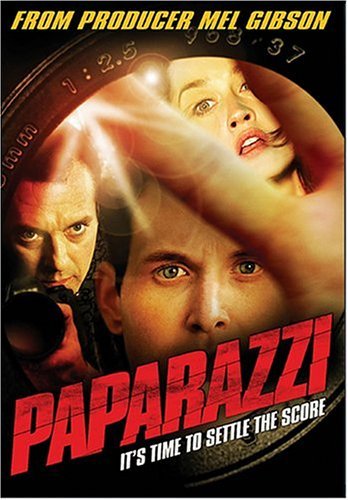
First released back in 2004, Paparazzi tells the story of Bo Laramie (Cole Hauser).  Bo is an up-and-coming super star.  As the film begins, we’re told — by a breathless correspondent from E! News — that Bo has arrived.  He’s starring in what promises to be “the world’s biggest action franchise.”  Bo has a wife (Robin Tunney), a son, and a beautiful house on the beach.  Whenever he goes jogging, huge groups of women magically materialize so that they can giggle as he runs by.

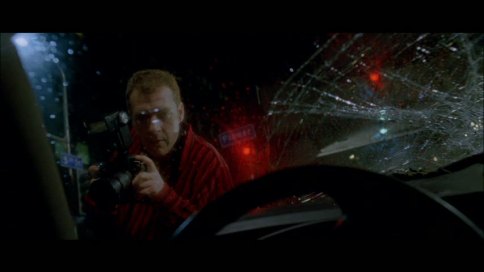
However, not everything is perfect in the world of Bo Laramie.  Like far too many defenseless celebrities, he’s being harassed by the paparazzi.  At first, Bo attempts to be polite.  However, a demonic photographer named Rex (Tom Sizemore) refuses to stop trying to take pictures of Bo at his son’s soccer game.  Things escalate until eventually, Bo’s son is in a coma and Bo is coming up with ludicrously elaborate ways to kill all of Rex’s colleagues.

The thing that distinguishes Paparazzi is not that it’s a revenge film.  What distinguishes Paparazzi is that it seems to seriously be arguing that celebrities have the right to kill people who annoy them.  Rex and his colleagues are portrayed as being pure evil (one even laughs maniacally after snapping a picture) while Bo is the victim who has to deal with the issues that come from being a multimillionaire.  Even the homicide detective played by Dennis Farina seems to be continually on the verge of saying, “Right on!” while looking over the results of Bo’s handiwork.

It’s so ludicrous and stupid and over-the-top that it can’t help but also be a lot of fun.

Don’t get me wrong.  Paparazzi is a terrible film.  In fact, it’s so terrible that, if a group of aliens ever somehow saw Paparazzi, they would probably hop in their spaceship and come to Earth specifically to wipe out the human race.  However, as bad as the film is, it’s also one of those films that you simply cannot look away from.  Watching this film is like witnessing a tornado of pure mediocrity coming straight at you.  You know that you should just stop watching and get to safety but it’s such an unexpectedly odd sight that you can’t look away.  Once you’ve seen it, you’ll never forget it and it becomes impossible not to become fascinated by the fact that such a terrible film could actually exist.

Consider the following:

1) When he’s not busy killing photographers, Bo Laramie is filming a movie called Adrenaline Force 2.  Seriously, that title is so generic that I couldn’t help but smile every time it was mentioned.  Can you imagine anyone saying, “I want to see that new movie, what’s it called, uhmm… Adrenaline Force 2?”

2) Speaking of generic, do you think that anyone named Bo Laramie could ever possibly become the biggest film star in the world?

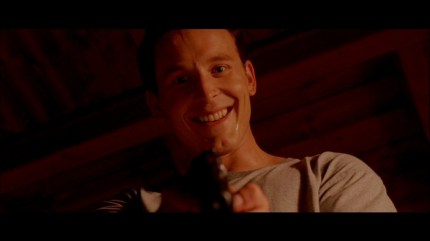
3) In the role of Bo Laramie, Cole Hauser seems like he’s as confused by this movie as everyone else.  However, towards the end of the film, he starts to flash a psychotic little grin and the contrast between that grin and Laramie’s previously stoic facade is oddly charming.

Hauser-in-Paparazzi-cole-hauser-12392470-853-480

4) You haven’t lived until you’ve seen Tom Sizemore play the world’s sleaziest photographer.

5) Vince Vaughn has a cameo as himself!  He’s co-starring in Adrenaline Force 2.

6) Mel Gibson has a cameo as himself!  He’s seen sitting in a psychologist’s office.  (No, seriously…)

7) Matthew McConaughey has a cameo as himself!  He shows up out-of-nowhere, tells Bo that it’s a pleasure to meet him, and then goes, “Alright, alright…”

8) Chris Rock has a cameo as a …. pizza deliveryman!  At first, I assumed that Chris Rock was playing himself and I kept waiting for him to explain why he was delivering a pizza to Bo Laramie’s house.  However, according to the end credits, Vaughn, McConaughey, and Gibson were playing themselves while Rock was playing the role of “Pizza Guy.”

9) Plotwise, this film invites the viewer to play a game of, “What if everyone in this film wasn’t a total and complete idiot?”  For all the effort that Bo puts into plotting his revenge, it’s hard not to feel that he just got extremely lucky.

10) The film manages to be both silly and completely humorless at the same time.  As a result, it’s a good for more than a few laughs.

11) There’s a scene where, out of nowhere, Bo recites an inner monologue about the price of fame that will remind observant viewers of Tony Bennett’s classic narration from The Oscar.

12) At one point, Tom Sizemore says, “I am going to destroy your life and eat your soul. And I can’t wait to do it.”

13) The film’s director used to be Mel Gibson’s hairdresser.

14) Finally, the film was produced by Mel Gibson and that probably means that the film actually is making a sincere case for murdering members of the paparazzi.

If ever a film has deserved the description of being so bad that it’s good, it is Paparazzi.  Between the sense of entitlement, the feverish fantasies of revenge, and the out-of-nowhere celebrity cameos, Paparazzi is a film that has earned the title of guilty pleasure.

Tom-in-Paparazzi-tom-sizemore-26901287-853-480

What Lisa Watched Tonight: The Killing Jar (directed by Mark Young)


Earlier tonight, I happened to catch, on Chiller, the 2011 film The Killing Jar.

Why Was I Watching It?

I was hoping that, at some point, the classic Siouxsie and the Banshees song would show up on the soundtrack.  It didn’t.

What’s It About?

I’m trying to work up the strength necessary to go into it all but basically, there’s this diner down south and one night, right around closing time, a news story comes over the radio about a brutal murder that was committed at a nearby farm.  There’s only a few people left in the diner — a depressed waitress (Tara from Buffy, a.k.a. Amber Benson), a tough trucker (Kevin Gage), a wimpy deputy (Lew Temple), a mysterious stranger (Harold Perrineau), two teenagers who don’t matter, and the Danny Trejo-look alike who apparently owns the place (Danny Trejo).  Anyway, all these people are so upset to hear about the murders that they blame them on the first surly stranger who happens to step into the diner.  Unfortunately, that stranger is played by Michael Madsen and he responds by shooting up the place (Danny Trejo’s head explodes in close-up) and holding the survivors hostage.  Things get a little bit more complicated when Mr. Greene (Jake Busey) shows up and reveals that someone at the diner happens to be a contract killer known as Mr. Smith.  Guess what?  It’s not Michael Madsen.

After typing all that, I feel I have a responsibility to add that this all sounds a lot more interesting than it actually is.

What Works

Well, the big “twist” is kinda obvious and you probably figured out just from reading the previous paragraph.  However, it’s still kinda fun, kinda being the word to remember.  Benson and Gage both give pretty good performances and Busey seems to be having a lot of fun.  Madsen, to be honest, seems to be on the verge of falling asleep in a few scenes but still, he can say more with an annoyed eye squint than most actors can with a 10-page monologue.  However, the film really belongs to the always underappreciated Harold Perrineau and his combative, confrontational scene with Madsen is one of the few instances when the film really comes to life.

Danny Trejo’s head explodes with style.

What Doesn’t Work

Oh.  My.  God.  Where to begin?

I can count the number of succesful “hostage” films on one hand and let’s just say that The Killing Jar is no Dog Day Afternoon.  Taking place entirely in one location and with a small cast mouthing melodramatic dialogue, The Killing Jar unfolds like one of those really bad plays that an ex-boyfriend of mine used to write in high school.  They always ended with everyone dead and always seemed to feature at least one evil redhead who ended up crying over the dead body of her ex-boyfriend.

Director Young does not help matters by confusing tension with meaningless pauses.  There’s a lot of scenes of people glaring at each other but since nobody really comes across like a human being, the glares don’t mean anything.

HOWEVER, what really didn’t work about this film was the fact that the first 20 minutes of the film was taken up with Amber Benson asking people if they wanted a slice of “Pecan Pie,” that she claimed was “the best this side of the Mason-Dixon.”  The problem here is that the film was clearly meant to be set in my part of the world.  And in my part of the world, we pronounce it “PEH-cahn.”  However, Benson repeatedly pronounced it “PEE-can.”  Seriously, this annoyed me more than words can express.  Listen up all you aspiring filmmakers — if you’re going to insist on setting your crappy films in my part of the world, at least try to get the pronunciation right.  Speaking for myself, I don’t have the slightest idea what a PEE-can is supposed to be but it sounds kinda nasty.  I’ll take a PEH-cahn over a PEE-can any day.

PEH-cahn Pie.  Good Lord, people, it’s not that difficult.

“Oh My God!  Just Like Me!” Moments:

None.

Lessons Learned:

I have no desire to ever eat another pecan pie.