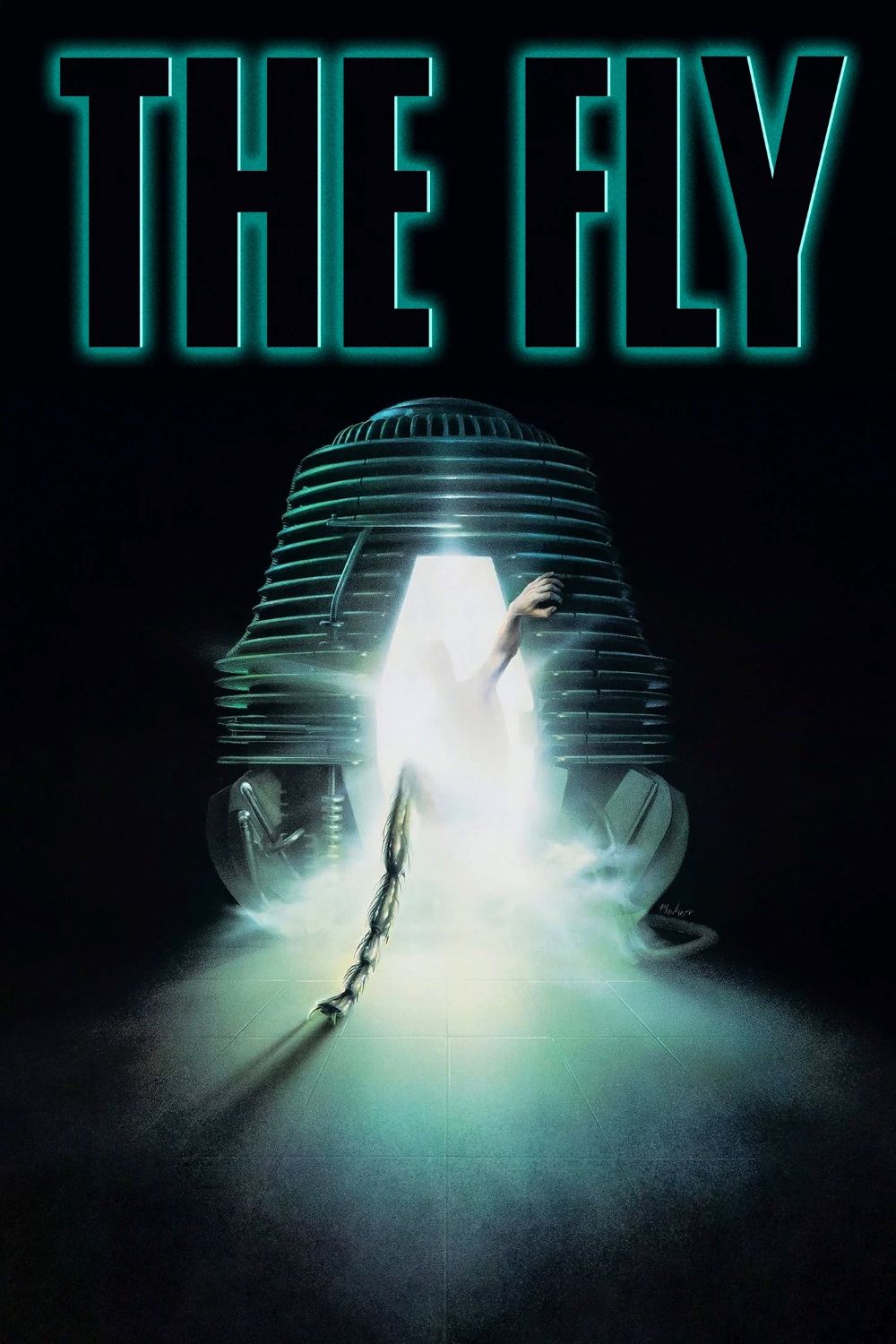
Horror Film Review: The Fly (dir. by David Cronenberg)


“I’m saying… I’m saying I – I’m an insect who dreamt he was a man and loved it. But now the dream is over… and the insect is awake.” – Seth Brundle

There’s a cruel little stretch in David Cronenberg’s The Fly (1986) when its central experiment seems to have worked out beautifully. Seth Brundle feels stronger, his confidence skyrockets, and the future looks wide open. Of course, we know better. The movie’s title alone tells us this isn’t heading anywhere pleasant. What makes the film so effective is how badly it makes us want to be wrong. Beneath the slime, broken flesh, and increasingly alarming eating habits is a romance worth caring about. Cronenberg gets us invested in a life just before showing us how horribly it can unravel.

A remake of the 1958 film of the same name, The Fly also draws from the original 1957 short story by French-British writer George Langelaan. Cronenberg takes considerable liberties with the plot, but his film really leans into the story’s darker themes and tone. Scientific curiosity leads to bodily catastrophe, and love becomes inseparable from the suffering it cannot prevent. Those ideas give the remake something substantial to build on. Cronenberg then adds his own fascination with unstable flesh and the loss of bodily control, creating a version that feels less like a retelling than a deeply personal reinvention.

For me, that combination makes it levels better than the original. The 1958 film remains an entertaining science-fiction nightmare, but Cronenberg makes the premise more emotionally involving by changing how the disaster unfolds. Instead of making the scientist’s altered appearance the central revelation, he turns transformation into a drawn-out process. We watch the damage develop alongside the characters, who keep trying to understand it, explain it, and bargain with it. The suspense isn’t simply about what Seth will look like next. It’s about how much of his old life will remain when the next change arrives.

Jeff Goldblum plays Seth as a brilliant scientist whose social skills haven’t quite caught up with his intellect. When journalist Veronica Quaife, played by Geena Davis, becomes interested in his teleportation research, their professional connection develops into something warmer. The attraction gives Seth’s otherwise isolated existence a welcome sense of possibility. Unfortunately, jealousy and alcohol eventually push him into testing the machine on himself. An unnoticed housefly enters the pod with him, and the resulting genetic fusion begins rewriting his body. His breakthrough works, just not in any way he intended.

Goldblum is terrific because he makes Seth’s awkwardness appealing without sanding down his less attractive qualities. His strange rhythms and sudden bursts of enthusiasm suggest someone who spends most of his time following thoughts other people haven’t caught up with. You can see why Veronica would find him fascinating, but you can also see the arrogance underneath his excitement. Once the transformation begins, Goldblum doesn’t abandon that characterization. He twists it. Curiosity becomes fixation, confidence becomes aggression, and Seth’s desire to share his discovery becomes a demand that someone else validate it.

Davis makes Veronica much more than the person standing nearby when the next horrible thing happens. She gives the relationship an emotional credibility that the entire movie depends on. Her affection for Seth feels genuine, as does her growing uncertainty about staying close to him. The film never pretends those feelings are mutually exclusive. She can love him and fear him, want to help him and recognize that she’s in danger. Davis handles those contradictions without making them feel like dramatic switches. They accumulate, leaving Veronica increasingly trapped between what she remembers and what she sees.

That tension becomes sharper because Seth initially welcomes his altered condition. His new strength and energy seem to confirm everything he wants to believe about his invention. He hasn’t damaged himself; he has supposedly improved himself. Cronenberg lets that delusion become seductive before exposing its ugliness. Seth’s denial isn’t just a convenient way to delay the inevitable. It grows naturally from his pride and the sheer awfulness of the alternative. Accepting the truth would mean admitting that the achievement meant to transform his life has instead made that life impossible.

Then the effects start making denial difficult for everybody. Chris Walas and his team give the transformation a wonderfully unpleasant physicality. Seth doesn’t simply sprout insect features and become a conventional movie creature. His body deteriorates, sheds pieces of itself, and develops functions he can barely comprehend. The makeup is remarkable, but its real achievement is how closely it works with Goldblum’s performance. Changes in posture, movement, and speech keep the effects attached to a recognizable person. We aren’t admiring an elaborate monster design from a safe distance. We’re watching someone struggle to inhabit his own skin.

Considering its 1986 release, the film can definitely be seen as an analogy for the AIDS crisis of the era. Seth’s deterioration and Veronica’s anguish as she watches someone she loves waste away give that reading real weight. Cronenberg originally understood the material as an analogy for disease more generally, rather than one specific illness. That broader intention doesn’t weaken the AIDS interpretation; it leaves room for it. The film captures the helplessness surrounding serious illness without requiring every detail to correspond to a single diagnosis. What matters is the frightening gap between recognizing that a body is failing and being able to do anything about it.

That’s also why the relationship becomes more upsetting as the creature effects become more extreme. The physical horror never replaces the human situation; it tightens its grip on it. Seth wants to survive, but his desperation increasingly threatens Veronica’s safety and autonomy. Her compassion cannot solve that conflict, and the film refuses to pretend otherwise. Cronenberg finds something genuinely tragic in the persistence of affection after the possibility of rescue has nearly disappeared. By the climax, we can be horrified by Seth’s actions without forgetting the frightened person behind them. Neither response cancels out the other, which makes the final stretch devastating.

The real achievement of The Fly is that its most outrageous images never overwhelm its simplest emotional truth: watching someone suffer can mean discovering how little power love actually gives you. Cronenberg turns a familiar monster-movie setup into something grotesque, intimate, and painfully sad without losing its dark humor or entertainment value. The original premise supplies the accident, but this remake makes every consequence matter. Long after the shock of the effects settles, what remains is the distance between the future Seth and Veronica briefly imagined and the ending neither could escape. That’s a far nastier thing to leave an audience with than a jump scare.

Late Night Retro Television Reviews: Friday the 13th 1.3 “Cupid’s Quiver”


Welcome to Late Night Retro Television Reviews, a new feature where we review some of our favorite and least favorite shows of the past! On Fridays, I will be reviewing Friday the 13th, a show which ran in syndication from 1988 to 1990.  The show can be found on YouTube!

Tonight’s episode is directed by a future Oscar nominee and a multiple Genie winner!

Episode 1.3 “Cupid’s Quiver”

(Dir by Atom Egoyan, originally aired on October 12th, 1987)

This week’s cursed antique is a statue of Cupid that shoots neon arrows at women and causes those targeted to fall madly in love with the statue’s owner.  Unfortunately, the curse kicks in when the owner of the statue is then forced to murder the woman who is now in love with him.  Yikes!  What a mean statue.

When we first see the statue, it belongs to a frat boy who uses the statue at a club.  After the frat boy is arrested for murder, possession of the statue falls to a total loser named Eddie Monroe (Denis Forest).  Eddie is a janitor and groundskeeper at a local college.  He’s the type of guy who hardly anyone ever notices and even those who do notice him think that he is a complete creep.  Eddie is obsessed with a student named Laurie Warren (Carolyn Dunn), following her around campus and taking pictures of her.  He’s even built an elaborate shrine to her in his apartment, one where he’s cut the heads off of the people that Carolyn was with and replaced them with his own head.  (Double yikes!)  Laurie, of course, wants nothing to do with Eddie.

Could Eddie’s new statue help him out?  He hopes so and he even takes it to the club to test it on someone else beforehand.  Eddie is determined to force Carolyn to love him, even if he’ll be required to kill her almost immediately afterwards.  Fortunately, Ryan, Jack, and Micki are on campus, searching for the statue.

This episode is often cited as one of the best of the show’s run, largely because it was directed by a future Oscar nominee, Atom Egoyan.  (Amongst Egoyan’s films: Exotica, The Sweet Hereafter, Felicia’s Journey and Where The Truth Lies.)  It’s certainly not a bad episode, as Egoyan approaches the storyline with a sense of humor.  The scenes of the frat boy and then Eddie wandering around with their cupid statue are more than a little silly and Egoyan seems to understand that.  He does a good job contrasting the ludicrousness of the statue with the seriousness of the consequences of using it.  The ultimate message is that both the statue and the men who carry it with them are more dangerous than they look.

I also enjoyed the scenes in which Ryan and a far more reluctant Micki went to a frat house to search for the statue.  The frat house is a stereotypical den of debauchery, full of empty beers can and a black bra hanging from a ceiling fan.  Ryan, not surprisingly, is right at home.  Micki cannot wait to escape and I have to say that, as often happens when I watched episodes of this show, I definitely related to Micki.  Watching Ryan and Micki wander through various frat parties in search of Eddie and his statue, I had to ask myself which is worse, a cursed antique or a fraternity?

Horror Film Review: Terror Train (dir by Roger Spottiswoode)


Wow.  Fraternities are mean!

How else do you explain the prank that begins the 1980 slasher film, Terror Train?  At a party, awkward pledge Kenny (Derek MacKinnon) is told that Alana Maxwell (Jamie Lee Curtis) is waiting for him in an upstairs bedroom and she totally wants to have sex with him!  Poor Kenny.  Really, he should have been able to figure that this was a prank but I guess he’s just naive.  Anyway, he goes upstairs, strips down to his underwear, and listens as Alana says, “Don’t be shy …. kiss me!”

Kenny thinks that Alana is waiting for him in the bed but actually, she’s hiding behind a curtain.  So, what’s in the bed?  Well, as Kenny soon discovers, it’s a limbless corpse!  Oh, those wacky pre-med students!  Under the direction of Doc (Hart Bochner), they’ve stolen a cadaver from the medical school and they’ve used it to play the joke of the century!  Everyone bursts into the room, laughing.

Ha ha!  Funny joke, right?

Well, not to Kenny.  Kenny totally freaks out and starts spinning around and gets all wrapped up in the sheets.  Needless to say, Kenny does not get laid that night.

In fact, Kenny ends up losing his mind.  And that’s unfortunate but, as they say, life goes on.  Three years later, the pranksters are all due to graduate so they’re going to throw a costume party on a train!  The conductor (Ben Johnson) watches as these rich, costumed college kids get on his train and you can just tell that he’s thinking, “There better not be no funny business.”  He need not worry!  Alana is on the train and she still feels so bad over what happened to Kenny that you can be sure that there won’t be any pranks during this graduation party!

Unfortunately for everyone else, Kenny’s decided to get on the train as well.  While his former classmates are smoking weed, getting drunk, dancing to the best disco music of 1980, and taunting a magician (David Copperfield), Kenny is killing people and stealing their costumes.

Kenny’s first victim actually dies before the train leaves.  When he comes staggering up to everyone with a sword sticking out of him, everyone assumes that it’s just another joke.  Nope!  Turns out the sword is real but everyone’s too busy boarding to notice as the guy collapses to the ground and is promptly dragged underneath the train.  In a scene that always makes me cringe, the train slowly crushes him as it starts to move forward.  I mean, seriously …. Agck!

So, now Kenny is wandering around the train, dressed like Grouch Marx and killing people.  It takes people a while to notice because we’re not exactly dealing with the smartest group of college graduates.  And, once they do realize …. well, what are they going to do?  They’re stuck on a train in the middle of nowhere!  Even if they do get off the train, it’s snowing and below freezing outside!  I mean, it’s almost as bad as Minnesota in January out there….

Of the many slasher films that Jamie Lee Curtis appeared in after Halloween, Terror Train is definitely the best.  After making his directorial debut here, Roger Spottiswoode went on to become one of the busiest directors in Hollywood and you can tell why when you watch this movie.  Spottiswoode’s makes great and atmospheric use of the train and Kenny’s habit of constantly changing his costume keeps you guessing just where he might be at any given time.  Even more importantly, Spottiswoode takes the time to develop the characters so that they become more than just cardboard victims.  Jamie Lee Curtis, Hart Bochner, Sandee Curris, and Timothy Webber all give excellent performance as the objects of Kenny’s wrath while old veteran Ben Johnson brings some gravitas to the film as the wise conductor.

(My only objection is that the worst of the pranksters is named Doc, which happens to be the name of our cat.  And let me just say that Doc the cat would never pull as cruel a prank as Doc the medical student.)

As we all know, Jamie Lee Curtis will be returning to the horror genre later this month.  She’ll be playing Laurie Strode in David Gordon Green’s Halloween remake or reboot or sequel or whatever it is.  Famously, Curtis refused to appear in horror films for several years, saying that she didn’t want to be typecast.  That was understandable on her part and, as much as I love horror movies, it was probably a smart career move.  That said, the slasher films that Curtis appeared are some of the best of the genre.  Halloween, Terror Train, and even Prom Night are all classics of their kind.  Terror Train is a suspense masterpiece, perfect for any cold and snowy night when you want to scream a little.