Guilty Pleasure No. 110: Undercover Brother (dir. by Malcolm D. Lee)


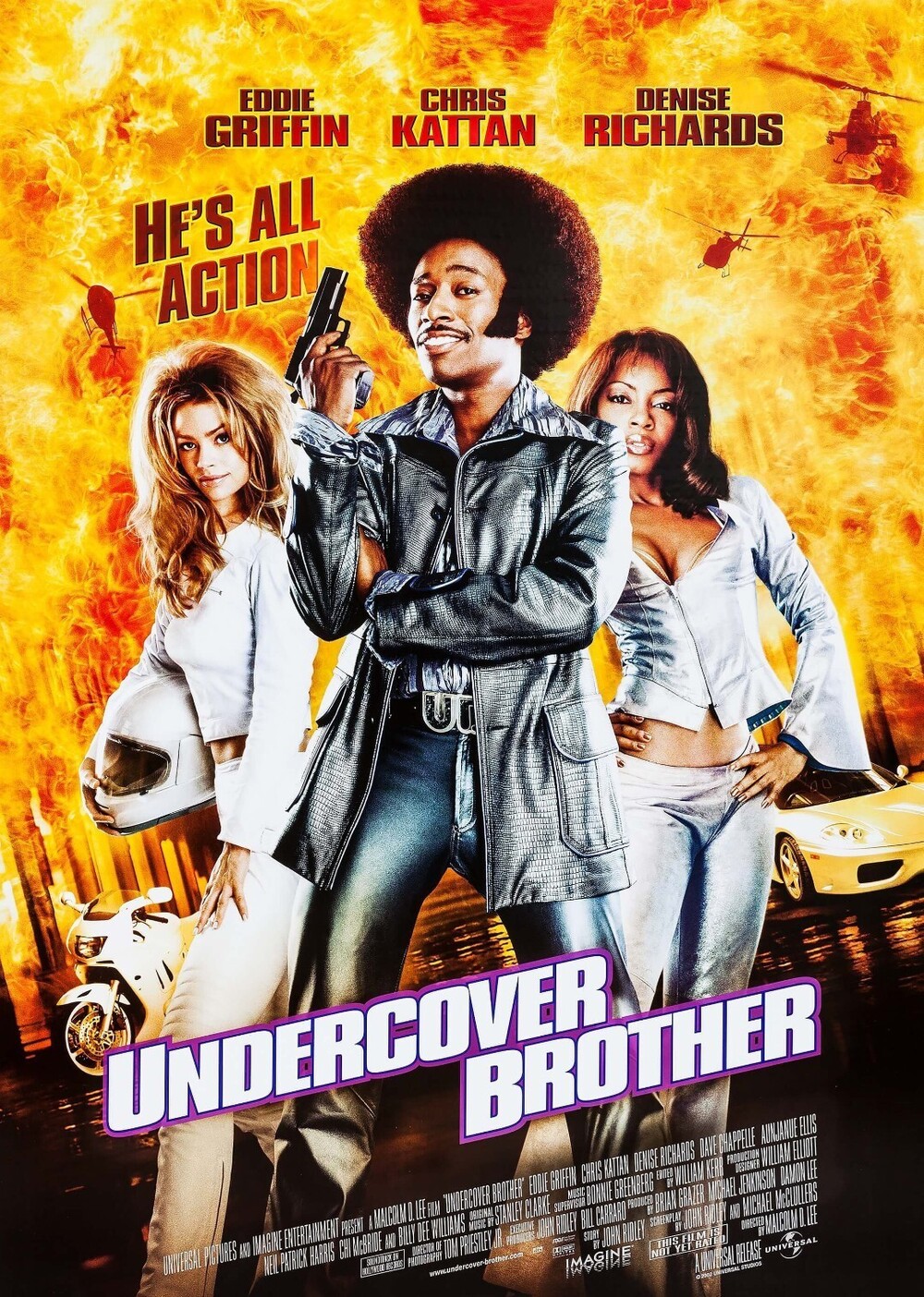
Undercover Brother is exactly the kind of movie that earns the phrase “guilty pleasure.” It is messy, broad, and often ridiculous, but it is also packed with enough energy, attitude, and sharp-enough satire to make its flaws feel like part of the joke rather than dealbreakers. The result is a comedy that may not always land cleanly, but it absolutely understands its own vibe and commits to it hard.

At the center of it all is Eddie Griffin, who gives the title character a big, swaggering, old-school cool that carries the movie through its shaggier patches. He plays Undercover Brother as a throwback spy hero with a giant Afro, loud fashion sense, and nonstop confidence, and that exaggerated persona is a big reason the film works as well as it does. Griffin’s performance is not subtle, but subtlety is not really the point here; he sells the movie’s cartoonish energy without making it feel lazy.

What makes Undercover Brother more than just a random parody is how committed it is to poking at both blaxploitation iconography and mainstream spy-movie clichés. The film was directed by Malcolm D. Lee and written from material based on John Ridley’s earlier animated series, and it leans into that satirical roots-and-gadgets formula with a lot of style. It clearly wants to be playful, but it also wants to say something about race, image, and the way Black identity gets packaged or watered down in pop culture.

That said, the movie is not exactly a model of precision. Some of the jokes are sharp and immediate, while others feel like they are still revving the engine long after the punchline should have arrived. The plot is basically an excuse to move from one set piece to another, and the film knows it, which helps, but it also means the whole thing can feel more like a high-speed sketch comedy than a fully shaped story. If you go in expecting airtight narrative logic, you will probably be annoyed; if you go in wanting a fast, funky send-up, you will have a much better time.

The supporting cast gives the movie a lot of its flavor. Dave Chappelle, Aunjanue Ellis, Billy Dee Williams, Chris Kattan, Denise Richards, and Neil Patrick Harris all add to the film’s chaotic mix, and the casting itself becomes part of the joke. Billy Dee Williams especially feels perfectly placed in a movie that is constantly riffing on cool, style, and old-school charisma, while Denise Richards gets a knowingly exaggerated role that plays into the film’s cartoonish battle between seduction and resistance.

What helps Undercover Brother age a little better than some early-2000s comedies is that it is not just throwing random nonsense at the screen for cheap laughs. There is a genuine satirical target here, and even when the movie gets clumsy, it still feels like it has a point of view. The movie clearly aims to be both goofy and observant, and even when the balance is uneven, it is hard not to appreciate the effort.

The best thing about Undercover Brother is its attitude. It moves like a movie that wants to be loud, stylish, and a little bit too much, and that confidence gives it a strange charm. The humor is often broad, sometimes cartoonish, and occasionally uneven, but the film’s willingness to fully commit to its bit makes it easy to forgive a lot. Even when the satire is more enthusiastic than elegant, the movie keeps its foot on the gas, and that momentum is a big part of its appeal.

Its biggest weakness is also the thing that makes it memorable: the movie can feel overstuffed with ideas, references, and gags, some of which work better than others. A few jokes feel a little dated now, and the film’s style of satire is not always as clean or as clever as it seems to think it is. Still, the movie has enough bite, personality, and goofy confidence that those rough edges become part of its charm instead of sinking it. That is the hallmark of a true guilty pleasure: you can see the flaws clearly, but you keep smiling anyway.

So Undercover Brother is not a perfect comedy, and it is not trying to be one. It is loud, silly, politically aware in a very pop-movie way, and shamelessly committed to its own funk. If you want polish, you will find plenty to criticize; if you want a movie with attitude, quotable energy, and the kind of swagger that makes its imperfections oddly lovable, this one delivers. It is a flawed satire, sure, but it is also a genuinely fun one, and that is why it still plays like a guilty pleasure worth revisiting.

Previous Guilty Pleasures

  1. Half-Baked
  2. Save The Last Dance
  3. Every Rose Has Its Thorns
  4. The Jeremy Kyle Show
  5. Invasion USA
  6. The Golden Child
  7. Final Destination 2
  8. Paparazzi
  9. The Principal
  10. The Substitute
  11. Terror In The Family
  12. Pandorum
  13. Lambada
  14. Fear
  15. Cocktail
  16. Keep Off The Grass
  17. Girls, Girls, Girls
  18. Class
  19. Tart
  20. King Kong vs. Godzilla
  21. Hawk the Slayer
  22. Battle Beyond the Stars
  23. Meridian
  24. Walk of Shame
  25. From Justin To Kelly
  26. Project Greenlight
  27. Sex Decoy: Love Stings
  28. Swimfan
  29. On the Line
  30. Wolfen
  31. Hail Caesar!
  32. It’s So Cold In The D
  33. In the Mix
  34. Healed By Grace
  35. Valley of the Dolls
  36. The Legend of Billie Jean
  37. Death Wish
  38. Shipping Wars
  39. Ghost Whisperer
  40. Parking Wars
  41. The Dead Are After Me
  42. Harper’s Island
  43. The Resurrection of Gavin Stone
  44. Paranormal State
  45. Utopia
  46. Bar Rescue
  47. The Powers of Matthew Star
  48. Spiker
  49. Heavenly Bodies
  50. Maid in Manhattan
  51. Rage and Honor
  52. Saved By The Bell 3. 21 “No Hope With Dope”
  53. Happy Gilmore
  54. Solarbabies
  55. The Dawn of Correction
  56. Once You Understand
  57. The Voyeurs 
  58. Robot Jox
  59. Teen Wolf
  60. The Running Man
  61. Double Dragon
  62. Backtrack
  63. Julie and Jack
  64. Karate Warrior
  65. Invaders From Mars
  66. Cloverfield
  67. Aerobicide 
  68. Blood Harvest
  69. Shocking Dark
  70. Face The Truth
  71. Submerged
  72. The Canyons
  73. Days of Thunder
  74. Van Helsing
  75. The Night Comes for Us
  76. Code of Silence
  77. Captain Ron
  78. Armageddon
  79. Kate’s Secret
  80. Point Break
  81. The Replacements
  82. The Shadow
  83. Meteor
  84. Last Action Hero
  85. Attack of the Killer Tomatoes
  86. The Horror at 37,000 Feet
  87. The ‘Burbs
  88. Lifeforce
  89. Highschool of the Dead
  90. Ice Station Zebra
  91. No One Lives
  92. Brewster’s Millions
  93. Porky’s
  94. Revenge of the Nerds
  95. The Delta Force
  96. The Hidden
  97. Roller Boogie
  98. Raw Deal
  99. Death Merchant Series
  100. Ski Patrol
  101. The Executioner Series
  102. The Destroyer Series
  103. Private Teacher
  104. The Parker Series
  105. Ramba
  106. The Troubles of Janice
  107. Ironwood
  108. Interspecies Reviewers
  109. SST — Death Flight

Retro Television Review: So Here’s What Happened 1.1 “Pilot”


Welcome to Retro Television Reviews, a feature where we review some of our favorite and least favorite shows of the past!  On Thursdays, I will be reviewing So Here’s What Happened, which aired on CBS in 2006.  The entire show is currently streaming on YouTube!

The first and only episode of this show has one message for all the mooks out there.  And that message is …. NEW YORK, BABY!

Episode 1.1 “Pilot”

(Dir by Michael Lembeck, aired on May 1st, 2006)

What to say about Vince Brophy (Bobby Cannavale)?  Hey, he’s a New Yorker, you know what I mean?  Hey, he starts every sentence by saying, “Hey,” y’know?  He knows the name of every single athlete who ever played for a New York sports team, y’know?  He meets a woman named Rochelle Jeter (Rashida Jones) and immediately asks her if she’s related to Derek Jeter, you know what I’m saying?  She says, “Yeah,” and she’s being sarcastic but Vince thinks that she’s being serious because who in their right mind would come into the old neighborhood and make a sarcastic joke, y’know?

Vince is such a New Yorker that he narrates the entire episode while sitting in his favorite barber chair.  His barber (Hector Elizondo) hangs on his every word, which is good since he presumably can’t see the flashbacks that the audience is forced to sit through.  Vince works at his family’s car lot and he wears solid suits and pinky rings and the pilot finds several excuses for him to say the word “Escalade.”  He’s not smart but he’s a stand-up guy, that Vince.  His co-worker asks him to be the godfather to his newborn and Vince agrees but then he nearly drowns the kid at the christening because he gets distracted when someone tells him that Derek Jeter don’t have no sister named Rochelle.  What a New Yorker!, y’know what I’m saying?

There’s a lot of talented people in this show.  Rashida Jones was months away from appearing on The Office.  Hector Elizondo is a comedy veteran.  Steve Park, a favorite of the Coen Brothers, appeared as Vince’s boss.  Mercedes Ruehl plays Vince’s mother.  And then you’ve got Bobby Cannavale in the lead role.  Cannavale is one of my favorite actors, a guy who is as good at playing sensitive as he is at playing tough.  Cannavale can play drama and he can play comedy and he’s easy on the eyes.  Unfortunately, all of these talented people were let down by a script that was written by none other than Paul Reiser.

The main problem with the show is that none of the characters have much of a personality beyond being from New York.  Obviously, New Yorkers are a unique group of people but every New Yorker I’ve met has also had their own individual personality to go along with their identity of being a citizen of America’s largest city.  The characters in this episode, on the other hand, have no identity beyond being a New Yorker in the most cliched ways possible.  Even worse, none of the jokes are particularly funny.  Vince crosses the line from being amiably dumb to being a buffoon far too quickly.

Perhaps not surprisingly, this was the only episode of this show.  The pilot did not lead to a series.  Fortunately, everyone involved went on to better things, y’know?

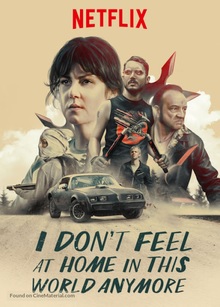
Sundance Film Review: I Don’t Feel At Home In This World Anymore (dir by Macon Blair)


(With the Sundance Film Festival currently taking place in Colorado, I am currently reviewing films that originally made a splash at Sundance!)

This is a sad story.

I Don’t Feel At Home In This World Anymore created quite a stir when it premiered at Sundance last year.  It may be hard to believe but, for a brief while, this film has just as much Sundance buzz as both Mudbound and Get Out.  It even won the Dramatic Grand Jury Prize, which has helped to launch many independent films into the public consciousness.

So, why isn’t I Don’t Feel At Home In This World Anymore a better known film?

Unfortunately, the distribution rights for this film were purchased by Netflix.  With very little fanfare and, as far as I can tell, not even the briefest of theatrical releases, Netflix started streaming I Don’t Feel At Home In This World Anymore on February 24th.  With Netflix putting most of its promotional muscle behind Mudbound, I Don’t Feel At Home In This World Anymore has been somewhat overlooked.  You can watch it, of course.  You can go on Netflix and you’ll find it sitting there with Sandy Wexler and maybe a Uwe Boll dragon movie.  Obviously, some distribution is better than no distribution and I Don’t Feel At Home In This World Anymore is probably too quirky of a movie to have ever set the box office on fire but still, it’s hard not to feel that this movie deserved better.

It tells the story of Ruth (Melanie Lynesky), a nursing assistant who is having a bad day.  One her patients dies.  She has to deal with an elderly racist.  She gets stuck in traffic and can only watch helplessly as a truck spews toxic exhaust into the environment.  When she stops off at a bar and tries to read book, a stranger casually tells her how the it ends.  As you can guess from the film’s title, this is not the world in which Ruth wants to live.  While she’s not the type to demand perfection, would it kill people to be just a little bit considerate?

Things get even worse when Ruth returns home and discovers that someone has broken into her house.  Whoever it was didn’t get away with much, just some medication, some silverware, and Ruth’s laptop.  The police are indifferent and basically blame Ruth, telling her that it’s her own fault for leaving her door unlocked.  Her neighbors are even less helpful, all claiming that they didn’t see anyone breaking into Ruth’s house.  No one seems to care.

No one but Tony.

Tony (who is played by Elijah Wood) is one of Ruth’s neighbors.  He likes to listen to heavy metal music.  He likes to work out.  He claims to be an expert in martial arts.  We’ve all known someone like Tony.  However, it turns out that Tony is the only person as upset about the break-in as Ruth is.

Tony and Ruth work together to try to track down Ruth’s stuff.  It starts out fairly simple but then gets progressively more complicated (and violent) as things go on.  Ruth and Tony become unlikely heroes.  (In one of the film’s more memorable moments, Ruth witnesses a sudden burst of violence and reacts by throwing up.)  The world may tell Ruth and Tony that they should just accept things the way that they are but Ruth and Tony aren’t willing to do that…

I Don’t Feel At Home In This World Anymore was directed by Macon Blair, who previously starred in the thematically similar Blue Ruin.  It’s not a perfect film, of course.  There are a few uneven moments but, overall, the film is strong enough that I can’t wait to see what Blair follows it up with.  The best thing about the film is that it provides lead roles to Melanie Lynesky and Elijah Wood, two quirky and appealing actors who rarely seem to get the parts that they really deserve.  As played by Lynesky and Wood, both Ruth and Tony are so likable and sincere in their desire to make the world a better place that you can’t help but wish the best for both of them.

I Don’t Feel At Home In This World Anymore is a good film and definitely one that deserves more attention than it’s received.  It’s on Netflix so, the next time you’re trying to decide what to watch, why not take a chance on it?

Previous Sundance Film Reviews:

  1. Blood Simple