In this video, Arnold Schwarzenegger is sent to the past to eliminate Guns N’ Roses but ultimately decides that it would be a waste of ammo. Obviously, he knew that fulfilling his mission would change history and the world would never get to hear Chinese Democracy.
This song (and this video) were used to promote Terminator 2: Judgement Day.
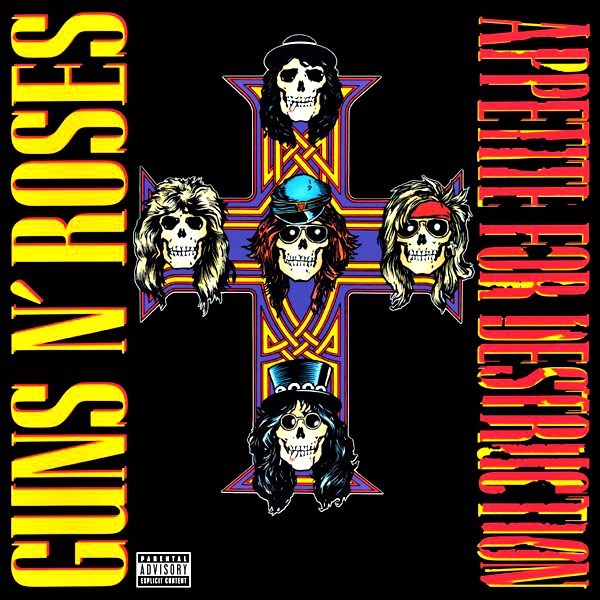
There are certain albums that feel less like recordings and more like seismic events, cultural detonations that change the very fabric of rock music overnight. Appetite for Destruction by Guns N’ Roses is exactly that kind of artifact. Dropped in the sweltering summer of 1987, it didn’t just arrive on the scene; it crash-landed with a leather-jacketed sneer, a bottle of Jack in one hand, and a middle finger permanently extended toward the polished, synth-pop wasteland of the mid-eighties. To talk about this record is to talk about a perfect storm of sleaze, desperation, genius, and raw, unadulterated fury. It’s an album that sounds like it was recorded in a dumpster behind a strip club, and I mean that as the highest possible compliment. From the opening rev of a motorcycle engine to the final, fading feedback, Appetite doesn’t ask for your permission—it takes your ears hostage and doesn’t let go for fifty-three glorious, grimy minutes.
Let’s get the obvious out of the way first: the opening one-two punch of Welcome to the Jungle and It’s So Easy is arguably the most ferocious start to any debut album in rock history. Welcome to the Jungle isn’t just a song; it’s a thesis statement, a mission brief, and a warning siren all rolled into one. That iconic, descending guitar riff from Slash, paired with Duff McKagan’s pulsating bass, creates this atmosphere of predatory tension that practically drips with sweat. And then Axl Rose comes in with that whisper-to-a-shriek delivery, painting a picture of Los Angeles as a concrete zoo where you’re either the hunter or the prey. The way the track builds, drops, and explodes is pure cinematic chaos. It’s easy to forget now, after it’s been played in a million stadiums and movie trailers, just how genuinely threatening and unhinged that song felt in 1987. It didn’t sound like a band trying to make it; it sounded like a band that had already survived the jungle and was now documenting the scars for the rest of us.
But what makes Appetite truly immortal isn’t just the aggression—it’s the staggering versatility that the band displays without ever losing their core identity. Take Sweet Child O’ Mine, for instance. That song is the ultimate bait-and-switch. It opens with that ridiculously beautiful, arpeggiated guitar line that Slash famously wrote as a joke, a warm-up exercise that accidentally became one of the most recognizable riffs on the planet. It’s a power ballad, sure, but it’s a power ballad with fangs. Axl’s vocal performance is nothing short of otherworldly; he goes from a fragile, almost pleading croon to that shattering, high-octane wail in the bridge, all while the rhythm section of McKagan and Steven Adler locks into a groove that’s as tender as it is thunderous. It’s the song that got the girls into the band, but it never feels like a sellout because the raw emotion is so palpable. It’s not a calculated radio hit; it’s a genuine love letter that happens to have a guitar solo that sounds like a soul ascending to heaven.
Then, just when you think you’ve got them figured out, they hit you with Nightrain. This is the dirty, drunk, punk-rock heart of the album. It’s a tribute to a cheap fortified wine, and it grooves with a swagger that the Rolling Stones would kill for in their prime. The chorus is pure, fist-pumping nihilism, and Slash’s solo is a molten, bluesy meltdown that feels like the last call at the end of the world. The production, handled brilliantly by Mike Clink, is key here. It’s raw and live-sounding, but it’s not muddy. Every instrument has its own filthy space, from Izzy Stradlin’s rhythm guitar chug to Duff’s melodic, punky bass lines. You can practically smell the stale beer and cigarette smoke bleeding out of the speakers. The album never loses that bar-band energy, even when the songwriting gets incredibly sophisticated.
And this is where the band’s secret weapon really shines: they somehow managed to attract every single rock subculture under the sun without alienating a single one. Think about the landscape of 1987—you had the hair-metal posers with their teased manes and lipstick on one side, the thrash-metal heads in their battle vests on another, the punk purists sneering from the dive bars, the hard-rock traditionalists worshipping at the altar of Led Zeppelin, and the blues-rock nerds obsessing over every bend of a B.B. King string. Guns N’ Roses walked into that fractured scene and said, “We’re all of you.” The hair-metal crowd heard It’s So Easy and Rocket Queen and latched onto the sleazy, glam-adjacent swagger, the gutter-sex appeal, and Axl’s pirouetting, bandana-flailing stage presence that fit right in with the Sunset Strip circus. But then the punks heard the raw, breakneck fury of Out ta Get Me and the sneering, three-chord nihilism of Anything Goes, and they recognized kindred spirits who’d rather spit on the floor than bow to radio executives. The heavy-metal contingent got their fix from the galloping, double-bass-driven assault of Paradise City’s thrashy finale and the down-tuned, Sabbath-esque crush of My Michelle, which rumbles with a darkness that made Bon Jovi sound like a children’s choir. Hard-rock traditionalists, meanwhile, found their holy grail in the swaggering, arena-filling anthems like Welcome to the Jungle and the grooving, fist-in-the-air defiance of Nightrain, tracks that could have sat comfortably beside Aerosmith’s Rocks or AC/DC’s Highway to Hell. And the blues-rock purists? They got Slash. That man plays like he sold his soul at a Mississippi crossroads, and nowhere is that more evident than in the extended, crying, bottleneck-inspired solos on Sweet Child O’ Mine and the achingly slow, gospel-tinged breakdown in Rocket Queen, where his Les Paul weeps and moans with a feel that’s pure Delta mud mixed with L.A. smog. The band was a living, breathing jukebox of rock’s entire lineage, and they wore those influences on their ripped sleeves without ever sounding like a tribute act. They synthesized punk’s attitude, metal’s power, blues’s soul, hard rock’s hooks, and even hair metal’s theatricality into something that felt wholly original—a grimy, beautiful mongrel that refused to be boxed in.
Lyrically, Axl Rose was operating on a level that most of his contemporaries—especially the hair-metal frontmen—couldn’t even comprehend. While the posers were writing about partying and chicks in a cartoonish, bubblegum way, Axl was penning dark, psychological character studies and social commentaries that appealed to the punk and metal crowds’ appetite for grit. Mr. Brownstone is a prime example—a track about heroin addiction that somehow manages to be both deeply sinister and weirdly funky. The riff is a slinky, rolling groove that hooks you immediately, but the lyrics are a stark, unflinching look at dependency and apathy. Lines like “I used to do a little but a little wouldn’t do it, so the little got more and more” are delivered with a grim, knowing smirk that makes the whole thing chilling. It’s not glorifying the drug; it’s just stating the bleak reality of the Sunset Strip scene with brutal honesty, a rawness that appealed as much to punk’s confessional nihilism as to metal’s fascination with darkness. That kind of authenticity was their secret weapon. They weren’t posers; they were survivors, and every track felt like a page from a very tattered diary.
Of course, we have to talk about the elephant in the room—or rather, the monster in the alley: Rocket Queen. This is the epic, the magnum opus, the sprawling, seven-minute closer that ties the whole chaotic experience together with a dirty bow. It starts with a swaggering, funky riff that’s pure rock and roll sleaze, the kind of groove that hair-metal bands would kill for, complete with the infamous, uh, “studio ambiance” that Axl recorded with Adriana Smith. It’s shocking and provocative, sure, but the real genius is how the song completely transforms halfway through. It drops into a slow, soulful, almost gospel-tinged breakdown, with Slash laying down one of the most emotional, heart-wrenching guitar solos of his career—a solo that owes everything to blues-rock legends like Eric Clapton and Joe Perry. Axl’s vocals shift from lustful grunts to a pleading, vulnerable cry, and the outro is pure catharsis, building into a heavy-metal crescendo that would make Judas Priest nod in approval. It’s the sound of a band laying every single card on the table—the filth, the tenderness, the rage, the longing—all in one track, pulling from every corner of rock’s spectrum without breaking a sweat. It’s audacious and slightly perverse, but it’s also breathtakingly ambitious, and it’s the perfect end to a record that refuses to be pigeonholed.
Looking at the deep cuts, Out ta Get Me is a paranoid, thrashy anthem about persecution that still hits with the force of a sledgehammer, its punk-rock speed and metal crunch making it a mosh-pit favorite, while My Michelle is a brutal, harrowing portrait of a real friend of the band’s tragic life, set to a riff that sounds like a carnival from hell—pure hard-rock horror with a bluesy underbelly. Even Anything Goes, which is probably the weakest track on the album, still has a nasty, infectious groove that would be a career highlight for most other bands, with a sleazy, hair-metal vibe that’s impossible to resist. The secret sauce isn’t just Axl’s incredible vocal range or Slash’s iconic top hat; it’s the rhythm section of Duff and Adler. Duff’s punk-rock bass lines are the melodic anchor, giving the heavier tracks a propulsive, Ramones-like energy, while Adler’s swing—often overlooked in favor of flashier drummers—is what gives these songs their hips. He plays with a loose, almost jazz-meets-blues feel that keeps the music from becoming too stiff, which is why you can actually dance to Paradise City despite its breakneck speed. That rhythmic foundation allowed the band to flirt with thrash tempos, blues shuffles, and hard-rock stomps all within the same album, making it a unifying force for fans who normally wouldn’t share a beer.
And Paradise City, what a monster that is. It’s the ultimate showstopper, starting with a slow, country-tinged blues-rock intro that sounds like it belongs in a dusty roadside bar, then building into a galloping, thrash-metal finale that’s pure adrenaline. The juxtaposition of the sweet, nostalgic chorus with the ferocious, double-time verses is pure genius, seamlessly bridging the gap between the melodic hooks of hair metal and the raw aggression of underground punk and heavy metal. When Axl screams “Take me down” at the end, it’s not just a vocal performance; it’s a primal exorcism that could only come from a band that digested every riff and every attitude that came before them. The album ends with Rocket Queen, but in a way, Paradise City is the grand finale, the song that encapsulates everything great about this record: the beauty, the ugliness, the speed, and the sheer, unapologetic volume.
What’s truly remarkable about Appetite for Destruction is its timelessness and its role as a great unifier. Sure, the production has a distinctly 80s reverb on the snare, and the lyrical content is deeply rooted in the hedonism of that specific era, but the emotion is universal. It’s the sound of young, hungry, and dangerous men who had nothing to lose and everything to prove. They were the antidote to the fluffy pop-metal that dominated the radio, injecting a dose of raw, dangerous rock that owed as much to Aerosmith and the Rolling Stones as it did to the Sex Pistols and the New York Dolls, while simultaneously delivering the crushing weight of Black Sabbath and the theatrical flair of Mötley Crüe. It was a melting pot of punk, blues, hard rock, heavy metal, and hair-metal sleaze, and it never felt forced because those genres weren’t costumes for them—they were the very fabric of their upbringing. In the decades since, Guns N’ Roses imploded, reformed, and became a nostalgia act, but Appetite remains untouchable. It’s not just a great debut; it’s a great album, full stop, precisely because it gave every tribe within rock music a reason to nod their heads. It’s one of those rare records where the hype is not only justified but perhaps undersold. Every single track contributes to a cohesive, nasty, beautiful whole, and it stands as a testament to the fact that sometimes, the most dangerous bands—the ones that refuse to pick a lane—make the most enduring art. So crank it up, pour a drink, and let the jungle swallow you whole. It’s a ride you won’t forget, and honestly, you won’t want to.
Paradise City seems to be the Guns N’ Roses song that’s liked even by people who don’t like Guns N’ Roses.
Paradise City is a good song and a good video. The video keeps things effectively simple, with clips of the band performing the song at Giants Stadium mixed in with behind-the-scenes footage of the band. All of the members of the band look like they’re getting along and, at no point, do Slash and Axl look like they’re about to come to blows. It’s a look at Guns N’ Roses that definitely goes against their later reputation for intraband strife.
This is what I like to call a “They sure can play” video because the emphasis is on the band as professional musicians who know what they’re doing and who aren’t just spending all of their time doing drugs and entertaining groupies. I’m usually not a fan of these type of videos because they often feel phony but it works for Guns ‘N Roses because they really could play.
In this video, Arnold Schwarzenegger is sent to the past to eliminate Guns N’ Roses but ultimately decides that it would be a waste of ammo. Obviously, he knew that fulfilling his mission would change history and the world would never get to hear Chinese Democracy.
This song (and this video) were used to promote Terminator 2: Judgement Day.
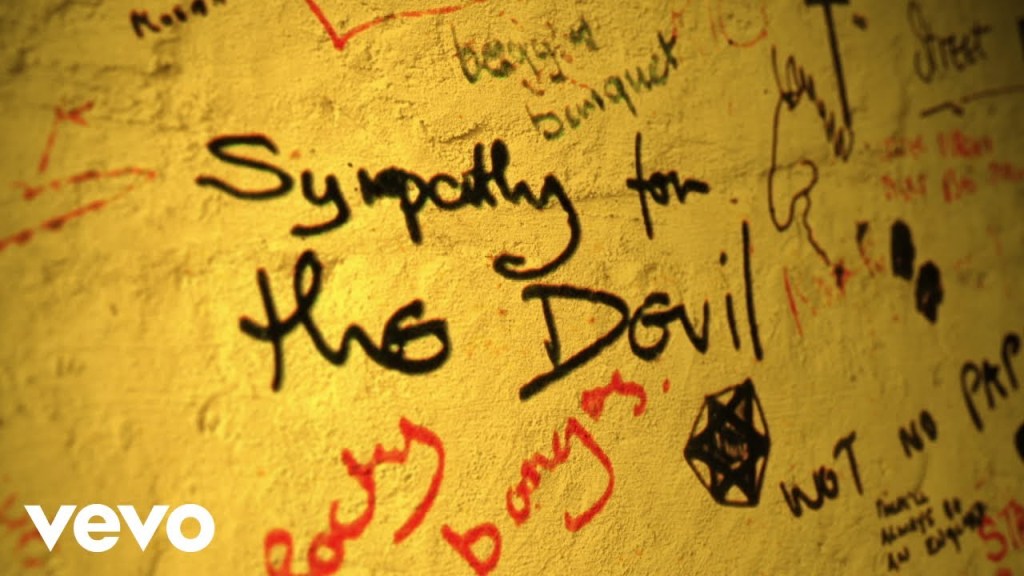
The latest “Song of the Day” is very near and dear to my blues-covered metal heart. I consider it one of the best rock ‘n’ roll songs ever created. It’s been covered by numerous bands in the decades since it’s initial release but I will always consider the original as the best. The latest song of the day is The Rolling Stones’ “Sympathy for the Devil”.
This song was released in the early days of December 1968. It was the opening track for The Rolling Stones’ latest album (Beggars Banquet) at that date. What makes this song so great is how simple the song really comes across. It doesn’t have the typical blues rock tone of previous Stones’ songs until Keith Richard’s guitar solo around the 2:55 mark. The song definitely sounds more like a combination of folk rock (by way of it’s spoken word-like lyrics) and a samba (due to the incorporation of additional percussions like the congas).
“Sympathy for the Devil” has been called a confession song while others see it as the narcissistic bragging of the narrator. Both viewpoints are quite valid and there are more as every listener of this song hears and imagines different themes. I always saw it as a combination of the two. It’s Lucifer’s confession and bragging about his role in the tumultuous and evil events in man’s history. It’s a song that its narrator wants to understand and admit that while he has been there through all those dark moments in history, he wouldn’t have been able to do what he’s done if not for people allowing him in and becoming complicit.
Sympathy for the Devil
Please allow me to introduce myself I’m a man of wealth and taste I’ve been around for a long, long years Stole many a man’s soul and faith
And I was ’round when Jesus Christ Had his moment of doubt and pain Made damn sure that Pilate Washed his hands and sealed his fate
Pleased to meet you Hope you guess my name But what’s puzzling you Is the nature of my game
I stuck around St. Petersburg When I saw it was a time for a change Killed the czar and his ministers Anastasia screamed in vain
I rode a tank Held a general’s rank When the blitzkrieg raged And the bodies stank
Pleased to meet you Hope you guess my name, oh yeah Ah, what’s puzzling you Is the nature of my game, oh yeah (woo woo, woo woo)
I watched with glee While your kings and queens Fought for ten decades For the gods they made (woo woo, woo woo)
I shouted out, “Who killed the Kennedys?” When after all It was you and me (who who, who who)
Let me please introduce myself I’m a man of wealth and taste And I laid traps for troubadours Who get killed before they reached Bombay (woo woo, who who)
Pleased to meet you Hope you guessed my name, oh yeah (who who) But what’s puzzling you Is the nature of my game, oh yeah, get down, baby (who who, who who)
Pleased to meet you Hope you guessed my name, oh yeah But what’s confusing you Is just the nature of my game (woo woo, who who)
Just as every cop is a criminal And all the sinners saints As heads is tails Just call me Lucifer ‘Cause I’m in need of some restraint (who who, who who)
So if you meet me Have some courtesy Have some sympathy, and some taste (woo woo) Use all your well-learned politesse Or I’ll lay your soul to waste, um yeah (woo woo, woo woo)
Pleased to meet you Hope you guessed my name, um yeah (who who) But what’s puzzling you Is the nature of my game, um mean it, get down (woo woo, woo woo)
Woo, who Oh yeah, get on down Oh yeah Oh yeah! (woo woo)
Tell me baby, what’s my name Tell me honey, can ya guess my name Tell me baby, what’s my name I tell you one time, you’re to blame
Oh, who woo, woo Woo, who Woo, woo Woo, who, who Woo, who, who Oh, yeah
What’s my name Tell me, baby, what’s my name Tell me, sweetie, what’s my name
Woo, who, who Woo, who, who Woo, who, who Woo, who, who Woo, who, who Woo, who, who Oh, yeah Woo woo Woo woo
Paradise City seems to be the Guns N’ Roses song that’s liked even by people who don’t like Guns N’ Roses. (My cousin John, who was once the lead singer of a band called Carlos Is A Bastard, still refers to them as being Guns N’ Poses.)
Paradise City is a good song and a good video. The video keeps things effectively simple, with clips of the band performing the song at Giants Stadium mixed in with behind-the-scenes footage of the band. All of the members of the band look like they’re getting along and, at no point, do Slash and Axl look like they’re about to come to blows. It’s a look at Guns N’ Roses that definitely goes against their later reputation for intraband strife.
This is what I like to call a “They sure can play” video because the emphasis is on the band as professional musicians who know what they’re doing and who aren’t just spending all of their time doing drugs and entertaining groupies. I’m usually not a fan of these type of videos because they often feel phony but it works for Guns ‘N Roses because they really could play.
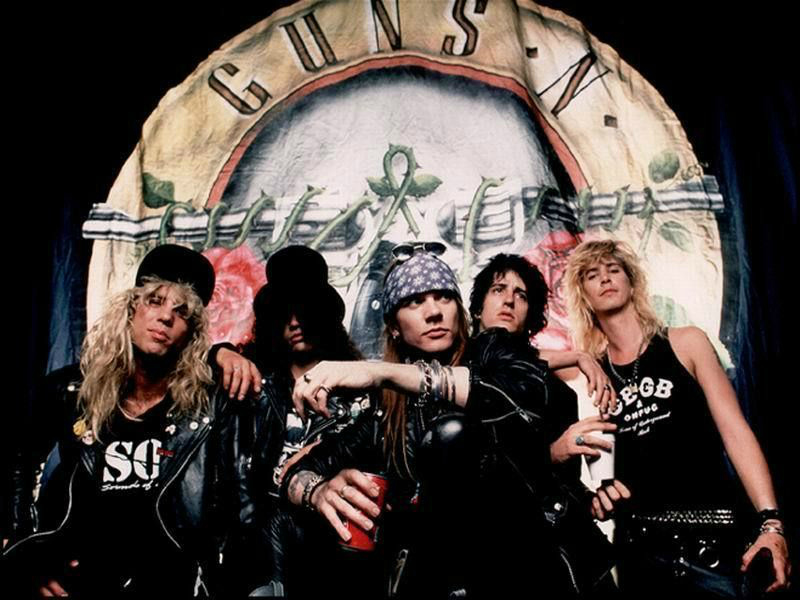
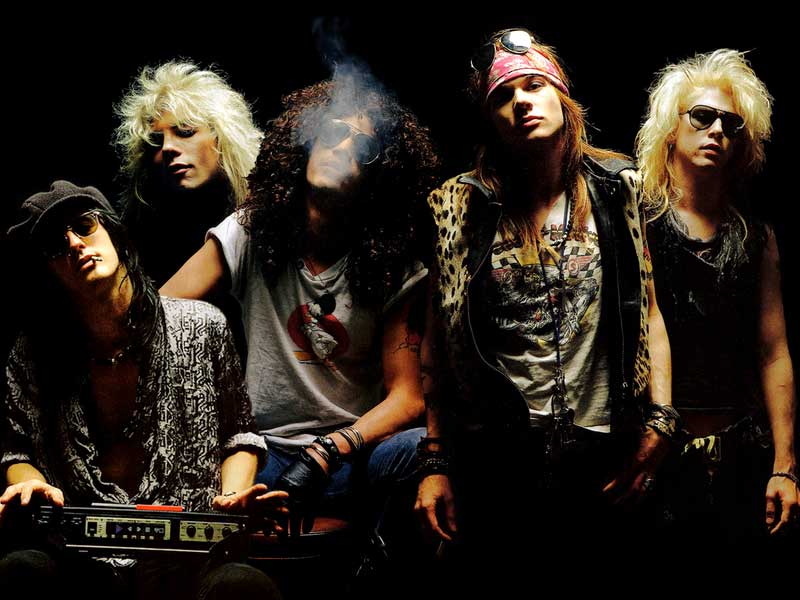
One cannot reminisce about the 80’s music scene without including the biggest (and most dangerous) band of that decade. Well, the band and it’s handlers sure thought of them that way. The band I speak of is Guns N’ Roses. this was the band that dared to put the word hard back into hard rock after the glam metal scene began to turn it into a joke.
Nothing against glam metal. Mötley Crüe was and is a favorite rock band of the 80’s for me. Yet, even they succumbed to the hairspray overload that glam metal would turn into. These bands became more about their look (especially in their music videos) than actually playing good music.
Guns N’ Roses still had the teased hair, but their music when they released their Appetite for Destruction album was a breath of fresh air in the hard rock scene and would grab glam metal fans from the vapors of hairnet spray into the dark, dingy bluesy lounges and then the overwhelming open air arenas.
I’ve already featured two of the bands most famous tracks from their first album, “Welcome to the Jungle” and “Sweet Child o’ Mine”, so it’s time to give their third biggest hit from this album time to shine.
“Paradise City” is a place we all should aspire to visit.
Paradise City
Take me down to the paradise city Where the grass is green and the girls are pretty Take me home (Oh, won’t you please take me home?)
Take me down to the paradise city Where the grass is green and the girls are pretty Take me home (Oh, won’t you please take me home?)
Just an urchin livin’ under the street I’m a hard case that’s tough to beat I’m your charity case so buy me somethin’ to eat I’ll pay you at another time Take it to the end of the line
Rags to riches or so they say You gotta keep pushin’ for the fortune and fame You know it’s, it’s all a gamble when it’s just a game You treat it like a capital crime Everybody’s doin’ their time
Take me down to the paradise city Where the grass is green and the girls are pretty Oh, won’t you please take me home, yeah, yeah?
Take me down to the paradise city Where the grass is green and the girls are pretty Take me home
Strapped in the chair of the city’s gas chamber Why I’m here, I can’t quite remember The surgeon general says it’s hazardous to breathe I’d have another cigarette but I can’t see Tell me who ya gonna believe
Take me down to the paradise city Where the grass is green and the girls are pretty Take me home, yeah, yeah Take me down to the paradise city Where the grass is green and the girls are pretty Oh, won’t you please take me home, yeah?
So far away So far away So far away So far away
Captain America’s been torn apart Now he’s a court jester with a broken heart He said “Turn me around and take me back to the start” I must be losin’ my mind, are you blind? I’ve seen it all a million times
Take me down to the paradise city Where the grass is green and the girls are pretty Take me home, yeah, yeah
Take me down to the paradise city Where the grass is green and the girls are pretty Oh, won’t you please take me home?
Take me down to the paradise city Where the grass is green and the girls are pretty Take me home, yeah, yeah
Take me down to the paradise city Where the grass is green and the girls are pretty Oh, won’t you please take me home, home
Oh, I want to go, I want to know Oh, won’t you please take me home? I want to see how good it can be Oh, won’t you please take me home?
Take me down to the paradise city Where the grass is green and the girls are pretty Take me home
Take me down to the paradise city Where the grass is green and the girls are pretty Oh, won’t you please take me home?
Take me down, take me down Oh, won’t you please take me home? I want to see how good it can be Oh, won’t you please take me home?
I want to see how good it can be Oh, oh take me home
Take me down to the paradise city Where the grass is green and the girls are pretty Oh, won’t you please take me home?
I want to know, I want to know Oh, won’t you please take me home? Yeah, baby
As a child of the 1980’s it would be difficult to come up with a greatest guitar solo ever list and not make mention of the work of one Slash. The man with the top hat, who played a mean Gibson Les Paul would become part of what the 80’s called “The Most Dangerous Band” in Guns N’ Roses.
“Sweet Child o’ Mine” would become one of the band’s biggest hits and, ultimately, their most recognizable. This is quite an impressive considering this is the band that came up with quite a bit of classic tunes in the short time they all played together. It’s also the song where Slash truly made his mark by creating not just one of the most recognized opening hard rock riffs, but also one of the best guitar solos.
For a band that was seen and who saw itself as “the most dangerous” they also came up with a power ballad that combined not just genuine emotions, but the hard rock sensibility one expected from a band such as Guns N’ Roses. It’s a power ballad worthy of past great power ballads such as “Stairway to Heaven” and “Free Bird”.
Sweet Child O’ Mine
She’s got a smile that it seems to me Reminds me of childhood memories Where everything Was as fresh as the bright blue sky
Now and then when I see her face She takes me away to that special place And if I stared too long I’d probably break down and cry
Sweet child o’ mine Sweet love of mine
She’s got eyes of the bluest skies As if they thought of rain I’d hate to look into those eyes And see an ounce of pain
Her hair reminds me of a warm safe place Where as a child I’d hide And pray for the thunder and the rain To quietly pass me by
[3x] Sweet child o’ mine Sweet love of mine
(guitar solo)
[4x] Where do we go? Where do we go now? Where do we go? Sweet child o’ mine
Quite the extreme reversal from #4 to #5 but then my taste in music between junior high and high school was pretty much all over the place. I could be listening to the latest teeny bopper, LAtin-freestyle dance track one month then I’m picking up that hard rock or metal song that I knew my parents would never approve of (especially my mom).
Guns N’ Roses’ “Welcome to the Jungle” was one such song though I was surprised that my Dad actually liked it as much as I did. My first memory of ever hearing “Welcome to the Jungle” was watching the latest and last Dirty Harry film with my dad. It was The Dead Pool and this song was used as a sort of soundtrack in the fake horror film in the film. I’m not sure if my dad liked the song because it was in a Dirty Harry flick or he just liked it because he grew up in the 60’s and 70’s listening to hard rock.
I don’t think my dad was too keen on the Guns N’ Roses look though. Even then he knew the hair metal, glam look was no bueno.
So, “Welcome to the Jungle” was my initial introduction to Guns N’ Roses and pretty much opened up my ears to a whole new spectrum of music. I never abandoned the R&B, dance pop and freestyle songs from junior high and even years later, but hard rock and metal soon joined the LP (and later CD) rotation.
Lisa Marie recently wrote up her very unique review of the James Bond film Live and Let Die and I’ve decided to use that review as the springboard for the latest “Song of the Day” entry. It’s easy enough to figure out that the latest choice is the similarly titled song from the film by Paul McCartney: “Live and Let Die”.
This song remains one of the most recognizable songs made specifically for a film. Most songs that become part of a film’s appeal tend to be pre-existing licensed songs and music. Live and Let Die would be the first James Bond film that would introduce Roger Moore as the British superspy and 007 agent. The song itself, written by Paul McCartney and his wife Linda, would become even more popular than the film through the years.
While the song has been covered by many bands and groups through the years it would be the cover by Guns N’ Roses in 1991 as part of their Use Your Illusion I album that many consider the best cover. I consider both favorite songs of mine, but I must pick McCartney’s original over the GnR cover by the smallest of margins.
Live and Let Die
When you were young and your heart was an open book You used to say live and let live you know you did you know you did you know you did But if this ever changin’ world in which we live in Makes you give in and cry Say live and let die Live and let die
What does it matter to ya When ya got a job to do Ya got to do it well You got to give the other fella hell
You used to say live and let live you know you did you know you did you know you did But if this ever changin’ world in which we live in Makes you give in and cry Say live and let die Live and let die