Paradise City seems to be the Guns N’ Roses song that’s liked even by people who don’t like Guns N’ Roses.
Paradise City is a good song and a good video. The video keeps things effectively simple, with clips of the band performing the song at Giants Stadium mixed in with behind-the-scenes footage of the band. All of the members of the band look like they’re getting along and, at no point, do Slash and Axl look like they’re about to come to blows. It’s a look at Guns N’ Roses that definitely goes against their later reputation for intraband strife.
This is what I like to call a “They sure can play” video because the emphasis is on the band as professional musicians who know what they’re doing and who aren’t just spending all of their time doing drugs and entertaining groupies. I’m usually not a fan of these type of videos because they often feel phony but it works for Guns ‘N Roses because they really could play.
“What are you going to do when a dog goes bad on you… bites somebody or hurts somebody? There’s only two things you can do, right? You either chain him up… or put him down. But which do you think is more cruel?” — Ben Russell
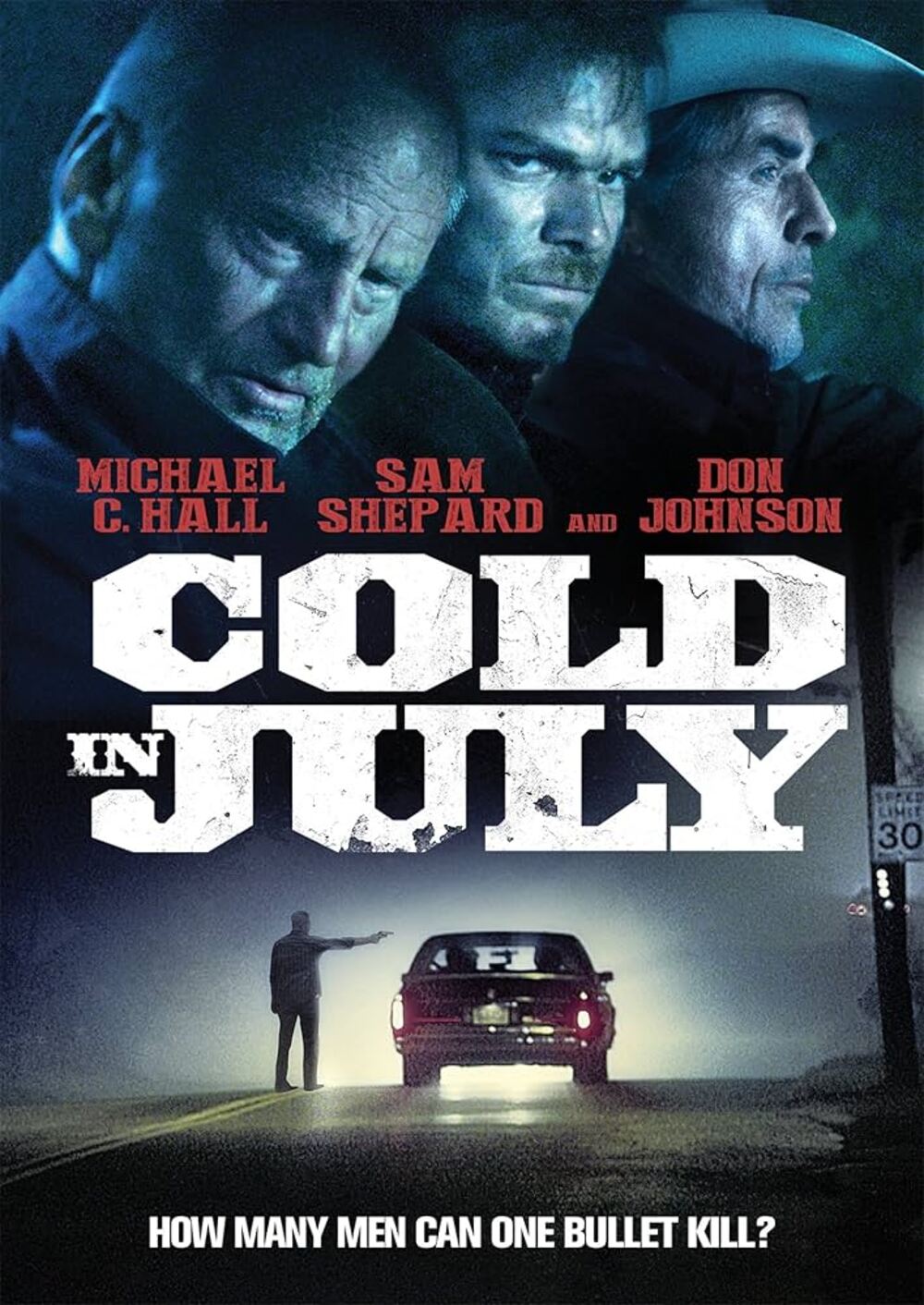
Cold in July opens with a jolt of primal terror, the kind that shatters the fragile illusion of safety in one’s own home. It’s the sticky summer of 1989 in small-town East Texas, where Richard Dane, a soft-spoken picture framer embodied with exquisite restraint by Michael C. Hall, stirs from sleep to the creak of floorboards under an intruder’s weight. No time for second thoughts; his hand finds the .38 revolver under the pillow, and in the inky darkness of his living room, he fires. The body hits the carpet with a thud, blood pooling like spilled ink. The local law rolls up, commends him under Castle Doctrine—self-defense sanctified by statute—and hauls the corpse away. But Richard can’t wash away the echo of that shot. Hall captures the everyman’s unraveling with microscopic precision: the thousand-yard stare at family photos, the hesitant touch of his wife Ann’s shoulder, the way he now checks locks twice before bed. He’s no vigilante archetype; he’s a man whose moral compass, once pointed true north, now spins wildly in the aftermath, haunted by the ghost of a kid he never knew.
Into this fragile peace stalks Ben Russell, the dead boy’s father, a parolee fresh from Huntsville’s iron grip, played by Sam Shepard as a specter of weathered fury. Shepard infuses Ben with that laconic Texan menace, eyes like weathered shale, voice gravel ground under boot heels. He doesn’t roar threats; he etches them into Richard’s walls—”YOU TOOK MY BOY”—and reduces Richard’s beloved Cadillac to a smoldering husk in the driveway. Ben’s grief manifests as a slow siege: parked across the street, watching Richard’s young son Jordan pedal his bike, a predator’s patience masking paternal devastation. The sheriff dismisses it; Ben’s alibis are airtight, greased by unseen hands. Richard’s domestic idyll fractures—nights fractured by paranoia, meals choked down in silence, a marriage straining under unspoken blame. Here, director Jim Mickle, adapting Joe R. Lansdale’s novel with co-writer Nick Damici, pivots from chamber-piece tension to a labyrinthine noir, peeling back layers of small-town complacency to expose the rot beneath. The film’s ’80s patina is immersive: wood-paneled walls sweating humidity, CRT screens buzzing with local news, Jeff Grace’s synth pulses throbbing like a migraine.
Enter Jim Bob Luke, Don Johnson’s hurricane in cowboy boots—a private investigator with a cherry-red Cadillac horned like a longhorn bull, Stetson cocked at a defiant angle, and patter slick as spilled bourbon. Johnson channels pure Miami Vice charisma, but earthier, a good-ol’-boy philosopher packing heat and homilies in equal measure. Hired by Richard to shadow Ben, Jim Bob unearths the seismic twist: the corpse in Richard’s living room wasn’t Freddy Russell, Ben’s son. The real Freddy lurks alive, ensnared in a subterranean web of illicit recordings peddled to depraved collectors, tentacles reaching into Dixie Mafia coffers. Those grainy tapes—clandestine glimpses of human extremity, captured in derelict husks of industry—form the film’s shadowy core, a vortex pulling the trio into moral freefall. Mickle evokes the era’s snuff hysteria without exploitation: no money shots of viscera, just the implication of captured agony, faces contorted in private hells, traded like contraband smokes. Freddy’s not victim but architect, his boyish features warped in the flicker of self-made damnation, a progeny turned parasite on society’s underbelly.
This revelation refracts the narrative through fractured prisms of identity and inheritance. Ben’s vendetta, born of purest paternal fire, curdles into horror as he beholds his bloodline’s perversion—proof that nurture’s failures can birth monsters no paternal love can redeem. Shepard’s performance peaks in silent devastation, a father unmade by the reel spinning his failure. Richard, the reluctant catalyst, crosses his own Rubicon; the man who fired in panic now shoulders a rifle into the fray, his arc tracing the corrosion of innocence by complicity. Jim Bob, ever the fulcrum, tempers the descent with levity—quips about hog-tying demons, a portable TV blasting The Three Stooges amid stakeouts—yet his bravado masks a code, a line drawn against the abyss. Their alliance, uneasy as oil and water, embodies the film’s thesis on makeshift brotherhood: strangers forged in crisis, bound by shared outrage against systemic blindness.
Deeper still, the forbidden footage interrogates voyeurism’s seductive poison. Richard’s first encounter with the tapes mirrors our own—initial revulsion yielding to morbid pull, the screen a portal to unfiltered id. Mickle frames it as cultural id, echoing ’70s/’80s panics over bootleg horrors like Faces of Death, where myth blurred into reality, VHS democratizing depravity. The mansion raid—a decaying palace of vice, corridors echoing with muffled cries—confronts not just Freddy but the machinery of consumption: projectors whirring, stacks of cassettes labeled in code, a clientele shielded by badges and bribes. Ben’s Oedipal climax shatters illusions; he doesn’t save his son but euthanizes the illusion, a mercy killing of legacy. Richard emerges scarred, paternal instincts twisted—he shields Jordan not from burglars now, but from the world’s hidden reels. Jim Bob’s fate underscores sacrifice’s cost, his flair extinguished in gunfire’s roar.
Thematically, Cold in July wrestles with manhood’s brittle myths in Reagan-era Americana. Richard starts as domesticated archetype—provider, protector by proxy—only to reclaim agency through blood, a Darwinian baptism. Ben embodies failed patriarchy, his prison-hardened shell cracking to reveal vulnerability’s raw nerve. Jim Bob, the id unbound, revels in machismo yet weeps for the fallen, humanizing the trope. Violence accrues gravity: each trigger pull exacts tolls—Richard’s queasy recoil post-kill, Ben’s hollow victory, the collateral innocents. Mickle’s visual lexicon amplifies this: desaturated palettes chilling the Texas swelter, shadows swallowing faces in interrogation rooms, slow-motion casings arcing like fallen stars. Lansdale’s source infuses pulp authenticity—dialogue taut as barbed wire, twists coiled like rattlers—elevated by Mickle’s restraint, never mistaking style for substance.
Flaws surface in the third act’s escalation: a shootout inferno, bodies stacking amid explosions, tips into excess after the scalpel-precision buildup. Threads like the sheriff’s graft fray loose, accents occasionally drift Yankee-ward, and stylistic nods to Coens or Tarantino flirt with homage overload. Yet these blemishes fade against strengths: a triumvirate of leads in career-best synergy, Grace’s score evoking Carpenterian dread laced with twang, production design nailing ’89 grit from payphone booths to mullet mustaches. Mickle’s sophomore leap post-Stake Land proves mastery of genre alchemy—thriller mechanics serving thematic depth.
Ultimately, Cold in July haunts as meditation on unseen currents: the darkness we film, consume, ignore. It indicts voyeurism’s complicity—Richard’s gaze on the tape mirroring ours—while affirming redemption’s flicker amid ruin. Ben buries not just Freddy but paternal ghosts; Richard fortifies his home anew, vigilant against shadows within. Jim Bob’s ghost lingers in punchlines and principles. In VOD glut, this neo-noir endures, twisty as kudzu vines, resonant as a revolver’s echo. It clings like summer sweat, whispering that some July colds seep bone-deep, thawing never.
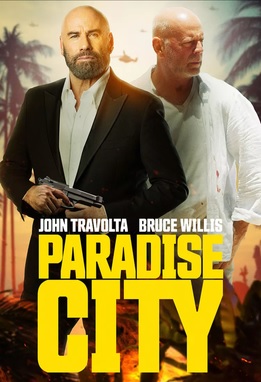
Ian Swan (Bruce Willis) is a famed bounty hunter who has spent the last ten years of his life pursuing an escaped fugitive who is wanted for the cold-blooded murder of four FBI men. Swan has tracked his prey to Hawaii but, when he’s shot and falls into the ocean, Swan is presumed dead. Swan’s long-estranged son, Ryan (Blake Jenner), comes to Hawaii to try to track down the man who killed his father. He meets up with Ian’s former partner, Robbie Cole (Stephen Dorff), and also the only cop on the island who cares about justice, Savannah (Praya Lundberg). Reluctantly, Cole works with Ryan and discovers that Ian’s shooting is somehow connected to a shady businessman named Arlene Buckley (John Travolta). A real estate developer, Buckley is working hard to elect a man named Kane (Branscombe Richmond) to the U.S. Senate. Buckley’s plan also involves taking control of a part of the Island that the natives call Paradise City. Got all that?
2022’s Paradise City has been advertised as being a John Travolta/Bruce Willis film but make no mistake. Neither Travolta nor Willis get much screen time, though they both make an impression in the limited time that they do have. Stephen Dorff manages to steal every scene in which he appears, playing Robbie as a well-meaning guy who can’t help but be kind of a screw-up. That said, Dorff really isn’t in that much of the film either. Instead, the main star of the film is Blake Jenner. Jenner has the blandly affable screen presence of a low-key frat boy. That worked for him when he was in films like Richard Linklater’s EverybodyWants Some!! but it’s not exactly ideal for an action star. Whereas the best action stars feel as if they’re always ready for a fight, Jenner comes across as the guy who would be trusted to order the keg for the next party.
Instead of taking charge of the screen, Jenner finds himself overshadowed by the gorgeous Hawaiian scenery. Hawaii is the true star of Paradise City and, even when the film itself doesn’t make a whole lot of sense, Hawaii itself is always amazing to look at. In many ways, Paradise City feels like an extra-violent episode of Baywatch Hawaii. (The film’s Baywatch aesthetic is confirmed when Savannah wears a bikini to a crime scene.) Just as with that show, the beaches and the jungles and the waterfalls and the oceans are all so stunning that it’s tempting to give the film a pass on the fact that the plot never makes much sense and any genuine emotional stakes are pretty much non-existent.
Unfortunately, it’s impossible to ignore the plot because, for a low-budget B-movie, Paradise City takes itself way too seriously. It’s one thing for Ryan to be estranged from his father. It’s another thing for the film to feature flashbacks to Ryan’s childhood, in which we discover firsthand that Ian never understood Ryan. It’s also one thing to make Buckley a family man. It’s another thing try to create a clumsy parallel between the way that Buckley is raising his son and the way that Ian raised Ryan. As opposed to films like Gasoline Alley or the DetectiveKnight films, Paradise City seems to be trying too hard to be something that it isn’t. Instead of just embracing its pulpy style and trying to entertain, the film is determined to tug at the audience’s heartstrings and make a statement about evil land developers. The film forgets that, sometimes, just being entertaining is the best thing that a film can be.
This was one of the last films that Bruce Willis made before it was announced that he would be retiring from acting. Watching the film, it’s easy to tell that a stand-in was used for most of Willis’s action scenes. When Willis delivers the majority of his lines, it’s hard not to miss the wiseguy energy that used to be his trademark. That said, when Willis is acting opposite Travolta and Dorff, he shows a bit of his old spark. The two scenes in which he confronts John Travolta are the best in the film. For a few minutes, he seems like the Bruce Willis who we all remember and it’s hard not to get a bit emotional watching two talented (if often underappreciated) actors acting opposite each other for what will probably be the last time.
Paradise City is not a particularly memorable film and the overly complicated plot is next to impossible to follow but I am happy that the cast and the crew got to hang out in Hawaii for a bit. It’s a lovely place to visit.
Paradise City seems to be the Guns N’ Roses song that’s liked even by people who don’t like Guns N’ Roses. (My cousin John, who was once the lead singer of a band called Carlos Is A Bastard, still refers to them as being Guns N’ Poses.)
Paradise City is a good song and a good video. The video keeps things effectively simple, with clips of the band performing the song at Giants Stadium mixed in with behind-the-scenes footage of the band. All of the members of the band look like they’re getting along and, at no point, do Slash and Axl look like they’re about to come to blows. It’s a look at Guns N’ Roses that definitely goes against their later reputation for intraband strife.
This is what I like to call a “They sure can play” video because the emphasis is on the band as professional musicians who know what they’re doing and who aren’t just spending all of their time doing drugs and entertaining groupies. I’m usually not a fan of these type of videos because they often feel phony but it works for Guns ‘N Roses because they really could play.
One cannot reminisce about the 80’s music scene without including the biggest (and most dangerous) band of that decade. Well, the band and it’s handlers sure thought of them that way. The band I speak of is Guns N’ Roses. this was the band that dared to put the word hard back into hard rock after the glam metal scene began to turn it into a joke.
Nothing against glam metal. Mötley Crüe was and is a favorite rock band of the 80’s for me. Yet, even they succumbed to the hairspray overload that glam metal would turn into. These bands became more about their look (especially in their music videos) than actually playing good music.
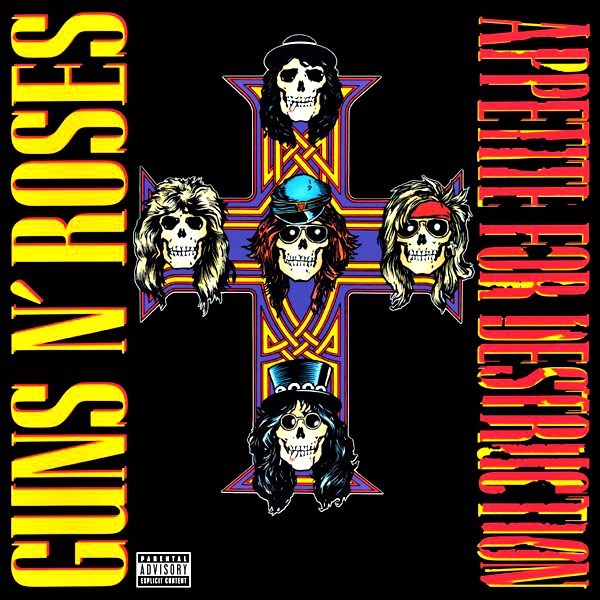
Guns N’ Roses still had the teased hair, but their music when they released their Appetite for Destruction album was a breath of fresh air in the hard rock scene and would grab glam metal fans from the vapors of hairnet spray into the dark, dingy bluesy lounges and then the overwhelming open air arenas.
I’ve already featured two of the bands most famous tracks from their first album, “Welcome to the Jungle” and “Sweet Child o’ Mine”, so it’s time to give their third biggest hit from this album time to shine.
“Paradise City” is a place we all should aspire to visit.
Paradise City
Take me down to the paradise city Where the grass is green and the girls are pretty Take me home (Oh, won’t you please take me home?)
Take me down to the paradise city Where the grass is green and the girls are pretty Take me home (Oh, won’t you please take me home?)
Just an urchin livin’ under the street I’m a hard case that’s tough to beat I’m your charity case so buy me somethin’ to eat I’ll pay you at another time Take it to the end of the line
Rags to riches or so they say You gotta keep pushin’ for the fortune and fame You know it’s, it’s all a gamble when it’s just a game You treat it like a capital crime Everybody’s doin’ their time
Take me down to the paradise city Where the grass is green and the girls are pretty Oh, won’t you please take me home, yeah, yeah?
Take me down to the paradise city Where the grass is green and the girls are pretty Take me home
Strapped in the chair of the city’s gas chamber Why I’m here, I can’t quite remember The surgeon general says it’s hazardous to breathe I’d have another cigarette but I can’t see Tell me who ya gonna believe
Take me down to the paradise city Where the grass is green and the girls are pretty Take me home, yeah, yeah Take me down to the paradise city Where the grass is green and the girls are pretty Oh, won’t you please take me home, yeah?
So far away So far away So far away So far away
Captain America’s been torn apart Now he’s a court jester with a broken heart He said “Turn me around and take me back to the start” I must be losin’ my mind, are you blind? I’ve seen it all a million times
Take me down to the paradise city Where the grass is green and the girls are pretty Take me home, yeah, yeah
Take me down to the paradise city Where the grass is green and the girls are pretty Oh, won’t you please take me home?
Take me down to the paradise city Where the grass is green and the girls are pretty Take me home, yeah, yeah
Take me down to the paradise city Where the grass is green and the girls are pretty Oh, won’t you please take me home, home
Oh, I want to go, I want to know Oh, won’t you please take me home? I want to see how good it can be Oh, won’t you please take me home?
Take me down to the paradise city Where the grass is green and the girls are pretty Take me home
Take me down to the paradise city Where the grass is green and the girls are pretty Oh, won’t you please take me home?
Take me down, take me down Oh, won’t you please take me home? I want to see how good it can be Oh, won’t you please take me home?
I want to see how good it can be Oh, oh take me home
Take me down to the paradise city Where the grass is green and the girls are pretty Oh, won’t you please take me home?
I want to know, I want to know Oh, won’t you please take me home? Yeah, baby