4 Shots From 4 Films is just what it says it is, 4 shots from 4 of our favorite films. As opposed to the reviews and recaps that we usually post, 4 Shots From 4 Films lets the visuals do the talking.
Happy birthday to my pre-code role model, the amazing Clara Bow!
4 Shots From 4 Clara Bow Films
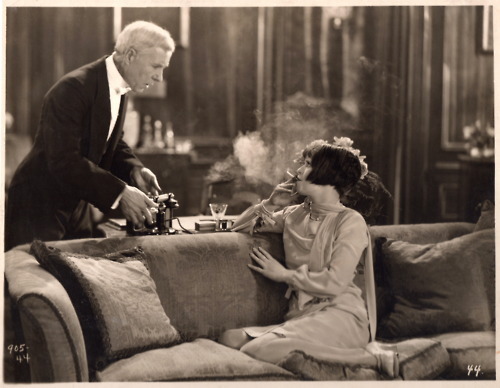
It (1927, dir by Clarence G. Badger)
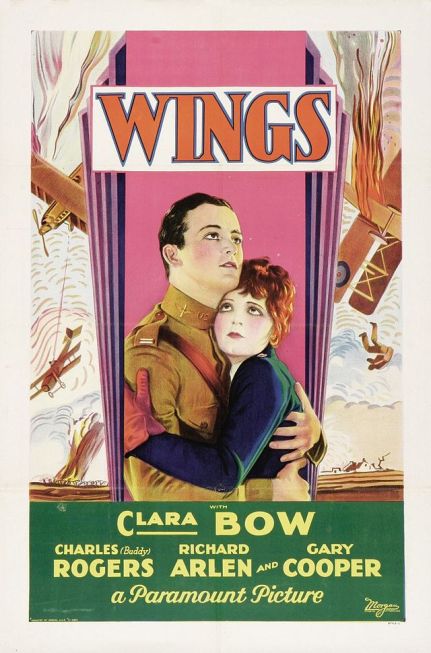
Wings (1928, dir by William Wellman)
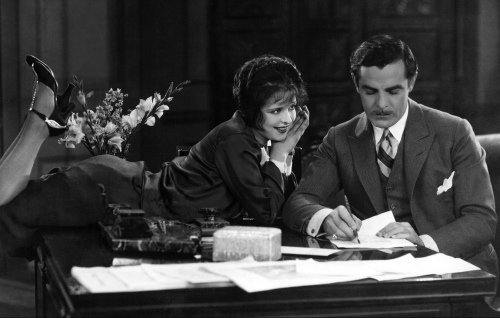
Dangerous Curves (1929, dir by Lothar Mendes)
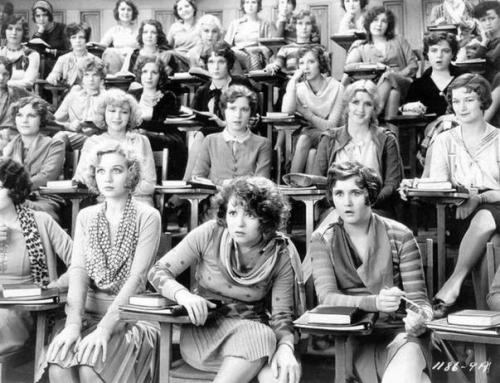
Call Her Savage (1932, dir by John Francis Dillon)
4 Shots From 4 Films is just what it says it is, 4 shots from 4 of our favorite films. As opposed to the reviews and recaps that we usually post, 4 Shots From 4 Films lets the visuals do the talking.
Happy birthday to my pre-code role model, the amazing Clara Bow!
4 Shots From 4 Clara Bow Films
It (1927, dir by Clarence G. Badger)
Wings (1928, dir by William Wellman)
Dangerous Curves (1929, dir by Lothar Mendes)
Call Her Savage (1932, dir by John Francis Dillon)
I recently went on YouTube and I did a search for “concert films.” The first video that came up was an upload of the 1980 film Rockshow.
Filmed during a 1976 world tour, Rockshow features Paul McCartney and Wings, the band that he formed after the break-up of the Beatles. McCartney and his band play a total of 30 songs in front of an enthusiastic audience. The crowd goes crazy for the Beatles songs, including Lady Madonna, The Long and Winding Road, Blackbird, and Yesterday. That’s to be expected. But they’re also pretty enthusiastic for the songs that McCartney wrote after the Beatles, quite a few of which I recognized. (Silly Love Songs, Band on the Run, the beautiful Maybe I’m Amazed, and that annoying Listen To What The Man Said were all familiar to me.) For all that I’ve read about people being disappointed by Paul McCartney’s post-Beatles career in the 70s, you wouldn’t know it from watching the audience in this film. The highlight, for me, was undoubtedly the energetic performance of Live and Let Die, which featured a very basic but still effective light show.
It’s rare that you ever read anything positive about Paul McCartney’s work with Wings and, watching the film, it was pretty obvious that the band mostly just existed to showcase Paul. The other members of the band seemed to understand that the crowd wasn’t there to see anyone but Paul McCartney and one gets the impression that they were okay with that. That said, I actually liked quite a bit of their music. Even if they weren’t as lyrically complex and creative as Paul’s work with the Beatles, the songs were still enjoyable to listen to and most of them got stuck in my head, for better or worse. There’s a tendency, amongst music snobs, to be dismissive of Paul’s post-Beatles work because he is often viewed as being the most “corporate” of the Beatles. In the popular imagination, John Lennon was the sarcastic peace activist. George Harrison was the spiritual seeker. Ringo Starr was the down-to-Earth comedian. And Paul is often portrayed as being the one who was the most concerned with scoring the most hits, selling the most albums, and making the most money. Well, so be it. That’s usually the point of having a band, after all. Very few people devote their life to the hope of being obscure and poor. Johnny Rotten moved into a mansion the first chance he got.
As for Rockshow, it’s an interesting time capsule. The main thing that stuck out to me was how straight-forward and simple the concert was. There were a few laser effects, a few lighting effects, and a screen that occasionally flashed images of comic book characters but, as far as extra flourishes were concerned, that was pretty much it. There weren’t any dancers doing carefully choreographed routines. There weren’t any explosions or fancy costume changes. Paul and the band played their songs and the audience obviously felt that they got their money’s worth. Paul comes across as being cheerful and enthusiastic about performing and the band seems to have a good time as well. “Hey Paul,” someone in the audience yells and Paul pauses to wave back and it’s a moment of human connection that is missing from so many concert films.
Rockshow runs a little long. 30 songs can be a bit much. But, overall, it’s a good concert film and an enjoyable time capsule. Do you want to experience 1976? Step into the YouTube time machine.
4 Shots From 4 Films is just what it says it is, 4 shots from 4 of our favorite films. As opposed to the reviews and recaps that we usually post, 4 Shots From 4 Films lets the visuals do the talking!
Today, I’m using this feature to take a look at the history of the Academy Award for Best Picture. Decade by decade, I’m going to highlight my picks for best of the winning films. To start with, here are 6 shots from 6 Films that won Best Picture during the early days of the Academy Awards! Here are….
6 Shots From 6 Best Picture Winners
Sunrise: A Song of Two Humans (1927, dir by F.W. Murnau, DP: Charles Rosher and Karl Struss)
Wings (1927, dir by William Wellman, DP: Harry Perry)
All Quiet On The Western Front (1930, dir by Lewis Milestone, DP: Arthur Edeson)
It Happened One Night (1934, dir by Frank Capra, DP: Joseph Walker)
Mutiny on the Bounty (1935, dir by Frank Lloyd, DP: Arthur Edeson)
Gone With The Wind (1939, dir by Victor Fleming, DP: Ernest Haller)
Well, someone’s having fun as February comes to an end. Personally, I can’t wait for March! The year really doesn’t start for me until after the Oscars finally bring the previous year to the end. Once the winner for 2022’s best picture is announced on March 12th, it’ll finally feel like 2023 to me and it will be time to celebrate.
4 Shots From 4 Films is just what it says it is, 4 shots from 4 of our favorite films. As opposed to the reviews and recaps that we usually post, 4 Shots From 4 Films lets the visuals do the talking.
Today is the 90th anniversary of the very first Academy Awards ceremony!
On May 16th, 1929, a private dinner was held at the Hollywood Roosevelt Hotel in Los Angeles, California. The dinner was largely meant to celebrate the establishment of the Academy of Motion Picture Arts and Sciences. The brainchild of Louis B. Mayer, the AMPAS was founded to help mediate labor disputes between the studios and the unions. As almost an afterthought, it was decided that AMPAS would also give out annual awards to honor the best films of the year.
12 awards were handed out on May 16th, before an audience of 270 people. The entire awards ceremony took 15 minutes. That’s quite a contrast to what the Academy eventually became.
In honor of that 15-minute ceremony, here’s….
4 Shots From 4 Films Honored At The Very First Oscar Ceremony
Wings (1927, dir by William Wellman) Won The Outstanding Production Awards
Sunrise (1927, dir by F.W. Murnau) Won Best Unique and Artistic Picture
The Last Command (1928, dir by Josef von Sternberg) Won Best Actor — Emil Jannings
Seventh Heaven (1927, dir by Frank Borzage) Winner Best Actress — Janet Gaynor
Along with her performance in Seventh Heaven, Janet Gaynor was also honored for her work in Street Angel and Sunrise. Emil Jannings was honored for his work in both The Last Command and The Way of all Flesh,
Here’s what else won at the inaugural Oscar ceremony:
Best Direction, Comedy Picture — Lewis Milestone for Two Arabian Knights
Best Direction, Drama Picture — Frank Borzage for Seventh Heaven
Best Original Story — Ben Hecht for Underworld
Best Adaptation — Benjamin Glazer for Seventh Heaven, based on the play by Austin Strong
Best Art Direction — William Cameron Menzies for The Dove and Tempest
Best Cinematography — Charles Rosher and Karl Struss for Sunrise
Best Engineering Effects — Roy Pomeroy for Wings
Best Title Writing — Joseph Farnham for Fair Co-Ed; Laugh, Clown, Laugh; and Telling the World.
4 Shots From 4 Films is just what it says it is, 4 shots from 4 of our favorite films. As opposed to the reviews and recaps that we usually post, 4 Shots From 4 Films lets the visuals do the talking.
Happy birthday to my pre-code role model, the amazing Clara Bow!
4 Shots From 4 Clara Bow Films
It (1927, dir by Clarence G. Badger)
Wings (1928, dir by William Wellman)
Dangerous Curves (1929, dir by Lothar Mendes)
Call Her Savage (1932, dir by John Francis Dillon)
As I mentioned in my previous review, Sunrise may have won the 1927 Oscar for Unique and Artistic Production but the official winner of the first Academy Award for Best Picture was the silent World War I romantic melodrama, Wings. Wings is one of those films that doesn’t seem to get much respect from contemporary critics, many of whom are quick to dismiss the film as being corny and clichéd. It’s not unusual to see Wings cited as being the first example of the Academy honoring the wrong film.
Wings tells the story of David Armstrong (Richard Arlen) and Jack Powell (Charles “Buddy” Rogers), who both live in the same small town and who are both in love with the pretty but self-centered Sylvia (Jobyna Ralston). Sylvia, meanwhile, is in love with the wealthy David but, when Jack asks for a picture of her, she gives him one that she had been planning to eventually give to David. Meanwhile, Mary (Clara Bow), who is literally the girl next door, pines for Jack.
When World War I breaks out, both Jack and David join the Air Force. At first they’re rivals but, under the pressure of combat and the threat of constant death, they become friends. When David flies, he has a tiny teddy bear to bring him luck. Jack, meanwhile, has Sylvia’s picture. Meanwhile, their tentmate — Cadet White (Gary Cooper) — insists that he doesn’t need any good luck charms and promptly suffers the consequences for upsetting God.
Meanwhile, Mary has joined the war effort and is driving an ambulance around Europe. Will Mary ever be able to convince Jack that they belong together? Will David ever catch the legendary German pilot, Kessler? Perhaps most importantly, will this new bromance be able to survive both war and the charms of Clara Bow? And finally, will anyone be surprised when all of this leads to a tragic conclusion with an ironic twist?
Wings has got such a bad reputation and is so frequently dismissed as being the first case of the Academy picking spectacle over quality that I was actually shocked when I watched it and discovered that Wings is actually a pretty good movie. Yes, it is totally predictable. Every possible war film cliche can be found in Wings. (From the minute that handsome and confident Gary Cooper announced that he didn’t need any lucky charms, I knew he was doomed.) And yes, the film does run long and it does feature a totally out-of-place subplot involving a character played by someone named El Brendel (who was apparently a popular comedian at the time). This is all true but, still, Wings works when taken on its own terms.
Here’s the thing with Wings: the aerial footage is still impressive (all the more so for being filmed without the benefit of CGI) and both Charles “Buddy” Rogers and Richard Arlen are handsome and appealing in a 1927 silent film sort of way. In fact, the entire film is appealing in a 1927 silent film sort of way. This is a time capsule, one that shows what films were like in the 20s and, as a result of the combat scenes, also provides a hint of what lay in the future for the film industry. Most importantly, Wings features Clara Bow, who has been my silent film girl crush ever since I first saw It. Whether she’s attempting to flirt with the clueless Rogers or hiding underneath her ambulance and shouting curses at the Germans flying above her, Clara brings a lot of life to every scene in which she appears.
If you’re a film historian, Wings is one of those films that you simply have to see and, fortunately for you, it’s actually better than you may have been led to think.