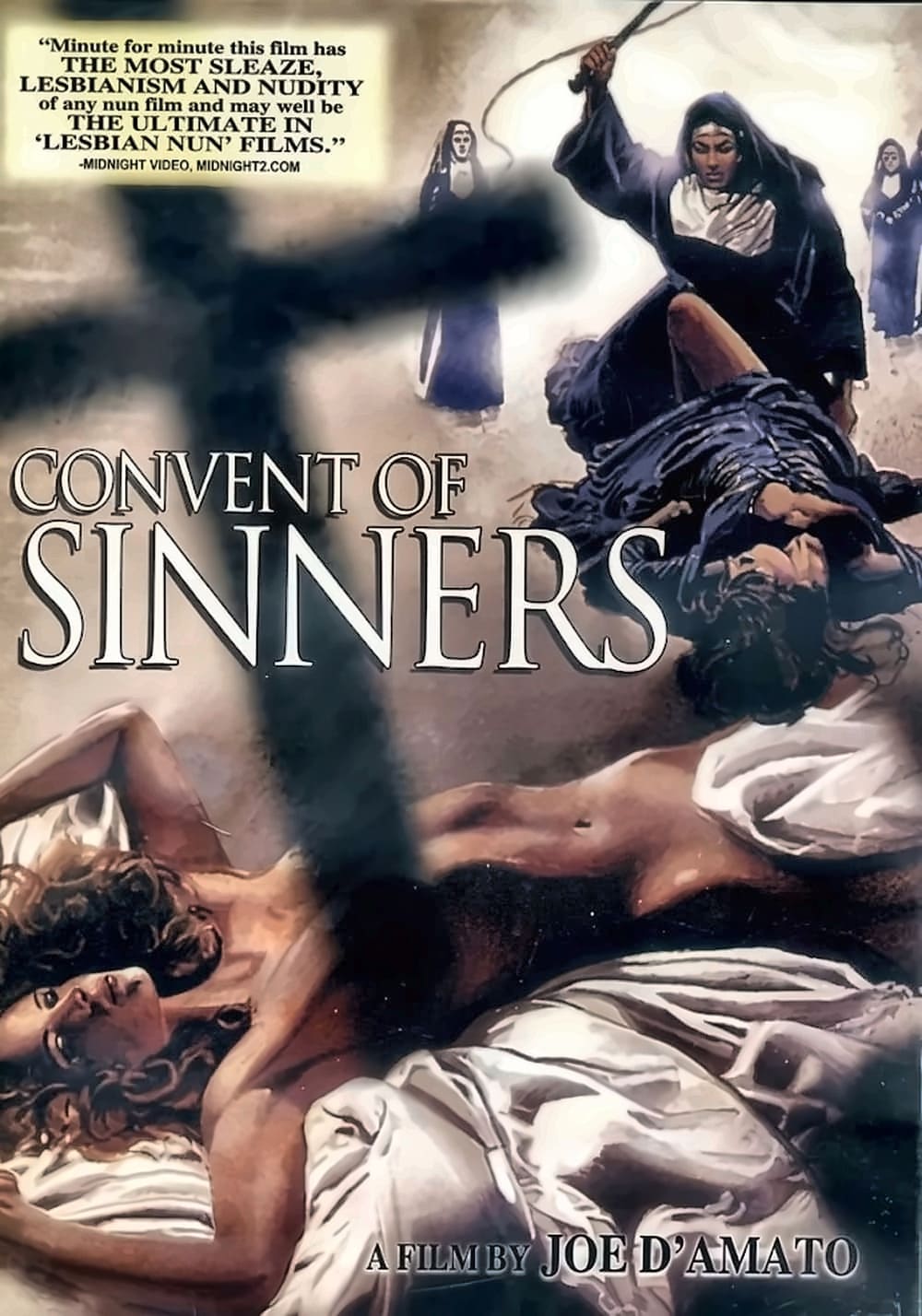
Convent of Sinners (1986) wants to expose the corruption behind convent walls, but Joe D’Amato keeps getting distracted by what he can undress inside them. That tension defines this erotic nunsploitation horror film, an atmospheric guilty pleasure with enough religious hypocrisy and malicious intrigue to suggest a sharper movie buried beneath the sleaze. D’Amato recognizes the dramatic possibilities of an institution where frustrated desire disguises itself as moral authority. He also leans so heavily on sexual titillation that his criticism struggles to compete with his exploitation instincts. The result is entertainingly disreputable, occasionally disturbing, and considerably less insightful than its premise promises.
Susanna, played by Eva Grimaldi, enters the convent after suffering sexual abuse at home, only to discover that her supposed sanctuary contains another collection of people determined to control her. The Mother Superior develops an attachment to her, a priest offers forbidden affection, and Sister Teresa resents the attention she receives. Loosely adapted from Denis Diderot’s La Religieuse, the story follows a vulnerable woman whose needs remain secondary to the desires of those claiming to protect her. Susanna becomes the object of affection, suspicion, and punishment without gaining much say in any of it. Escape from one abusive environment simply delivers her into another.
There is a strong foundation here for a bitter examination of institutional corruption. The convent’s inhabitants cannot acknowledge their feelings honestly, so attraction becomes favoritism, jealousy becomes accusation, and cruelty becomes spiritual correction. Susanna exposes tensions that already exist, but blaming her allows everyone else to avoid examining themselves. Religious authority gives ordinary resentment extraordinary reach. Someone who merely dislikes you can make life unpleasant; someone who claims your suffering serves God can make resistance look like further evidence against you. The film understands that distinction, even if it does not consistently develop it beyond another opportunity for humiliation.
Its place within the nunsploitation tradition makes that limitation especially noticeable. Ken Russell’s The Devils combines sexual obsession, religious hysteria, and institutional violence with a larger examination of political power. D’Amato uses related ingredients without approaching Russell’s ambition or furious visual imagination. Convent of Sinners concentrates on private jealousies and forbidden attachments, which could have supported a more intimate account of how authority becomes abusive. Instead, its serious implications repeatedly compete with scenes designed primarily to provoke or titillate. The comparison is useful because it demonstrates that lurid material and meaningful criticism can coexist, provided the filmmaking gives both a purpose.
Bruno Mattei’s The Other Hell offers the trashier comparison, turning a convent into a breeding ground for sinister secrets, violence, and supernatural horror. Both films exploit the reversal of sacred refuge into dangerous confinement, but Mattei foregrounds the horror-show possibilities while D’Amato emphasizes erotic melodrama. Convent of Sinners builds on this established genre territory through its mixture of religious imagery, repressed appetites, and punitive authority. Yet its reliance on sexual spectacle makes the corruption feel less like something being investigated than something supplying the next scandalous situation. The convent is an effective setting, but D’Amato does not always look beyond its exploitation value.
Karin Well’s Sister Teresa gives the persecution a concrete emotional motive. She resents the Mother Superior’s interest in Susanna, and her wounded pride feeds her vindictiveness. Underneath the religious vocabulary is someone furious about losing influence. The institution lets her disguise retaliation as moral responsibility, making her more dangerous than an openly spiteful rival. These dynamics provide some of the film’s strongest material because they reveal how easily a hierarchy can accommodate personal grudges. Teresa does not need to confess her jealousy when she can insist that Susanna is the problem. Her authority supplies the explanation her conscience ought to question.
Grimaldi gives Susanna a sympathetic presence, but the screenplay is far more interested in what happens to her than in who she is. Her longing for tenderness is understandable, and apparent affection offers a believable temptation in such an oppressive environment. Unfortunately, every refuge becomes another trap, and the repeated victimization eventually starts to flatten her character. D’Amato leans way too heavily on the sexual titillation and lurid exploitation of Susanna, weighing down whatever commentary he is attempting about religious hypocrisy and institutional corruption. Her suffering becomes an attraction in itself. The film wants us to condemn those treating her as an object while rarely resisting that temptation itself.
That mixture also connects it to The Convent of Hell, the erotic graphic novel written by Ricardo Barreiro and illustrated by Ignacio Noé. Its forbidden appetites, convent confinement, cruelty, and supernatural grotesquerie belong to the same imaginative tradition. Whether or not its creators would acknowledge these particular predecessors, the family resemblance to The Devils, The Other Hell, and Convent of Sinners is persuasive. This is a critical reading of their shared sensibility rather than a documented claim of direct influence from every film. Still, the progression makes sense: sacred imagery becomes a framework for escalating erotic excess, sometimes overshadowing whatever criticism accompanies it.
Ultimately, Convent of Sinners works better as an uneven guilty pleasure than as a convincing indictment of religious abuse. Its period atmosphere and enclosed setting lend weight to the melodrama, while its malicious characters keep the intrigue moving even when the pacing sags. There is enough solemn hypocrisy and shameless sleaze to satisfy a taste for Italian exploitation, but Susanna’s treatment grows repetitive and uncomfortable. D’Amato has found a subject with genuine dramatic bite; he simply keeps sacrificing that bite to another dose of titillation. The film peers behind the convent’s respectable façade, then becomes so absorbed in the scandal that it neglects the corruption it originally promised to expose.
Previous Guilty Pleasures
- Half-Baked
- Save The Last Dance
- Every Rose Has Its Thorns
- The Jeremy Kyle Show
- Invasion USA
- The Golden Child
- Final Destination 2
- Paparazzi
- The Principal
- The Substitute
- Terror In The Family
- Pandorum
- Lambada
- Fear
- Cocktail
- Keep Off The Grass
- Girls, Girls, Girls
- Class
- Tart
- King Kong vs. Godzilla
- Hawk the Slayer
- Battle Beyond the Stars
- Meridian
- Walk of Shame
- From Justin To Kelly
- Project Greenlight
- Sex Decoy: Love Stings
- Swimfan
- On the Line
- Wolfen
- Hail Caesar!
- It’s So Cold In The D
- In the Mix
- Healed By Grace
- Valley of the Dolls
- The Legend of Billie Jean
- Death Wish
- Shipping Wars
- Ghost Whisperer
- Parking Wars
- The Dead Are After Me
- Harper’s Island
- The Resurrection of Gavin Stone
- Paranormal State
- Utopia
- Bar Rescue
- The Powers of Matthew Star
- Spiker
- Heavenly Bodies
- Maid in Manhattan
- Rage and Honor
- Saved By The Bell 3. 21 “No Hope With Dope”
- Happy Gilmore
- Solarbabies
- The Dawn of Correction
- Once You Understand
- The Voyeurs
- Robot Jox
- Teen Wolf
- The Running Man
- Double Dragon
- Backtrack
- Julie and Jack
- Karate Warrior
- Invaders From Mars
- Cloverfield
- Aerobicide
- Blood Harvest
- Shocking Dark
- Face The Truth
- Submerged
- The Canyons
- Days of Thunder
- Van Helsing
- The Night Comes for Us
- Code of Silence
- Captain Ron
- Armageddon
- Kate’s Secret
- Point Break
- The Replacements
- The Shadow
- Meteor
- Last Action Hero
- Attack of the Killer Tomatoes
- The Horror at 37,000 Feet
- The ‘Burbs
- Lifeforce
- Highschool of the Dead
- Ice Station Zebra
- No One Lives
- Brewster’s Millions
- Porky’s
- Revenge of the Nerds
- The Delta Force
- The Hidden
- Roller Boogie
- Raw Deal
- Death Merchant Series
- Ski Patrol
- The Executioner Series
- The Destroyer Series
- Private Teacher
- The Parker Series
- Ramba
- The Troubles of Janice
- Ironwood
- Interspecies Reviewers
- SST — Death Flight
- Undercover Brother
- Out for Justice
- Food Wars!
- Cherry
- Death Race
- The Beast Within
- Girl Series
- Gone in 60 Seconds
- Swordfish
- Marked For Death
- The Internship
- The Angry Red Planet
- 2012
- Old School
- No Escape
- In Death Series
- Alligator
- Little Annie Fanny
- Wicked Wanda
- Congo
- The 13th Warrior
- Sudden Death
- The Convent of Hell

