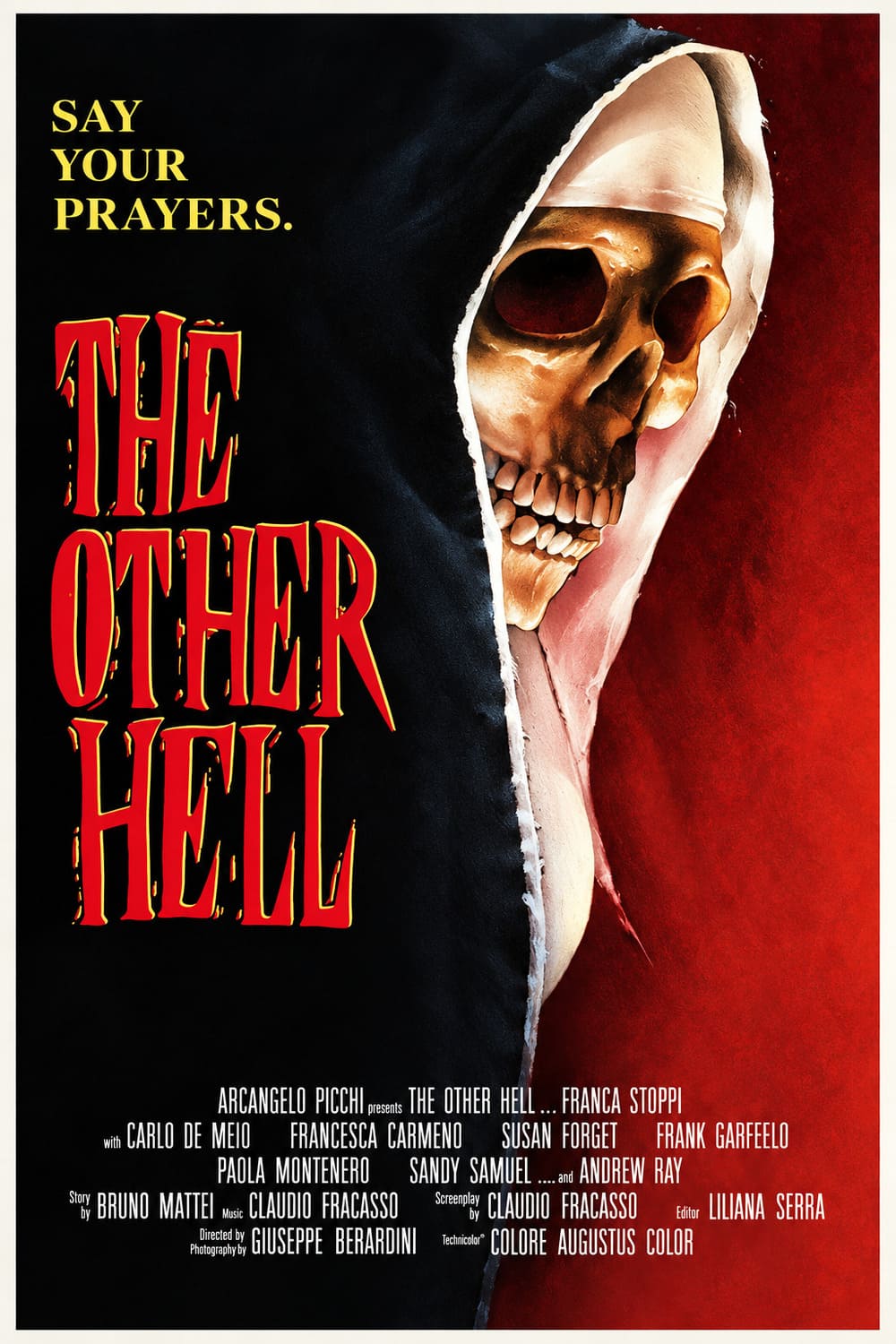
“The genitals are the door to evil!” — Mother Vincenza
The convent in Bruno Mattei’s The Other Hell feels less like a refuge from the world than a place where all its worst impulses have been locked inside. This ragged slice of Italian horror turns a religious sanctuary into a pressure cooker of Catholic guilt, supernatural menace, and institutional cruelty. It is messy, frequently ridiculous, and occasionally more confusing than frightening, but there is something appealing about its complete lack of restraint. Mattei throws so much sinister religious imagery at the screen that even the quieter scenes feel contaminated. This is not elegant Gothic horror. It is nunsploitation with dirty fingernails, steeped in the lurid sensibility of the Italian horror scene of the late ’70s and early ’80s.
The story centers on an isolated convent where disturbing incidents and violent deaths suggest that something evil has taken up residence. A priest arrives to investigate, but getting answers proves difficult when the Mother Superior treats every question like an attack on her authority. The convent’s inhabitants seem caught between fear, obedience, and knowledge they would rather keep buried. That gives the film a decent mystery beneath all the supernatural theatrics. Is the danger coming from an outside force, or has it grown out of the cruelty already hiding behind these walls? Mattei is not particularly careful about developing that question, but it gives the surrounding madness something to hang onto.
As a prime example of nunsploitation, The Other Hell understands the appeal of turning a supposedly sacred environment into a breeding ground for corruption. Religious devotion and institutional repression become difficult to separate, while images normally associated with comfort acquire an ugly edge. Habits, crucifixes, candles, and chapel interiors stop suggesting refuge and start looking like accessories in a nightmare. The film belongs comfortably to that late-’70s and early-’80s Italian exploitation tradition of borrowing familiar horror ingredients and making them nastier. Possession-movie hysteria, murder-mystery mechanics, and Gothic atmosphere all get thrown together, with coherence sometimes sacrificed for the next outrageous image.
Despite its place in the genre, this is not primarily an excuse for erotic convent shenanigans. Its strongest interest is in religious horror, bloody spectacle, and the suggestion that holiness can serve as camouflage for something rotten. That makes it feel closer to a supernatural shocker wearing a nun’s habit than an erotic melodrama with horror decorations. The violence interrupts stretches of investigation and ominous conversation with a bluntness that can be genuinely unpleasant. Sometimes those jolts feel earned; sometimes they seem dropped in because the movie has gone too long without doing something appalling. Either way, Mattei rarely lets good taste interfere.
Atmosphere is the film’s biggest asset. The convent feels cramped, shadowy, and emotionally airless, as though nobody has opened a window in decades. Dark corridors and severe religious imagery create an environment where even ordinary movement looks suspicious. At its best, the movie makes the building seem like an extension of its inhabitants’ damaged lives. Every room appears to conceal a secret, and every silence feels enforced rather than peaceful. The priest’s investigation becomes less a straightforward search for evidence than an attempt to navigate a place whose entire identity depends on keeping certain truths inaccessible. That is a stronger source of dread than some of the more obvious supernatural business.
The Goblin music helps considerably, lending the proceedings a sense of menace and grandeur that the filmmaking cannot always sustain on its own. There is something wonderfully excessive about hearing that ominous musical energy attached to such a scrappy production. A hallway suddenly feels more threatening; a strange encounter acquires the weight of an approaching catastrophe. Occasionally the score seems to be doing the heavy lifting, but that is hardly a fatal problem in a movie like this. Its unsettling sound fits a world where everything feels slightly disconnected from ordinary reality, and it gives the film an identity beyond its budgetary limitations.
The performances work best when they lean into the material’s severity rather than trying to make it naturalistic. The Mother Superior is particularly important because she gives the convent’s oppressive atmosphere a human face. Her authority feels defensive and punitive, making the institution itself seem hostile before any demonic explanation is necessary. Elsewhere, stiff dialogue and broad reactions can undercut the tension. These are not richly developed characters so much as people assigned positions within a nightmare: investigator, victim, authority figure, keeper of secrets. Still, their lack of warmth contributes to the sense that this place has drained everyone inside it.
Unfortunately, mood cannot solve every problem. The pacing drags, the investigation becomes repetitive, and the plot occasionally behaves as though connective tissue is an optional luxury. Scenes that should deepen the mystery can instead leave it feeling muddier. The film also wavers between disturbing imagery and outright absurdity without always controlling the transition. For some viewers, those weaknesses will make the experience exhausting. For others, they are part of its grubby appeal. Mattei’s willingness to follow a lurid idea wherever it leads produces both the film’s memorable moments and its least convincing ones. You rarely mistake it for disciplined filmmaking, but you also rarely mistake it for anything respectable.
There is an intriguing resemblance to The Convent of Hell, the graphic erotica novel written by Ricardo Barreiro and illustrated by Ignacio Noé, which appeared roughly two decades later. Its convent setting, infernal intrusion, forbidden spaces, and collision of religious repression with transgression make Mattei’s film seem like a possible precursor. That resemblance should not be confused with documented influence, but the shared territory is striking. Barreiro and Noé take the material much further into explicit erotic grotesquerie, whereas The Other Hell concentrates on supernatural violence and oppressive atmosphere. Both turn the convent’s promise of spiritual shelter inside out, exposing a world where secrecy and authority leave plenty of room for hell.

