Around 2 a.m. this morning, I watched the latest Lifetime Movie Network premiere, FANatic!
Why Was I Watching It?
Okay, so technically, I didn’t watch this last night. It premiered last night and I recorded it because I was watching the latest episode of The Walking Dead. However, I don’t think What Lisa Recorded Last Night has quite the same ring to it.
As for why I watched it at 2 in the morning — well, I fell asleep last night around 11:00. And then I woke up at one. Seeing as how I had already gotten my usual two hours of sleep, I decided that I might as well watch a movie!
What Was It About?
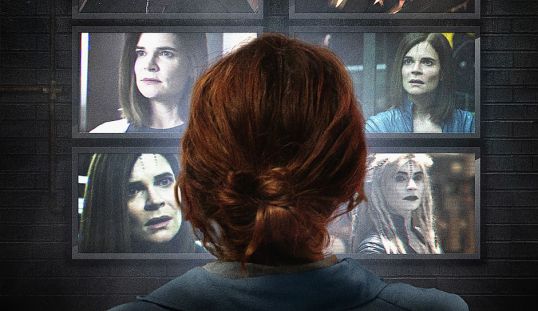
Nikki Myers (Katy Breier) has finally landed her dream job. She’s working as an assistant to Tess Daniels (Betsy Brandt), a highly acclaimed actress who happens to be the star of Nikki’s favorite show! It’s an enjoyably silly sci-fi show, one on which Tess co-stars with her husband, Hunter Clay (Benjamin Arthur). When the show started, Tess and Hunter were equals and Tess considered her role to be empowering. But, over the past few seasons, things have changed. Tess now finds her role to be demeaning and limiting. While Hunter gets to play the hero, Tess’s role becomes more and more about providing fan service for the show’s male viewers. Tess wants to leave the show…
But if Tess leaves the show, where does that leave Nikki!? Nikki’s spent the last few weeks bragging to her two friends about her job! If the show ends, how will Nikki be able to continue to steal props from the set? And how will she be able to continue to lie to her friends about the imaginary affair she’s having with Hunter!?
Seriously, when you look at things from her point of view, can you blame Nikki for becoming a little bit homicidal?
What Worked?
Yay! If nothing else, FANatic showed that the Lifetime-Degrassi conduit still exists! Perhaps because so many Lifetime films are produced in Canada, it’s not unusual to see former Degrassi actors pop up in supporting (and, sometimes, lead) roles. On Degrassi, Jake Epstein played the lovable, bipolar, drug addicted musician/photographer Craig Manning. In FANatic, he plays a slightly less likable character, a misogynistic television producer. Still, it’s always good to see Jake.
Anyway, FANatic was a lot of fun to watch, mostly because of the loving detail that was put into creating Tess and Hunter’s irresistibly silly sci-fi show. What’s interesting is that, if that show actually was on the air, it probably would be, at the very least, a cult hit. I knew more than a few people who would probably watch every episode.
Katy Breier did a good job playing the fanatic of the title. A film like FANatic is only as good as its villain and Breier brought a lot of life to the role.
What Did Not Work?
Seriously, why are redheads always crazy in Lifetime movies? Of course, that’s really not something that didn’t work. That’s just something that I, as a member of the 2% of the world’s population who has red hair, always notice.
But back to the question — hey, it all worked!
“Oh my God!” Just like me moments!
It’s hard for me to imagine myself ever becoming obsessed with any show to the extent that Nikki does. Then again, if that show starred James Franco…
According to the imdb, Fred Olen Ray is, as of this writing, credited with directing 148 films. Few of those films have necessarily been acclaimed by the mainstream critics but almost all of them are a lot of fun when taken on their own terms.
Take The Twin for instance, on which Ray shares a directing credit with screenwriter Max Derin.
Now, in many ways, The Twin is a ludicrous film. It’s very, very melodramatic and the whole film’s central issue (i.e., which twin is which) could have been very easily resolved if just one person in the movie had used a little common sense.
But you know what?
Criticism like that misses the entire point of the film. The Twin is a lot of fun and it’s certainly not a film that’s meant to be taken seriously. This is not a serious look at mental illness, young love, sibling rivalry, or anything else for that matter. This is an over-the-top and rather silly piece of pure entertainment and, if we can’t enjoy something like that, what hope is there for the world?
The film deals with Tyler (Timothy Granaderos), who would seem to be almost perfect. He’s handsome. He’s intelligent. He’s compassionate. He’s a wonderful boyfriend, always polite and considerate to his girlfriend, Jocelyn (Jess Gabor). Even Jocelyn’s overprotective mother, Ashley (Brigid Brannah), seems to like him.
However, Tyler has a secret. Years ago, his parents were killed in a car accident. The accident was caused by Tyler’s brother, Derrick. As you may have guessed from the film’s title, Derrick is Tyler’s twin. And we all know that, whenever a movie is called The Twin, that means that there’s going to be a good twin and an evil twin. It turns out that Derrick is the evil twin and that accident was no accident.
Derrick has spent the last few years in a mental asylum. When Tyler shows up to visit his brother, the staff tells Tyler that Derrick has picked up a strange new habit. He’s telling everyone that he’s actually Tyler and Tyler is Derrick. Oh well, Tyler shrugs, that’s what happens when you’ve got a sociopathic twin.
Later, when Tyler is alone with his twin, he’s shocked when Derrick attacks him. Derrick knocks him out and then switches clothes with him. Claiming to be Tyler, Derrick walks out of the hospital and into the lives on Jocelyn and Ashley. Meanwhile, Tyler is stuck in the hospital, begging for someone to just give him a blood test so that he can prove who he is….
Anyway, you can probably guess what happens next but that’s part of the fun. Derrick (as Tyler) spends a lot of good, quality time with Ashley and Jocelyn, both of whom are surprised by how different “Tyler’s” personality seems to now be. Ashley, of course, is more suspicious than Jocelyn. (This film premiered on Lifetime so you better believe that overprotective mom is eventually proven right.)
It may be predictable but, like I said, it’s all a lot of fun. I don’t know which parts of the film were directed by Derin and which parts by Fred Olen Ray but, as a whole, the film is cheerfully content to be a B-movie and you have to kind of love it for that. At a time when everyone is taking everything so seriously and so many filmmakers are giving into portentous pretension, it’s nice to see a thriller that’s pure entertainment.
Plus, Timothy Granaderos is a lot of fun as both Tyler and Derrick. Tyler is nice but kind of dull. Derrick is exciting but totally batshit crazy. Granaderos seems to be enjoying himself as he switches back and forth between being good and evil. An evil twin movie is only as good as its twins and Granaderos is pretty good.
So, keep an eye out for The Twin. Melodrama this enjoyable should not be missed.
Earlier tonight, I watched the latest Lifetime celebrity biopic, Britney Ever After.
Ever since that ill-fated Aaliyah movie, Lifetime biopics have had a reputation for being hot messes and I’m sure that a lot of people will say the same thing about Britney Ever After. Britney Ever After is about Britney Spears, following her from her first tour with *NSYNC through her relationship with Justin Timberlake through her marriages to both Jason Alexander and Kevin Federline and finally concluding with her well-publicized breakdown in 2008. As usually seems to happen with these biopics, the whole story is framed by interviews with a documentary crew. From what I saw, the twitter reaction was pretty savage and I’m sure that there will be all sorts of snarky reviews tomorrow.
But you know what?
As far as Lifetime celebrity biopics go, Britney Ever After was not that bad.
It suffered from some obvious problems. Since neither Britney nor her management had anything to do with the making of the film, none of Britney’s original music was heard. That means there was no Oops! I did it again! There was no Baby One More Time. No Toxic. No If U Seek Amy. There was no Work Bitch, which incidentally is both the greatest song that Britney’s ever done and my favorite song to sing while stuck in traffic. I think it was mentioned, at one point, that Britney was working on a song called Womanizer but I may have misheard. When the actress playing Britney sang, it was only to cover songs by other artists. In the film, Britney performed I Love Rock and Roll and a bit of Walking After Midnight.
For what I presume are legal reasons, the film had to be circumspect. Yes, Justin Timberlake (played by Nathan Keyes) was a character in the movie but he was portrayed so blandly that he could have been any hyperactive teenager with good hair. Jason Allen Alexander (Kelly McCabe) shows up just long enough to marry Britney and then be told that the marriage is going to be annulled. Amazingly, Britney’s entire marriage to Kevin Federline (Clayton Chitty) takes place over less than 10 minutes of screen time. Adnan Ghalib (Serge Jaswal) and Sam Lufti (Benjamin Arce) get more attention that Kevin but both of them are portrayed so negatively that they probably wish they hadn’t.
(Adnan and Sam both made the mistake of testifying about Britney in court, meaning that their douchebaggery was a part of the public record and free for Britney Ever After to portray.)
As for Britney’s “rivalry” with Christina Aguilera (which, early in their careers, pretty much defined both of their public personas), it goes unmentioned. Christina is only briefly seen in a long shot. For those of you hoping for any details about the dark side of life at the Mickey Mouse Club, Britney Ever After is not for you. Really, the film’s main problem was one of logistics. Britney Ever After had only 90 minutes to tell the story of a very dramatic and complicated life. If the film felt rushed, that’s because it had a lot to show and not much time to do it.
But, even with all that in mind, Britney Ever After was not the disaster that some seem to believe that it was. In the role of Britney, Natasha Bassett did far better than I was expecting. There were some issues, of course. Her attempt to duplicate Britney’s Southern accent led to her sounding more like Jessica Simpson than Britney Spears. During the film’s early scenes, she seemed almost too innocent to be believed but it quickly became apparent that this was intentional on the film’s part. One of the themes running through the film was how Britney’s image was continually shaped by her parents, her management, and her boyfriends. In the end, Britney is portrayed as having no control over her own life. When Britney suffers a break down in 2007, she’s at least trying to live her own life. When everyone around her panics, are they concerned about her health or are they concerned about her image and their investment in her career? This unanswered question hangs over the final 30 minutes of Britney Ever After. If Natasha Bassett never quite seemed to be Britney, she was still very believable as a character living the exact same life and dealing with the exact same issues.
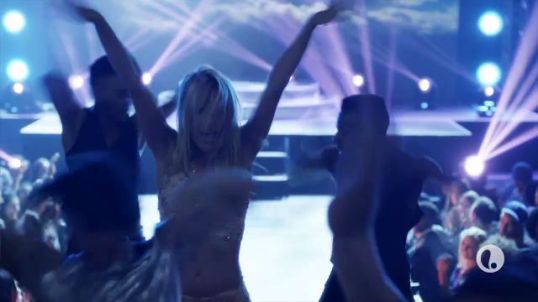
Plus, there was an enjoyably silly scene where Britney ran into Justin in a club and they had an epic dance off. If only all relationship issues could be solved by a dance off!
That said, I was a bit disappointed that, at no point, was Crossroads mentioned.
(Seriously, a Britney movie with no mention of Crossroads!?)
But give the film some credit. It did a good job of capturing the suffocating experience of being hounded by paparazzi. And the film was even-handed and compassionate when it came to portraying Britney’s 2007 breakdown. Like Britney, I’m bipolar and I’ve always felt that I could understand what she was going through while the rest of the world was finding so much entertainment in her very public struggle. Since 2008, Britney’s father has had conservatorship over her life and control of all of her assets. For nearly ten years, Britney Spears has not been allowed to stand on her own and has essentially made a lot of money for everyone but her. During the documentary segments that provide a wrap-around to the film’s story, Britney Ever After obliquely hints at this sad reality. In those sequences, there’s a sadness to Bassett’s performance, an acknowledgement that Britney has paid a price for public stability.
Britney Ever After was on Britney’s side, which is more than can be said of many other biopics.
“When it comes to dying for your country, it’s better not to die at all!”
— Paul Baumer (Lew Ayres) in All Quiet On The Western Front (1930)
Tonight, I watched the third film to ever win the Oscar for Best Picture, the 1930 anti-war epic, All Quiet On The Western Front.
All Quiet On The Western Front opens in a German classroom during World War I. Quotes from Homer and Virgil, all exalting heroism, are written on the blackboard. The professor, a man named Kantorek (Arnold Lacy), tells his all-male class that “the fatherland” needs them. (It’s all very patriarchal, needless to say.) This, he tells them, is a time of war. This is a time for heroes. This is a time to fight and maybe die for your country. He beseeches his students to enlist in the army. The first to stand and say that he will fight is Paul Baumer (Lew Ayres). Soon, almost every other student is standing with Paul and cheering the war. Only one student remains seated. Paul and the others quickly turn on that seated student, pressuring him to join them in the army. That seated student finally agrees to enlist, even though he doesn’t want to. Such is the power of peer pressure.
A year later, a visibly hardened Paul returns to his old school. He’s on furlough. He’s been serving in a combat zone, spending his days and nights in a trench and trying not to die. He’s been wounded but he hasn’t been killed. He can still walk. He can still speak. He hasn’t gone insane. He is one of the few members of his class to still be alive. (That student who didn’t want to enlist? Long dead.) When Kantorek asks Paul to speak to his new class, Paul looks at the fresh-faced students — all of whom have just listened to Kantorek describe the glories of war — and Paul tells them that serving in the army has not been an adventure. It has not made him a hero. The only glory of war is surviving. “When it comes to dying for one’s country, it’s better not to die at all!” Kantorek is horrified by Paul’s words but he needn’t have worried. The students refuse to listen to Paul, shouting him down and accusing him of cowardice and treason.
(This scene is even more disturbing today, considering that we live in a time when accusations of treason and calls for vengeance are rather cavalierly tossed around by almost everyone with a twitter account.)
What happened between those two days in the classroom is that Paul saw combat. He spent nights underground while shells exploded over his head. He watched as all of his friends died, one by one. One harrowing night, spent in a trench with a French soldier who was slowly dying because of Paul stabbing him, nearly drove Paul insane. In the end, not even his friend and mentor, Kat (Louis Wolheim), would survive. From the first sound of bombs exploding to the film’s haunting final scene, the shadow of death hangs over every minute of All Quiet On The Western Front. By the end of it all, all that Paul has learned is that men like Kantorek and the buffoonish Corporal Himmelstoss (John Wray) have no idea what real combat is actually like.
All Quiet On The Western Front may be 87 years old but it’s still an incredibly powerful film. There are certain scenes in this pre-code film that, after you watch them, you have to remind yourself that this film was made in 1929. I’m not just talking about a swimming scene that contains a split second of nudity or a few lines of dialogue that probably wouldn’t have made it past the censors once the production code started to be enforced. Instead, I’m talking about scenes like the one where a bomb goes off just as a soldier attempts to climb through some barbed wire. When the smoke clear, only his hands remains. And then there’s the sequence where the camera rapidly pans by soldier after soldier falling dead as they rush the trenches. Or the scene where Paul literally watches as one of his friends, delirious and out-of-his-mind, suddenly dies. Or the montage where a pair of fancy boots is traded from one doomed soldier to another, with each soldier smiling at his new boots before, seconds later, laying dead in the mud. Or the harrowing scene where Paul tries to keep a French soldier from dying.
All Quiet On The Western Front remains a powerful film. It’s perhaps not a surprise that, when it briefly played in Germany, the Nazis released live mice in the theaters to try to keep away audiences. (Both the film and the book on which it was based were later banned by the Nazi government.) Sadly, we’ll never get to see All Quiet On The Western Front the way that it was originally meant to be seen. A huge hit in 1930, All Quiet On The Western Front was rereleased several times but, with each rerelease, the film was often edited to appease whatever the current political climate may have been. Over the years, much footage was lost. The original version of All Quiet On The Western Front was 156 minutes long. The version that is available today is 131 minutes long. But even so, it remains a harrowing and powerful antiwar statement.
With all due respect to both Wingsand Broadway Melody, All Quiet On The Western Front was the first truly great film to win the Oscar for Best Picture. Sadly, it remains just as relevant today as when it was first released.
What’s an Insomnia File? You know how some times you just can’t get any sleep and, at about three in the morning, you’ll find yourself watching whatever you can find on cable? This feature is all about those insomnia-inspired discoveries!
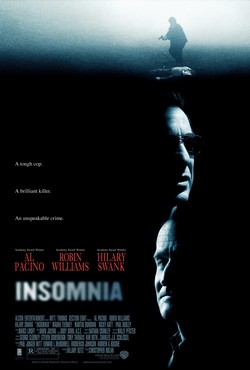
Last night, if you were up at 2 in the morning, you could have turned over to Starz and watched the atmospheric 2002 mystery, Insomnia.
I have to admit that I’m cheating a little bit by including Insomnia in a series about obscure films that you might find on cable late at night. While Insomnia does seem to often turn up during the early morning hours, it’s hardly an obscure film. A remake of an acclaimed Norwegian film, it not only stars three Oscar winners (Al Pacino, Robin Williams, and Hilary Swank) but it was directed by Christopher Nolan. Insomnia got a lot of attention when it was first released in 2002. But, doing an insomnia file about a movie that’s actually about insomnia was just too good of an opportunity to pass up.
I should also mention that I didn’t have insomnia last night. I was up because I currently have a cold and I watched Insomnia in a feverish and congested haze. And yet I couldn’t help but feel that, somehow, that was actually the ideal way to watch Insomnia. With its ominous atmosphere and Nolan’s eye for the surreal, Insomnia plays out like a semi-lucid fever dream.
A teenage girl has been murdered in a small Alaskan fishing village. The chief of police (played by the great character actor Paul Dooley) asks his former LAPD partner, Will Dormer (Al Pacino), to come to Alaska and help with the investigation. Accompanying Dormer is his partner and friend, Hap Eckhart (Martin Donovan).
Dormer has issues that go far beyond anything happening in Alaska. He’s burned out and he’s plagued by rumors that, in the past, he was a crooked cop. He’s being investigated by Internal Affairs and, shortly after they arrive in Alaska, Eckhart admits that he’s been given immunity as part of a deal to testify against Dormer. While pursuing the suspected murderer through the Alaskan fog, Dormer fires his gun. When the fog clear, Dormer discovers that he’s killed Eckhart. Was it an accident or did Dormer intentionally shoot his partner? Not even Dormer seems to know for sure. He lies and says that the murderer shot Eckhart.
Working with a local detective (Hilary Swank), Dormer tries to solve the Alaska murder, with the knowledge that, once he does, he’ll have to return to Los Angeles and he’ll probably be indicted. Because of the midnight sun, night never falls in Alaska and, tortured by guilt, Dormer cannot sleep. Add to that, the murderer knows that Dormer shot Eckhart. And now, he’s calling Dormer and cruelly taunting him.
Who is the murderer? His name is Walter Finch. He’s a writer and, in a stroke of brilliance, he’s played by none other than Robin Williams. To me, Robin Williams’s screen presence always carried hints of narcissism and self-destruction. Even in comedic roles, there was a transparent but very solid wall between Williams the audience. When he was shouting out a thousand words a minute and rapidly switching from one character to the next, it always seemed as if it was all a technique to keep anyone from figuring out who he really was. In Insomnia (and, that same year, in One Hour Photo), Robin Williams reveals an inner darkness that he rarely showed before or after. Finch may possess Williams’s trademark eccentric smile and nervous voice but, underneath the surface, he’s an empty shell who views human beings as being as disposable as the characters in his paperback novels.
Christopher Nolan takes us directly into the heads of these two enemies, with shots of the desolate Alaskan landscape seeming to perfectly capture the inner desolation of two minds destroyed by guilt and paranoia. (Neither Finch nor Dormer is capable of connecting with the world outside of his damaged psyche.) As seen through Nolan’s lens, Alaska becomes as surreal and haunting as one of the dream landscapes from Inception.For those of us who found both The Dark Knight Rises and Interstellar to be so bombastic that they verged on self-parody, Insomnia is a nice reminder that Nolan doesn’t need a pounding Han Zimmer score to make a great movie. With Insomnia, Nolan gives us not bombast but a deceptively low-key and atmospheric journey into the heart of darkness.
Ironically, for a film about two men who cannot sleep, Insomnia will haunt your dreams.
Every month this year, I am updating my predictions for which films and performers will be nominated for Oscars in 2018. At this point in the year, this is largely an academic exercise. The nominees below are a mix of wild guesses, instinctual feeling, and wishful thinking. Usually, a clear picture of the Oscar race doesn’t start to form until October at the earliest. (Last year, at this time, nobody had even heard of Moonlight or Hell or High Water.) In other words, take these predictions with a grain of salt.
This update is heavily influenced by what happened at the Sundance Film Festival last month. In fact, it’s probably a bit too influenced by Sundance. If these predictions turned out to be 100% correct, the 2018 Oscars would be the Sundance Oscars. That said, it seems that there’s always a few successful Oscar campaigns that start during Sundance. (And then there’s always a few Sundance sensations that totally fizzle during awards season. Birth of a Nation, anyone? Or perhaps The End of the Tour.) But, as of right now, Sundance is pretty much the only thing that we have to go on, as far as future Oscar contenders are concerned.
Again, take all of this with a grain of salt. Just because I may brag about knowing what I’m talking about, that doesn’t necessarily mean that I do.
The big additions here are Mudbound, The Big Sick, and Call Me By Your Name, all three of which got a lot of attention and acclaim at Sundance. Both Mudbound and Call Me By Your Name are already being mentioned, by some Oscar bloggers, as possible winners for best picture. The Big Sick may seem like more of a dark horse but, from what I’ve read, it sounds like the sort of movie that could emerge as a surprise contender. With its Muslim protagonist and its mix of comedy and drama, it sounds like it could catch the cultural zeitgeist.
Dropping from the list: T2, All Eyez On Me, and War Machine. T2 has gotten good but not great reviews in the UK. As for All Eyez on Me and War Machine — well, it’s just a feeling I have. Both of them could be good but it’s easier to imagine a scenario in which they’re both disappointments.
Guadagnino and Rees are new contenders. Rees would be the first black woman ever nominated for best director.
Best Actor
Chadwick Boseman in Marshall
Timothée Chalamet in Call Me By Your Name
Tom Cruise in American Made
Kumail Nanjiani in The Big Sick
Gary Oldman in Darkest Hour
I’m a little bit iffy on Chadwick Boseman. In Marshall, he will be playing Thurgood Marshall, which sounds like a good, Oscar baity role. But Marshall itself sounds like a rather standard biopic. Timothee Chalamet and, especially, Kumail Nanjiani received a lot of Sundance acclaim. The fact that Nanjiani has been outspoken in his opposition to Trump’s travel ban will probably help his chances.
Sundance was also responsible for Logan Lerman falling off this list. Sidney Hall got terrible reviews.
Among the new additions, Danielle MacDonald was one of the break-out stars at Sundance. Carey Mulligan is due to get another nomination (and Mudbound is expected to be a major Oscar contender). As for Lois Smith, she’s a respected veteran actress who gets to play a rare lead role in Marjorie Prime. So, why not a nomination?
I’m continuing to predict a nomination for James Franco and yes, it probably is just wishful thinking on my part. But dammit, I just like the idea of Franco getting a nomination for playing Tommy Wiseau.
Skarsgard is probably wishful thinking as well. If It works, it will be because of Skarsgard’s performance as Pennywise.
Finally, Hammer, Mitchell, and Stuhlbarg are our Sundance nominees. Many people think that all three are overdue for some Academy recognition. (There’s some debate over whether Hammer should go supporting or lead for Call Me By Your Name. I’m going to assume that he’s going to pull a Viola Davis and go supporting.)
As always, this is the most difficult category to predict. Blige, Hunter, and Leo are all Sundance nominees. (Hunter is especially said to be award-worthy in her Big Sick role.) For the second month in a row, Scott Thomas and Swinton are listed more because of who they are than any other reason.
Tonight, I watched the 1969 winner of the Oscar for Best Picture, Midnight Cowboy.
Midnight Cowboy is a movie about Joe Buck. Joe Buck is played by an impossibly young and handsome Jon Voight. Joe Buck — and, to be honest, just calling him Joe seems wrong, he is definitely a Joe Buck — is a well-meaning but somewhat dumb young man. He lives in Midland, Texas. He was raised by his grandmother. He used to go out with Annie (Jennifer Salt) but she eventually ended up being sent to a mental asylum after being raped by all of Joe Buck’s friend. Joe Buck doesn’t have many prospects. He washes dishes for a living and styles himself as being a cowboy. Being a Texan, I’ve known plenty of Joe Bucks.
Joe Buck, however, has a plan. He knows that he’s handsome. He’s convinced that all women love cowboys. So, why shouldn’t he hop on a bus, travel to New York City, and make a living having sex with rich women?
Of course, once he arrives in the city, Joe Buck discovers that New York City is not quite as inviting as he thought it would be. He lives in a tiny and dirty apartment. He can barely afford to eat. Walking around the city dressed like a cowboy (and remember, this was long before the Naked Cowboy became one of the most annoying celebrities of all time) and randomly asking every rich woman that he sees whether or not she can tell him where he can find the Statue of Liberty, Joe Buck is a joke. Even when he does get a customer (played, quite well, by Sylvia Miles), she claims not to have any money and Joe Buck feels so sorry for her that he ends up giving her his money.
As I watched the first part of the movie, it stuck me that the main theme of Midnight Cowboy appeared to be that, in 1969, New York City was literally Hell on Earth. But then Joe Buck has flashbacks to his childhood and his relationship with Annie and it quickly became apparent that Midland, Texas was Hell on Earth as well. Towards the end of the film, it’s suggested that Miami might be paradise but not enough to keep someone from dying on a bus.
Seriously, this is a dark movie.
Joe Buck eventually meets Ratso Rizzo (Dustin Hoffman). Ratso’s real name is Enrico but, after taking one look at him, you can’t help but feel that he’s a perfect Ratso. Ratso is a con man. Ratso is a petty thief. Ratso knows how to survive on the streets but New York City is still killing him. As a child, Ratso had polio and now he walks with a permanent limp. He coughs constantly, perhaps because he has TB. Ratso becomes Joe Buck’s manager and roommate (and, depending on how you to interpret certain scenes and lines, perhaps more) but only after attempting to steal all of his money.
Unfortunately, Ratso is not much of a manager. Then again, Joe Buck is not much of a hustler. Most of his customers are men (including a student played by a young but recongizable Bob Balaban), but Joe Buck’s own sexual preference remaining ambiguous. Joe Buck is so quick to loudly say that he’s not, as Ratso calls him, a “fag” and that cowboys can’t be gay because John Wayne was a cowboy, that you can’t help but suspect that he’s in denial. When he’s picked up by a socialite played by Brenda Vaccaro, Joe Buck is impotent until she teases him about being gay. In the end, though, Joe Buck seems to view sex as mostly being a way to make money. As for Ratso, he appears to almost be asexual. His only concern, from day to day, is survival.
Did I mention this is a dark movie?
And yet, as dark as it is, there are moments of humor. Joe Buck is incredibly dense, especially in the first part of the movie. (During the second half of the film, Joe Buck is no longer as naive and no longer as funny. It’s possible that he even kills a man, though the film is, I think, deliberately unclear on this point.) Ratso has a way with words and it’s impossible not to smile when he shouts out his famous “I’m walking here!” at a taxi. And, as desperate as Joe Buck and Ratso eventually become, you’re happy that they’ve found each other. They may be doomed but at least they’re doomed together.
There’s a lengthy party scene, one that features several members of Andy Warhol’s entourage. I was a bit disappointed that my favorite 60s icon, Edie Sedgwick, was nowhere to be seen. (But be sure to check out Ciao Manhattan, if you want to see what Edie was doing while Joe Buck and Ratso Rizzo were trying not to starve.) But, as I watched the party scene, I was reminded that Midnight Cowboy is definitely a film of the 60s. That’s both a good and a bad thing. On the positive side, the late 60s and 70s were a time when filmmakers were willing to take risks. Midnight Cowboy could only have been made in 1969. At the same time, there’s a few moments when director John Schlesinger, in the style of many 60s filmmakers, was obviously trying a bit too hard to be profound. Some of the flashbacks and fantasy sequences veer towards the pretentious.
Fortunately, the performances of Voight and Hoffman have aged better than Schlesinger’s direction. Hoffman has the more flamboyant role (and totally throws himself into it) but it really is Voight who carries the film. Considering that he’s playing a borderline ludicrous character, the poignancy of Voight’s performance is nothing short of miraculous.
Midnight Cowboy was the first and only X-rated film to win best picture. By today’s standards, it’s a PG-13.
I recently discovered this film. I haven’t watched it yet but I hear its terrible.
In Love (1983)
I know that I’ve shared this trailer in the past but what can I say? Even though it’s an edited trailer and I’ve never seen the actual film, I still love this trailer. That song really gets stuck in your head.
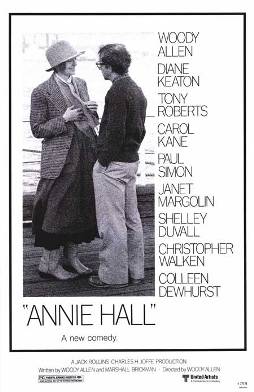
You take a risk when you review a Woody Allen film, even an acknowledged, Best Picture-winning classic like 1977’s Annie Hall. Do you address the accusations that have been made about him? Do you ignore them and hope that they won’t be the Elephant in the Room, stomping through your review? Do you try to justify reviewing (or, in some cases, even watching) Allen’s film? Or do you just let the work speak for itself?
I love Annie Hall. Quite frankly, I like a lot of Woody Allen’s films, even though I understand why his work is an acquired taste for quite a few other people. I’ll address the elephant in the room in a paragraph or two but you know what? I watched Annie Hall last night and I want to mention a few reasons why I enjoy this film.
First off, Annie Hall features one of Christopher Walken’s first (and best) performances. He only has a few lines but he makes quite an impression. He plays Duane, the brother of Annie Hall (Diane Keaton). When Annie’s boyfriend, Alvy Singer (Woody Allen), is visiting the Hall family, Duane invites Alvy into his bedroom and tells him that, whenever he’s driving, he fantasizes about intentionally swerving into incoming traffoc. In the very next scene, Duane is driving an oblivious Annie and a terrified Alvy to the airport. It’s a wonderfully funny moment. (If you keep your eyes open, you’ll notice that Annie’s apartment is full of pictures of Duane and his thousand yard stare.)
Secondly, this film also features an early role for Jeff Goldblum. He only has one line — “I forgot my mantra” but my God, he does amazing things with that line.
Third, when Alvy and his agent, Rob (Tony Roberts), are driving through Los Angeles, they pass a theater. According to the marquee, the theater is showing House of Exorcism, a Mario Bava film. That’s right: Italian horror in a Woody Allen film. How glorious is that?
Fourth, Annie Hall is an extremely dated film. It was made in 1977 and, as to be expected about a film directed and written by a stand up comedian, it’s full of references that were probably hilariously on target then but rather obscure now. As well, like almost all Woody Allen films, it’s a very New York film. Alvy is an intellectual, left-wing Jew who suspects that everyone he sees is an anti-Semite and who is dating an aspiring actress and singer who hails from middle America. (During the scene where Alvy meets her family, he immediately pegs Grammy Hall as a “classic Jew hater.”) The film is very much told from Alvy’s point of view, which means jokes about New York periodicals and a flashback to an Adlai Stevenson rally. That being said, I’m a Texas girl who was born long after Annie Hall was first released and I still enjoy the film because it’s a film that captures some universal truths about human relationships.
The first time I watched Annie Hall, I was 17 and I saw a lot of myself in Annie. While I wouldn’t be caught dead wearing some of her outfits, I knew what it was like to be insecure. I knew what it was like to be nervous. I know what it was like to worry about being smart enough. And, like Annie, I eventually learned that independence was the key to happiness. Annie Hall has stood the test of time because both Annie and Alvy are relatable while still remaining wonderfully unique and neurotic individuals.
(If ever a film has been a ode to the joy of being neurotic, it’s Annie Hall.)
Fifth, I love the scene where Alvy asks a random couple of the street how they make their relationship work. “I’m totally shallow and have no original thoughts,” the woman replies. “And I’m the exact same way,” her husband cheerfully adds.
Sixth, I’m going to assume that Paul Simon was primarily playing himself.
Seventh, there are just so many great scenes. Like when Alvy deals with a rude cop by ripping up his license. And then, there’s that lobster scene. And that moment when Alvy comes over to Annie’s apartment to kill a “spider the size of a buick.” (Judging by the number of times Alvy has to hit the spider with that tennis racket, I assume buick’s are pretty big.) There’s the two scenes of Annie singing, one when she’s still insecure and can’t compete with the sound of plates smashing around here and the other when she’s developed the confidence to dominate and control both the stage and the audience. There’s the scenes where Alvy breaks the fourth wall and get advise from random people on the streets of New York. And what about when Annie starts laughing while telling the horrible story of how her uncle died at the post office? Or what about when Alvy tries to avoid having sex with his first wife by discussing the JFK assassination? Or when we literally see Annie mentally check out of making love to Alvy? Or how about the split-screen therapy sessions? Or the sudden moment when Annie and Alvy become cartoon characters? Or the scene with the pretentious blowhard at the movies?
(As a Southern girl, I have to admit that it’s always strange to me to hear Alvy and Annie talking about “waiting on line” at the movies. Down here, we say “in line,” which makes a lot more sense. Since a line is just a crowd of people standing in a certain order, saying that you’re “on line,” is the same as saying your standing on someone’s head. You get in a crowd, not on them. Whenever I hear someone from up north talking about “waiting on line,” I assume they must be bidding for something on Ebay.)
I like Annie Hall and I always will. As for the accusations against Woody Allen, they don’t keep me from enjoying his better films because:
I’ve always been a big believer that art can and should be judged separately from the artist.
Having read what both sides have said about Woody Allen and the accusations that have been made against him, I don’t think he did it.
Obviously, some are going to disagree with me on both those points. So be it. Everyone has to make their own choice. For me, though, what’s important is that Annie Hall is a film that I’ve loved since the first time I saw it and I’ll continue to love it.
If you’re ever visiting my former hometown of Denton, Texas, you owe it to yourself to do two things.
Number one, go to Recycled Books and Records. It’s right across the street from the old courthouse and it’s perhaps the greatest used bookstore in the world. When I was going to college at UNT, I would spend hours in Recycled Books. Not only do they have three floors of books but they have some really nice apartments on the fourth floor. I attended my share of hazily remembered parties in those apartments.
The second thing that you must do is stop by the Campus Theater. The Camps Theater is located on the other side of the old courthouse and it is a true historical landmark. (It’s also the home of the Denton Community Theatre.) When you step inside of the theater, be sure to look for a plaque on the wall. The plaque will inform you that, in 1967, Arthur Penn’s Bonnie and Clyde premiered at the Campus Theater.
Bonnie and Clyde not only premiered in Denton but it was also filmed around North Texas. This was a pragmatic decision, made to minimize studio interference. Even with that in mind, that’s still the way it should have been because Bonnie Parker and Clyde Barrow are true Texas legends. In the 1930s, they were young, they robbed banks, and they killed people. Much like many of the outlaws of the era, they became folk heroes and they died in a hail of bullets.
In the picture above, Clyde is short, scrawny, and slightly handsome in a class clown sort of way. Bonnie, meanwhile, is even shorter than Clyde and has the hard look of someone who has never known an easy life. Both of them have a look that should be familiar to anyone who has spent any time in the small towns that dot the North Texas landscape. They look like real people. They don’t look like film stars.
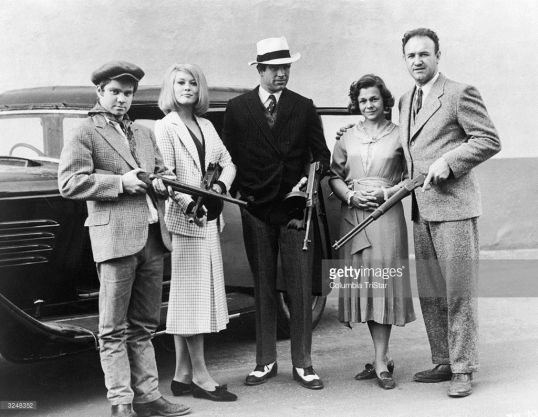
Here’s the movie’s version of Bonnie and Clyde:
In other words, Bonnie and Clyde is not a documentary. But that doesn’t matter. 50 years after it was first released Bonnie and Clyde remains a powerful and, even more importantly, extremely entertaining film. When the film was released, it was controversial for it violence and, having recently rewatched it, I have to say that the violence still makes an impression. When guns are fired, the shots seem to literally explode in your ear. When people are torn apart by bullets, they die terrible deaths and the film’s most graphic demises are reserved for its most likable characters. Towards the end of the film, with the Texas Rangers relentlessly closing in on Bonnie and Clyde, the tension becomes almost unbearable.
What makes the violence all the more disturbing is that it often interrupts scenes that, until the bullets started flying, were often humorous. A bank robbery starts out as a lark, becomes an exciting chase scene as Bonnie and Clyde attempt to escape, and suddenly turns into an act of shocking of violence when Clyde fire a gun and shoots a man point-blank in the face. Later, stopping to help an old farmer change a tire leads to a sudden ambush. Perhaps the film’s outlook is best captured in a scene in which the Barrow gang cheerfully bonds with a hostage until they suddenly find out that he’s an undertaker, a reminder that the promise of death is always present.
“Get him out of here!” Bonnie snaps.
Like many of the great gangster films, Bonnie and Clyde presents its outlaws as being folk heroes. They may rob banks and occasionally kill people but they look good doing it and they seem like they would be fun to hang out with. The thing that set Bonnie and Clyde apart from previous gangster films is that it refused to even pretend to condemn its bank robbers. The cops and the Texas Rangers are all on the side of the banks and the banks are on the side of big business. Bonnie and Clyde aren’t outlaws. They’re rebels. When they rob banks, they’re not just taking money. They’re standing up to the same establishment that was feared in the 30s, resented in the 60s, and hated today.
Clyde is played by Warren Beatty (who also produced the film) and Bonnie is played by Faye Dunaway and both of them give performances that literally define screen charisma. You never forget that you’re watching two movie stars but, at the risk of repeating myself, Bonnie and Clyde is not meant to be a documentary. At times, it almost seems as if Beatty’s Clyde and Dunaway’s Bonnie know that they’re characters in a gangster movie. They know that they’re doomed because that’s how gangster movies work so, as a result, they’re determined to live as much life as possible before that final reel. The supporting cast — Gene Hackman, Estelle Parsons, Michael J. Pollard, Gene Wilder — are all great but the film is definitely a celebration of Beatty and Dunaway.
Bonnie and Clyde went from premiering at the Campus Theater to a best picture nomination. However, it lost to In The Heat of the Night.
The Story of Suicide Sal
A Poem by Bonnie Parker
We each of us have a good “alibi”
For being down here in the “joint”;
But few of them really are justified
If you get right down to the point.
You’ve heard of a woman’s “glory”
Being spent on a “downright cur,”
Still you can’t always judge the story
As true, being told by her.
As long as I’ve stayed on this “island,”
And heard “confidence tales” from each “gal,”
Only one seemed interesting and truthful —
The story of “Suicide Sal.”
Now “Sal” was a gal of rare beauty,
Though her features were coarse and tough;
She never once faltered from duty
To play on the “up and up.”
“Sal” told me this tale on the evening
Before she was turned out “free,”
And I’ll do my best to relate it
Just as she told it to me:
I was born on a ranch in Wyoming;
Not treated like Helen of Troy;
I was taught that “rods were rulers”
And “ranked” as a greasy cowboy.”
Then I left my old home for the city
To play in its mad dizzy whirl,
Not knowing how little of pity
It holds for a country girl.
There I fell for “the line” of a “henchman,”
A “professional killer” from “Chi”;
I couldn’t help loving him madly;
For him even now I would die.
One year we were desperately happy;
Our “ill gotten gains” we spent free;
I was taught the ways of the “underworld”;
Jack was just like a “god” to me.
I got on the “F.B.A.” payroll
To get the “inside lay” of the “job”;
The bank was “turning big money”!
It looked like a “cinch” for the “mob.”
Eighty grand without even a “rumble” —
Jack was last with the “loot” in the door,
When the “teller” dead-aimed a revolver
From where they forced him to lie on the floor.
I knew I had only a moment —
He would surely get Jack as he ran;
So I “staged” a “big fade out” beside him
And knocked the forty-five out of his hand.
They “rapped me down big” at the station,
And informed me that I’d get the blame
For the “dramatic stunt” pulled on the “teller”
Looked to them too much like a “game.”
The “police” called it a “frame-up,”
Said it was an “inside job,”
But I steadily denied any knowledge
Or dealings with “underworld mobs.”
The “gang” hired a couple of lawyers,
The best “fixers” in any man’s town,
But it takes more than lawyers and money
When Uncle Sam starts “shaking you down.”
I was charged as a “scion of gangland”
And tried for my wages of sin;
The “dirty dozen” found me guilty —
From five to fifty years in the pen.
I took the “rap” like good people,
And never one “squawk” did I make.
Jake “dropped himself” on the promise
That we make a “sensational break.”
Well, to shorten a sad lengthy story,
Five years have gone over my head
Without even so much as a letter–
At first I thought he was dead.
But not long ago I discovered
From a gal in the joint named Lyle,
That Jack and his “moll” had “got over”
And were living in true “gangster style.”
If he had returned to me sometime,
Though he hadn’t a cent to give,
I’d forget all this hell that he’s caused me,
And love him as long as I live.
But there’s no chance of his ever coming,
For he and his moll have no fears
But that I will die in this prison,
Or “flatten” this fifty years.
Tomorrow I’ll be on the “outside”
And I’ll “drop myself” on it today;
I’ll “bump ’em” if they give me the “hotsquat”
On this island out here in the bay…
The iron doors swung wide next morning
For a gruesome woman of waste,
Who at last had a chance to “fix it,”
Murder showed in her cynical face.
Not long ago I read in the paper
That a gal on the East Side got “hot,”
And when the smoke finally retreated
Two of gangdom were found “on the spot.”
It related the colorful story
of a “jilted gangster gal.”
Two days later, a “sub-gun” ended
The story of “Suicide Sal.”
The Story of Bonnie and Clyde
Another Poem by Bonnie Parker
You’ve read the story of Jesse James
Of how he lived and died;
If you’re still in need
Of something to read,
Here’s the story of Bonnie and Clyde.
Now Bonnie and Clyde are the Barrow gang,
I’m sure you all have read
How they rob and steal
And those who squeal
Are usually found dying or dead.
There’s lots of untruths to these write-ups;
They’re not so ruthless as that;
Their nature is raw;
They hate all the law
The stool pigeons, spotters, and rats.
They call them cold-blooded killers;
They say they are heartless and mean;
But I say this with pride,
That I once knew Clyde
When he was honest and upright and clean.
But the laws fooled around,
Kept taking him down
And locking him up in a cell,
Till he said to me,
“I’ll never be free,
So I’ll meet a few of them in hell.”
The road was so dimly lighted;
There were no highway signs to guide;
But they made up their minds
If all roads were blind,
They wouldn’t give up till they died.
The road gets dimmer and dimmer;
Sometimes you can hardly see;
But it’s fight, man to man,
And do all you can,
For they know they can never be free.
From heart-break some people have suffered;
From weariness some people have died;
But take it all in all,
Our troubles are small
Till we get like Bonnie and Clyde.
If a policeman is killed in Dallas,
And they have no clue or guide;
If they can’t find a fiend,
They just wipe their slate clean
And hand it on Bonnie and Clyde.
There’s two crimes committed in America
Not accredited to the Barrow mob;
They had no hand
In the kidnap demand,
Nor the Kansas City depot job.
A newsboy once said to his buddy;
“I wish old Clyde would get jumped;
In these awful hard times
We’d make a few dimes
If five or six cops would get bumped.”
The police haven’t got the report yet,
But Clyde called me up today;
He said, “Don’t start any fights
We aren’t working nights
We’re joining the NRA.”
From Irving to West Dallas viaduct
Is known as the Great Divide,
Where the women are kin,
And the men are men,
And they won’t “stool” on Bonnie and Clyde.
If they try to act like citizens
And rent them a nice little flat,
About the third night
They’re invited to fight
By a sub-gun’s rat-tat-tat.
They don’t think they’re too tough or desperate,
They know that the law always wins;
They’ve been shot at before,
But they do not ignore
That death is the wages of sin.
Some day they’ll go down together;
And they’ll bury them side by side;
To few it’ll be grief
To the law a relief
But it’s death for Bonnie and Clyde.







 Through the Shattered Lens