Film Review: Boyfriend Killer (dir by Alyn Darnay)


bk

In the Lifetime film, Boyfriend Killer, there was a brief scene that I really liked and I think it epitomizes why I enjoyed this film and why I watch Lifetime films in general.

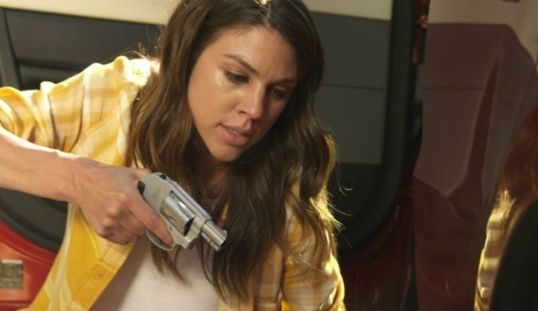
In the scene, Sandra Durro (Barbie Castro, who also produced this film) shares a hug with Krystal Kellers (Kate Mansi), her son’s girlfriend.  The camera quickly cuts back and forth from Sandra’s face to Krystal’s face and the audience sees that both of them have the same look of irritation and loathing on their face.  That really does get to a basic truth.  A mom is never going to fully trust her son’s girlfriend.  And a girlfriend is always going to suspect that her boyfriend’s mom is judging her.

Of course, Sandra has good reason to not fully trust Krystal.  Boyfriend Killer opens with the death of Sandra’s son, Preston.  Preston, who was handsome and charismatic and had a great life ahead of him, was killed in a car crash and Sandra suspects that it wasn’t an accident.  When Sandra and her friend Carrie (Yancy Butler) are packing up Preston’s things, Krystal suddenly shows up and announces that she wants to help.

From the first minute we meet Krystal, there’s something off about her.  She claims to be sad but her grief is almost too theatrical.  It’s almost as if all she knows about being sad is what she’s seen in the movies.  Add to that, Krystal claims that she and Preston were deeply in love, despite the fact that Preston rarely spoke about her.  Krystal always seems to be sneaking around the house, searching for something.  When Sandra gets near Preston’s computer, Krystal freaks out.  Krystal explains that she and Preston both used that computer so if Sandra touches it, she’ll actually be invading Krystal’s privacy.

Well, what’s a mother to do?

It turns out that things between Preston and Krystal were never as perfect as Krystal claims.  In fact, shortly before his death, Preston had told Krystal that he never wanted to see her again.  Could that have had something to do with the fact that Krystal tried to convince Preston to kill her ex?

Sandra certainly thinks that it might.  However, before Sandra can really pursue her suspicions, she has a funeral to attend, a funeral that Krystal makes all about her.  It turns out that Krystal has an announcement to make, one that catches everyone by surprise…

Boyfriend Killer is a fun melodrama, one that pretty much epitomizes everything that we love about Lifetime movies.  Barbie Castro is relatable and sympathetic as the grieving mother (you really want her to get justice for her son) and Yancy Butler provides good support as her friend.  Kate Mansi, who played a similar role in Unwanted Guest, is a force of nature in the role of Krystal.  Krystal is a familiar Lifetime character — the duplicitous temptress — but Mansi plays the role with such determination and drive that Krystal becomes a wonderfully hissable villain.  Krystal is less defined by the bad things she does than by her total confidence that she’ll never get caught.  You alternate between marveling at how far she’ll go and eagerly anticipating the moment when she gets her comeuppance.

Finally, I have to make special mention of Patrick Muldoon, who plays Sandra’s alcoholic ex-husband.  To a certain group of pop culture fanatics, Muldoon will always be known as Jeff, the handsome college student whose smile and killer dance moves inspired Kelly to dump Zack on Saved By The Bell.  (Hell, I would have dumped Zack for Jeff.  Jeff’s in college, has a great smile, and is a manager at the Maxx.  Zack’s in high school and spends all of his time with Screech.)  And some are always going to think of Muldoon as being the doomed Zander Barclow in Starship Troopers.

However, over the past few years, Patrick Muldoon has given some seriously good performances.  They haven’t gotten the attention that they deserve but he was excellent in both Patient Killer and Deadly Revenge.  And he’s excellent here, playing a well-meaning guy who cannot shake his demons.  It’s a good and poignant performance, one that elevates the film.

One of the great things about Lifetime is that they constantly rebroadcast all of their movies so keep an eye out for Boyfriend Killer!

A Quickie With Lisa Marie: Deadly Ex (dir by Tom Shell)


deadly-ex

On Sunday night, I watched the premiere of Deadly Ex on the Lifetime Movie Network.

In Deadly Ex, Jason Gerhardt plays Gary.  He’s a guy who appears to have a successful life, despite a few regrets.  For instance, he gave up his teenage dream of being a lawyer but he’s still managed to do okay for himself.  He’s married to Jess (Marguerite Moreau) and his two wonderful, teenage children (Sammi Hanratty and Matt Cornet) but domestic bliss has somehow eluded him.  In fact, he’s on the verge of divorce.

How bad is Gary’s marriage?  It’s so bad that he leaves his wife and children behind when he goes to his high school reunion!  However, that also means that he gets to spend some time catching up with his ex-girlfriend, Valerie (Natasha Henstridge).  In turns out that, in high school, Gary wasn’t the best boy friend.  He rather callously dumped Valerie.  But that was a long time ago and Gary’s changed.  He says that he’s sorry and he means it.  Valerie tells him that she forgives him and…

Well, this is a Lifetime film.  And it’s called Deadly Ex.  So you can probably guess that Valerie hasn’t quite forgiven or gotten over Gary.  Instead, Valerie follows Gary back to his hometown.  She enrolls as a student in Jess’s yoga class.  She starts to send gifts to Gary’s house.  And, eventually, she shows up with a knife…

Plotwise, Deadly Ex is typical Lifetime fare but it’s distinguished by two things.  First off, Natasha Henstridge gives a terrific performance as the insanely driven Valerie.  Films like this are only as good as their villains and Henstridge bravely throws herself into her performance.  Marguerite Moreau also does a good job, playing a mother who will take any risk to defend her family.  Secondly, the final confrontation between Valerie and Jess is extremely well-done and director Tom Shell actually keeps you guessing as to how it’s going to end and who is going to survive.

Finally, Deadly Ex manages to tap into a fantasy that I think everyone has.  Who hasn’t wanted to run into their ex and brag about how wonderful their life has been since the break-up?  For that matter, who hasn’t wanted to get a chance to put an ex in his place?  Me, I’d rather do it with a perfectly timed quip than a knife but I guess that’s just me.

(Also, I should mention that, while watching the film, I was able to totally relate to Gary and Jess’s daughter, Carissa, largely because she had perfected the dismissive “whatever” glance that I’ve been employing since I was 13 years old.)

If you’re into Lifetime movies (and who isn’t, really?), Deadly Ex is one to keep an eye out for.

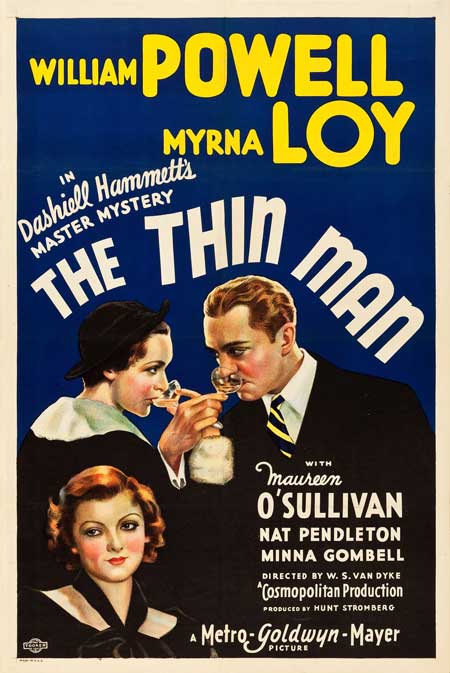
Lisa Reviews An Oscar Nominee: The Thin Man (dir by W.S. Van Dyke)


the_thin_man_1934_poster

Last night, I rewatched the classic 1934 mystery-comedy, The Thin Man.

And you know what?

Nick and Nora Charles should be everyone’s relationship goal.

Technically, The Thin Man is a murder mystery and it’s actually a pretty good one.  While I was rewatching the film, I was surprised to see that the whodunit aspect of the plot held up far better than I remembered.  But, ultimately, the movie is really a portrait of the ideal romance.  Every couple should aspire to be like Nick and Nora.

Nick Charles (William Powell) is a retired private detective, an unflappable gentleman who speaks exclusively in quotable quips.  Nick is the type who can apparently spend every hour of the day drinking without ever getting stupidly drunk.  He has beautiful homes on both coasts and a list of friends that would make anyone jealous.  Whether cop or crook, everyone loves Nick.

Nora Charles (Myrna Loy) is Nick’s wife.  She’s independently wealthy.  She’s beautiful.  She’s always chic.  She is always the smartest and funniest person in the room.  And she’s probably the only person who can outquip Nick.  Nora loves Nick’s lifestyle, whether they’re throwing a party or literally shooting ornaments off of a Christmas tree.  As Nora says at the end of one crowded party, “Oh, Nicky, I love you because you know such lovely people.”

And, of course, there’s Asta.  Asta is their terrier.  If Nick and Nora are the ideal couple, Asta is the ideal pet.  Asta is just as quick to investigate a mystery as Nick and Nora.  Asta may be a playful dog but he’s also remarkably well-behaved.  No insistent yapping.  No accidents on the carpet.  No growling at visitors.  As I’ve mentioned many times on this site, I’m not a dog person but I love Asta.

It’s not just that Nick and Nora are obviously in love and, in this pre-code film, they’re actually allowed to express that love.  And it’s not just that they say things in The Thin Man that they wouldn’t be allowed to get away with in the film’s sequels.  (If you have any doubt that this is a pre-code film, just check out the scene where the police are going through Nora’s dresser.  “What’s that man doing in my drawers?” Nora demands while Nick does a double take.)  It’s that Nick and Nora seem to be having so much fun.  They’re wealthy.  Other than to themselves, they really have no commitments.  (Nick only comes out of retirement because Nora say she thinks a mystery sounds like it would be fun to solve.)  They have no children to worry about.  Even if you don’t want to be either Nora or Nick by the end of this film, you’ll still definitely want to hang out with them.

The Thin Man is a murder mystery.  In fact, it’s probably one of the most enjoyable movies ever made about a double murder.  Dorothy Wynat (Maureen O’Sullivan) asks Nick to help find her father (Edward Ellis), the thin man of the title.  The investigation leads to a rather complicated mystery, one in which everyone that Nick and Nora meets is a suspect.  I have to admit that, with my ADD, I always have a hard time following all of the clues.

Of course, so does Nick.  That truly is part of the appeal of The Thin Man.  Nick is often confused about what it all the clues and evidence add up to but that never seems to upset him.  He and Nora are too busy enjoying themselves to get upset. That’s one reason why, even after you know who the murderer is, The Thin Man is a movie that’s enjoyable to watch over and over again.  The Thin Man is less about the mystery and more about the way Nick and Nora manage to throw the perfect dinner party even as they reveal who the murderer is.

1934 was a good year for comedy.  The Thin Man was nominated for best picture but it lost to another charming little comedy, It Happened One Night.

Scenes I Love: George Meets Mary Again in It’s A Wonderful Life


It may seem strange, on Valentine’s Day, to share a scene that I love from a Christmas movie.  Well, we’re all about being strange here at the Shattered Lens!

Add to that, George and Mary share one of the greatest romances ever put on the big screen.  It may be a Christmas movie but it’s also a love story.

So, for your viewing pleasure, here’s how it all started…

4 Shots From 4 Films: The Thin Man, Bonnie and Clyde, The Notebook, Like Crazy


4 Shots From 4 Films is just what it says it is, 4 shots from 4 of our favorite films. As opposed to the reviews and recaps that we usually post, 4 Shots From 4 Films is all about letting the visuals do the talking.

Love love love

4 Shots From 4 Films

 The Thin Man (1934, dir by W.S. Van Dyke)

The Thin Man (1934, dir by W.S. Van Dyke)

Bonnie and Clyde (1967, dir by Arthur Penn)

Bonnie and Clyde (1967, dir by Arthur Penn)

The Notebook (2004, dir by Nick Cassavetes)

The Notebook (2004, dir by Nick Cassavetes)

Like Crazy (2011, dir by Drake Doremus)

Like Crazy (2011, dir by Drake Doremus)

Lisa Reviews An Oscar Nominee: The Divorcee (dir by Robert Z. Leonard)


Before I get into reviewing the 1930 best picture nominee, The Divorcee, I want to share something that I recently posted on twitter:

I’m not just sharing this because it’s one of the best things that I’ve ever tweeted.  I’m also sharing it because it’s a beyond perfect description of Jerry (played, in an Oscar-winning performance, by Norma Shearer), the lead character in The Divorcee.  (Whenever you tweet something that is beyond perfect, you’ve earned the right to make sure everyone else knows it.)  The Divorcee came out in 1930 so, needless to say, it’s a bit dated but I totally related to the character of Jerry and that’s perhaps the main reason why I enjoyed this film.

The Divorcee tells the type of story that, today, would probably make for a memorable Lifetime film.  It’s a film that follows four friends over several years.  They are the idle rich, the type who go to parties, dance on tables, and cheerfully ignore the ban on liquor.  Jerry (Norma Shearer) loves Ted (Chester Morris).  Dorothy (Helen Johnson) loves Paul (Conrad Nagel).  However, Paul loves Jerry and when Jerry announces that she and Ted are engaged to be married, Paul doesn’t handle it well.  In fact, Paul gets drunk, Paul drives a car with Dorothy in the passenger’s seat, and eventually Paul crashes the car, leaving Dorothy so disfigured that she spends the rest of the movie wearing a black veil.

The years pass.  In order to make up for horribly disfiguring her, Paul agrees to marry Dorothy.  Jerry marries Ted.  They’re happy until they’re not.  On the day of their third anniversary, Jerry discovers that Ted has been cheating on her.  So, Jerry cheats on Ted.  When Ted gets upset, they file for divorce.

Suddenly, Jerry is …. (dramatic music cue) … THE DIVORCEE!

Ted becomes an alcoholic, the type who makes scenes at parties and destroys ornate wedding cakes.  In the past, I assume Jerry would have been forced to wear a scarlet D and she would have made it work because there’s nothing that Jerry can’t do.  However, since this film takes place in the 1920s, Jerry spends her time flirting and plotting to steal Paul away from Dorothy.

And it would have worked too if not for the fact that Dorothy is a complete and total saint…

Drinking, sex, adultery, disfigurement, and Norma Shearer!?  That’s right, this is a pre-code film!  The Divorcee is actually a pretty typical example of a type of film that was very popular during the 1930s and actually remains rather popular today.  This is a film where rich people do stupid things but look good doing it.  When an audience watches a film like this, they can both look down on the rich and vicariously experience their lifestyle.  No wonder these movies are so popular!

Anyway, I liked The Divorcee.  It’s an incredibly silly little film but it’s hard for me not to enjoy something this melodramatic.  Chester Morris and Conrad Nagel are stuck playing heels and Helen Johnson is a bit to saintly but it doesn’t matter because the film is pretty much designed to be a showcase for Norma Shearer, the most underrated of all of the Golden Age actresses.  (Far too often, Shearer is dismissed as simply being Irving Thalberg’s wife.)  Shearer gives a great performance.  She seems to be having the time of her life and it’s fun to watch.

The Divorcee was nominated for best picture but it lost to a far different picture, All Quiet On The Western Front.

the_divorcee_poster

Twin Blasts From The Past: What To Do On A Date and Dating Do’s and Don’ts (dir by Ted Peshak)


It’s been a while since I’ve shared any old educational films here on the Shattered Lens but I figured now might be the perfect time to share an old movie from 1951, What To Do On A Date.  Produced by the good (or so I assume) people at Coronet Films, What To Do On A Date is … well, the plot is pretty much in the title.

Now, to be honest, this could have just as easily been called What To Do On A Date If You Want To Make Sure That Lisa Never Agrees To A Second Date.  Seriously, this is totally squaresville.  Like real Melvin.  But you know what?  I’m notoriously hard to please and, with Valentine’s Day coming up, this may be helpful to someone.

I don’t know who, exactly.  But hey, it’s on YouTube and that’s the important thing.

(I’m all about helping.  You know that.)

If you still need help after What To Do On A Date, you can watch 1949’s Dating Do’s and Don’ts.  It was directed by the same guy who did What To Do On A Date.  People in the 1940s were notorious for knowing what to do on dates.  The Baby Boom didn’t just happen, y’know.

(Apparently, the version of Dating Do’s and Don’ts uploaded to YouTube is incomplete.  But you’ll get the general point.)


Lisa Reviews An Oscar Nominee: 42nd Street (dir by Lloyd Bacon and Busby Berkeley)


forty-second-street-1933

If you’re a regular reader of this site, it will not take you by surprise to learn that the 1933 Best Picture Nominee, 42nd Street, is one of my favorite films of all time.

I mean, how couldn’t it be?  Not only is it a pre-Code film (and we all know that pre-Code films were the best) and one the features both Ginger Rogers and Dick Powell in early roles but it’s also a film that depicts the backstage world of a stage musical with such a combination of love and snark that it will be familiar to everyone from community theater nerds to Broadway veterans.  42nd Street is a classic musical, though I have to admit that I think the majority of the songs are a bit overrated.  Even more importantly, 42nd Street is the ultimate dance film.  The film’s big production number, choreographed and filmed in the brilliant and flamboyant Busby Berkeley style, is such an iconic moment that it’s still being imitated and lovingly parodied to this day.

Every dance movie owes a debt to 42nd Street but few have come close to matching it.  Remember how much we all hated Smash?  There were a lot of reasons to hate Smash but the main reason was because it tried to be 42nd Street and it failed.  There can only be one 42nd Street.

It’s hard to estimate the number of show business clichés that currently exist as a result of 42nd Street.  Then again, it can be argued that they were clichés before they showed up in 42nd Street but 42nd Street handled them in such an expert fashion that they were transformed from being urban legends to immortal mythology.

42nd Street takes place in the backstage world, following the production of a Broadway musical through casting to rehearsals to opening night.  It’s an ensemble piece, one populated by all the usual suspects.  Julian Marsh (Warner Baxter) is the down-on-his-luck producer who desperately needs a hit.  Dorothy Brock (Bebe Daniels) is the celebrated star who is dating a rich, older man (Guy Kibbee, who made quite the career out playing rich, older men) while secretly seeing her ex, a down-on-his-luck Vaudevillian (George Brent).  From the minute that we first see Dorothy, we know that she’s eventually going to end up with a boken ankle.  It’s just a question of which chorus girl will be promoted to take her place.  Will it be “Anytime” Annie (Ginger Rogers) or will it be the naive and wholesome Peggy (Ruby Keeler)?  You already know the answer but it’s still fun to watch.

If you had any doubts that this was a pre-code film, the fact that Ginger Rogers is playing a character named “Anytime” Annie should answer them.  42nd Street is often described as being a light-hearted camp spectacle but there’s a cynicism to the film, a cynicism that could only be expressed during the pre-code era.  The dialogue is full of lines that, just a few years later, would never have gotten past the censors.

(This is the film where it’s said that Anytime Annie “only said no once and then she didn’t hear the question!”  This is also the film where Guy Kibbee cheerfully tells Annie that what he does for her will depend on what she does for him.  Just try to get away with openly acknowleding the casting couch in 1936!)

The menacing shadow of the Great Depression looms over every glossy production number.  Julian needs a hit because he lost all of his money when the Stock Market crashed and if the show is not a hit, everyone involved in the production will be out on the streets.  The chorus isn’t just dancing because it’s their job.  They’re dancing because it’s an escape from the grim reality of the Great Depression and, for the audience watching, the production numbers provided a similar escape.  42nd Street said, “Yes, life is tough.  But sometimes life is fun.  Sometimes life is sexy.  Sometimes, life is worth the trouble.”  Someday, 42nd Street promises, all the misery will be worth it.

Ultimately, 42nd Street is all about that iconic, 20-minute production number:

42nd Street was nominated for best picture but it lost to the nearly forgotten Cavalcade.

Film Review: From Straight A’s to XXX (dir by Vanessa Parise)


814cfc78-0826-468f-a85f-9be1a395efab

I just finished watching the latest Lifetime original film, From Straight A’s to XXX.

Like many Lifetime films, it’s based on a true story.  In this case, it tells the story of Miriam Weeks (Haley Pullos), who briefly became notorious for paying her tuition to Duke University by appearing in adult films under the name Belle Knox.  Her story became notorious because it touched on almost every important cultural issue of the past twenty years.  Stuffy pundits acted as if Belle Knox was somehow a sign of the collapse of civilization.  The story was regularly held up as a sign that my generation was spoiled and entitled, which was interesting since Miriam wouldn’t have ever made her first movie if college was actually affordable.  That’s one issue that, interestingly enough, was rarely brought up in all the discussions about the Duke porn star.  If students are having to do pornography to pay for college, shouldn’t the question be why it costs so much to get an education?

As for Belle Knox herself, she became a media celebrity.  She was interviewed by people like Piers Morgan and she proved herself to be quite adroit at putting that windbag in his place.  Rather than asking for sympathy, Belle defended herself and asked a very important question: why was the stigma of porn on her, as opposed to the men who watched her?

From Straight A’s to XXX does a good job telling Belle’s story.  Interestingly enough, it actually goes out of its way to be fair and evenhanded.  While the film is on Belle’s side, it doesn’t dismiss those who had concerns about how she was paying her way through college.  While Belle is shown defending herself to the media and explaining how her career has empowered her, the film also makes a point to show that not every porn actress is Belle Knox.  At one convention, she’s confronted by two veteran porn actresses who point out that they work just as hard as she does but, unlike her, they will never be invited to appear on CNN, suggesting that the only reason anyone cares about her or what she thinks is because of the novelty of her being a student at Duke.  And while this may be the most pro-porn film to ever appear on Lifetime, it doesn’t shy away from the dark side of the industry.  Belle’s first job is a genuinely disturbing nightmare of abuse and serves as a valuable warning.  Make sure you know who you’re working with before you show up for the job.  As a producer later explains to Belle, there are professionals and unprofessionals in every industry and porn is no different.

As for Duke University — well, let’s just say that Duke doesn’t come across as looking all that good by the end of From Straight A’s to XXX.  With a few notable exceptions, all of the students are portrayed as being rich snobs.  When Belle’s secret life is discovered, she finds herself harassed by every man on campus.  In one particularly disturbing scene, she returns to her dorm room just to discover that her door has been defaced.  When she tries to sleep, drunk frat boys try to break into her room.  When she reports that she’s being harassed, she gets little help.  Her roommate remains supportive throughout the entire film but otherwise, Duke does not come across well.

From Straight A’s to XXX is well-directed by Vanessa Parise, who has also directed such Lifetime films as Perfect High and The Unauthorized Beverly Hills 90210 Story.  Much like The Unauthorized Beverly Hills 90210 Story, From Straight A’s to XXX is a tribute to a strong woman who was ultimately punished for being stronger than others were comfortable with.  (That From Straight A’s to XXX was written and directed by women goes a long way to keeping potentially salacious material from becoming sordid.)  Haley Pullos is sympathetic as Miriam/Belle and a bearded Judd Nelson does a good job in the role of a porn producer who shows the difference between professionals and unprofessionals in the industry.

Finally, From Straight A’s to XXX ends with Belle becoming a Libertarian activist and that fact alone makes this one of the best Lifetime films of the year so far!  You can’t go wrong with any film that ends with a Libertarian political rally.

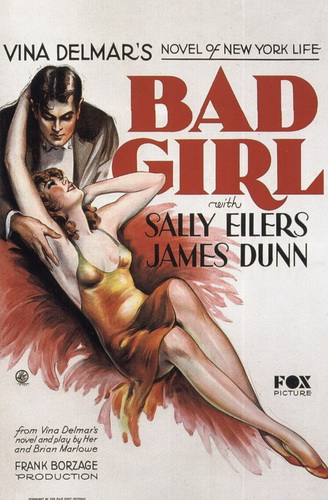
Lisa Reviews An Oscar Nominee: Bad Girl (dir by Frank Borzage)


bad-girl

Seeing as how I started this day by watching Fifty Shades Darker, it seemed appropriate to end the day by watching yet another film about the difficulty of finding love and commitment.  This film came out a little bit earlier than Fifty Shades of Grey.  In fact, it even predates the whole concept of fan fiction.  This film came out in 1931 and it would probably be totally forgotten today if not for the fact that, 85 years ago, it was nominated for Best Picture.

Of course, that’s not to say that Bad Girl is particularly well-known.  Until I came across it on my list of best picture nominees, I didn’t know that it even existed.  According to Wikipedia, it was based on a novel and a play and it did rather well at the box office.  The Academy apparently liked it, awarding it Oscars for both Best Director and Best Adapted Screenplay.  It’s currently available on YouTube.  That’s where I saw it.  But, despite all of that, it definitely appears to be one of the more obscure films to have ever been nominated for best picture.

Bad Girl opens with Dorothy Hailey (Sally Eilers) in a wedding gown.  However, she’s not getting married.  Instead, she’s a store model and, in a rather surreal little sequence, Dorothy and her co-workers walk through the store in their bridal gowns while sleazy men leer at them.  As Dorothy complains to her best friend, Edna Diggs (Minna Gombell), men are “only interested in one thing.”  When Dorothy’s boss propositions her, Dorothy claims to have a prizefighter husband waiting for her at home.  In truthfulness, Dorothy lives with her overprotective brother (William Pawley), a judgmental brute who accuses her of being a tramp if she stays out too late.

At Coney Island, Edna makes a bet that Dorothy won’t be able to get surly Eddie Collins (James Dunn) to talk to her.  Dorothy takes the bet and then proceeds to go over to Eddie and play a ukulele, until Eddie gets annoyed enough to tell her to be quiet.  Eddie claims to not like women  and he accuses Dorothy of being a tease.  “Listen, sister,” he tells her, “if you don’t want guys to salute, take down the flag.”

Wow, Eddie sure does seem to be a jerk, doesn’t he?

Well, don’t worry.  It turns out that Eddie isn’t as bad as he seems, it’s just that he’s often in a bad mood because he doesn’t have much money and he wants to open up his own radio store.  However, Eddie and Dorothy quickly fall in love and soon, they’re married…

But, of course, things never go that smoothly.  It turns out that Eddie is proud and stubborn.  Fortunately, he’s played by a charming actor named James Dunn because, without Dunn’s considerable working class charm, Eddie would probably be insufferable.  Dorothy, meanwhile, fears letting Eddie know that she’s pregnant…

And you know what?

I liked Bad Girl.  

On the one hand, Bad Girl is definitely a dated film.  Any film released in 1931 is going to seem dated when watched in 2017.  But, at the same time, that also means that Bad Girl works as a nice little time capsule.  Watching Bad Girl was like stepping into a time machine.  And it turns out that the 1930s weren’t that bad!  Everyone wore nice clothes and talked like James Cagney.

But, dated it may be, there is also an almost timeless quality to Bad Girl.  Even decades after the film was originally released, the likable chemistry between James Dunn and Sally Eilers feels real and you really do care about what happens to them.  You feel like they belong together and it’s hard not to worry when they fight or when they misunderstand each other’s intentions.  (This happens rather frequently.)  Furthermore, Bad Girl is a film about people who, often times, are struggling just to make ends meet.  That’s something to which everyone can still relate.  It certainly sets it apart from a lot of the other films made both then and today.

Bad Girl was nominated for best picture but it lost to a film that was almost its total opposite, Grand Hotel.  Unlike most of the other old best picture nominees, I have never seen Bad Girl on TCM but it is on YouTube and you can watch it below!