Insomnia File #40: The Spanish Prisoner (dir by David Mamet)


What’s an Insomnia File? You know how some times you just can’t get any sleep and, at about three in the morning, you’ll find yourself watching whatever you can find on cable? This feature is all about those insomnia-inspired discoveries!

If, at 3 in the morning on Wednesday, you were struggling to get to sleep, you could have flipped over to Flix and watched the 1998 film, The Spanish Prisoner.

Joe Ross (Campbell Scott) is an engineer.  He’s a quiet, polite, and always considerate man.  At one point, he’s told that he’s “too nice” and, watching him, you can’t help but agree.  Joe works in an otherwise bland office where the walls are covered with menacing posters that, in an accusatory manner, announce, “SOMEONE TALKED!”  Paranoia is in the air but Joe, for whatever reason, seems to be incapable of sensing it.

Joe has just invented something called The Process.  It’s deliberately left obscure just what exactly The Process is but we do know that it stands to make Joe’s boss, Mr. Klein (Ben Gazzara), a lot of money.  When Mr. Klein invites Joe and the company lawyer, George (Ricky Jay), to an island retreat, Joe assumes that it’s so Mr. Klein can offer him a lucrative cash bonus as a reward for creating the process.  Instead, it turns out that Mr. Klein has no interest in giving George any extra reward.  Instead, Klein feels that Joe should just be happy to be a part of the company.

On the island, Joe takes a picture of a mysterious man named Jimmy Dell (Steve Martin).  Jimmy offers to give Joe a thousand dollars for the camera.  Joe, instead, hands over the camera for free.  Later, Jimmy tracks down Joe and apologizes for his behavior.  He and Joe strike up an unlikely friendship on the island.  Upon learning that Joe will soon by flying back to New York, Jimmy gives Joe a package to deliver to his sister.  Joe agrees.

It’s not until Joe is on the plane and in the air that he starts to wonder about what’s inside the package.  It doesn’t help that his secretary, Susan (Rebecca Pidgeon), won’t stop talking about you never really know anyone and how easy it is to trick an innocent person into becoming a drug mule.  Finally, Joe steps into the plane’s lavatory, unwraps the package, and….

And that’s all I can tell you without spoiling the film.  The Spanish Prisoner is a film about a dizzying confidence game, one that is full of nonstop twists and turns.  No one in the film turns out to be who you thought they were when you first saw them.  At times, it can be a bit hard to keep up with the plot but that’s actually a part of the fun.  The Spanish Prisoner keeps you guessing and, fortunately, Campbell Scott gives a likable enough performance that you’re willing to explore the maze at the heart of this film with him.  Steve Martin is also wonderfully sinister as Jimmy, using his own “nice guy” image to keep us off-balance.

As you might expect from a film written and directed by David Mamet, the dialogue is heavily stylized.  The characters all move and speak at their own odd rhythm.  Lines that should be innocuous take on a dangerous edge and it becomes impossible not try to read between the lines of even the simplest of exchanges.  It creates a rather dream-like atmosphere, one in which you’re never quite sure what’s real and what’s just another part of the game.

The Spanish Prisoner is an intriguing mystery and one that seems like it will definitely reward repeat viewings.

Previous Insomnia Files:

  1. Story of Mankind
  2. Stag
  3. Love Is A Gun
  4. Nina Takes A Lover
  5. Black Ice
  6. Frogs For Snakes
  7. Fair Game
  8. From The Hip
  9. Born Killers
  10. Eye For An Eye
  11. Summer Catch
  12. Beyond the Law
  13. Spring Broke
  14. Promise
  15. George Wallace
  16. Kill The Messenger
  17. The Suburbans
  18. Only The Strong
  19. Great Expectations
  20. Casual Sex?
  21. Truth
  22. Insomina
  23. Death Do Us Part
  24. A Star is Born
  25. The Winning Season
  26. Rabbit Run
  27. Remember My Name
  28. The Arrangement
  29. Day of the Animals
  30. Still of The Night
  31. Arsenal
  32. Smooth Talk
  33. The Comedian
  34. The Minus Man
  35. Donnie Brasco
  36. Punchline
  37. Evita
  38. Six: The Mark Unleashed
  39. Disclosure

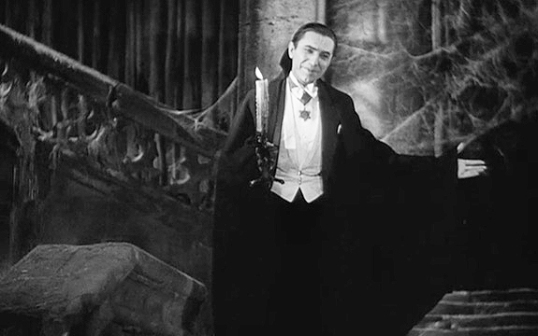
Horror Scenes That I Love: Bela Lugosi Introduces Himself In Dracula


I swear, nothing annoys me more than when wannabe hipsters go out of their way to trash old movies.

You see that a lot on twitter.  People who, for the most part, haven’t even studied film or cultural history will try to post something snarky about a film that was made decades before they were born.  They either make fun of the acting or the dialogue or they attempt to call out the film for not being properly woke.  It’s an easy way to get likes and retweets but it’s also about as intellectually lazy as you can get.

For instance, there’s a tendency to dismiss the 1931 version of Dracula and Bela Lugosi’s performance in the lead role.  Personally, I do think that Dracula is a bit too stagey (it was, after all, based on a stage play that was based on Bram Stoker’s novel) and I wouldn’t put it up there with director Tod Browning’s best work.  The Spanish-language version of Dracula, which was filmed at the same time, is technically a better film.  But, that being said, I will accept no criticism of Lugosi’s performance.  Lugosi is the perfect Dracula.  If he seems overly theatrical …. well, Dracula’s a pretty theatrical character.  It has to be remembered that Lugosi is playing a character who is supposed to be several hundred years old.  If he acts like a man out-of-time, that’s because that is exactly what he is.

Ultimately, it comes down to this — a lot of actors have played Dracula.  Some of them have been very good in the role.  Some of them have been very bad.  But, if not for Lugosi, none of them would have had the opportunity.

So, in honor of that legacy, today’s horror scene that I love comes from the original Dracula and features Bela Lugosi at his creepiest:


International Horror Film Review: The Student of Prague (dir by Stellan Rye and Paul Wegener)


The year is 1820 and Balduin (Paul Wegener) has a problem.

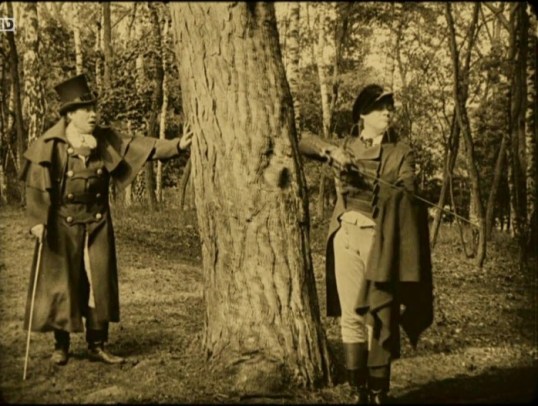
Yes, he might be the most popular student at the University of Prague.  And yes, he may be known as the greatest swordsman in the city.  And yes, he might get invited to all of the parties and he might have a lot of friends who all look up to him.  However, what Balduin does not have is money.  While everyone else seems to be living a life of luxury, Balduin lives in a tiny room where his only luxury is the mirror in which he often appreciates his own reflection.

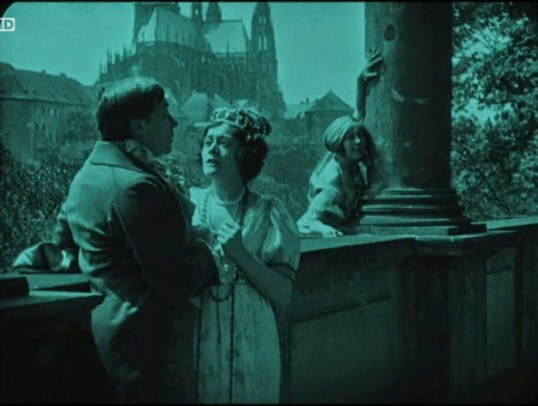
Balduin could really use some money because he’s fallen in love with Countess Margit (Grete Berger) but there’s no way that a member of the noble class could ever marry a destitute man.  Instead, it appears that Margit is destined to marry her cousin, the Baron (Fritz Wiedermann).

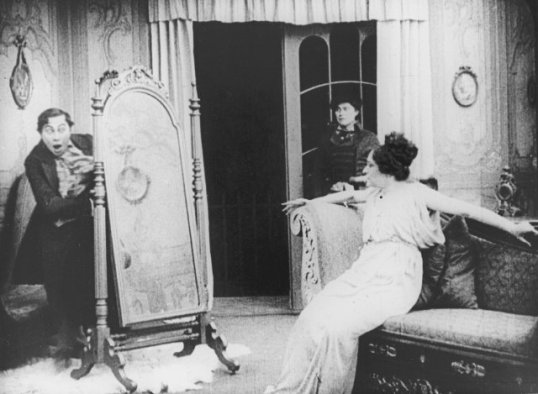
However, an old man named Scapinelli (John Gottowt) claims to have a solution.  He promises to give Balduin a fortune in gold if he agrees to let Scapinelli remove just one thing from his room.  Convinced that he’s fooled the old man because he has nothing of worth in his room, Balduin agrees to Scapinelli’s conditions.  Scapinelli promptly turns to the mirror and, as Balduin watches, Balduin’s reflection steps out of the mirror and then leaves with Scapinelli.  Balduin starts to laugh hysterically.

So now, Balduin has no reflection but he does have a lot of money!  Balduin sets out to try to win Margit away from the Baron.  Making things difficult is that, no matter where Balduin goes, someone always seems to be following him. Sometimes, it’s a mysterious wandering girl (Lyda Salmonova) who always seems to be intent on eavesdropping on every conversation that he has.  And then other times, it’s his doppelganger!  There’s now two Balduins running around Prague and, whenever the first Balduin finds himself alone with Margit, the second Balduin always seems to pop up and ruin everything.

Obviously something must be done….

This German silent film was first released in 1913 and it’s considered by some to be the first feature-length horror film.  (Georges Méliès directed several films featuring ghosts and haunted houses but the majority of those films ran only a handful of minutes.)  It’s also considered to be one of the first art films and, since Paul Wegener financed the production and distributed the film himself, also the first independent film.  It was also the first film to make use of the type of double exposure tricks that we today take for granted.  In 1913, audiences were stunned to see Paul Wegener apparently acting opposite himself.  The film was a big hit, with none the less than psychoanalyst Otto Rank praising the film for its psychological depth.

Of course, to watch the film today, audiences have to adjust both their expectations and the way that they take in and process cinematic storytelling.  As of this writing, The Student of Prague is 106 years old and it’s definitely a film of its time.  The camera largely remains stationary and, from a modern perspective, the film is rather slow-paced.  And yet, the film’s story remains rather intriguing.  Despite the static camera work, the film manages to create and maintain a properly ominous atmosphere and a scene in which Balduin and Margit attempt to meet in a cemetery is effectively creepy.  Paul Wegener’s performance holds up well.  Largely eschewing the overly theatrical acting style that we usually tend to associate with silent cinema, Wegener gives a nuanced and effectively subtle performance as both Balduin and his doppelganger.  When he’s acting opposite of himself, you don’t think about the fact that you’re witnessing an early camera trick.  Instead, Wegener creates two separate but believable versions of the same character.  The doppelganger represents all of Balduin’s undesirable impulses and everything that has kept Balduin from achieving happiness.  By the end of the film, Balduin can’t live with his doppelganger but he can’t live without him as well.

The Student of Prague is an interesting piece of history and one that every true student of horror should watch and learn from at least once.

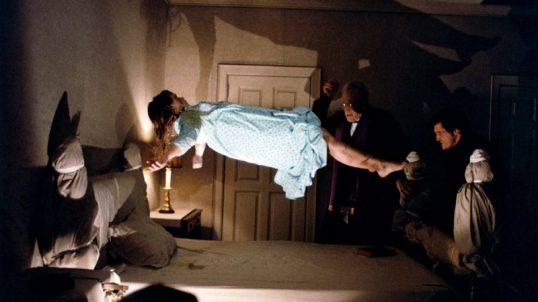
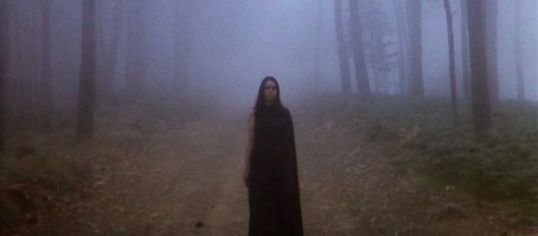
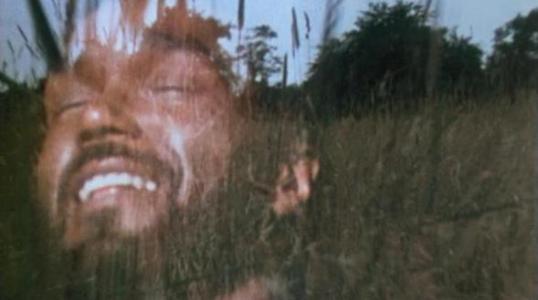
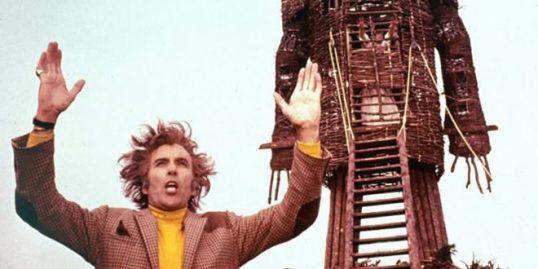
4 Shots From 4 Films: The Exorcist, Female Vampire, Ganja and Hess, The Wicker Man


4 Shots From 4 Films is just what it says it is, 4 shots from 4 of our favorite films. As opposed to the reviews and recaps that we usually post, 4 Shots From 4 Films lets the visuals do the talking!

This October, we’re using 4 Shots From 4 Films to look at some of the best years that horror has to offer!

4 Shots From 4 1973 Horror Films

The Exorcist (1973, dir by William Friedkin)

Female Vampire (1973, dir by Jess Franco)

Ganja and Hess (1973, dir by Bill Gunn)

The Wicker Man (1973, dir by Robin Hardy)

Horror Film Review: Single White Female (dir by Barbet Schroeder)


Allie Jones (Bridget Fonda) is an always fashionable software designer who is living in New York City and who has just broken up with her cheating lover, Sam (Steven Weber).  She has pretty hair, a big apartment, a closet full of nice clothes, and a totally devoted gay best friend.

Hedra Carlson (Jennifer Jason Leigh) is shy and socially awkward and in need of someone who will give her a cute nickname like “Hedy.”  She has pretty hair that’s just slightly less pretty than Allie’s, a job at a bookstore, a dead twin sister, a pair of really nice earrings, and a television that only seems to show old black-and-white movies.

Together …. THEY SOLVE CRIMES!

No, actually, they don’t.  Instead, Hedy answers an ad that Allie placed about needing a new roommate.  Even though Allie was thinking of asking another homeless woman to move in with her, Hedy impresses Allie by fixing her sink.  Seriously, how can you turn down a potential roommate who knows how to do simple plumbing?  Allie invited Hedy to live with her and, at first, everything is great.  Hedy even brings home a dog that Allie quickly falls in love with.  However, then Sam shows back up and we quickly discover just how obsessed Hedy has become with her roommate.

Single White Female was originally released way back in 1992 and, even if you’re viewing it for the very first time, you’ll probably feel a sense of deja vu while watching the movie.  This is one of those films that has been so endlessly imitated and has been unofficially remade so many times that you probably already know everything that happens in the film, regardless of whether you’ve actually sat through it or not.  A few years ago, there was a film called The Roommate that basically was Single White Female, just with a college setting and a bit less of a subversive subtext.  As well, I’ve lost count of the number of Lifetime films that have basically ripped off Single White Female‘s plot.  Any time that a new friend proves herself to be excessively clingy, chances are that she’s going to get compared to Jennifer Jason Leigh in this film.


And yet, despite all of the imitations, Single White Female still holds up surprisingly well.  A lot of that is because Single White Female was directed by Barbert Schroeder.  Schroeder started his career as a disciple of the French New Wave and, much like Paul Verhoeven, his American films tend to be genre films with just enough of a subversive subtext to stick in your mind afterwards.

For example, Single White Female is often describes as being a film about “the roommate from Hell” but what always seems to be missed is that, especially during the film’s first half, Allie is often as bad of a roommate as Hedy.  For instance, when Allie comes home late after spending two days with Sam, Hedy is pissed off and waiting for her.  On the surface, the scene is the first indication that Hedy has become obsessed with Allie.  But, at the same time, Hedy actually is making a valid point.  After repeatedly telling Hedy that she wants nothing to do with Sam, Allie runs off and spends two days with him without bothering to call home once.  Though Hedy may have been a bit too quick to yell, she still had every right to be annoyed.

In fact, Allie really is a bit of self-centered character.  She impulsively invited Hedy to live with her and then, just as impulsively, she gets back together with Sam and decides that it’s time for Hedy to move out.  Of course, then Hedy tosses a dog out of a window and you pretty much lose whatever sympathy you may have had for her.

Still, you can’t help but feel that, just as Hedy wants to be Allie, there’s a part of Allie that would like to be Hedy.  Hedy does all the things that Allie’s scared to do.  When Allie is sexually harassed and nearly raped by a client, Hedy’s the one who actually gets revenge.  While Allie tries to get over and suppress her anger at Sam, Hedy’s the one who acts on that anger.  Just Hedy seems to need Allie’s life to be happy, Allie seems to need Hedy’s anger to survive.  In short, there’s a lot more going on underneath the surface of Single White Female than its reputation might lead you to presume.

Not surprisingly, the film is dominated by Jennifer Jason Leigh’s performance.  When Hedy first appears, Leigh plays her as just being slightly off.  She has some obvious confidence issues but, at the same time, she comes across as being so innocent and naive that you can’t help but want to protect her.  You find yourself wondering how she could have possibly survived living in a city like New York.  It’s only as the film progresses that you start to discover that Hedy was never particularly naive and everything that she’s done and said has basically been about manipulating the people around her.  And yet, even after Hedy has started killing dogs and people, you can’t help but feel a strange empathy (though not necessarily sympathy) for her.  There’s an emptiness to Hedy, an emptiness that she attempts to fill by stealing the personalities of the people around her and Leigh does a great job of expressing the pain that would come from not having an identity of your own.  Plus, poor Hedy just seemed so happy with Allie said that she liked her earrings!  I mean, I just can’t imagine being that insecure but I get the feeling it would really suck.

(Fortunately, I’ve also never really had a truly bad roommate situation.  One advantage of having three older sisters is knowing that you’ll always have someone to stay with.)

Despite all of the imitations and rip-offs that have come out over the years, both Single White Female and Jennifer Jason Leigh’s performance hold up remarkably well.  I’d recommend watching it before inviting anyone to come live with you.  If nothing else, you’ll at least learn what stiletto heels are really for.


Horror on the Lens: The Little Shop of Horrors (dir by Roger Corman)


(It’s tradition here at the Lens that, every October, we watch the original Little Shop of Horrors.  And always, I start things off by telling this story…)

Enter singing.

Little Shop…Little Shop of Horrors…Little Shop…Little Shop of Terrors…

Hi!  Good morning and Happy October the 2nd!  For today’s plunge into the world of public domain horror films, I’d like to present you with a true classic.  From 1960, it’s the original Little Shop of Horrors!

When I was 19 years old, I was in a community theater production of the musical Little Shop of Horrors.  Though I think I would have made the perfect Audrey, everybody always snickered whenever I sang so I ended up as a part of “the ensemble.”  Being in the ensemble basically meant that I spent a lot of time dancing and showing off lots of cleavage.  And you know what?  The girl who did play Audrey was screechy, off-key, and annoying and after every show, all the old people in the audience always came back stage and ignored her and went straight over to me.  So there.

Anyway, during rehearsals, our director thought it would be so funny if we all watched the original film.  Now, I’m sorry to say, much like just about everyone else in the cast, this was my first exposure to the original and I even had to be told that the masochistic dentist patient was being played by Jack Nicholson.  However, I’m also very proud to say that — out of that entire cast — I’m the only one who understood that the zero-budget film I was watching was actually better than the big spectacle we were attempting to perform on stage.  Certainly, I understood the film better than that screechy little thing that was playing Audrey.

The first Little Shop of Horrors certainly isn’t scary and there’s nobody singing about somewhere that’s green (I always tear up when I hear that song, by the way).  However, it is a very, very funny film with the just the right amount of a dark streak to make it perfect Halloween viewing.

So, if you have 72 minutes to kill, check out the original and the best Little Shop of Horrors

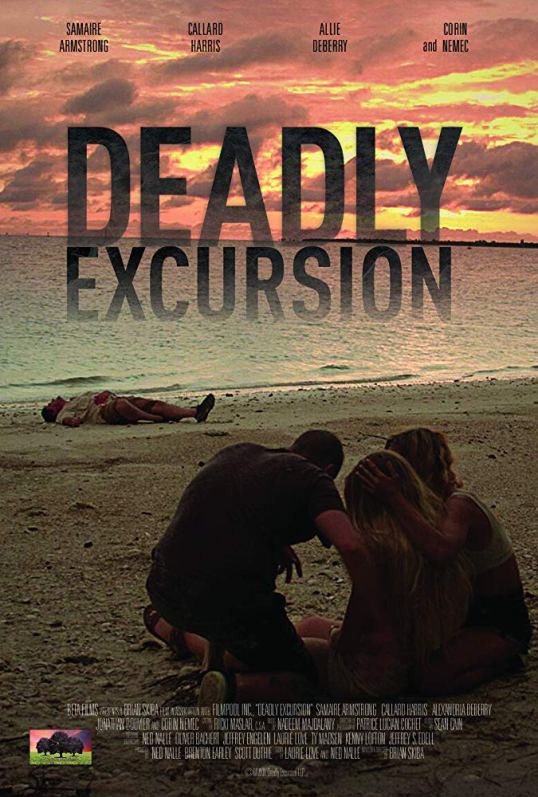
What Lisa Watched Last Night #199: Deadly Excursion (dir by Brian Skiba)


Last night, while overseeing the first day of horrorthon, I still found the time to turn over the Lifetime Movie Network and watch the 2019 thriller, Deadly Excursion!

Why Was I Watching It?

The film premiered way back in January.  I watched it on Lifetime but, for some reason, I didn’t get a chance to review it.  I may have been busy trying to keep up with all the Oscar news.  Who knows?  So, when I saw that Deadly Excursion would be re-airing on the Lifetime Movie Network last night, I was like, “Yay!  It’s a second chance to do the right thing!”

What Was It About?

Sam (Samire Armstrong) needs a vacation!  Not only is she recently separated from her cheating husband (Corin Nemec) but her daughter, Ellie (Alexandria DeBerry), will soon be leaving home.  Sam and Ellie head down to Florida where, during their first night in paradise, Sam meets the charming Javier (Callard Harris) and Ellie meets Javier’s brother, Ian (Jonathan Bouvier).  Javier invites Sam to spend the day on his boat.  Despite barely knowing him, Sam agrees and decides to bring along her daughter.

Well, as you probably already guessed, Javier is not the nice guy that he pretends to be.  Anyway, one thing leads to another and soon Sam and Ellie are trapped on an island where they have to figure out how to survive while being stalked by international criminals.

What Worked?

Paradise may be deadly but it’s still very nice to look at.  The ocean, the island, the beach, the blue sky, the green trees, this is a film full of pretty views.  This is one of those films that will make you want to take a vacation, though hopefully not a deadly one.

Samaire Armstrong and Alexandria DeBerry was well-cast and convincing as mother-and-daughter while Callard Harris and Jonathan Bouvier were both properly menacing.  Harris especially did a good job of playing up Javier’s sleazy charm.  And, of course, Corin Nemec was his usual likable self.

What Did Not Work?

Obviously, any melodrama is going to require a certain suspension of disbelief but Deadly Excursion occasionally took it a bit too far.  Samaire Armstrong did the best that she could with the character but, at the start of the movie, Sam was often just too naive to be believed.

“Oh my God!  Just Like Me!” Moments

I related to the relationship between Sam and Ellie.  It reminded me of my own relationship with my mom, back when she was newly single and I was a bratty teenager.

The film also reminded me of the trip that my mom, my sisters, and I all took to Hawaii the summer after Erin graduated from high school.  It was a fun trip to paradise but it was also kinda disturbing because there was this obviously sleazy beach bum who totally fell in love with my mom and who just would not stop showing up and trying to convince us all to come party with him at some isolated spot that apparently only he knew about.  Finally, we were all just like, “Dude, it’s not going to happen!”  He looked really depressed at the news but he stopped following us around.  If only Sam had been willing to say the same thing to Javier.

Lessons Learned

Don’t get on a boat with a strange man that you barely know.  Actually, if you needed a movie to teach you that, you should probably be a little bit concerned.  I mean, it’s just common sense, right?  But, still, it’s a good lesson.  Another good lesson is that, if you ever do find yourself stranded in the middle of nowhere, a good plan is to call Corin Nemec.  He’ll do his best to rescue you.

Lisa Reviews An Oscar Nominee: Deliverance (dir by John Boorman)


1973’s The Exorcist is often cited as the first horror film to ever be nominated for best picture and technically, I guess that’s correct.  It was definitely the first best picture nominee to ever deal with a battle between humans and a malevolent supernatural force and no one can deny that The Exorcist has influenced a countless number of horror films.

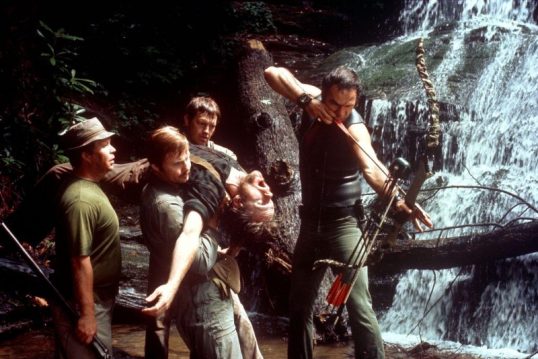
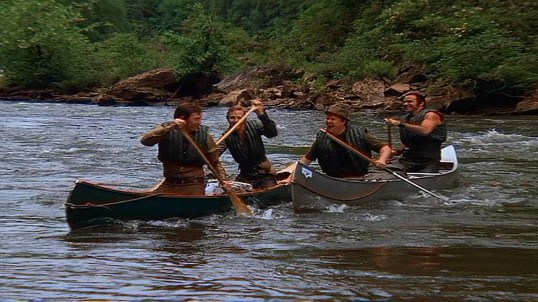
That said, I think you could make the argument that Deliverance, which was nominated for best picture the year before The Exorcist, was in its own way, a horror film.  Certainly, every crazed hick slasher film that has come out since 1972 owes a debt to Deliverance.  Deliverance‘s ending has been imitated by so many other horror films that it’s become a bit of cliche.  Though there might not be any supernatural creatures in Deliverance, the film still features its own set of horrifying monsters.  The toothless redneck rapists (played by character actor Bill McKinney and rodeo performer Herbert “Cowboy” Coward) seem as if they’ve jumped straight out of a nightmare and into the movie.  Of course, they aren’t the only monsters in this film.  There’s also the (fictional) Cahulawassee River, which is due to be dammed up and seems to be determined to take out its anger on anyone foolish enough to try to navigate it.

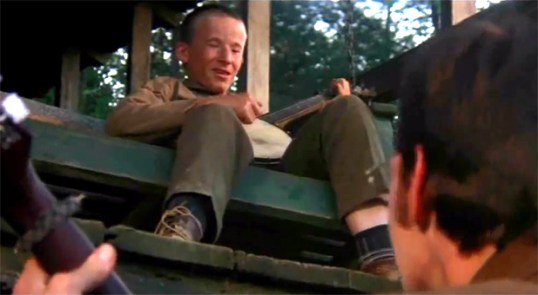
Much as with The Texas Chainsaw Massacre (which came out just two years after Deliverance), the main theme here seem to be that you should be careful about going off the main road.  Just as the unfortunate hippies and college students in Texas Chainsaw Massacre proved to be no match for a clan of backwoods cannibal, the four middle-aged men at the center of Deliverance discover that they’re no match for either nature or its inhabitants.  At the start of the film, we watch as three of the men deal with the locals in a condescending and rather smirky manner.  Only one of them actually tries to be nice to the locals, engaging in a banjo duel with a young boy who clearly loves his banjo but who still refuses to smile or shake hands.  The boy knows what the men are getting themselves into them.  The boy knows what awaits them.

If you grew up in the South, as I did, you’ll recognize all four of the men.  It’s not just that they’re played by recognizable actors.  It’s that each one of them is a common archetype of the type of men you find down here.

For instance, there’s Lewis (Burt Reynolds), the self-styled alpha male with his leather vest and his bow-and-arrow and his constant talk about how society is eventually going to collapse and only the strong are going to survive.  You know that Lewis is full of it from the minute you see him but he’s so charismatic that you can also understand why the other three men have fallen under his control.

And then there’s Bobby (Ned Beatty).  Bobby is quick to laugh and quick to talk and quick to make a bad joke.  When he says that he’s a salesman, you’re not surprised.  From the start of the film, Lewis complains that Bobby isn’t strong enough or serious enough and, when the mountain men attack, Bobby is the one they target.  And yet, towards the end of the film, Bobby is the one who sells the hastily concocted story about what happened on the river.

Drew (Ronny Cox) is the nicest of the men.  With his glasses and his guitar and his rather touching belief that everything will be okay if everyone just tells the truth, Drew’s the prototype of the Southern liberal.  One can imagine him teaching in a community college and vainly trying to convince his relatives that segregation and nostalgia for the Confederacy is holding the South back.

And finally, there’s Ed (Jon Voight).  Ed smokes a pipe and it’s obvious that he’s someone who has a very secure life.  Ed is the one who is everyone’s friend.  He’s the one who sticks up for Bobby.  He’s the one who reminds Drew to wear his life jacket.  He’s the only one who can get away with (gently) mocking Lewis.  Ed seems like a nice guy but, at the start of the film, there’s a strange emptiness to Ed.  You get the feeling that the reason Ed is friends with everyone is because he doesn’t have any firm beliefs.  Instead, he just adapts to each situation and says whatever everyone wants to hear.  You can’t help but wonder what Ed believes.  By the end of the movie, of course, both Ed and the viewer have learned what Ed is capable of doing.

Cox, Voight, and especially poor Ned Beatty are all perfectly cast in their roles.  Burt Reynolds reportedly felt that this film was his best performance and he was probably right.  Director John Boorman captures both the beauty and the menace of nature, leaving you both in awe of the the river and fearful of what it can do those foolish enough to try to conquer it.  Interestingly enough, while Boorman was directing Deliverance, he was offered The Exorcist.  He turned it down, feeling that the script was too exploitive of the possessed child.  Boorman would, however, direct The Exorcist II: The Heretic (co-starring Deliverance‘s Ned Beatty).

(At the same time, Jon Voight was offered the role of Father Karras in The Exorcist but, like Boorman, turned the film down so he could work on Deliverance.)

While the film is best known for its sequences on the river, one should not overlook the haunting scenes of the survivors once they make their way back to civilization.  After having spent the previous 80 minutes or so presenting everyone in the backwoods as a threat, the final third of Deliverance actually emphasizes the decency of the townspeople.  When one of the men breaks down and starts to cry in the middle of dinner, everyone is quietly respectful of his emotions.  Towards the end of the film, as the survivors are driven out of town, they find themselves stuck behind the old country church, which is being moved upriver.  “Just got to wait for the church to get out of the way,” their driver says while the church’s bell mournfully rings for both the death of the town and the death of innocence.

(Of course, even with all the kind townspeople around, there’s still a somewhat menacing sheriff.  It’s just not a Southern film without a scary sheriff, is it?  “Don’t you boys ever do nothing like this again,” he says at one point.  The sheriff is played by James Dickey, the author of both the novel and the screenplay on which the film is based.)

Deliverance was nominated for three academy awards.  In the directing and the editing categories, it lost to Cabaret.  For best picture, it lost to The Godfather.  Deliverance, The Godfather, and Cabaret, all competing against each other?  1972 was a very good year.

SyFy Film Review: Zombie Tidal Wave (dir by Anthony C. Ferrante)


“Fire up the wood chipper!  It’s feeding time!”

So announces Hunter Shaw (Ian Ziering) towards the end of Zombie Tidal Wave, proving once again that any film, regardless of genre or tone, is automatically made a hundred times better by stuffing someone in a wood chipper.  Or, in this case, several zombies.  Needless to say, there’s soon blood and chunks of blue skin flying everywhere.  It’s messy but, when you’re being attacked by zombies, you do what you have to do.

SyFy advertised Zombie Tidal Wave as being from “some of the people behind Sharknado” and this film definitely shares the same sensibility as the first Sharknado film.  What’s often forgotten is that the first Sharknado film was not quite the all-out parody that the later films in the series eventually became.  It was definitely a comedy but, at the same time, there weren’t any celebrity cameos and David Hasselhoff didn’t end up in space.  Instead, it took a ludicrous idea — sharks in a tornado — and then presented it with just a hint of self-awareness.

Zombie Tidal Wave does the same thing.  As a result, you do get Ian Ziering delivering one-liners, like the one at the start of this review.  And the entire film is full of references to other zombie films.  For instance, there’s a band called The Fulcis and the first zombie to appears bears a distinct resemblance to the boat zombie from Zombi 2.  The many scenes of zombies rising from the ocean will remind veteran zombie fans of Shock Waves.  When the zombies invade a hospital, I was reminded of the infamous Hell of the Living Dead.  But, at the same time, Zombie Tidal Wave plays things relatively straight.  Zombies invade.  People get bitten.  Some people sacrifice themselves for the good of the other survivors.  Zombie Tidal Wave has its moments of humor but it never becomes an out-and-out parody.

Why are zombies washing up on the shores of an island community?  Well, it’s because of an earthquake, one that’s unleashed a horde of the undead.  Hunter Shaw is a fisherman and perhaps the most respected citizen of the besieged community.  Naturally, it falls upon him to not only bring everyone together but also to figure out how to defeat the zombies.  To be honest, it really is a typical SyFy movie, which a handful of characters spending most of the film looking for each other while trying to stay alive and then eventually banding together to battle the threat.  Some people, like Hunter and his wife (Cheree Cassidy) rise to the challenge.  Others, like the rich white guy in the pink shirt, don’t.  Personally, my favorite character was Taani (Angie Teodora Dick) because she grabbed a pointed stick as soon as the invasion began and spent the entire movie kicking zombie ass.  GO TAANI!

Anyway, as a lifelong fan of zombie movies, I enjoyed Zombie Tidal Wave.  It didn’t waste any time getting to the zombie action and really, that’s the important thing isn’t it?  The pace was quick and, as he did in Sharknado, Ian Ziering played the grim hero with the right mix of sincerity and horror.  I don’t know if Zombie Tidal Wave is going to launch a Sharknado-style franchise or not but it was still an entertaining SyFy film.

6 Paranormal Beings Who Deserve Their Own Film


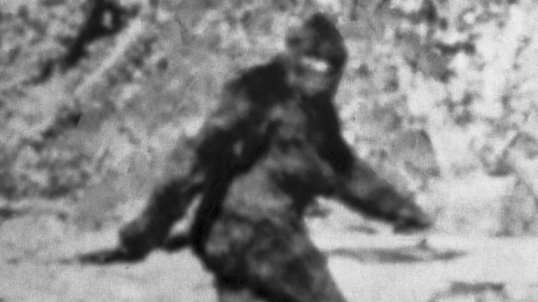
Bigfoot’s such an attention hog.

Don’t get me wrong.  Whether we call him a Sasquatch or a Yeti, we all love Bigfoot.  For a few centuries now, people have been spotting him and yet, to the best of my knowledge, he’s never actually attacked anyone.  He seems to have a good attitude towards his place in the world.  There may be multiple Bigfoots (Bigfeet?) or maybe there’s just one extremely old missing link wandering around out there.  But regardless, they seem to be harmless.

That said, there’s been so many movies about Bigfoot that it’s easy to forget that there are other cryptids out there.  Here are 6 paranormal beings who may (or may not) exist and who, in my humble opinion, all deserve to star in a film of their own.

1. The Goatman of Maryland

Who is the Goatman of Maryland?  He used to be a scientist at the Beltsville Agricultural Research Center in Beltstville, Maryland.  He did experiments on goats until, one day, karma intervened and he was transformed into a being that was half-man and half-goat.  Grabbing an axe, the Goatman disappeared into the woods and now haunts the backroads of Beltsville.  He’s been described as being a hermit but he apparently has a strong hatred of the teenagers who foolishly hang out in the woods.  Seriously, how has Goatman not starred in a major film yet?  Get on it, horror filmmakers!  I want to review a Goatman movie next October.

2. Champ

Champ is America’s very own version of Nessie.  It ia said to live in Lake Champlain, a body of water that’s shared by New York, Vermont, and Quebec.  Since at least 1819, people have wrote about spotting a giant sea serpent swimming around Lake Champlain.  In 1873, the famous showman P.T. Barnum offered a monetary reward to anyone who could capture Champ and bring the creature to me.  To me, that’s the plot of your movie right there.  Get on it, all of you aspiring screenwriters!  Champ needs a film worthy of a champion.

3, Ludwig the Bloodsucker

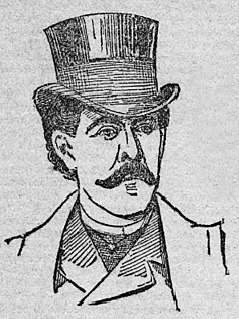
Ludwig was an urban legend in New York City back in the 1860s.  He was said to be an undead creature from Eastern Europe who haunted the back alleys and the bars of the Bowery district.  As you might guess from his name, he had a taste for blood.  (In all probability, Ludwig’s legend was probably the result of a combination of Know Nothing and Anti-Saloon League propaganda.)  Ludwig has been described as being “America’s first vampire” and that right there is why he needs to start in a movie of his very own.  I think Christoph Waltz would make a great vampire.

4.  Dark Watchers

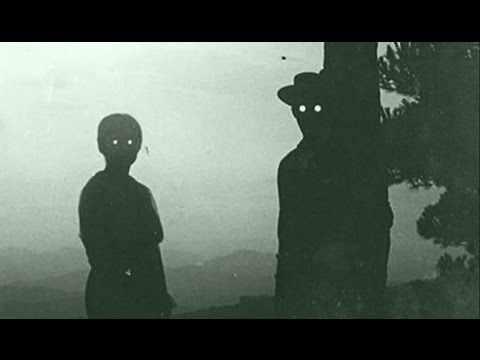
Who are the Dark Watchers?  Reportedly, they hang out in the Santa Lucia Mountains in California.  They wear wide-brimmed hats and carry walking sticks and they’re described as being giants.  They never emerge from the shadows but many people have reported spotting their silhouettes while hiking through the mountains.  What are they watching for and where do they live?  Are they dangerous or are they merely observers?  You know what would answer those questions?  A movie!

5. Jackalope

One of the biggest disappointments of my life was when I learned that jackalopes apparently don’t actually exist.  How can you not love a rabbit with antlers!?  Seriously, if any creature has earned the right to star in a PIXAR film of its very own, it’s the mighty jackalope.

6. Wicked Wanda

Wicked Wanda was the ghost who supposedly lived on the top floor of my dorm during my first semester of college.  I never found her, though I did go searching a few times.  There really wasn’t much to her legend, beyond the fact that she was supposedly up there and she was wicked.  Still, if they can make a thousand movies about Annabelle, how about one movie about Wanda?