BOOTLEGGERS (1974) – #ArkansasMovies – My Celebration of Movies Filmed in the Natural State!


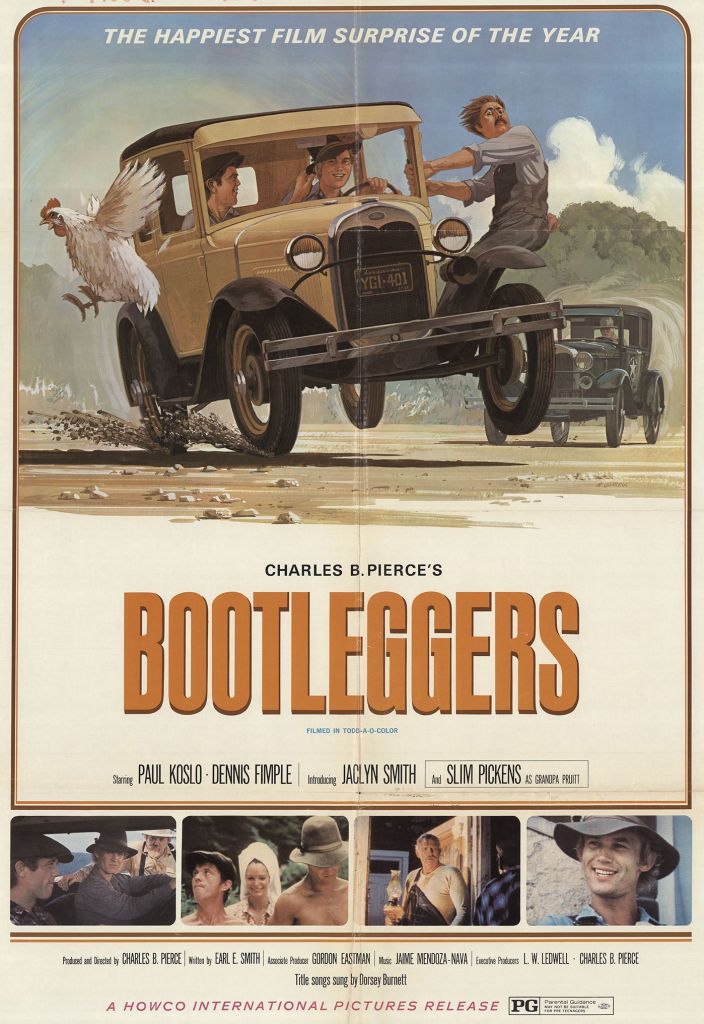
All my life, my Dad has told me that Roger Corman’s BLOODY MAMA (1970), which was filmed completely in Arkansas, contained scenes along the beautiful white bluffs of Calico Rock, Arkansas. Dad and I watched it today, and we didn’t see any such scenes. I did some quick internet research, and it turns out my dad has been spreading misinformation all these years. He had mistaken the film for a different movie called BOOTLEGGERS (1974). It was filmed in and around the Ozark town of Calico Rock, and it was directed by B-movie maestro Charles B. Pierce (THE LEGEND OF BOGGY CREEK, THE TOWN THAT DREADED SUNDOWN). Having never seen the film before and only being a few generations removed from my own family’s legacy of bootlegging, I was happy to see that it’s streaming on Amazon Prime and Tubi.

Set in rural Arkansas during the Prohibition era, the movie follows Othar Pruitt (Paul Koslo) and his moonshine-running buddy Dewey Crenshaw (Dennis Fimple) as they manufacture high quality moonshine whiskey and battle their local business rivals, the Woodalls, led by their vicious patriarch Rufus (Seamon Glass). When he’s not battling the Woodall’s and running from the law, Othar finds time to hang out with his grandpa (Slim Pickens) and romance the tough but beautiful Sally Fannie (Jaclyn Smith, who receives an “introducing” credit). If you’ve seen many southern redneck movies, you probably know where this is all heading, but the fun is watching how it gets there!

BOOTLEGGERS is not a traditionally great movie, but there is a lot of fun to be had if you’re in the right frame of mind for some crude regional filmmaking. Director Charles B. Pierce clearly understood rural Arkansas in a way most filmmakers don’t. The dusty roads, cave-based moonshine stills, and run-down old homes feel more authentic since they are actually filmed on location. Heck, a lot of the extras look like they could have wandered into the scenes straight off the local streets and fields. I love Arkansas, and I get an extra layer of enjoyment hearing the characters reference some of my favorite local towns, like Mountain View and Hot Springs. The print I watched looks like a really bad VHS copy, but Tak Fujimoto’s cinematography still manages to capture the scenic nature of the area with its beautiful mountains and those limestone cliffs hanging over the White River. One gripe though… the characters keep referring to the river as the Buffalo River, which is another beautiful river in Arkansas, but it is not the river in this movie.

Another element of the film that I found interesting is the casting of Paul Koslo as the lead and good guy of the film, Othar Pruitt. Koslo almost always plays a slimy bad guy with bad hair, at least he did in Charles Bronson’s 70’s films THE STONE KILLER, MR. MAJESTYK and LOVE AND BULLETS. The German born actor is actually pretty good as an Arkansas redneck, and he seems more comfortable handling the revenge sections of the film than he does the romance and comedy.

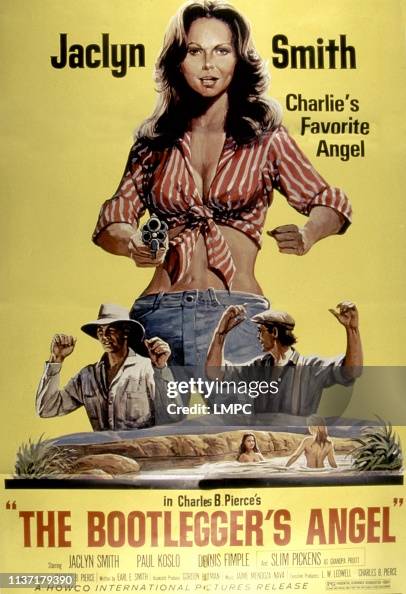
As far as the other cast members, Dennis Fimple steals most of his scenes as Othar’s friend Dewey. He’s the goofy but lovable hillbilly friend that these types of movies almost always have. He’s fun here. I always love seeing Slim Pickens and he’s pretty much exactly what you’d expect as an old moonshiner with plenty of homespun wisdom. Jaclyn Smith, a couple of years before her CHARLIE’S ANGELS fame, has a few fun scenes as a pistol-packing local hairdresser who takes a liking to Othar. Needless to say, when she did hit it big, the producers shamelessly repackaged the film to make it seem she was much more important to the plot than she actually is. All part of the 70’s fun of trying to make a buck at the drive-in!

At the end of the day, BOOTLEGGERS isn’t as professionally made as a movie like the Arkansas set WHITE LIGHTNING with Burt Reynolds. What it is though, is a solid southern redneck film, set in a beautiful location, with good performances and a violent ending that should please its intended audience. It certainly did me!
Horror On the Lens: This Is Not A Test (dir by Fredric Gadette)


For today’s horror on the lens, we have a low-budget apocalypse film from 1962.  The film follows Deputy Colter (Seamon Glass), a deputy who tries to take charge of the formation of a shelter and who quickly reveals himself to be a mentally unstable fascist. Though this film undoubtedly gets off to a rough start, it soon develops a convincingly ominous and almost dream-like atmosphere.

After watching the film, be sure to check out my review from last year.  And, as always, enjoy!

Lisa Reviews An Oscar Nominee: Deliverance (dir by John Boorman)


1973’s The Exorcist is often cited as the first horror film to ever be nominated for best picture and technically, I guess that’s correct.  It was definitely the first best picture nominee to ever deal with a battle between humans and a malevolent supernatural force and no one can deny that The Exorcist has influenced a countless number of horror films.

That said, I think you could make the argument that Deliverance, which was nominated for best picture the year before The Exorcist, was in its own way, a horror film.  Certainly, every crazed hick slasher film that has come out since 1972 owes a debt to Deliverance.  Deliverance‘s ending has been imitated by so many other horror films that it’s become a bit of cliche.  Though there might not be any supernatural creatures in Deliverance, the film still features its own set of horrifying monsters.  The toothless redneck rapists (played by character actor Bill McKinney and rodeo performer Herbert “Cowboy” Coward) seem as if they’ve jumped straight out of a nightmare and into the movie.  Of course, they aren’t the only monsters in this film.  There’s also the (fictional) Cahulawassee River, which is due to be dammed up and seems to be determined to take out its anger on anyone foolish enough to try to navigate it.

Much as with The Texas Chainsaw Massacre (which came out just two years after Deliverance), the main theme here seem to be that you should be careful about going off the main road.  Just as the unfortunate hippies and college students in Texas Chainsaw Massacre proved to be no match for a clan of backwoods cannibal, the four middle-aged men at the center of Deliverance discover that they’re no match for either nature or its inhabitants.  At the start of the film, we watch as three of the men deal with the locals in a condescending and rather smirky manner.  Only one of them actually tries to be nice to the locals, engaging in a banjo duel with a young boy who clearly loves his banjo but who still refuses to smile or shake hands.  The boy knows what the men are getting themselves into them.  The boy knows what awaits them.

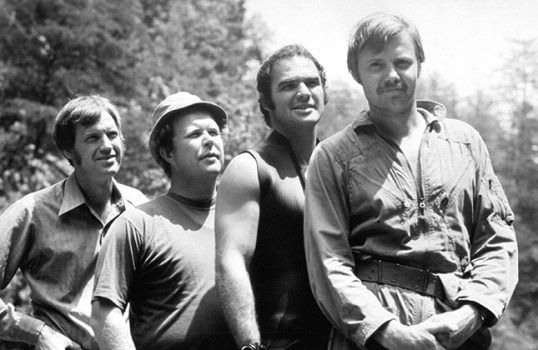
If you grew up in the South, as I did, you’ll recognize all four of the men.  It’s not just that they’re played by recognizable actors.  It’s that each one of them is a common archetype of the type of men you find down here.

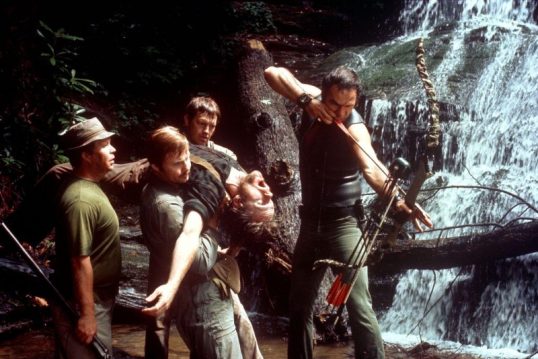
For instance, there’s Lewis (Burt Reynolds), the self-styled alpha male with his leather vest and his bow-and-arrow and his constant talk about how society is eventually going to collapse and only the strong are going to survive.  You know that Lewis is full of it from the minute you see him but he’s so charismatic that you can also understand why the other three men have fallen under his control.

And then there’s Bobby (Ned Beatty).  Bobby is quick to laugh and quick to talk and quick to make a bad joke.  When he says that he’s a salesman, you’re not surprised.  From the start of the film, Lewis complains that Bobby isn’t strong enough or serious enough and, when the mountain men attack, Bobby is the one they target.  And yet, towards the end of the film, Bobby is the one who sells the hastily concocted story about what happened on the river.

Drew (Ronny Cox) is the nicest of the men.  With his glasses and his guitar and his rather touching belief that everything will be okay if everyone just tells the truth, Drew’s the prototype of the Southern liberal.  One can imagine him teaching in a community college and vainly trying to convince his relatives that segregation and nostalgia for the Confederacy is holding the South back.

And finally, there’s Ed (Jon Voight).  Ed smokes a pipe and it’s obvious that he’s someone who has a very secure life.  Ed is the one who is everyone’s friend.  He’s the one who sticks up for Bobby.  He’s the one who reminds Drew to wear his life jacket.  He’s the only one who can get away with (gently) mocking Lewis.  Ed seems like a nice guy but, at the start of the film, there’s a strange emptiness to Ed.  You get the feeling that the reason Ed is friends with everyone is because he doesn’t have any firm beliefs.  Instead, he just adapts to each situation and says whatever everyone wants to hear.  You can’t help but wonder what Ed believes.  By the end of the movie, of course, both Ed and the viewer have learned what Ed is capable of doing.

Cox, Voight, and especially poor Ned Beatty are all perfectly cast in their roles.  Burt Reynolds reportedly felt that this film was his best performance and he was probably right.  Director John Boorman captures both the beauty and the menace of nature, leaving you both in awe of the the river and fearful of what it can do those foolish enough to try to conquer it.  Interestingly enough, while Boorman was directing Deliverance, he was offered The Exorcist.  He turned it down, feeling that the script was too exploitive of the possessed child.  Boorman would, however, direct The Exorcist II: The Heretic (co-starring Deliverance‘s Ned Beatty).

(At the same time, Jon Voight was offered the role of Father Karras in The Exorcist but, like Boorman, turned the film down so he could work on Deliverance.)

While the film is best known for its sequences on the river, one should not overlook the haunting scenes of the survivors once they make their way back to civilization.  After having spent the previous 80 minutes or so presenting everyone in the backwoods as a threat, the final third of Deliverance actually emphasizes the decency of the townspeople.  When one of the men breaks down and starts to cry in the middle of dinner, everyone is quietly respectful of his emotions.  Towards the end of the film, as the survivors are driven out of town, they find themselves stuck behind the old country church, which is being moved upriver.  “Just got to wait for the church to get out of the way,” their driver says while the church’s bell mournfully rings for both the death of the town and the death of innocence.

(Of course, even with all the kind townspeople around, there’s still a somewhat menacing sheriff.  It’s just not a Southern film without a scary sheriff, is it?  “Don’t you boys ever do nothing like this again,” he says at one point.  The sheriff is played by James Dickey, the author of both the novel and the screenplay on which the film is based.)

Deliverance was nominated for three academy awards.  In the directing and the editing categories, it lost to Cabaret.  For best picture, it lost to The Godfather.  Deliverance, The Godfather, and Cabaret, all competing against each other?  1972 was a very good year.

Film Review: This Is Not A Test (dir by Fredric Gadette)


This Is Not A Test opens with Deputy Dan Colter (played by Seamon Glass) out on patrol.  Suddenly, an alert comes across the radio.  Missiles have been launched.  They’re heading for the United States.  War is imminent.  This is not a test.

Deputy Colter proceeds to set up a road block.   Every motorist who approaches is ordered to pull over to the side of the road and not go anywhere.  Among those who pull over to the side of the road are a young woman and her grandfather, a truck driver, a couple who have a small dog, and a nervous young man in a suit.  Colter explains to them what’s going on.  He tells them that they can’t leave.  He has his orders.  This is not a test.  This is a real emergency.  And since Colter is the only available man in uniform, that means that he’s in charge.  When the young woman expresses some doubts to her grandfather, the old man tells her that they have to do what they’re told.

Colter has a plan for surviving the war.  He says that they can all get in the back of the truck driver’s big rig.  He estimates that they’ll have to stay there for two weeks or so.  Under his orders, everyone starts to unload the truck.  Of course, not everyone thinks that the truck is going to provide adequate protection but there aren’t any other options available.  A few people get upset when Colter announces that, for reasons of safety, they can’t take any alcohol into the truck.  Of course, considering that one of the people at the road block is a psychotic, knife-wielding murderer, the alcohol might be the least of their concerns.

As the group tries to create a shelter, they’re also forced to deal with not only a group of rather mild-mannered looters but also the fact that Colter, himself, doesn’t seem to be particularly stable.  Colter is enjoying his authority a bit too much, especially when it comes to judging whether they have room in the truck for the couple’s dog or not.  One almost gets the feeling that Colter’s looking forward to being the sole man in charge after the bombs drop….

Over the police radio, reports continue to come in.  The missiles are getting closer.  This is not a test….

This Is Not A Test is an extremely low-budget film from 1962.  It was cast with unknown, largely amateur actors and the whole film has a grainy, almost dream-like feel to it.  (It would appear that this night-set film was actually filmed at night, which means that the visuals are often as dark as the film’s storyline.)  The film gets off to a rough start, with a lot of clumsy dramatics but, as things progress, the film develops a very convincing atmosphere of impending doom.  The film emphasizes the fact that no one has the slightest idea what to do and Deputy Colter soon proves himself to be an aspiring dictator.  Though most of the actors give rather stiff performance, Seamon Glass makes the aspiring fascist into a very believable and recognizable character.

The low-budget and the amateurish acting aside, This Is Not A Test deserves a lot of credit for following its dark storyline through to its natural conclusion.  There is no exit.  There is no escape.  This is not a test.