4 Shots From 4 Films is just what it says it is, 4 shots from 4 of our favorite films. As opposed to the reviews and recaps that we usually post, 4 Shots From 4 Films lets the visuals do the talking!
Today’s edition of 4 Shots from 4 Films is dedicated to four of the best films that I’ve ever seen about Hollywood! I mean, it is Oscar Sunday after all!
4 Shots From 4 Films About Hollywood
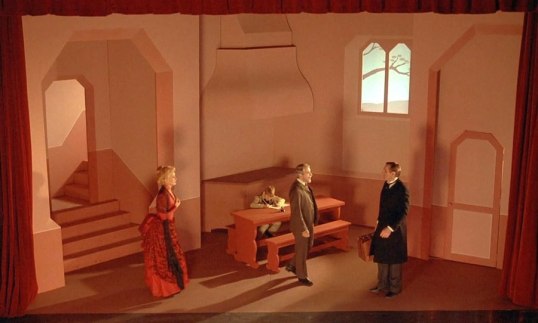
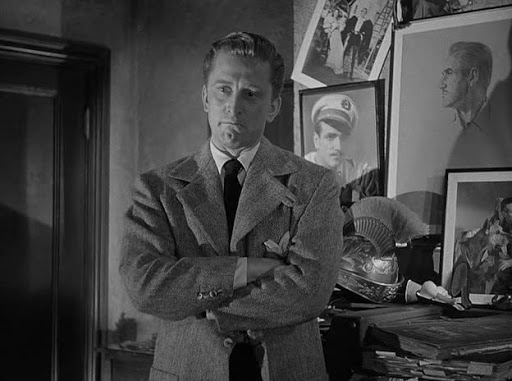
The Bad and the Beautiful (1952, dir by Vincente Minnelli)
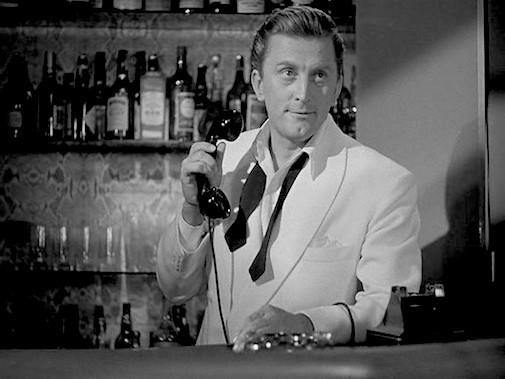
The Stunt Man (1980, dir by Richard Rush)
Mulholland Drive (2000, dir by David Lynch)
Once Upon A Time In Hollywood (2019, dir by Quentin Tarantino)
There’s a lot of film bloggers out there who have a natural aversion to anything that Jason Reitman is associated with.
And listen, I understand. The fact of the matter is that Jason Reitman probably does owe a lot of his success to the fact that people in the industry know and like his father. And it’s also true that Jason Reitman does tend to specializes in making films that you’re either going to love or you’re going to hate. His films mix drama and comedy and sentiment and snark and sometimes, his refusal to come down firmly on the side of either one can feel like a bit of a cop out. There’s a quirkiness to many of his films and sometimes, it can come across as being a bit cutesy. And I’ll even go as far as to agree with those who say that it’s been a while since Reitman’s made a really good film. The most common complaint I hear about Reitman is that his first four films (Thank You For Smoking, Juno, Up In The Air, and Young Adult) were okay and then he let his good reviews go to his head. Of course, some people — okay, a lot of people — will tell you that, of those four films, Juno’s overrated.
I get all of that and I actually agree with some of those points. Reitman is a director who sometimes seems to have lost his way after his early successes. I think the closest that Reitman’s come to giving us a good film post-Young Adult was with Tully and even then, that felt more like a Diablo Cody film than a Jason Reitman film.
But, with all of that in mind, I still really like Jason Reitman’s early films and I think that he still has the potential to once again be an important and interesting filmmaker. Thank You For Smoking and Juno are better than many give them credit for being. Charlize Theron has never been better than she was in Young Adult. Finally, this morning, I rewatched 2009’s Up In The Air for the first time in a long time and I was pleasantly surprised to see how well it holds up.
Up In The Air features George Clooney and Anna Kendrick. Clooney plays Ryan Bingham, an obsessive traveler who boats about living a life without commitment. Ryan works for a company that hires him out to fire people. If your boss is too much of a pussy to tell you that you’ve been terminated to your face, he hires Ryan to do it for him. Ryan specializes in trying to convince people that being fired is not a tragedy but an opportunity for a new beginning. Ryan also has a side gig as a motivational speaker. His speeches are largely about avoiding commitment and personal baggage.
Anna Kendrick plays Natalie Keener. Natalie works for the same company as Ryan but, at the age of 23 and just out of college, she’s a lot less confident when it comes to destroying people’s livelihoods. (“I’ve worked here for 17 years and I’m being fired by a 7th grader,” is one person’s response to being terminated by Natalie.) Natalie has come up with a new plan where all firings will be done via Skype. That way, the person doing the firing will never have to leave their office and won’t have to deal with the people they’ve fired one-on-one. Ryan says he considers this proposal to be inhumane but mostly, he’s just worried that he’ll lose his traveling privileges if Natalie’s plan is instituted.
Ryan and Natalie travel the country. Ryan teaches Natalie how to fire people and Natalie discovers that it’s not as easy to destroy someone’s life as she thought. Everywhere they go, they deal with people who are facing economic uncertainty. Ryan meets another frequent flyer, Alex (Vera Farmiga) and, after Alex reveals that she’s even less interested in commitment than Ryan, they begin an affair. Ryan starts to fall in love with Alex and even invited her to attend his sister’s wedding with him. However, Alex has a secret of her own.
One thing that I really like about Up in the Air is that Ryan and Natalie never end up sleeping together. I remember, when I first saw the movie, I was convinced that it was going to happen. After all, Ryan is handsome and charming and Natalie is attractive and, after her boyfriend dumps her, vulnerable. I was cringing at the knowledge that there would eventually be some contrived scene where Natalie and Ryan end up getting drunk and then end up waking up in bed together and the end result would be Natalie going from being a well-rounded, multi-dimensional character to just being a plot device in Ryan’s journey to becoming a better man. Well, there is a scene where Natalie and Ryan get drunk at the same time but it doesn’t lead to Natalie and Ryan becoming lovers and I respected Up in the Air for having enough respect for its characters to not do the convenient thing.
The other thing I liked about Up In The Air is that it’s one of the few films to make proper use of George Clooney’s deceptively smooth screen presence. We all know that Clooney is handsome and charming but what makes him an appealing actor is that there’s always been hints that there’s a lot dorkiness and insecurity hiding underneath the suave facade. Ryan may seem like he’s got it all together but, as the film progresses, you come to realize that he’s a lot more insecure and neurotic than he lets on. All of his snarky comments have more to do with his own fear of failure than anything else. Much as how the real life Clooney still sometimes seems as if he hasn’t fully gotten over being dismissed as just being another pretty face in the early days of his career, Ryan has never gotten over his dysfunctional childhood. Instead of taking a risk on love, he instead obsesses on getting frequent flyer miles. (At one point, Sam Elliott pops up out of nowhere and, in a scene that you could really only expect to find in a Jason Reitman film, gives Ryan a pep talk.) There’s a sadness to Ryan, one that seems to come from deep inside of his soul. Clooney does an excellent job of bringing that sadness to the surface while still giving a likable and compelling performance.
Up In The Air was released at a time when America was stuck in what seemed like a never-ending recession. Despite the fact that the news media and the politicians were insisting that things were on the verge of getting better (or, at the very least, boasting that unemployed actors were no longer “job-locked,” whatever the Hell that meant), many people believed that their best days were officially behind them. A lot of the contemporary reviews of the film focused on what it had to say about living in a time of economic uncertainty. That was ten years ago and we’re now living in a strong economy but, even so, Up In The Air still resonates. Reitman includes scenes in which people talk about what it was like to be fired. The majority of these people were not actors but were instead people recruited from the local unemployment office and they were speaking about their own experiences. The pain and resentment on their faces and in their voices is so palpable that it’s actually a bit jarring when J.K. Simmons and Zach Galifianakis show up, playing employees who are “terminated” by Ryan. I guess I should admit that I’ve never actually been fired from a job but, after watching Up In The Air, it’s not something that I would ever want to experience.
Up In The Air holds up well. Reitman’s direction is quirky but effective and he does a good job of mixing comedy in with the drama. (Wisely, whenever he has to make a choice, he emphasizes the drama over the comedy, instead of trying to maintain some sort of mythical 50/50 balance between them.) This film features one of George Clooney’s best performances and he has a really likable chemistry with Vera Farmiga. Anna Kendrick also does a great job with a character who could have become a stereotype in less skilled hands. Finally, along with Juno and The Gift, this film is one of the reasons why I always have a hard time watching Jason Bateman in any film or show where he’s cast as hero. Bateman plays Ryan’s boss and the character is so smarmy (and Bateman does such a good job of playing him) that he’ll make your skin crawl.
It’s been a while since Up In The Air was first released and Jason Reitman’s career has had its ups and downs. Still, regardless of whatever film Reitman makes next, Up In The Air remains a classic of the aughts.
The 1935 adventure film, The Lives of a Bengal Lancer, is a film that probably could not be made today.
Of course, that’s true of a lot of films from the 30s. In some cases, that’s a good thing and, in some cases, that’s a bad thing. The Lives of Bengal Lancer is an entertainingly old-fashioned adventure story but it’s also a shameless celebration of the British Empire. The fact that it was made in Los Angeles and featured all-American Gary Cooper in the lead role doesn’t diminish the fact that it’s pretty much a celebration of British colonialism.
Gary Cooper plays Lt. Alan MacGregor, a Scottish-Canadian who serves in British Calvary. He’s a member of the Lancers and is currently serving in India, which, at the time that this movie was set (and made), was still under British control. When the film begins, MacGregor is greeting the new arrivals. Among those arrivals are Lt. John Fosythe (Franchot Tone) and Lt. Donald Stone (Richard Cromwell). Lt. Forsythe is an experienced officer who has been sent to India as a replacement for another officer who managed to get himself killed while out on a patrol. Meanwhile, Lt. Donald Stone is a newly commissioned officer who is desperate to win the approval of his father (and McGregor’s superior), Col. Tom Stone (Guy Standing). Unfortunately, Donald quickly discovers that winning the approval of his father isn’t going to be easy. Col. Stone, after all, has a lot to deal with.
For instance, there’s Mohammed Khan (Douglas Dumbrille). Kahn is a local prince and he boasts that he has got an Oxford education. He pretends to be an ally of the British but instead, he is plotting a revolution. The first step in that revolution is to intercept a convoy of British weapons but how can Kahn discover the convoy’s route? Maybe he could kidnap a lancer who is close to the unit’s commanding officer? With the help of a Russian femme fatale named Tania (Kathleen Burke), Khan is able to capture Donald. When MacGregor and Forsythe defy the colonel’s orders and attempt to rescue Donald on their own, they end up getting captured as well!
“We have ways to make men talk!” Khan declares and soon, the three men are having their fingernails ripped out and the skin underneath burned with fiery bamboo. It’s a shocking act of sadism, one that caught me by surprise in 2020. I can only imagine how audiences in 1935 reacted to Gary Cooper and Franchot Tone being so graphically tortured on the big screen. Though the men swear that they will not reveal the location of the convoy, how much torture can they take before they break?
As I said at the start of this review, The Lives of a Bengal Lancer is an old-fashioned film and, with its depiction of savage rebels and heroic colonizers, it would probably cause a riot if it were released today. However, if you can set aside the whole pro-imperialist theme of the film, this is a fairly entertaining film. It gets off to a slow start and, to modern eyes, some of the acting is bit creaky but Gary Cooper is, not surprisingly, well-cast as the film’s hero and he’s ably supported by Tone and Cromwell. Douglas Dumbrille and Kathleen Burke are entertainingly campy villains and the film’s final battle is well-done.
A box office success, The Lives of a Bengal Lancer was nominated for Best Picture but it lost to an even bigger hit (and a film that was a bit more critical of the British Empire), Mutiny on the Bounty.
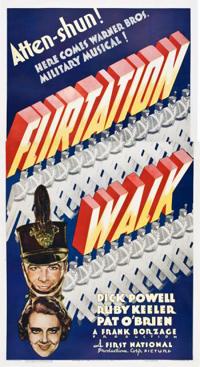
In the 1934 Best Picture nominee, Flirtation Walk, Dick Powell plays a soldier who is constantly trying to go AWOL.
It’s not that Richard “Dick” Palmer Grant Dorcy Jr. dislikes the army. In fact, he’s actually getting a pretty good deal out of his enlistment. He’s been stationed in Hawaii, where he gets to go to luaus and hang out on the beach. He has a wonderful friend and mentor in the person of Sgt. Scrapper Thornhill (Pat O’Brien). Since this film was made in 1934, he’s not going to have to worry about going to war for another 7 years. He’s known as The Canary because he loves to whistle and sing. Everyone like Pvt. Dick Dorcy and that includes Kit Fitts (Ruby Keeler).
Unfortunately, Kit’s father is General Fitts (Henry O’Neill) and he’s none too amused about his daughter having a romance with an irresponsible enlisted man. He would much rather that Kit marry his aide, Lt. Biddle (John Eldredge). After he’s told to stay away from Kitt, Dick makes plans to desert so he can run off with her. Fortunately, Scrapper finds out what Dick is planning and he goes to Kit and warns her that Dick’s about to throw away his life for her. Not wanting him to get into trouble, Kit pretends that she never felt anything for Dick. When a broken-hearted Dick wonders why Kit rejected him, Biddle smugly informs him that he’s neither “an officer nor a gentleman.”
Stung, Dick decides to fix that problem. In order to become an officer, he applies for admission to West Point and gets in. Dick leaves Hawaii for the mainland and he does very well at West Point. He’s even put in charge of producing, writing, and directing West Point’s annual theatrical production. However, things get complicated with Gen. Fitts arrives to serve as superintendent. Coming with Gen. Fitts are both Kit and Lt. Biddle.
Deciding to express his angst through art, Dick writes a show about a female general. Since Kit is the only female at West Point, guess who gets the lead role? Though Kit is still in love with Dick, she can’t get him to listen to her explanation for why she rejected him. Will a stroll along West Point’s famed Flirtation Walk help fix things?
Well, it is a Dick Powell musical….
Flirtation Walk is a pleasant but forgettable movie. Dick Powell and Ruby Keeler make for a cute couple but neither one of them gives a particularly interesting performance and the bland songs don’t make much of an impression either. Those who are into military history might enjoy the fact that the film was actually filmed on location at West Point but, for the rest of us, this is a nice but not particularly memorable musical romance. For me, the most interesting part of the film was that it didn’t even attempt to be realistic when it came to Dick’s theatrical production. It’s a huge production, if never coming close to being as much fun as the one from 42nd Street.
Why was Flirtation Walk nominated for Best Picture? I imagine it was because it was a hit at the box office. It only received one other nomination, for Best Sound Recording. Regardless of why it was nominated, it lost to the far more memorable It Happened One Night.
4 Shots From 4 Films is just what it says it is, 4 shots from 4 of our favorite films. As opposed to the reviews and recaps that we usually post, 4 Shots From 4 Films lets the visuals do the talking!
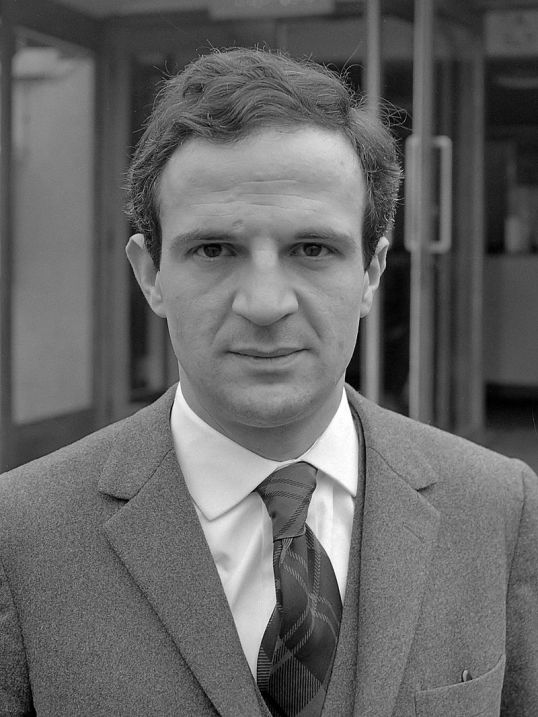
Francois Truffaut, the greatest French director not named Jean Renoir or Jean Rollin, was born on February 6th, 1932. If he was still with us, he would be 88 years old and I would like to think that he would still be making films. The greatest director of the French new wave, Truffaut truly loved cinema and that love came through in every film he ever made. My favorite Francois Truffaut film — and this will probably come to a surprise to no one — is Day For Night. Seriously, if you don’t fall in love with the movie making process while watching Day For Night, you might want to get checked to make sure that you still have a heart.
In honor of what would have been his 88th birthday, here are….
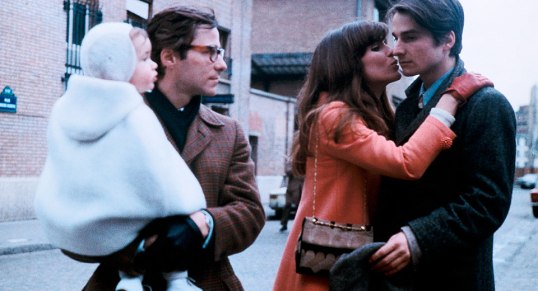
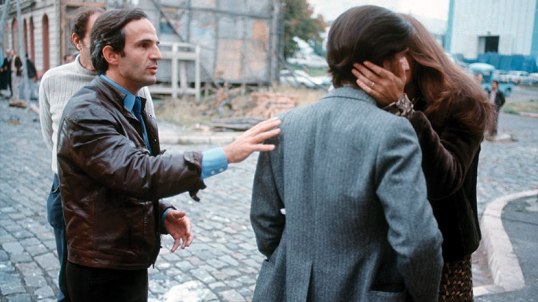
4 Shots From 4 Francois Truffaut Films
Shoot the Piano Player (1960, dir by Francois Truffaut)
Kirk Douglas passed away today in Beverly Hills, California. He was 103 years old.
Kirk Douglas was one of the last surviving stars of Hollywood’s Golden Age. Douglas began his career in the 40s and he made his last film appearance in 2008. Interestingly enough, that final appearance was in a film that was made for French television, called The Empire State Building Murders. The film was meant to be a mockumentary and a tribute to old detective and crime films of the 40s. It was full of archival footage of Douglas contemporaries like James Cagney, Edward G. Robinson, and Lauren Bacall. Douglas played a character named Jim Kovalski. As a result of a stroke that he suffered in 1996, Douglas did not speak in the film but his very presence was powerful just because he was Kirk Douglas and he was still with us. Even though he was noticeably frail, Kirk Douglas remained an icon.
Indeed, if there was any Golden Age star that you would have expected to reach 100, it would have been Kirk Douglas. Douglas played several different characters over the course of his career but almost all of them had one thing in common. They were all tough. On screen, Kirk Douglas always came across as someone who laughed at death. One could imagine the Grim Reaper showing up at his front door and Douglas simply saying, “Get the Hell out of here.” If anyone could bully Death into submission, it would have been Kirk Douglas.
Kirk Douglas was a survivor. In several interviews, he described himself as being a “tough son of a bitch.” Kirk Douglas was not the type to allow himself to be pushed around and the fact that he even had a career in Hollywood during the studio system is kind of amazing. It wasn’t just that Douglas had a reputation for not suffering fools. It’s also that Douglas was an actor who was willing to put his career on the line for what he believed in. By not only hiring Dalton Trumbo to write the script for Spartacus but also giving him onscreen credit, Douglas has been credited with helping to bring the blacklist to an end. At the height of his stardom, Douglas appeared in Stanley Kubrick’s antiwar film, Paths of Glory. He stood up for the state of Israel and defended it against it’s most vehement critics, even rebuking his friend Jimmy Carter at one point.
What’s my favorite Kirk Douglas performance? In Spartacus, Douglas made “I am Spartacus” a rallying cry for revolutionaries everywhere. In Ace In the Hole, he was the perfect representation of an amoral journalist. Playing a gangster, he was both charming and dangerous in the classic film noir, Out of the Past.Lust for Life was an imperfect film but he gave a strong performance as Van Gogh. Paths of Glory featured Douglas at his most compassionate and outraged. Later in his career, he starred in the campy but entertaining Holocaust 2000. That said, my favorite Kirk Douglas film remains The Bad and The Beautiful, which is one of the best films ever made about Hollywood. Douglas played a real heel in The Bad and the Beautiful and, watching the film, you get the feeling he loved every minute of it.
Kirk Douglas’s death is not really a shock. When he appeared at the Golden Globes in 2017, he was noticeably frail. With his passing, though, we’ve lost a true icon of American cinema and one of the last living links to the Golden Age of Hollywood.
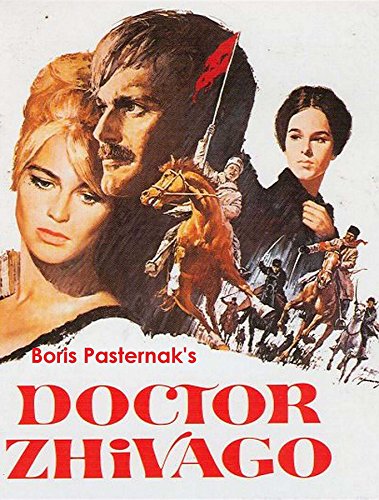
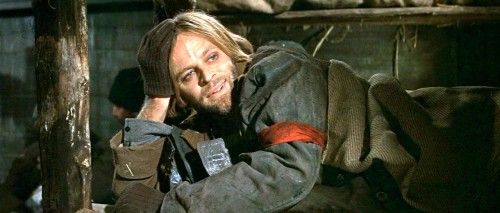
Klaus Kinski is the main reason to watch the 1965 film, Doctor Zhivago.
The legendarily difficult and erratic Mr. Kinski shows up about halfway through this 3-and-a-half hour film. He plays a cynical and unstable prisoner on a train. The train is full of passengers who are escaping from Moscow and heading for what they hope will be a better and more stable life in the Ural Mountains. (The film takes place during the Communist revolution and the subsequent purges.) That Kinski taunts everyone on the train is not a surprise. Both Werner Herzog and David Schmoeller (who directed Kinski in Crawlspace) have made documentaries in which they both talked about how difficult it was to work with Kinski and how several film crews apparently came close to murdering Klaus Kinski several times throughout his career.
Instead, what’s surprising about Kinski’s performance is that he’s even there to begin with. Doctor Zhivago is an extremely long and extremely stately film. It’s one of those films where almost every actor gives a somewhat restrained performance. It’s a film where almost every shot is tastefully composed and where the action often slows down to a crawl so that we can better appreciate the scenery. It’s a film that stops for an intermission and which opens with a lengthy musical overture. In short, this is a film of old school craftsmanship and it’s the last place you would expect to find Klaus Kinski luring about.
When he does show up, you’re happy to see him. Even though he’s only onscreen for about five minute, Kinski gives the film a jolt of much-needed energy. After hours of watching indecisive characters talk and talk and talk, Kinski pops up and basically, “Screw this, I hate everything.” And it’s exciting because it’s one of the few time that Doctor Zhivago feels unpredictable. It’s one of the few times that it feels like a living work of art instead of just a very pretty but slightly stuffy composition.
Just from reading all that, you may think that I don’t like Doctor Zhivago but that’s actually not the case. It’s a heavily flawed film and you have to be willing to make a joke or two if you’re going to try to watch the whole thing in just one sitting but it’s still an interesting throwback to a very specific time in film history. Doctor Zhivago was designed to not only be a spectacle but to also convince audiences that 1) TV was worthless and that 2) Hollywood craftsmanship was still preferable to the art films that were coming out of Europe. At a time when television and independent European cinema was viewed as being a real threat to the future of the film industry, Doctor Zhivago was a film that was meant to say, “You can’t get this on your black-and-white TV! You can only get this from Hollywood where, dammit, people still appreciate a good establishing shot and treat the production code with respect!” Even today, some of the spectacle is still impressive. The beautiful shots of the countryside are still often breath-taking. The scenes of two lovers living in an ice filled house are still incredibly lovely to look at. The musical score is still sweepingly romantic and impressive.
It’s the story where the film gets in trouble. Omar Sharif plays Yuri Zhivago, a doctor and a poet who falls in love with Lara (Julie Christie) while Russia descends into chaos. The Czar is overthown. The communists come to power and prove themselves to be just as hypocritical as the Romanovs. The revolutionary Pasha (Tom Courtenay, bearing a distracting resemblance to Roddy McDowall) is in love with Lara and helps to bring about the revolution but is then declared an enemy of the people during the subsequent purges. The craven Komarovsky (Rod Steiger) also wants to possess Lara and he’s so corrupt that he manages to thrive under both the Czar and the communists. Alec Guinness plays Yuri’s half-brother and is the most British Russian imaginable. Doctor Zhivago is based on a Russian novel so there’s a lot of characters running around and they’re all played by a distinguished cast of international thespians. However, none of them are as interesting as the scenery.
As for the two main actors, Omar Sharif and Julie Christie convince you that they’re in love but not much else. Sharif is never convincing as a poet and he feels miscast as a man who spends most of his time thinking. Reportedly, Lean’s first choice for the role was Peter O’Toole and it’s easy to imagine O’Toole in the part. But O’Toole had already done Lawrence of Arabia with Lean and didn’t feel like subjecting himself to another year of Lean’s notoriously prickly direction. So, the role went to O’Toole co-star, Sharif. Julie Christie turned down Thunderball to do both this film and Darling, for which she would subsequently win an Oscar.
(Speaking of the Oscars, Doctor Zhivago was nominated for Best Picture and, though it won five other Oscars, it lost the big prize to The Sound of Music, of all things. 1965 really wasn’t a great year for the Oscars. The only 1965 Best Picture nominee that still feels like it really deserved to be nominated is Darling. Of the other nominees, Ship of Fools is ponderous and A Thousand Clowns is almost unbearably annoying. And The Sound of Music …. well, I prefer the Carrie Underwood version.)
Doctor Zhivago is a big, long, epic film. It’s lovely to look at and it has a few nice scenes mixed in with a bunch of scenes that seem to go on forever. In the conflict between the state and the individual, it comes down firmly on the side of the individual and that’s a good thing. (The communist government attempts to suppress Yuri’s love poems because they celebrate the individual instead of society. And though the government might be able to destroy Yuri’s life, they can’t destroy his spirit. Again, it’s a message that would have worked better with a more thoughtful lead actor but still, it’s a good message.) It’s a flawed film but watch it for the spectacle. Watch it for Klaus Kinski.
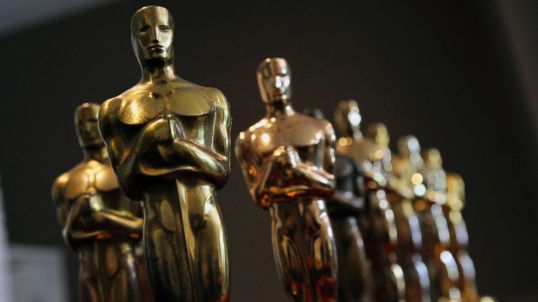
It’s a fool’s errand to try to predict next year’s Oscars nominees this early but we’re all about taking risks here at the Shattered Lens. So, with that in mind, here is my latest set of monthly predictions.
If you look over these names, you’ll see a lot of familiar ones. That’s because it’s early in the year and familiarity is really the only thing that a lot of these unreleased films have going for them. Some of the films mentioned below were hits at Sundance. From what I’ve read, I really do think Minari could be a contender because, along with being loved by critics, it sounds like it’s very much of the current cultural moment.
But the important thing to remember is that, last year at this time, no one expected Joker to become the film of the year. No one had even heard of Parasite. Most people were still predicting the Oscars would be dominated by Harriet. So, my point is — take this stuff with several grains of salt.
To be honest, I think a lot depends on how the presidential election goes. If Trump is reelected, I think you’ll see the Academy voting for angry, political films, if just as a way to get back at Trump and the people who voted for him. (Think about the otherwise baffling love that was previously shown to a movie like Vice.) The Trial of the Chicago 7 sounds incredibly tedious to me but I could imagine people voting for it and thinking to themselves, “This is so going to piss off the Republicans.” If Trump is defeated, I imagine the Academy will be a bit more upbeat in their selections.
If you want to see how my thinking has evolved, check out my predictions for January here! (It’s only been a month so my thinking hasn’t really evolved at all. Still, we could always use the clicks.)
4 Shots From 4 Films is just what it says it is, 4 shots from 4 of our favorite films. As opposed to the reviews and recaps that we usually post, 4 Shots From 4 Films lets the visuals do the talking!
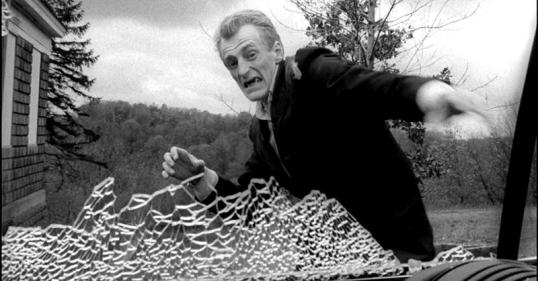
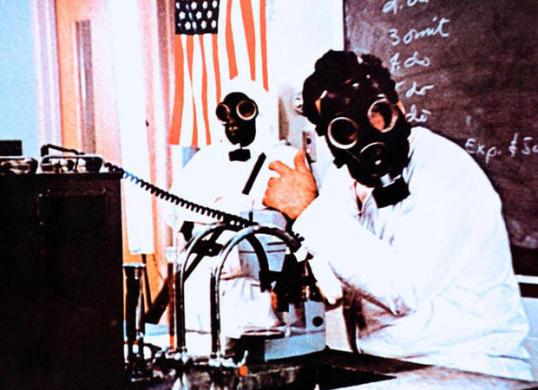
Today would have been George Romero’s 80th birthday.
Now, those of you who have been reading us since the beginning know how important the work of George Romero has been to this site. A mutual appreciation of Night of the Living Dead is one of the things that first brought many of us together. It’s a film that we watch ever Halloween and Arleigh’s review of the original remains one of our most popular posts. If this site had a patron saint, it would probably be George Romero.
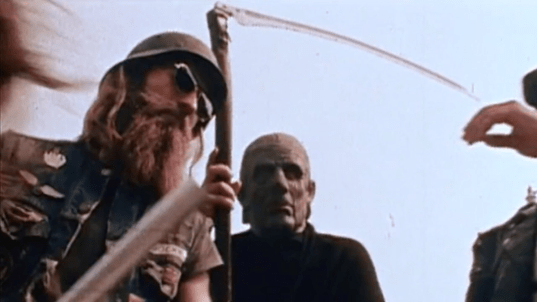
And yet, Romero wasn’t just a director of zombie films. He made many films, dealing with everything from hippie lovers (There’s Always Vanilla) to wannabe vampires (Martin) to government conspiracies (The Crazies) and eccentric bikers (Knightriders). George Romero was one of the pioneers of independent films and today, on his birthday, we should all take a minute to consider and appreciate the man’s cinematic legacy. It’s not just horror fans who owe George Romero a debt of gratitude. It’s lovers of cinema everywhere.
With that in mind, here are….
4 Shots From 4 George Romero Films
Night of the Living Dead (1968, dir by George Romero)
Actually, the <inions are cute. One of the first things that Arleigh and I bonded over was our love of the Minions. That said, I have my doubts that there’s really much more that can be done with the Minions. Still, I get the feeling this new movie will be cute.







 Through the Shattered Lens