SXSW 2020 Review: Still Wylde (dir by Ingrid Haas)


Still Wylde is an 11-minute film about a long-time couple, Gertie (Ingrid Haas) and Sam (Barry Rothbart), and what happens when Gertie gets pregnant with the child that they hope to name Wylde.

It’s a film that, if I may be allowed to indulge in a cliche, made me laugh and then made me cry.  And then it made me briefly laugh again and then it made me cry a lot.  It’s an emotional roller coaster and it’s also a good example of why the short film format can be so powerful.  A lot of time passes in just 11 minutes and you truly feel like you come to know Gertie and Sam over the course of the film.  Because it is a short film, every moment counts.  There is no filler.  Instead, every minute of the film is about getting to know Gerite and Sam and following them on their journey.  You come to care about them.  You share their joy and you share their heartbreak and, in the end, you’re happy that they have one another.

From the minute you see Gertie buying every single pregnancy test at the local convenience store and then pacing in front of a dead plant after getting the results, you feel as if you know who she is.  From the minute that Sam starts stuttering as he tries to figure out the right way to respond to Gertie’s news, you know who Sam is.  It’s kind of impossible not to love Sam and Gertie and to get caught up in their story.

And all it took was 11 minutes!

Through May 6th, Still Wylde and several other films that would have been featured at this year’s SXSW are currently available for free on Prime.  Definitely check them all out.  Let’s do what we can to support brave and honest filmmakers like Ingrid Haas and so many others during this difficult time.

Now, I’m going to go cry for a little bit more….

SXSW 2020 Review: Waffle (dir by Carlyn Hudson)


Can I get a connection?

The 10 minute short film, Waffle, begins with what appears to be a sleep over.  Kerry (Kerry Baker) and Katie (Katie Marovitch) are both sitting on a couch in their pajamas, talking about a time when they hung out with the cutest boys in their class and they all ended up making out in someone’s car.  There’s a lot of giggling and hugging and most viewers won’t buy it for a second.

It’s not just the fact that both of the women appear to be a little bit older than the usual sleep over participants.  In fact, neither one appears to still be in high school.  It’s also hard not to notice that, for two best friends, Katie and Kerry really don’t seem to know each other that well.  When Kerry is trying to tell the story about a night that she and Katie hung out together, Katie keeps interrupting her and telling her to change the details.  Katie is also quite insistent that Kerry will have waffles, despite Kerry’s lack of enthusiasm for the idea.  When Kerry mentions that her friend Rapahel (Raphael Chestang) is coming by, Katie does not react well to the news.

Things only get stranger from that point on.  Katie is someone who is not only used to getting what she wants but who also has the money necessary to make sure that no one ever says no.  Kerry has her own motivations but it doesn’t take long to notice that she doesn’t seem to be particularly enthusiastic about spending too much time with her “best friend.”  The film goes from being a comedy to a drama to back to being a comedy to being …. well, I don’t want to give away too much.  Let’s just say that a lot happens in just ten minutes.

Waffle is a clever look at the struggle to make a connection in an increasingly isolated community.  Katie Marovitch alternates between being menacing and being almost sympathetic in the role of Katie while Kerry Cook’s performance keeps the story grounded in an identifiable reality.

It’s on Prime, at least through May 6th so, if you’ve got ten minutes to spare, be sure to check it out.

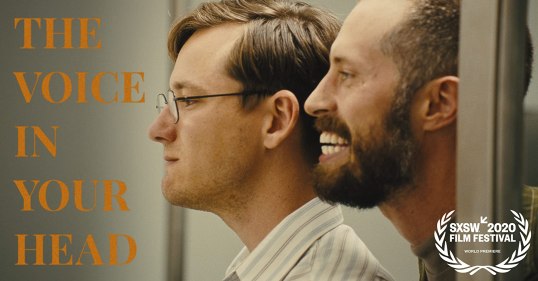
SXSW 2020: The Voice In Your Head (dir by Graham Parkes)


Poor Dan!

As played by Lewis Pullman, Dan seems like a decent enough guy.  He’s a little bit on the dorky side and he seems to be kind of shy.  He’s one of those people who you always see kind of shuffling along with head down.  When he speaks, it’s in such a soft voice that it can be a struggle to hear him.  He’s insecure and anxious and really, it’s understandable once you see what he has to live with.

The thing you have to understand about Dan is that he wakes up every morning and has to deal with the voice of his anxiety (played by Mat Wright), a loud and obnoxious bully who follows him everywhere that he goes and who constantly tells him that everything he’s doing is wrong.  Dan can’t even have a friendly conversation with his co-worker, Julia (Trian Long Smith), without the voice taunting him and telling him that he’s useless.  The voice is everything that Dan is not.  The voice is loud and flashy and obnoxious and totally unconcerned with any feelings that he may hurt.  The voice is every moment of anxiety that anyone in the world has ever felt.  He’s every insecure thought and lingering regret.  He’s ….

Well, there’s actually a bit more to the voice but I’m not going to spoil this short film but revealing all of its secrets.  About halfway through this film’s 13-minute running time, there’s a huge twist and I can’t reveal the details.  I will say that it’s a very clever little twist and it’s one that will take you by surprise.

The Voice In Your Head is a well-directed comedy about anxiety.  Lewis Pullman is sympathetic as Dan while Mat Wright is brilliantly obnoxious in the role of the Voice.  I don’t personally know the director, Graham Parkes, so I won’t speculate on what may or may not have inspired this film but, just from watching, he seems to be someone who not only understands anxiety but who also understands a good deal about human nature.  The things that cause us the greatest anxiety often appear totally different once we actually confront them and that’s something that this film certainly understands.

It’s on Prime, at least through May 6th.  So, be sure to check it out.

SXSW 2020 Review: Affurmative Action (dir by Travis Woods)


Due to the COVID-19 pandemic, South By Southwest has been canceled this year but fortunately, you can still go over to Amazon Prime and watch some of the feature films, documentaries, and shorts that were scheduled to be featured this year.  That’s what I’m going to be doing tonight and tomorrow.

I started things off by watching Affurmative Action, which is a 5-minute short film that is largely made up with shots of various “Meet the Team” pages.  Those are the pages that appear on almost every business’s website, where you see smiling pictures of all of the people who are in leadership positions.  This is especially true of small businesses, where the idea is that you look at all of the smiling, cheerful, hip faces and you say to yourself, “These are people who I want to work with!”

The majority of the “meet the team” pages that are featured in Affurmative Action come from advertising, media, and other creative companies that are located in either New York or Los Angeles, which are two very diverse cities with reputations for being culturally liberal.  Director Travis Woods points two things out to us over the course of five minutes:

First off, it’s very common to see a dog (and, in one, case a cat) listed as being a part of the team.  Sometimes, they’re listed as being “mascot.”  One lucky dog was a Vice President of Barking or something like that.

Secondly, it’s very rare to see any black faces on the Meet The Team pages.  In fact, the film makes the argument that you’re more likely to see a dog on the Meet The Team page than you are a black person.

Now, I have to admit that, when I first watched the documentary, I had what is probably a very stereotypical white girl reaction to it.  “Awwwww!” I said, “those dogs are so cute!”  (I’ll also admit right now that I was the one who suggested to Arleigh that Doc Bowman should become a contributor to the Shattered Lens.)  But, once I got over the cuteness of the dogs, I also realized that the documentary was making a very valid and important point about the lack of diversity in many companies, especially when it comes to upper management.  The dogs may be cute but they’re not the ones who are being shut out of leadership positions and who aren’t being given the same opportunity to advance in their careers.  If nothing else, Affurmative Action is a film that I will remember every time that I look at a “Meet The Team” page.

As I said, it’s a short film.  It’s only five minutes long.  The dogs are cute.  The film’s point is serious and will make you think.

Lisa Marie’s Possibly Pointless and Totally Random Oscar Predictions for April


To do Oscar predictions during a pandemic or not?

That’s the question.

Erik Anderson at Awards Watch announced on twitter that he’s not doing his monthly Oscar predictions for April and May.  (He is, however, focusing on the Emmys so be sure to visit the site and check out his thoughts!)  Over at Clayton Davis’s Awards Circuit, the Oscar predictions have been taken down and replaced by an ominous (though definitely needed) counter of how many people are currently infected with the Coranavirus.  As of right now, there’s a lot of uncertainty.  Are theaters even going to reopen before the year ends and if they do reopen, will people be willing to run the risk of going outside to see a movie?  So many of the big films of 2020 have been moved back to 2021 that one could legitimately wonder whether any of the big “Oscar” films are even going to come out this year. Most ominously, for me, is that we could get hit by a second wave of the Coronavirus.  It’s easy to imagine a situation where theaters reopen in the summer and, regardless of how business goes, are forced to close again in December.

The Academy is aware that the future is uncertain.  Earlier this week, they loosened the eligibility rules.  Films that premiere on VOD or a streaming service are now eligible for Oscar consideration as long as it can been proven that the film would have also gotten a theatrical release if not for the pandemic.  I’m not sure how exactly that could be proven but it does show that the Academy is, as of now, planning to give out some Oscars next February.

(Of course, just because the rules have been temporarily loosened, that doesn’t mean that every studio and director is going to want to put their huge blockbusters out on Prime or Netflix or VOD.  I doubt Spielberg wants to premiere West Side Story in your living room.)

So, for that reason, I’m going to continue to do my monthly Oscar predictions.  Needless to say, these are even more random than usual. The predictions below are also being made on the assumption that theaters will be open in November, December, and January.  Again, there are no guarantees, other than perhaps Netflix.

So, without further ado, here are my predictions.  Also, be sure to check out my predictions from January, February, and March!

Best Picture

Ammonite

The Father

Hillbilly Elegy

Mank

Minari

News of the World

Nomadland

On The Rocks

Respect

West Side Story

Best Director

Sofia Coppola for On The Rocks

Paul Greengrass for News of the World

Ron Howard for Hillbilly Elegy

Francis Lee for Ammonite

Steven Spielberg for West Side Story

Best Actor

Ben Affleck in The Way Back

Tom Hanks in News of the World

Anthony Hopkins in The Father

Bill Murray in On The Rocks

Gary Oldman in Mank

Best Actress

Amy Adams in Hillbilly Elegy

Jennifer Hudson in Respect

Sofia Loren in The Life Ahead

Frances McDormand in Nomadland

Kate Winslet in Ammonite

Best Supporting Actor

David Alvarez in West Side Story

Tom Burke in Mank

Bo Hopkins in Hillybilly Elegy

Forest Whitaker in Respect

Steve Yeun in Minari

Best Supporting Actress

Glen Close in Hillbilly Elegy

Ariana DeBose in West Side Story

Saoirse Ronan in Ammonite

Amanda Seyfried in Mank

Helena Zengel in News of the World

We’ll see what happens.  Right now, your guess is as good as mine.  In fact, your guess is probably better.

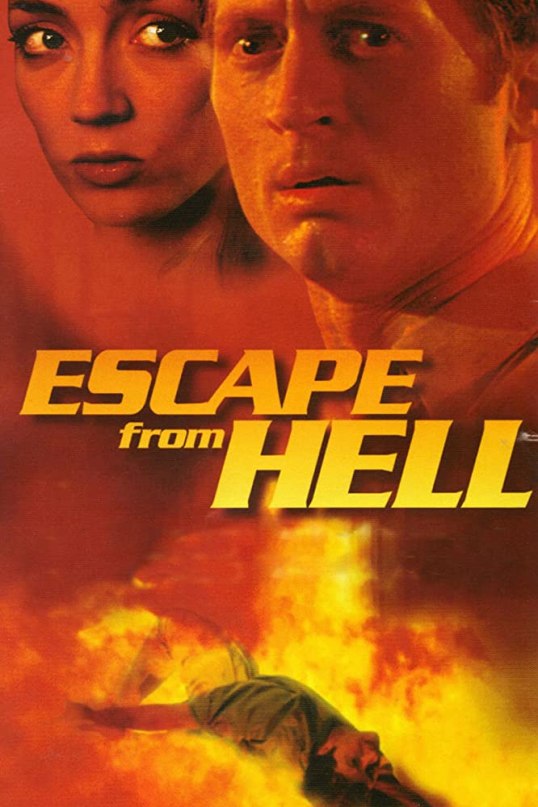
Film Review: Escape From Hell (dir by Danny Carrales)


The 2000 film, Escape From Hell, tells the story of two doctors.

Dr. Marissa Holloway (Emily Jo Tisdale) believes that there is a Heaven and that there is a Hell and that, at the end of your life, you go to one of them.  The film lets us know, early on, that she’s right by letting us into the mind of a good but irreligious family man who is on the verge of death.  At first, the man sees himself heading into a shining light but then, suddenly, he’s plunging into flames!  That’s right.  The good man who loved his family and helped people out and who never did anything wrong to anyone still went straight to Hell.

Dr. Eric Robinson (Daniel Kruse) doesn’t believe that there’s an afterlife.  He believes that everyone who says that they’ve seen either a light or a glimpse of Hell was suffering from a hallucination.  He’s hostile to Marissa’s beliefs.  Could it have something to do with his difficult relationship with his estranged father?  Who knows?

Together, Dr. Holloway and Dr. Robinson solves crimes!

No, actually, they don’t.  Instead, they star in a low-budget, evangelically-themed remake of Flatliners.  After his father dies, Dr. Robinson is more determined than ever to prove that there’s no afterlife so he decides that the smartest thing to do would be to die for a few minutes and then be brought back to life by another doctor.  Like I said, it’s basically Flatliners all over again.  The main difference, of course, is that Flatliners imagined a New Agey afterlife with no God while Escape From Hell leaves little doubt that there’s a Heaven and a Hell and just about everyone’s going to the second place.

Dr. Robinson does originally go to Heaven and it’s a nice-looking meadow.  (Apparently, he just gets to skip Purgatory so lucky him.)  However, the doctor is soon informed that he doesn’t belong in Heaven so bang!  It’s down to Hell that he goes.  Hell is essentially a rocky place with constantly burning fires.  The whole place is tinted red and looks like something you might expect to find in an old video game.  Unfortunately, Dr. Robinson doesn’t get to talk to the five people you meet in Heaven but he does get to talk to a handful of people in Hell, the majority of whom are confused as to why they’re down there but who also realize that they somehow massively screwed up and will never get a chance to escape.  One of the people that Robinson meets turns out to be a demon.  There’s a lot of really cheap CGI that looks kind of silly but, at the same time, still possesses a certain low-rent charm.

While Dr. Robinson is learning about the afterlife, his colleagues are trying to bring him back to life.  If they don’t bring him back quickly enough, Robinson, much like Franklin Delano Roosevelt will be stuck in Hell in forever!

(I should admit that we don’t actually see FDR in Hell.  I just assume he’s down there.)

If you haven’t picked up on it by now, I have a weakness for achingly sincere films that feature primitive CGI.  It’s easy to make fun of movies like Escape from Hell but I tend to view them as being examples of outsider art.  Yes, it’s a flawed film that was apparently made by people who weren’t really sure what they were doing but that’s actually the film’s charm.  The bad acting, the melodramatic dialogue, the cheap CGI, the extremely literal definitions of Hell and Heaven, and the final message that almost everyone on the planet is destined to suffer eternal torment; all of it contributes to make a film unlike almost any other (except, of course, for the original Flatliners)  It’s silly, preachy, and entertaining in its own bizarre way.  It’s the cinematic equivalent of the school prayer advocate who says that children who don’t want to pray can, “Simpy lower their heads and think about how they’ve got it all figured out.”  It may not be good but it’s always watchable in its own twisted way.

Film Review: Peter: The Redemption (dir by Leif Bristow)


I have two main thoughts on the 2016 religious film, Peter: The Redemption.

First off, John Rhys-Davies is a treasure.  The veteran actor plays the role of Peter, the rock of the Church.  The film focuses on Peter’s final days, locked away in a Roman prison and suffering torture at the hand of the Romans.  He’s told repeatedly that all he has to do to win his freedom (and his life) is to publicly renounce his beliefs and confess that the Christians were behind the plot to set Rome on fire.  While Peter waits for death, he is haunted by memories of the night that he denied knowing Jesus.  He feels that he is not worthy to be crucified.  He worries if he’s done enough to atone for his mistakes.  Rhys-Davies gives a powerful performance, capturing both Peter’s anguish and his inner strength.  This is probably one of the best performances that you’ll ever find in a low-budget religious film.

My other thought is that you really haven’t lived until you’ve seen Stephen Baldwin plays the Emperor Nero.  Baldwin plays Nero as being something of a wannabe hipster, desperately trying to convince everyone that he’s more interesting than he actually is and dreaming of rebuilding Rome in his own image.  Baldwin’s Nero is a crazy conspiracy theorist, the type who often seem to be struggling to follow his own line of thought.  There’s not a subtle moment to be found in Baldwin’s performance as Nero but, interestingly, his interpretation of the role is probably fairly close to being historically correct.  By the account of most of the Roman historians who lived through and actually managed to survive his reign, Nero considered himself to be an artist and an intellectual and his dream was to be as acclaimed as a performer as he was an emperor.  It’s been said that Nero was killed as much for his artistic pretensions as his administrative mistakes and that his final words were, “What an artist dies within me!,” and one can certainly believe that while watching Baldwin’s performance.

Unfortunately, Peter: The Redemption gets distracted by a subplot involving the blossoming relationship between a servant in Nero’s court and one of Peter’s guards.  It’s the same basic story as Quo Vadis?, just told in a lot less time and on a much smaller budget.  To be honest, I kind of liked the film’s low-rent version of Rome.  Rome is usually presented as being this glamorous and impressive city but most historians of the era tend to emphasize the fact that the streets of Rome were often dirty and the walls were covered with frequently obscene graffiti.  (In fact, graffiti was the main form of political protest in the Roman Empire.)  No wonder Nero wanted to burn the place down.

Anyway, Peter: The Redemption is okay.  It tells its story effectively enough and the performance of John Rhys Davies elevates every scene in which he appears.  The film gets bogged down whenever it concentrates on the romance in Nero’s court but Baldwin and Rhys Davies keep things watchable.

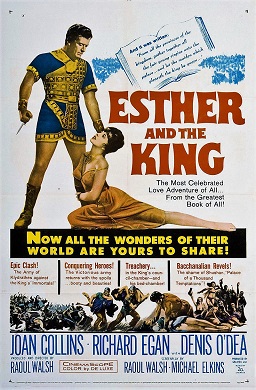
Film Review: Esther and the King (dir by Raoul Walsh)


The 1960 Italian-American co-production, Esther and the King, opens in ancient Persia.  King Ahasuerus (Richard Egan) has just returned from conquering Egypt and he is angered to discover that his wife, Vashti (Daneila Rocca), has been cheating on him with not just his main advisor, Haman (Sergio Fantoni), but also with the entire palace guard as well.  After the Queen shows her further displeasure with the King by doing a topless dance in front of the entire royal court, the King banishes her from his life.

Since the king now needs a new wife, every attractive woman in the land is dragged off to the palace so that she can audition for the role.  Among those forcibly recruited is the strong-willed Esther (Joan Collins), who was previously engaged to a rebel named Simon (Rick Battaglia).  What the king doesn’t know is that Esther is both Jewish and the cousin of Mordecai (Denis O’Dea), who has recently offended Haman by refusing to bow down before him.  Haman and his wife (Rosalba Neri) are now plotting to execute all of the Jews is Persia.  Despite her love for Simon, Esther remains in the competition to become the Queen so that she can save her people….

There are a few things that you immediately notice about Esther and the King.

First off, it’s an extremely loose adaptation of the story of Esther, one that is designed to make the King out to be a far more sympathetic figure than he actually was.  Whereas the King actually banished his wife after refused to attend a banquet where the drunken King wanted her to pose naked, Esther and the King presents the King as being the wronged party as his wife is literally cheating with every available man in the kingdom.  (Ironically, the film actually presents the King as being forced to banish his wife after she removes her top during a banquet whereas, in actuality, it was her refusal to do so that led to be her being exiled.)  The film also adds in considerably more battles and a lot more court intrigue as all of the king’s potential wives compete for his attention.  And, of course, then there’s Esther’s fiancee, Simon, who does not appear anywhere in the original text.

The other thing that you immediately notice about Esther and the King is that ancient Persia apparently looked a lot like ancient Rome.  That’s not surprising when you consider that this was an Italian co-production and that Esther and the King is as much of an old school peplum film as a biblical adaptation.  This is a biblical adaptation that is as concerned with sword fights and banquets as it is with prayer and religion.

Regardless of whether it’s historically accurate or not, it’s an entertaining film.  Admittedly, Richard Egan is a bit of a stiff as the King and Joan Collins really doesn’t bring much beyond beauty to the role of Esther.  But the sets are properly ornate and the costume are to die for.  Mario Bava was the film’s cinematographer (and some sites credit him as being the film’s co-director as well) and Esther and the King is gorgeous to look at.  This is one of those historical epics where almost everything feels appropriately big, from the palaces to the emotions to the melodrama.  The supporting cast is largely made up of Italian actors who all appear to be having a great time playing up the drama of it all.  Sergio Fantoni is wonderfully hissable as the evil Haman.  (Boo!  Haman!  Boo!)  Rosabla Neri also has some memorably manipulative moments as Zeresh, the wife of Haman (boo!)  For those of us who like big and not necessarily historical accurate epics about the ancient world, Esther and the King is a lot of fun.

Film Review: Alexander (dir by Oliver Stone)


Before I really get into talking about Oliver Stone’s 2004 film, Alexander, I should acknowledge that there’s about four different version of Alexander floating around.

There’s the widely ridiculed theatrical version, which was released in 2004 and which got terrible reviews in the United States, though it was apparently a bit more popular in Europe.  This version of Alexander was a notorious box office bomb and Oliver Stone’s career has never quite recovered from it.  Though Stone’s still making movies, it’s been a while since he’s really been taken as seriously as you might expect a two-time Oscar winner to be taken.  The box office and critical failure of Alexander is a big reason for that.

There’s also the Director’s Cut of Alexander, which is slightly shorter than the version that was released into theaters and which apparently emphasizes the action scenes more than the original film did.  For an Oscar-winning director to release a director’s cut that’s actually shorter than the version that he originally sent into theaters is rare and it shows that the film’s subject matter was one that Stone was still trying to figure out how to deal with.

There is also the “Final Unrated Cut,” which lasts 3 hours and 45 minutes and which Stone described as being the Cecil B. DeMille-version of the story.  At the time the Final Unrated Cut was released in 2007, Stone announced that he had put everything back into the movie and that we were finally able to see the version of the story that he wanted to tell.

However, Stone apparently still left some stuff out because, in 2009, we got the Final Cut, which goes on for 206 minutes and which, once again, apparently includes everything that Stone wanted to put in the original cut of the film.  The Final Cut has actually received some positive reviews from critic who were not impressed by the previous three versions of Alexander.

For the record, I saw the Director’s Cut.  This is the second of the Alexanders, the one that runs 167 minutes.  Some day, I’ll watch the four hour version and I’ll compare the two films.  But for now, I’m reviewing the 167-minute version of Alexander.

Anyway, Alexander is a biopic of Alexander The Great, the Macedonian ruler who took over a good deal of the known world before mysteriously dying at the age of 32.  The film jumps back and forth in time, from an elderly Ptolemy (Anthony Hopkins, going about as overboard as one can go while playing an ancient Greek historian) narrating the story of Alexander’s life to Alexander (Colin Farrell) conquering his enemies to scenes of Alexander’s mother (Angelina Jolie) and one-eyed father (Val Kilmer) shaping Alexander’s outlook on the world.  Along the way, we discover that Alexander was driven to succeed and forever lived in the shadow of his father.  We also discover that he may have been in love with his general, Hephaistion (Jared Leto), even though he married Roxane (Rosario Dawson, who gets to do an elaborate dance).  We also discover that no battle in the ancient world could begin before Alexander gave a long speech and that all of the Macedonians spoke with thick Irish accents.  Stone has said that the Irish accents were meant to signify that the Macedonians were working-class.  Other people say that, because Colin Farrell’s accent was so thick, the rest of the cast had to imitate him so he wouldn’t sound out-of-place.

And here’s the thing — yes, Alexander is a big, messy film that is often incoherent.  Yes, the cast is full of talented actors, every single one of which has been thoroughly miscast.  Yes, it’s next to impossible to keep track of who is fighting who and yes, it’s distracting as Hell that all of the Macedonians have Irish accents and that Angelina Jolie uses an Eastern European accent that’s so thick that it almost becomes a parody of itself.  All of these things are true and yet, I was never bored with the director’s cut.  The sets were huge, the costumes were beautiful, and the cast was eccentric enough to be interesting.  Val Kilmer, Angelina Jolie, and Anthony Hopkins all go overboard, chewing every piece of scenery that they can get their hands on.  Colin Farrell alternates between being determined and being wild-eyed.  Jared Leto allows his piercing stare to do most of his acting.  Even Christopher Plummer shows up, playing Aristole with a North Atlantic accent.  No one appears to be acting in the same film and strangely, it works.  The ancient world was chaotic and the combination of everyone’s different acting styles with Stone’s frantic direction actually manages to capture some of that chaos.

Oliver Stone apparently spent years trying to bring his vision of Alexander’s life to the big screen.  Watching the film, it’s a classic example of a director becoming so obsessed with a story that they ultimately forgot why they wanted to tell it in the first place.  Stone tosses everything he can at the cinematic wall, just to see what will stick.  Is Alexander a tyrant or a misunderstood humanist?  Is he a murderer or a noble warrior?  Is he in love with Hephaistion or has his borderline incestuous relationship with his mother left him incapable of trusting anyone enough to love them?  The film doesn’t seem to know who Alexander actually was but it’s so desperate to try to find an answer among all of the endless battle scenes and lengthy speeches that it becomes undeniably compelling to watch.  If nothing else, Alexander gives us the rare chance to see an Oliver Stone film in which Stone himself doesn’t seem to quite know what point it is that he’s trying to make.

Alexander is a mess but there’s something fascinating about its chaos.  It’s a beautiful wreck and, as with all wrecks, it’s impossible to look away.

The International Lens: The Enigma of Kaspar Hauser (dir by Werner Herzog)


Once upon a time, in 19th century Germany, there was a young man who was known as Kaspar Hauser.

No one was really sure what Kaspar’s original name was or where he even came from.  He was found, in 1828, wandering the streets of Nuremberg.  He carried an unsigned letter with him, one that said that he was 16 yeas old, from the Bavarian border, and that he had been raised by someone who taught him how to read and write and about “the Christian religion.”  The note also stated that the boy had never been allowed to step out of the house before being taken and abandoned in Nuremberg.  He carried a second letter, which was supposedly from his mother and stated that the boy’s name was Kaspar and that his father had been in the Cavalry.  Some people who saw the two letters felt that they had both been written in the same handwriting, leading to speculation that Kaspar may written the letters himself.

When he was first found, it was believed that Kaspar could barely speak.  He knew the word for “Horses!” and he often repeated the phrase, “My father was cavalryman!”  As time progressed, Kaspar’s vocabulary expanded and he said that his earliest memories were of being locked away in a room.  His meals were brought to him by someone who always wore a mask.  Some people felt that Kaspar may have been the kidnapped child of a nobleman or an unacknowledged member of the royal family.  Others felt that he was a charlatan and that he was faking the entire thing.  Briefly, Kaspar was a celebrity as people from around the world wondered who he was and where he had come from.

In 1828, he was found with a cut on his forehead.  He said that he was attacked by a mysterious stranger who announced, before cutting him, “You have to die!”  The stranger was never found and there was even some speculation that Hauser had cut himself.  In 1830, he was found with another wound on his forehead, this time claiming that he had been grazed by a bullet after a gun accidentally went off.  Again, some felt that Hauser was intentionally injuring himself for the attention while others felt that the people who had held him prisoner were again trying to kill him.

Hauser was found wounded one last time, in 1833.  This time, he was found with a deep cut to his chest.  He claimed that he had, again, been attacked by a mysterious stranger.  A note was found where Hauser claimed that he had been attacked, a cryptic letter that claimed that the attacker was the same man who had previously cut Hauser’s head.  By this point, there was a lot more skepticism about Hauser and his stories and it was generally assumed that he had stabbed himself and injured himself worse than he ha intended.  It’s said that when Hauser died of his wounds, his last words were, “I didn’t do it to myself.”  Assuming that Hauser was born when the note from his mother claimed that he was, Kaspar Hauser was 21 when he died.

The mystery of Kaspar Hauser is an intriguing one and it’s one that’s explored in Werner Herzog’s 1974 film, The Enigma of Kaspar Hauser.  The film sticks fairly closely to the known facts of Hauser’s life.  For instance, Herzog does not show us the final attack on Hauser.  Instead, he just has Hauser tell us about the attack, leaving it to us to decide whether or not Kaspar is telling the truth.  At the same time, the film starts with footage of Kaspar being held in a small room.  We watch as a dark-clad stranger carries Hauser to Nuremberg and, after showing him how to walk, then abandons him on the streets of the city.  Herzog accepts Hauser’s claim that he was raised in a locked room but he leaves it to us to decide why Hauser was in that room and why he was eventually abandoned in Nuremberg.

Kaspar Hauser is played by an actor named Bruno S.  Bruno S. was a nonprofessional and he was 42 year-old when he played the 16 year-old Hauser.  And yet, Bruno S. has such an unconventional screen presence that he seems perfect for the role.  With his wide-eyed stare and his tentative movements, Bruno S. is poignantly believable as someone who is discovering the world for the same time.  As the film progresses, Hauser develops a sharp and cynical wit, all of which Bruno S. captures perfectly.

Hauser is another Herzog protagonist who, because he’s on the outside of regular society, has developed the ability to see the world in a way that no one else can.  While he lays dying, Hauser has visions of nomadic Berbers in the Sahara Desert.  Why?  Why not?  That’s the enigma of Kaspar Hauser.  As in all of his best films, Herzog embraces the questions without trying to manufacture answers and the end result is a haunting film about one of Germany’s most enduring historical mysteries.