Film Review: Bloody Sunday (dir. by Paul Greengrass)


On January 30th, 1972, in the Bogside area of Derry, Northern Ireland, the British army opened fire on what-was-meant to be a peaceful demonstration.  13 men were killed on the spot, another died later of his injuries.  In the months leading up to the demonstration, the British army had been frequently attacked by pro-independence, largely Catholic “nationalist” groups and the Army was quick to claim that the were acting in self-defense and that they had been fired upon.  Others, however, pointed out that almost all of the men killed (most were just teenagers) had been shot while fleeing the soldiers and none had any weapons on them.  This was the event known that later became known as Bloody Sunday and served as one of the leading catalysts for the decades of “Troubles” that would follow.

Earlier today, 38 years after the fact, British Prime Minister David Cameron finally publicly acknowledged the fact that the 14 men killed on Bloody Sunday were murdered.  Much like the classic Monty Python skit where Eric Idle is convicted of murdering 300 people in one day, Cameron said that he was “very, very sorry.”  (Actually, Idle said that but the idea is the same.)

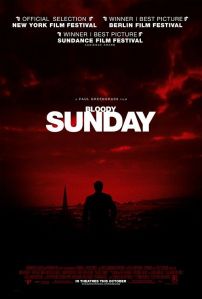
The Bogside Massacre also served as the basis of one of the best (and most important) films of the first decade of the 21st Century, 2002’s  Bloody Sunday.

Directed by Paul Greengrass (who would later, of course, direct the final two Bourne films), Bloody Sunday is a disturbing recreation of January 30th, 1972.  We watch as the civil rights activist Ivan Cooper (a very likable James Nesbitt) makes his way through the Bogside area of Derry, encouraging people to attend the march while still finding time to beg the local IRA leadership not to start any violence.  While most critical attention is, understandably, given to the scenes that recreate the massacre itself, these early scenes are just as important.  They establish the idea of the people of Bogside as being a community full of actual individuals as opposed to just a collection of pawns in the war between the nationalists and the unionists.

While Cooper tries to ensure peace, we are given contrasting scenes of the British army preparing for the exact violence that Cooper is trying to prevent.  Ironically, in these opening scenes, both Cooper and his military counterparts are motivated by the same basic fear of the IRA.  Its only once the demonstration has started and the first shots are fired that Cooper realizes that the establishment is far more dangerous than the insurgents.

Throughout the film, Greengrass directs in his signature, documentary-style, employing hand-held cameras and rejecting any artistic flourishes that might take the viewer out of the “reality” of the situation.  Each scene ends with a fade-to-black and, as a result, the viewer gets the feeling that he is literally dropping in on the action.  This is not to say that Greengrass is not an artful director.  The power of his artistry, however, comes from his ability to hide the technique.  As a director, he does not demand attention with a lot of showy tricks.  Instead, he earns the attention by perfecting his craft.

Greengrass’s psuedo-documentary style is at its strongest and most devastating during the recreation of the massacre itself.  Perhaps because the film was made for British television at a time when there was still official doubt about what set off the Bogside Massacre, Greengrass leaves hazy the exact reason as to why the army starts firing.  However, what he does make clear is that the 14 men killed were, essentially, murdered.   One of the unfortunate things about being as big a movie fan as I am is that I’ve grown jaded to the sight of people dying on-screen.  However, unlike many other similar films, the deaths in Bloody Sunday are not presented as just being plot devices or as an excuse to get an emotional response from the audience.  Instead, the deaths in Bloody Sunday hurt because you immediately know that, regardless of which you side you support as far as the Troubles are concerned, none of the deaths were necessary.  They were, instead, the product of a nation’s wounded pride.  14 men died so that the British could feel British again.

As you can probably guess, the British don’t come across particularly well in Bloody Sunday and, quite frankly, they shouldn’t.  Watching this movie, you’re left with the impression that the Bogside Massacre was the British Army’s attempt to exorcise the demons of the collapse of the British Empire by killing the Irish.  (Though, in all fairness, the Irish killed a lot of British in the time leading up to Bloody Sunday.)  However, and this is to Greengrass’s credit, individual British soldiers are shown to question the massacre.  Its only when those soldiers are forced give up their individuality and function as a collective that they commit (and, at the film’s end, conspire to cover up) murder.  For just that, this movie should be required viewing for anyone who insists on claiming that “individualism” is a threat to society.

The film ends on a quiet note as a somber Cooper announces that he no longer sees a “peaceful” solution.  This scene gets its power largely from Nesbitt’s own charismatic performance.  Playing the closest thing the film has to a central character, Nesbitt makes his early enthusiasm for the march so infectious that its simply devastating to see him after the massacre, angry and disillusioned.  It also reminds the viewer that, in the years after Bogside, there was no peace and many more innocent people — on both sides of the conflict — would die.  The British army may have thought it was going to scare Northern Ireland into submission but instead, they helped to perpetuate a continuing cycle of death, destruction, and hatred that, regardless of any treaty, continues to this very day.

I should admit that I’m a fourth Irish.  My great-grandparents were born and raised in Ardglass, Northern Ireland.  Though I’ve never been, I hope to visit Ardglass some day.  Though I no longer consider myself to be a member of any religion, I was raised in the Catholic church.  As such, I’ve always had an interest in Irish history and the Troubles in particular.  I’ve also always been biased towards the nationalist side. 

So, it would be fair for someone to ask if I’d have the same reaction to this film if I was a Protestant with family living around London and the honest answer is that I don’t know.

However, the power of Bloody Sunday doesn’t come from political ideology.  Instead, the movie serves as a disturbing but powerful reminder of what can happen when people surrender their free will to groupthink.  Though the oppressors in Bloody Sunday may be British, recent history has proven that, when actively opposed, those with all the power will always react with the same brutal fury.  The forces of oppression remain the same whether they’re in Northern Ireland, Iran, Honduras, or the U.S.A.
Poll: Which Movie Should Lisa Marie Review?


Last night, with the help of my friend Jeff, I conducted an experiment. 

First, I took out my contacts which basically left me blind.  Then, just to make sure I was totally without sight, I had Jeff blindfold me.  He then took me by the hand and led me over to my DVD collection.  Clumsily, I grabbed 10 DVDs at random and handed them back to Jeff.  I then proceeded to walk into a wall, at which point I tried to take off the blindfold and ended up losing my balance and falling down flat on my ass. 

Why was I risking life and limb to randomly select 10 DVDs?

I did it so you could have the chance to tell me what to do.  At the bottom of this article, you will find a poll listing the 10 DVDs I randomly selected.  Come next Saturday (June 19th to be exact), I will watch and review whichever movie receives the most votes in the poll.  In short, I’m giving you all the power.

Now, to be honest, I’m feeling just a little trepidation about doing this.  Whenever you set up a poll, you’re running the risk of absolutely no one voting.  Fortunately, I have a plan B in that I recently got the 1st season of Gossip Girl on DVD.  If nobody votes in the poll, I’ll just spend next Saturday watching Gossip Girl and writing several long — very long —  essays on how different Chuck is in the books as compared to the TV show.

The choice, as they say, is yours.

The 10 movies I blindly selected are listed below in alphabetical order.

1) Anatomy of a Murder (1959) — Jimmy Stewart asks Lee Remick a lot of questions about her panties.

2) Darling (1965) — Julie Christie claws her way to the top of the modeling industry and discovers ennui.

3) Emanuelle in America (1978) — Emanuelle investigates decadence in America.  Some people think that this movie contains footage taken from an actual snuff film.  We call those people “idiots.”

4) Hatchet For The Honeymoon (1969) — Mario Bava directs this film about a man driven to murder by the sight of an unflattering bridal gown.

5) Lost in Translation (2003) — I will admit that I squealed with joy when I discovered that I had randomly selected one of my favorite movies of all time.

6) Primer (2004) — Engineers play with time and space.  Oddly enough, this movie was filmed a few miles away from where I live.

7) The Sidewalks of Bangkok (1986) — Like most of Jean Rollin’s film, this is something of a misunderstood masterpiece.

8 ) Sole Survivor (1982) — An atmospheric little horror film with a sadly generic title.

9) Starcrash (1978) — Strange sci-fi movie in which Christopher Plummer recruits space pirate Caroline Munro to battle a pre-Maniac Joe Spinell.  This film also marks the screen debut of David Hasselhoff.

10) The Sweet House of Horrors (1989) — One of Lucio Fulci’s last films.

So, those are our ten options.  On Saturday, July 19th, I will sit down, watch, and review whichever movie receives the most votes.  On that day, for four to six hours, I will give up my independence and submit to the wishes of the majority.

Film Review: Zombie 5: Killing Birds (dir. by Claudio Lattanzi and Joe D’Amato)


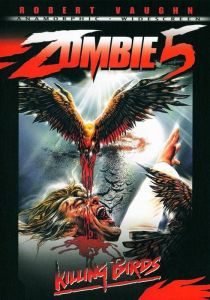
Thanks to the wonderful people at Anchor Bay, I recently watched Zombie 5: Killing Birds, one of the last of the old school Italian horror films.

Admittedly, when I first hit play on the DVD player, I was expecting the worst.  Of all the various official and unofficial sequels to Lucio Fulci’s masterpiece Zombi 2 (which, of course, was itself an unofficial prequel to Dawn of the Dead), Zombie 5: Killing Birds has the worst reputation.  While most Italian horror fans seem to agree that Zombie 4 is enjoyable on its own stupid terms and even Zombi 3 has a few brave defenders, its hard to find anyone willing to defend Killing Birds.  The general consensus has always seemed to be that Killing Birds is a generic and rather forgettable splatter film that, title aside, had absolutely nothing in common with the Fulci classic.

Having now seen Killing Birds, I can say that the general consensus, in this case, is largely correct.  Killing Birds is generic, predictable, and ultimately forgettable.  However, taken on its own terms, it’s a perfectly enjoyable way for a lover of zombie cinema to waste 90 minutes.  As long as you don’t compare it to Zombi 2, i’ts a perfectly tolerable piece of trash that actually has one or two memorable moments tossed randomly through its running time.  At the very least, its a hundred times better than Umberto Lenzi’s similar Black Demons.

The film deals with a bunch of grad students who, while searching for a nearly extinct species of Woodpecker, end up spending the night at a deserted house in Louisiana.  Many years ago, a brutal murder was committed at this house and, well, you can guess the rest.  The grad students end up falling prey to a bunch of zombies, largely because the students are all remarkably stupid.  Meanwhile, B-movie veteran Robert Vaughn shows up as Dr. Fred Brown, a blind man who spends his days studying birds.  There’s a lot of birds in this movie and its never quite clear how they link up to the living dead but they certainly do look menacing flying past the camera.

With the exception of Vaughn (who overacts just enough to keep things interesting without going so far over the top as to become ludicrous), the film’s cast is likeable but not memorable.  Everyone’s playing a stereotype (i.e., the leader, the computer geek, the slut, the girl with looks and brains) and no one makes much of an effort to be anything more than a stereotype.  While this certainly keeps Killing Birds from displaying anything resembling nuance, it’s also strangely comforting.  Its lets a neurotic viewer like me know, from the start, that there’s no need to think too much about anything she might see for the next hour and a half.  Since this movie was made in the late 80s, most of the men sport a mullet and all of the women wear those terribly unflattering khaki pants that I guess were all the rage back then.

As I stated before, the film does have its occasional strengths.  Some of the deaths are memorably nasty (even if the gore effects are decidedly cut-rate, pun not intended).  As well, the film does an excellent job at capturing the hot, humid atmosphere of the Louisiana bayous.  I’ve spent enough time in that part of the country that I can attest that the movie perfectly captures the stagnant heat and the way dehydration can cause your mind to play tricks on you.  While the zombies themselves are hardly as impressive as Fulci’s, the filmmakers wisely keep them in the shadows for most of the film and, if nothing else, this allows the viewer to imagine something scarier than what they’re actually seeing.  Finally, this movie does have one of the most effective nightmare sequences that I’ve ever seen.  Lasting barely a minute and not really having much to do with the overall plot, this nightmare still features some rather disturbing imagery.  One image, in particular, has so stuck with me that I found myself paying homage to it in a my own writing.

Though the movie’s director is credited as being Claudio Lattanzi, it is pretty much an open secret that the movie was actually directed by the infamous Joe D’Amato (who, regardless of what else he may have done during his storied life, also directed one of my favorite movies ever, Beyond The Darkness).  I’ve read a few interviews where D’Amato said that he allowed Lattanzi to be credited as director because he wanted to help Lattanzi’s launch his own career.  To judge by the movie itself, however, it seems more probable that Lattanzi wasn’t delivering the movie that D’Amato wanted and D’Amato stepped in as a result.  Regardless, Killing Birds is hardly the best example of D’Amato’s work but, at the same time, it’s hardly the worst either. 

In the end, Killing Birds is a movie that will probably be best appreciated by those who already have a good working knowledge of Italian exploitation films.  It’s hardly a masterpiece (and, despite enjoying it, I would hesitate to even call it a “good” movie) but it’s not really deserving of all the criticism that it’s received over the years either.  As a bonus, the Anchor Bay DVD come with a lengthy interview with Robert Vaughn in which he discussed his career in B-movies and, while Vaughn says nothing about Killing Birds during the interview, he’s still interesting and enjoyable to listen to.  Unlike a lot of “reputable” actors who have made B-movies, Vaughn never condescends to the films that both started and ended his movie career.

A Quickie With Lisa Marie: Putney Swope (dir. by Robert Downey, Sr.)


One of my favorite recent DVD discoveries is an underground film from 1969 called Putney Swope.   Directed by Robert Downey, Sr. (who, as we all know, was the father of not only Iron Man and Sherlock Holmes but Sgt. Osiris as well!), Putney Swope is a hilarious satire of advertising, race relations, and everything in between.  It’s a must-see for anyone interested in American independent film, American satire, or just plain vulgarity in the service of art and humor.

Since the film takes place at the Truth and Soul Advertising Agency, it features several fake commercials that are so spot-on perfect that they could easily pass for the real thing if not for all the profanity and occasional nudity.  Below is my favorite Truth and Soul Commercial:

Review: Test Tube Babies (dir. by W. Merle Connell)


If I haven’t already made it clear in my previous reviews on this site, I love exploitation films.  Regardless of whether they’re blaxploitation or gialli or whether they’re about zombies or cannibals or just people looking for revenge, I love everything about them.  I love them because they’re shameless, they’re frequently incoherent, and occasionally, they’re works of pure (if fractured) genius. 

However, I have a special place in my heart for the old school exploitation films of the 1930s and 40s.  These are the exploitation movies that came out while the American film industry still operated under the puritanical production code.  While the mainstream film industry was still struggling with the idea of Clark Gable saying “damn” onscreen, the underground B-movie makers were making the movies that everyone saw but few people ever talked about.  These were low-budget movies, filmed on the cheapest stock available and often times edited with all the skill of a chainsaw-wielding maniac.  And while these movies were not necessarily impressive technically, they continue to serve as proof that even our elders occasionally enjoyed a dirty joke.

For the most part, these exploitation films were disguised as being public service announcements.  Hence, a film like Ruined Souls wasn’t just a movie about young people skinny dipping and having sex.  No, it was a warning about the dangers of venereal disease.  Typically, once the film had finished showing off all the bad behavior it could, an authority figure (usually a doctor) would show up and explain why those in the audience shouldn’t do any of the things they had just watched.  There’s a shamelessness to these old school exploitation films that reminds me why I admire panhandlers who go through the trouble to come up with an entertaining way to ask me for my money.

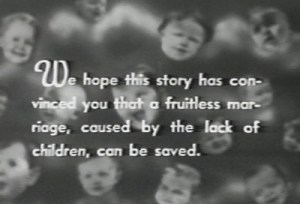
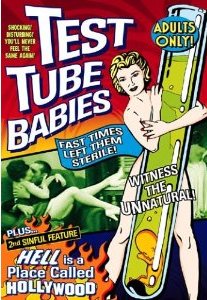
1948’s Test Tube Babies (directed by W. Merle Connell and produced by George Weiss, who would produce most of Ed Wood’s early films) is a typical example of an old school exploitation film.  Now the title might lead you to think that this is going to be another horror film about demonic children.  However, the exact opposite is true.  The message of Test Tube Babies (the film’s PSA) is that any marriage — regardless of how drab and dull — can be saved by forcing the wife to go through hours of excruciatingly painful labor.

The first half of Test Tube Babies plays out roughly like the 1st half of Revolution Road.  A boring young man named George meets a frumpy young woman named Cathy.  They’re attracted to each other and, since this is the 1940s after all, they get married so that they can have sex.  George and Cathy go on a whirlwind honeymoon.  They get a house in the suburbs.  George gets a job and Cathy settles into the life of being a slave (or “housewife,” as it was apparently known in the 1940s.)

However, is it possible that there is trouble in paradise?  Shortly after the honeymoon is concluded, we start to get hints that maybe Cathy isn’t entirely satisfied being an indentured servant.  At the breakfast table, Cathy and George talk about how boring their social life is.  When George’s womanizing friend Frank comes to visit, Cathy greets him in her nightie and proceeds to dance with him while a simmering George watches.  What’s wrong with Cathy?  Could it be that she’s suddenly realized that she’s surrendered her own identity just to be someone’s wife?  Perhaps it has dawned on her that marriage is really just a societal invention that’s designed to keep anyone from truly challenging the status quo.  Or maybe she just needs a child to give her an excuse to remain in a loveless charade of a marriage.

Regardless of the reason why, Cathy is clearly dissatisfied with her new life.  Soon, once George is off at work, Cathy invites all of her decadent friends over to the house for a party.  This party appears to be the 1940s version of a key party.  As Cathy plays hostess, Frank proceeds to make out with another man’s wife and then, from out of nowhere, an elderly lady with bleached blond hair shows up and starts talking about her former life as a burlesque dancer.  As Cathy watches in horror (no doubt wondering why she couldn’t have just listened to her husband like a good, dutiful slave), the dancer starts to dance and things quickly escalate until Cathy is finally forced to call George at work and beg him to come home.

One of the reasons I love these old school exploitation films is that they provide a chance to see what our grandparents considered to be risqué.   It’s a chance to peer into the repressed sexuality of our elders.  So, what can we learn from watching the party scene in Test Tube Babies?

1)  To judge from the leering reaction given to the frumpy clothing worn by the female guests, Sears was apparently the Victoria’s Secret of the 1940s.

2) The entire party sequence ends with a bizarre catfight between two women, over the course of which both women somehow end up naked.  This serves to prove that, much as I always suspected, men have always been the same.

In a plot development that was later shamelessly ripped off by Revolution Road, all of this suburban decadence leads to Cathy and George realizing how empty their “perfect” sham of a marriage really is.  Whereas Kate Winslet decided that this emptiness was linked to her sacrificing her own identity to be a wife, Cathy decides that the marriage is empty because she’s not yet a mother.  After all, what could be better than bringing another human being into the world for the sole purpose of justifying a failed marriage?  Never mind that neither George nor Cathy comes across like the type of people who could actually raise a happy child.  What’s important here is to go through the societal motions.

Cathy, of course, wants to get pregnant immediately because you know us women.  We’re just slaves to the old biological clock.  However, despite George’s best efforts, Cathy simply cannot get knocked up.  She wonders if maybe something’s wrong with her.  George is quick to agree that something could be wrong with her so, like any good American couple, they go to a doctor to specifically find out what’s wrong with the wife.

(Interestingly enough, just to judge from the movie’s dialogue and the fact that Cathy is shocked when told to undress before being examined, it would appear that this is not only the first time that she’s ever been to a gynecologist but perhaps the first time she’s even heard the term “gynecologist.”  To judge from this movie, apparently women in the 40s were simply locked up in the attic until some idiot came by and paid their dowry.)

It’s here that the movie takes a truly shocking turn as it is revealed that — gasp! — nothing is wrong with the wife.  Instead, George is sterile.  And this, of course, leads us to the whole concept of test tube babies and how they can even save the most pointless of marriages.

Now, the filmmakers obviously knew that this would a bitter pill for a 1948 audience to swallow so, in order to make sure we understand that this sort of thing actually does happen, we are introduced to Dr. Wright.  If for no other reason, see this movie for Dr. Wright.  With his oily hair, his ever-present smirk, and an equally ever-present cigarette, Dr. Wright is probably the creepiest gynecologist this side of Jeremy Irons in Dead Ringers.  As played by exploitation vet Timothy Farrell, Dr. Wright is the only character in the film to seem to realize that he’s surrounded by idiots.

In the great tradition of old school exploitation, Dr. Wright is used to explain and justify the concept of a test tube baby.  By doing so, Dr. Wright justifies and excuses all of the “decadence” that has previously been put up on-screen.  Dr. Wright also makes a good argument for the health benefits of cigarettes.  Seriously, I have never seen a doctor smoke as much as Dr. Wright.  Literally, his every scene is enveloped in a cloud of smoke.  He smokes while conducting a consultation, he smokes in between operations, and apparently he even smokes while conducting his examinations.  (Which reminds me of a story concerning an ex-boyfriend but the less said about that the better…)  Perhaps his best scene comes when, spying a nervous George in a hospital waiting room, Dr. Wright suggests that George “smoke a cigarette and relax.”  (“I’ve already gone through two packs!” George replies and everyone shares a cancerous laugh.)

In the end, what can you really say about this odd little time capsule?  As far as old school exploitation is concerned, it’s not a classic in the way that a movie like Reefer Madness is.  Still, the movie holds a strange fascination for me.  Some of it, of course, is the whole “so-good-that-its-bad” factor.  This movie has that in spades.  However, I think an argument can be made that movies like Test Tube Babies provide a view into the American subconscious that more mainstream films simply can not.  Freed up from the confines of the Hollywood production code, the old school exploitation movies could give the people what they wanted to see as opposed to what they felt they should want to see.

Perhaps that’s the real appeal of a movie like Test Tube Babies.  Its proof that people were fucked up before any of us were born and that they’ll continue to be fucked up long after we’re gone.

Then again, perhaps I’m just reading too much into an amusingly bad B-movie.

Perhaps it would be best to give the movie the final word…

Review: My Best Fiend (dir. by Werner Herzog)


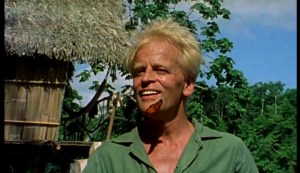
How do I explain my fascination with Klaus Kinski, an actor who died long before I even saw my first movie?  Certainly, it’s not due to his charming screen presence.  Kinski never made any secret of the fact that he loathed most of his films and that loathing is usually painfully apparent on-screen.  Nor can my fascination be linked to the quality of the films he made.  With the exception of a few Italian spaghetti westerns and a set of films he made with Werner Herzog, the majority of Kinski’s films are of little interest beyond his performance in them.  Kinski’s film career was largely made up of playing countless murderers, rapists, and psychopaths.  By most (but certainly not all) accounts, he committed even worse behavior offscreen.

Yet somehow, Klaus Kinski has captured not only my imagination but the imagination of film buffs around the world.  A very good friend of mine has confessed to me that she finds watching Kinski in a bad film to be an almost erotic experience and I have to admit that I do as well.  Kinski had one of those faces that was so ugly that it was almost beautiful and, watching him onscreen, it’s hard not to feel as if the you are literally watching cinematic exorcism.  It’s as if the fictional characters that Kinski creates are little more than his real-life demons being captured on-screen.  A lot of actors specialize in playing insane but Kinski seemed to actually be insane.  Even today, watching his performance in Augirre, The Wrath of God on DVD, it’s hard not to feel as if Kinski is going to jump out of the TV at any minute and proceed to destroy your living room while screaming insults in German.  Even nearly 20 years after his death, Klaus Kinski remains mad, bad, and dangerous to know. 

I have to admit, I’ve always had a weakness for the whole fantasy of the bad boy with the wounded poet’s soul and, even middle-aged and ugly, Klaus Kinski was the ultimate bad boy.  Whether or not Kinski had the soul of a poet is another question and a difficult one to answer.  However, if you’re going to solve to riddle of who Klaus Kinski really was, that’s the question that must be answered.  And probably the best place to start your investigation is with Werner Herzog’s 1999 documentary/tribute, My Best Fiend.

Herzog directed Kinski in five films, beginning with the classic Aguirre, the Wrath of God in 1972 and ending with the unfortunate Cobra Verde in 1987.  The spirit of their collaboration can be seen in the fact that Herzog was rumored to have directed Kinski at gunpoint in Aguirre (though Herzog denies this) and that Kinski eventually physically assaulted Herzog during the filming of Cobra Verde.  In both the contemporary press and his own controversial autobiography (entitled Kinski: All I Need Is Love) Kinski regularly declared Herzog to be “an idiot.”  Herzog, for his part, regularly declared that he would never make another movie with Kinski just before signing him to another role.  Despite all this however, Kinski’s best performances were given in his movies with Herzog and no other actor has ever proven to be as perfectly suited to translate Herzog’s worldview as Klaus Kinski (though Nicolas Cage came close in last year’s Bad Lieutenant).  My Best Fiend is Herzog’s attempt to understand his late muse.

The film opens with a classic Kinski image.  We see a young, long-haired Kinski, standing on stage.  He’s in the middle of one of his infamous one-man shows and has decided that the audience is not paying proper attention to him.  He responds to this by literally attacking the audience. 

We soon learn that shortly after this footage was filmed, Kinski agreed to star in Aguirre, the Wrath of God.  Over archival footage of Kinski scowling and screaming in the Amazon, Herzog talks about both working with Kinski as an actor and about filming Aguirre in general.   (Even if you’re not interested in the twisted life of Klaus Kinski, My Best Fiend is fascinating as a behind-the-scenes look at filmmaking.)  Herzog talks about how Kinski regularly threatened to leave the production and how he responded by threatening to murder Kinski if he did.  Members of the film crew are interviewed.  They create a portrait of a monstrous man who, at one point during filming, shot off a cameraman’s thumb for no discernible reason.  And yet, as all of this is presented to us, Herzog also shows us clips of Kinski’s amazing performance in the movie.  Much like Herzog, we are forced to wonder how such a loathsome human being could also be such a gifted (and, in his admittedly warped way, sensitive) artist.

Though most of the film is devoted to Aguirre, Herzog does offer up anecdotes about his other collaborations with Kinski.  He tells how Kinski would regularly threaten to have him killed and he admits to often fantasizing about killing Klaus Kinski himself.  He goes as far as to mention that, during several film shoots, members of the crew would frequently (and seriously) offer to kill Kinski for him.  He also tells of the hurt of continually reading the latest Kinski interview in which Kinski would, without fail, refer to his director as being an untalented hack.

And yet, the portrait of Klaus Kinski that emerges here is not exactly negative.  Even as Herzog tells us that he often wanted to murder Kinski, he finds the time to visit the apartment where an undiscovered, penniless Kinski once lived.  He talks to people who knew Kinski when he was younger and they offer up stories of a young man who, while undeniably arrogant, was also refreshingly honest in his refusal to compromise his own unique vision of the world.  Herzog interviews two of Kinski’s costars, Eva Mattes and Claudia Cardinale.  Both Mattes and Cardinale describe Kinski as being gentle, calm, and supportive while dealing with them.  Mattes is especially touching as the amount of affection she felt for this supposed madman is obvious in every word she says.  Kinski, himself, is seen assuring Herzog that all the insults and extreme negativity in All I Need Is Love is simply a ruse to convince people to buy the book.  In short, Kinski is simply giving the people what they want. 

As much as I loved My Best Friend, there were still some things that I wish the movie had spent more time on.  Beyond a few tantalizing hints, we learn little of Kinski’s life before he first met Herzog (though we do learn that Kinski had spent time in a mental hospital where he was diagnosed as being schizophrenic) and even less time is spent on the hundreds of films that Kinski made without Herzog.  While this makes sense as the film is about Herzog’s relationship with Kinski, it also creates the impression that Kinski was an unknown before Herzog cast him.  This simply is not true as Kinski was already had something of a cult following as the result of appearing in several Italian spaghetti westerns.  As well, Herzog doesn’t go into near enough detail about the Cobra Verde shoot that eventually led to the end of his collaboration with Kinski.  Perhaps its understandable that Herzog would prefer to concentrate on obvious triumphs like Aguirre and Nosferatu but it’s still hard not to feel that he’s allowing his own ego to get in the way of telling the full story of his relationship with Klaus Kinski.

However, any and all flaws are rendered moot by the film’s final scenes.  We first see Kinski, during the shooting of Fitzcarraldo, angrily screaming and shouting at a crew member.  This is Kinski at his worst (though Herzog insists this is actually a rather mild example of Kinski’s anger), a raving madman who seems to intent of inspiring his audience to rise up and destroy him.

This is followed by a scene in that same Peruvian jungle where Kinski, smiling almost beatifically, gently plays with a butterfly. 

After seeing that scene, it leaves me convinced (as it did Herzog) that there truly was the soul of poet lurking underneath the monstrous facade of Klaus Kinski.

6 Exploitation Film Trailers That I Love


The only thing I love more than a good exploitation film is a good exploitation film trailer.  I’ve been known to buy Anchor Bay DVDs of films that I hate just to see what trailers will be included in the extras.  Often times, when I find myself suffering from writer’s block, I cure it by watching 42nd Street Forever.

Below are 6 exploitation film trailers.  They are six of my personal favorites though I could easily list 666. 

Enjoy!

1) Teenage Mother (1967) — This trailer (if not the actual film, which is pretty dull) is pure exploitation perfection.

2) They Call Her One Eye (1974) — They Call Her One Eye is the American title for a Sweedish film called Thriller, A Cruel Picture.  It’s an appropriate title but its also one of the best movies ever made in the history of cinema.

3) Ms. 45 (1981) — I love this movie.  Whenever I break up with a boyfriend or just find myself annoyed with men in general, this is the movie that I end up popping into my DVD player.  Consider yourself warned. 🙂

4) The House With The Laughing Windows (1976) — This giallo, directed by Pupi Avati, is probably one of the best films ever to come out of Italy period.  The trailer only begins to hint just how girm, dark, depressing, disturbing, and downright odd this little gem really is.

5) Starcrash (1979) — Starcrash was Luigi Cozzi’s attempt to cash in on Star Wars.  For what its worth, Starcrash is actually a lot more fun and, as played by Caroline Munro, intergalactic priate Stella Starr is actually one of the few truly strong women to appear in Italian exploitation cinema.  (The next Halloween party I’m invited to, I’m going to go as Caroline Munro in Starcrash.)  The special effects pretty much define the whole concept of “That’s a great movie when you’re stoned.”

6) Spasmo (1974) — Our final trailer is for that rarest of things, a good movie directed by Umberto Lenzi. 

Review: Robin Hood (Dir. by Ridley Scott)


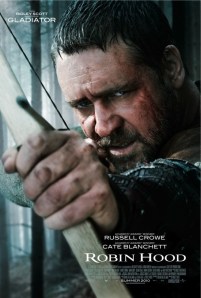
Just a short while ago, I listed Ridley Scott’s Robin Hood as one of the 10 upcoming movies of the 2010 that I was looking forward to seeing.  Well, I have now seen the movie and what can I say other than “Wow!  What a huge disappointment!”

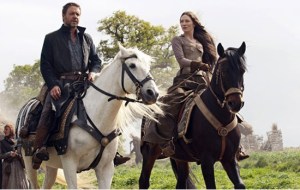
To make things clear, this movie is not really about Robin Hood.  It’s about a common archer named Robin Longstride who fights in the Crusades, comes back to England, assumes another man’s identity, is adopted by a blind nobleman, ends fighting the French, and who discovers that his late father apparently wrote out the first draft of what will become the Magna Carta.  Finally, at the end of the movie, Robin Longstride is declared an outlaw (or as Oscar Isaac, who plays King John, puts it, “AN OUTLAWWWWWWWWWW!) and it’s mentioned that he goes by the alias of “Robin of Hood.”

So, if you’re expecting a movie about Robin Hood or anything that is usually associated with Robin Hood — green tights, archery competitions, stealing from the rich and giving to the poor, that sort of thing — you’re pretty much out of luck.

On the face of it, this certainly isn’t an unwelcome idea.  To be honest, I’ve always found whole idea of Robin Hood and his “merry men” to be a bit silly and rather dull.  When it comes to English folklore, I’ve always preferred to read about King Arthur self-destructing.  Add to that, it’s hard for me think about Robin Hood without thinking about the Dennis Moore episode of Monty Python’s Flying Circus. 

(Remember Dennis Moore’s theme song — “Dennis Moore…Dennis Moore…He steals from the poor and gives to the rich…stupid bitch…”)

So, I really can’t complain about the way that the movie jettisons most of what one would traditionally expect from a film called Robin Hood.  However, once the movie abandons tradition, it fails to come up with anything compelling to replace it with.

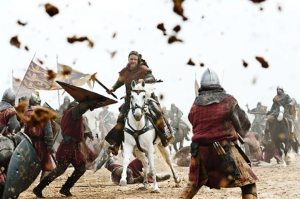
The movie opens with commoner Robin Longstride taking part in the Crusades.  He’s a bitter, disillusioned archer who has grown weary of killing.  So far so good.  If nothing else, Ridley Scott has proven that he knows how to direct action and the early battle scenes are very well done.  Robin is played by Russell Crowe and, even though he’s a bit too old for the role, Crowe has always been convincing playing men of action.  Of course, this is largely because Crowe is himself a man of action but no matter.  Crowe is believable in these scenes in ways that a more universally acclaimed actor like Leonardo DiCaprio never could be.  It’s important that the movie convince on from the start that Robin is a master archer and both Scott and Crowe manage to do that.  In fact, if the entire movie was just about an archer trying to survive of the chaos of the Crusades, it would have been a good deal better than Robin Hood.

(Speaking of archers, I’m actually quite a bit more skilled at with a bow than you probably think.  Just three years ago, while visiting a city known as The Crossing, I used one shortbow and a quiver of 12 arrows to kills over 100 rats at Barana’s Shipyard.  Of course, I should probably add that I was playing Dragonrealms at the time.  I was a red-haired, Elven moon mage and my name was Cinzia, in honor of the Italian actress Cinzia Monreale.  Sad to say, Cinzia was eventually killed by some sort of swamp monster but, while she lived, she was pretty good with a bow and arrow.  But back to the movie…)

The movie starts to fall apart once Robin returns to England.  In a set of circumstances that are way too tedious to go into now, Robin ends up assuming the identity of Sir Robert of Loxley and returning the crown of the dead King Richard the Lionhearted to London where it is promptly placed on the head of the new King John (Oscar Isaac). 

Robin then departs on a personal mission of his own.  He goes up to Nottingham to return the dead Sir Robert’s sword to his father, the blind Sir Walter of Loxley (Max Von Sydow, going overboard).  In Nottingham, Robin meets Robert’s widow, the maid Marian.  Marian is played by Cate Blanchett who, for some odd reason, appears to be recreating his award-winning role as Katharine Hepburn in the aviator for most of her performance.  Robin, to his credit, does not pretend to be “Sir Robert” when he first arrives in Nottingham.  However, Walter promptly asks him to do so and in return, Walter will tell Robin all about Robin’s father.  And so, again, Robin agrees to pretend to be Sir Robert. 

Meanwhile, Robin has been accompanied by three friends.  One of them — Little John — is played by the same guy who played Martin Keamy on Lost.  These three friends — along with Friar Tuck who assures us that he’s “not a churchy-type friar” — will eventually become Robin Hood’s band of merry men though not in this movie.  In this movie, they’re just four red herrings that have little to do.

King John, it would seem, is something of a neurotic tyrant so he is easily manipulated by his good friend Sir Godfrey (Mark Strong) into allowing Godfrey and his private army to roam the English countryside and “collect taxes.”  What John doesn’t realize, of course, is that Godfrey is actually half-French and all of Godfrey’s soldiers actually are French.  How this escape John’s attention is hard to determine as all of Godfrey’s soldiers either speak French or English with a heavy French accent.

(Actually, Sir Godfrey reminded me of another life I experimented with in Dragonrealms, a Gor’Tog Barbarian named Ironcrotch.  The less said about Ironcrotch, the better.)

Anyway, Godfrey’s real mission is to be so tyrannical while collecting taxes that the English people will rise up against their king and the whole country will plunge into civil war.  While this is going on, the French will then invade England and easily conquer it.  As long as it took me to type all of that up and for you to read, it feels even longer when you’re sitting in a theater watching it.

On paper, at least, Ridley Scott would look like the perfect director for this movie but, other than the early battle scenes, his direction here is often rather uninspired. He seems to be bored with the movie and, for that matter, so does Russell Crowe.  Crowe gives a surprisingly dull performance.  You believe him as a soldier but you never believe him as a leader and that’s unfortunate because, for this movie to work, you have to believe Crowe as a man so charismatic that he could become a beloved criminal.  When you consider just how talented Crowe has proven himself to be over the years, his performance here becomes even more distressing and, finally, somewhat infuriating.  Once could accept a less-than-brilliant performance from someone like Jason Stathan.  But this is Russell-freaking-Crowe, for the love of God!

In fact, the only actor who really seems to truly invested in his role is Oscar Isaac and he’s actually the best thing in the entire film.  For over a month, I’ve been mocking the way he’s seen shouting “OUTLAWWWWW!” in the trailer for Robin Hood.  Divorced from the rest of his performance, it just seems like a ludicrously over-the-top moment.  However, when seen in the context of the character that he creates over the course of the film, it makes perfect sense that King John would randomly shout such things.  Isaac makes plays the monarch as a spoiled brat, a hedonist given to cowardice, insecurity, and histrionics.  Wisely, he never plays John as evil and, in some scenes, he almost manages to make this historically reviled man into an almost sympathetic figure,  While the rest of the movie merely goes through all of the expected paces, Isaac always manages to bring something unexpected to every scene he is in.  If there is any redemption to be found in Robin Hood, it is in his performance.

I should also add that, as critical as I’ve been of Robin Hood, I still enjoyed listening to all the anti-taxation, anti-government rhetoric.  I only wish the movie had gone even further with the whole idea of Robin Hood as a 12th century libertarian.

In the end, what can you really say about a movie like Robin Hood?  It is what it is.  It’s a summer movie that’s obviously designed to serve as the launching pad for a bigger film franchise.  To criticize it is to almost invite some stranger to accuse you of being a spoilsport.  Summer movies are meant to be big and loud and borderline obnoxious.  They’re meant to be a collection of trailer-ready scenes that can entice you into paying way too much to sit through them.  Summer movies are made to make money and ultimately, the only judgment that carries any weight is the verdict of the box office.

Interestingly enough, the theater where I saw Robin Hood was deserted except for me and my friend.  A lot of this, of course, is due to us attending a matinée showing but still, even a matinée will usually manage to bring in a handful of retirees who want to spend their twilight years complaining about how difficult is to hear movies nowadays.  But no, on this day, it was just me and my friend. 

(This worked out nicely, to be honest, because it allowed me and him to…uhmm…well, yeah, anyway.  Back to the review…)

To me, that nearly deserted theater pretty much sums up Robin Hood.  It’s the movie that everyone wants to see but that nobody’s going to want to watch twice.  It’s the type of movie that you forget even while you’re watching it.  Considering all of the talent that was involved in the making of this movie, I think the viewer is justified in expecting something just a little more.

Review: Ticket to Heaven (dir. by Ralph L. Thomas)


At the start of 1980’s Ticket To Heaven, we’re introduced to David (Nick Mancuso), a normal young man from an upper middle class background.  David is likable enough but, when we first meet him, is still feeling depressed after breaking up with his longtime girlfriend.  He handles his loneliness by meeting up with Karl, a friend from college.  Karl, who is accompanied by an almost unbelievably positive young woman (played by a very young Kim Cattrall), invites David to come spend the weekend at a religious “retreat.”  For reasons that have more to do with Cattrall than with any interest in religion, David agrees.

The retreat turn out to be a camp where everyone is extremely friendly and extremely positive.  From the minute David arrives, everyone is smiling at him and telling him how thrilled they are to meet him.  It’s such a positive experience that David doesn’t even complain when he’s given little to eat, allowed very little sleep, and forced to endure hours of talk about the great spiritual leader who set up the camp.  When David does eventually decide that he’d like to leave, all of his friendly campmates are so wounded by his rejection that he changes his mind.  Who wouldn’t?  After all, they’re so nice and idealistic and positive.

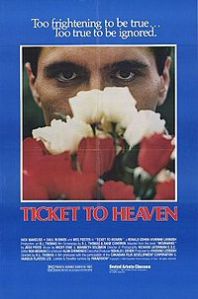
Needless to say, David never leaves the camp.  When his best friend (played by Saul Rubinek)  happens to run into David on the street, he’s shocked to discover that David has become a blank-eyed zombie whose life now revolves around selling flowers in the street and making money for his new friends.  However, David’s old friends aren’t quite ready to give him up and the rest of the film details the battle between the two groups for David’s mind and soul.

Ticket to Heaven is a genuinely unsettling film.  As directed by Ralph Thomas, the entire film seem to ooze a very real creepiness that stays with you even after the end credits have rolled.  The film is at its best when it shows, in painfully believable detail, just how easy it is for someone to become brainwashed and to set aside everything that makes them unique in the name of a “greater good.”

The film’s cast is made up of a talented group of mostly Canadian character actors and, down to the smallest role, they’re all disturbingly believable.  Kim Cattrall is probably the most recognizable face in the cast, though Michael Wincott (he of the sexy, gravelly voice) also shows up in a tiny role.  Nick Mancuso and Saul Rubinek are believable as best friends and Mancuso is such a likeable presence that it makes his transformation into soulless zombie all the more disturbing.  Meg Foster — who looks like a thin, somewhat stable version of Kirstie Alley — gives an excellent and chilling performance as one of the cult’s leaders.

However, for me, the film’s best performance was given by an actor named R.H. Thomson.  Playing a cult deprogrammer named Linc Strunc (what a great name), Thomson is only in a handful of scenes but he dominates every one of them.  Speaking through clenched teeth and giving off an attitude of weary cynicism, Thomson takes a role that could have been a stereotype and makes it instead very compelling.  If I choose to believe Wikipedia, Thomson is still active as an actor and, after seeing his work in Ticket to Heaven, I may have to track down his other films.

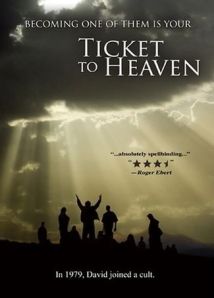
Despite having won a Genie (the Canadian version of the Oscar), Ticket to Heaven is something of an obscure film.  I have to admit that I bought the DVD on something of a whim and that was mostly because I was intrigued by the words “In 1979, David joined a cult…” on the DVD’s cover.  I’ve long been fascinated by cults and just how easily some people can surrender everything the makes them a unique and individual human being.

During my first semester away at college, there used to be a small handful of students who, every night, would gather together outside the student union.  Since I’ve always been a night person, I’d often find myself walking by their little group and I always felt a little bit anxious whenever I saw them.  They all looked perfectly normal but there was still something off about them.  As my roommate Kim put it, they all looked like they had wandered out of a toothpaste commercial.  There was also the fact that they obviously considered themselves to be a part of an exclusive club that the rest of us had not been invited to join.

One night, Kim and I went down to the student union to check our mail.  As we were heading back to our dorm, we passed this little group and I noticed that one of them appeared to be holding a microphone.  I guess he saw me looking because he held the microphone up to his lips and said, his voice booming, “HEY YOU, DO YOU KNOW THE LORD!?”  At the time, Kim and I both considered ourselves to be decadent Pagans so we answered by sharing a long kiss in front of them and then laughing at the dead glares that greeted our response before we then ran, hand-in-hand, back to the dorms.   In retrospect, I guess that was my invitation to join the club and I’m glad I was too busy trying to be worldly to accept it. 

 A few nights later, I found myself suffering from the insomnia that’s plagued me for as long as I can remember.  Around 3:00 a.m., I was sitting down in the dorm’s lobby, trying to write angsty poetry.  On the other side of the lobby was this guy that we’ll call “Rich.”  You’ve probably known someone like Rich.  He’s one of those guys who was always smiling a little bit too much, who was always almost desperately friendly.  Rich was someone who, for whatever reason, was obviously lost and looking at him, you got the sense that he’d never been truly happy a day in his life.  I always felt sorry for Rich but I was also a little scared of him.

That night, I was happy that he wasn’t trying to talk to me.  Instead, he was just quietly sitting in a corner with a blank stare.  Suddenly, he was approached by three men who greeted him by name and, visibly shaking, Rich stood up to greet them.  It took me a few minutes but then I recognized that two of the guys were from that same group that always gathered outside the union.  Standing in between them was a balding, bearded man who I’d never seen before or since.

The four of them sat down and they were soon leaning forward in huddled conversation.  I found myself straining to hear what they were saying but I could only pick up a few words.  I could see that Rich was still shaking and that he had started to cry.

Suddenly, the bearded man spoke in a voice that snapped through the entire lobby.  “You little shit,” he said, “You pathetic motherfucker!”

As the two others sat there impassively, the bearded man leaned forward until his face was inches in front of Rich’s.  From where I was sitting, it looked almost as if Rich’s face was being eclipsed by the back of the man’s head.  The man continued to speak but now his voice was low and I couldn’t make out the exact words.  But I could tell from his body language and his gestures that he was giving Rich more of the same.

After about an hour of this, Rich started nodding and, tears flowing down his face, he started to say, “Praise God!  Praise God!  Thank you!  Praise God!”

The four of them stood up and, as I watched in disbelief, they stood there hugging each other as Rich continued with his “Praise God!”  The three guys then headed out and Rich, smiling even though his face was still slick with tears, skipped out of the lobby.

Rich graduated at the end of that semester.  A few years later, when I was about to graduate, I heard someone say that Rich had recently committed suicide.  I don’t know if that’s true and it’s almost too obvious an ending to his story. 

I thought a good deal about Rich and that night after I finished watching Ticket to Heaven.

Admittedly, Ticket to Heaven is not a “perfect film.”  Strong as Mancuso’s performance is, David is still something of a sketchy character.  The film does a good job showing the techniques that the cult uses to brainwash David but it’s never quite clear why David was so susceptible to those techniques to begin with.  There are hints, of course.  David is shown to be upset over breaking up with his girlfriend and there are hints that his safely middle class existence has left with him with little sense of having an individual existence of his own.  That doesn’t change the fact that David ultimately comes across as less of a real person and more as a way for the film to preach its anti-cult message.

Indeed, the film’s biggest flaw is that it is essentially a message film.  As well-acted and intelligently scripted as it often is, the movie exists to deliver a message.  Fortunately, it’s a good message but that doesn’t stop the film from sometimes rather heavy-handed.  This is most obvious in the movie’s final scene in which things are tied up just a little bit too neatly. 

Still, flaws aside and despite having been made 30 years ago, Ticket to Heaven remains a relevent film.  We live in a world that, for the most part, is made up of brainwashed people and, watching the movie, I had to wonder how much difference there really was between the overbearingly positive cultist played by Kim Cattrall and the grim-faced jihadists that currently haunt our nightmares.  When you consider just how much evil is justified, on a daily basis, in the name of the greater good, its becomes obvious that the movie’s warning against becoming a living zombie is just as important today as when the film was made.

The film’s cult is based on an actual, real-life group that was apparently very active in the late 70s and who are still around today, the Unification Church.  I vaguely remember them being in the news back in 2004 when the head of the church was declared to be “the prince of peace” at a ceremony that was attended by a few congressmen.  Type “Unification Church” into google and you’ll end up with links to a lot of stories that would seem to suggest that the real cult is even more creepy than the fictionalized version in Ticket to Heaven.


Review: A Dog Called Vengeance (dir. by Antonio Isasi)


I’ve always felt that a truly good movie should inspire the viewer to seek to confess something about themselves.  So here’s my confession.  When I was a toddler, I was mauled by a stray dog.  I don’t remember it, of course but I still have the small scars on my left arm as proof.  As a result, I’m scared of dogs and I always have been.  I jump when I hear one barking and the sound of one growling can easily set off a panic attack.  Whenever I see one nearby, regardless of whether it’s on a leash or not, my heart starts to race.  

For that reason, I suppose it was inevitable that a movie like the 1976 Spanish production A Dog Called Vengeance would get to me.

The film opens in an unnamed South American country.  Political prisoner Jason Miller escapes from a jungle prison.  As he flees, Miller runs into a tracker and the tracker’s dog, a German Shepard named King.  Miller kills the tracker and then continues to run.  King, after a few rather sad scenes in which he tries to revive his dead master, gives chase.

And that, in short, is pretty much the entire 108-minute film.  Miller runs and King chases.  Whenever Miller thinks that he’s safe (whether he’s taking a bath in a river or making love to a woman who has agreed to hide him), that relentless dog shows up and tries to kill him.   I have to admit that this movie did little to alleviate my fear of dogs because King is truly viscous.  The scenes were attacks both Miller and other assorted humans left me cringing and I don’t think it’s just a coincidence that Miller looks to be truly scared during some of the attack scenes.  King easily dominates the 1st half of this movie.

The 2nd half of the movie feels like a totally different movie from the first.  Jason Miller, having reached the city, is reunited with his comrades in the revolution.  Whereas the first half of the movie was almost wordless, the movie suddenly become a lot more talky as Miller and his associated debate the merits and morality of revolution.  Personally, I prefer the second half if just because a nice element of moral ambiguity is introduced here as it becomes pretty obvious that the “revolutionaries” are just as corrupt as the country’s dictator.  In the city, Miller finds himself still being pursued by his enemies but now his friends want him dead as well.  And, of course, that dog shows up again as well…

Anatonio Isasi’s direction is, for the most part, strong and Jason Miller (best known as Father Karras in the Exorcist) gives a good, low-key performance as the film’s lead.  But, of course, the real star of the movie is that damn dog and, despite not being a doglover, I have to admit that it did a pretty good job.  Not only did I believe that dog wanted to kill Miller but I believed that he easily could as well.  However, at the same time, it hard not to feel a little bit of admiration for King.  He was just so compellingly relentless in his pursuit.  It’s probably one of best unacknowledged canine performances in film history.

A Dog Called Vengeance is the epitome of the type of flawed yet oddly compelling film that could only have been made outside of the Hollywood system.  By refusing to shy away from showing either the full savagery of the dog’s attacks or in man’s response to those attacks, director Isasi manages to craft a political allegory that also works as a simple thriller.  By refusing to paint either Miller or the dog in purely black-and-white terms, he introduces a moral ambiguity that most Hollywood studios would never have the guts to even attempt.  Tellingly, the most shocking and disturbing scene in the film is not one of King’s many attacks on Miller.  Instead, it’s a scene in which our paranoid “hero” guns down an innocent dog while its 10 year-old owner watches in horror.

Unfortunately, A Dog Called Vengeance isn’t an easy film to find.  I saw it as part of the Grindhouse 2 DVD compilation and the transfer — taken straight from a VHS release — was terrible with frequently blurry images and terrible sound.  To a certain extent, this did give an authentic “grindhouse” feel to the experience of watching the movie but it doesn’t change the fact that it took a while to get used to just how bad the movie looked.  Luckily, the transfer seemed to improve as the film went on and, by the end of the movie, was no longer an issue.