Film Review: Cyrus (dir. by Mark and Jay Duplass)


Last Tuesday night, as we watched the end credits of Cyrus rolling across the screen at the Plano Angelika, a very dear and close friend of mine leaned over and whispered in my ear, “That was a really odd fucking movie.” 

(Actually, it was two weeks ago.  Sorry, I started this review a while ago and only recently returned to finish it.)

And he’s right.  Though the film is worth seeing (though I’d honestly suggest waiting until it comes out on DVD unless you’re just the world’s biggest John C. Reilly or Jonah Hill fan), Cyrus really is an odd fucking movie.

Cyrus is the latest film from Jay and Mark Duplass, the two brothers responsible for 2008’s Baghead, one of the unacknowledged great films of the last decade.  In Cyrus , John C. Reilly plays a character named — appropriately enough — John.  John is a likable loser, a less musical version of the character Reilly played in Chicago.  When the movie opens, John is depressed over the fact that his ex-wife, Jamie (Catherine Keener), is getting married again.  At Jamie’s suggestion, he goes to a party where he proceeds to have too much to drink, flirts awkwardly with every woman he sees, and somehow manages to charm Molly (Marisa Tomei).  Molly is soon sleeping over at John’s house but every morning, John wakes up to discover that she’s either already left or is in the process of sneaking out.  John asks her if she’s married.  Molly replies that she’s not but is still vague about why she never stays the entire night.  Finally, one morning, John follows Molly after she leaves.  He sits out in front of her house and, after she’s left for work, John proceeds to creep around outside the house. 

And, of course, its while he’s doing all of this creepy stalker stuff that he first meets Cyrus (played, of course, by Jonah Hill).  Cyrus is Molly’s 22 year-old son and from the minute he first appears, its obvious that there’s something off about him.  He’s far too friendly and speaks in the oddly stilted cadence of someone who is obviously making an effort to act “normal.”  He  spends all of his time composing New Agey synthesizer music in an elaborate home recording studio.   Of course, the main sign that there’s something odd about Cyrus is that he’s played by Jonah Hill.

However, the main thing that distinguishes Cyrus is just how close he is to his mother.  From the first moment that we see him and Molly interact (he’s playing his music and Molly enters the house and immediately starts dancing to it), its obvious that Cyrus is Oedipus, Norman Bates, and Yanni all wrapped up into one package.  And, obviously, he views John as being competition…

Cyrus is an uneven film, one that starts out strong but — once the title character is actually introduced — suddenly seems to get hit by an identity crisis.  Is it a realistic portrait of sad, lonely people trying to find love in uncertain times or is it an Apatowish mix of stoner sentiment and over-the-top comedy?  Is Cyrus meant to be the emotionally wounded, painfully insecure outsider that he appears to be the movie’s more contemplative moments or is he just a sociopathic comedic device that Reilly has to overcome in order to pursue his relationship with Tomei?  That’s the question that is at the heart of Cyrus and discovering the answer is the film’s entire excuse for existing.  Unfortunately, the Duplass Brothers don’t seem to know the answer themselves and as a result, the entire film feels directionless and we’re left with too many unanswered questions.

For instance, where is Cyrus’s father?  It’s mentioned by both Cyrus and Molly that the father is no longer in their lives but why?  Though its never explicitly stated, its obvious that both Cyrus and Molly have suffered abuse in the past, probably at his hands.  However, the issue itself is never directly confronted and its hard to believe that John wouldn’t have asked about it at some point.  For that matter, beyond her role as Cyrus’s mother and John’s girlfriend, Molly isn’t given any back story whatsoever.  Considering the fact that the entire movie is about how Cyrus and John feel towards her, it’s interesting that she’s never given a scene where she really gets to explain how she truly feels towards either of them.  A good deal of the film’s attitude towards Molly can be seen in the fact that, while a major plot point hinges on her being at her job as opposed to at home, we never find out just what exactly it is that she does for a living.

That’s unfortunate because, in many ways, Cyrus shows a good deal of promise and psychological insight.  One of the subtle pleasures of the film is seeing how all of the various relationships (John and Molly, John and Cyrus, Molly and John, John and his ex-wife, Cyrus and Molly) actually run parallel with each other.  When Molly first flirts with John, John replies, “Are you hitting on me?  I’m Shrek.”  And it seems like he’s got a point until you see Cyrus and Molly together.  It’s at that point that you realize that John probably once looked just like Cyrus and that Cyrus is eventually going to grow up to be John.  It’s hard not to wonder if Cyrus’s father looked like John or if Molly is attracted to John because he reminds her of her son.  On the other hand, much as Cyrus is totally dependent on Molly, John is similarly dependent on his ex-wife (who, as played by Catherine Keener, looks strikingly similar to Marisa Tomei).  In a nice touch, his ex-wife’s new husband seems to have the same opinion of John that John has of Cyrus.

The Duplass Brothers also get a quartet of excellent performances from the film’s leads.  This is all the more exceptional considering that three of them are playing characters that are either underwritten (Tomei and Keener) or else totally inconsistent (Hill).  The film really belongs to John C. Reilly who is such a sympathetic, likable presence as John that he convinces the audience to forgive a lot of the film’s unevenness.  His best moments are to be found in the film’s opening party scene where he essentially acts like a total drunk jackass yet you still feel oddly sorry for him.  He’s just such a nice guy.

As previously stated, Cyrus is an odd film, an uneasy mix of independent and mainstream sensibilities.  Watching it, I found myself wondering if the Duplass Brothers were really sure what type of movie they wanted to make, if they wanted to emulate the cold, detached dry wit of the Coen Brothers or if they were indulging in a little Judd Apatow-style schmaltz.  Both styles attempt to co-exist in Cyrus and the end result is a movie that seems to be struggling to establish its own identity.  Still, Cyrus is worth seeing if just for the performances.  As flawed as the film is, it confirms what Baghead indicated, that the Duplass Brothers as intriguing filmmakers to watch out for in the future.

A Few Thoughts On The Girl With The Dragon Tattoo Remake


Have I mentioned how much I loved The Girl With The Dragon Tattoo?  Have I suggested that the late Stieg Larsson, in the Millenium Trilogy, did for Europe what James Ellroy did for America with the American Tabloid trilogy?  Have I gone into the fact I think Noomi Rapace’s performance as Lisbeth in both the original film and its sequels will probably be remembered as one of the greatest film performances of all time?  Have I explained that I think, even beyond Rapace’s performance, Lisbeth herself is one of the best characters in the history of film?  For that matter, have I talked about the hours that I’ve spent standing with my back to a mirror and looking over my shoulder and debating on which shoulder-blade a dragon would look most appropriate?  Personally, I think my left shoulder-blade is a bit nicer than my right but last night, my friend Jeff was telling me that…

Sorry, I’m losing focus here.  Okay, getting the ADD under control.  Anyway, the point of the matter is that I love The Girl With The Dragon Tattoo. 

That’s why I feel a lot of caution about the upcoming, David Fincher-helmed remake.  First off, quite frankly, I really don’t see what can be improved on the original films.  It’s not as if the original film version of the Girl With The Dragon Tattoo failed to do justice to the book (if anything, the book fails to do justice to the film that eventually made from it).  I suppose a remake would give people who can’t handle subtitles the chance to see the story but honestly, who cares about those losers?  Speaking of the story, the rumors I hear seem to indicate that this remake is going to be an “Americanized” version of The Girl With The Dragon Tattoo, which I’m not really sure can be done as the entire book is basically meant to act as a metaphor for Swedish society.  Of course, it is possible that the remake is going to be set in Sweden as well but if that’s the case, what’s the point of the remake?

I know the usual argument to these concerns is that, as a director, Fincher will not allow the film to be Hollywoodized.  At one point that may have been true but, judging from The Curious Case of Benjamin Button, Fincher’s got more Hollywood in him than most people want to admit.  The fact that he’s also teamed up with Aaron Sorkin (an establishment figure if there ever was one) to direct a movie about Facebook doesn’t exactly fill me with confidence but I’ll hold off on judging until the Social Network actually shows up in theaters.

However, I am encouraged by the news (announced yesterday) that Fincher has cast Daniel Craig as the male lead, Mikael Blomkvist (or whatever his name is going to be in the Hollywood version).  Craig’s name had been mentioned for the role ever since the remake was first announced but there were also reports that the role would go to Brad Pitt (who, of course, has already made 3 films with Fincher).  Nothing against Brad Pitt (who I think is a truly underrated actor) but it’s hard to think of a worst choice for the role of Mikael.  Mikael’s defining characteristic is just how ineffectual he is.  He’s the ultimate well-meaning intellectual, the type of guy who wants to fight injustice but is to insulated from the harsh realities of life to effectively do so.  (That’s why he needs Lisbeth, she represents everything he wishes he could do but can’t.)  In short, Mikael is a hero by default and casting an actor like Brad Pitt would throw the entire movie off-balance.

Mikael is not a role for a star.  Mikael is a role for a character actor and, James Bond aside, that’s exactly what Daniel Craig is.  (That’s one reason why Craig’s Bond is dull, regardless of how good a performance Craig gives in the role.)  Not only is Craig the right age, he projects just the right amount of idealistic weariness for the role.  Admittedly, it helps that Craig bears a passable physical resemblance to the original Mikael, Michael Nyqvist which, if nothing else, will make it easier for fans of the original film — like me — to accept him.

(For the record, my personal choice for Mikael would have been Tim Roth.)

Of course, the question now is who will win the role of Lisbeth and why would they want it?  For me, Noomi Rapace is Lisbeth.  She is the girl with dragon tattoo.  It’s hard to think of single mainstream actress in her 20s or early 30s who could hope to match Rapace’s performance.  (Perhaps a young Angelina Jolie could have though physically, Jolie is all wrong for the part.)  However, even beyond what Rapace did with the character, Lisbeth is one of the most vivid and memorable characters in recent literary history.  Even without having to worry about the shadow of Rapace’s previous performance, the role is not an easy one.

Originally, rumor had it that Kristen Stewart was a lock for the role.  At the risk of being burned at the stake as a heretic, I’m going to say that I think Stewart could have been an adequate (though not a great) Lisbeth except for the fact that she’s about ten years too young.  (While Lisbeth is described as looking like a teenager, she also projects a worldliness of someone much older.  Physical appearance can be faked but life experience can not.)  Carey Mulligan, star of An Education (the best film of 2009, by the way), was another actress who was frequently mentioned.

Well, according to Entertainment Weekly, neither Stewart nor Mulligan will play Lisbeth Salander.  Neither will Natalie Portman who, according to EW, was offered the role but turned it down.  The offer to Portman makes sense as she’s physcially right for the role and she’s an undeniably talented actress.  However, much as Pitt could never have been convincing as Mikael, Portman would have been miscast as Lisbeth.  Portman may be a talented actress but she’s also a rather passive one.  Even in her previous “action” roles (Leon, V For Vendetta), Portman essentially played a lost, damaged character (much like Lisbeth) who needed an older male figure to serve as her mentor (which, needless to say, is nothing like Lisbeth).

Again, according to EW, the role of Lisbeth has been narrowed down to four actresses: Rooney Mara, Lea Seydoux, Sarah Snook, and Sophie Lowe.  It’s probably a good sign that none of these actresses are household names exactly.  Competing with the shadow of Noomi Rapace’s Lisbeth is going to be difficult enough without also having to deal with the shadow of their own previous performances.  (For instance, even if Stewart gave a brilliant performance as Lisbeth, it would still be impossible for me to get through the remake without making at least one Twilight joke.)

For me, the real question is not who is going to be cast as Libseth but if Fincher and his producers are going to give us the real Lisbeth — this would be the unapologetically lesbian Lisbeth who can only befriend Mikael once she’s sure that she doesn’t any sort of sexual attraction towards him — or if we’re going to get a more mainstream, Hollywood version of Lisbeth.  Are we going to get the real Lisbeth who needs no one or are we going to get another version of what Hollywood claims to be a strong woman, one who can fight up until the final 30 minutes of the film at which point she’s suddenly rendered helpless by the demands of Mainstream Filmmaking 101.

More than anything, that will be the test that Fincher’s Girl With The Dragon Tattoo will have to pass if it wants to be anything more than an unneeded imitation of the original.

(Incidentally, the perfect Lisebth Salander would be Jena Malone.  End of story.)

A Quickie With Lisa Marie: Blood Freak (dir. by Brad Grinter)


It’s difficult to explain why exactly Blood Freak, a no-budget horror film from 1972, is a movie that you simply have got to see.  I could tell you about how it’ll force you to wonder if the movie was meant to be taken seriously or if it’s all just a huge joke.  I could go on for paragraph after paragraph about how this movie (and its status as one of the great cult films of the last century) represents one of the purest triumphs of independent cinema and how this movie is one of the few American films to ever come close to Lucio Fulci’s theory of “pure film.”  But I fear that even after I do all that, I will not be able to convey just how beautifully odd and wonderful this movie truly is. 

So, instead of doing all of that, I think I’ll just tell you what Blood Freak is about.

Steve Hawkes (a body builder who appeared in several Spanish exploitation films in the late 60s) plays an aimless drifter who, as the movie starts, finds himself in Florida.  He meets a virginal young woman named Angel.  Soon, they are a very clean-cut, chaste couple.  As seen in the clip below, Angel even gets him a job working at the local turkey farm.

However, there’s trouble brewing.  Angel has a sister named Ann.  Ann is Angel’s opposite in every way.  Not only does she stay out for all hours of the night with her sleazy friends but she also introduces our hero to a little drug called marijuana.

Soon, Hawkes discovers that — apparently like most of America in the early 70s — he is now addicted to marijuana! (“I have a feeling I’m hooked!” he explains.)  Of course, we all know what happens when you mix marijuana and repeated exposure to turkeys.  That’s right, our hero ends up falling asleep and then waking up as a blood-crazed man/turkey hybrid,  as seen in the scene below (which, fair warning, has some fake blood in it).

However, if that wasn’t enough, there’s one more thing that makes this movie an absolute requirement for any discerning film lover.  Blood Freak has a narrator.  And our narrator isn’t some wimpy, off-screen guy with a stern voice and a moralistic outlook.   No, our narrator is Brad Grinter, the film’s writer and director.  Grinter pops up every few minutes, sitting behind a desk and explaining the larger social and moral concerns raised by the story of a muscle-bound drifter transformed into a half-Turkey.  Whenever Grinter appears to lose his train of thought (which happens frequently), he holds up what appears to be the film’s script and reads his commentary line-for-line.  While he explains why marijuana is bed (Mmmkay), Grinter puffs away on an ever-present cigarette.  Several times, he has to pause in his commentary in order to hack up a lung.  One of his more inspiring moments can be seen below:

Blood Freak.  See it.

(On a related note, I usually love Something Weird Video but I’m a little bit annoyed with them that they’re apparently only selling the Blood Freak DVD as part of an over-priced box set.  Still, a used copy of the film on DVD shouldn’t be hard to track down.  Why anyone would want to sell their copy of it, I can’t begin to guess but apparently, not everyone recognizes the brilliance of this film in quite the same way as I do.  Their loss.)

A Quickie With Lisa Marie: Holocaust 2000 (dir. by Alberto De Martino)


Earlier this morning, while suffering from an annoyingly persistent case of insomnia, I decided to spend 2 hours watching a classic Italian exploitation film, Alberto De Martino’s oddly effective Omen rip-off, Holocaust 2000.

In Holocaust 2000, Kirk Douglas plays a businessman who wants to build a gigantic nuclear power plant in the Middle East.  There are a few problems with this plan.  First off, the site that Douglas selects just happens to be right next to a cave that is full of religious artifacts.  Secondly, there’s a handful of angry environmentalists picketing his London office.  And, perhaps the biggest problem, Douglas’ son happens to be the Antichrist.  This fact is obvious to the viewer because not only is his son named Angel (yes, we’re in the land of irony) but he also looks and acts nothing like Douglas.  Not only does Angel have a noticeably weak chin (no cleft to be seen at all) and speak with a rather posh accent but he’s also so extremely English that he’s even played by an actor named Simon Ward.

In other words, the viewer is pretty much in on the game from the beginning.  What makes the movie work is that director De Martino understands that everyone’s going to know that Angel’s the antichrist from the minute he first appears so, as opposed to the Omen films, he doesn’t waste a lot of time playing any “is-he-or-isn’t-he” games.  Instead, in the great tradition of Italian exploitation, De Martino jumps straight into the apocalypse without worrying about things like narrative cohesion and the end result is an enjoyably chaotic film that rarely makes sense but is never boring.  Whereas the Omen films are almost tedious in their attempts to provide theological justification for all the blood that’s spilled on-screen, Holocaust 2000 has a cheerful, let’s-make-it-up-as-we-go-along feel to it that, at times, almost makes the whole thing feel like some long lost Lucio Fulci film.

Holocaust 2000 is probably best known for two sequences.  The first features a helicopter blade very graphically chopping off the top of a man’s head.  If seeing the original Dawn of the Dead made me nervous around helicopters, seeing Holocaust 2000 has ensured that I will never ever step anywhere near one of those things.  Seriously, I’ve seen a lot of gore over the past few years but the decapitation scene in this movie …. well, perhaps it’s best to just shudder and move on.  (For the record, Holocaust 2000 came out before Dawn of the Dead so the helicopter decapitation scene here was not stolen from that film.  If anything, it was simply a more graphic version of David Warner losing his head in the Omen.)

The second sequence is a scene in which a very nude Kirk Douglas (who, it must be admitted, looked a lot better at 61 than most 20 year-olds do today) has a nightmare in which he watches the world literally come to an end.  Set to Ennio Morricone’s intense and memorable score, this sequence manages to be surreal, disturbing, and entertaining all at the same time.  It epitomizes everything that makes Holocaust 2000 such a surprisingly effective work of pure cinematic exploitation.

Like many of the great Italian exploitation films, Holocaust 2000 was released under several titles.  It is currently available on DVD under the title Rain of Fire and a big bleh to Lionsgate for choosing to go with such a boring name.  Admittedly, I can see their logic.  Though the movie was first released in theaters in 1977, it took 31 years for it to show up on DVD.  During that time, 2000 came and went and the world didn’t end (or maybe it did and the last 10 years have just been an extended hallucination, the choice is yours).  But still, Rain of Fire sounds like a substandard country song about a nasty divorce that ends in murder.  On the other hand, a title like Holocaust 2000 — nakedly exploitive and borderline offensive — represents everything that we’ve come to so love about Italian exploitation films.

Film Review: Salt (Directed by Phillip Noyce)


I have long come to accept that, when it comes to issues of gender equality, most movies are like Iron Man 2.  If you’ll remember, that’s the film in which Gwynneth Paltrow said she was better suited to be a secretary than a CEO, Scarlett Johansson beat up an army but only because she was given permission ahead of time by a very manly Samuel L. Jackson, Jr., and the world was saved because Robert Downey, Jr. made peace with the patriarchy.  While the inherent sexism of most movies has never ceased to bother me, I’ve come to accept it because I love film. 

(For the record, I enjoyed Iron Man 2 even if I did roll my eyes more than once.)

Still, hope continues to rest at the bottom of Pandora’s box.  With the year only a little more than a half over, American movie screens have played host to a handful of unusually strong and independent female characters.  (It’s the independence that sets them apart.)  From Jennifer Lawrence in Winter’s Bone to Katie Jarvis in Fish Tank to even Kristen Stewart and Dakota Fanning in the Runaways, they have challenged the standard movie stereotype of the weak, ultimately helpless female.  The best known of them is, of course, Noomi Rapace as Lisbeth in The Girl With The Dragon Tattoo and its sequels.  However, if the Girl With the Dragon Tattoo features the strongest woman to appear on American movie screen this year, the just-released Salt features the second strongest.

In Salt, Angelina Jolie plays Evelyn Salt, a CIA agent who is married to Mike (August Diehl), a nice guy who happens to be the world’s leading authority on spiders.  On the day of her wedding anniversary, Salt finds herself tasked with interrogating a Russian defector named Orlov.  As Salt listens (and her fellow agents watch), Orlov tells a story of how, decades earlier, hundreds of Russian children were secretly smuggled into the U.S. where they served as “sleeper” agents, working their way into American society until such time as they might be activated.  Orlov goes to explain that one of these sleeper agents is going to assassinate the President of Russia.  That agent, Orlov adds, is named “Evelyn Salt.”  While Salt’s co-workers react to this accusation by attempting to arrest her, Salt reacts by escaping from custody and fleeing in an attempt to both find her husband, who has mysteriously disappeared, and prove her innocence.

Or is she?  There’s a lot of twists and turns in Salt’s plot and while they don’t always make sense, they’re a lot of fun to watch.  Director Phillip Noyce keeps the action moving and, in the lead role, Angelina Jolie brings a wonderful sense of moral ambiguity to the character that you’re never quite sure whose side she is really on.  Jolie makes the character seem real even when she’s jumping off a bridge and landing on top of a speeding truck without so much as even a bruise as a result.

Admittedly, I enjoyed Salt for much the same reason that I enjoyed the far superior Girl With The Dragon Tattoo.  It was fun to not only see a woman in a movie do stuff that usually only a man is allowed to do but also manage to do all of it a lot more convincingly than most contemporary male action heroes.  With the exception of a very intense torture scene at the start of the film, Salt is never shown with tears in her eyes.  She is never shown begging for mercy.  Most importantly, she is never portrayed as being helpless.  Considering just how much importance society puts into the idea of all women being inherently helpless, movies like Salt are a refreshing change of pace.

Of course, that doesn’t change the fact that pretty much everything Salt did in the film was basically done to save her marriage.  As strong a character as Salt was, its unfortunate that the film had to make sure we understood that it was all due to the purifying love of one man.  It’s as if the filmmakers were worried that if they made Salt too independent, they’d lose the audience and they were probably right.

Still, 2010 may very well be remembered as the year that women in movies were finally allowed to kick some ass.  After an eternity of serving as decorations (with their every action governed by some male filmmaker’s infantile Whore/Madonna complex), women are finally being allowed to do something other than scream and wait to be rescued.  Will this trend continue?  Probably not.  It’s a bit much to ask of a country that can’t even bring itself elect a female President.  However, while it lasts, I’m enjoying the trend and I’ll miss it once it’s over.

Film Review: Drag Me To Hell (directed by Sam Raimi)


There are exactly two things that keep Sam Raimi’s otherwise entertaining 2009 horror romp Drag Me To Hell from being a classic.

The first is that, about halfway through the movie, Alison Lohman murders her pet kitten.  Admittedly, Lohman’s character is trying to thwart a gypsy curse at the time and the action does show just how terrified she’s become.  But that doesn’t change the fact that it’s a cute kitten and quite frankly, I’m getting sick of seeing cats being killed in horror films.  There’s something truly hypocritical about how far most filmmakers are willing to go to assure an audience that a dog has somehow survived the end of the world while cats are continually killed on-screen without a second thought.

Am I saying that the film would have been better is Lohman had murdered a cute puppy instead?  Yes, I am.  At least that would have been unexpected.  That would have let the audience know that all the rules no longer applied.  Quite frankly, whenever you see a cat in a horror film, you know that cat is going to end up either pinned to a door or hanging in the closet.  Dogs, however, always make it to the end.

I imagine this is because there’s more “dog people” than “cat people” in the world.  People — especially men of a certain age — just love dogs and I’ve never really understood why.  I guess there’s a charm to a loud, smelly, slobbering beast eating its own fecal matter that I’ve never been able to pick up on.

The second thing that keeps Drag Me To Hell from reaching classic status is the fact that Bruce Campbell is nowhere to be found, making this the 1st Raimi film not to feature Bruce in at least a cameo.  Regardless of how well-made or entertaining the movie may have been, I sat through the entire thing waiting for Bruce to show up and, when he didn’t, it was hard not to feel as if perhaps an era in filmmaking had come to an end.

However, despite these two issues, Drag Me To Hell is probably one of the best horror movies to have been released in the past few years.  If nothing else, it proves that, even after directing three Spiderman films, Raimi is still a B-movie director at heart and a brilliant one at that.

In Drag Me To Hell, Alison Lohman plays Christine, a young bank loan officer who, attempting to impress her boss and win a promotion, refuses to give a loan to a decrepit old gypsy woman (played, wonderfully, by Lorna Raver as the type of grotesque character who could only appear in a Raimi film).  The gypsy woman responds by promptly dying but before doing so, she puts a curse on Christine.  In three days, Christine will be dragged to Hell.

What makes this is so effective is that Raimi, as opposed to a less adventurous director, sets the film up to suggest that perhaps Christine deserves to be dragged to Hell.  As disgusting as the old woman is, she clearly doesn’t deserve to be treated as badly as she is by Christine and Christine herself (even before she kills that poor kitten) is a bit of a fake, a former “fat girl” who, when she lets her guard down, reverts back to a country hick accent that she’s obviously spent a lot of time trying to lose. 

Lohman does an excellent job in the lead role, giving a likeable performance as an unlikeable character.  Speaking as a former country girl who still occasionally feels a twinge of shame when I hear myself say “git” instead of “get,” one of my pet peeves is when an actor or actress trots out an unconvincing, patronizing attempt at a rural accent.  However, Lohman captures the accent perfectly and, unlike most actors who try to play country, never allows her performance to just be about doing dialect.  Instead, both she and Raimi show how Christine’s insecurities lead to her actions without ever suggesting that they excuse them.

Though absence of Bruce Campbell is painfully obvious, Raimi still surrounds Lohman with a very strong supporting cast who all bring just the right amount of B-movie seriousness to their roles.  As Raver’s daughter, Bojana Novakovic appears in one the film’s best scenes in which she tauntingly explains the cure to Lohman.  Dileep Rao (who would be wasted later that year in Avatar) steals almost every scene he’s in as a friendly psychic who tries to help Lohman.  Lohman’s boyfriend is played by Justin Long (of the “I’m a Mac” fame) and he’s perfect as a somewhat nerdy guy who, quite frankly, seems like he might be a little bit too nice for his own good.  Plus, the film’s final scene proves that Long can shed a tear with the best of them.  Bruce Campbell would have been ideally cast as Lohman’s boss but, in Campbell’s absence, David Paymer fills the role well enough.

When Drag Me To Hell was first released in 2009, the majority of reviews described it as being an entertaining throwback to the old school horror films of the 50s and 60s.  And, in many ways, this is a totally correct assessment.  What wasn’t often mentioned was that Drag Me To Hell is one of the very few Hollywood horror films to capture the chaotic spirit of H.P. Lovecraft.  Countless filmmakers have attempted to bring Lovecraft’s Cthulhu mythos to the screen and they’ve failed because they could never translate to the screen Lovecraft’s theme of mankind as a bunch of powerless pawns, existing and dying at the whims of a bunch of “demons” whose motivations could never be understood or questioned.  Though Drag Me To Hell is not based on Lovecraft’s work, it perfectly captures the feeling of helplessness in the face of metaphysical chaos that runs through Lovecraft’s best stories.  As the movie progresses, it becomes apparent that Christine isn’t going to be dragged to Hell so much because of the gypsy curse as much as just because the movie’s demon has decided to drag her to Hell.  It’s this theme (and the way that Raimi relentlessly develops it) that takes Drag Me To Hell to a whole other level and which makes its final scene so powerful and effective.

When first released, Drag Me To Hell’s special effects were criticized by some and it is true that the film’s demon, when he does show up, is an obvious CGI creation but who cares?  If anything, the obvious fakeness of the demon adds to the film’s exploitation charm (though the demon is probably another role that Bruce Campbell could have done wonders with).  If you want perfect CGI devoid of subtext or originality, Avatar’s out on DVD.  Me, I’ll take Drag Me To Hell any day.

Paranormal Activity 2: Too Scary For Texas


According to Variety, Cinemark has pulled the trailer for Paranormal Activity 2 from several theaters in my homestate of Texas because, apparently, filmgoers (the majority of whom were apparently in the theater to see Twilight: Eclipse) complained that it was too frightening.

Uhmmm….right.

I’ve seen the trailer for Paranormal Activity 2 online and, to be honest, the scariest thing about it is that it confirms that a sequel was actually made to Paranormal Activity One. 

(As a sidenote, the PA 2 trailer recycles the old footage of viewers supposedly jumping in fright while watching the first film.  I always wondered just who exactly these idiots were and whether or not they’d ever actually seen a movie before.)

This whole thing seems to be an old-fashioned publicity stunt designed to create word-of-mouth among the type of people who probably think that the obnoxious filmmakers in Cannibal Holocaust actually were eaten by cannibals at the end of the movie.

It’s especially interesting that these complaints supposedly came from Texas.  I suppose that’s going to be the new advertising angle — Paranormal Activity 2: The Movie So Scary That Even Texans Are Afraid To Watch.  I imagine that now filmgoers are supposed to say, “Wow, it’s got to be scary!  I mean, we expect that sort of cowardly behavior from those new age hippies in Vermont but these are cowboys here!”

(By the way, I’m from Texas and I’ve never worn a cowboy hat and I don’t own a horse.  I do say “y’all” on occasion.  Seriously though, FUCK VERMONT.  Sorry, I’ve always wanted to say that.)

I have to be honest, as much as I disliked the first Paranormal Activity, this publicity stunt has won the filmmakers a very small place in my heart.  This is the type of shameless, silly stunt that would make the grindhouse proud.  Hopefully, they’ll have a nurse present at all screenings of Paranormal Activity 3.

Anyway, if you think you can handle it, here’s the trailer that’s apparently too scary for Texas:

Review: Sole Survivor (Dir. by Thom Eberhardt)


In my “which movie should I review poll” 1983’s Sole Survivor came in dead last, receiving a total of 3 votes out of the 234 cast.  I really wasn’t surprised to see that because Sole Survivor, along with having a dreadfully generic title, isn’t really that well-known.  I found the DVD at Half-Price Books where it was being sold for a dollar in the clearance section.  If not for the fact that I can’t resist a bargain, I would never have heard of this movie either.  Which is a shame because, taken on its own low-budget terms, Sole Survivor is actually a pretty effective horror film.

Written and directed by Thom Eberhardt, Sole Survivor has a plot that should be familiar with anyone who has ever seen any of the Final Destination films.  Denise (played by an actress named Anita Skinner) is a neurotic commercial producer who, as the film opens, is the sole survivor of a horrendous airplane crash.  (When we first see Denise, she’s still sitting in her seat, surrounded by the remains of her fellow passengers.)  Against the advice of just about everyone, Denise insists on dealing with the trauma of the accident by trying to return to her normal life.  This is complicated, however, by the fact that she’s still having dreams about the plane crash.  Everywhere she looks, she sees mysterious and menacing strangers watching her.  And, on top of everything else, she is now being stalked by a mentally unstable former actress who claims to be having nightmarish visions of Denise’s future.  Is Denise suffering from survivor’s guilt (as her doctor boyfriend insists) or is she instead being pursued by Death?  If you’ve ever seen a horror film, you can probably guess the answer.

As I mentioned previously, its easy to compare Sole Survivor with the Final Destination films.  However, a more appropriate comparison would be to the 1962 black-and-white classic Carnival of Souls.  Whereas the Final Destination films are largely about coming up with ludicrously convoluted ways for Death to get what he or she wants, Sole Survivor (like Carnival of Souls)  is less concerned with how Death gets the job done and more concerned with building and maintaining a growing sense of dread and hopelessness.  For the most part, director Eberhardt disdains easy shock effects in order to concentrate on building up a palpable atmosphere of doom.  As a result, the film can occasionally seem to be a little slow but it stays with you even after the final credit. 

Also, much like Carnival of Souls, Sole Survivor features an excellent lead performance from an actress who, more or less, disappeared from movie screens after the film’s release.  Carnival had Candace Hilligoss.  Sole Survivor has Anita Skinner.  Skinner gives an excellent lead performance, always remaining a sympathetic.  According to an interview with the film’s producers, Skinner was uncomfortable with the more excessive side of Hollywood and retired from acting shortly after making Sole Survivor.

Sole Survivor was released on DVD by Code Red, so now people like me can appreciate this neglected movie.  The transfer looks great.  Unfortunately, the DVD is pretty thin when it comes to extras.  Neither Eberhadt nor Skinner are interviewed nor do they contribute to the film’s commentary track.  Instead, we have to make due with the film’s producers.  In general, producers usually provide the worst DVD commentary tracks with typical insights running along the lines of “We had the same lawyer” and “So, after that, we brought in another screenwriter.”  The producers of Sole Survivor aren’t quite that bad but their commentary is still definitely lacking in insight. 

But that’s a minor complaint.  In the end, what matters is the movie and not the commentary track.  And as a movie, Sole Survivor is a an overlooked classic of the horror genre.

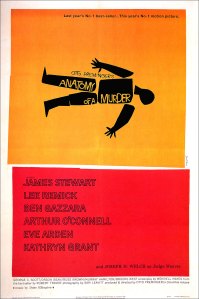
Review: Anatomy of a Murder (Dir. by Otto Preminger)


Last Friday, I randomly selected 10 movies from my DVD library and I asked you, this site’s wonderful readers, to vote on which one of those movies I should watch and then review.  234 votes were cast and the winner (by two votes!) is the 1959 courtroom classic Anatomy of a Murder.

First off, a confession of my own.  When I’m not reviewing movies or chattering away on twitter, I work in a law office.  Before anyone panics, I’m not a lawyer, I just hang out with a couple of them.  For the most part, I answer the phone, I schedule appointments, and I keep all the files in alphabetical order.  On a few very rare occasions, I’ve accompanied my boss to court and the thing that has always struck me about real-life courtroom drama is how boring it all really is.  There are no surprise witnesses, no impassioned closing statements, and those all trail rarely, if ever, jump to their feet and start yelling that they’re innocent.  For the most part, real life lawyers are usually just as poorly groomed and bored with their work as the rest of us.  Don’t even get me started on the judges, the majority of whom seem to have judgeships because they weren’t really making the grade as an attorney. 

As a result, it’s rare that I get much out of seeing lawyer-centric movies or tv shows any more.  After seeing the reality of it, I find fictionalized courtroom theatrics to be ludicrous and, for the most part, evidence of a lazy writer.  However, I’m happy to say that last night, I discovered that — no matter how jaded I may now be about the legal process — Anatomy of a Murder is still one of my favorite movies.

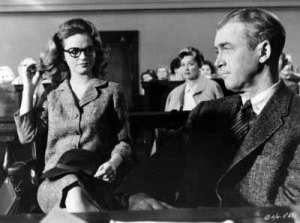
Based on a best-selling novel and directed by the notorious Otto Preminger, Anatomy of a Murder tells the story of Paul Beigler (James Stewart), a former district attorney who is now in private practice after having been voted out of office.  Having apparently fallen into a state of ennui, Beigler spends his time drinking with another alcoholic attorney (Arthur O’Connell) and trying to avoid his secretary’s (Eve Arden) attempts to get paid.

However, things change for Beigler when he is hired to defend an army officer named Frederick Manion (Ben Gazzara).  Manion has been arrested for murdering a bar own named Barney Quill.  Manion says that he was justified in committing the murder because Quill raped his wife, Laura (Lee Remick).  Others claim that Manion is himself just a notoriously violent bully and that the openly flirtatious Laura was having an affair with Quill.  Despite strongly disliking Manion and disturbed by Laura’s own obvious instability, Beigler takes on the case.

Beigler decides to argue that Manion was temporarily insane when he shot Quill and that he was acting on “irresistible impulse.”  As shaky as that line of defense might seem, it’s not helped by the fact that Manion himself is a bit of a brute.  Meanwhile, Beigler finds himself facing not the innefectual D.A. in court but instead a young, ambitious prosecutor from the State Attorney General’s Office, Claude Dancer (played by a young and obviously ambitious George C. Scott).  As the trial begins, small hints start to appear that seem to indicate that there’s a lot more to the murder of Barney Quill than anyone realizes…

Director Otto Preminger is an odd figure in film history.  Up until the early 60s, he was a consistently interesting director who made intelligent, well-acted films that often challenged then-contemporary moral attitudes.  However, once the 60s hit, he became something of a parody of the egotistical, old school, autocratic filmmaker and his films seemed to suffer as a result.  Like many of the film industry’s top directors, he found himself adrift once the 60s and 70s hit.  His decline was so dramatic that, as a result, there’s a tendency to forget that he made some truly great and important films, like Laura, Carmen Jones, The Man With The Golden Arm, and, of course, Anatomy of a Murder.

Anatomy of a Murder represents Preminger at his best.  His own natural tendency towards embracing melodrama and shock are  perfectly balanced with an intelligent script and memorable performances.  Whereas later Preminger films would often come across as little more than big screen soap operas, here he makes the sordid believable and compelling.  Preminger has never gotten much attention as a visual filmmaker but here, he uses black-and-white to perfectly capture the grayness of the both the film’s location and the moral issues that the film raises.  He keeps the camera moving without ever calling attention to it.  As a result, the movie has an almost documentary feel to it.

As previously stated, Preminger gets a lot of help from a truly amazing cast.  At first, it’s somewhat strange to imagine a Golden Age icon like Jimmy Stewart appearing in the same film as a dedicated method actor like Ben Gazzara.  These are two men who represent not only different philosophies of acting but seemingly from two different worlds as well.  However, Preminger uses their differing acting styles to electrifying effect.  One of the joys of the movie is watching and contrasting the old style, “move star” turns of James Stewart, Arthur O’Connell, and Eve Arden with the more “naturalistic” approaches taken by their younger co-stars, Gazzara, Lee Remick, and especially George C. Scott.  The contrast in style becomes a perfect reflection of the film’s contrast between what is legal and what is correct.  All the actors, as both individuals and as an ensemble, give memorable performances.  When you look at the cast, you realize that any one of their characters could have been the center of the story without the film becoming any less compelling. 

Lee Remick (a notoriously fragile actress who, for years, I knew solely as the poor woman who kept getting attacked by her adopted son in the original Omen) brings out the best in everyone she shares a scene with.  Whether she’s making Stewart blush or breaking down on the witness stand, she dominates every scene as an insecure young woman who forces herself to be happy because otherwise, she’d have to confront the fact that she’s miserable.  (I should admit that I related more than a bit to Remick’s character.  To me, the movie was about her and therefore, about me.) 

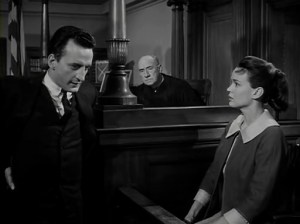
She is perhaps at her best towards the end of the film when she is on the witness stand and is cross-examined by George C. Scott.  Starting out as flirtatious and seemingly confident, Remick slowly and believably falls apart as Scott methodically strips away every layer of defense that, until now, she’s spent the entire movie hiding behind.  By the end of the scene, Remick has shown as every layer of pain that has built up in Laura Manion over the years.  For his part, Scott is simply amazing in this scene.  Determined and focused, Scott doesn’t so much cross-examine Remick but seduces her and the audience along with her.  As a result, when he suddenly turns off the charm and lunges in for his final attack, it’s devastating for everyone watching.  (And, as was correctly pointed out to me by a friend while I was watching the film last night, George C. Scott was quite the sexy beast when he was young.)

Lastly, the film’s judge is played by an actual lawyer by the name of Joseph Welch.  Welch wasn’t a great actor but he did make for a great judge.

Of course, it wouldn’t be a Preminger film is a few contemporary morals weren’t challenged and, at the time it was released, Anatomy of a Murder was considered to be very daring because of its frank discussion of topics like rape and spousal abuse.  It doesn’t seem quite so daring now but it does seem to be remarkably mature in a way that even most modern movies can’t match.  That being said, the film does occasionally embrace the “she must have been asking for it” male viewpoint but still, it’s a remarkably advanced movie for the 1950s.

One of the wonderful things about watching a 51 year-old film is that it provides a chance to see what was considered to be shocking in the years before you or I was born.  From watching this movie, I’ve discovered that, in the year 1959, “panties” was apparently a taboo phrase.  A good deal of the film’s plot revolves around the panties Lee Remick’s character was wearing the night she was raped and their subsequent disappearance.  At one point, there’s even a scene where Welch, Stewart, and Scott struggle to come up with a less offensive term to use when referring to them in the court.  (Scott suggests employing a term he heard in France.)  Seen 51 years later (in a time when we can not only say “thong” in polite conversation but specifically go out of our way to show off the fact that we’re wearing one), this scene, and the actors’ obvious discomfort whenever they have to say the word “panties”, never fails to amuse me.

Preminger’s other grand challenge to the 50s mainstream was in getting Duke Ellington to compose the film’s jazz soundtrack.  At the risk of being called a heretic by some of my closest friends, I’ve never been a big fan of jazz but it works perfectly here.  Ellington, himself, makes a cameo appearance and wow, is he ever stoned.

In conclusion, allow me to thank the readers of the site for “ordering” me to watch, once again, a truly classic film.  Now, seeing as how close the vote was and that I know, for a fact, that some people voted more than once, I think it would be only fair for me to also rewatch and review the other 9 movies (Lost in Translation, Primer, Hatchet For the Honeymoon, Emanuelle in America, Starcrash, Darling, Sole Survivor, The Sweet House of Horrors, and The Sidewalks of Bangkok) in my poll over the next couple of weeks.  I’m looking forward to each and every one of them (well, almost all of them) and, again, thank you for allowing me to start things off with a great film like Anatomy of a Murder.

Found on YouTube: Dean Miller — Zombie Exterminator


Nearly a year ago, I was searching YouTube for the trailer to Umberto Lenzi’s 1980 zombie film Nightmare City and I ended up coming across a tribute to the film’s main character, the virile and bearded TV news anchorman Dean Miller (played, with a notable lack of enthusiasm, by Hugo Stiglitz.)

The video artfully takes Lenzi’s overlong film and reduces it down to 3 and a half minutes of Dean Miller killing people.  Interestingly, not a hint of nuance or plot is lost in the process.  Anyway, the video has always made me smile so I figured why not share it?  I should clarify that I have no idea who actually put this together beyond the fact that I had nothing to do with it.

Actually, I’m being a little bit too hard on Nightmare City.  For a Lenzi film, its actually fairly entertaining and it does feature one of the abosolute worst endings in the history of cinema.  If a hurricane ever hits North Texas and I find myself having to stay inside for a few days, my survival plan is to pass the time writing up a review of Nightmare City.

As previously stated, Miller was played by actor Hugo Stiglitz.  Quentin Tarantino, of course, later borrowed Stiglitz’s name for Inglorious Basterds.  Tarantino’s Stiglitz, it must be said, was a bit more interesting than the actual Stiglitz.