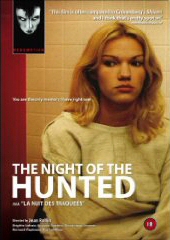
Review: Night of The Hunted (dir. by Jean Rollin)


When, at that age of 22, I first saw Jean Rollin’s Night of the Hunted, I cried as much as the first time I saw Titanic at the age of 12.  In both cases, the tears were inspired by a “doomed” love story.  The main difference between the two films is that I don’t cry over Titanic anymore.  But Night of Hunted still brings me to tears every time I see it.

The film opens with the image of a terrified young woman (Brigitte Lahaie) running through a dark forest until she eventually reaches a highway.  She’s picked up by a young man (Vincent Gardere) who, being a guy, proceeds to take her back to his apartment in Paris.  She confesses that she can’t remember who she is, why she was running, or even being picked up by the young man in the first place.  Saying that she needs some sort of memory to fill the emptiness, she proceeds to make love to Gardere.  Gardere, being a guy, doesn’t object.

However, he does make the mistake of later leaving Lahaie alone in the apartment afterwards.  As soon as Gardere leaves, Lahaie forgets ever meeting him and why she’s even in the apartment in the first place.  Even as she tries to figure out what’s going on, the apartment is visited by a doctor who tells Lahaie that she is his patient and that she needs to go with him to a “clinic” where he can treat her.  No longer remembering her encounter with Gardere, Lahaie agrees.

Needless to say, the “clinic” turns out to be what Lahie was so desperately trying to escape just a few hours before.  We learn that Lahie is merely one of several hundred people who, months earlier, were exposed to a biological warfare experiment gone wrong.  Now, as a result, her brain is slowly dying one cell at a time.  The clinic is actually a government-run prison where she and her fellow victims have been sent to be forgotten about and to eventually die.  Lahie finds herself surrounded by men and women who, as they slowly lose everything that made them unique, revert back to their most primal instincts.  While Gardere tries to find her, Lahie struggles to survive just one final night in both the clinic and in the prison of her own fading mind.

Director Jean Rollin is best known for his sexually-themed vampire films but the Night of the Hunted is not as huge a departure for him as it may first seem.  One of Rollin’s reoccurring themes is the importance of our memories, no matter how idealized they may sometimes be and this theme is present in every frame of Night of the Hunted.

The lead role is played by Rollin’s frequent muse and collaborator, Brigitte Lahaie.  Because the majority of Lahaie’s career has been spent making adult films, she’s never gotten the due she deserves as an actress.  Playing a difficult role here, Lahaie is the movie’s greatest strength.  She brings a real sincerity and empathy to her role and its impossible to imagine this movie working without her.  If nothing else, this movie is a wonderful display of Lahaie’s often underrated talent. 

Rollin made the film for very little money and used a cast made up almost entirely of nonprofessionals and French adult film veterans.  So, yes the film does sometimes have a grainy look and the editing is definitely jagged.  When the characters shoot at each other, it is obvious that they’re firing toy cap guns.  To me, however, this works in the film’s favor.  The raw quality of the film perfectly mirrors that constant fear and confusion that Lahaie and her fellow prisoners live in.  No, the film is not technically perfect but a flawed masterpiece is preferable to uninspired technical perfection any day.

Despite working with a miniscule budget, Rollin captures some haunting images in this film.  Never has Paris looked as desolate as in this movie.  One of Rollin’s trademarks has always been his own fascination with architecture and, as a result, the cold skyscraper where Lahaie is held prisoner almost becomes a character itself.  I’ve always considered Jean Rollin to be horror cinema’s equivalent to Jean-Luc Godard and, with its images of a sterile city run by passionless autocrats, Night of the Hunted brings to mind Godard’s Alphaville.

 The film’s most haunting image comes at the end and it is this image that brings tears to my eyes every time.  Whatever flaws the film may have, Night of the Hunted has one of the best final shots in the history of cinema.  Even if everything preceeding it had been worthless, this movie would be worth sitting through just for the stark beauty of the final shot.  Night of the Hunted ends on a note that manages to be darkly sad and inspiringly romantic at the same time.  It’s an ending that makes Night of the Hunted one of the most romantic films of all time.
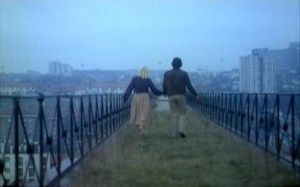
Night of the Hunted was released in 1980 and, like the majority of Rollin’s films, was never released in the States.  Redemption, however, has released it on DVD (which is how I first saw it in 2008.)   While the transfer is undeniably rough, that actually gives the movie a documentary-like quality that works in its favor.  The film is in French with English subtitles.   As is so often the case with subtitles, a lot of the film’s nuance is sacrificed in translation.  Fortunately, the combination of Rollin’s visual sense and Lahaie’s lead performance more than makes up for it.

Review: The Girlfriend Experience (dir. by Steven Soderbergh)


“Sometimes clients think they want the real you, but at the end of the day, they say they don’t. They want what you want to be.” — Chelsea

In between his larger projects (the Che biopic) and studio work (Ocean’s 11 through 13), Steven Soderbergh has kept busy with low-budget, experimental films like Bubble and Full Frontal. His latest entry in this HD-shot, minimalist phase is The Girlfriend Experience. When it was first announced in 2008, much of the buzz centered on Soderbergh’s decision to cast real-life porn star Sasha Grey in the lead role. From that point through its festival run, discussion of the film fixated heavily on that choice. Yet The Girlfriend Experience is ultimately a more intriguing work than its casting gimmick suggests, attempting to draw parallels between the high-end sex industry and the power structures of modern capitalism.

First off, Sasha Grey is not the film’s weak link, despite expectations tied to her background. While her performance can be uneven, there are several moments where she displays clear presence and control. What some have interpreted as a flat or vacuous screen persona actually aligns closely with the character. Chelsea is a $10,000-a-night escort whose clientele consists of wealthy, powerful men—people accustomed to buying whatever and whoever they want. What they purchase from Chelsea is the illusion of intimacy: the “girlfriend experience.”

One of the earliest scenes illustrates this perfectly, as Chelsea spends time with a client in what initially appears to be a normal relationship between a successful man and a poised, younger partner. That illusion, however, defines the entire film. Chelsea is not simply selling sex; she is selling the performance of a perfect relationship. On the surface, everything appears polished and authentic, but beneath it lies something transactional and deeply artificial.

Grey captures this duality effectively. Where some may see a performer out of her depth, her detachment instead feels intentional—part of the character’s constructed identity. It becomes difficult to distinguish where Grey ends and Chelsea begins. Whether this translates into a long-term mainstream acting career is uncertain, but with the right material and direction, she shows potential beyond the limitations of typecasting.

Despite its subject matter, The Girlfriend Experience is less about sex than it is about the commodification of fantasy. Even Chelsea’s boyfriend, Chris (played by Chris Santos), participates in this economy of illusion as a personal trainer selling physical transformation and confidence. The film avoids sentimentality, and when it briefly leans in that direction, it feels out of step with its otherwise clinical tone. Its strength lies in exposing how fragile these constructed realities are once stripped away.

Chelsea herself embodies this contradiction. She is savvy and business-minded, clearly aware of how to leverage her work into future opportunities, yet she clings to a lingering naivete. As competition emerges and her client base becomes less secure, her vulnerability surfaces. Despite operating within a world of calculated transactions, she remains susceptible to the same power dynamics that define her clients’ world.

Shot quickly during the financial collapse of 2008–2009, the film subtly mirrors that instability. Soderbergh draws a parallel between Chelsea’s profession and the broader economic system—both built on selling aspirational illusions. Just as consumers were sold the dream of prosperity they couldn’t afford, Chelsea sells emotional intimacy that isn’t real. In both cases, the illusion eventually collapses, revealing a harsher truth underneath.

Soderbergh’s direction may be challenging for some viewers. The film unfolds in a non-linear, fragmented style typical of his more experimental work. Those familiar with his filmography will likely adjust, but audiences expecting something closer to his mainstream efforts may find it disorienting. Still, his continued experimentation with HD cinematography is notable. The image is strikingly crisp—sometimes to the point of artificiality—which reinforces the film’s thematic focus on surface versus reality. Beneath that clean exterior lies something far more complicated and unpolished.

Of Soderbergh’s work in this digital format, The Girlfriend Experience stands as his strongest effort so far. It is far from perfect—at times it feels visually and emotionally restrained for a filmmaker of his caliber—but it carries an unmistakable French New Wave influence, particularly reminiscent of Jean-Luc Godard. The film is unlikely to earn major accolades, and it may ultimately be remembered as a curious crossover moment for Sasha Grey. Still, its very existence speaks to a willingness—on both the director’s and the actor’s part—to take risks outside conventional boundaries.

In an industry often driven by safety and predictability, that alone makes The Girlfriend Experience worth noting. Whether or not it succeeds by traditional standards is almost beside the point; the film exists, invites interpretation, and leaves its audience to decide its value on their own terms.