Whenever it’s time to share this film for Horrorthon, I have a little story that I like to tell:
Enter singing.
Little Shop.…Little Shop of Horrors.…Little Shop.…Little Shop of Terrors….
When I was 19 years old, I was in a community theater production of the musical Little Shop of Horrors. Though I think I would have made the perfect Audrey, everybody always snickered whenever I sang so I ended up as a part of “the ensemble.” Being in the ensemble basically meant that I spent a lot of time dancing and showing off lots of cleavage. And you know what? The girl who did play Audrey was screechy, off-key, and annoying and after every show, all the old people in the audience always came back stage and ignored her and went straight over to me. So there.
Anyway, during rehearsals, our director thought it would be so funny if we all watched the original film. Now, I’m sorry to say, much like just about everyone else in the cast, this was my first exposure to the original and I even had to be told that the masochistic dentist patient was being played by Jack Nicholson. However, I’m also very proud to say that — out of that entire cast — I’m the only one who understood that the zero-budget film I was watching was actually better than the big spectacle we were attempting to perform on stage. Certainly, I understood the film better than that screechy little thing that was playing Audrey.
The first Little Shop of Horrors certainly isn’t scary and there’s nobody singing about somewhere that’s green (I always tear up when I hear that song, by the way). However, it is a very, very funny film with the just the right amount of a dark streak to make it perfect Halloween viewing.
So, if you have 72 minutes to kill, check out the original and the best Little Shop of Horrors….
Today’s horror on the lens is the 1957 Roger Corman-directed, sci-fi “epic,” Not of this Earth.
Paul Johnson (Paul Birch) may seems like a strange character, with his stilted way of speaking and his sunglasses and his overdramatic reaction to any and all loud noises. Paul could us be an eccentric. Or, he could be …. NOT OF THIS EARTH! Actually, his habit of draining people of their blood and sending weird, umbrella-like creatures out to attack his enemies would seem to suggest that the latter is probably true.
Listen, it’s not easy being a blood-sucking alien. I mean, sure, there’s always seems to be people stupid enough to show up at your mansion so that you can drain their bodies. Paul is lucky that he doesn’t exactly seem to be surrounded by brain surgeons. But sometimes, things happen. For instance, someone might show up from your home planet and demand an immediate transfusion! What is an alien to do?
Watch this low-budget but undeniably entertaining film to find out! And be sure to especially keep an eye out for the great Dick Miller, who reportedly improvised his role as a vacuum cleaner salesman. (Before going into acting, Miller actually did sell vacuum cleaners door-to-door.)
1989’s The ‘Burbs takes place in …. well, it’s right there in the title.
Welcome to the suburbs! It’s place with big houses, green lawns, and neighbors who often don’t have much to do other than watch each other and gossip. Ray Peterson (Tom Hanks) lives with his wife, Carol (Carrie Fisher), and is friends with Art Weingartner (Rick Ducommun) and Mark Rumsfield (Bruce Dern). Ricky Butler (Corey Feldman) is the local teenager. It’s a nice neighborhood …. at least, until the Klopeks move in.
The Klopeks are viewed with suspicion from the minute they show up. They’re from a different country, they always seem to be burying something in their backyard, and Dr. Werner Klopek (Henry Gibson) is oddly stand-offish. When Walter Seznick (Gale Gordon) disappears and the the Klopeks are seen around Walter’s house and with Walter’s dog, Ray and his friends start to suspect that their new neighbors might be ritualistic murderers!
Oh, how I love The ‘Burbs. The film’s portrait of the suburbs as being a hotbed of paranoia may be a familiar one but it doesn’t matter when you’ve got actors like Tom Hanks and Bruce Dern throwing themselves into their roles. As always, Hanks is the glue that holds the film and its disparate parts together, giving a likable performance as a man who goes from being the voice of reason to being convinced that his neighbors are cannibals. Bruce Dern gleefully sends up his own image as a paranoid Vietnam vet but there’s also a sweetness to Dern’s performance that really makes it stand out. Dern’s character might be a little crazy but he does truly care about his neighbors.
Just as he did with Piranha and The Howling, Dante balances humor with suspense. He does such a good job of telling the story and getting good performances from his cast, that even the film’s big twist works far better than one might expect. It’s an 80s film so, of course, a few things explode towards the end of it. The film’s character-based humor is replaced with some broader jokes but no matter. The Burbs is an entertaining trip to the heart of suburban paranoia.
As the saying goes, just because you’re paranoid, that doesn’t mean that they aren’t out to get you.
“Man is a feeling creature, and because of it, the greatest in the universe….”
Hell yeah! You tell ’em, Peter Graves!
Today’s Horror on the Lens is 1956’s It Conquered The World. Graves plays a scientist who watches in horror as his small town and all of the people who he loves and works with are taken over by an alien. Rival scientist Lee Van Cleef thinks that the alien is going to make the world a better place but Graves understands that a world without individual freedom isn’t one that’s worth living in.
This is one of Corman’s most entertaining films, featuring not only Graves and Van Cleef but also the great Beverly Garland. Like many horror and science fiction films of the 50s, it’s subtext is one of anti-collectivism. Depending on your politics, you could view the film as either a criticism of communism or McCarthyism. Watching the film today, with its scenes of the police and the other towns people hunting anyone who fails to conform or follow orders, it’s hard not to see the excesses of the COVID era.
Of course, there’s also a very persuasive argument to be made that maybe we shouldn’t worry too much about subtext and we should just enjoy the film as a 50s B-movie that was directed with the Corman touch.
Regardless of how interpret the film, I defy anyone not to smile at the sight of ultra-serious Peter Graves riding his bicycle from one location to another.
Here, for your viewing pleasure, is It Conquered The World!
Who wouldn’t love to see a movie where a youngish Jack Nicholson played a French soldier who, while searching for a mysterious woman, comes across a castle that’s inhabited by both Dick Miller and Boris Karloff?
In Roger Corman’s 1963 film The Terror, New Jersey-accented Jack Nicholson is the least believable 19th century French soldier ever. However, it’s still interesting to watch him before he became a cinematic icon. His performance here is rather earnest, with little of the sarcasm that would later become his trademark. Boris Karloff is, as usual, great and familiar Corman actor Dick Miller gets a much larger role than usual. Pay attention to the actress playing the mysterious woman. That’s Sandra Knight who, at the time of filming, was married to Jack Nicholson.
Reportedly, The Terror was one of those films that Corman made because he still had the sets from his much more acclaimed film version of The Raven. The script was never finished, the story was made up as filming moved alone, and no less than five directors shot different parts of this 81 minute movie. Boris Karloff’s scenes were filmed first, with the other actors performing in front of a body double during their scenes. Among the many directors who filmed bits and pieces of TheTerror: Roger Corman, Jack Hill, Monte Hellman, Francis Ford Coppola, Coppola’s roommate Dennis Jakob, and even Jack Nicholson himself! (Despite this number of directors involved, Corman received the sole directorial credit.) Perhaps not surprisingly, the final film is a total mess but it does have a definite historical value.
(In typical Corman fashion, scenes from The Terror were later used in the 1968 film, Targets. In that film, Karloff plays a version of himself, an aging horror actor who watches The Terror and dismisses it as being “terrible.”)
Though the Academy of Motion Picture Arts and Sciences claim that the Oscars honor the best of the year, we all know that there are always worthy films and performances that end up getting overlooked. Sometimes, it’s because the competition too fierce. Sometimes, it’s because the film itself was too controversial. Often, it’s just a case of a film’s quality not being fully recognized until years after its initial released. This series of reviews takes a look at the films and performances that should have been nominated but were, for whatever reason, overlooked. These are the Unnominated.
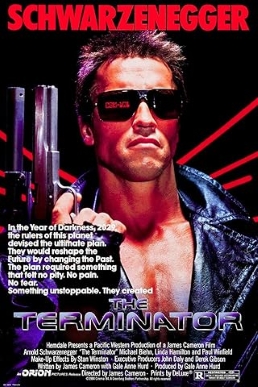
First released in 1984, TheTerminator was the one of the top box office hits of the year. It’s the film that established James Cameron as a filmmaker. It’s the film that made a bona-fide star out of Arnold Schwarzenegger. It’s a film that was imitated a thousand times before it even got its first official sequel. It’s a film that’s still celebrated today. 41 years later, people are still saying, “I’ll be back.” Would Arnold Schwarzenegger ever have become governor of California if he hadn’t first played a killing machine? There’s a reason why his political nickname was the Governator.
And yet, TheTerminator was not nominated for a single Oscar. For all of the explosions and the gunfire and the screaming, it wasn’t even nominated for Best Sound. Some of the special effects may now seem a bit hokey in this age of rampant CGI but it’s still a surprise that TheTerminator was not nominated for Best Visual Effects. The breath-taking action scenes did not result in a nomination for Best Editing. Linda Hamilton was not nominated for her fantastic performance as Sarah Connor, a young woman who finds herself being pursued by a killer cyborg from the future. Arnold Schwarzenegger was not nominated for playing one of the most memorable villains of the past 40 years. Those who claim that Schwarzenegger was just playing himself are being overly glib. Anyone could have said, “I’ll be back.” It took Schwarzenegger’s delivery to make it a great line.
The lack of nominations aren’t really not a surprise, of course. The Academy has only recently started to show an openness to nominating genre films for major awards and, even now, a genre film has to be considered a “cultural event” to even get a nomination. Black Panther, Get Out, and even Mad Max: Fury Road and Dune were all nominated because it was felt that they had transcended their genre origins. TheTerminator is a sci-fi action movie and it’s proud to be a sci-fi action movie. (Terminator 2: Judgment Day, it could be argued, transcended its genre origins but it was released in 1991 and Silence of the Lambs was destined to be the genre nominee that year.) It’s also so relentlessly paced and intelligently written and directed that it’s a film that, even after all these years, it can still leave you breathless. Nominated or not, The Terminator is a film that grabs your attention and holds it for a full 107 minutes. There’s not many films that can make that claim.
TheTerminator is a film that has held up surprisingly well. (It’s certainly held up better than some of its more recent sequels.) The performances of Linda Hamilton, Michael Biehn, and Arnold Schwarzenegger still work. It’s still terrifying to watch as The Terminator relentlessly kills everyone that he comes into contact with. (One thing that always gets me about the Terminator is that, even though he’s huge and superstrong and could probably physically rip anyone he wanted to apart, he still carries and uses a gun. This makes him seem like even more of a bully.) The Terminator is a machine and what makes him especially intimidating is that he doesn’t care if people see him coming or if they witness his crimes. He has one function and that’s all he worries about. When Michael Biehn first shows up, you can’t help but wonder why this guy, with his slight build and his somewhat nervous mannerisms, would be sent to try to stop the Terminator. Of course, by the end of the movie, you understand.
(And what an ending! The sight of those clouds, Linda Hamilton’s delivery of her final line, and the feeling that the future has already been determined, it all definitely makes an impression that has managed to survive every sequel after JudgmentDay. There’s a reason why Skynet — much like “I’ll be back” — has taken on a cultural life of its own.)
There were a lot of very good films that were nominated for Oscars in 1984. The Terminator, much like Once Upon A Time In America, was not one of them but it will still never be forgotten.
“What is it exactly that you want?” a preacher (Frank Maxwell) asks a congregation of leather-clad bikers.
“We want to get loaded!” Heavenly Blues (Peter Fonda) replies, “And we want to have a good time!”
And have a good time, they proceed to have. Of course, it’s a good time for them. Everyone else who meets the bikers at the center of 1966’s The Wild Angels are horrified by this collection of rebellious and violent outsiders. Sure, Heavenly Blues might actually be a soulful guy who mistakenly believes that he can control the gang’s more excessive tendencies. His girlfriend, Mike (Nancy Sinatra), actually seems rather reserved and conservative when compared to the rest of the gang. But make no mistake about it, the majority of the members of the gang are into violence for its own sake. They are bullies who couldn’t make the football team so, instead, they hopped on a motorcycle and formed their own society. They’re self-styled rebels but what are they rebelling against? What have you got?
I know, I know. That famous line comes from Marlon Brando and it was uttered in The Wild One. Peter Fonda, to put it lightly, was no Marlon Brando and, as directed by Roger Corman, The Wild Angels doesn’t have the societal concerns that lay at the hear of The Wild One. As Corman was often the first to admit, his main concern when it came to making movies was to make money. Corman wasn’t necessarily against message films. He often stated that, as a director, 1962’s The Intruderwas the film in which he took the most pride. The Intruder took a firm stand against racism and it let everyone know where Corman stood on when it came to the Civil Rights Movement. It was also one of his few films to lose money. The Wild Angels celebrates rebellion but one gets the feeling that celebration is motivated by the fact that younger filmgoers would be happy to pay to see a movie about a bunch of “youngish” people telling the old folks to shut up and get out of the way. The Wild Angels themselves don’t seem to be motivated by any sort of grand ideology. Heavenly Blues preaches about getting loaded and having a good time and celebrating freedom but he also allows the members of the gang to drape a Nazi flag over a casket. What does Heavenly Blues actually believe in?
Heavenly Blues believes in loyalty to his friends. For all the fights and the orgies and the scenes of motorcycles roaring down country roads, this is ultimately just a film about a guy who wants to give his best friend a decent burial. The Loser (Bruce Dern) dies about halfway through the film and one gets the feeling that he probably would have lived if the gang hadn’t kidnapped him from the hospital. Heavenly Blues wants to give The Loser the type of wild funeral that Blues thinks he would have wanted though I think The Loser probably would have been happier not have been killed by the actions of his idiot friends. Diane Ladd, who was married to Bruce Dern at the time and who has said Laura Dern was conceived during the filming of The Wild Angels, is heart-breaking as The Loser’s girlfriend, Gaysh. Gaysh wants to mourn her boyfriend while the rest of the gang is more concerned with figuring out who her next boyfriend is going to be.
Does Heavenly Blues ever realize that he’s traveling with a bunch of animals? He does but one gets the feeling that he’s accepted his fate. There’s no going back. The past can’t change and the future cannot be controlled so Heavenly Blues is content to live in the present. All he can do is try to give his friend a decent burial while the sirens of cops shriek in the distance.
The Wild Angels was a controversial film when it was first released. It also made a lot of money and led to a whole cycle of outlaw biker films, culminating with Easy Rider. Seen today, it’s a portrait of a society coming apart, with the establishment and the bikers not even willing to stop fighting long enough to allow for a simple burial. It’s definitely a time capsule film, one of those productions that epitomizes an era. There’s not much going on underneath the surface and most of the film’s bikers really are awful people but there is something touching about Blues giving it all up just to try to give his friend a decent burial.
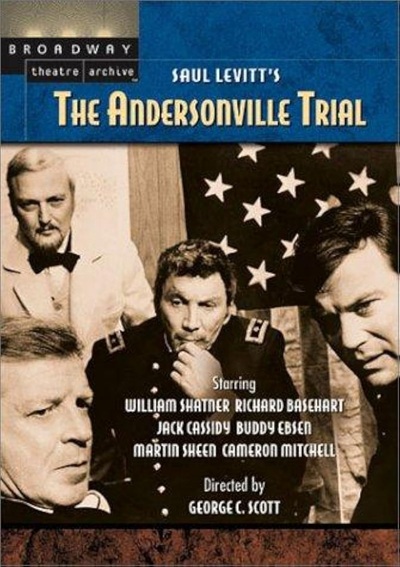
1970’s The Andersonville Trial takes place in one muggy military court room. The year is 1865. The Civil War is over but the wounds of the conflict are still fresh. Many of the leaders of the Confederacy are still fugitives. Abraham Lincoln has been dead for only a month. The people want someone to pay and it appears that person might be Captain Henry Wirz (Richard Basehart).
Originally born in Switzerland and forced to flee Europe after being convicted of embezzlement, Henry Wirz eventually ended up in Kentucky. He served in the Confederate Army and was eventually named the commandant of Camp Sumter, a prison camp located near Andersonville, Georgia. After the war, Captain Wirz is indicted for war crimes connected to his treatment of the Union prisoners at the camp. Wirz and his defense counsel, Otis Baker (Jack Cassidy), argue that the prison soon became overcrowded due to the war and that Wirz treated the prisoners as well as he could considering that he had limited resoruces. Wirz points out that his requests for much-needed supplies were denied by his superiors. Prosecutor Norton Chipman (William Shatner) argues that Wirz purposefully neglected the prisoners and their needs and that Wirz is personally responsible for every death that occurred under his watch. The trial is overseen by Maj. General Lew Wallace (Cameron Mitchell), the same Lew Wallace who would later write Ben-Hurand who reportedly offered a pardon to Billy the Kid shortly before the latter’s death. Wallace attempts to give Wirz a fair trial, even allowing Wirz to spend the trial reclining on a couch due to a case of gangrene. (Agck! The 19th century was a scary time!)
The Andersonville Trial started life as a 1959 Broadway production. On stage, George C. Scott played Chipman, an experience he described as difficult because, even though Chipman was nominally the play’s hero, Wirz was actually a much more sympathetic character. When the play was adapted for television in 1970, Scott returned to direct. Admittedly, the television version is very stagey. Scott doesn’t make much effort to open up the play. Almost all of the action is confined to that courtroom. We learn about the conditions at Fort Sumter in the same way that the judges learned about the conditions. We listen as the witnesses testify. We listen as a doctor played by Buddy Ebsen talks about the deplorable conditions at Fort Sumter. We also listen as a soldier played by Martin Sheen reports that Wirz has previously attempted to suicide and we’re left to wonder if it was due to guilt or fear of the public execution that would follow a guilty verdict. We watch as Chipman and Baker throw themselves into the trial, two attorneys who both believe that they are correct. And we watch as Wirz finally testifies and the play hits its unexpected emotional high point.
As most filmed plays do, The Andersonville Trial demands a bit of patience on the part of the viewer. It’s important to actually focus on not only what people are saying but also how they’re saying it. Fortunately, Scott gets wonderful performances from his ensemble cast. Even William Shatner’s overdramatic tendencies are put to good use. Chipman is outraged but the play asks if Chipman is angry with the right person. With many of the Confederacy’s leaders in Canada and Europe, Wirz finds himself standing in for all of them and facing a nation that wants vengeance for the death of their president. Wirz claims and his defense attorney argues that Wirz was ultimately just a soldier who followed orders, which is what soldiers are continually told to do. The Andersonville Trial considers when military discipline must be set aside to do what is morally right.
Admittedly, when it comes to The Andersonville Trial, it helps to not only like courtroom dramas but to also be a bit of a history nerd as well. Fortunately, both of those are true of me. I found The Andersonville Trial to be a fascinating story and a worthy production.
Directed by Martin Scorsese, 1985’s After Hours opens in an office. This isn’t the type of office that one might expect a Scorsese movie to open with. It’s not a wild, hedonistic playground like the office in The Wolf of Wall Street. Nor is it a place where an aging man with connections keeps his eye on the business for his friends back home, like Ace Rothstein’s office in Casino. Instead, it’s a boring and anonymous office, one that is full of boring and anonymous people. Scorsese’s camera moves around the office almost frantically, as if it’s as trapped as the people who work there.
Paul Hackett (Griffin Dunne) works in the office, at a job that bores him but presumably pays him enough to live in New York. Paul is not a typical Scorsese protagonist. He’s not a fast-talker or a fearsome fighter. He’s not an artist consumed by his own passion or an amoral figure eager to tell his own story. Instead, he’s just a guy who wears a tie to work and who spends his day doing data entry. He’s a New Yorker but he doesn’t seem to really know the city. (He certainly doesn’t know how much it costs to ride the subway.) He stays in his protected world, even though it doesn’t seem satisfy him. Paul Hackett is not Travis Bickle. Instead, Paul is one of the guys who would get into Travis’s cab and, after spending the drive listening to Travis talk about how a storm needs to wash away all of New York’s sin, swear that he will never again take another taxi in New York.
One day, after work, Paul has a chance meeting with a seemingly shy woman named Marcy (Rosanna Arquette). Marcy lives in SoHo, with an artist named Kiki (Linda Fiorentino) who sells plaster-of-Paris paperweights that are made to look like bagels. Marcy gives Paul her number and eventually, Paul ends up traveling to SoHo. He takes a taxi and, while the driver is not Travis Bickle, he’s still not amused when Paul’s last twenty dollar bill blows out the window of the cab.
Paul’s trip to SoHo doesn’t goes as he planned. Kiki is not impressed with him. Marcy tells him disturbing stories that may or may not be true while a search through the apartment (not cool, Paul!) leads Paul to suspect that Marcy might have disfiguring burn scars. Paul decides to end the date but he then discovers that he doesn’t have enough change on him to take the subway home. As Paul attempts to escape SoHo, he meets a collection of strange people and finds himself being hunted by a mob that is convinced that he’s a burglar. Teri Garr plays a sinister waitress with a beehive hairdo and an apartment that is full of mousetraps. Catherine O’Hara chases Paul in an ice cream truck. Cheech and Chong play two burglars who randomly show up through the film. John Heard plays a bartender who appears to be helpful but who also has his own connection to Marcy. Even Martin Scorsese appears, holding a spotlight while a bunch of punks attempt to forcibly give Paul a mohawk. The more that Paul attempts to escape SoHo, the more trapped he becomes.
Martin Scorsese directed After Hours at a time when he was still struggling to get his adaptation of The Last Temptation of Christ into production. If Paul feels trapped by SoHo, Scorsese felt trapped by Hollywood. After Hours is one of the most nightmarish comedies ever made. It’s easy to laugh at Paul desperately hiding in the shadows from Catherine O’Hara driving an ice cream truck but, at the same time, it’s impossible not to relate to Paul’s horror as he continually finds himself returning again and again to the same ominous locations. In many scenes, he resembles a man being hunted by torch-wielding villagers in an old Universal horror film, running through the shadows while villager after villager takes to the streets. Paul’s a stranger in a strange part of the city and he has absolutely no way to get home. I think everyone’s had that dream at least once.
Paul is not written to be a particularly deep character. He’s just a somewhat shallow office drone who wanted to get laid and now just wants to go home. Fortunately, he’s played by Griffin Dunne, who is likable enough that the viewer is willing to stick with Paul even after Paul makes some very questionable decisions and does a few things that make him a bit less than sympathetic. Dunne and John Heard keep the film grounded in reality, which allows Rosanne Arquette, Linda Fiorentino, Catherine O’Hara, and especially Teri Garr to totally play up the bizarre quirks of their character. Teri Garr especially does a good job in this film, revealing a rather frightening side of the type of quirky eccentric that she usually played.
Scorsese’s sense of humor has been evident in almost all of his films but he still doesn’t get enough credit for his ability to direct comedy. (One need only compare After Hours to one of Brian De Palma’s “comedies” to see just how adroitly Scorsese mixes laughs and horror.) After Hours is one of Scorsese’s more underrated films and it’s one that everyone should see. After Hours is a comedy of anxiety. I laughed while I watched it, even while my heart was racing.
The character at the center of the 1962 Edgar Allan Poe adaptation, The Premature Burial, Guy spends his days terrified of being buried alive. Like his father before him, Guy suffers from a disease that can make him appear to be dead despite actually being alive. Guy is convinced that his father was buried alive and swears that he could even hear his father crying for help inside of his tomb. Though his fiancée, Emily (Hazel Court), insists that Guy is driving himself mad with his fears, Guy continue to spend his time trying to invent a coffin from which one can easily escape. Even after Emily and Guy are married, Guy continues to obsess.
Finally, faced with the prospect of opening his father’s tomb to discover whether or not his father truly was buried alive, Guy appears to drop dead of a heart attack. But is he really dead or is he about to be buried alive!? And who is responsible for the series of mysterious events that apparently drove Guy to collapse of fright? Watch the film to find out! Or read the Edgar Allan Poe short story.
This was the third of Roger Corman’s Edgar Allan Poe adaptations and it’s the first one to not feature Vincent Price as the lead character. For the most part, the members of the small cast all do a good job with their roles. Ray Milland is both sympathetic and a little frightening as the obsessed Guy. Heather Angel is properly enigmatic as Guy’s overprotective sister and Hazel Court will keep you guessing as far as her character’s motivations are concerned. Dick Miller has a small but key role as a grave digger who seems to take just a little bit too much enjoyment from his work. The film’s atmosphere is properly gothic and, if the film isn’t as visually audacious as the first two Poe films, Corman still finds time to include a creepy and psychedelic dream sequence.
That said, Vincent Price is still very much missed. Corman reportedly wanted to use Price but, because Corman produced and financed the film himself, Corman’s former business partners at American International Pictures would not allow Price to appear in the film. (Price was under exclusive contract to AIP.) By the time Corman and AIP worked out their disagreements and again joined forces, Ray Milland had already been cast in the lead role.
While the actors all do a good job, it’s hard to deny that Guy Correll would have been an ideal role for Vincent Price, even if it would have meant essentially re-doing his performance from The Pit and the Pendulum. It’s not just that the film misses Price’s theatrical acting style. The film also misses the energy that Price brought to the previous two Poe films. ThePremature Burial moves at a stately pace and, in the end, it’s a bit too slow and respectable for its own good. Price would have jazzed things up and made a decent film into a truly memorable one. Fortunately, Price would return for the later Poe adaptations.