Review: Dante’s Peak (dir. by Roger Donaldson)


“Not extinct, just dormant… as in sleeping. And your volcano might just be waking up.” — Harry Dalton

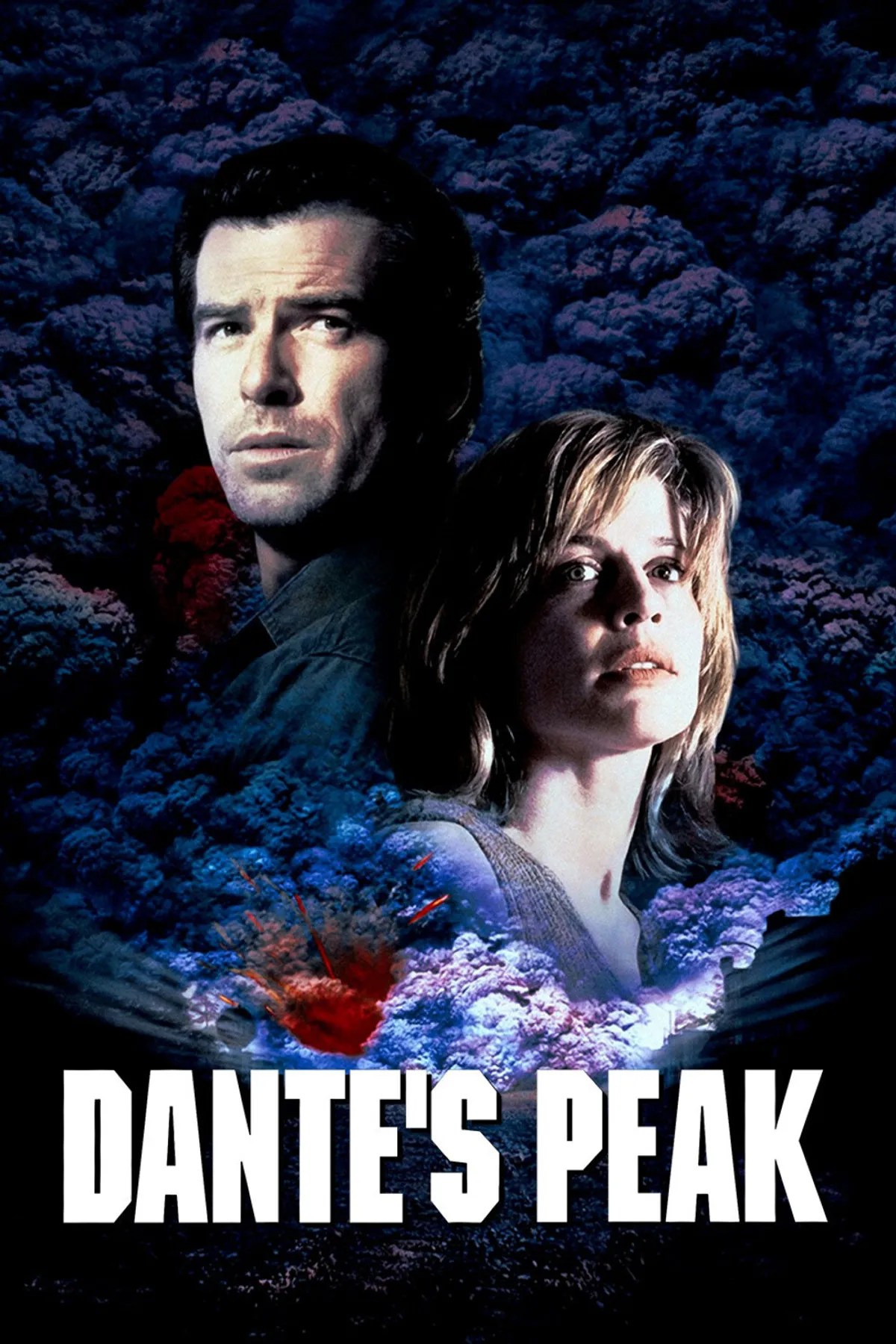
Dante’s Peak takes a simple but reliable disaster-movie setup—a quiet town sitting beneath a volcano that is very much not as dormant as everyone hopes—and turns it into a tense, highly watchable piece of 1990s spectacle. Directed by Roger Donaldson, the 1997 film is hardly subtle, and its character work can be pretty thin, but it remains an unusually watchable entry in the genre because it takes its central threat seriously. The movie spends enough time establishing the town and its people that, once the mountain finally blows, the destruction has some weight behind it. It is a familiar formula, but Dante’s Peak executes it with enough sincerity and old-school craftsmanship to stay entertaining.

Pierce Brosnan stars as Harry Dalton, a volcanologist for the U.S. Geological Survey who is still carrying the emotional scars of a prior eruption that killed his fiancée. Harry is sent to the picturesque Pacific Northwest town of Dante’s Peak after unusual seismic and chemical activity suggests that its supposedly dormant volcano may be waking up. His assignment initially sounds routine: inspect the mountain, collect some samples, talk to local officials, and determine whether there is any reason for concern. Naturally, there is. The water supply starts showing signs of dangerous acidity, tremors grow more frequent, steam vents become harder to ignore, and the mountain begins sending increasingly blunt warnings that it is ready to erupt.

The central tension is not whether the volcano will blow. The title alone pretty much gives that away. Instead, the first half works because of the fight over how seriously the warning signs should be taken. Dante’s Peak has just received national attention as one of the best small towns in America, and Mayor Rachel Wando, played by Linda Hamilton, is understandably hesitant to cause mass panic and wreck the town’s economy over an uncertain prediction. Harry believes the danger is real, but he also knows from painful experience that hesitation can get people killed. That conflict gives the movie a decent human foundation before the large-scale effects take over.

Brosnan is a good fit for Harry Dalton. This was the same period when he was newly established as James Bond, and Dante’s Peak makes smart use of his natural screen presence without turning Harry into an outright action hero. He is calm, capable, handsome, and articulate, but he is also clearly rattled by the possibility of repeating a tragedy he could not prevent. The role is not especially demanding on paper, yet Brosnan gives Harry enough fatigue and frustration that he comes across as a real professional rather than just a disaster-movie scientist whose only job is to shout warnings at dismissive bureaucrats.

Hamilton is arguably even more important to the movie’s success. Rachel could have been written as a generic authority figure who slows down the plot by refusing to believe the expert, but Hamilton makes her more sympathetic than that. She is not ignoring Harry because she is foolish or selfish. She has a town to protect, businesses that depend on tourism, residents who do not want to abandon their homes, and two children who become central to the film’s increasingly dangerous rescue mission. Hamilton had already cemented her action credentials in Terminator 2: Judgment Day, but here she plays a more grounded version of strength. Rachel is practical, stubborn, and brave without ever feeling like she has wandered in from another franchise with a shotgun and a leather jacket.

The supporting cast is more uneven. Charles Hallahan gets the familiar disaster-movie role of Paul Dreyfus, the superior whose skepticism creates a frustrating delay in the evacuation. Elizabeth Hoffman is memorable as Rachel’s grandmother, Ruth, even though the movie leans hard into the “stubborn elderly relative refuses to leave” setup. Rachel’s children, Lauren and Graham, mostly function as a way to push the adults back into danger after the eruption begins, and their choices can be maddening. Still, the cast sells the stakes well enough that the film avoids feeling completely mechanical.

Where Dante’s Peak really delivers is in its escalation. The first clear sign that things have gone wrong is genuinely creepy: the town’s supposedly pristine water supply turns corrosive. That detail is one of the movie’s best touches because it makes the volcano feel dangerous before it becomes visually spectacular. Then the film starts layering hazards on top of each other. There are earthquakes, falling volcanic debris, ash clouds, mudslides, a collapsing bridge, boiling water, and eventually a full eruption. It is an impressively varied disaster package. Rather than relying on one big explosion and calling it a day, the movie treats the volcano as a chain reaction that attacks the town from every direction.

The standout sequence is the drive across the lake after volcanic material has made the water acidic. It is ridiculous in the specific, memorable way that disaster cinema often is: a family in a damaged vehicle tries to outrun a lake that is essentially eating the vehicle out from under them. The science of the scene has been criticized plenty over the years, and fairly so, but it works as suspense filmmaking. Donaldson understands how to stage the moment visually, showing the immediate effects on the vehicle while keeping the characters trapped in a situation that gets worse by the second. It is the kind of scene people remember long after forgetting much of the dialogue.

Visually, the movie has aged better than some of its late-1990s peers because it balances computer-generated imagery with practical destruction, physical sets, and real locations. The effects do not always look flawless now, especially in wider shots of the erupting mountain, but the overall physicality helps. Buildings shake, roads split open, ash hangs in the air, and characters actually look buried in the mess rather than pasted in front of it. The town itself is also nicely chosen. Dante’s Peak looks like the sort of clean, friendly, postcard-perfect place that a disaster movie needs to destroy. The contrast between its calm opening scenes and its ash-covered final act is one of the film’s strongest visual ideas.

Roger Donaldson directs efficiently, even if he never quite gives the film a distinctive personality. He keeps the geography clear during most of the action, which matters a lot in a movie built around people trying to flee shifting dangers. You usually understand where Harry and Rachel are, what obstacle is in front of them, and why they cannot simply drive away. The pacing is a little slow in the middle, particularly when the scientific warnings begin repeating themselves, but that patience pays off once the final act kicks in. The movie takes a while to get to the eruption, then makes sure the eruption earns its screen time.

The screenplay by Leslie Bohem is where Dante’s Peak shows its limitations. The dialogue is often blunt, the romance between Harry and Rachel is predictable, and several characters exist mainly to make unwise decisions at the exact moment the plot needs more danger. The film also has a habit of making Harry right about nearly everything, which can flatten the debate around whether to evacuate. Still, there is something likable about how earnestly it embraces its own premise. It never winks at the audience or tries to become ironic. It wants viewers to care about the town, fear the mountain, and cheer when people narrowly escape certain death.

That sincerity is probably why Dante’s Peak has endured better than its mixed critical reputation might suggest. It is not a great disaster movie in the way that The Poseidon Adventure or The Towering Inferno can be called great, and it does not have the full-throttle spectacle of Twister. But it is dependable comfort-viewing for anyone who enjoys this particular brand of high-stakes Hollywood nonsense. The movie’s science is questionable in spots, its family drama can get corny, and its plot follows the disaster handbook almost page for page. Yet Brosnan and Hamilton give it enough credibility, Donaldson keeps it moving, and the volcanic destruction is still satisfying.

In the end, Dante’s Peak is a solid, unpretentious disaster thriller that understands the appeal of watching ordinary people try to outrun an extraordinary catastrophe. It may not reinvent the genre, but it delivers the basics with conviction: a looming natural threat, decent leads, escalating tension, and a finale full of lava, ash, and desperate escapes. Sometimes that is more than enough.
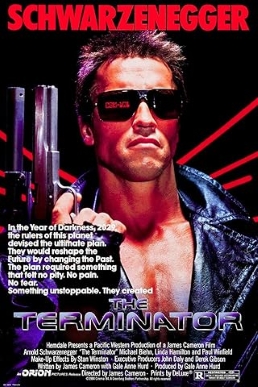
Scenes That I Love: Linda Hamilton in The Terminator


Today, the Shattered Lens wishes a happy birthday to actress Linda Hamilton.

This scene that I love is the haunting conclusion of the original Terminator.  Even with the Terminator (momentarily) vanquished, there’s still a storm coming.

Scenes That I Love: Linda Hamilton in The Terminator


Today, the Shattered Lens wishes a happy birthday to actress Linda Hamilton.

This scene that I love is the haunting conclusion of the original Terminator.  Even with the Terminator (momentarily) vanquished, there’s still a storm coming.

The Unnominated #19: The Terminator (dir by James Cameron)


Though the Academy of Motion Picture Arts and Sciences claim that the Oscars honor the best of the year, we all know that there are always worthy films and performances that end up getting overlooked.  Sometimes, it’s because the competition too fierce.  Sometimes, it’s because the film itself was too controversial.  Often, it’s just a case of a film’s quality not being fully recognized until years after its initial released.  This series of reviews takes a look at the films and performances that should have been nominated but were, for whatever reason, overlooked.  These are the Unnominated.

First released in 1984, The Terminator was the one of the top box office hits of the year.  It’s the film that established James Cameron as a filmmaker.  It’s the film that made a bona-fide star out of Arnold Schwarzenegger.  It’s a film that was imitated a thousand times before it even got its first official sequel.  It’s a film that’s still celebrated today.  41 years later, people are still saying, “I’ll be back.”  Would Arnold Schwarzenegger ever have become governor of California if he hadn’t first played a killing machine?  There’s a reason why his political nickname was the Governator.

And yet, The Terminator was not nominated for a single Oscar.  For all of the explosions and the gunfire and the screaming, it wasn’t even nominated for Best Sound.  Some of the special effects may now seem a bit hokey in this age of rampant CGI but it’s still a surprise that The Terminator was not nominated for Best Visual Effects.  The breath-taking action scenes did not result in a nomination for Best Editing.  Linda Hamilton was not nominated for her fantastic performance as Sarah Connor, a young woman who finds herself being pursued by a killer cyborg from the future.  Arnold Schwarzenegger was not nominated for playing one of the most memorable villains of the past 40 years.  Those who claim that Schwarzenegger was just playing himself are being overly glib.  Anyone could have said, “I’ll be back.”  It took Schwarzenegger’s delivery to make it a great line.

The lack of nominations aren’t really not a surprise, of course.  The Academy has only recently started to show an openness to nominating genre films for major awards and, even now, a genre film has to be considered a “cultural event” to even get a nomination.  Black Panther, Get Out, and even Mad Max: Fury Road and Dune were all nominated because it was felt that they had transcended their genre origins.  The Terminator is a sci-fi action movie and it’s proud to be a sci-fi action movie.  (Terminator 2: Judgment Day, it could be argued, transcended its genre origins but it was released in 1991 and Silence of the Lambs was destined to be the genre nominee that year.)  It’s also so relentlessly paced and intelligently written and directed that it’s a film that, even after all these years, it can still leave you breathless.  Nominated or not, The Terminator is a film that grabs your attention and holds it for a full 107 minutes.  There’s not many films that can make that claim.

The Terminator is a film that has held up surprisingly well.  (It’s certainly held up better than some of its more recent sequels.)  The performances of Linda Hamilton, Michael Biehn, and Arnold Schwarzenegger still work.  It’s still terrifying to watch as The Terminator relentlessly kills everyone that he comes into contact with.  (One thing that always gets me about the Terminator is that, even though he’s huge and superstrong and could probably physically rip anyone he wanted to apart, he still carries and uses a gun.  This makes him seem like even more of a bully.)  The Terminator is a machine and what makes him especially intimidating is that he doesn’t care if people see him coming or if they witness his crimes.  He has one function and that’s all he worries about.  When Michael Biehn first shows up, you can’t help but wonder why this guy, with his slight build and his somewhat nervous mannerisms, would be sent to try to stop the Terminator.  Of course, by the end of the movie, you understand.

(And what an ending!  The sight of those clouds, Linda Hamilton’s delivery of her final line, and the feeling that the future has already been determined, it all definitely makes an impression that has managed to survive every sequel after Judgment Day.  There’s a reason why Skynet — much like “I’ll be back” — has taken on a cultural life of its own.)

There were a lot of very good films that were nominated for Oscars in 1984.  The Terminator, much like Once Upon A Time In America, was not one of them but it will still never be forgotten.

Previous Entries In The Unnominated:

  1. Auto Focus 
  2. Star 80
  3. Monty Python and The Holy Grail
  4. Johnny Got His Gun
  5. Saint Jack
  6. Office Space
  7. Play Misty For Me
  8. The Long Riders
  9. Mean Streets
  10. The Long Goodbye
  11. The General
  12. Tombstone
  13. Heat
  14. Kansas City Bomber
  15. Touch of Evil
  16. The Mortal Storm
  17. Honky Tonk Man
  18. Two-Lane Blacktop

Horror Film Review: Children of the Corn (dir by Fritz Kiersch)


What to say about the original Children of the Corn?

First released in 1984, this film was based on one of Stephen King’s least interesting short stories. It’s a pretty dumb and poorly-paced movie, featuring villainous puritan children who are more annoying than menacing. The heroes aren’t particularly likable, even if one of them is played by Linda Hamilton. And yet, somehow, Children of the Corn spawned an 11-entry film franchise. (The 11th Children of the Corn film was released in 2020, 36 years after the original.) The original film was remade in 2009 and it continues to be a familiar reference point on the pop cultural landscape. I’ve lost track of the number of Children of the Corn parodies that I’ve seen.

The plot is pretty simple. One day, all of the children in a small rural town get together and kill all the adults. They worship a mysterious entity called He Who Walks Behind The Rows and they sacrifice any adult who is stupid enough to wander into town. The leader of the children is shrill-voiced little twerp named Isaac (John Franklin) and his second-in-command and chief enforcer is the sullen Malachai (played by Courtney Gaies). The children all dress like 1880s settlers and they spend a lot of time staring at each other. Eventually, Malachai overthrows Isaac and ties him to a cross, which leads to a seemingly endless scene of Isaac screeching, “Malachai!” over and over again.

Meanwhile, two adults have accidentally driven into town, Burt (Peter Horton) and his girlfriend, Vicky (Linda Hamilton). They end up running over a child who was trying to flee the cult. They put the body in the trunk of their car and then they kind of forget about it. In their defense, they’ve got a lot to deal with. The children want to sacrifice Vicky and Burt wants to lecture all of the children about how their backwards ways are ruining America. I’m not kidding. This film about children wearing old timey clothes and talking about He Who Walks Behind The Rows tries to convince the viewers that it has a sincere message.

Children of the Corn was not the first movie about killer children but it’s certainly one of the most influential. You have to wonder why because the film itself simply isn’t very good. Beyond the bad acting and the heavy-handed sermonizing, the film’s pacing is all off. A simple story shouldn’t have this many slow spots. Director Fritz Kiersch falls so in love with shots of that haunted cornfield that he forget to use them to tell a compelling story.

And yet, it can’t be denied that there is an audience for this film and the many sequels that followed. I imagine some of it has to do with the fact that people are just fascinated by the idea of evil children. We’re expected to like and forgive the behavior of children, regardless of how obnoxious they may be. Movies like Children of the Corn exploit a real fear that many people have, that children will figure out that they can get away with murder and therefore, they will. It’s a simple and not particularly well-executed idea but it’s one that led to an 11-film franchise so I guess one should never discount the value of keeping it simple.

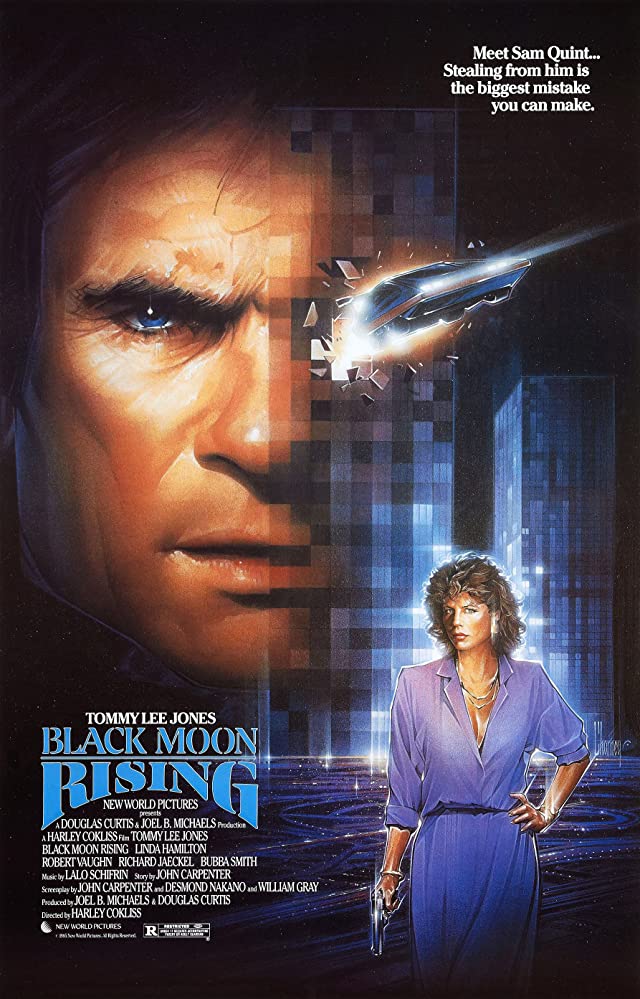
Black Moon Rising (1986, directed by Harley Cokeliss)


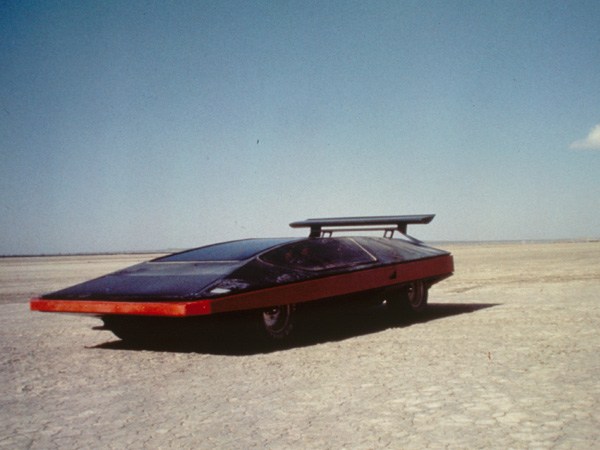
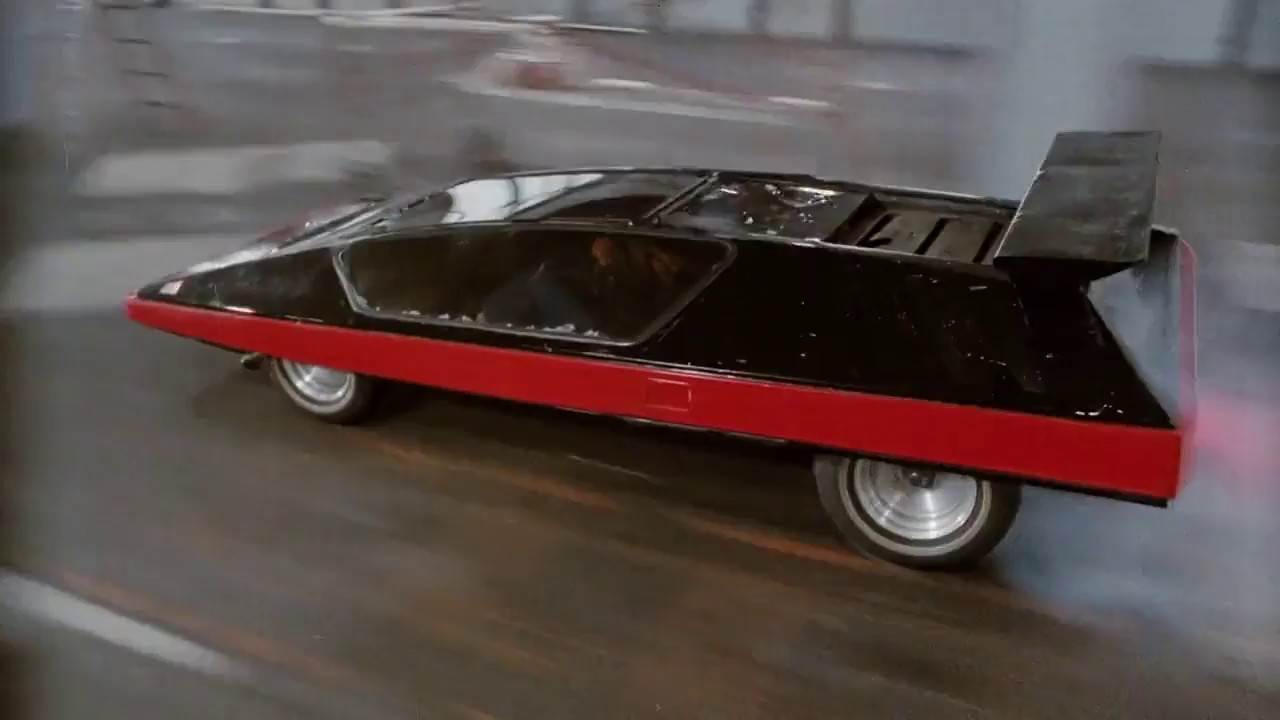
The FBI needs someone to steal a computer disk that can bring down a corrupt Las Vegas corporation so they hire reformed thief Sam Quint (Tommy Lee Jones).  Quint manages to steal the disk but he finds himself being pursued by Ringer (Lee Ving), an old acquaintance who now works for the corporation.  In order to keep the disk from falling into Ringer’s hands, Quint hides it in the back bumper of an experimental racing car called the Black Moon.  The Black Moon, which runs on water and can fly when it reaches its top speed, is being taken to Los Angeles by Earl Windom (Richard Jaeckel) so Quint assumes that he’ll just follow Window to L.A. and then retrieve the disk when no one is watching.

However, as soon as the Black Moon arrives in Los Angeles, it’s stolen by Nina (Linda Hamilton).  Nina works for Ed Ryland (Robert Vaughn), an outwardly respectable businessman who secretly runs a syndicate of car thieves.  Now, Quint and Nina (who conventiently falls in love with Quint) have to steal the car back from Ryland while staying one step ahead of both Ringer and the FBI.

Black Moon Rising is not a movie that you watch for the plot or for the non-existent romantic chemistry between Tommy Lee Jones and Linda Hamilton.  You don’t even watch it for the white collar villainy of Robert Vaughn, who basically just recycles his performance from Superman III.  This is a movie that you watch for the car!  The Black Moon is definitely an impressive vehicle.  Who wouldn’t want to steal one of these?

In a car chase movie like Black Moon Rising, the most important thing is that the car must be cool.  The Black Moon looks like something Mad Max would drive and it can actually fly so, by definition, it’s pretty cool.  Unfortunately, Black Moon Rising doesn’t spend as much time with the car as it should.  The movie gets bogged down with the scenes of Quint and Nina falling in love and Quint having to deal with his FBI handler (played by Bubba Smith).  This is a film that would have benefited from being directed by someone like Hal Needham, who understood that people don’t come to car chase movies for the plot.  They come to car chase movies because they want to see people driving fast and cars crashing in spectacular ways.  Still, even though the car isn’t onscreen as much as it should be, the car is still cool enough to make Black Moon Rising watchable.

One final note: the screenplay is credited to John Carpenter.  Though the imdb claims that this was the first script that Carpenter ever sold and that the film spent ten years in development, Carpenter says that he wrote the script around the same time that he made Escape from New York.  He also says that he’s never actually seen the completed film.


A Movie A Day #254: Mr. Destiny (1990, directed by James Orr)


When did your life first start to go downhill?

Larry Burrows (James Beluhsi) is convinced that, if he had not struck out while playing in the state high school baseball championship when he was 15, his life would have turned out so much differently.  He would be a success, instead of a mid-level executive with money problems, a dissatisfied wife, Ellen (Linda Hamilton), and a weird best friend (Jon Lovitz, of course).  On Larry’s 35th birthday, Michael Caine shows up as Larry’s guardian angel and, before you can say “George Bailey,” Larry is transported to an alternate timeline where he won that baseball game and got everything that he wanted.  Now, Larry has a big home, a sexy wife (Rene Russo), and a sexy mistress (Courtney Cox).  But he doesn’t have Ellen and Larry realizes that this all he ever wanted in the first place.

1990 was a busy year for Jim Belushi, starring in both this and Taking Care of Business.  Of the two films, Mr. Destiny is marginally better.   The story itself is predictable and the film makes a big mistake by trying to get dramatic during the final act.  (Everyone knows that Larry’s rival at the compamy is sleazy because he is played by Hart Bochner and everyone remembers Die Hard.  There was no need to turn him into a murderer, even if it was in a parallel universe.)   However, Michael Caine has the ability to make even the worst dialogue sound good.  Belushi is relatively restrained and any film that features Rene Russo, Courtney Cox, and Linda Hamilton can’t be all bad.   Mr. Destiny is forgettable but inoffensively entertaining.

Horror on the Lens: Children of the Corn (dir by Fritz Kiersch)


ChildrenoftheCorn

Today’s horror on the lens is the 1984 film that TSL editor-in-chief Arleigh Sandoc has called the worst Stephen King adaptation of all time.  For the record, I tend to agree with that judgment but, for some reason, a lot of people seem to like Children of the Corn.

And I will admit — the kids are creepy.  Especially that little Isaac guy with the shrill voice.  Whenever Isaac starts screaming, “MALACHI!!!!,” — well, it’s like nails on a chalkboard, to be honest.

Anyway, in case you’d forgotten, this is the movie where all the little kids hang out in a cornfield and kill adults.  It attempts to say something about religion but I’m not sure what it’s trying to say.  It’s all kind of silly but, as I said, some people seem to like it.

(Personally, I prefer that old episode of South Park where they keep declaring shenanigans on the carnival, all the cows jump off a cliff, and the visiting yankee tourists end up getting devoured by rats in jail.)

In order to help you decide for yourself whether or not this is a decent film, here is Stephen King’s Children of the Corn!  Enjoy it while you can because you just know that YouTube is going to eventually yank it down for copyright reasons.

What Lisa and the Snarkalecs Watched Last Night #102: Bermuda Tentacles (dir by Nick Lyon)


Last night, the Snarkalecs and I turned over to SyFy so we could watch and live tweet the latest offering from the Asylum, Bermuda Tentacles!

Why Were We Watching It?

Because it was the first SyFy original film of 2014, that’s why!  Seriously, yesterday should have been a freaking national holiday.  (Sad to say but rumor has it that the SyFy network may be looking to phase out original films — like Bermuda Tentacles — in order to devote more time to episodic television.  I sincerely hope that the network will reconsider that plan.)

What Was It About?

The President (John Savage) has gone missing in the Bermuda Triangle.  It’s up to rebellious Chief Petty Officer Trip Oliver (Trevor Donavon) to save him!  But while Trip and his crew float around under the sea in a submarine, gigantic CGI tentacles attack Admiral Linda Hamilton and the entire U.S. Navy.  Could the two events be related?

What Worked?

What do I always say about Asylum films?  It all worked.  Asylum films are the epitome of low-budget fun and that was certainly the case here.  To be honest, those who criticize a film like Bermuda Tentacles are missing the point.

Asylum films are designed to be watched by large groups of snarky individuals.  That’s why I always look forward to watching them with the Snarkalecs.  And I have to say that we, as a group, were on fire last night!  We were all in full snark mood and it was a wonderful thing to behold.  Unfortunately, we weren’t able to get #BermudaTentacles trending, largely because there were thousands of tweens tweeting about fucking Ashton Irwin at the same time we were tweeting about the movie.   But still, it was a good effort and everyone should be proud.

One thing that the Snarkalecs seemed to especially appreciate about Bermuda Tentacles was just how long, by Oval Office standards, the President’s hair was.

https://twitter.com/trinityskywlker/status/455164564212944896

Thank you, John Savage, for not getting a haircut!

What Did Not Work?

I have to admit that, unlike TSL editor-in-chief Arleigh Sandoc, I’m hardly an expert as far as military history or ranks are concerned.  However, it was obvious, even to me, that the Navy in Bermuda Tentacles didn’t appear to follow any sort of real-world protocol.  Quite a few people on twitter doubted that an admiral would be on a destroyer and some had issues with a scene where the President referred to Oliver as being a “soldier” as opposed to being a “sailor.”  This really wasn’t a big deal to me because, quite frankly, I hardly expect Asylum films to be documentaries.  However, judging from some of the comments on twitter, it was a big deal to quite a few people who had actually served in the Navy.

“Oh my God!  Just like me!” Moments

I had a harder time than usual relating to the characters in Bermuda Tentacles, largely because they were all career military whereas I majored in art history.  I was happy to see that the Admiral was a woman and that none of the men in her command had any problems with taking orders from her.  I would hope that, if I was an admiral, I would be just as effective.

Lessons Learned

There’s nothing quite as uniquely fun as watching a SyFy film with the Snarkalecs.  I’m already excited for the SyFy premiere of Big Ass Spider next Saturday.