The San Diego Film Critics Name Leave No Trace The Best of 2018!


On Monday, the San Diego Film Critics picked their best of 2018!  Check out their nominees here and the winners below!

Best Picture
LEAVE NO TRACE
Runner-up: GREEN BOOK

Best Director
Debra Granik, LEAVE NO TRACE
Runner-up: Peter Farrelly, GREEN BOOK

Best Actor, Male
Ethan Hawke, FIRST REFORMED
Runner-up: Viggo Mortensen, GREEN BOOK

Best Actor, Female
Glenn Close, THE WIFE
Runner-up: Melissa McCarthy, CAN YOU EVER FORGIVE ME?

Best Supporting Actor, Male (tie)
Richard E. Grant, CAN YOU EVER FORGIVE ME?
Timothée Chalamet, BEAUTIFUL BOY

Best Supporting Actor, Female
Nicole Kidman, BOY ERASED
Runner-up: Nina Arianda, STAN & OLLIE

Body of Work: John C. Reilly, THE SISTERS BROTHERS, RALPH BREAKS THE INTERNET, STAN & OLLIE

Best Comedic Performance
Hugh Grant, PADDINGTON 2
Runner-up: Jesse Plemons, GAME NIGHT

Best Original Screenplay
Bo Burnham, EIGHTH GRADE
Runner-up: Nick Vallelonga, Brian Hayes Currie, Peter Farrelly, GREEN BOOK

Best Adapted Screenplay
Armando Iannucci, David Schneider, Ian Martin, Peter Fellows, Fabien Nury, THE DEATH OF STALIN
Runner-up: Joel Edgerton, BOY ERASED

Best Documentary
THREE IDENTICAL STRANGERS
Runner-up: FREE SOLO

Best Animated Film
ISLE OF DOGS
Runner-up: SPIDER-MAN: INTO THE SPIDER-VERSE

Best Foreign-Language Film
SHOPLIFTERS
Runner-up: CAPERNAUM

Best Costume Design (tie)
Sandy Powell, THE FAVOURITE
Lindy Hemming, PADDINGTON 2

Best Editing
Jamie Gross, David Egan, GAME NIGHT
Runner-up: Christopher Tellefsen, A QUIET PLACE

Best Cinematography (tie)
Bruno Delbonnel, THE BALLAD OF BUSTER SCRUGGS
Joshua James Richards, THE RIDER

Best Production Design
Fiona Crombie, THE FAVOURITE
Runner-up: John Paul Kelly, STAN & OLLIE

Best Visual Effects
READY PLAYER ONE
Runner-up: CHRISTOPHER ROBIN

Best Use Of Music In A Film
BAD TIMES AT THE EL ROYALE
Runner-up: BOHEMIAN RHAPSODY

Best Ensemble
GAME NIGHT
Runner-up: THE FAVOURITE

Best Breakout Artist
Thomasin McKenzie, LEAVE NO TRACE
Runner-up: Charlie Plummer, LEAN ON PETE

The San Diego Film Critics Society Gives Some Love To Buster Scruggs!


On Firday, the San Diego Film Critics Society announced their nominations for the best of 2018 and, to their credit, they showed a lot of love to the Coen Brother’s fascinatingly strange western anthology film, The Ballad of Buster Scruggs!

(That’s Buster up at the top of the post.  He’s only in the movie for about 20 minutes but you’ll never forget him.)

Here are the nominations from San Diego!

Best Picture
THE BALLAD OF BUSTER SCRUGGS
THE FAVOURITE
GREEN BOOK
LEAVE NO TRACE
A QUIET PLACE

Best Director
Bo Burnham, EIGHTH GRADE
Debra Granik, LEAVE NO TRACE
John Krasinski, A QUIET PLACE
Peter Farrelly, GREEN BOOK
Yorgos Lanthimos, THE FAVOURITE

Best Actor, Male
Christian Bale, VICE
Ethan Hawke, FIRST REFORMED
Viggo Mortensen, GREEN BOOK
John C. Reilly, THE SISTERS BROTHERS
Lucas Hedges, BOY ERASED

Best Actor, Female
Carey Mulligan, WILDLIFE
Glenn Close, THE WIFE
Lady Gaga, A STAR IS BORN
Melissa McCarthy, CAN YOU EVER FORGIVE ME?
Elsie Fisher, EIGHTH GRADE

Best Supporting Actor, Male
Joel Edgerton, BOY ERASED
Mahershala Ali, GREEN BOOK
Richard E. Grant, CAN YOU EVER FORGIVE ME?
Sam Elliott, A STAR IS BORN
Timothée Chalamet, BEAUTIFUL BOY

Best Supporting Actor, Female
Alia Shawkat, BLAZE
Nicole Kidman, BOY ERASED
Nina Arianda, STAN & OLLIE
Thomasin McKenzie, LEAVE NO TRACE
Zoe Kazan, THE BALLAD OF BUSTER SCRUGGS

Best Comedic Performance
Awkwafina, CRAZY RICH ASIANS
Hugh Grant, PADDINGTON 2
Jason Bateman, GAME NIGHT
Jesse Plemons, GAME NIGHT
Ryan Reynolds, DEADPOOL 2

Best Original Screenplay
Bo Burnham, EIGHTH GRADE
Bryan Woods, Scott Beck, John Krasinski, A QUIET PLACE
Joel Coen, Ethan Coen, THE BALLAD OF BUSTER SCRUGGS
Nick Vallelonga, Brian Hayes Currie, Peter Farrelly, GREEN BOOK
Wes Anderson, ISLE OF DOGS

Best Adapted Screenplay
Armando Iannucci, David Schneider, Ian Martin, Peter Fellows, Fabien Nury, THE DEATH OF STALIN
David Lowery, THE OLD MAN & THE GUN
Debra Granik, Anne Rosellini, LEAVE NO TRACE
Joel Edgerton, BOY ERASED
Nicole Holofcener, Jeff Whitty, CAN YOU EVER FORGIVE ME?

Best Documentary
FREE SOLO
LOVE, GILDA
RBG
THREE IDENTICAL STRANGERS
WON’T YOU BE MY NEIGHBOR?

Best Animated Film
HAVE A NICE DAY
INCREDIBLES 2
ISLE OF DOGS
RALPH BREAKS THE INTERNET
SPIDER-MAN: INTO THE SPIDER-VERSE

Best Foreign-language Film
CAPERNAUM
COLD WAR
THE GUILTY
ROMA
SHOPLIFTERS

Best Costume Design
Sandy Powell, THE FAVOURITE
Guy Speranza, STAN & OLLIE
Lindy Hemming, PADDINGTON 2
Mary E. Vogt, CRAZY RICH ASIANS
Mary Zophres, THE BALLAD OF BUSTER SCRUGGS

Best Editing
Christopher Tellefsen, A QUIET PLACE
Jamie Gross, David Egan, GAME NIGHT
Joel Coen, Ethan Coen, THE BALLAD OF BUSTER SCRUGGS
Patrick J. Don Vito, GREEN BOOK
Yorgos Mavropsaridis, THE FAVOURITE

Best Cinematography
Alexander Dynan, FIRST REFORMED
Alfonso Cuarón, ROMA
Bruno Delbonnel, THE BALLAD OF BUSTER SCRUGGS
Joshua James Richards, THE RIDER
Magnus Nordenhof Jønck, LEAN ON PETE

Best Production Design
Adam Stockhausen, READY PLAYER ONE
Fiona Crombie, THE FAVOURITE
Hannah Beachler, BLACK PANTHER
John Paul Kelly, STAN & OLLIE
Tim Galvin, GREEN BOOK

Best Visual Effects
BLACK PANTHER
CHRISTOPHER ROBIN
ISLE OF DOGS
PADDINGTON 2
READY PLAYER ONE

Best Use Of Music In A Film
BAD TIMES AT THE EL ROYALE
BLAZE
BOHEMIAN RHAPSODY
GREEN BOOK
A STAR IS BORN

Best Ensemble
THE BALLAD OF BUSTER SCRUGGS
BOY ERASED
THE FAVOURITE
GAME NIGHT
GREEN BOOK

Best Breakout Artist
Thomasin McKenzie, LEAVE NO TRACE
Elsie Fisher, EIGHTH GRADE
Rami Malek, BOHEMIAN RHAPSODY
Charlie Plummer, LEAN ON PETE
Bo Burnham, EIGHTH GRADE

Here Are The Chicago Film Critics Association Nominations For 2018!


On Friday, the Chicago Film Critics Association announced their nominations for the best of 2018!  The winners will be announced on Saturday night.

Here are the nominees!

BEST PICTURE
The Favourite
First Reformed
Hereditary
Roma
A Star is Born

BEST DIRECTOR
Bradley Cooper, A Star is Born
Alfonso Cuarón, Roma
Yorgos Lanthimos, The Favourite
Lynne Ramsay, You Were Never Really Here
Paul Schrader, First Reformed

BEST ACTOR
Christian Bale, Vice
Bradley Cooper, A Star is Born
Ethan Hawke, First Reformed
Rami Malek, Bohemian Rhapsody
Joaquin Phoenix, You Were Never Really Here

BEST ACTRESS
Yalitza Aparicio, Roma
Toni Collette, Hereditary
Lady Gaga, A Star is Born
Regina Hall, Support the Girls
Melissa McCarthy, Can You Ever Forgive Me?

BEST SUPPORTING ACTOR
Mahershala Ali, Green Book
Timothee Chalamet, Beautiful Boy
Richard E. Grant, Can You Ever Forgive Me?
Michael B. Jordan, Black Panther
Steven Yeun, Burning

BEST SUPPORTING ACTRESS
Olivia Colman, The Favourite
Elizabeth Debicki, Widows
Zoe Kazan, The Ballad of Buster Scruggs
Regina King, If Beale Street Could Talk
Rachel Weisz, The Favourite

BEST ADAPTED SCREENPLAY
BlacKkKlansman by Charlie Wachtel, David Rabinowitz, Kevin Willmott & Spike Lee
Can You Ever Forgive Me? by Nicole Holofcener & Jeff Whitty
The Death of Stalin by Armando Iannucci, David Schneider & Ian Martin
If Beale Street Could Talk by Barry Jenkins
A Star is Born by Eric Roth, Bradley Cooper & Will Fetters

BEST ORIGINAL SCREENPLAY
Eighth Grade by Bo Burnham
The Favourite by Deborah Davis & Tony McNamara
First Reformed by Paul Schrader
Roma by Alfonso Cuaron
Vice by Adam McKay

BEST ANIMATED FEATURE
Incredibles 2
Isle of Dogs
Ralph Breaks the Internet
Ruben Brandt: Collector
Spider-Man: Into the Spider-verse

BEST DOCUMENTARY
Free Solo
Minding the Gap
RBG
Three Identical Strangers
Won’t You Be My Neighbor?

BEST FOREIGN LANGUAGE FILM
Burning
Capernaum
Cold War
Roma
Shoplifters

BEST ART DIRECTION
Annihilation
Black Panther
The Favourite
Paddington 2
Roma

BEST CINEMATOGRAPHY
Cold War – Lukasz Zal
The Favourite – Robbie Ryan
First Man – Linus Sandgren
If Beale Street Could Talk – James Laxton
Roma – Alfonso Cuaron

BEST EDITING
First Man
The Other Side of the Wind
Roma
Widows
You Were Never Really Here

BEST ORIGINAL SCORE
First Man – Justin Hurwitz
If Beale Street Could Talk – Nicholas Britell
Mandy – Johan Johannson
Suspiria – Thom Yorke
You Were Never Really Here – Jonny Greenwood

BEST USE OF VISUAL EFFECTS
Annihilation
Black Panther
First Man
Mission: Impossible – Fallout
Paddington 2

MOST PROMISING FILMMAKER
Ari Aster, Hereditary
Bo Burnham, Eighth Grade
Bradley Cooper, A Star is Born
Bing Liu, Minding the Gap
Boots Riley, Sorry to Bother You

MOST PROMISING PERFORMER
Yalitza Aparicio, Roma
Elsie Fisher, Eighth Grade
Lady Gaga, A Star is Born
Thomasin Harcourt McKenzie, Leave No Trace
John David Washington, BlacKkKlansman & Monsters and Men

Here Are The 2018 Satellite Nominations!


Awards season has just begun, which means that it’s time for the International Press Academy to announce their nominees for the 23rd Satellite Awards.  If you’ve never heard of the Satellite Awards, they’re like the Golden Globes, just with even less credibility.  For instance, the Satellite people are the one who nominated The Wolf of Wall Street for best picture, despite having not seen the film.

That said, the Satellite nominations are good way to gauge which films are currently getting awards buzz.  Let’s put it like this: getting a Satellite nomination is not going to automatically translate into Oscar recognition.  But it doesn’t hurt.

Below are the film nominations.  (In the interest of space, I’m only posting the film nominations.  If you want to see which tv shows picked up nominations, click here.)

Film

Actress in a Motion Picture, Drama
Major, Independent or International

  • Yalitza Aparicio, “Roma”
  • Glenn Close, “The Wife”
  • Viola Davis, “Widows”
  • Nicole Kidman, “Destroyer”
  • Melissa McCarthy, “Can You Ever Forgive Me?”
  • Rosamund Pike, “Private War”

Actor in a Motion Picture, Drama
Major, Independent or International

  • Willem Dafoe, “At Eternity’s Gate”
  • Ben Foster, “ Leave No Trace”
  • Ryan Gosling, “First Man
  • Ethan Hawke, “First Reformed”
  • Lucas Hedges, “Boy Erased”
  • Robert Redford, “The Old Man & the Gun”

Actress in Motion Picture, Comedy or Musical
Major, Independent or International

  • Emily Blunt, “Mary Poppins Returns”
  • Olivia Colman, “The Favourite”
  • Trine Dyrholm “Nico, 1988″
  • Elsie Fisher, “Eighth Grade”
  • Lady Gaga, “A Star is Born”
  • Constance Wu, “Crazy Rich Asians”

Actor in Motion Picture, Comedy or Musical
Major, Independent or International

  • Bradley Cooper, “A Star is Born”
  • Rami Malek, “Bohemian Rhapsody”
  • Lin-Manuel Miranda, “Mary Poppins Returns”
  • Viggo Mortensen, “Green Book”
  • Nick Robinson, “Love, Simon
  • John David Washington, “BlacKkKlansman”

Actress in a Supporting Role
Major, Independent, Comedy & Musical or International

  • Claire Foy, “First Man
  • Nicole Kidman, “Boy Erased”
  • Regina King, “If Beale Street Could Talk”
  • Margot Robbie, “Mary Queen of Scots”
  • Emma Stone, “The Favourite”
  • Rachel Weisz, “The Favourite”

Actor in a Supporting Role
Major, Independent, Comedy & Musical or International

  • Mahershala Ali, “Green Book”
  • Timothée Chalamet, “Beautiful Boy”
  • Russell Crowe, “Boy Erased”
  • Adam Driver, “BlacKkKlansman”
  • Sam Elliott, “A Star is Born”
  • Richard Grant, “Can You Ever Forgive Me?”

Motion Picture, Drama
Major

  • Black Panther,” Walt Disney
  • First Man,” Universal
  • “Hereditary,” A24
  • “If Beale Street Could Talk,” Annapurna Pictures
  • “Mary Queen of Scots,” Focus Features
  • “Widows,”  Twentieth Century Fox

Motion Picture, Independent

  • “BlacKkKlansman,” Focus Features
  • “Eighth Grade,” A24
  • “First Reformed,” A24
  • “Leave No Trace,” Bleecker Street Media
  • “Private Life,” Netflix
  • “A Private War,” Aviron Pictures

Motion Picture, Comedy or Musical
Major, Independent or International

  • “Crazy Richard Asians,” Warner Bros.
  • “The Favourite,” Fox Searchlight Pictures
  • “Green Book,” Universal Pictures
  • “Mary Poppins Returns,” Walt Disney
  • “Nico, 1988,” Magnolia Pictures
  • “A Star is Born,” Warner Bros.

Motion Picture, International Film

  • “The Cakemaker,” Israel
  • “Cold War,” Poland
  • “The Guilty,” Denmark
  • “I Am Not A Witch,” United Kingdom
  • “Roma,” Mexico
  • “Shoplifters,” Japan

Motion Picture, Animated or Mixed Media

  • “Incredibles 2,” Walt Disney
  • “Isle of Dogs,” Fox Searchlight Pictures
  • “Liz and the Blue Bird,” Eleven Arts
  • “Mirai,” GKIDS Films
  • “Ralph Breaks the Internet,” Walt Disney
  • “Ruben Brandt, Collector,” Sony Pictures Classics

Motion Picture, Documentary

  • “Crime + Punishment,” Hulu
  • “Free Solo,” National Geographic
  • “Minding the Gap,” Hulu
  • “RBG,” Magnolia Pictures
  • “Three Identical Strangers,”  Focus Features
  • “Won’t You Be My Neighbor,” Focus Features

Director

  • Bradley Cooper, “A Star is Born”
  • Alfonso Cuaron, “Roma”
  • Peter Farrelly, “Green Book”
  • Barry Jenkins, “If Beale Street Could Talk”
  • Yorgos Lanthimos, “The Favourite”
  • Spike Lee, “BlacKkKlansman”

Screenplay, Original

  • Bo Burnham, “Eighth Grade”
  • Alfonso Cuaron, “Roma”
  • Deborah Davis & Tony McNamara, “The Favourite”
  • John Krasinski, Scott Beck, Bryan Woods, “A Quiet Place
  • Paul Schrader, “First Reformed”
  • Nick Vallelonga, Brian Hayes Currie & Peter Farrelly, “Green Book”

Screenplay, Adapted

  • Bradley Cooper, Eric Roth, “A Star is Born”
  • Debra Granik, Anne Rosellini, “Leave No Trace”
  • Nicole Holofcener, Jeff Whitty, “Can You Ever Forgive Me?”
  • Barry Jenkins, “If Beale Street Could Talk”
  • Armando Iannucci, David Schneider, Ian Martin, Peter Fellows, “The Death of Stalin”
  • Spike Lee, David Rabinowitz, Kevin Wilmott, Charlie Wachtel, “BlacKkKlansman”

Original Score

  • Thomas Ades, “Colette”
  • Terence Blanchard, “BlacKkKlansman”
  • Nicholas Britell, “If Beale Street Could Talk”
  • Alexandre Desplat, “The Sisters Brothers”
  • Justin Hurwitz, “First Man”
  • Hans Zimmer, “Widows”

Original Song

  • “All The Stars” from “Black Panther”
  • “Can You Imagine That?” from “Mary Poppins Returns”
  • “Requiem for a Private War” from “A Private War”
  • “Revelation” from “Boy Erased”
  • “Shallow” from “A Star is Born”
  • “Strawberries & Cigarettes” from “Love, Simon

Cinematography

  • Alfonso Cuaron, “Roma”
  • James Laxton, “If Beale Street Could Talk”
  • Matthew Libatique, “A Star is Born”
  • Robbie Ryan, “The Favourite”
  • Rachel Morrison, “Black Panther
  • Lukasz Zal, “Cold War”

Visual Effects

  •   “Avengers: Infinity War,” Walt Disney
  •   “Black Panther,” Walt Disney
  •   “Fantastic Beasts: The Crimes of Grindelwald,” Warner Bros.
  •   “Jurassic World: Fallen Kingdom,” Universal
  •   “Rampage,” Warner Bros.
  •   “Ready Player One,” Warner Bros.

Film Editing

  • Barry Alexander Brown, “BlacKkKlansman”
  • Jay Cassidy, “A Star is Born”
  • Tom Cross, “First Man
  • Alfonso Cuaron, “Roma”
  • Joi McMillon, Nat Sanders, “If Beale Street Could Talk”
  • Joe Walker, “Widows”

Sound (Editing and Mixing)

  • Black Panther,” Walt Disney
  • First Man,” Universal
  • “Mary Poppins Returns,” Walt Disney
  • A Quiet Place,” Paramount
  • “Roma,”  Netflix
  • “A Star Is Born,” Warner Bros.

Art Direction and Production Design

  • Black Panther,” Walt Disney
  • “Fantastic Beasts: The Crimes of Grindelwald,”  Warner Bros.
  • “The Favourite,” Fox Searchlight
  • First Man,” Universal
  • “Mary Poppins Returns,” Walt Disney
  • “Roma,” Magnolia Pictures

Costume Design

  • Colleen Atwood, “Fantastic Beasts: The Crimes of Grindelwald”
  • Erin Benach, “A Star is Born”
  • Alexandra Byrne, “Mary Queen of Scots”
  • Ruth E. Carter, “Black Panther
  • Andrea Flesch, “Colette”
  • Sandy Powell, “The Favourite”


Horror Review: 28 Days Later (dir. by Danny Boyle)


For decades, the zombie film genre has been defined by the rules established by the grandfather of the modern zombie story, George A. Romero. His 1968 landmark horror film Night of the Living Dead transformed what had once been a gothic creature rooted in the voodoo folklore of Haiti and the Caribbean into an apocalyptic force symbolizing social collapse and human weakness. The film not only terrified audiences but also laid the foundational blueprint for every zombie movie that followed. Romero’s zombies weren’t merely monsters — they were a reflection of humanity’s fears, prejudices, and inner decay. His influence has remained so pervasive that, even today, filmmakers working in horror are inevitably responding to his legacy, whether they realize it or not.

Through the years, there have been numerous attempts to deviate from Romero’s formula. The most prominent early success came in the 1980s with the Return of the Living Dead series — a clever horror-comedy franchise that infused dark humor and punk aesthetics into the genre. Yet even that beloved cult entry eventually lost steam. True reinvention did not arrive until 2002, when British filmmaker Danny Boyle and screenwriter Alex Garland collaborated on 28 Days Later, a project that both revitalized the zombie genre and split its devoted fan base down the middle. Was it truly a “zombie” film, or something else entirely? That very debate remains unresolved more than twenty years later.

Boyle’s film begins not with a supernatural curse or the reanimation of the dead, but with a catastrophic act of human arrogance. A group of naïve animal-rights activists break into a research laboratory to rescue chimpanzees subjected to bureaucratic cruelty. However, they find that these animals have been injected with a rage-inducing virus — the product of bioengineering rather than black magic. One of the activists, horrified by what she witnesses, ignores the pleas of a desperate scientist and frees a chimp, unleashing a pandemic that will decimate Britain within weeks. This opening sequence is both economical and horrifying: the origins of the apocalypse come from compassion twisted into recklessness. Boyle establishes his tone immediately — quick editing, grainy digital video, and an oppressive sense of realism create a world that feels disturbingly possible.

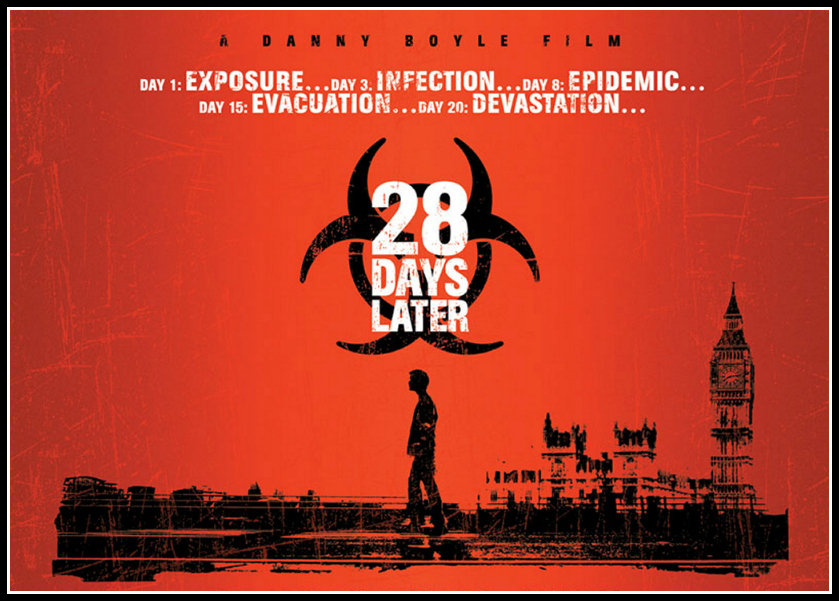
The narrative then leaps forward twenty-eight days. In a now-iconic sequence, the protagonist Jim (played by Cillian Murphy) awakens from a coma in an abandoned London hospital. His disorientation mirrors that of the audience: sterile hallways littered with trash, flickering lights, a haunting silence broken only by the hum of wind through the empty city. When Jim emerges into the sunlight, the camera captures a London entirely devoid of people, its majestic landmarks standing as hollow monuments to civilization’s sudden collapse. This is one of cinema’s most unforgettable depictions of isolation. The haunting score by John Murphy and the use of Godspeed You! Black Emperor’s instrumental “East Hastings” heighten the apocalyptic stillness, transforming London into a ghost metropolis.

Jim’s bewilderment only deepens when he seeks refuge in a church — a setting traditionally associated with salvation — only to find it desecrated by carnage. His presence awakens a horde of infected individuals who charge at him with terrifying speed. Unlike Romero’s slow, lumbering undead, Boyle’s infected are human beings transformed by a virus that amplifies their aggression to animalistic extremes. They move like predators, sprinting at prey with berserk fury. Jim narrowly escapes thanks to two survivors, Selena (Naomie Harris) and Mark (Noah Huntley), who introduce him to the brutal new rules of existence: infection spreads through blood contact, turning victims within seconds, and hesitation means death.

The trio’s uneasy alliance soon crumbles after Mark becomes infected, forcing Selena to kill him without hesitation. This harrowing moment establishes her as one of the film’s strongest and most pragmatic characters — a refreshing departure from the damsel archetype that has long haunted horror cinema. Jim and Selena later encounter Frank (Brendan Gleeson), a good-natured taxi driver, and his teenage daughter Hannah (Megan Burns), who have been surviving in a fortified apartment building. Together they form a fragile surrogate family and travel in search of a military broadcast promising safety and a potential cure.

Boyle deftly blends moments of human warmth amid horror. Scenes like the group’s scavenging trip through an abandoned grocery store — a darkly comic echo of Dawn of the Dead’s consumer satire — offer glimpses of joy and normalcy. The countryside sequences, shot with a painterly eye, contrast the urban decay of London with the serene beauty of a world reclaiming itself from human control. Nature, the film quietly suggests, endures long after people have vanished.

Their journey leads them to a fortified mansion commanded by Major Henry West (Christopher Eccleston), a British officer whose soldiers claim to have “the answer to infection.” The supposed sanctuary quickly reveals a darker truth. West’s band of men have descended into moral depravity, promising their commander that the promise of “women” will restore morale. The film shifts from survival horror to psychological thriller as the real threat emerges — not the infected outside, but the monstrousness within human beings when order collapses. In this descent into militaristic patriarchy and madness, Boyle channels the spirit of Romero’s Day of the Dead, where the military’s illusion of control becomes the true source of terror.

Boyle and Garland’s reinvention of the zombie mythos was revolutionary. Longtime fans of Romero’s shambling undead initially resisted the notion that 28 Days Later even qualified as a zombie movie. After all, its creatures weren’t reanimated corpses but living people overtaken by an uncontrollable virus. Yet their function within the story — relentless, dehumanized embodiments of contagion and rage — served the same thematic role as zombies always had: mirrors for society’s breakdown. The debate over whether the infected “count” as zombies is less important than the fact that Boyle redefined the genre’s emotional and kinetic language. His infected didn’t just pursue victims; they hunted them. Their blistering speed and screams injected pure chaos into what had once been slow, creeping dread.

The technical and artistic choices heightened the film’s intensity. Shot largely on digital video with handheld cameras, 28 Days Later looked raw and immediate, more like found footage than polished fiction. This realism bridged the gap between old-school horror and the new century’s fixation on viral outbreaks and global instability. Coming in the post-9/11 era, its images of deserted cities and military lockdowns felt eerily prescient, foreshadowing later fears of pandemics and authoritarian control.

The performances ground the film emotionally. Cillian Murphy’s portrayal of Jim evolves from bewildered innocence to hardened survivor, serving as the audience’s emotional compass. Naomie Harris delivers one of the genre’s most capable female performances, blending vulnerability with ferocity. Brendan Gleeson, always magnetic, brings compassion and tragedy to Frank — a man whose paternal instincts ultimately lead to heartbreak. Christopher Eccleston’s Major West stands as a chilling embodiment of human corruption in crisis: the soldier who insists he is saving civilization while replicating its worst impulses.

Despite being produced on a modest budget of roughly eight million dollars, Boyle’s film achieved a scale and impact far greater than its resources suggested. The empty London shots — achieved by closing key streets at dawn for only minutes at a time — remain astonishing feats of logistical precision and cinematic audacity. More importantly, the film’s minimalist production enhanced its believability. Everything about 28 Days Later feels lived-in, grimy, and plausible.

Two decades on, 28 Days Later continues to stand as one of the most influential horror films of the 21st century. Its success reinvigorated a genre that had grown stale and inspired a wave of imitators across film, television, and video games, from Zack Snyder’s Dawn of the Dead remake to AMC’s The Walking Dead. Beyond its cultural impact, it remains a haunting meditation on rage — personal, societal, and political. Boyle and Garland transformed horror into a canvas for existential dread, exploring how quickly civility unravels when survival becomes the only law.

Whether one calls it a zombie film or not hardly matters anymore. 28 Days Later breathed new life into the undead myth, shattering old rules and redefining what modern horror could be. The debate it sparked continues, but one truth is undeniable: the genre has never been the same since Jim first walked through that silent, ruined London — a world devoured not by the dead, but by the terrifying rage of the living.