I’m kind of torn as far as the upcoming Steve Jobs films is concerned.
It’s about Steve Jobs, about whom I’m not really that interested.
But it stars Michael Fassbender, who I absolutely love.
It was written by Aaron Sorkin, whose work I usually find to be overwitten and cutesy.
But it was directed by Danny Boyle, who is one of my favorite directors.
Plus, it also features Kate Winslet, who I absolutely adore, and Seth Rogen, who I think could be an intriguing dramatic actor. As well, it looks like it’s going to be nominated for a bunch of Oscars so I’m going to have to see it whether I want to or not.
Here’s the 2nd trailer for Steve Jobs. It’s definitely better than the first trailer.
However, it might be nice if they had been. It would certainly put a lot less pressure on me. Here we are — it’s September and the Oscar race is still largely up in the air. Hopefully, the picture will start to become a bit more clear over the next few weeks. For instance, Beasts of No Nation was just acclaimed at the Venice Film Festival and, as I write this, we are just a few days into the Toronto Film Festival.
But for now, it still looks like it is anyone’s race to win!
Below are my predictions for September! If you want to see just how confused I’ve been (and how random my predictions have occasionally been) for the majority of the year, be sure to check out my predictions for January, February, March, April, May, June, July, and August!
To be honest, I’m really only interesting in seeing Steve Jobs because it stars Michael Fassbender and it was directed by Danny Boyle. I do, however, think it will be interesting to see Seth Rogen in a dramatic role and I’m also curious to see if Kate Winslet can overcome the fact that screenwriter Aaron Sorkin is incapable of writing strong female characters.
(And for those of you about to go, “What about C.J. on The West Wing!?,” don’t. Just don’t. First off, everyone always cites C.J. as a strong female character in a Sorkin-penned melodrama and it’s gotten just a little bit boring. Secondly, I never watched The West Wing because I had and continue to have a life.)
Here’s the latest trailer for the very Oscar baitish Steve Jobs.
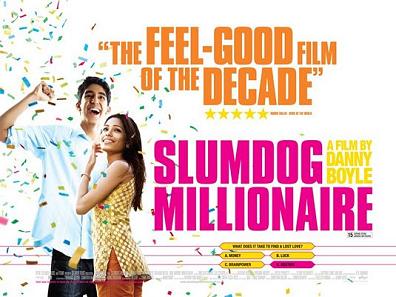
A few thoughts on the 2008 winner for best picture, Slumdog Millionaire:
First off, whenever I think about Slumdog Millionaire, it’s impossible for me not to think of that episode of The Office where Holly and Michael do an homage to the film at the Dunder Miflin company picnic and, along with traumatizing all of the children in the audience, they also manage to accidentally reveal that half of the employees at the picnic are about to get laid off. If you need to know just how successful Slumdog Millionaire was here in the United States, just consider that it was popular enough to be parodied by Michael Scott.
Secondly, as I sit here thinking about what I want to say about the film itself, I find myself wondering if it’s really necessary for me to rehash the film’s plot. I mean, everyone’s seen this movie, right? It was released 7 years ago. It won a bunch of Oscars. It’s on cable constantly! I mean, everyone already knows what happens, right?
Oh, really? Okay, apparently there’s one person out there who has never seen Slumdog Millionaire.
For his benefit, I will reveal that Slumdog Millionaire is a British-made film about India. Jamal (Dev Patel) is an 18 year-old telemarketer, who works from India and calls people in Scotland, reading from a script and saying things like, “I really love Sean Connery.” When Jamal is selected to compete on the Indian version of Who Wants To Be A Millionaire, he shocks both the audience and the show’s producers by getting every answer right. However, before he can answer the final question and potentially become a millionaire, he is taken into a backroom and tortured by the police, who are convinced that a “slumdog” like Jamal couldn’t possibly know all the answers. As Jamal explains how he knew each answer, the film flashes back to Jamal’s childhood in the slums of Bombay.
It’s during these flashbacks that we see how Jamal — and thousands of other poor children like him — were forced by local gangsters to work as beggars. (In one extremely harrowing scene, a child is blinded specifically so he’ll be a more sympathetic beggar.) While Jamal eventually escapes this life, his brother Salim (Madhur Mittal) and his childhood love, Latika (Freida Pinto) remain under the power of a cruel crime boss (Mahesh Manjrekar).
So, that’s a relatively spoiler-free plot outline of Slumdog Millionaire. You’re welcome.
Now, personally, I love Slumdog Millionaire but a lot of people don’t. It seems to be one of those films that always gets mentioned when certain people talk about unworthy Oscar winners. Some of that is because Slumdog Millionaire won best picture the same year that The Dark Knight was not even nominated. In the eyes of some, being upset over the snubbing of The Dark Knight means that you’re also required to insanely resent every film that was not snubbed. (Looking in your direction, Sasha Stone…) But even more of the anti-Slumdog sentiment seems to come from the fact that the plot of Slumdog Millionaire revolves around an episode of Who Wants To Be A Millionaire. They feel that Slumdog Millionaire is essentially a feature-length commercial for a game show.
However, I think those people are overlooking one very important detail. In Slumdog Millionaire, How To Be A Millionaire is not portrayed in the most positive light. The whole plot of the film, after all, is that, as a result of doing well on the show, Jamal was taken into a dank room and tortured! You have to wonder what went on behind the scenes on the American version of the show.
The film’s poster refers to Slumdog Millionaire as being “the feel good film of the decade.” I don’t know if I’d agree with that description. It’s a fun film to watch because Danny Boyle is one of those hyperactive directors who can make anything fun. But, at the same time, Slumdog Millionaire is a pretty dark film. Happy ending or not, the majority of the film is about children living in extreme poverty and being exploited by rich sadists.
For those who would complain that Slumdog Millionaire gets a bit too melodramatic for its own good — well, can you ever really be too melodramatic? Along with everything else, Boyle meant for Slumdog Millionaire to serve as an homage to the famously melodramatic cinematic conventions of Bollywood and he largely succeeds.
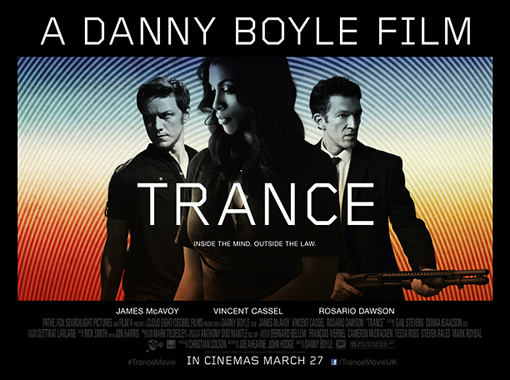
Trance, the latest film from Danny Boyle, is an enjoyable mess. The film makes little sense, the characters are rarely consistent, and tonally, Trance is all over the place. At the same time, it’s also a lot of fun.
Seeking to do for hypnosis what Inception did for dreams, Trance opens with Simon (an excellent James McAvoy), a fine art auctioneer who has gotten into trouble with online gambling. Desperately needing money, Simon agrees to help the criminal Franck (Vincent Cassel) steal a painting. However, during the robbery, Simon attacks Franck. Franck responds by whacking Simon on the head.
As a result of the blow to his head, Simon ends up with amnesia and can’t remember anything that happened immediately after the robbery. Unfortunately for Franck, Simon was attempting to steal the painting for himself when he got hit on the head. As a result, neither Simon nor Franck have the painting and Simon can’t remember where he hid it. After unsuccessfully attempting to restore Simon’s memory through physical torture, Franck then decides that Simon should see a hypnotist.
Simon goes to see Dr. Elizabeth Lamb (a surprisingly effective Rosario Dawson). In several hallucinogenic and increasingly surreal scenes, we watch as Elizabeth leads the hypnotized Simon through the twists and turns of his own troubled subconscious. While Simon initially lies about why he’s undergoing hypnosis, Elizabeth quickly reveals that she knows what’s going on. However, to Franck’s surprise, Elizabeth agrees to continue to treat Simon and help him remember the location of the painting. Soon, both Simon and Franck find themselves falling in love with Elizabeth, little suspecting that Elizabeth has an agenda of her own…
Judging from some of the reviews and other online comments that I’ve come across, I may be in a minority but I actually really enjoyed Trance. Seriously, how can you not enjoy a film that’s so unapologetically over-the-top? I loved the film for its lush cinematography. I loved the fact that everyone’s apartment appeared to decorated exclusively with neon. I loved the fact that all three of the main characters came across like they were continually on the verge of having a nervous breakdown. In the end, I even loved the fact that Boyle didn’t even attempt to make the film realistic. Trance is a celebration of pure style, a collection of barely connected set pieces that come together to make Trance into a pure cinematic experience.
Danny Boyle is one of those directors that people tend to either love or hate. If you don’t like Danny Boyle, you probably won’t enjoy Trance. However, if you’re like me and you’re an unapologetic fan, you’ll appreciate Trance for what it is, a pure triumph of style over substance. Like many other Boyle films, the visuals are so strong, the music is so propulsive, and camerawork is so kinetic that you can forgive the fact that the film’s plot doesn’t make much sense. Boyle may be a messy filmmaker but it’s often a beautiful mess.
As of this month, I have been reviewing films here at the Shattered Lens for 3 years. In honor of that anniversary, I thought I’d post my picks for the 50 best films that have been released in the U.S. since 2010.
Without further ado, here’s the list!
Black Swan (directed by Darren Aronofsky)
Exit Through The Gift Shop (directed by Banksy)
Hanna (directed by Joe Wright)
Fish Tank (directed by Andrea Arnold)
Higher Ground (directed by Vera Farmiga)
Shame (directed by Steve McQueen)
Anna Karenina (directed by Joe Wright)
The Cabin In The Woods (directed by Drew Goddard)
127 Hours (directed by Danny Boyle)
Somewhere (directed by Sofia Coppola)
Life of Pi (directed by Ang Lee)
Hugo (directed by Martin Scorsese)
Inception (directed by Christopher Nolan)
Animal Kingdom (directed by David Michod)
Winter’s Bone (directed by Debra Granik)
The Artist (directed by Michel Hazanavicius)
The Guard (directed by John Michael McDonagh)
Bernie (directed by Richard Linklater)
The King’s Speech (directed by Tom Hooper)
Bridesmaids (directed by Paul Feig)
Tinker, Tailor, Soldier, Spy (directed by Thomas Alfredson)
Django Unchained (directed by Quentin Tarantino)
Never Let Me Go (directed by Mark Romanek)
Toy Story 3 (directed by Lee Unkrich)
The Girl With the Dragon Tattoo (directed by Niels Arden Oplev)
Young Adult (directed by Jason Reitman)
Sucker Punch (directed by Zack Snyder)
The Master (directed by Paul Thomas Anderson)
Incendies (directed by Denis Villeneuve)
Melancholia (directed by Lars Von Trier)
Super (directed by James Gunn)
Silver Linings Playbook (directed by David O. Russell)
Scott Pilgrim Vs. The World (directed by Edgar Wright)
The Last Exorcism (directed by Daniel Stamm)
Skyfall (directed by Sam Mendes)
Easy A (directed by Will Gluck)
Harry Potter and the Deathly Hallows Parts 1 and 2 (directed by David Yates)
The Avengers (directed by Joss Whedon)
How To Train Your Dragon (directed by Chris Sanders and Dean DeBois)
Win Win (directed by Thomas McCarthy)
Les Miserables (directed by Tom Hooper)
Take This Waltz (directed by Sarah Polley)
Cave of Forgotten Dreams (directed by Werner Herzog)
Rust and Bone (directed by Jacques Audiard)
Cosmopolis (directed by David Cronenberg)
Ruby Sparks (directed by Jonathan Dayton and Valarie Faris)
Brave (directed by Mark Andrews and Brenda Chapman)
Martha Marcy May Marlene (directed by Sean Durkin)
Someday, I want to have my own tv network. I’ll call it Lisa Marie Television (or LMTV for short) and it’ll be like Lifetime but with the Lisa Marie difference. What’s the Lisa Marie difference? Sweetheart, if you have to ask, you’ll never know. El. Oh. El.
Anyway, as I wait for that day to come, I’m going to continue my series of posts on my favorites of 2012 by telling you about some of the best things that I saw on television over the course of the previous year:
1) SyFy Movies On Saturday
For me, one of the highlights of 2012 has been meeting and getting to know the Snarkalecs on twitter. Who are the Snarkalecs? We’re just a group of very witty people who are capable of appreciating films like Two-Headed Shark Attack and Arachnoquake. Every Saturday night, we watch and live tweet whatever’s playing on the SyFy network. It’s the perfect way to end the week. My favorite SyFy film of 2012? Jersey Shore Shark Attack.
2) The Basic Lupine Urology episode of Community
A great crime has occurred at Greendale Community College. A yam has been callously destroyed and the study group is going to find out who was responsible and make sure the perpetrator is punished to the full extent of the law. This spot-on perfect parody of Law and Order was one of the highlights of Community’s third season. Donald Glover and Danny Pudi were simply adorable playing good cop/bad cop.
3) Joe Manganiello and Alexander Skarsgard on True Blood
The latest season of True Blood may have been uneven but whenever Alexander Skarsgard or Joe Manganiello showed up on-screen, the show was perfect (especially if they happened to be naked at the time).
4) South Park
As always. This year highlights have included the classic anti-bullying episode and the annual Halloween episode.
5) Survivor: Philippines
The previous season of Survivor was one of the best, featuring truly interesting competitors like Jonathan Penner, Lisa Whelchel, Abi-Marie, and Malcolm. Perhaps best of all, the season ended with the most deserving survivor winning the million bucks.
6) Clint Eastwood’s Chair Speech
A lot of very snide comments have been made about Eastwood’s speech at the Republican National Convention but, personally, I think it was brilliant political theater. Even better, his two main points — that the President is essentially an empty suit and the Vice President is a jackass — are looking more and more true with each passing day.
7) The Joe Biden/Paul Ryan Vice Presidential Debate
Speaking of great political theater…. The 2012 Presidential election was dominated by debates but there’s only one that was truly memorable and it was the Vice Presidential debate between Joe Biden and Paul Ryan. While Paul Ryan talked about disaster in his overly serious grad student way, Joe Biden grinned like an aging serial killer deep in the throes of senility. This was less a political debate and more a case of performance art.
8) The London Olympics
I loved watching the London Olympics this year and not just because of the Fab Five, either. The Danny Boyle-directed opening ceremonies were amazing to watch and I had fun going on twitter to ridicule NBC’s hilariously bad coverage of the games.
9) Liz & Dick on Lifetime
Oh, c’mon — it was fun!
10) The Office Made A Comeback…Sorta
After one of the worst seasons in the history of primetime television, The Office has redeemed itself slightly with its current (and final) season. Even Catherine Tate has become tolerable.
Tomorrow, I’ll continue my look back at the past year with a list of my 10 favorite novels of 2012.
With the recent announcement that Gary Ross will not be directing Catching Fire, the second film in The Hunger Games trilogy, there’s been a lot of online speculation has started as to who will take his place. Since I was bored at work, I spent an hour or two reading some of that speculation. Needless to say, a lot of names are being tossed around and some are a lot more plausible than others. However, a few names seem to be mentioned more often than others.
Speaking for myself, I don’t think that the loss of Gary Ross is going to really hurt the sequel, financially or artistically.
Financially, people are going to see the sequel regardless of who directs it and, quite frankly, I doubt many people went to the Hunger Games because they just couldn’t wait to see Gary Ross’s follow-up to Seabiscuit.
From an artistic point of view, the main reason that I loved the Hunger Games was because, after years of seeing blockbuster movies where being female was essentially the same as being helpless and insipid, it was so refreshing to see a film about a strong, independent young woman who is concerned about something more than just keeping her boyfriend happy. In short, I loved The Hunger Games because of Jennifer Lawrence’s performance as Katniss Everdeen. In short, Gary Ross was about as important to The Hunger Games franchise as Chris Columbus was to the Harry Potter films.
As for who the new director is going to be, here’s some of the more interesting names that I’ve seen mentioned:
Danny Boyle is one of my favorite directors of all time and he’s certainly showed that he can create entertaining films that both challenge conventional and force you to think. As well, directing the opening ceremonies for the London Olympics and, if that’s not good training for the Hunger Games then what is?
J.J. Abrams is a far more conventional director than Danny Boyle but he’s also proven that he can make blockbuster films that don’t necessarily insult one’s intelligence. Add to that, he created Alias and he deserves a lot of credit for that.
As the only woman to ever win best director, Kathryn Bigelow is an obvious choice for a franchise that is ultimately all about empowerment. Plus, she’s proven she can handle action films and I think it would be a neat if, under her direction, Catching Fire made more money than Avatar.
Sofia Coppola, who should have won an Oscar for Lost in Translation, would bring a definitely lyrical quality to Catching Fire and, if nothing else. her version would be amazing to look at. Add to that, Sofia Coppola deserves to have at least one blockbuster on her resume. (Yes, I know a lot of you people hated Somewhere but you know what? You’re wrong and I’m right.)
Alfonso Cuaron has proven, with Harry Potter and the Prisoner of Azbakan, that he can step into a franchise without sacrificing his own individual vision. Children of Men shows that he can create a realistic dystopian future.
Debra Granik is best-known for directing Jennifer Lawrence in Winter’s Bone. If not for Granik, Katniss Everdeen could have very easily ended up being played by Kristen Stewart.
Catherine Hardwicke is, of course, best known for directing the first Twilight film and a lot of people will never forgive her for that. And you know what? That’s really not fair to Hardwicke. Say what you will about Twilight, the film was actually pretty well-directed and Red Riding Hood is one of the unacknowledged masterpieces of 2011. (No, really…) Finally, Hardwicke directed Thirteen, one of the best films ever made. Hardwicke’s Catching Fire probably wouldn’t be critically acclaimed but it would be a lot of fun.
Patty Jenkins is one of the more surprising names that I saw mentioned on several sites. Jenkins is best known for directing the ultra-depressing Monster as well as the atmospheric pilot for AMC’s The Killing. Apparently she was also, for a while, signed up to direct Thor 2, which would suggest that she can handle blockbuster action. Of course, she was also fired from Thor 2.
Mike Newell directed the best of the Harry Potter films (Harry Potter and the Goblet of Fire) and has shown that he can handle action and spectacle. He’s also directed Mona Lisa Smile, which is one of my favorite films of all time.
Sam Raimi would turn Catching Fire into a thrill ride. While you would lose a lot of the story’s subtext, the film would certainly not be boring. Add to that, Raimi directing would increase the chances of a Bruce Campbell cameo.
To be honest, I haven’t seen anyone mention the name of Mark Romanek so I’m going to mention him because I think he’s great and that Never Let Me Go was one of the best films of 2010. Add to that, he actually played an important role in my life in that I can still remember being 12 years old, seeing his video for Fiona Apple’s Criminal, and going, “That’s what I’m going to do once I get to high school…”
Julie Taymor is best known as a theatrical director but her films have all been distinguished by a strong, individualistic vision. More people need to see her film version of The Tempest.
Susanna White, though not well-known, was a contender to direct The Hunger Games before the job went to Gary Ross. White got her start working with the BBC before coming over to America to direct episodes of Generation Kill and Boardwalk Empire for HBO. She was also a contender to director another film based on YA literature, The Host.
With Hanna, Joe Wright gave us the best film of 2011 (regardless of what the Academy thinks) and he’s proven that he knows how to mix empowerment and action.
There are other names in contention, of course. I’ve seen everyone from Stephen Soderbergh (bleh, to be honest) to Rob Zombie mentioned. Arleigh suggested both James Cameron and David Fincher but I think he was mostly doing that to annoy me. Someone on twitter (may have been me) mentioned Tyler Perry and then laughed and laughed. However, the 14 names above are the ones that I find to be the most interesting and/or plausible.
So, who do you think would be a the best director for Catching Fire?
As for me and who I would like to so direct the film, I think that the director of Catching Fire should be a woman because Catching Fire is, ultimately, a story about empowerment. I also think that characterization is far more important than action so I’m not as concerned about whether or not the director has a history of blowing things up onscreen. Instead, what the franchise needs is a strong, female director with an eye for detail and a strong appreciation for what film is capable of accomplishing as an art form.
Since February is Oscar month, I figured why not start things off with one of my favorite dance scenes of all time? When Danny Boyle won his Oscar for directing Slumdog Millionaire (which, of course, was also named the best picture of 2008), he specifically thanked choreographer Longinus Fernandes for creating the “Jai Ho” dance sequence that is used to punctuate the film’s finale. Indeed, the credit was deserved because that dance sequence not only served as a perfect coda for Boyle’s kinetic vision but it also elevated the entire film and transformed an otherwise grim little story about poverty and crime into the “feel good movie of 2008.”
To me, this scene epitomizes everything that caused me to fall in love with film in the first place.
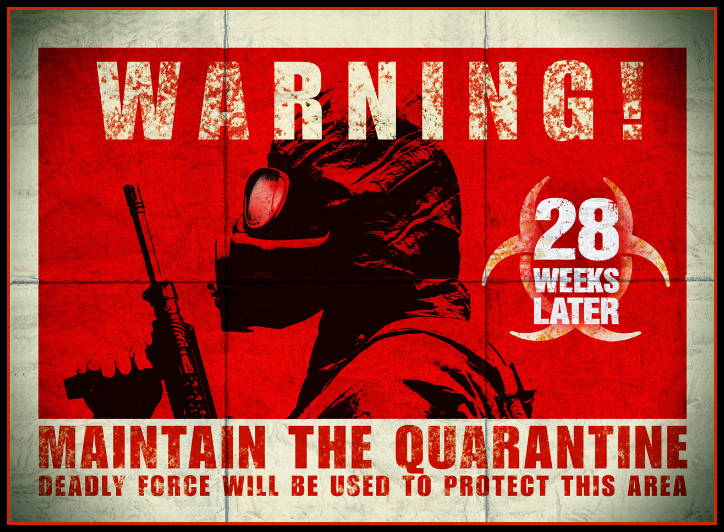
Danny Boyle and Alex Garland’s 28 Days Later was made in such a way that any sequel was almost destined to struggle in its shadow. Their film was not only one of the most influential horror films of the early 2000s, but also an exercise in experimental filmmaking and cinematic reinvention. It fused realism and terror through its digital photography, unconventional pacing, and minimalist score. Any follow-up would have to contend not just with its fresh twist on the zombie mythos (despite the infected not technically being zombies) but also its unique atmosphere, music, and stripped-down aesthetic. Against those odds, 28 Weeks Later manages to stand as an impressive and worthy successor—one that in some respects even surpasses the original.
Spanish director Juan Carlos Fresnadillo approaches the material with a clear reverence for Boyle and Garland’s vision while imprinting his own stylistic and emotional signature on the sequel. From the very first scene, Fresnadillo establishes a tone that blends despair and dread with human frailty. The film opens on a stunningly tense prologue in which Don (a gaunt and haunted Robert Carlyle) and Alice (Catherine McCormack) are living with several others in a rural cottage outside London during the first weeks of the Rage virus outbreak. In this sequence, Fresnadillo distills the central moral dilemma that runs through both films: whether to preserve one’s humanity through compassion or to surrender to pure survival instinct. When Don is forced to choose between rescuing his wife and saving himself, his decision—while horrifying to watch—feels horribly plausible. The following chase through open fields as he flees dozens of Rage-infected attackers captures the raw panic that made Boyle’s original so memorable, yet Fresnadillo shoots it with a sharper sense of chaos and movement. It sets the tone for a story that is both intimate in its human tragedy and apocalyptic in its reach.
Following this intense opening, the film transitions through an introductory credits montage that fills in the aftermath. Don’s escape was not the end of the story but the beginning of a grim reconstruction effort. The British Isles, we are told, were swiftly quarantined when it became clear the infection could not be contained. Twenty-eight weeks later, with the infected population presumed dead from starvation, a U.S.-led NATO force spearheads an ambitious effort to repopulate and rebuild. Led by General Stone (played with austere calm by Idris Elba), the military has converted London’s Isle of Dogs into a heavily fortified safe zone. This enclave represents both restoration and repression—a fragile bubble of civilization built atop the bones of horror.
Within this environment lives Don, now employed as a maintenance manager and struggling to suppress the guilt from his past. The arrival of his two children, Tammy (Imogen Poots) and Andy (Mackintosh Muggleton), who were abroad in Spain during the initial outbreak, reopens emotional wounds he had hoped were sealed. Their reunion, though heartfelt, carries an undercurrent of deception. Don’s explanation of their mother’s fate does not align with what the audience has already witnessed. This dishonesty propels the children into dangerous territory when they decide to sneak out of the Green Zone to retrieve personal belongings from their old cottage. While this act of recklessness fits with youthful impulses and emotional longing, it also feels like the film’s only contrived lapse in logic—an inevitable but frustrating horror trope that sets off the story’s next catastrophe.
What the children discover at the cottage reintroduces the virus in a shocking way. Without realizing it, they bring the Rage infection back into the supposedly secure refuge of London. As soon as containment is broken, the military response escalates with brutal efficiency. General Stone declares a “Code Red,” authorizing the use of extreme measures to eradicate the infected—including indiscriminate firebombing of civilian areas. These scenes echo not only classic apocalyptic tropes but also resonate as a grim reflection of post-9/11 militarism. Many viewers and critics interpreted this act of mass destruction as allegory for the United States’ War on Terror and the ethical corruption of occupation forces. Fresnadillo’s direction, while hinting at this reading, avoids heavy-handed political critique. His portrayal of military overreaction feels less ideological than tragic—a manifestation of fear, confusion, and the blunt-force nature of institutional power. The armed forces are not villains so much as desperate men trapped in an impossible moral quagmire. As in George A. Romero’s The Crazies, which 28 Weeks Later strongly recalls, the destructive consequences stem not from malice but from the futility of trying to maintain order amid chaos.
Where 28 Days Later focused on a small group of survivors and the intimate erosion of morality under crisis, 28 Weeks Later expands the scale dramatically. Fresnadillo transforms Boyle’s compact nightmare into a large-scale urban apocalypse. The sweeping aerial shots of a deserted London—bridges empty, streets silent—hammer home the desolation. When the city is engulfed in flames and gas clouds during the firebombing sequence, the imagery becomes both terrifying and grimly beautiful, a vision of civilization consuming itself. The sequel’s tone is darker and more nihilistic than Boyle’s film, which allowed a trace of optimism in its ending. Here, even innocence becomes a catalyst for doom: it is the children’s actions, driven by love and loss, that inadvertently reignite the infection and condemn the survivors to another wave of horror. This subversion of the “innocent child” trope underscores Fresnadillo’s bleak worldview—where sentiment and humanity, however noble, can still create destruction.
In several ways, 28 Weeks Later aligns more closely with Romero’s Living Dead films than with Boyle’s original. Though Boyle borrowed some of Romero’s thematic DNA, Fresnadillo fully embraces it. The infected may not be reanimated corpses, but the societal collapse, moral ambiguity, and recurring cycles of violence all trace back to Romero’s legacy. One of the sequel’s most striking qualities is its unflinching pessimism: even individuals acting out of love or duty become agents of devastation. The so-called survivors are reduced to primal instincts—running, hiding, killing—in a landscape where institutional power and human decency dissolve together. Fresnadillo makes the action kinetic without glamorizing it. His camera work, switching between chaotic handheld intensity and precise, panoramic destruction, keeps the viewer off balance, mirroring the unpredictability of the apocalypse itself.
The performances elevate the material beyond genre expectations. Robert Carlyle’s portrayal of Don is both gut-wrenching and terrifying. His character’s transformation—from remorseful father to infected embodiment of pure rage—serves as the film’s emotional and thematic anchor. Imogen Poots, in an early standout role, conveys resilience and vulnerability in equal measure, while Jeremy Renner delivers a strong supporting turn as Sergeant Doyle, the soldier torn between obedience and morality. Their performances, though sometimes confined within the film’s relentless pace, enrich its exploration of guilt, loyalty, and the futility of control.
Despite sacrificing some character depth for momentum, the film’s taut editing and grim atmosphere sustain tension throughout. Fresnadillo’s direction never loses sight of his central message: that humanity’s efforts to rebuild are perpetually haunted by its capacity for self-destruction. Even as the few surviving characters reach supposed safety, the final scenes undermine any hope of resolution. The closing image—infected sprinting through the streets of Paris—reminds viewers that, although the city itself appears intact and bustling in daylight, the Rage virus has now breached mainland Europe. This ending shifts the scale of threat from the quarantined British Isles to the broader continent, making containment and redemption feel like dangerous illusions.
As a sequel, 28 Weeks Later earns its place alongside 28 Days Later by honoring the original’s DNA while pushing its boundaries. It retains the visceral dread and societal commentary but broadens the lens to encompass collective failure rather than individual struggle. Fresnadillo’s approach feels colder and more apocalyptic, transforming the story into a study of fear’s infectious nature—social, political, and biological. While his film might not achieve the same creative purity as Boyle’s indie landmark, it succeeds in redefining the tone, expanding the mythology, and pushing the series toward a darker, more cinematic landscape.
In the end, 28 Weeks Later is both a continuation and an escalation—a relentless, despairing study of human fragility under crisis. Its pacing, performances, and imagery combine to create an experience that’s not only horrifying but profoundly unsettling in its realism. If 28 Days Later showed us the collapse of civilization, its sequel reveals the hopeless struggle to rebuild it. Few horror sequels accomplish that much, and fewer still end with such haunting inevitability.



 Through the Shattered Lens