Retro Television Review: Crime Story 1.19 “The Pinnacle”


Welcome to Retro Television Reviews, a feature where we review some of our favorite and least favorite shows of the past!  On Mondays, I will be reviewing Crime Story, which ran on NBC from 1986 to 1988.  The entire show can be found on Tubi!
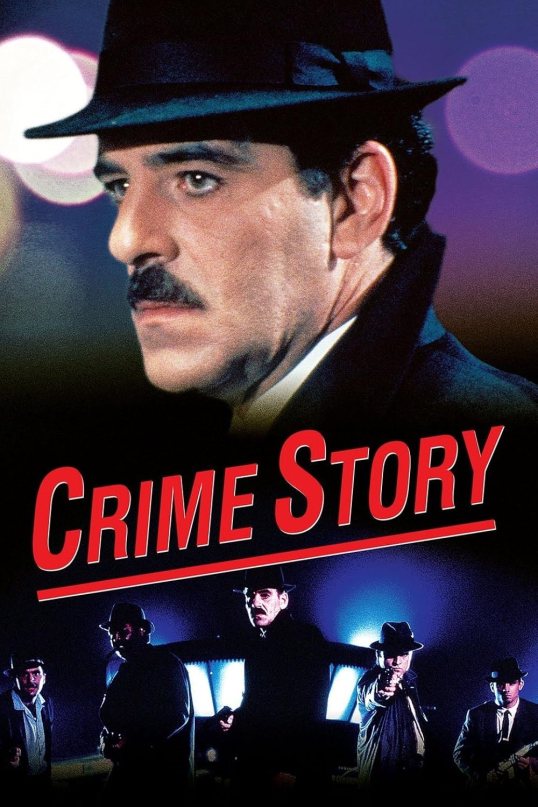
This week, things get dark.

Episode 1.19 “The Pinncale”

(Dir by John Nicolella, originally aired on February 27th, 1987)

When an earnest businessman named Pete Bauer (Bob Stupak) decides to open up a casino with Luca’s help, he has no idea what he’s getting himself into. Pete’s vision is a fun tourist destination where a chicken plays tic-tac-toe and the biggest loser at a table is still given $5,000 for being a good sport. Luca’s vision is to drive Pete out of business by skimming all of his profits, fixing his slot machines so that they always pay off, and sending Pauli, Holman, and Jack Claymore over to make sure everything goes off as planned.

As we learned last week, Jack is an FBI agent working undercover. Being sent over to Pete’s casino gives Jack a chance to see how Luca and his people rip off others. One night, when Pauli has a date with a showgirl, Jack is the one who gets to take the envelope containing the cash over to Luca. Jack hands it over. Luca gives him a $500 tip, little realizing that he’s also given Jack enough evidence to take back to Torello and Abrams.

Unfortunately, Pete is forced to sell his casino to Luca before Jack’s next meeting with Torello and Abrams. Pauli and Holman decide to celebrate. They stop off at Jack’s apartment complex to pick him up. Unfortunately, they arrive just in time to catch Jack in a phone booth leaving a message for Torello. They beat up Jack and then drag him off to a deserted construction site, where he’s tied crucifixion-style to a casino sign.

When Luca finds out, he leaves a meeting with Manny Weisbord so that he can personally shoot Jack in the back of the head. As Luca explains to Steve Kordo, there are some things that he simply has to do himself. Even though Luca may be recreating himself as a businessman in Las Vegas, he’s still a Chicago gangster at heart.

When Abrams and Torello find Jack’s body, Abrams says that whatever chance they had to arrest Luca was just blown out of Jack’s head. Yikes! That’s a graphic way to put it, but Abrams isn’t wrong.

This episode was a case of tonal whiplash, starting out as a comedy but ending in tragedy. For the first 30 minutes, it was hard not to be amused by how efficiently Luca and his men ruined Pete’s business. (Holman even convinced Pete to book a polka band.) However, the final few minutes reminded us that Luca, Holman, and even Pauli are all ruthless murderers. It doesn’t matter if you were a likable character like Jack Claymore. If you betray Luca, you’ll regret it.

As for Torello, this is the second cop he’s lost in his pursuit of Luca. His entire obsession with taking down Luca started with the murder of Detective Wes Connelly in the pilot. How will he react now that he’s seeking justice not just for Wes but for Jack as well?

Back to School Part II #17: The Boys Next Door (dir by Penelope Spheeris)


Boys-next-door

Three years after starring in Grease 2, Maxwell Caulfield starred in another (albeit far different) film about teenage delinquents, 1985’s The Boys Next Door.  Directed by Penelope Spheeris (who also did Suburbia, another film about wayward youth), The Boys Next Door is a frequently harrowing film about a road trip gone very wrong.

The film opens with a series of black-and-white photographs of real-life serial killers, so you know what you’re about to get yourself into before the main action even begins.  Caulfield plays Roy, a not-very-smart teenager who lives in an industrial town in the southwest.  With his generally bad attitude and violent temper, Roy is one of the least popular kids at the local high school.  In fact, his only friend appears to be Bo (Charlie Sheen).  Bo is just as stupid as Roy but he’s not as violent.  Bo’s problem is that he’s a follower, the type who is incapable of making his own decisions.  If Roy says, “Let’s beat the Hell out of someone,” Bo is going to agree because … well, why not?

When Roy and Bo graduate from high school, they don’t have much more to look forward to than a life of working in a factory.  After an angry Roy violently lashes out at a graduation party, he decides that he and Bo should get out of town.  Fortunately, Bo has received $200 as a graduation gift.  Roy and Bo decide to use that money to take a trip to Los Angeles.

On the way to L.A., it quickly becomes obvious that Roy is more than just an angry kid.  When he and Bo rob a gas station, Roy savagely beats the attendant.  When they get to Los Angeles, all Roy can talk about is how much he hates the city and everyone who lives in it.  Roy is especially vocal about how much he hates anyone who he perceives as being gay…

Of course, even as Roy is loudly expressing every homophobic thought that pops into his tiny mind, it’s hard not to notice that he seems to be rather obsessed with Bo.  In fact, he is so obsessed with Bo that he basically kills anyone who shows the least bit of interest in Bo.  Paranoid that Bo is going to abandon him, Roy is willing to do anything to keep that from happening.

The Boys Next Door is one of those films that really took me by surprise.  It may start and look like your typical low-budget thriller but The Boys Next Door ultimately reveals itself to be a disturbingly plausible portrait of a sociopath.  The film suggests that, as individuals, both Roy and Bo are somewhat laughable but, as a team, they’re deadly.  It’s no wonder that Roy is so insistent that Bo always stay with him because, without Bo around, Roy wouldn’t have any motivation to do anything.  Everything that Roy does — from theft to murder — is largely to impress Bo.  Unfortunately, Bo is too stupid to understand what’s going on in his friend’s head.

Especially when compared to some of the other performances that they are known for, both Sheen and Caulfield do surprisingly good work as the two murderers.  Penelope Spheeris wisely directs the film as if it were a documentary and the end result is a harrowing film that deserves to be far better known.