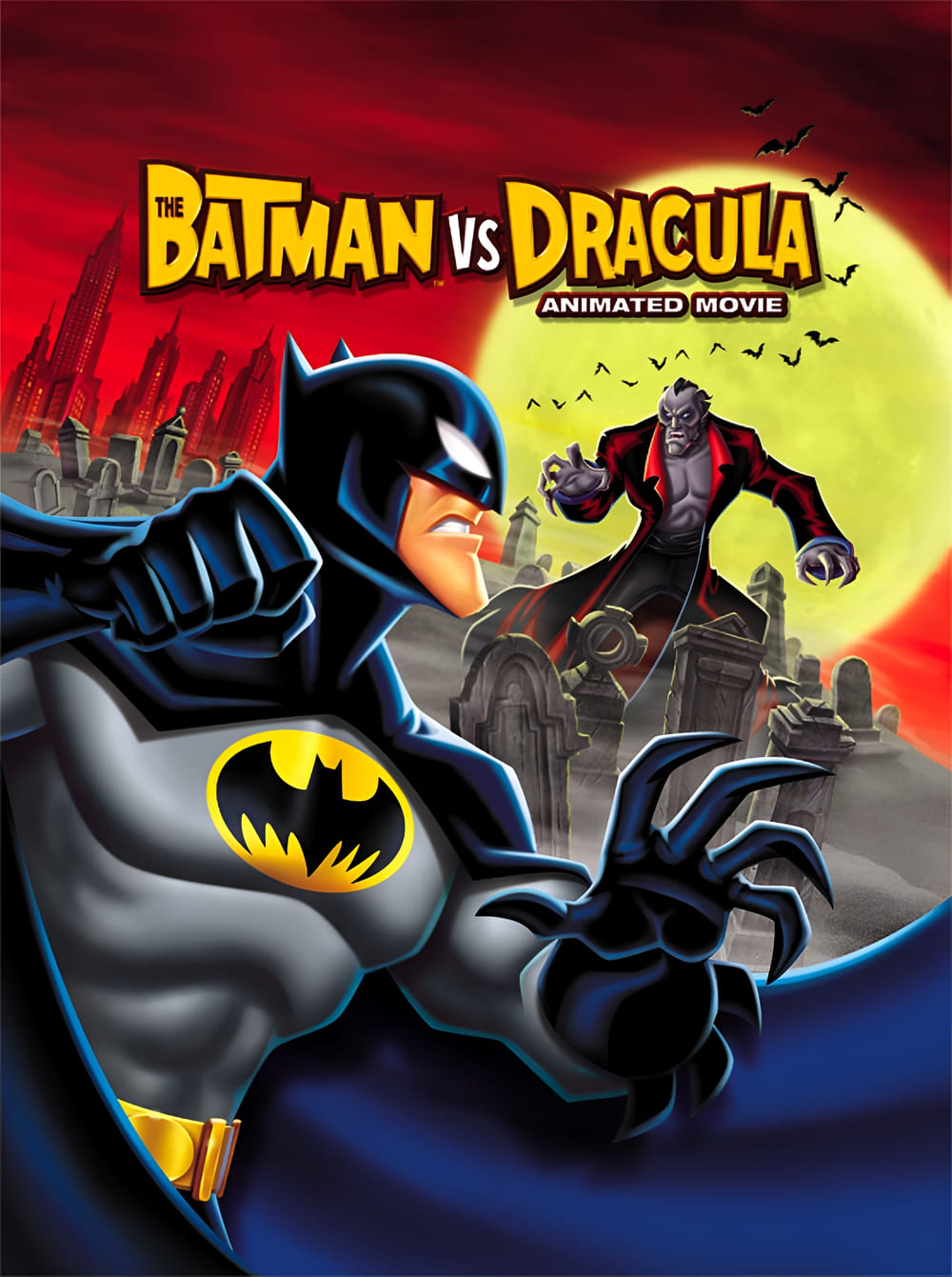
Horror Film Review: The Batman vs. Dracula (dir. by Michael Gougen)


“We cast kindred shadows.” — Dracula

Few Batman stories sound as wonderfully absurd as The Batman vs. Dracula, a 2005 direct-to-video animated film that pits the Dark Knight against literature’s most famous vampire in a Gotham overrun by the undead. Spun off from The Batman television series, the movie could have been a disposable Halloween cash-in, but it turns out to be a stylish, energetic, and genuinely atmospheric monster movie. It draws inspiration from DC’s Elseworlds graphic novel Batman & Dracula: Red Rain, and while it is not as dark or graphic as that comic, it understands why Batman and Dracula make such a natural pairing.

The film immediately separates itself from the more famous Batman: The Animated Series. This is not Kevin Conroy’s Batman, Mark Hamill’s Joker, or the sleek, noir-influenced world associated with Bruce Timm and Paul Dini. Instead, it uses the visual language of The Batman, the 2004 series that presented a younger, more athletic, and more stylized version of the Dark Knight. Rino Romano voices Bruce Wayne and Batman, while the character designs are longer, sharper, and more angular than the classic animated-series versions. The animation has a strong early-2000s action-cartoon identity, with exaggerated movement, dramatic camera angles, bold colors, and a constant emphasis on kinetic action.

That art style can be divisive, especially for viewers who prefer the timeless look of the Timm-era shows. Yet The Batman vs. Dracula may be one of the best possible uses of it. The story is not trying to be grounded or realistic; it is a comic-book monster movie. Gotham becomes a place of foggy graveyards, moonlit rooftops, blood-red lighting, underground tunnels, and shadowy streets. The film embraces vampire-movie imagery with enthusiasm, and its action scenes have enough movement and visual flair to make Dracula feel like a legitimate threat rather than just another costumed villain.

The plot begins with Joker and Penguin escaping Arkham Asylum. Joker immediately returns to causing chaos, while Penguin heads to a cemetery in search of buried treasure. In classic comic-book fashion, Penguin accidentally awakens Dracula, who has been imprisoned for centuries. Once free, the Count begins feeding on Gotham’s citizens and transforming them into vampires. He also hopes to resurrect his lost bride, giving the story a more personal and gothic motivation than a simple plan for conquest. Batman must investigate the disappearances, protect Vicki Vale, and find a way to stop an enemy whose powers push him far beyond the limits of ordinary crime-fighting.

The influence of Batman & Dracula: Red Rain is one of the film’s most interesting aspects. That 1991 Elseworlds graphic novel, written by Doug Moench and illustrated by Kelley Jones, imagined an alternate Gotham threatened by Dracula and his vampire followers. The animated movie does not directly adapt the comic, but it borrows its central idea: Batman confronting a supernatural outbreak that cannot be solved with fists, gadgets, and a few well-timed detective deductions. The film softens the comic’s darker horror elements for a younger audience, but the connection gives the premise more comic-book credibility than a random crossover might otherwise have.

Dracula is the movie’s greatest asset. Peter Stormare gives him a cold, aristocratic voice that makes him feel ancient, arrogant, and genuinely menacing. He does not behave like a generic monster; he acts like a ruler who sees humanity as prey. The film wisely gives him several moments where he overpowers Batman, which keeps the conflict from feeling too easy. Batman cannot simply throw batarangs and win. Dracula’s speed, strength, hypnotic abilities, and growing vampire army force Bruce Wayne to research, adapt, and prepare.

That detective element gives the film more structure than expected. Batman spends much of the runtime investigating strange attacks and disappearances, gradually uncovering the source of the vampire outbreak. Because he spends so much of the story on the defensive, the eventual solution feels earned. The movie lets Batman be vulnerable and clever rather than turning him into an invincible action hero. It is a simple approach, but it works well for a film that runs only about 83 minutes.

The supporting cast adds plenty of personality. Penguin accidentally releasing Dracula is a fun setup, and Tom Kenny gives the character a greedy, nervous energy that fits this version of Oswald Cobblepot. Joker receives the more memorable arc, however. Voiced by Kevin Michael Richardson, he eventually becomes a vampire, and the result is appropriately creepy. Vampire Joker is one of the movie’s best visual ideas, transforming a familiar Batman villain into something closer to pure horror. The design and voice work make him unsettling without pushing the film too far beyond its family-friendly boundaries.

Vicki Vale, voiced by Tara Strong, has a larger role than many viewers might expect. She serves partly as a love interest and partly as someone Batman must protect, but she is not entirely passive. The romance between Bruce and Vicki is fairly conventional, but it gives the story a small emotional anchor amid all the vampire chaos. Alastair Duncan’s Alfred provides the usual steady support, helping Bruce stay focused while Gotham descends into supernatural panic. The film keeps its cast and plot focused, which helps it avoid the padding that sometimes affects direct-to-video superhero movies.

The biggest weakness remains the visual style. The Batman was always a more divisive interpretation of the character, and its angular designs will not appeal to everyone. Compared with Batman: The Animated Series, this film can look less refined and less iconic. Some faces appear stiff, the proportions can seem strange, and the overall aesthetic is very much a product of its era. Still, the movie benefits from fully committing to its own look rather than trying to imitate the classic animated series. It feels like a one-off horror experiment, not a lesser attempt to recreate a beloved version of Batman.

At around 83 minutes, The Batman vs. Dracula moves quickly and never overstays its welcome. It has action, humor, mystery, horror imagery, and enough atmosphere to feel like a genuine seasonal movie rather than a random superhero crossover. It may not reach the artistic heights of the best DC animated films, but it does something those films rarely attempted: it places Batman in a full-blooded monster movie and lets him face one of horror’s most enduring icons.

For Batman fans, vampire-movie fans, or anyone seeking an easy Halloween watch, The Batman vs. Dracula is an easy recommendation. It is not essential Batman viewing, but it is far more stylish and entertaining than its title suggests. By borrowing the spirit of Batman & Dracula: Red Rain and pairing it with the distinctive look of The Batman, the film becomes a pulpy, gothic, early-2000s adventure that embraces its absurd premise and makes it work.
Late Night Retro Television Review: Freddy’s Nightmares 1.7 “Sister’s Keeper”


Welcome to Late Night Retro Television Reviews, a feature where we review some of our favorite and least favorite shows of the past! On Fridays, I will be reviewing Freddy’s Nightmares, a horror anthology show which ran in syndication from 1988 to 1990. The entire series can be found on Plex!

This week, Freddy is out for revenge.

Episode 7.1 “Sister’s Keeper”

(Dir by Ken Wiederhorn, originally aired on November 20th, 1988)

Freddy’s Nightmares started with Freddy Krueger killing Deputy Blocker, the man who had led the vigilante mob that set him on fire.  This episode finds Freddy seeking revenge on Blocker’s twin teenager daughters, neurotic Merit (Hili Park) and the supercool, super awesome Lisa (Gry Park).  Merit is convinced hat Freddy is haunting her nightmares and, as a result, she’s a bit of an outcast at school.  Lisa, on the other hand, believes that Freddy is dead and buried.  Lisa is stable and popular at school and even has a jock boyfriend.

Needless to say, Merit is a bit jealous of Lisa.  For me, this was the most realistic part of this episode.  People are always jealous of girls named Lisa, especially when they’ve got it all together as this Lisa does.  (Trust me, I know!)  It’s a heavy burden to bear but it happens.  Lisa, being a saint, tries to help Merit out but Merit is pretty unappreciative.

Lisa even dresses up like Merit and pretends to be Merit so that she can experience what it’s like to be her sister.  Lisa discovers that her boyfriend is just as interesting in sleeping with Merit as in sleeping with her.  Booo!  What a creep!  Even worse, Lisa discovers that Freddy is real and that he’s after both her and Merit.

Like the pilot, this episode tells one story and most of the action centers around Freddy.  Freddy actually takes part in this week’s story and, even by his standards, he’s cruel.  “I’ll make it gentle,” he tells the terrified Merit, a reminder that Freddy was always a far more perverse killer than the seemingly asexual Jason Voorhees or Michael Myers.  This episode was a reminder of just how scary Freddy could be.  Robert Englund didn’t hold up.

Merit and Lisa learn how to dream “in sync” so that they can both face Freddy at the same time.  It’s a cool idea that does absolutely no good.  As Lisa puts it, “It doesn’t work, you can’t make him go away!”  Lisa ends up dead (boo!) while Merit is blamed for her murder.  And so the episode ends.

Wow, that’s not a happy ending.  Not only did Freddy triumph but supercool Lisa was killed, largely due to her sister’s incompetence.  Then again, there really aren’t that many happy endings to be found when it comes to Freddy Krueger.  The ending was depressing but effective and, even more importantly, it was really the only way the story could have ended.

This episode was pretty good.  It’s certainly the best that I’ve seen so far.  Merit and Lisa were real-played by the Park sisters and Robert Englund once again showed just how frightening he could be as Freddy Krueger.  Within the confines imposed by television syndication, this was a genuinely frightening episode.


Film Review: Friday the 13th Part VII: The New Blood (dir. by John Carl Buechler)


Hi, did everyone out there have a good Easter?  I did!  My entire family got together up at my Uncle’s place.  There was a big Easter egg hunt and me and Erin smuggled in extra Easter eggs which we then “helped” our niece and nephew discover.  Usually, going to my Uncle’s place means a day spent laying out near the pool in a bikini and trying to work on my tan.  (Though, to be honest, I’m a redhead so I don’t so much tan as I just burn.)  However, this Easter, it rained so most of the day was spent inside and watching figure skating with my sisters and cousins.  I hope everyone else had a good Easter as well and I hope you’ll forgive me for being a little late with my latest review in my series looking at the Friday the 13th franchise.  In this post, I review 1988’s Friday the 13th Part VII: The New Blood.

(Minor Spoilers Follow)

As I mentioned in my review of Jason Lives, The New Blood was the first of what I like to call Friday the 13th’s gimmick films.  In these films, Paramount Pictures (and later New Line Cinema) attempted to revive the franchise’s declining profits by adding a gimmick.  No longer would it be enough for Jason to simply show up and stalk unfortunate campers.  Previous installments had their gimmicks (such as Part 3 being filmed in 3D) but they all stuck with the same basic story and structure.  However, from now on, Jason would no longer just be a silent antagonist in a communal cinematic nightmare.  From now on, he would fight psychics and Freddy Krueger and go to both outer space and New York City.  (And don’t even get me started on the film where he was revealed to actually be some sort of weird space slug.  Not yet, anyway…) 

The problem with the gimmick films is that, along with dealing with the gimmick, they still had to deal with the business of killing summer counselors and other random campers.  Whereas previous film made at least a little effort to provide the viewers with interesting and/or attractive characters, the gimmick films are distinguished by a real laziness when it comes to characterization.  Ironically enough, surrounding the gimmick with such weak material only served to remind the viewer just how gimmicky the gimmick ultimately was.  That is why the gimmick films are my least favorite of the franchise.

That said, The New Blood is probably the best of the gimmick films.  Anyone who doesn’t think that being called the best of the worst is much of a compliment has obviously never been in a community theater production of Little Shop of Horrors. 

The New Blood of the title is a girl named Tina Shepherd.  When we first meet Tina, she’s ten years old and living in a house that sits on the shores of Crystal Lake.  (Apparently, the residents of Forrest Green decided to change the name of the town back to Crystal Lake sometime after Jason Lives.  If nothing else, these two films convinced me of the importance of zip codes.)  One night, as Tina listens to her father and her mother fight, she runs out to a nearby dock, gets in a canoe, and starts to float away.  Her father runs out onto the dock and shouts at her to return.  Tina yells back and suddenly, the entire dock collapses and her father drowns.  As all of this is going on, we discover that Jason just happens to be in the lake, chained to a rock below the dock.  (You have to wonder what having a zombie serial killer chained up a yard away from your house does to property values.  Nothing good, I imagine but then again, what do I know about real estate?)

Anyway, jump forward ten years.  Tina (now played by Lar Park Lincoln) has just been released from a mental asylum and returns to Crystal Lake with her psychiatrist Dr. “Bad News” Crews (played by a wonderfully evil Terry Kiser).  Dr. Crews claims to be helping her deal with her feelings of guilt but actually, he’s seeking to exploit the fact that Tina has latent psychic abilities.  What all can Tina do?  Well, that’s a good question because the film itself seems to be unsure of just what exactly Tina is capable of.  As a result, Tina often seems to have whatever psychic abilities are most convenient for whatever’s happening on-screen at the moment.  While most of the time Tina seems to be telekinetic, there are other times when she can see the future, set fires, and even raise the dead.

It’s this last power that gets everyone in trouble when, one night after getting annoyed with Dr. Crews, Tina runs out to the lake and attempts to bring her father back to life.  While she fails to bring back her dad, she does manage to free Jason (played here, for the first time, by Kane Hodder) from his chains.  By this action, Tina joins the long line of horror film heroines who are ultimately responsible for every death that occurs over the course of the movie.

That’s pretty bad news for the vapid collection of potential victims who are trying to throw a surprise birthday party in the house next door.  Among those potential victims: nice guy Nick (Kevin Butler) who falls in love with Tina, evil Melissa (Susan Jennifer Sullivan) who wants Nick, Eddie (Jeff Bennett) who spends his time talking about a sci-character called “Space Mummy,” and about a half-dozen other people whose names I didn’t manage to catch.  Seriously, this is the most empty-headed and shallow collection of dumbfug toadsuckers ever!  As opposed to previous installments (in which the actors at least had enough chemistry that you believed that they just might actually spend a weekend at the lake together), the victims in New Blood feel as if they were just randomly dropped in the house just so that Jason could kill them.  They’re such a vacous, spiteful collection of people that, for the first time in the series, you truly find yourself rooting for Jason. 

Anyway, the birthday boy never shows up for his party but that doesn’t really worry anyone at the house.  As one of them puts it. “You know Michael.  Guy probably got arrested for drunk driving and spent the night in jail.”  (Sounds like a great guy, no?)  No, Michael’s not in jail.  Michael’s dead because Tina brought Jason back to life and soon, so is just about everyone else.  It all leads to a final apocalyptic battle between Jason and Tina that manages to be both silly and exciting at the same time.  It also goes a long way towards making up for what we’ve had to sit through in order to reach it.

One of my favorite chapters of Peter M. Bracke’s excellent oral history of the franchise, Crystal Lake Memories, deals with the making of The New Blood.  Say whatever else you will about this film’s cast, they’re some of the most outspoken in the history in the history of the franchise.  Reading their memories about making this film, three things quickly become clear:

1) Everyone was scared of Kane Hodder.

2) Lar Park Lincoln didn’t like the majority of the cast.

3) The majority of the cast didn’t like Lar Park Lincoln.

In fact, quite a few really nasty things are said about Lar Park Lincoln but you know what?  Outside of Kane Hodder and Terry Kiser, Lar Park Lincoln probably comes the closest to giving an actual performance than anyone else in the cast and I think it can be argued that she makes Tina into one of the few truly strong female characters ever to be found in a Friday the 13th film.  Take it from a former community theatre ingenue: it takes as much talent to make a slasher film “final girl” credible as it does to play Margaret Thatcher.  As for the rest of the cast of disposable victims, they’re some of the most forgettable of the series.  In the role of Nick, Kevin Blair (who reportedly did not get along with Lincoln and who has absolutely no chemistry with her on-screen) is stiff but handsome and Susan Jennifer Sullivan has a lot of style as the bitchy Melissa.  Otherwise, they’re a pretty bland group and director Buechler doesn’t seem to have much use for them other than to make sure that they’re in the right position to be killed by Kane Hodder.

The New Blood is best remembered for introducing Kane Hodder in the role of Jason Voorhees.  Though I personally believe that The Final Chapter’s Ted White was the best Jason (he was certainly the most ruthless), it can’t be denied that Kane Hodder was the perfect embodiment of the version of Jason that came to dominate the last few films in the original series.  Whereas Ted White’s Jason was a calculating killer, Hodder’s Jason is a machine that happens to be designed for killing and little else.  He kills not so much out of anger or pain as much as he kills, like any good zombie, just because that’s the only thing he knows how to do.  One reason why this film’s final battle is actually exciting to watch is because it’s set up as a confrontation between the literally cerebral Lar Park Lincoln and the overwhelmingly physical Kane Hodder.  Hodder, famously, is the only actor have played Jason in multiple films and he earned that right with his performance here.

And make no mistake about it: Hodder gives a performance in this film and, as a result, The New Blood is a lot more watchable than it has any right to be.

(I would also suggest that if you do watch this movie on DVD, be sure to listen to Hodder and Buechler’s commentary track.  Both of them seem to be having so much fun watching the film that it actually makes the film more enjoyable.)

While The New Blood did, ultimately, make more money than the previous Jason Lives, it still failed the match the box office success of the first few films in the series.  Though Lar Park Lincoln apparently wrote a script for a sequel that would have featured Tina and Jason once again going to war (interestingly enough, it’s rumored that Lincoln’s script opened with Kevin Blair getting killed off), Paramount decided to try out another gimmick and abandoned the new blood for Manhattan.  The end result was one of the worst films in the series but we’ll deal with that in my next post.