Spielberg. Williams. Koepp. Kaminski. What the heck is Disclosure Day?
The teaser trailer for Steven Spielberg’s Disclosure Day hit my phone via Letterbox’d. This is connected to those weird X-Files looking posters I’ve been seeing as of late. It looks like another film with aliens, similar to Close Encounters of the Third Kind with a dash of Zemekis’ Contact or sprinkle of Villeneuve’s Arrival. The film stars Josh O’Connor (Wake Up Dead Man: A Knives Out Mystery), Emily Blunt (Jungle Cruise), Colin Firth (Kingsman), Coleman Domingo (The Running Man), Wyatt Russell (Marvel’s Thunderbolts), and Eve Newson (Robin Hood).
Spielberg and Koepp have a good track record together with the Jurassic Park films, and it’a always good to see a pairing with John Williams. Still, this all looks really weird. Either way, we’ll find out when the film is released next June.
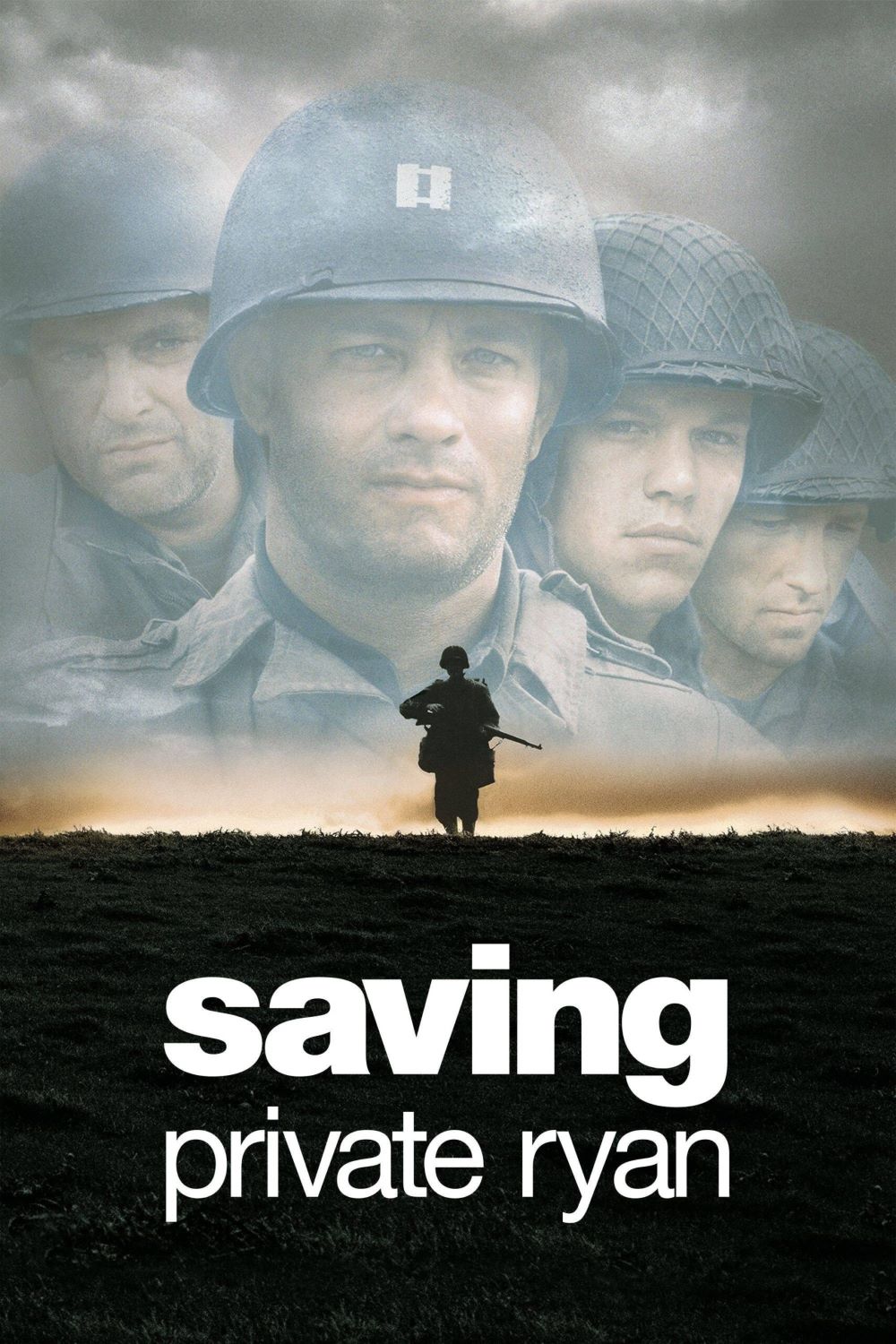
“Someday we might look back on this and decide that Saving Private Ryan was the one decent thing we were able to pull out of this whole godawful, shitty mess.” — Sergeant Horvath
Saving Private Ryan stands as a landmark achievement in war cinema, intricately weaving immersive battle scenes, rich character dynamics, and profound moral themes into a nearly three-hour exploration of World War II’s human cost. One of its most remarkable features is the opening Omaha Beach landing sequence, a meticulously crafted, over 24-minute depiction of warfare’s brutal reality. Spielberg deploys a cinema verité style with handheld cameras capturing disorientation and chaos through the soldiers’ eyes. The sound design envelops the viewer in a sensory onslaught—gunfire, shouting, explosions—creating a visceral experience that immerses audiences directly in the terror and confusion of D-Day.
The filming process drew heavily on historical accuracy, with the production shot on the coast of County Wexford, Ireland, employing amputee actors and practical effects over computer graphics to simulate violent injuries and battlefield horrors. Muted tones evoke wartime photographs, and rapid, shaky editing conveys the disorganized, frantic environment soldiers endured. Consulting WWII veterans and historians, Spielberg created a sequence that reshaped cinematic portrayals of war, influencing how future films would approach the genre’s raw immediacy and emotional weight.
The film’s narrative follows a squad led by Captain Miller on a mission to locate and bring home Private James Ryan, whose three brothers have been killed in combat. The mission is steeped in the real-life tragedy of the five Sullivan brothers who died together aboard the USS Juneau in the Pacific, prompting military policies to prevent similar familial devastation. This historical context frames the story’s ethical heart: risking several men’s lives to save one, raising enduring questions about the value of individual sacrifice within the broader war.
In Saving Private Ryan, sacrifice is portrayed ambiguously—not as the sacrifice of a single hero but as the collective cost borne by the men tasked with rescuing one individual under perilous conditions. As the squad journeys through the war-torn French countryside, the deaths, injuries, and tensions they face underscore war’s randomness and the difficulty of weighing one life against many. The narrative refuses to romanticize or simplify, instead confronting the audience with the tragic truth that countless soldiers lose their lives without recognition or purpose, while some survive against staggering odds.
Duty and camaraderie thread throughout the film, portrayed through the soldiers’ evolving relationships and personal struggles. Each grapples with loyalty not only to their mission but to their fellow men and their own moral codes.
Integral to the film’s power is Tom Hanks’s layered performance as Captain John Miller. Hanks breathes life and emotional depth into Miller, portraying him as a man shaped by civilian life—revealed poignantly when he discloses his pre-war profession as a schoolteacher—now transformed by the relentless demands of war. He embodies an officer who is both composed and vulnerable, carrying the heavy burden of leadership with quiet dignity. Hanks’s portrayal reveals the internal struggles beneath Miller’s stoic exterior: moments of doubt, moral conflict, and fatigue subtly expressed through a trembling hand or a weary gaze. This humanity makes Miller relatable, as a man trying to maintain order and purpose amid chaos.
Hanks skillfully balances Miller’s authoritative presence with warmth and empathy, particularly evident in his paternal interactions with younger soldiers, reinforcing Miller’s role as both a leader and protector. His nuanced acting delivers the complexity of a man constantly negotiating duty and compassion. In scenes of high tension or moral quandaries, Hanks conveys the weight of command while allowing glimpses into Miller’s psychological strain, deepening the film’s emotional resonance.
Following Hanks’s Miller, a standout amongst the supporting cast is Tom Sizemore’s portrayal of Technical Sergeant Mike Horvath, Miller’s steady second-in-command. Sizemore embodies the pragmatic, battle-hardened soldier whose loyalty and experience provide emotional grounding for the squad. Sizemore portrays Horvath’s weariness and quiet commitment, adding layers of realism that deepen the exploration of how war reshapes individuals. The chemistry and shared history between Miller and Horvath are palpable, illustrating the bonds that sustain soldiers through hardship and lending emotional weight to the narrative.
The film wrestles with intense moral ambiguity throughout. The mission’s premise—to risk many lives to save one—compels both characters and viewers to confront complex questions about justice, value, and the cost of war. Scenes presenting difficult choices, such as the decision to spare or execute prisoners, dramatize these ethical dilemmas and highlight the emotional burdens borne by soldiers.
Technically, the film excels, with Janusz Kaminski’s dynamic cinematography capturing both the chaos of battle and intimate moments with evocative clarity. The immersive sound design reinforces the brutal reality, stripping warfare of glamor and confronting audiences with its daunting human costs.
Despite the overwhelming destruction and loss, Saving Private Ryan offers moments of humanity and hope. The rescue mission serves as a fragile symbol of compassion in the midst of devastation, while the film’s closing reflections on memory and legacy emphasize the lasting significance of sacrifice and survival.
Saving Private Ryan stands as a monumental achievement in the war genre, combining visceral combat realism, compelling characters, and moral complexity. Through Hanks’s deeply human Captain Miller and the nuanced supporting performances, especially Sizemore’s grounded Horvath, the film explores themes of sacrifice, duty, and brotherhood with unflinching honesty. Its enduring legacy lies in its unvarnished yet empathetic portrayal of war’s cost and the profound sacrifices made by those who lived it.
It looks like life found a way yet again to bring us another Jurassic World film. This time around, the dinosaurs appear to be out and everywhere on the planet. It’s like someone at Universal saw Mission Impossible: Fallout and said “How about we try all of that, but with Dinosaurs?!”
Motorcycle chases? Check, now with dinos.
Issues on a flight? Check, now with dinos.
I’ll admit though that I’m excited for this one. I’ve always wanted to see a Jurassic Park scenario where Dinosaurs reached the mainland, and The Lost World was possibly the closest we had there. It’s also cool to see that Blue (everyone’s favorite Raptor) has a little one of her own!
This third film brings back both Sam Neill and Laura Dern, reprising their roles as Alan Grant and Ellie Sattler. Jeff Goldblum and B.D. Wong are back as well with the Jurassic World cast, Bryce Dallas Howard, Chris Pratt, Isabella Sermon, Daniella Pineda, Justice Smith, and Omar Sy. Dichen Lachman (Netflix’s Altered Carbon) and Mamoudou Athie (Underwater) are new to the series.
Jurassic Park Dominion premieres in theatres June 10, with Colin Trevorrow returning as Director.
I can’t quite remember how I found out about 1988’s Who Framed Roger Rabbit. Growing up, most of my movie news came from four major sources – Entertainment Tonight, Siskel & Ebert, the occasional movie poster you’d see at a bus stop or cinema. If you were really lucky, the production company would sometimes create a “Behind the Scenes”/”Making of” showcase a little after the movie premiered. If possible, I would read the billing block of a poster to see if I could recognize anyone familiar, Just seeing Amblin Entertainment meant you’d have Steven Spielberg, Kathleen Kennedy and Frank Marshall involved. Nothing new there. I knew Robert Zemeckis and Alan Silvestri from Romancing the Stone and Back to the Future. Movies have had mixes of animation and live action – Bedrooms & Broomsticks, Mary Poppins, etc., but the big buzz here was the film planned to somehow involve both the Disney and Warner Bros. animation studios. It was an alien concept for me, because they couldn’t be more different from each other. Historically, animation on the WB side of things were edgy and almost dared to be even raunchy if they could get away with it. Disney, on the other hand, was pristine and extremely kid friendly. Bugs Bunny and Mickey Mouse? Daffy Duck vs. Donald Duck, all on the same screen? It was the 1980’s equivalent of asking Marvel (which ironically, is owned by Disney now) and DC (which the WB has owned for decades) to write a single Justice League / Avengers crossover story.
At the time, Steven Spielberg was already well known for blockbusters like the Indiana Jones films and E.T., but did he really have enough clout to bring two major companies together like that? It blew my 13 year old mind and I became completely obsessed.
Around the time Who Framed Roger Rabbit came out, I picked up anything I could find about it. I had Alan Silvestri’s soundtrack, a poster, a stuffed Roger doll, and the video game when it came out. I even read Gary Wolf’s novel. I begged my parents to let me see it, and it was one of the rare times where my Mom took my sis and I to the movies instead of my dad (the major movie buff, who took us to see Robocop twice the year before). I think she went in part to shut me up, and to give herself a break from my nearly 2 year old brother. It remains one of the two best movie related memories I have of her.
In the world of Who Framed Roger Rabbit, humans and cartoons share the same space in Los Angeles. Cartoons live in Toontown, owned by Marvin Acme (Stubby Kaye). It’s the story of Eddie Valiant (Bob Hoskins – Hook, Mermaids), a Los Angeles Private Eye with a bit of a grudge against toons. For a quick buck, Valiant is hired by R.K. Maroon (Alan Tilvern – Firefox, Little Shop of Horrors) to snoop on Acme. Valiant’s work puts him in the path of Roger Rabbit (Charles Fleischer, Back to the Future Part II), after Eddie takes some racy pictures of Acme playing patty cake with Roger’s wife, Jessica (Kathleen Turner, Romancing the Stone). Roger angrily swears they’re still a happy couple and that Acme somehow coerced her before running off into the night. The next morning, Eddie is informed that the Marvin Acme’s been killed overnight. To make things worse, Acme’s Will is missing, leaving the fate of Toontown up in the air. All of the evidence points to Roger, but Roger asks for Eddie’s assistance in clearing his name. Can Eddie save Roger before Judge Doom (Christopher Lloyd, Back to the Future) and his pack of weasels get their hands on him?
The production for the film required jumping over a number of hurdles. Zemeckis, himself a cartoon fan, wanted to bring some of the Warner Bros. characters along with Disney characters. Even better, he also wanted to add some of Tex Avery’s classic style to the film. Similar to what he did with Ready Player One, Spielberg negotiated with some of the studios, and while he couldn’t get everyone, he did manage to get Disney, WB and a few others to commit. With this in place, they had to somehow merge animation with live-action in a way that made it look like the cartoons were interacting with their environment.
This would require one really huge magic trick, made up from an assortment of parts.
Since it was around 1986-1987, there really was no CG, yet.. James Cameron made 6 stuntmen in Alien suits look like 600 through the use of Oscar Winning Editing, and the technology that gave us the paradigm shifting dinosaurs of Jurassic Park wouldn’t occur for another 3 or 4 years. For Who Framed Roger Rabbit, the approach was a mix of robotics, puppetry, sleight of hand gadgetry, and a lot of imagination.
The art was handled by Richard Williams and his team, who would go on to win a Special Achievement Oscar for his contribution to the film. They had to draw every cell/frame by hand, on paper and then have them inked. These would then go to Industrial Light & Magic, who would add shadow, highlights and special effects To make things harder, the artists had to work around Zemeckis’ filming style and figure out how to fit the characters into each scene.
Take Jessica Rabbit’s performance of “Why Don’t You Do Right?”, sung by Amy Irving (Carrie, The Fury). At first glance, it seems a really easy shot. Girl steps on the stage, performs and leaves, right? However, there are so many things happening here on an effects level that I still don’t fully understand how they did it after all these years. ILM handled the lighting, from the sparkles in the dress, the use of the handkerchief and the great moment where Jessica blocks the spotlight in her walk from Acme to Valiant. I had to later explain to my mom that the “Wow” I whispered in the theatre during that scene had little or nothing to do with puberty. It was because I hadn’t seen anything like that before with a cartoon, and I’d hate the Academy forever if the movie didn’t win an Oscar for that.
Having cartoons on screen is one thing, but making it feel like they were interacting with people is another. Hoskins was the anchor that tied most of it all together. Having to work with nearly nothing – not even a green screen – and perform the physical actions required of the role was quite a feat compared to what some actors do with the motion capture rooms and digital walls we use today. Near lifesize models of Roger were created to help Hoskins handle some of the physical “grab and move” sequences, and actor Charles Fleischer actually spent time dressed as Roger on set (but off camera, of course) to feed his side of the conversation to Hoskins when filming a scene.
Puppeteers were brought on for moments were toon characters needed to hold objects, such as guns or knives. There is a moment of the movie where you can see one of the holes for the guns that the weasels, but it’s a pretty minute hiccup with all of the great work that was done. For the car sequences with Benny the Cab (also Fleischer), they used a special mini-car with a driver in the back. The car and driver were painted over (still, frame for frame) by the animators.
And ff course, it wouldn’t be a Zemeckis film without Alan Silvestri at the helm, musically speaking. Silvestri’s score for was a mix of detective noir and cartoony antics, which made for a perfect fit for the film. Overall, Who Framed Roger Rabbit is one of those films I cherished growing up, and it’s almost impossible for me to avoid recommending it.
It looks like we have a set of new agents donning the black suits this time around.
Seems Thor and Valkyrie are doing a side gig for the Men In Black. There’s no Agent K or Agent J to save the world from otherworldly dangers. We now have Agent H and Agent M to take up the mantle of protecting the world. The trailer also shows us that the MIB is a global organization and no more New York as the stomping ground, but we also have London and it’s branch of the MIB.
Men In Black International was a sequel that didn’t garner too much excitement when first announced, but as the cast was finalized and announced the excitement began to rise. And it is quite a cast when one really looks at it: Chris Hemsworth, Tessa Thompson, Liam Neeson, Emma Thompson, Kumail Nanjiani, Rafe Spall and Rebecca Ferguson.
Men In Black International will be out June 14, 2019. A release date with enough time between it and the juggernaut that will be Avengers: Endgame.
Lisa Marie is not the only history nerd in this here place. I don’t think it was a coincidence that TSL’s co-founders ended up being both history nerds. We both love films the depict historical events. Some of them turn out to be great while some end up on the trash heap.
One filmmaker who has made a career late in his life of making historical films is Steven Spielberg. The same one who gave us great blockbusters in the scifi, thriller and fantasy genres has also given us some excellent historical films such as Saving Private Ryan, Schindler’s List, Munich and Lincoln.
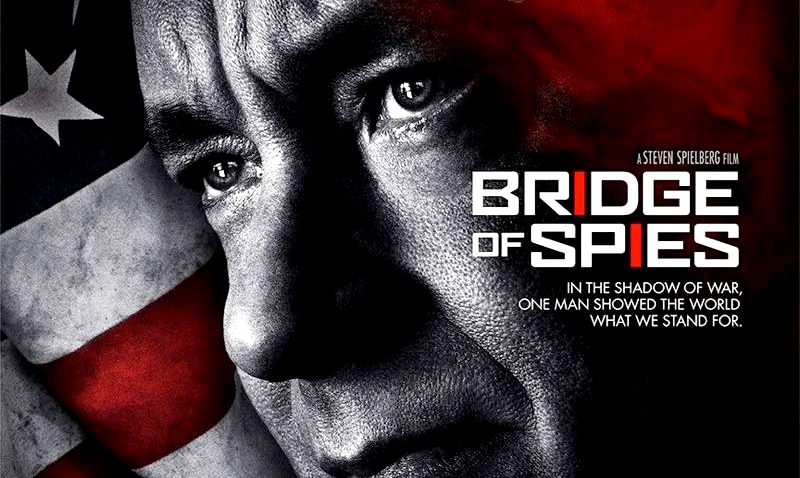
We have the first trailer for Spielberg’s latest film which is based on the real-life events surrounding the 1960 U-2 spy plane incident where American pilot Francis Gary Powers was shot down while on a mission over the Soviet Union and was subsequently swapped back into US custody for a Soviet spy that the Americans were holding.
Bridge of Spies showcases the events which led to that swap and how contentious the negotiations had been before it finally came about. Everyone knows the Cuban Missile Crisis put the world very close to nuclear annihilation, but what many don’t know is how the Gary Powers Incident also pushed the two nuclear powers very close to the brink.
Bridge of Spies is set for an OCt. 16, 2015 release date…just in time for the start of Lisa Marie’s favorite film season: Awards Season.
Was there ever a need for a fourth film in the Jurassic Park franchise? For years many have tried to answer that and projects to get it up and running stalled for need of a director willing to sign on to a franchise that has been passed up by the superhero action tsunami that has hit pop culture.
It is now 2015 and we’re just months away from finally seeing the fruits of over a decade’s worth of labor to bring a fourth Jurassic Park film to the big screen. While it may still have Steven Spielberg attached as executive producer there’s no Joe Johnston anywhere near this fourth film. We have Carl Trevorrow taking the director’s chair with Chris Pratt and Bryce Dallas Howard taking on the lead roles.
Jurassic World is set to open it’s doors to the world on June 12, 2015 (took them long enough).
The 1980’s was a special time in my life. It was another phase in my development in loving film. That decade saw many films starring kids and teens in coming-of-age tales both comedic, thrilling, dramatic and poignant. While there were many filmmakers who delved into this genre it was Steve Spielberg who mined it to great effect culminating in his classic boy-meets-alien film, E.T.: The Extra-Terrestrial. It’s been almost 30 years since the release of that film and now comes a filmmaker who seem to have grown up idolizing and loving Spielberg films of that era. The year is now 2011 and J.J. Abrams is that filmmaker who dared to pay homage to those very same coming-of-age Spielberg films of the 80’s with his very own simply titled Super 8.
From the very moment the film begins there’s a sense of wonderment as we, the audience, meet young kids who become the central characters of Super 8. The film takes place in the early days of 1979 in the town of Lillian, Ohio as Joe Lamb (Joel Courtney) tries to cope with the death of his mother. His friends keep him busy and dwelling on this tragedy through the Super 8 film they’re making in their spare time after school. These early scenes we begin to see the dynamics of the group as Joe acts as the calming influence on the group’s filmmaker, Charles (Riley Griffiths), the neurotic actor in Martin (Gabriel Basso) and the group’s stuntman/special effects tech in Carey (Ryan Lee). They all meet up at an old train depot where they plan to shoot scenes for their Super 8 zombie film. Into this eclectic group of kids comes in Alice (Elle Fanning) to play the wife to Martin’s detective character in their film.
It’s the scenes between the kids which lifts Super 8 from just being a nostalgic film to one that’s charming and magical. These scenes captures the creativity and youthful energy kids have always had no matter the era and place. These kids don’t act like stereotypes of what Hollywood thinks kids in films should act. There’s still little of the cynical teen dialogue that films nowadays give kids to say to make them seem more mature and worldly. There’s a sense of innocence in how these kids interact with each other. Some have called these scenes as being too on-the-nose nostalgic of Spielberg films of the 80’s. What some might call nostalgic I prefer to call as timeless. I still remember myself behaving with my childhood friends the way these kids did in this film
If Super 8 had just been about these group of kids trying to finish their Super 8 zombie film I conjunction with the dysfunction in the two main leads in Joe and Alice’s home life then Abrams film would’ve been the instant classic some have dubbed it. There’s only one problem with this and that’s the last half hour of the film and the scenes leading up to that involving the train derailment and the arrival of the U.S. Air Force to clean things up. The film begins to take on a split personality as these new elements get introduce to what has been a great coming-of-age story.
It’s these new elements and the final half hour which shows Abrams trying to combine a sweet story of kids and their lives growing up in small-town with an otherworldy and conspiracy tale that seem to come out of left field. By the time the final act of Super 8 arrives it becomes a different film altogether and the transition doesn’t work as well as the filmmakers might have hoped it would. Sure, this final reel has the thrills, explosions and danger, but the tonal shift in the story became so jarring that I had wished that Abrams just made two films instead of one. One film being the coming-of-age story and the other a thrilling sci-fi film.
Despite this I still enjoyed the film and I definitely loved the first two-thirds. The performances by Joel Courtney and Elle Fanning as Joe and Alice became the focal point for the story’s emotional foundation. Elle Fanning’s performance as Alice was one of the best things about Super 8. She nails every scene where she has to show extreme ranges of emotions but at the same time not try to oversell them. There’s a scene in the middle of the film where she begins to recount a personal detail as Joe sits behind her listening. Emotions begin to overwhelm her, but as kids moving towards teenhood are wont to do she tries to hold back the tears just waiting to flow freely and the sobs wanting to escapes. I wouldn’t be surprised if this scene alone had more than a couple people in the audience remembering similar events in their lives and just sobbing along with Alice.
Super 8 has been advertised as this mysterious film that may or may not have aliens but does pay homage to Spielberg and kid films of the 80’s. Abrams’ film definitely delivers on the thrills in the end, but it could’ve been so much more if it just stayed on course with just being about the kids and their magical time together making an amateur Super 8 zombie film in 1979. That would’ve been a film that deserved labels of instant classic.
All in all, Super 8 comes across as one of the more entertaining and magical films of the summer of 2011 if not the entire year. Make sure to stick around as the end credits roll to see the fruits of the kids labor titled simply as “The Case”.
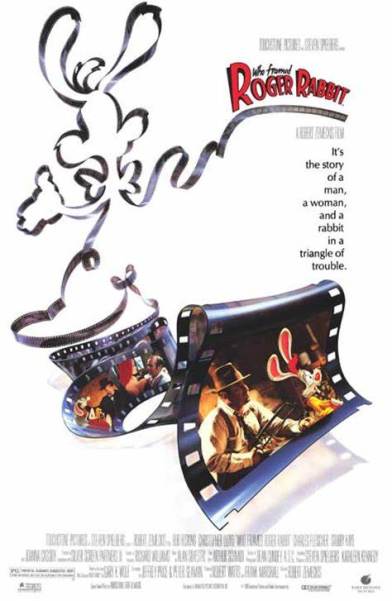 I can’t quite remember how I found out about 1988’s Who Framed Roger Rabbit. Growing up, most of my movie news came from four major sources – Entertainment Tonight, Siskel & Ebert, the occasional movie poster you’d see at a bus stop or cinema. If you were really lucky, the production company would sometimes create a “Behind the Scenes”/”Making of” showcase a little after the movie premiered. If possible, I would read the billing block of a poster to see if I could recognize anyone familiar, Just seeing Amblin Entertainment meant you’d have Steven Spielberg, Kathleen Kennedy and Frank Marshall involved. Nothing new there. I knew Robert Zemeckis and Alan Silvestri from Romancing the Stone and Back to the Future. Movies have had mixes of animation and live action – Bedrooms & Broomsticks, Mary Poppins, etc., but the big buzz here was the film planned to somehow involve both the Disney and Warner Bros. animation studios. It was an alien concept for me, because they couldn’t be more different from each other. Historically, animation on the WB side of things were edgy and almost dared to be even raunchy if they could get away with it. Disney, on the other hand, was pristine and extremely kid friendly. Bugs Bunny and Mickey Mouse? Daffy Duck vs. Donald Duck, all on the same screen? It was the 1980’s equivalent of asking Marvel (which ironically, is owned by Disney now) and DC (which the WB has owned for decades) to write a single Justice League / Avengers crossover story.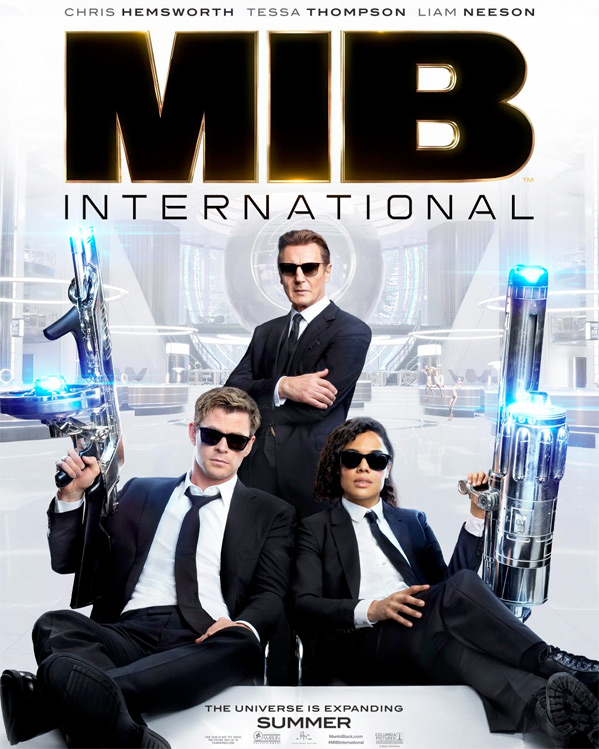


 Through the Shattered Lens