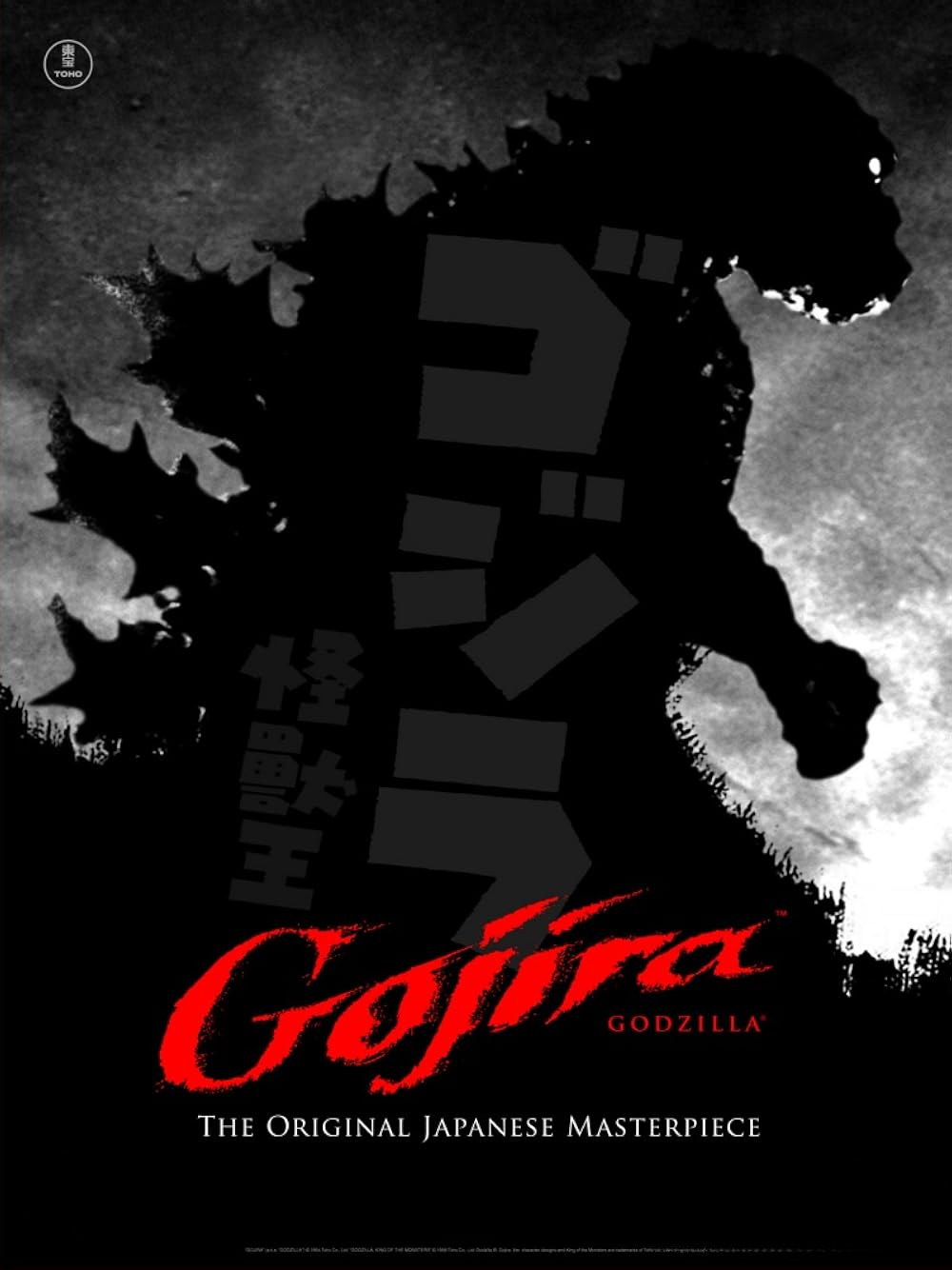
Film Review: Godzilla (dir. by Ishirō Honda)


“Godzilla was baptized in the fire of the H-bomb and survived. What could kill it now?” — Dr. Yamane

If your only exposure to Godzilla is the big guy body-slamming other monsters while kids cheer, the original 1954 Japanese Godzilla—titled Gojira in Japan—is going to hit you like a ton of bricks. Directed by Ishirō Honda, this isn’t a lighthearted monster romp. It’s a funeral procession in disguise, soaked in grief and dread, that happens to feature a radioactive giant stomping Tokyo into paste. Importantly, this is not the 1956 Americanized version, Godzilla, King of the Monsters!, which inserted newly filmed scenes of Raymond Burr as reporter Steve Martin, making him the central viewpoint character. Honda’s original is a different, heavier experience.

The setup is simple enough. Ships keep sinking, an island community connects the disasters to an old legend, and a prehistoric creature disturbed by hydrogen-bomb testing emerges from the sea. What follows builds toward one of the most devastating stretches of monster-movie filmmaking ever put to celluloid. When Godzilla attacks Tokyo, Honda shoots the rampage like a war picture, not a creature feature. There’s no wink, no reassuring invitation to laugh at the destruction. Night falls, the city burns, and civilians flee through the streets in scenes that are hard to shake. That’s clearly the point.

Here’s the thing you can’t separate from this movie: Japan was less than a decade removed from the end of World War II. Tokyo’s destruction onscreen bears an eerie resemblance to the aftermath of the American firebombing campaign of 1945, particularly the devastating March 9–10 raid. The burning neighborhoods, shattered buildings, and displaced civilians evoke a catastrophe that contemporary audiences didn’t need help imagining. Calling these sequences archival footage would go too far; they’re carefully constructed effects and dramatic scenes. But their emotional force comes partly from how closely this imagined disaster brushes against living memory. Honda makes the destruction feel remembered rather than merely invented.

The political undercurrent is what elevates Godzilla from an impressive genre exercise to something more troubling. The film is an unmistakable response to nuclear weapons and testing, made when hydrogen-bomb explosions in the Pacific were immediate public concerns. Its opening evokes the Lucky Dragon No. 5 incident, in which Japanese fishermen were exposed to radioactive fallout from an American hydrogen-bomb test at Bikini Atoll earlier that year. That wasn’t distant history to the original audience. It was the news. Godzilla turns that fear into a physical presence: something humanity has disturbed but cannot control.

The film’s concern with proliferation becomes clearest through Dr. Serizawa and his Oxygen Destroyer. He possesses a discovery that could kill Godzilla, but he understands that demonstrating its power could open the door to another arms race. The question isn’t simply whether this weapon can solve today’s emergency. It’s what happens when governments demand more of it tomorrow. That’s a sharper dilemma than the usual hunt for a monster-killing gadget. The proposed solution belongs to the same destructive cycle as the problem, and Serizawa knows that good intentions won’t keep his invention out of dangerous hands.

Dr. Yamane, played by a wonderfully grave Takashi Shimura, complicates things further by wanting Godzilla studied rather than destroyed. His position can seem maddening when people are dying, but it gives the creature an identity beyond walking target practice. Godzilla is dangerous, yet he’s also a living consequence of human interference. That doesn’t make killing him unnecessary, but it makes the victory harder to celebrate. Honda lets scientific curiosity, public safety, and moral responsibility pull against each other. The film’s strongest human conflict isn’t really about who gets the girl. It’s about what people owe one another when knowledge becomes destructive.

Special credit goes to Eiji Tsuburaya’s effects work. The creature suit, miniature buildings, and optical effects can look rough now, but dismissing them as cheap misses the ambition involved. This was a substantial production by contemporary Japanese standards, not a tiny-budget throwaway. The physical weight of the collapsing structures gives the rampage a tactile quality, while the black-and-white photography helps hold the illusion together. Akira Ifukube’s score supplies another crucial layer: those heavy rhythms and mournful passages make Godzilla feel less like an attraction than an approaching calamity. The images and music work together to give the monster tragic gravity.

Honda’s willingness to linger on suffering is even more important than the effects. A mother clutching her children and telling them they’ll soon join their father is a brutal interruption of anything resembling uncomplicated monster-movie fun. The hospital scenes refuse to let the attack end when Godzilla leaves the frame. Injured people remain, children face radiation examinations, and survival looks nothing like relief. These moments make the film’s anti-nuclear concerns inseparable from its storytelling. Honda doesn’t merely tell you that destruction is terrible. He keeps looking at the people who have to endure it.

Is the movie perfect? Not entirely. The love triangle between Emiko, Ogata, and Serizawa is more functional than riveting, and some explanatory passages slow the momentum. A few effects shots expose the gap between the filmmakers’ ambitions and their available techniques. But the sincerity carries it through. There’s no ironic safety net, and that directness becomes a strength. The same applies to the ending: Serizawa’s sacrifice is moving because it answers a moral crisis, not just a tactical one. He wants to stop the immediate catastrophe without leaving humanity another means of creating the next.

The American version deserves a little more fairness than simply calling it worthless: it retains powerful material, and Burr’s performance isn’t the problem. Still, its cuts and added viewpoint weaken the original’s political and emotional coherence. Honda’s Godzilla is the fuller experience, and one of science fiction’s enduring achievements. It helped define the modern kaiju film, but its importance goes beyond launching a franchise. Underneath the creature suit and miniature tanks is a serious film about wartime trauma, nuclear fear, and whether humanity can survive its own inventions. That’s a lot for a monster movie to carry. Honda makes it hurt.
Horror Film Review: Godzilla (dir by Luigi Cozzi, Inshiro Honda, and Terry Morse)


The year was 1976 and the flamboyant Italian producer, Dino de Laurentiis, was drumming up a lot of publicity for his remake of the monster classic, King Kong.  In Italy, the journalist, screenwriter, and director Luigi Cozzi assumed that the King Kong remake would be a huge hit and decided to get in on the action himself.  If Italian audiences loved a film about a big monkey, how about a film about a big radioactive lizard?

Cozzi’s original plan was to buy the distribution rights to Gojira but Toho Studios turned him down.  They did, however, agree to allow Cozzi to distribute the American cut of Gojira, Godzilla, King of the Monsters.  (That’s the version where Raymond Burr appears as American reporter Steve Martin and, through some clever editing tricks, appears to be interacting with the characters from the original Japanese version.)

Cozzi immediately ran into two huge problems when it came to distributing Godzilla, King of the Monsters.  First off, the film was in black-and-white and most Italian theater owners refused to show black-and-white films.  Cozzi’s solution was to “colorize” the film by putting translucent gel over the frame, resulting in random splotches of color that gave the entire film what could generously be called a radioactive glow.  Secondly, the American cut was considered to be too short for theatrical distribution.  Cozzi proceeded to re-cut the re-cut, adding in scenes of actual war footage and clips from other 50s monster movies.  As a result Cozzi’s film opens not with Tokyo on fire but instead stock footage of Hiroshima before the bomb was dropped.  Later, footage of actual victims of the bomb would he used as footage of victims of Godzilla.

Having re-cut the film, Cozzi then decided that the movie could use a synthesizer-heavy soundtrack, which was provided by Vince Tempera, Fabio Frizzi, and Franco Bixio.

The end result …. well, the end result is a mess but it’s a mess that fascinating for fans of Godzilla.  The colorization creates an odd effect, in which the images are all familiar but still seem different, as if being viewed in a dream.  Often times, the splashes of color are so harsh and random that it makes it difficult to actually see what’s happening in the scene.  I had to look away a few times, due to the harshness brightness of some of the yellows.  There are a few times — and by that, I mean a very few times –when the color effects oddly work.  In those rare moments, Godzilla’s atomic nature seems to be radiating through the entire movie.

As for the “new footage,” it’s thoroughly tasteless to use actual footage from Hiroshima and Nagasaki but, at the same time, it also serves to remind the viewer of the national trauma that inspired the creation of Godzilla in the first place.  The footage reminds the viewer of the horrors of war while also leaving viewers wondering they really should be watching it used in the way that it’s used in this movie.  (For his part, Cozzi said he used actual war footage because modern audiences would expect more violence and destruction than was present in the original film.  It’s reasonable to assume that any subtext was purely accidental.)

Finally, the soundtrack …. actually, I like this version’s score.  It’s wonderfully ominous, especially at the start of the film.

Nicknamed Cozilla by Cozzi himself, 1977’s Godzilla is a bizarre experiment that doesn’t quite work but I would say it’s still one that should be seen by anyone who is interested in the history of either Godzilla or exploitation films in general.  (And make no mistake, this version of Godzilla is definitely an exploitation film.)  For years, the film was impossible to see outside of Italy.  Now, of course, you can find a copy on just about every torrent site.

Previous Godzilla Reviews:

  1. Godzilla, King of the Monsters (1958)
  2. Godzilla Raids Again (1958)
  3. King Kong vs Godzilla (1962)
  4. Mothra vs. Godzilla (1964)
  5. Ghidorah: The Three-Headed Monster (1964)
  6. Invasion of the Astro-Monster (1965)
  7. Godzilla vs. The Sea Monster (1966)
  8. Son of Godzilla (1967)
  9. Destroy All Monsters (1968)
  10. All Monsters Attack (1969)
  11. Godzilla vs Hedorah (1971)
  12. Godzilla vs Gigan (1972)
  13. Godzilla vs Megalon (1973)
  14. Godzilla vs Mechagodzilla (1974)
  15. The Terror of Mechagodzilla (1975)
  16. Godzilla vs. Mothra (1992)
  17. Godzilla vs. Destoroyah (1995)
  18. Godzilla, Mothra, and King Ghidorah: Giant Monsters All-Out Attack (2001)
  19. Godzilla (2014)
  20. Godzilla: Planet of the Monsters (2017)
  21. Godzilla, King of the Monsters (2019)
  22. Godzilla vs Kong (2021)
  23. Godzilla Minus One (2023)

Horror Film Review: Terror of Mechagodzilla (dir by Ishiro Honda)


Megchagodzilla has returned!

The robot version of Godzilla, Mechagodzilla made his debut in 1974’s Godzilla vs. Mechagodzilla.  In that film, it was revealed that Mechagodzilla was built and controlled by a bunch of aliens who wanted to use him to subjugate humanity so that the aliens could take over the Earth.  The real Godzilla put an end to those plans, not only saving the world from an alien invasion but also tossing Mechagodzilla into the ocean.

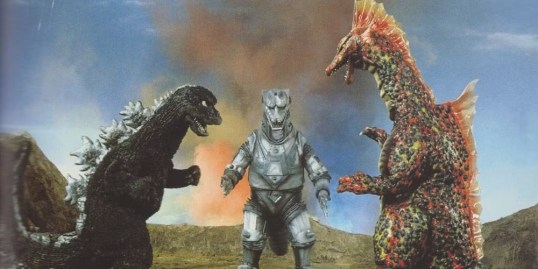
Unfortunately, it would appear that Godzilla didn’t do a good enough job taking care of his robotic counterpart because, in 1975’s Terror of Mechagodzilla, the aliens are able to resurrect Mechagodzilla and they once again sent it out to destroy humanity, starting with Japan.  Working with the aliens is a mad scientist named Dr. Mafune (Akihko Hirata).  Mafune’s daugther, Katsura (Tomoka Ai0), is a cyborg who has a mechanical and mental connection to Mechagodzilla.  Whenever her eyes glow, Mechagodizlla does something destructive.  The aliens team Mechagodzilla up with a new monster, the fearsome Titanosaurus.


Mechagodzilla and Titanosaurus work together to once again destroy Japan and it must be said that they appear to be quite capable of doing just that.  Say what you will about the special effects in these films, the scene where Mechagodzilla blows up an entire city block does pack a punch.  If Mechagodzilla is laser-focused on blowing stuff up, Titanosaurus just seems to be looking for a fight with someone.  Titanosaurus is a very enthusiastic monster, like a previously bullied kid who has just hit a growth spurt and now can’t wait to beat up everyone on the playground.  Eventually, Godzilla shows up to give Titanosaurus the fight that he’s looking for.

This film is one of the ones where Godzilla is firmly established as being humanity’s champion.  The atomic beast who once represented the trauma of the nuclear attacks on Hiroshima and Nagasaki is now a friend to all humans.  That said, it’s hard not to notice that it takes Godzilla a while to actually show up.  He allows Mechagodzilla and Titanosaurus to blow up a lot of buildings and probably kill a lot of people before he finally puts in an appearance and orders them to stop.  It’s nice that Godzilla showed up in time to save a group of children from Mechagodzilla but you have to wonder how many of those children are now orphans because Godzilla wasn’t willing to do anything while Mechagodzilla was blowing up apartment buildings.

The majority of this film centers not on Godzilla but instead on some Interpol agents who are trying to figure out what the professor and the aliens are planning on doing.  (To me, it seemed pretty obvious that the aliens were planning on using a bunch of giant monsters to destroy humanity but maybe Interpol had some information that I didn’t.)  The agents do eventually manage to track down the aliens and the professor.  There’s some sub-James Bond style action as the agents attack the evil lair.  Despite everything that Interpol does in this film, it’s obvious that Godzilla is man’s only hope.

This was the last of the original Godzilla films.  After this film came out, it would be nearly ten years before the monster was revived and returned to once again being a threat to humanity as opposed to being a friend.  Sadly, Terror of Mechagodzilla doesn’t feature enough giant monster action.  When the monsters are onscreen and fighting, this movie is a lot of fun.  Godzilla’s visible frustration with having to deal with Mechagodzilla again is very endearing.    Unfortunately, the majority of the film gets bogged down with the humans searching for the bad guys and trying to figure out their extremely simple plot.  In the end, the movie leaves the viewer thankful for Godzilla but also frustrated that he didn’t get more to do.

Previous Godzilla Reviews:

  1. Godzilla, King of the Monsters (1958)
  2. Godzilla Raids Again (1958)
  3. King Kong vs Godzilla (1962)
  4. Mothra vs. Godzilla (1964)
  5. Ghidorah: The Three-Headed Monster (1964)
  6. Invasion of the Astro-Monster (1965)
  7. Godzilla vs. The Sea Monster (1966)
  8. Son of Godzilla (1967)
  9. Destroy All Monsters (1968)
  10. All Monsters Attack (1969)
  11. Godzilla vs Hedorah (1971)
  12. Godzilla vs Gigan (1972)
  13. Godzilla vs Megalon (1973)
  14. Godzilla vs Mechagodzilla (1974)
  15. Godzilla vs. Mothra (1992)
  16. Godzilla vs. Destoroyah (1995)
  17. Godzilla, Mothra, and King Ghidorah: Giant Monsters All-Out Attack (2001)
  18. Godzilla (2014)
  19. Godzilla: Planet of the Monsters (2017)
  20. Godzilla, King of the Monsters (2019)
  21. Godzilla vs Kong (2021)
  22. Godzilla Minus One (2023)