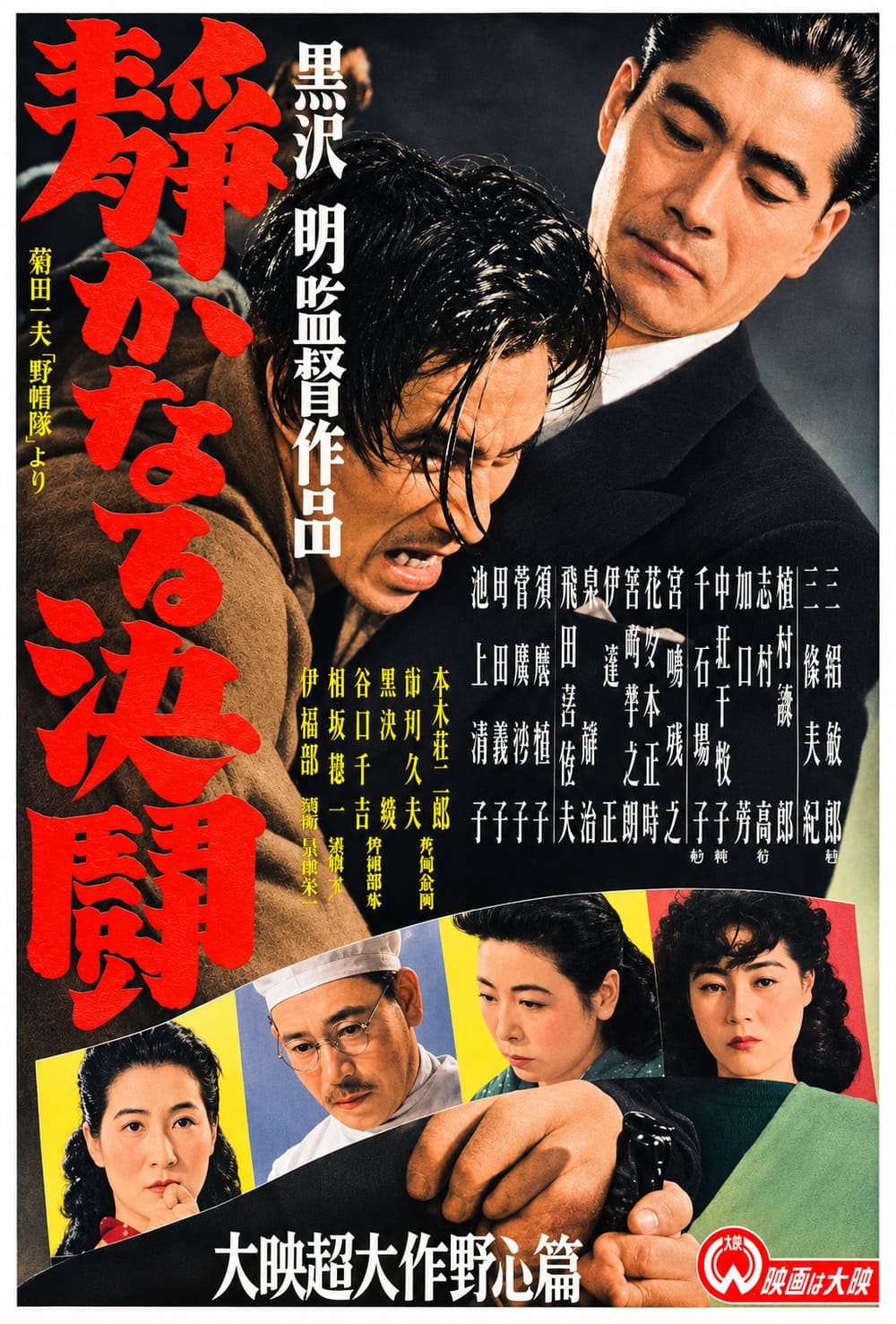
Film Review: The Quiet Duel (directed. by Akira Kurosawa)


“I’m fighting desperately now to curb my desires.” — Dr. Kyoji Fujisaki

The most painful thing in The Quiet Duel is not the illness at the center of its story. It is the distance between what people feel and what they allow themselves to say. Akira Kurosawa’s 1949 drama keeps returning to that gap, watching a young doctor turn emotional restraint into something close to a second profession. The result can be moving, frustrating, and occasionally a little too pleased with its own nobility. But there is something compelling about a film that makes silence feel this crowded. Beneath its respectable surface, practically everyone is struggling to get a word in.

Toshiro Mifune plays Kyoji Fujisaki, a surgeon who contracts syphilis after cutting himself during an operation at a wartime field hospital. When he returns home, he joins his father’s medical practice and quietly begins treating himself. He also breaks off his engagement to Misao, refusing to explain his diagnosis because he believes she would insist on waiting for him. From his perspective, withholding the truth is an act of love. From hers, it is an inexplicable rejection. That difference is the film’s dramatic engine, although Kurosawa is sometimes more willing to admire Kyoji’s intentions than examine the damage his decisions cause.

The film also continues the Kurosawa–Mifune collaboration that began with Drunken Angel (1948), and the change in Mifune’s role is striking. In that earlier film, he played a tubercular gangster opposite Takashi Shimura’s alcoholic doctor. Here, Mifune becomes the doctor himself, with Shimura playing his physician father. Disease again brings questions of responsibility into focus, but the emotional balance has shifted. The unruly patient has given way to an almost painfully conscientious caregiver. Seen together, the films suggest how quickly Kurosawa recognized that Mifune’s intensity could work through resistance and repression, not just outward aggression.

That distinction matters because Kyoji could easily become a rather bloodless monument to goodness. Mifune keeps him from settling into that shape. His composure feels maintained rather than natural, as though every polite exchange requires a small act of self-discipline. Beneath it sit frustration, sexual desire, and an entirely understandable wish for an ordinary future. When those feelings break through, they do not seem imported for a big acting scene. They feel like the release of pressure the performance has been accumulating all along. Kurosawa’s direction gives that contrast room to register, letting the restrained exterior make the eventual outburst more uncomfortable.

The wartime opening establishes the stakes with an immediacy the rest of the film cannot always match. Rain, fatigue, and cramped operating conditions make the hospital feel barely held together. Kurosawa uses the setting as more than atmospheric decoration: the physical strain of the work helps explain how a momentary accident can change a life. Kyoji does not suffer because he is reckless or selfish. He suffers while doing something necessary. Before the screenplay develops its more insistent moral contrasts, the direction offers something simpler and harder to dismiss. There is no dependable relationship between the goodness of an action and the consequences awaiting the person who performs it.

Once the action moves to the family hospital, Kurosawa exchanges that immediate physical pressure for a more enclosed emotional tension. People share rooms while remaining separated by information they cannot, or will not, communicate. The audience knows what Misao does not, making their conversations painfully uneven. Every pause carries a meaning she cannot access. This is effective melodramatic construction, drawing us close to Kyoji while leaving her outside his confidence. Yet the same arrangement creates a problem: because we understand his reasons, the film can seem to assume that we should also accept them. Sympathy begins doing the work that scrutiny might have done.

Misao is where that problem becomes hardest to ignore. Miki Sanjo gives her hurt a directness that cuts through Kyoji’s elaborate reasoning. She does not need to know his secret for her confusion to be legitimate. His decision supposedly protects her freedom while denying her the information needed to exercise it. That contradiction deserves more attention than the film gives it. An honest conversation would not cure the illness or settle their future, but it would acknowledge that the future belongs to both of them. Instead, her pain too often becomes another way of measuring how much he is prepared to sacrifice.

Kurosawa’s handling of the supporting cast provides a welcome alternative to this tightly wound romantic impasse. Shimura brings patience and practical understanding to the father, making care seem less like heroic renunciation and more like sustained attention. His scenes with Mifune allow warmth into a film that can otherwise become airless. The nurse Minegishi also introduces concerns beyond Kyoji’s broken engagement, helping the hospital feel like a workplace occupied by several lives rather than a chamber built around one man’s suffering. These relationships give the director opportunities to observe ordinary companionship, and the film benefits whenever he allows those quieter connections to carry the scene.

Still, the direction does not entirely overcome the material’s theatrical weight. The contained settings can make repression tangible, but extended speeches sometimes explain emotions that the actors have already communicated. At those points, the film seems reluctant to trust its own images. Kyoji’s distress becomes less powerful when it arrives with an accompanying statement of what we should learn from it. The return of the soldier who infected him creates a similar difficulty. His irresponsibility supplies a forceful contrast, but it also makes the ethical arrangement too convenient. Responsibility and selfishness become opposing examples rather than qualities that might uneasily coexist within the same person.

What keeps the film from becoming merely a lecture is its sense that war continues inside ordinary life. Kyoji has returned home, but returning is not the same as recovering. The hospital offers meaningful work without restoring everything he has lost. Here, the connection to Drunken Angel becomes especially useful: both films place damaged bodies alongside the difficult business of caring for other people. What changes is Mifune’s position within that relationship. Kurosawa turns the actor’s force inward, testing how much agitation can exist beneath professional composure. The result is less immediately combustible than their first collaboration, but revealing in a different way.

By the end, the title feels less like a description of one man’s struggle with illness than a description of the film arguing with itself. Is silence an expression of love, or a way of keeping control? Is sacrifice still generous when someone else has no say in it? The Quiet Duel does not pursue those questions as far as it might, but it cannot entirely silence them either. Kurosawa’s direction is most persuasive when it leaves room for that discomfort, and Mifune makes it visible. Together, they leave us with a good man trying so hard to do right that he sometimes forgets to let anyone stand beside him.

Kurosawa-Mifune Collaborations
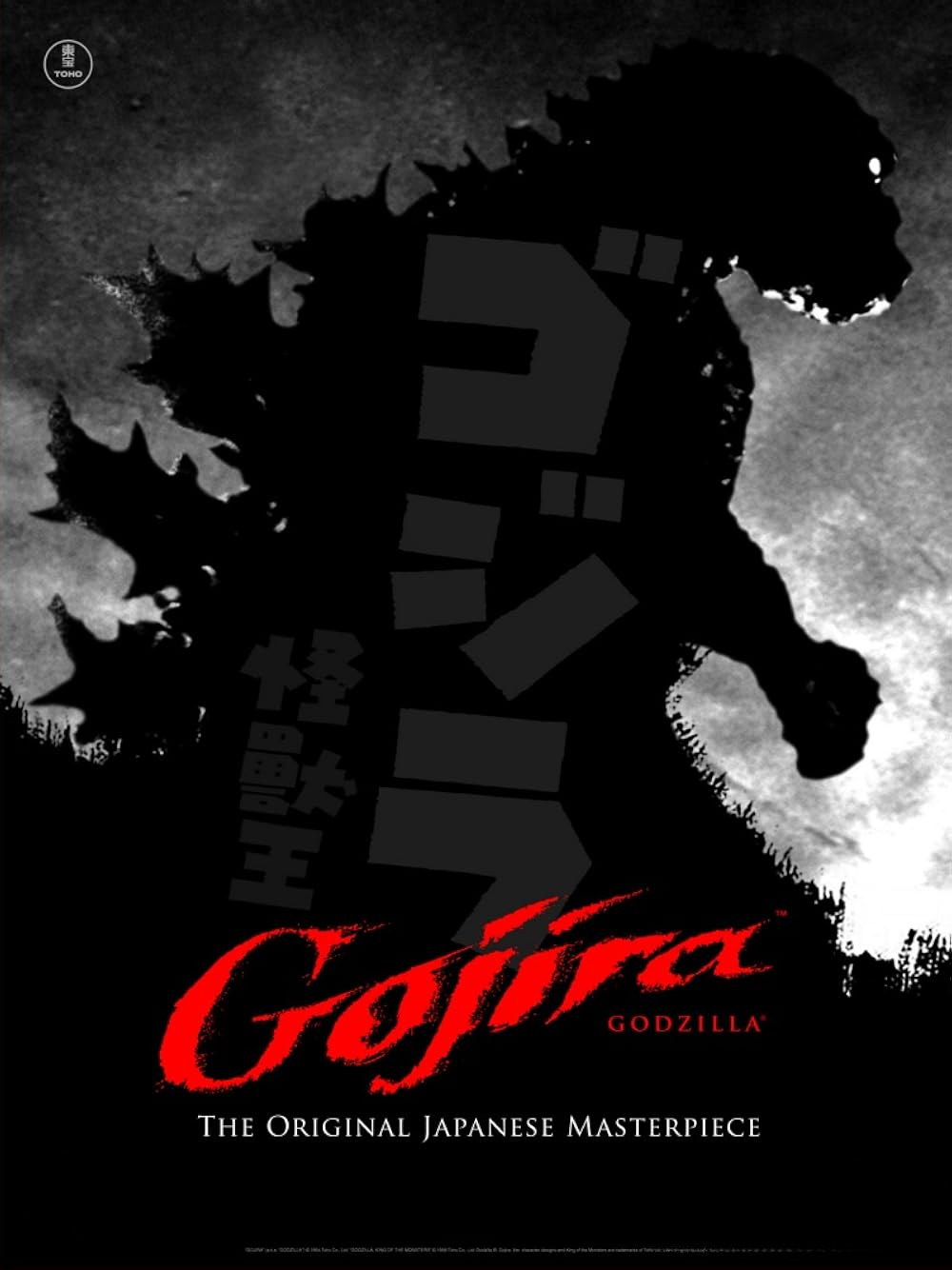
Film Review: Godzilla (dir. by Ishirō Honda)


“Godzilla was baptized in the fire of the H-bomb and survived. What could kill it now?” — Dr. Yamane

If your only exposure to Godzilla is the big guy body-slamming other monsters while kids cheer, the original 1954 Japanese Godzilla—titled Gojira in Japan—is going to hit you like a ton of bricks. Directed by Ishirō Honda, this isn’t a lighthearted monster romp. It’s a funeral procession in disguise, soaked in grief and dread, that happens to feature a radioactive giant stomping Tokyo into paste. Importantly, this is not the 1956 Americanized version, Godzilla, King of the Monsters!, which inserted newly filmed scenes of Raymond Burr as reporter Steve Martin, making him the central viewpoint character. Honda’s original is a different, heavier experience.

The setup is simple enough. Ships keep sinking, an island community connects the disasters to an old legend, and a prehistoric creature disturbed by hydrogen-bomb testing emerges from the sea. What follows builds toward one of the most devastating stretches of monster-movie filmmaking ever put to celluloid. When Godzilla attacks Tokyo, Honda shoots the rampage like a war picture, not a creature feature. There’s no wink, no reassuring invitation to laugh at the destruction. Night falls, the city burns, and civilians flee through the streets in scenes that are hard to shake. That’s clearly the point.

Here’s the thing you can’t separate from this movie: Japan was less than a decade removed from the end of World War II. Tokyo’s destruction onscreen bears an eerie resemblance to the aftermath of the American firebombing campaign of 1945, particularly the devastating March 9–10 raid. The burning neighborhoods, shattered buildings, and displaced civilians evoke a catastrophe that contemporary audiences didn’t need help imagining. Calling these sequences archival footage would go too far; they’re carefully constructed effects and dramatic scenes. But their emotional force comes partly from how closely this imagined disaster brushes against living memory. Honda makes the destruction feel remembered rather than merely invented.

The political undercurrent is what elevates Godzilla from an impressive genre exercise to something more troubling. The film is an unmistakable response to nuclear weapons and testing, made when hydrogen-bomb explosions in the Pacific were immediate public concerns. Its opening evokes the Lucky Dragon No. 5 incident, in which Japanese fishermen were exposed to radioactive fallout from an American hydrogen-bomb test at Bikini Atoll earlier that year. That wasn’t distant history to the original audience. It was the news. Godzilla turns that fear into a physical presence: something humanity has disturbed but cannot control.

The film’s concern with proliferation becomes clearest through Dr. Serizawa and his Oxygen Destroyer. He possesses a discovery that could kill Godzilla, but he understands that demonstrating its power could open the door to another arms race. The question isn’t simply whether this weapon can solve today’s emergency. It’s what happens when governments demand more of it tomorrow. That’s a sharper dilemma than the usual hunt for a monster-killing gadget. The proposed solution belongs to the same destructive cycle as the problem, and Serizawa knows that good intentions won’t keep his invention out of dangerous hands.

Dr. Yamane, played by a wonderfully grave Takashi Shimura, complicates things further by wanting Godzilla studied rather than destroyed. His position can seem maddening when people are dying, but it gives the creature an identity beyond walking target practice. Godzilla is dangerous, yet he’s also a living consequence of human interference. That doesn’t make killing him unnecessary, but it makes the victory harder to celebrate. Honda lets scientific curiosity, public safety, and moral responsibility pull against each other. The film’s strongest human conflict isn’t really about who gets the girl. It’s about what people owe one another when knowledge becomes destructive.

Special credit goes to Eiji Tsuburaya’s effects work. The creature suit, miniature buildings, and optical effects can look rough now, but dismissing them as cheap misses the ambition involved. This was a substantial production by contemporary Japanese standards, not a tiny-budget throwaway. The physical weight of the collapsing structures gives the rampage a tactile quality, while the black-and-white photography helps hold the illusion together. Akira Ifukube’s score supplies another crucial layer: those heavy rhythms and mournful passages make Godzilla feel less like an attraction than an approaching calamity. The images and music work together to give the monster tragic gravity.

Honda’s willingness to linger on suffering is even more important than the effects. A mother clutching her children and telling them they’ll soon join their father is a brutal interruption of anything resembling uncomplicated monster-movie fun. The hospital scenes refuse to let the attack end when Godzilla leaves the frame. Injured people remain, children face radiation examinations, and survival looks nothing like relief. These moments make the film’s anti-nuclear concerns inseparable from its storytelling. Honda doesn’t merely tell you that destruction is terrible. He keeps looking at the people who have to endure it.

Is the movie perfect? Not entirely. The love triangle between Emiko, Ogata, and Serizawa is more functional than riveting, and some explanatory passages slow the momentum. A few effects shots expose the gap between the filmmakers’ ambitions and their available techniques. But the sincerity carries it through. There’s no ironic safety net, and that directness becomes a strength. The same applies to the ending: Serizawa’s sacrifice is moving because it answers a moral crisis, not just a tactical one. He wants to stop the immediate catastrophe without leaving humanity another means of creating the next.

The American version deserves a little more fairness than simply calling it worthless: it retains powerful material, and Burr’s performance isn’t the problem. Still, its cuts and added viewpoint weaken the original’s political and emotional coherence. Honda’s Godzilla is the fuller experience, and one of science fiction’s enduring achievements. It helped define the modern kaiju film, but its importance goes beyond launching a franchise. Underneath the creature suit and miniature tanks is a serious film about wartime trauma, nuclear fear, and whether humanity can survive its own inventions. That’s a lot for a monster movie to carry. Honda makes it hurt.

Guilty Pleasure No. 20: King Kong vs. Godzilla (dir. by Ishirō Honda)


KingKongvGodzilla

With the release of the new American reboot/remake/sequel of the classic 1954 Godzilla by Ishirō Honda, I thought it was high time I shared one of my guiltiest of all film pleasures growing up.

Godzilla and everything kaiju I ate up as a wee lad growing up during the 80’s. There really wasn’t anything on Saturday morning and afternoon tv other than reruns of badly dubbed Japanese monsters flicks and anime. One such film was Ishirō Honda’s very own King Kong vs. Godzilla. Yes, you read that correctly. The King of All Monsters fought the Eight Wonder of the World to decide once and for all who was the greatest giant monster of all-time.

The film itself wasn’t that great when I look back on it. Hell, even I had a sort of understanding even as an 8-year old kid that King Kong vs. Godzilla was a pretty bad film, but I still had a blast watching it. The film lacked in coherent storyline and important themes of man vs. nature and the psychological impact of the two atomic bombings of the US on Japan to end World War II wasn’t at all evident in this monster mash-up.

What the film had was King Kong fighting Godzilla. It was like watching two of the greatest icons of youths of my generation duking it out for our pleasure. It didn’t need to have a story or worry about whether it’s depiction of the natives on King Kong’s island was even remotely racist (it was so racist). All it needed to do was show everyone the very fight they’ve been waiting for. Fans of both monster wouldn’t have to wait forever to see the fight happen. This wasn’t going to be a dream fight never to happen like Mayweather vs. Pacquiao.

So, while King Kong vs. Godzilla was never one of the good entries in the Godzilla filmography (I think it was probably the worst) it more than made up for being one of the most campiest and entertaining entries in the Big Guy’s decades long history.

If there ever was a film from my youth that needs to be remade it would be King Kong vs. Godzilla and only Guillermo Del Toro should be chosen to direct it.

  1. Half-Baked
  2. Save The Last Dance
  3. Every Rose Has Its Thorns
  4. The Jeremy Kyle Show
  5. Invasion USA
  6. The Golden Child
  7. Final Destination 2
  8. Paparazzi
  9. The Principal
  10. The Substitute
  11. Terror In The Family
  12. Pandorum
  13. Lambada
  14. Fear
  15. Cocktail
  16. Keep Off The Grass
  17. Girls, Girls, Girls
  18. Class
  19. Tart