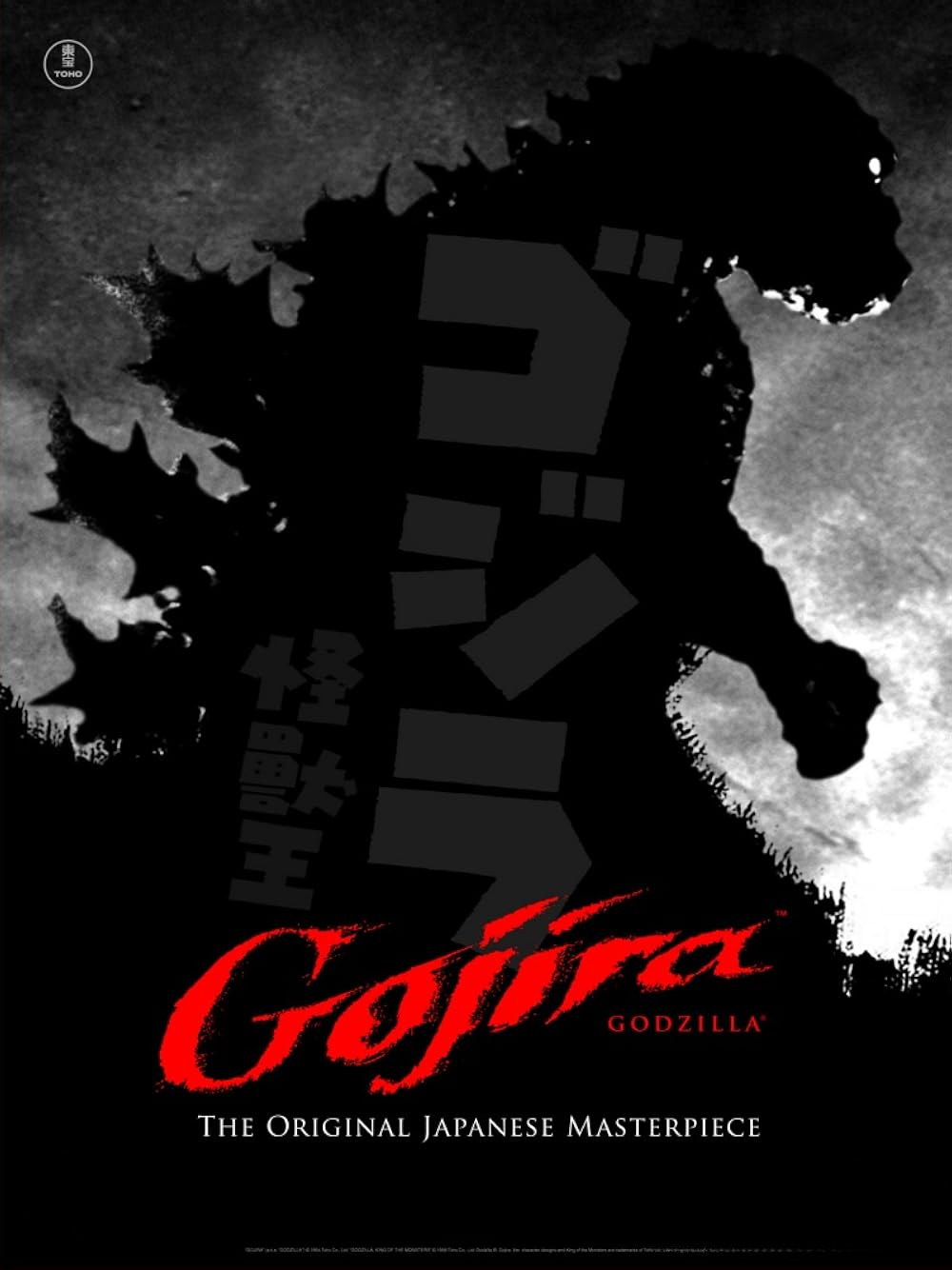
“Godzilla was baptized in the fire of the H-bomb and survived. What could kill it now?” — Dr. Yamane
If your only exposure to Godzilla is the big guy body-slamming other monsters while kids cheer, the original 1954 Japanese Godzilla—titled Gojira in Japan—is going to hit you like a ton of bricks. Directed by Ishirō Honda, this isn’t a lighthearted monster romp. It’s a funeral procession in disguise, soaked in grief and dread, that happens to feature a radioactive giant stomping Tokyo into paste. Importantly, this is not the 1956 Americanized version, Godzilla, King of the Monsters!, which inserted newly filmed scenes of Raymond Burr as reporter Steve Martin, making him the central viewpoint character. Honda’s original is a different, heavier experience.
The setup is simple enough. Ships keep sinking, an island community connects the disasters to an old legend, and a prehistoric creature disturbed by hydrogen-bomb testing emerges from the sea. What follows builds toward one of the most devastating stretches of monster-movie filmmaking ever put to celluloid. When Godzilla attacks Tokyo, Honda shoots the rampage like a war picture, not a creature feature. There’s no wink, no reassuring invitation to laugh at the destruction. Night falls, the city burns, and civilians flee through the streets in scenes that are hard to shake. That’s clearly the point.
Here’s the thing you can’t separate from this movie: Japan was less than a decade removed from the end of World War II. Tokyo’s destruction onscreen bears an eerie resemblance to the aftermath of the American firebombing campaign of 1945, particularly the devastating March 9–10 raid. The burning neighborhoods, shattered buildings, and displaced civilians evoke a catastrophe that contemporary audiences didn’t need help imagining. Calling these sequences archival footage would go too far; they’re carefully constructed effects and dramatic scenes. But their emotional force comes partly from how closely this imagined disaster brushes against living memory. Honda makes the destruction feel remembered rather than merely invented.
The political undercurrent is what elevates Godzilla from an impressive genre exercise to something more troubling. The film is an unmistakable response to nuclear weapons and testing, made when hydrogen-bomb explosions in the Pacific were immediate public concerns. Its opening evokes the Lucky Dragon No. 5 incident, in which Japanese fishermen were exposed to radioactive fallout from an American hydrogen-bomb test at Bikini Atoll earlier that year. That wasn’t distant history to the original audience. It was the news. Godzilla turns that fear into a physical presence: something humanity has disturbed but cannot control.
The film’s concern with proliferation becomes clearest through Dr. Serizawa and his Oxygen Destroyer. He possesses a discovery that could kill Godzilla, but he understands that demonstrating its power could open the door to another arms race. The question isn’t simply whether this weapon can solve today’s emergency. It’s what happens when governments demand more of it tomorrow. That’s a sharper dilemma than the usual hunt for a monster-killing gadget. The proposed solution belongs to the same destructive cycle as the problem, and Serizawa knows that good intentions won’t keep his invention out of dangerous hands.
Dr. Yamane, played by a wonderfully grave Takashi Shimura, complicates things further by wanting Godzilla studied rather than destroyed. His position can seem maddening when people are dying, but it gives the creature an identity beyond walking target practice. Godzilla is dangerous, yet he’s also a living consequence of human interference. That doesn’t make killing him unnecessary, but it makes the victory harder to celebrate. Honda lets scientific curiosity, public safety, and moral responsibility pull against each other. The film’s strongest human conflict isn’t really about who gets the girl. It’s about what people owe one another when knowledge becomes destructive.
Special credit goes to Eiji Tsuburaya’s effects work. The creature suit, miniature buildings, and optical effects can look rough now, but dismissing them as cheap misses the ambition involved. This was a substantial production by contemporary Japanese standards, not a tiny-budget throwaway. The physical weight of the collapsing structures gives the rampage a tactile quality, while the black-and-white photography helps hold the illusion together. Akira Ifukube’s score supplies another crucial layer: those heavy rhythms and mournful passages make Godzilla feel less like an attraction than an approaching calamity. The images and music work together to give the monster tragic gravity.
Honda’s willingness to linger on suffering is even more important than the effects. A mother clutching her children and telling them they’ll soon join their father is a brutal interruption of anything resembling uncomplicated monster-movie fun. The hospital scenes refuse to let the attack end when Godzilla leaves the frame. Injured people remain, children face radiation examinations, and survival looks nothing like relief. These moments make the film’s anti-nuclear concerns inseparable from its storytelling. Honda doesn’t merely tell you that destruction is terrible. He keeps looking at the people who have to endure it.
Is the movie perfect? Not entirely. The love triangle between Emiko, Ogata, and Serizawa is more functional than riveting, and some explanatory passages slow the momentum. A few effects shots expose the gap between the filmmakers’ ambitions and their available techniques. But the sincerity carries it through. There’s no ironic safety net, and that directness becomes a strength. The same applies to the ending: Serizawa’s sacrifice is moving because it answers a moral crisis, not just a tactical one. He wants to stop the immediate catastrophe without leaving humanity another means of creating the next.
The American version deserves a little more fairness than simply calling it worthless: it retains powerful material, and Burr’s performance isn’t the problem. Still, its cuts and added viewpoint weaken the original’s political and emotional coherence. Honda’s Godzilla is the fuller experience, and one of science fiction’s enduring achievements. It helped define the modern kaiju film, but its importance goes beyond launching a franchise. Underneath the creature suit and miniature tanks is a serious film about wartime trauma, nuclear fear, and whether humanity can survive its own inventions. That’s a lot for a monster movie to carry. Honda makes it hurt.

