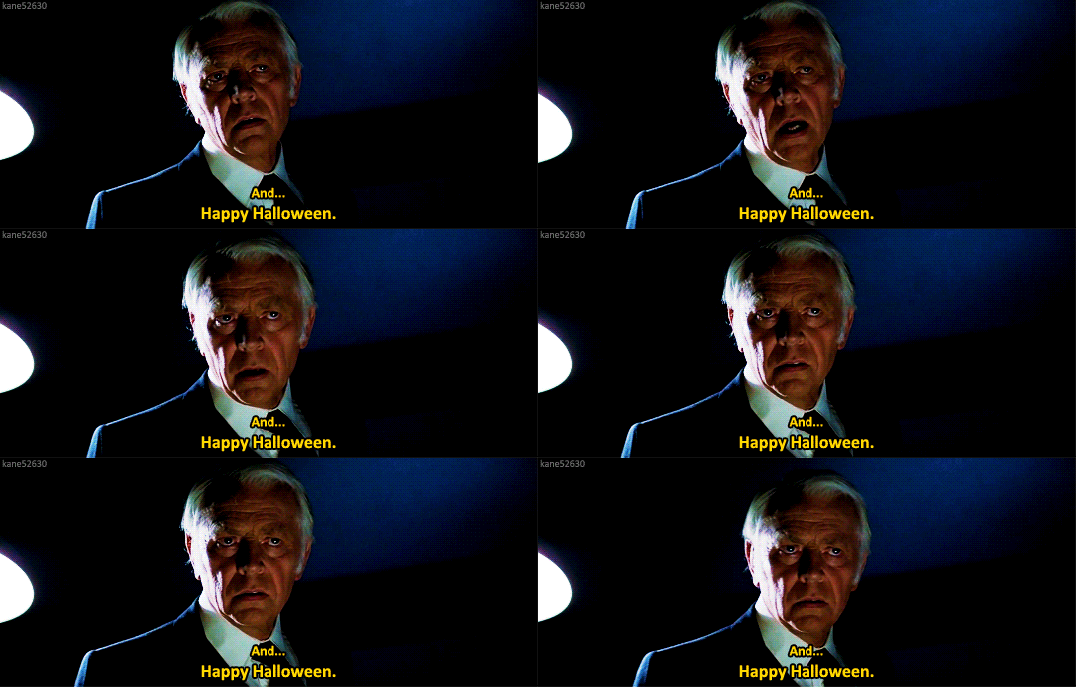
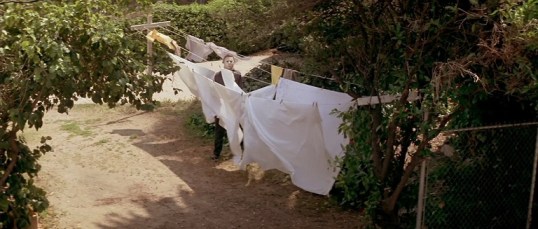
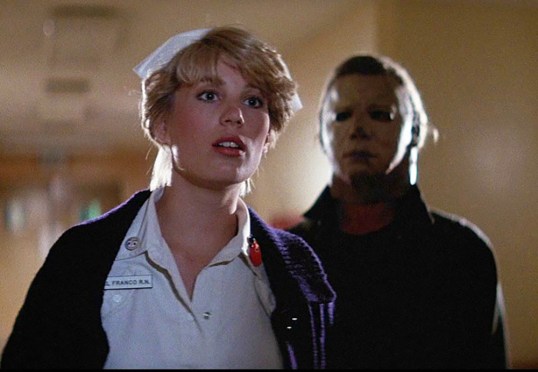
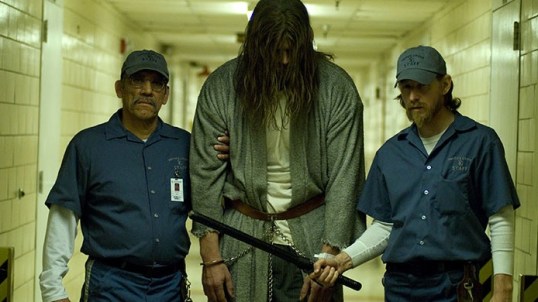
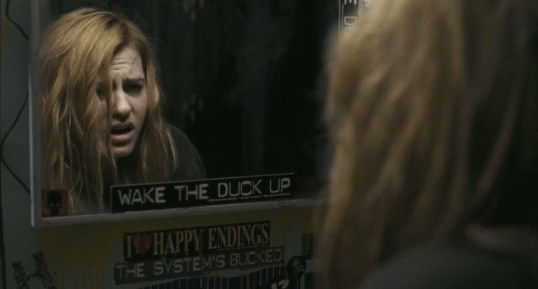
4 Shots From 4 Films is just what it says it is, 4 shots from 4 of our favorite films. As opposed to the reviews and recaps that we usually post, 4 Shots From 4 Films lets the visuals do the talking!
4 Shots From 4 Halloween Films
Halloween (1977, dir by John Carpenter, DP: Dean Cundey)
Halloween II (1981, dir by Rick Rosenthal, DP: Dean Cundey)
Halloween (2007, dir by Rob Zombie, DP: Phil Parmet)
Halloween II (2009, dir by Rob Zombie, DP: Brandon Trost)
This scene is from It’s The Great Pumpkin, Charlie Brown! It’s a crime that this wonderful and sweet animated special is no longer aired during the holidays. No wonder the Great Pumpkin hasn’t been seen this year!
What I love about this scene is that you can actually see the rock getting tossed into Charlie Brown’s bag while all of the other trick-or-treaters got candy. Everyone in the neighborhood knows which ghost is Charlie Brown and they’ve all decided to give him rocks!
May your Halloween bring you more candy than rocks and we hope you enjoy the last day of our annual horrorthon! Be safe, be sincere, and don’t forget the true meaning on Halloween!
Both on his own and as a member of Goblin. Claudio Simonetti has been responsible for some of the most iconic scores in the history of Italian horror cinema. He is probably best known for Goblin’s score for Dario Argento’s Suspiria. The minute you hear the opening of that score, you are immediately transported into Argento’s nightmarish world of witches, death, and ballet.
In 1999, Simonetti formed Daemonia, a heavy mental band that played updated version of his classic horror scores, along with new material. In this video, they perform Suspiria and the end result is a perfect video for Halloween!
“A tragedy condemned to repeat itself time and again?” — Casares
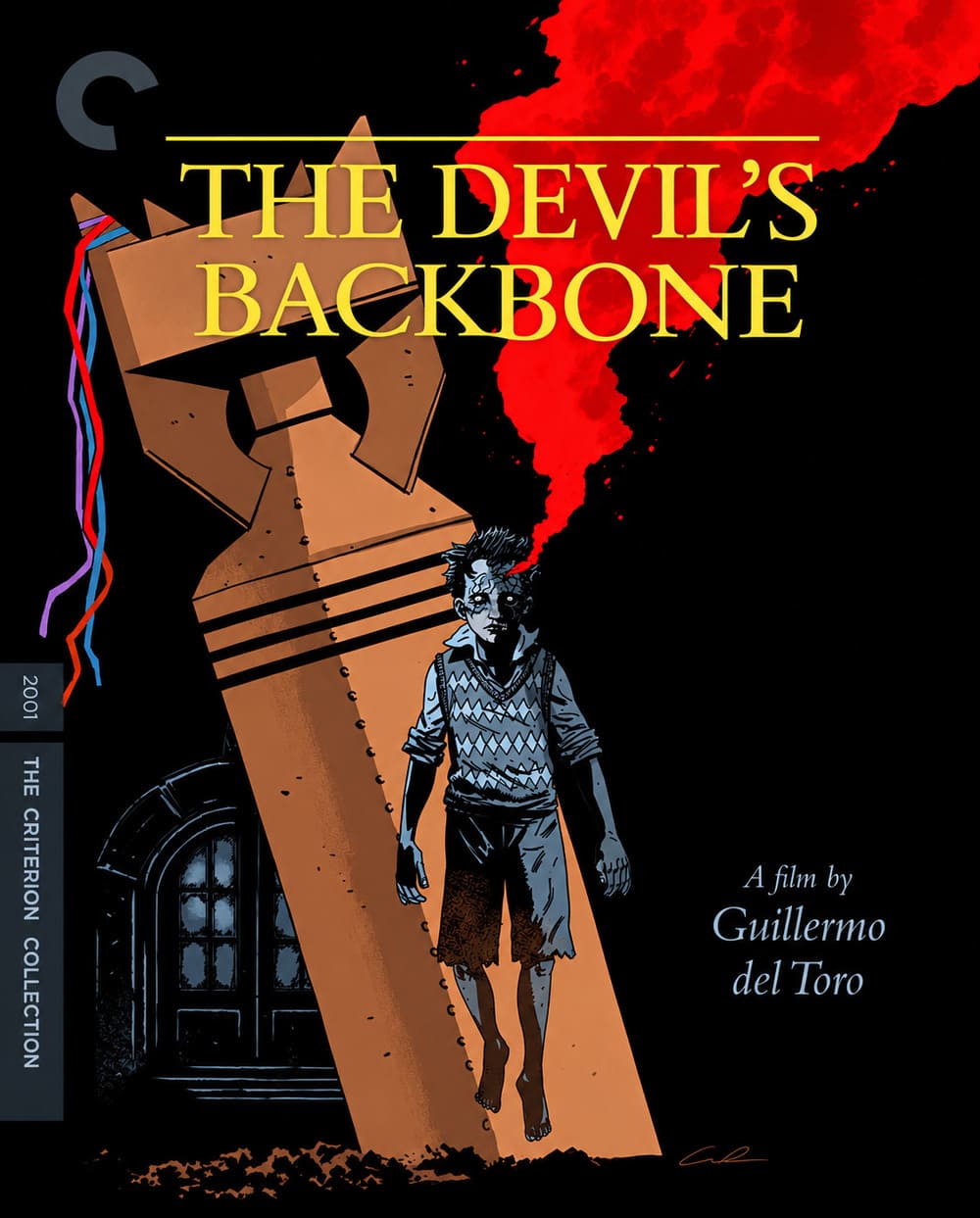
The first time you see the ghost in The Devil’s Backbone, you’re likely to wonder what he’s going to do to the children. By the end, the more troubling question is what people have already done to him. That change in perspective is the heart of Guillermo del Toro’s 2001 supernatural horror film, a movie that slowly rearranges your sense of where the danger lies. It delivers eerie encounters, hidden secrets, and an isolated setting, but its real achievement is making those familiar ingredients feel emotionally necessary. The haunting isn’t there to interrupt the human story. It’s there to reveal the human story everyone else has found a way to avoid.
Set in 1939, near the end of the Spanish Civil War, the film follows Carlos, played by Fernando Tielve, as he arrives at a remote orphanage. He enters a community that has already established its routines, rivalries, and silences. The other boys know things he doesn’t, while the adults seem reluctant to explain much of anything. Carlos has enough to worry about before he encounters Santi, the ghost of a dead child whose presence suggests that the building holds more than ordinary unhappiness. Del Toro links these sources of anxiety from the beginning. Being haunted is frightening, but so is depending on strangers who control your life without telling you the truth about it.
Carlos makes an effective guide because he’s neither unusually helpless nor conveniently fearless. Tielve lets curiosity, stubbornness, and insecurity coexist without making them seem like separate performance choices. Carlos wants answers, but he also wants to fit in, and those desires don’t always lead him in the same direction. Investigating something strange can bring him attention he doesn’t necessarily want. Standing up for himself can make an already uncertain situation worse. The film respects the practical difficulty of being a child in an unfamiliar place: even when you recognize that something is wrong, you may have very little power to change it.
The orphanage makes that lack of power feel tangible. It’s a refuge, but it’s also a place Carlos hasn’t chosen and can’t simply leave. Del Toro makes its rooms and corridors feel connected to daily life rather than arranged exclusively for scares. Children sleep, argue, and establish little territories within a building that also contains private grief and concealed violence. That mixture matters. The frightening spaces aren’t somewhere separate from ordinary experience; they’re part of the same home. As Carlos learns more, familiar locations take on different meanings. The building doesn’t change, but his understanding of what has happened inside it does.
Visually, the film finds unease without depending entirely on darkness. Dusty daylight and exposed spaces can feel just as uncomfortable as a shadowy passageway. The unexploded bomb in the courtyard captures this approach perfectly. There’s nothing hidden about it. Everyone can see the danger, yet its continued presence has become part of the routine. It’s a striking image because it turns familiarity into something unsettling. Getting used to a threat doesn’t make it safe; sometimes it simply means you’ve stopped expecting anyone to remove it. That idea extends beyond the courtyard and into the orphanage’s relationships, where people tolerate arrangements that remain fragile or harmful.
Santi initially appears to belong to a different category of danger. Unlike the bomb, he’s mysterious, difficult to understand, and impossible to explain through the ordinary rules of the place. His appearance is disturbing, but del Toro gives that disturbance an emotional dimension. The ghost looks wounded rather than merely monstrous. As Carlos pays closer attention, the signs of suffering become harder to separate from the features that make Santi frightening. It’s an impressive balancing act. The film doesn’t need to make him visually comforting to encourage sympathy. Instead, it asks whether an unsettling appearance has prevented everyone from seeing a vulnerable child.
That question gives the haunting its purpose. Santi isn’t simply a supernatural problem that must be removed so the orphanage can return to normal. His presence challenges the idea that its normal life was acceptable to begin with. Something has happened that demands acknowledgment, and continuing without that acknowledgment becomes part of the wrong. This is where the mystery develops a moral dimension without turning into a lecture. Carlos’s discoveries don’t just provide information; they alter his obligations. Once he understands more, looking away is no longer an innocent choice. The ghost becomes frightening partly because he makes avoidance impossible.
The other boys complicate Carlos’s education in whom to fear and whom to trust. Their bullying and competitiveness can be cruel, but del Toro doesn’t flatten them into miniature villains. They’re children negotiating their own uncertain circumstances, sometimes by making someone else feel smaller. Their relationships develop through friction, guarded exchanges, and changing impressions rather than instant friendship. That makes their growing connections more convincing. The film understands that solidarity isn’t automatic just because people share a difficult situation. It has to be built, and building it requires recognizing something beyond your own immediate need to feel secure.
The adults offer even less reliable guidance. Carmen, played by Marisa Paredes, has the authority necessary to keep the orphanage functioning, but that authority doesn’t mean she can control everything happening within it. Professor Casares, played by Federico Luppi, brings gentleness and thoughtfulness, though neither quality guarantees action when action is needed. Both characters have emotional lives that extend beyond their responsibilities to the children. Their disappointments and attachments make them sympathetic, but they also create blind spots. Del Toro is especially good at showing the gap between wanting to protect someone and actually providing protection. Affection matters, but it isn’t a substitute for judgment or courage.
There’s a quiet sadness in those adult relationships that deepens the horror rather than distracting from it. These are people who can recognize beauty, offer tenderness, and understand suffering, yet still hesitate at crucial moments. The film doesn’t treat their limitations with contempt. It allows us to see how exhaustion and longing can narrow a person’s attention. At the same time, the children still have to live with the consequences. That tension keeps the story from becoming too reassuring. Good intentions don’t make an institution safe, and a sympathetic guardian can still fail someone who depends on them.
Jacinto, played by Eduardo Noriega, makes that distinction more brutal. His resentment and self-interest bring an increasingly direct threat into the orphanage. Beside Santi, he creates the film’s clearest reversal: the figure who looks unnatural may deserve compassion, while an ordinary human being can choose extraordinary cruelty. Jacinto is effective, though he’s also where the storytelling becomes less nuanced. As his role sharpens, some of the earlier uncertainty gives way to a more straightforward confrontation. The emotional complications surrounding Carmen and Casares are often more absorbing than his menace. Still, his presence makes the children’s vulnerability impossible to dismiss as merely a product of their imaginations.
The war gives that vulnerability a wider context without overwhelming the intimate story. It shapes the orphanage’s resources, its loyalties, and the uncertain future awaiting everyone inside. Physical distance from the fighting offers no real independence from its consequences. This isn’t a peaceful household suddenly disturbed by a ghost; it’s a precarious refuge whose existing problems become harder to conceal. The historical setting also reinforces the difference between having power and deserving it. The children inherit dangers they didn’t create, while the adults’ decisions determine how much of that danger reaches them. Even private acts of selfishness carry greater weight in a community with so little protection to spare.
What holds these ideas together is del Toro’s empathy, which is more demanding than simple sympathy for the unfortunate. The film asks us to revise our judgments, but it doesn’t suggest that every harmful action can be forgiven once we understand its cause. Santi’s suffering deserves recognition; another person’s resentment doesn’t justify turning others into victims. That distinction keeps the movie emotionally generous without making it morally vague. It encourages careful attention to people who frighten us while remaining clear-eyed about those who exploit the vulnerability of others. The mystery changes how we see the characters, not whether their choices matter.
The film does lose a little of its delicacy as it approaches the ending. Its early strength lies in allowing dread to gather through spaces, relationships, and unanswered questions. Later, the conflicts become more explicit, and the plotting pushes the separate elements into alignment. Some of that uneasy openness gives way to more familiar suspense. For me, the quieter stretches are the most distinctive, especially when a look or an uncomfortable pause communicates more than a dramatic confrontation could. Even so, the emotional investment survives the shift. By then, the children feel too specific and their situation too precarious for the resolution to become merely a matter of mechanics.
What stays with you after The Devil’s Backbone isn’t simply the appearance of its ghost, but the effort required to see him clearly. Del Toro takes a figure we’re prepared to recoil from and makes our changing response the measure of the story’s emotional progress. The film remains chilling because understanding doesn’t erase violence or restore what has been lost. It offers something smaller: the possibility that a person’s suffering will finally be recognized rather than absorbed into another household secret. That’s why its sadness feels earned. The ghost stops being just a frightening interruption and becomes someone whose absence should have mattered all along.
I decided to review one more Donald James Parker film for October. Admittedly, Parker doesn’t have a huge role in 2015’s Love Waits. He plays a band director who offers some kind advice to one of his students, Cheri Martin (Brittany Mann), and tells her not to feel bad for challenging the other members of the band in her quest to move up to first chair. Indeed, there’s very little anger to be found in the band director, and that certainly sets him apart from the fire-and-brimstone characters that Parker usually plays. Parker is—dare I say it?—actually a bit likable in the role.
That said, the film was also directed and written by Parker, and it’s easy to see that his usual anger has been divided amongst several other characters. When the film first started, I was convinced that Cheri’s father was meant to be the film’s villain and that the movie would hopefully end with him being led away in handcuffs. Imagine my surprise when it became clear that Jeff Martin (played by Collin Alexander Brown) was meant to be a sympathetic character. When we first meet Mr. Martin, he’s coming home from work and throwing a fit when he discovers that his 14-year-old daughter has yet to start making dinner. She apologizes for forgetting. “That’s not going to fill my stomach!” he snaps. Later, when he’s again driving home, he catches Cheri out walking with Duke Williams (Hunter Johnson), a boy who is supposedly her own age. (I say supposedly because all of the actors playing the teen characters either look too young or too old.) Mr. Martin orders Cheri to get in his car and then starts yelling at her, freaking out like Terry O’Quinn in The Stepfather. Mr. Martin reminds Cheri that she’s not allowed to leave the house without permission and she’s not allowed to talk to a boy without having an adult present. Again, I assumed Mr. Martin was being set up as a villain, but the film actually treats him like a hero. One of the big problems is that Collin Alexander Brown yells almost all of his lines and comes across as an utter lunatic.
Of course, it’s not just Mr. Martin who orders Cheri around. When Cheri tries to practice her flute, her babysitter (Cheri is fourteen but cannot be left on her own) immediately starts to correct her. A major theme of the film appears to be that Cheri’s job is to follow orders and not complain, even if her father does seem to spend a lot of time yelling at her over the least little thing. Even beyond the adults around her, Cheri has to deal with her school’s resident mean girl, Judy (Haleigh Johnson). At the start of the film, Judy and her friends walk up to Cheri and say, “I hear you’re a virgin, Cheri Martin, and that makes you a loser.” When Cheri asks Judy’s friends if they’ve “done it,” one of them replies, “Duh, I’m nearly fourteen.” Eventually, Judy’s promiscuity leads to her getting her face slashed, and everyone in Cheri’s youth group agrees that, even though they don’t like Cheri, they didn’t want that to happen. “We should visit her in the hospital,” someone says. They don’t so much visit her to offer sympathy as to tell her “I told you so,” and that’s really all Judy needs to hear to change her ways and agree to wear a purity ring.
The message is about resisting peer pressure, and I actually happen to agree with that. You shouldn’t do anything unless you actually want to do it and that’s especially true when it comes to sex. That said, the film’s youth group seems to largely operate under a system of peer pressure, and the film also seems to suggest that things like sex education are actually a conspiracy to turn girls like Cheri into girls like Judy. I didn’t agree with that at all and I actually found the argument to be more than a little offensive, as if women can’t be trusted with the knowledge necessary to make their own decisions. The main thing is that, like all Parker films, Love Waits seems to take place in an alternate universe where 1850s morality is combined with a truly over-the-top bitterness. Also in typical Parker fashion, Love Waits takes a 15-minute story and stretches it out to a punishing two hours.
Every time the members of Cheri’s youth group proclaimed, “We have to do something!,” I found myself wishing someone would say, “No, you don’t.” Whenever a non-religious character was dragged into the school library so the youth group could pray over them, I was reminded of Hank Hill’s famous verdict on his town’s megachurch: “No offense, but your church just keeps coming at you.”
Welcome to Late Night Retro Television Reviews, a feature where we review some of our favorite and least favorite shows of the past! On Fridays, I will be reviewing SLEDGE HAMMER!, a cop comedy which ran on ABC from 1986 to 1988. The entire series can be found on Prime!
This week, Sledge might be DOA!
Episode 1.12 “Miss of the Spider Woman”
(Dir by Charles Braverman, originally aired on December 20th, 1986)
Sledge has been poisoned!
The poison takes five days to do its work. Unfortunately, Sledge spent four days in a coma. Plus, daylight savings time kicked in. And also, his watch is broken. So, by the time Sledge wakes up, he’s actually only got about four or five hours left to go. While the doctors try to find an antidote, Doreau and Sledge investigate who poisoned him and why.
Actually, the why is easy to explain. It was a mistake! The mysterious Juanita (Eileen Barnett) wanted to poison Sledge’s neighbor but the woman who was hired to “deliver” the poison to Sledge was near-sighted and ended up in the wrong apartment. Whoops! Instead of trying the poison trick again, Juanita just has Sledge’s neighbor shot. It’s all because the neighbor was expecting a package that contained a valuable statue that Juanita wanted.
Through some good old-fashioned, death-fueled police work, Sledge tracks Juanita down to her boat. Juanita gives him what she says is the antidote and then reveals that he actually just drank more poison. Oh, Sledge! At least Sledge is still able to subdue and arrest her. Captain Trunk arrives at the last minute with actual antidote. Sledge survives! Later, he eats a powdered donut that had the fingerprints of a notorious serial killer. Everything’s back to normal!
This was a good take on two classic film noirs, D.O.A. and The Maltese Falcon. David Rasche made me laugh even while I was worrying about Sledge dying. I was happy he survived. The city wouldn’t be the same without him.