Sinners (dir. by Ryan Coogler)


I’m on a 2 day Vacation from my DayJob, for a four day Easter Weekend. I caught Sinners earlier Thursday afternoon, having purchased a ticket the Sunday before. That I stood up and slow danced with the credits and mid/post credit scenes of the film says a lot for me. It says I need to frequent more packed showings so that I don’t do such things. More importantly, it says the blues was as seductive as most of the movie, playing a crucial part in every scene. I dare say that Sinners could almost be a musical in the same way that the Coen Brothers’ O Brother, Where Art Thou? was. There was not a musical moment in this movie where I wasn’t bobbing my knee or nodding my head (thanks to either Academy Award Winner Ludwig Goransson or whoever had the vocals at any particular moment). I even sang along at one point with a song I recognized. I’m kicking myself in the pants for not staying at the movie theatre for another showing. I really should have. That just felt so good.

I like to think I knew a lot about Vampires. I mean, I’ve been a fan for like 3 decades now, but Sinners puts a spin on the genre through myth and music that caught me off guard. Granted, if you’ve watched all of the trailers, you’ve seen most of the film already (trailers being what they are these days), but I’ll try to keep it as vague as possible. Despite what’s shared, there’s a lot left out. 

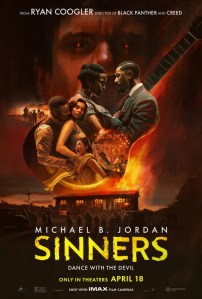
Ryan Coogler’s Sinners takes us to Mississippi in 1932, where two brothers, Smoke & Stack (both played by longtime Coogler associate Michael B. Jordan) return home with a plan to open up a juke joint. It involves picking up a few friends and associates along the way, particularly their guitarist cousin Sammie (Miles Caton, in his Introductory role). Sammie’s father, a Preacher, wants him to turn away from the music he makes and join the Church, proclaiming that the blues will lead to the Devil. Sammie, however, loves what he does and he’s damn good at it. 

The brothers are smooth talkers and quick dealers, a pair of gangsters working off the notion that anything’s possible at the right price. They also have some unresolved relationships with the women in their lives. Grief drove a stake through Annie (Wunmi Mosaku, Deadpool & Wolverine) and Smoke’s relationship, while Stack can’t seem to get rid of Mary (Hailee Steinfeld (Spider-Man: Through the Spider Verse), no matter how hard he tries. Take all that and add living in Mississippi as a person of color in the 1930s, and things are kind of rough all around. There’s a scene that suggests life in Chicago could be brighter, but “better the devil you know”, suggests otherwise.

Granted, Coogler isn’t shy in showing the effects of racism (as Fruitvale Station showed), and Sinners doesn’t detour from that. For it to be historically accurate (even if fictional), shades of that darkness have to exist in the film, though it may not seem as heavily showcased at first. At best, one could say that any racism or segregation elements take a back seat to the bloodsuckers prowling the night. 

Jordan’s twin set up is really good. Both Smoke and Stack have their distinctive styles, though there are a few moments where you may get lost in figuring who’s who. Jayme Lawson (The Batman‘s Bella Real, who I didn’t even realize until this write up) also did well here. Li Jun Li (Babylon) and Delroy Lindo’s provided some the more comedic moments than anything else. Although every actor does well in Sinners, it wouldn’t be half as powerful as it was without Miles Caton’s Sammie. He felt like the audience’s lens through all this, and when he sings, it’s rich, kind of reminiscent of Aloe Blacc’s style a decade ago. Another stand out is Jack O’Connell (Ferrari28 Years Later), whose character has all the best of intentions, yet may not have everyone’s best interests at heart. 

I unfortunately didn’t get a chance to see the film in the Panavision 70 or IMAX formats it was filmed in. To do that means a trip into Manhattan, which I simply don’t really do much anymore since moving out (though I may make an attempt before the weekend’s out). Coogler makes some fantastic use of space, framing the camera for some beautiful wide shots when needed, along with a nice one shot, but the real magic happens during the 2nd half. The party sequence itself is worth the price of admission, possibly rivaling the one in Damian Chazelle’s Babylon. The camera flows just as well as did during the fight sequences of the Black Panther films. I’d imagine those sequences must look really awesome in those formats. 

The only real complaint I have over Sinners is that I felt that some of the decisions made in the 2nd half didn’t fully make sense to me, which ironically was some of the same issues I had with Robert Rodriguez’ From Dusk Till Dawn, which moves along similar lines. I get why the decisions were made, but at the same time, I kind of hoped for a little more there. That might be more of a nitpick than anything else. It’s has horror, someone’s bound to make a decision that threatens everyone else. Additionally, not every loop is closed. Most of the important ones were from a story standpoint, but there were one or two elements I would have like to have found out about. It’s not a total loss.

Oh, while you’re going to watch this, it may be best to send the little ones off to watch Minecraft. Sinners is seductive in a number of ways, and there are a few steamy scenes that aren’t for their eyes. Additionally, there’s also a copious amount of blood, that may also be a little off putting. Parental Guidance suggested, indeed. 

Overall, I loved Sinners. I’ve already scooped up Ludwig Goransson’s Score (which should be be available in about an hour, as of this writing) and would happily watch it again. Note that if you are going to see it, there is an extended Mid Credits scene that is longer that I expected it to be. Really, when it starts, you might as well sit back down if you stood up to go. There’s also a post credit scene as well, which isn’t as impactful, but fun to watch, all the same.

FREEDOM!!! 


I’m passionate about movies, but my day job consists of providing high quality tax planning and preparation services for a wide variety of clients in the Central Arkansas area. After a couple of months of 70-90 hour work weeks, April 16th is the day that I can begin to focus a little less on work and a little more on the things I truly love. I can’t wait to continue to share my passion for movies, music, Charles Bronson, Chow Yun-Fat, and so many other things with all of you. I need a few days to get some rest and get my mind straight, but I’ll soon be back to sharing my opinions and my life! Thanks to all of you who read my work! ❤️

Somewhere In Sonora (1933, directed by Mack V. Wright)


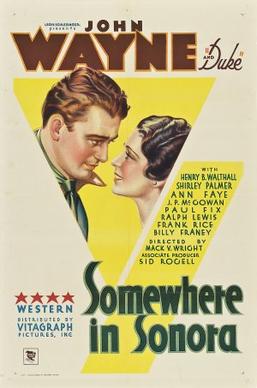
After stagecoach rodeo racer John Bishop is framed for causing a competitor to have an accident, he’s hauled off to jail.  Fortunately, Bishop’s boss, Bob Leadly (Henry B. Walthall), comes through for Bishop and helps him escape from the jail.  To thank Bob, Bishop heads down to Mexico to search for Bob’s son, Bart (Paul Fix).  The last that Bob heard, Bart was running with an outlaw gang called “The Brotherhood of Death.”  The only way get out of the Brotherhood of Death is to die.

By an amazing coincidence both Bart and Bishop’s girlfriend, Mary (Shirley Palmer), are in the Mexican town of Sonora.  To try to get Bart to return home, Bishop goes undercover and infiltrates the gang.  Once inside, Bishop discovers that gang leader Monte Black (J.P. McGowan) is planning on robbing the silver mine that belongs to Mary’s father.

This is a John Wayne B-western, typical of the poverty row productions that he was making before John Ford cast him as the Ringo Kid in Stagecoach and made him into a star.  This one features the usual horse chases and bar fights and John Wayne gives a solid-enough performance in the lead role.  The most interesting thing about it is that, even though it’s a western, it’s set in modern times.  I guess frontier days lasted longer in some parts of the county than in others.

John Wayne’s horse, Duke, appears in this picture and shows again that he was the most talented of all the horse actors in the 30s.  He earned his co-starring credit.

Film Review: Short Cuts (dir by Robert Altman)


Opening with a swarm of helicopters spaying for medflies and ending with an earthquake, 1993’s Short Cuts is a film about life in Los Angeles.

An ensemble piece, it follows several different characters as they go through their own personal dramas.  Some of them are married and some of them are destined to be forever single but they’re all living in varying states of desperation.  Occasionally, the actions of one character will effect the actions of another character in a different story but, for the most part, Short Cuts is a portrait of people who are connected only by the fact that they all live in the same city.  There are 22 principal characters in Short Cuts and each one thinks that they are the star of the story.

Jerry Kaiser (Chris Penn) cleans the pools of rich people while, at home, his wife, Lois (Jennifer Jason Leigh), takes care of their baby and works as a phone sex operator.  Jerry’s best friend is a makeup artist named Bill (Robert Downey, Jr.) who enjoys making his wife, Honey (Lili Taylor), looks like a corpse so that he can take her picture.  One of her photographs is seen by a fisherman (Buck Henry) who has already discovered one actual corpse that weekend.  He and his buddies, Vern (Huey Lewis) and Stuart (Fred Ward), discovered a dead girl floating in a river and didn’t report it until after they were finished fishing.  (The sight of Vern unknowingly pissing on the dead body is one of the strongest in director Robert Altman’s filmography.)

Stuart’s wife, Claire (Anne Archer), is haunted by Stuart’s delay in reporting the dead body.  A chance meeting Dr. Ralph Wyman (Matthew Modine) and his wife, artist Marian (Julianne Moore), leads to an awkward dinner between the two couples.  Claire works as a professional clown and Ralph ends up wearing her clown makeup while his marriage falls apart.

Earlier, Claire was stopped and hit on by a smarmy policeman named Gene Shepard (Tim Robbins), who just happens to be married to Marian’s sister, Sherri (Madeleine Stowe).  Gene is already having an affair with Betty Weathers (Frances McDormand), the wife of a helicopter pilot named Stormy (Peter Gallagher).  When Stormy discovers that Betty has been cheating, he takes a creative revenge on her house.

Doreen Pigott (Lily Tomlin) lives in a trailer park with her alcoholic husband, Earl (Tom Waits).  Driving home from her waitressing job, Doreen hits a young boy.  The boy says he’s okay but when he gets home, he passes out.  His parents, news anchorman Howard Finnegan (Bruce Davison) and his wife, Anne (Andie MacDowell), rush him to the hospital, where his doctor is Ralph Wyman.  As Howard waits for his son to wake up, he has a revealing conversation with his long-estranged father (Jack Lemmon, showing up for one scene and delivering an amazing monologue).  Meanwhile, a baker named Andy (Lyle Lovett) repeatedly calls the Finnegan household, wanting to know when they’re going to pick up their son’s birthday cake.

Based on the short stories of Raymond Carver and directed by Robert Altman, Short Cuts can sometimes feel like a spiritual descendent of Altman’s Nashville.  The difference between this film and Nashville is that Short Cuts doesn’t have the previous film’s satiric bite.  As good as Nashville is, it’s a film that can be rather snarky towards it character and the town in which it is set.  Nashville is used as a metaphor for America coming apart at the seams.  Short Cuts, on the other hand, is a far more humanistic film, featuring characters who are flawed but, with a few very notable exceptions, well-intentioned.  If Nashville seem to be a portrait of a society on the verge of collapse, Short Cuts is a film about how that society ended up surviving.

It’s not a perfect film.  There’s an entire storyline featuring Annie Ross and Lori Singer that I didn’t talk about because I just found it to be annoying to waste much time with.  (The Ross/Singer storyline was the only one not to be based on a Carver short story.)  The conclusion of Chris Penn’s storyline wasn’t quite as shocking as it was obviously meant to be.  But, flaws and all, Altman and Carver’s portrait of humanity does hold our attention and it leaves us thinking about connections made and sometimes lost.  Seen today, Short Cuts is a portrait of life before social media and iPhones and before humanity started living online.  It’s a time capsule of a world that once was.

The TSL Grindhouse: Nomads (dir by John McTiernan)


1986’s Nomads opens with anthropologist Jean-Charles Pommier being rushed into an emergency room, badly beaten and struggling for his life.  Despite the best efforts of Dr. Eileen Flax (Lesley-Anne Down), Pommier dies in the ER.  Flax is shocked by Pommier’s death and, naturally, she’s upset that she couldn’t save him.  But, at the same time, people die in hospitals.  It happens to the best of doctors.

Except soon, Flax is seeing flashes of the events that led to Pommier’s death.  Pommier has somehow entered her mind and soon, she’s reliving his investigation into the origins of a group of destructive, urban nomads that Pommier witnessed causing havoc throughout Los Angeles.  Pommier often felt like he was the only person who was capable of seeing the nomads and he grew to be tortured by his fear that they were specifically stalking him.  We soon learn that there was reason for that….

Now, based on his name, you’re probably assuming that Pommier is meant to be French.  And he is!  He’s from France, though he considers himself to be a citizen of the world.  He’s traveled everywhere, taking pictures of different cultural rituals across the globe.  However, in Nomads, the very French Jean-Charles Pommier is played by Pierce Brosnan.  Pierce Brosnan is, needless to say, not French.  He’s Irish, even though a lot of people seem to be shocked when they first learn that.  Brosnan normally speaks with an accent that could best be described as a mix of posh London and mid-Atlantic American.  Everything about him screams the UK.  In short, Pierce Brosnan is one of the least convincing French people ever seen on film and he delivers his lines in an accent that sounds like every accent other than the French accent.  Watching this film, I found myself thinking about the Monty Python skit where Terry Jones and Carol Cleveland starred in a French movie.  (“I see you have a cabbage.”  “Oui.”)  Brosnan is not a bad actor and it’s entertaining to watch him overact in Nomads.  But there’s nothing French about him and every time that someone referred to him as being French, it totally took me out of the movie.

Which is a shame because Nomads may be narratively incoherent but it’s got some memorably surreal visuals and it does a good job of generating a properly ominous atmosphere.  Director John McTiernan (who later went on to do Predator, Die Hard, and The Hunt For Red October) makes smart use of slow motion and a handheld camera to keep the audience off-balance.  At its best, Nomads achieves a dream-like intensity that makes up for the fact that the story doesn’t make the least bit of sense.  The nomads themselves are a memorable and creepy.  While Adam Ant plays their leader (and the scene where he smiles as Brosnan attempts to throw him off a building is truly disturbing), the most frightening of the nomads is Mary Woronov as Dancing Mary.  Seriously, after I watched this film, I checked all the locks in the house.  No urban nomads were going to interrupt me in my sleep!

My suggestion to everyone is to do a Nomads/Nomadland double feature.  You’ll never get in another van.

Film Review: Into the Wild (dir by Sean Penn)


He went looking for America but couldn’t find it.

That’s not actually the tag line that was used to advertise 2007’s Into The Wild but perhaps it should have been.  Based on the true story of Chris McCandless, a college graduate who gave away all of his money and then roamed the country for two years before starving to death in an abandoned bus in Alaska, Into The Wild seems to be Sean Penn’s attempt to make a modern-day Easy Rider.  Just as Dennis Hopper and Peter Fonda crossed the country and met several different people over the course of that seminal road film, Into The Wild follows Emile Hirsch’s Chris McCandless as he takes on the identity of Alexander Supertramp and hikes across the continent.  Along the way, he meets and befriends hippies (Catherine Keener and Brian H. Dierker), blue collar workers (Vince Vaughn), wayward teenagers (Kristen Stewart), and, most poignantly, a retired man (Hal Holbrook) who sincerely tries to help Chris make peace with his wanderlust.

You would think that this would be the type of film that would bring out Sean Penn’s worst directorial instincts but Penn actually directs with a very real sensitivity and a willingness to see the good in just about everyone that Chris meets.  It is true that, especially at the start of the film, Chris can sometimes be a bit difficult to take.  He’s so self-righteous and sure of himself.  He mistakes his college diploma for being a badge of experience and occasionally, he can come across as being incredibly condescending.  But, as the film progresses, Chris starts to realize that he doesn’t know everything and that he can’t do everything by himself.  Sometimes, he does need help, even if he doesn’t want to admit it.  The film’s most moving moments feature Chris and Hal Holbrook’s Ron Franz.  Ron has the years of experience that Chris lacks and Ron also becomes one of the few people to whom Chris is willing to truly listen.  And yet, when Ron offers to adopt Chris and give him a permanent home, Chris’s response is to promise to talk to him about it when Chris returns from Alaska.  As Chris leaves, it’s obvious that Ron knows that he’s never going to see Chris again.  Dying in Alaska, Chris finally makes some sort of inner peace with the parents (William Hurt and Marcia Gay Harden) and the sister (Jena Malone) that he earlier abandoned.  It’s an amazingly touching scene.  Penn, whose other directorial efforts have been a bit didactic, seems to be willing to grant a certain grace to everyone in the film, even those whose politics or cultural attitudes he might not necessarily share.  Penn not only captures the visual beauty of the America wilderness but also the beauty of the people, a beauty that too many other directors chose to downplay.

It’s a strong film and certainly the best of Penn’s directorial efforts.  Emile Hirsch is not always likable as Chris but, then again, the heart of the film is found in the people that Hirsch meets and Penn gets excellent performances from his entire supporting cast.  Hal Holbrook received a much deserved Oscar nomination.  I also liked Vince Vaughn’s performance as guy who teaches Chris about hard work before getting arrested for stealing cable and also Jena Malone as Chris’s sister, the one person who understands him, even if she’s not invited to travel with him.

Into The Wild is a poignant portrayal of  both wanderlust and the often-neglected corners of America.  Did Chris find a little of something that he was looking for before he died in that bus?  One can only hope.


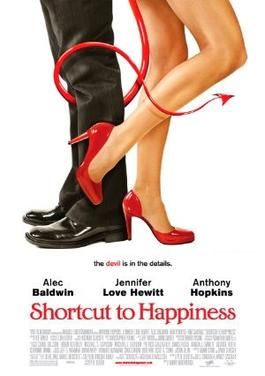
Insomnia File #70: Shortcut to Happiness (dir by Alec Baldwin)


What’s an Insomnia File? You know how some times you just can’t get any sleep and, at about three in the morning, you’ll find yourself watching whatever you can find on cable or streaming? This feature is all about those insomnia-inspired discoveries!

If you’re having trouble getting to sleep tonight, you can always jump over to Tubi and watch Shortcut to Happiness, a.k.a. The Devil and Daniel Webster.

When was Shortcut to Happiness released?  There’s some debate about that.  Though the film’s credited director is Harry Kirkpatrick, it was actually directed by Alec Baldwin.  (Please, no Rust jokes.)  The film was shot in 2001, in New York City.  However, shortly before filming could be completed, the film’s financiers were arrested and charged with bank fraud which led to the film ending up in limbo.  A rough cut of the movie appeared at a few film festivals in 2003.  By that point, Baldwin had started to distance himself from the film, claiming that he wasn’t given a chance to shoot all of the scenes that he needed to and that the film was taken away from him in post-production.  A newly edited version of the film was finally released in 2007, six years after filming began.

Alec Baldwin not only directed the film but starred as Jabez Stone, an aspiring writer who makes a deal with the devil (Jennifer Love Hewitt) to become a successful published author.  Stone gets his wish but it comes with a price.  In ten years, he will have to give up his soul.  Stone becomes rich and successful, writing books that have absolutely no literary merit.  He loses all of his friends and, by the time the ten year deadline rolls around, Stone is miserable.  Stone sues to keep his soul.  He’s defended by Daniel Webster (Anthony Hopkins), a man who Stone thought was just a publisher but who apparently is actually the famed 19th century statesman.  (The film is rather vague on this point.)  In one of the film’s few funny moments, the jury is revealed to be made up of deceased writers, including Ernest Hemingway and Mario Puzo.  The trial plays out and …. well, again, it’s hard to really follow any of the arguments made by either Webster or the Devil.  The film is so tonally inconsistent and poorly directed that I was often left wondering if Hopkins and Hewitt had even been on the set at the same time.

Both Hopkins and Hewitt give good performances.  The problem is that they both seem to be appearing in different films.  Hewitt gives a broadly comedic performance as the Devil, pouting whenever Webster argues with her.  Hopkins, meanwhile, seems to be recycling his dignified and very serious performance from Amistad.  Meanwhile, Baldwin the director totally miscasts Baldwin the actor.  For the film to work, Jabez needs to be young and hungry.  Instead, Baldwin comes across as someone who is already old enough to know better than to make a deal with the Devil.

It’s a true mess of a film but worth seeing just because of the story behind it.  That said, the 1941 version of The Devil and Daniel Webster remains the one to beat.

Previous Insomnia Files:

  1. Story of Mankind
  2. Stag
  3. Love Is A Gun
  4. Nina Takes A Lover
  5. Black Ice
  6. Frogs For Snakes
  7. Fair Game
  8. From The Hip
  9. Born Killers
  10. Eye For An Eye
  11. Summer Catch
  12. Beyond the Law
  13. Spring Broke
  14. Promise
  15. George Wallace
  16. Kill The Messenger
  17. The Suburbans
  18. Only The Strong
  19. Great Expectations
  20. Casual Sex?
  21. Truth
  22. Insomina
  23. Death Do Us Part
  24. A Star is Born
  25. The Winning Season
  26. Rabbit Run
  27. Remember My Name
  28. The Arrangement
  29. Day of the Animals
  30. Still of The Night
  31. Arsenal
  32. Smooth Talk
  33. The Comedian
  34. The Minus Man
  35. Donnie Brasco
  36. Punchline
  37. Evita
  38. Six: The Mark Unleashed
  39. Disclosure
  40. The Spanish Prisoner
  41. Elektra
  42. Revenge
  43. Legend
  44. Cat Run
  45. The Pyramid
  46. Enter the Ninja
  47. Downhill
  48. Malice
  49. Mystery Date
  50. Zola
  51. Ira & Abby
  52. The Next Karate Kid
  53. A Nightmare on Drug Street
  54. Jud
  55. FTA
  56. Exterminators of the Year 3000
  57. Boris Karloff: The Man Behind The Monster
  58. The Haunting of Helen Walker
  59. True Spirit
  60. Project Kill
  61. Replica
  62. Rollergator
  63. Hillbillys In A Haunted House
  64. Once Upon A Midnight Scary
  65. Girl Lost
  66. Ghosts Can’t Do It
  67. Heist
  68. Mind, Body & Soul
  69. Candy

Embracing The Melodrama: The Client List (dir by Eric Laneuville)


In 2010’s The Client List, Jennifer Love Hewitt stars as Samantha Horton.

Samantha’s a former beauty queen whose mother (Cybill Shepherd) always hoped would go on to win Miss Texas and then maybe appear in movies and on television.  Instead, Samantha got knocked up by her boyfriend, Rex (Teddy Sears).  Rex was a football star at UT so marrying him didn’t seem like it would be a dead-in but then Rex blew out his knee.  Now, they’re living in small town Texas, they’ve got three children, and they’ve got a bank threatening to foreclose on their home.  When Samantha and Rex head down to the bank, their loan officer spends the entire time staring at Samantha’s chest while Samantha reveals that she has a photographic memory.

Desperately needing a job and with Rex drinking away his troubles, Samantha gets a job at a massage parlor the next town over.  Naively, Samantha assumed that her job would actually just be to give men massages.  Instead, it turns out that the massage parlor is actually a brothel where the workers continually tell each other that it “beats the heck out of waitressing.”

(They don’t say “heck” but I gave up cursing for Lent.)

At first, Samantha is disgusted by the idea of working as a prostitute.  But, with Rex drinking too much and the house about to bet taken away, Samantha goes back to the parlor and soon becomes the most popular person working there.  She works herself to exhaustion but one of her clients has just the solution for that.  “I’ve never even smoked weed before,” Samantha says while looking at the baggie of cocaine.  I’m sorry …. you dated someone who went to UT without ever smoking weed?  I don’t buy that.

Samantha can now stay awake for hours, going to work and buying her family a lot of Christmas presents.  Samantha’s clients include some of the most powerful men in the county.  When one of her co-workers confesses to having doubts about the job, Samantha sends her to a church group so she’ll have someone to talk to.  Soon, words gets out that the massage parlor is a house of prostitution and Samantha is getting arrested and led out of the parlor in her underwear while TV cameras roll.  “That looks kind of like your wife,” someone says to Rex.

The Client List caused quite a stir when it aired on Lifetime back in 2010.  (It also led to a TV series where Jennifer Love Hewitt starred as a different character.)  It’s an enjoyably sordid story, one that embraces the melodrama and mixes morality and sex in a way that would have made Cecil B. DeMille proud.  The film takes place in my homestate and, fortunately, it stars a lot of Texas-born actors so the accents are authentic, even if the dialogue was obviously written by a Yankee.  (“She’s as busy as popcorn,” a character said at one point and I nearly went blind from rolling my eyes.)  That the film actually carries some emotional weight is totally due to the lead performance of Jennifer Love Hewitt, who I’ve always liked because we’re both Texas girls and we’ve both got big boobs so I feel like we share the same struggle.  Hewitt gives an authentic and heartfelt performance here, leaving no doubt that everything that Samantha does, she does for her family.  The Client List is a true Lifetime classic.

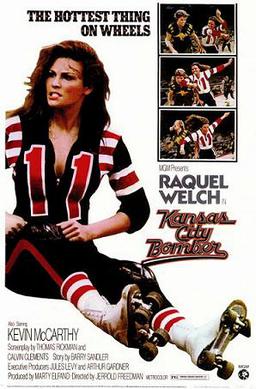
The Unnominated #14: Kansas City Bomber (dir by Jerrold Freedman)


Though the Academy of Motion Picture Arts and Sciences claim that the Oscars honor the best of the year, we all know that there are always worthy films and performances that end up getting overlooked.  Sometimes, it’s because the competition too fierce.  Sometimes, it’s because the film itself was too controversial.  Often, it’s just a case of a film’s quality not being fully recognized until years after its initial released.  This series of reviews takes a look at the films and performances that should have been nominated but were, for whatever reason, overlooked.  These are the Unnominated.

In 1972’s Kansas City Bomber, Raquel Welch stars as KC Carr.

KC. is a star on the roller derby circuit, a tough fighter who is loved by the audience and who shows no fear when it comes to skating around the track and getting into brawls with the other team.  The audience especially loves it when she fights Jackie Burdette (Helena Kallianiotes), madly cheering over every punch landed and every elbow thrown and every strand of hair pulled.  It’s not glamorous work but KC loves the adulation of the crowds and the comradery of her team.  She’s a single mother and putting on roller skates and getting bruised in fights allows her to support her daughter, Rita (a pre-Taxi Driver Jodie Foster).

But then KC is traded to another team, the Portland Loggers.  It takes KC a while to fit in with her new team.  She’s viewed with suspicion, especially when she starts to date the owner of the team, Burt Henry (Kevin McCarthy).  Burt may seem charming but KC soon discovers that he has a jealous side.  When KC spends too much time with her best friend and roommate, Burt trades her to another team.  When a male skater named “Horrible” Hank (Norman Alden) reveals that he has a rather obvious crush on KC, Burt goes out of his way to humiliate Hank.  Burt wants to start a new team in Chicago and he’s promised to make KC a star.  Will KC give up her own freedom to be Burt’s well-compensated star or will she stand up for herself and show that she doesn’t belong to anyone?

You already know the answer.  The wonderful thing about Raquel Welch is that she was tough.  She didn’t let people push her around and, if that resulted in people in Hollywood whispering that she was difficult, so be it.  Like KC Carr, Raquel Welch didn’t make any apologies.  Kansas City Bomber is one of the few of Welch’s early 70s films to celebrate and show how just how tough she was.  For once, Welch is given an actual character to play and she proves herself to be a strong and fierce actress.  It’s fun and more than a little empowering to watch her performance here.  Everyone underestimates KC Carr, just as everyone underestimated Raquel Welch.  In both cases, the doubters are proven wrong.

Kansas City Bomber is not a great film.  (The pacing is totally off and the supporting characters are not quite as memorable as either Welch or Kevin McCarthy.)  But Raquel Welch gave a great performance.  That Welch was never Oscar-nominated isn’t really a surprise.  She didn’t appear in the type of movies that received Oscar attention and she was often cast in roles that didn’t give her much of an opportunity to show off what she could do.  She definitely deserved a nomination for Kansas City Bomber.  

Previous entries in The Unnominated:

  1. Auto Focus 
  2. Star 80
  3. Monty Python and The Holy Grail
  4. Johnny Got His Gun
  5. Saint Jack
  6. Office Space
  7. Play Misty For Me
  8. The Long Riders
  9. Mean Streets
  10. The Long Goodbye
  11. The General
  12. Tombstone
  13. Heat

April Noir: Blue Velvet (dir by David Lynch)


First released in 1986 and still regularly watched and imitated, Blue Velvet is one of the most straight forward films that David Lynch ever made.

For all the talk about it being a strange and surreal vision of small town America, the plot of Blue Velvet is not difficult to follow.  After his father has a stroke that leaves him confined to a hospital bed, Jeffrey Beaumont (Kyle MacLachlan) returns home from college.  Lumberton appears to be a quiet and friendly little town, with pretty houses and manicured lawns and friendly people.  Jeffrey, with his dark jacket and his expression of concern, appears a little out-of-step with the rest of the town.  He’s been away, after all.  One day, while walking through a field, Jeffrey discovers a rotting, severed ear.  Jeffrey picks up the ear and takes it Detective Williams (George Dickerson).  Detective Williams, who looks like he could have stepped straight out of an episode of Dragnet, is such a man of the innocent 1950s that his wife is even played by Hope Lange.

“Yes, that’s a human ear, alright,” Williams says, deadpan.

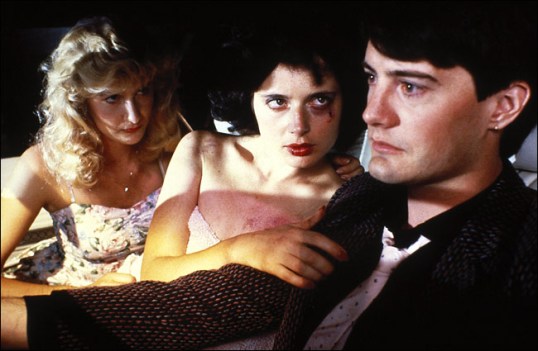
Blue Velvet (1986, dir by David Lynch, DP: Frederick Elmes)

With the help of Detective Williams’s blonde and seemingly innocent daughter, Sandy (Laura Dern), Jeffrey launches his own investigation into why the ear was in the field.  He discovers that Lumberton has a teeming criminal underworld, one that is full of men who are as savage as the ants that we saw, in close-up, fighting over that ear in the field.  Jeffrey discovers that a singer named Dorothy (Isabella Rossellini) is being sexually blackmailed by a madman named Frank Booth (Dennis Hopper).  When Dorothy discovers Jeffrey hiding in her closet (where he had been voyeuristically watching her and Frank), it leads to Jeffrey and Dorothy having a sadomasochistic relationship.  “Hit me!” Dorothy demands and both the viewer and Jeffrey discover that he’s got his own darkness inside of him.  “You’re like me,” Frank hisses at Jeffrey at one point and, if we’re to be honest, it almost feels like too obvious a line for an artist like David Lynch.  Lynch once described the film as being “The Hardy Boys in Hell,” and the plot really is as straightforward as one of those teenage mystery books.

That said, Blue Velvet also features some of Lynch’s most memorable visuals, from the brilliant slow motion opening to the moment that the camera itself seems to descend into the ear, forcing us to consider just how fragile the human body actually is. The film goes from showcasing the green lawns and blue skies to Lumberton to tossing Jeffrey into the shadowy world of Dorothy’s apartment building and suddenly, the entire atmosphere changes and the town becomes very threatening.  We find ourselves wondering if even Detective Williams can be trusted.  That said, my favorite visual in the film is a simple one.  Sandy and Jeffrey walk along a suburban street at night and the camera shows us the dark trees that rise above them, contrasting their eerie stillness to Sandy and Jeffrey’s youthful flirtation.

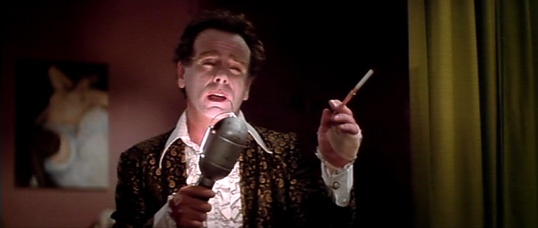
Dean Stockwell in Blue Velvet

Dean Stockwell shows up as Ben, an associate of Frank’s who lip-synchs to Roy Orbison’s In Dreams while Frank himself seems to have a fit of some sort beside him.  In retrospect, Blue Velvet played a huge role in Dennis Hopper getting stereotyped as an out-of-control villain but that doesn’t make him any less terrifying as Frank Booth.  Hopper, recently sober after decades of drug abuse and self-destructive behavior, summoned up his own demons to play Booth and he turns Frank into a true nightmare creature.  Isabella Rossellini is heart-breaking as the fragile Dorothy.  That said, the heart of the film belongs to Kyle MacLachlan and Laura Dern and both of them do a wonderful job of suggesting not only the darkness lurking in their characters but also their kindness as well.  For all the talk about Lynch as a subversive artist, he was also someone who had a remarkable faith in humanity and that faith is found in both Jeffrey and Sandy.  MacLachlan and Dern manage to sell moments that should have been awkward, like Sandy’s monologue about the returning birds or Jeffrey’s emotional lament questioning why people like Frank have to exist.  Both Jeffrey and Sandy lose their innocence but not their hope for a better world.

Blue Velvet is a straight-forward mystery and a surreal dream but mostly it’s an ultimately hopeful portrait of humanity.  The world is dark and full of secrets, the film says.  But that doesn’t mean that it can’t be a beautiful place.


Blue Velvet (1986, dir by David Lynch, DP: Frederick Elmes)