Film Review: Insidious (dir. by James Wan)


I wasn’t expecting much from Insidious, the new horror film that’s recieved a surprising amount of critical acclaim over the past month.  After all, the film is the product of a collaboration between the makers of Saw and Parnormal Activity, two of the most overrated horror films ever.  Add to that, the movie is rated PG-13 and the lesson I took away from seeing The Roommate earlier this year was that PG-13 dooms horror.  Insidious might be the proverbial exception that proves the rule.

As with all good horror films, Insidious starts with a deceptively simple premise.  Patrick Wilson and Rose Byrne play a married couple whose marriage is thrown into choas when their oldest son slips into what appears to be a coma.  After three months of being in the hosptial, their son is moved back into their house where he spends his days lying in bed, hooked up to ominous medical equipment. 

(Speaking for myself, there is no more disturbing sound than the sound of heart monitor, because for every beep, there’s that moment of deafening silence between beeps.  The film’s director James Wan knows this too because he makes brilliant use of sound in this film.)

While Wilson deals with things by finding excuses to stay late at work, Byrne is soon seeing shadowy figures running through the house and hearing voices coming from empty rooms.  Even as Wilson continues to insist that its just her imagination (that’s something all men seem to have in common — they never ask for direction and they always refuse to accept that the house is haunted), Byrne becomes more and more convinced that its not.  Eventually, with a help of an eccentric psychic (well-played by Lin Shaye), Wilson and Byrne are forced to confront the evil forces that have taken control of their lives.

Let’s get the most important thing out of the way first.

Insidious is one scary movie.  It’s scarier than any movie rated PG-13 has any right to be.  It scared me when I was sitting in the theater watching it and, even more importantly, it’s still scary a day later.

Let me set the scene for you.  As I sit here writing this, it is nearly 3 in the morning.  I live in a two-story house that is full of random cold spot and which, for some reason, never seems to be totally lit even with all the lights on.  My friends are with their families for Easter.  My sister Erin is currently in Arlington, visiting with our other sister, Melissa.  I’m in this house alone with only my overactive imagination keeping me company.  Oh, did I mention that, because of some foundation issues, this house tends to randomly creak?

About two hours ago, I had just taken a shower and I was sitting, wrapped in a towel and a blow dryer, on the edge of my bed.  I have this antique floor  mirror that sits a few feet in front of my bed and I was about to start drying my hair when it suddenly occured to me — what if I looked at the mirror and I suddenly saw a dark shadow — like the ones in Insidious — sitting on the bed directly behind me?

And yes, I knew that was a silly thought just like I know, despite what the Insidious might tell us, there’s no such thing as ghosts and demons.  I knew that if I rasied my head, I would not see anything but isolated, vulnerable little me reflected in the mirror.

But, God help me, I could not bring myself to look.  Because, even though I knew that there was 99.9% chance that nothing would be sitting behind me, I knew that there was 0.1.% chance that something would be.  I sat there, almost paralyzed with my heart pounding so hard I could almost hear it.  I realized I was starting to breathe faster, knowing that if there was something there, it was there with me at that exact moment, siting behind me, waiting to strike…

Finally, realizing that I was on the verge of giving myself a very real panic attack over a very unreal possibility, I forced myself to look up at the reflection in the mirror.

A dark shadow was sitting directly behind me.

And I screamed and jumped off that bed so quickly that I’m amazed I actually managed to stay on my feet.  I swung around, cluthing that blow dryer like a weapon, prepared to do whatever…

Nobody was sitting on the bed. 

Slowly, I creeped across the room.  Cautiously, I stuck a foot underneath my bed to feel if anything was hiding underneath it.  I opened the closests and pushed my clothes to the side to confirm that nobody was hiding behind them. 

Finally, after I somehow found the courage to sit back down on the bed, I realized that there had indeed been a shadow behind me and that shadow, because of the angle of the lights in my room, had been mine.

That’s the type of film Insidious is.  It’s the type of film that uses the simple things that scare us — the unexplainable noises, the things that you sometimes think you see out of the corner of your eye — to creates a truly macabre experience that sicks with you.  At its best, its a truly creepy film that works its way into your imagination through a perfect combination of atmosphere and paranoia.  One reason why the haunted house genre has remained such a dependable horror set up is because it perfectly reflects one of our most basic fears — the fear of having no control, of knowing that there is no place to hide, that the forces of chaos and evil can even get to us in the sanctuary of our own homes.  Especially during its first half, Insidious exploits this fear perfectly.  James Wan’s camera prowls through the otherwise unremarkable suburban home like a creature possessed and you find yourself spotting shadowy figures and sudden movements in every frame that flickers before your eyes.  Wan makes remarkably good use of sound here.  I realize that sound of silence may be an oxymoron but if silence can make a sound, then director Wan manages to capture it in Insidious.

A lot of critics and filmgoers have been rather critical of the film’s second half and it is true that the second half if remarkably different from the first.  If the first half finds Wan concentrating on atmopshere then the second half concentrates on shock and, as a result, it feels a lot more conventional. During the 2nd half of them, we learn just what exactly is happening and why and unfortunately, no possible solution could hope to compete with the sense of dread that the first part of the movie generated.  That doesn’t mean that the second half of the movie isn’t well-executed.  It is.  It’s just not as surprising as the first half.

(However, there is one scene in that 2nd half — a red-skinned demon cheerfully sharpening his finger nails — that is just so bizarre and disturbing that it borders on genius.)

Now, I will admit (POSSIBLE SPOILER COMING UP DEPENDING ON HOW ANAL YOU ARE) that I was not a huge fan of the film’s ending.  It’s not that the ending didn’t work or that it wasn’t well-exectued.  It’s just that it’s the same type of ending that we’ve come to expect from all horror films, the type of thing that used to be considered a twist but now is just a cliche.

Still, ending aside, Insidious is an effective, little horror film.  While it is true that the film rather liberally borrows from a lot of previous horror films (most blatantly from Poltergiest, Mario Bava’s Shock, an Australian film called Patrick, and an excellent Canadian shocker called The Changeling), Wan still takes all of those familiar elements and molds them into a genuinely scary experience.
Film Review: Win Win (dir. by Thomas McCarthy)


When I watched the pilot episode of Game Of Thrones, I got very excited when I saw that Thomas McCarthy was credited as the director.  Now, McCarthy isn’t a household name but chances are, you’ve seen him.  He played the plagiarist journalist in the final season of The Wire.  He was John Cusack’s romantic rival in 2012.  He was nominated for an Academy Award for co-writing the Pixar film Up.  However, McCarthy has received most of his critical acclaim as the director of low-key, character dramas like The Station Agent and The Visitor.  I have to admit that I was shocked to see McCarthy’s name linked to Game of Thrones because, with the exception of Peter Dinklage, it appeared to have nothing in common with his previous films.  Well, turns out that I wasn’t the only one who thought that because apparently, despite McCarthy being credited as the director, the majority of the pilot was actually reshot (quite well) by Tim Van Patten.

So, you might not be seeing Thomas McCarthy’s work on television but fortunately, you can still catch it in the movie theaters.  McCarthy’s latest film is a surprisingly poignant comedy called Win Win.

InWin Win, Mike (played by Paul Giamatti) is an attorney who works and lives in small New Jersey town.  Mike is married to Jackie (Amy Ryan), owns a big house, helps to coach the high school’s mediocre wrestling team, and can’t pay his bills.  Rather than let his family know that he’s on the verge of going broke, Mike instead becomes the legal guardian of one of his clients, the increasingly senile Leo (Burt Young).  In return to acting as Leo’s guardian, Mike receives a payment.  He also promises to take care of Leo so that Leo doesn’t have to enter a nursing home.  However, since Mike is played by Paul Giamatti, it doesn’t come as much of a shock that Mike promptly moves Leo out of his home and into the nursing home.  Leo, however, is too senile to understand that he’s being taken advantage of and all of Mike’s second thoughts disappear as soon as he gets the first check.

However, things get complicated once Leo’s delinquent grandson Kyle (Alex Shaffer) shows up looking for his grandfather.  Mike takes Kyle to see Leo and soon finds out that Kyle’s mother (and Leo’s daughter) Jill (Melanie Lynesky) is currently in drug rehab and Kyle has nowhere to go.  Reluctantly, he and Jackie agree to allow Kyle to stay with their family until his mother gets out of rehab.

While Kyle, at first, seems to just be an inarticulate drop out, he quickly reveals to himself to actually be a very intelligent (if very angry) young man.  Even better, from Mike’s point-of-view, Kyle is a former wrestling champion.  Mike arranges for Kyle to enroll in the local high school and join the wrestling team.  With Kyle now on the team, they actually start to win matches.  Suddenly, everything is starting to look up for Mike.  He’s a town hero, Jackie starts to bond with Kyle, and Leo remains unaware of how Mike is taking advantage of him.

And then, Kyle’s mom shows up and everything pretty much goes to Hell.

Win Win is the latest entry in the genre of film known as Paul Giamatti Has A MidLife Crisis.  The fact that the film remains interesting despite being the thousandth time that we’ve seen Giamatti have a midlife crisis is a tribute to both McCarthy’s intelligent script and Giamatti’s excellent lead performance.  Giamatti could play these roles in his sleep and the fact that he doesn’t is what makes him such a consistently interesting character actor.  Giamatti gets strong support from Shaffer and especially Ryan.  However, my favorite performance in the film came from Bobby Cannavale, who plays Giamatti’s loyal if somewhat dull-witted best friend.  Cannavale shows that you can give a very smart performance playing dumb and hopefully, his performance here well lead to greater things for him.

Now, I have to admit — I know nothing about wrestling.  Actually, I know less than nothing about wrestling.  And, to be honest, I really don’t care if I ever know anything about it.  Yet this film, which centered around wrestling, held my attention because McCarthy, as a director, uses the wrestling story to portray something universal.  His direction here is never flashy nor is it technically perfect.  (To be honest, I counted three appearances by the boom mic.)  McCarthy isn’t a polished director but that lack of polish works to this film’s advantage.  He may not have been the right director for Game of Thrones but he was obviously just what Win Win needed.

Lisa Marie Does Jane Eyre (dir. by Cary Fukunaga)


Hey, ladies!  Did your man make you sit through Battle Los Angeles?  Did he spend the whole time going, “Oh Hell yeah!” every time something exploded?  Did he insist on repeatedly going, “Hoorah!” after the movie ended? 

You want to get revenge?  Well, here’s what you’re going to do.  You’re going to go up to him and you’re going to tell him, in the sweetest way possible, that he’s going to take you to see the latest film adaptation of Jane Eyre.  Tell him that this is a revisionist take on the story and that its full of scenes of lesbian flirtation between Jane and Helen.  Of course, that’s a lie but this is the same guy who just gave you a card for Valentine’s Day.  You don’t owe him a damn thing.

And who knows?  He might find something to enjoy in Jane Eyre because it’s one of the best films of 2011 so far.  (Though I doubt it because Jane Eyre really is an unapologetic chick flick.)

Charlotte Bronte’s Jane Eyre is one of those books that has a timeless appeal to it.  I don’t know if it was the first novel to feature a young governess isolated in a creepy mansion but it certainly set the standard that all other gothic romances would have to meet.  The first film version was a silent film from 1910 and since then, Jane Eyre and the enigmatic Mr. Rochester have been played by everyone from Joan Fontaine and Orson Welles to Susannah York and George C. Scott to Charlotte Gainsbourg and William Hurt.  In this latest version, Jane is played Mia Wasikowska and Rochester by Michael Fassebender and the end result is probably the best film version of Jane Eyre to date.

With a few notable exceptions, the film is faithful to Bronte’s book.  Jane is an orphan who, after being mistreated by her wealthy aunt (Sally Hawkins, cast very much against type), is sent away to a “charity school” where she is again mistreated and abused until finally, she turns 18 and she leaves the school to take a job as the governess for a young French girl named Adele (Romy Settbon Moore).  Adele is the ward of the mysterious, arrogant, surly, but oh so hot Mr. Rochester.  Though Rochester is, at first, a rather fearsome employer, he soon starts to warm up to Jane and the two of them defy the 19th century class system by falling in love.  However, not everything is perfect.  Jane discovers that Rochester has secrets of his own and then there’s the constant sound of footsteps and moaning that seem to echo through the old mansion late at night.  Fires are mysteriously set.  A guest is savagely attacked in his sleep.  When Jane discovers the truth, she also discovers that nothing is as perfect as it seems.

One reason why the original novel has remained such an important work (and one that is still readable as opposed to say, The Scarlet Letter) is because Bronte used her narrative to tell several different stories.  Me, I’ve always related to the character of Jane and her struggle to maintain her independence in a society where women are not encouraged to think for themselves.  Others see the story as an early soap opera, a melodramatic romance in which true love conquers all.  There’s also an argument to be made that the book is primarily meant to be an examination of the 19th century British class system.  Of course, if that’s all a bit too much for you, you can always just read Jane Eyre as an early “haunted house” story.

The genius of this latest film adaptation is to be found in the way that director Cary Fukunaga and screenwriter Moira Buffini brings all of these various themes to life while still crafting a compelling and entertaining movie out of them.  Perhaps the biggest change they made is to begin their film near the book’s conclusion.  They then proceed to tell the story of Jane’s childhood and romance with Rochester through flashback, a move that recreates the book’s ground-breaking 1st person narration (ground breaking because, before Jane Eyre, it was rare that any female character was allowed to tell her own tale).  While some may complain that the 1st half of the book is pretty much reduced down to 15 minutes of screen time, Fukunaga and Buffini pick their scenes carefully and, most importantly. the essence of Bronte’s narrative comes through if not the exact details.

As a director, Fukunaga plays up the gothic aspects of the story.  Whenever Jane ventures outside, the skies are overcast and you can almost literally feel the chill of a desolate wind.  Meanwhile, the interior scenes are so full of menacing shadows and expressionistic camera angles that Fukunaga’s film almost feels like the noir version of Jane Eyre.  By doing so, this Jane Eyre becomes not just a prototypical gothic love story but instead, it becomes a true coming-of-age story with the mysteries of Mr. Rochester coming to symbolize the mysteries of life itself.

Fukanaga is helped by some excellent performances.  Jamie Bell and Judi Dench — playing a clergyman and a housekeeper respectfully — both bring life to characters that have been reduced to stereotypes in previous versions of this story.  Fassebender is a perfect Rochester, displaying both strength and weakness in equally believable measures.  However, the film’s success or failure obviously lies with Mia Wasikowska’s performance in the title role and this is Jane Eyre’s crowning triumph.  Wasikowska gives a fiercely, intelligent performance.  Her Jane is strong-willed, indepedent, and intelligent without ever becoming so idealized as to be unbelievable.  If Jane Eyre was the first strong woman to appear in literature, Wasikowska gives a performance that is equally strong.  There have been over 20 Jane Eyres since 1910 and Mia Wasikowska may very well be the best.

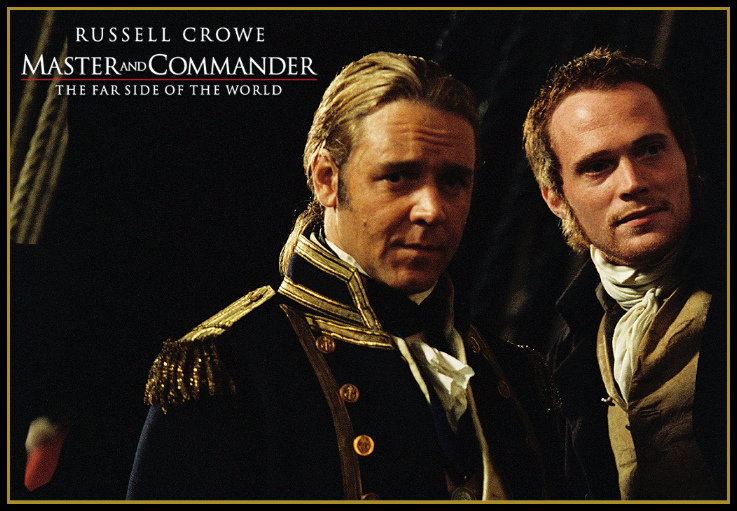
Quickie Review: Master and Commander: The Far Side of the World (Peter Weir)


If there was a film which deserved better when it first came out in 2003 it would be Peter Weir’s epic adaptation of the Patrick O’Brian seafaring novels starring the character of Capt. Jack Aubrey. It was just bad luck on the part of Weir’s film that it came out the same year and month as the juggernaut that would sweep through not just the box-office for the 2003 holiday season, but all through the award-season. If Master and Commander: The Far Side of the World had only come out a year later there’s a great chance it would’ve been the frontrunner for 2005 Academy Awards for Best Picture, Best Director, Best Adapted Screenplay and many more. But the juggernaut that was Peter Jackson’s Lord of the Rings: The Return of the King would not be denied after two previous years when Jackson and his magnum opus were passed over.

To say that Peter Weir was at the top of his game with Master and Commander would be an understatement. Working from a script written by Weir himself and John Collee, the film would take several episodes from the Patrick O’Brian Aubrey-Maturin novels and combine them to make a coherent and thrilling period piece that rarely ever get made anymore. This was epic filmmaking at its finest with Weir’s direction keeping the long-running time of the film from becoming too tedious. Yet, he was also able to keep the film from becoming one battle setpiece following another. There was enough of a balance between the quiet storytelling, especially between the characters of Capt. “Lucky” Jack Aubrey (played by Russell Crowe in what had to be his best role ever) and his close friend and ship’s doctor Stephen Maturin (Paul Bettany matching Crowe scene for scene) to keep the film grounded in reality.

Master and Commander is set during the Napoleonic Wars when France and England battle it out on land and in the high seas. On one side is the HMS Surprize captained by Jack Aubrey which patrols the sea lanes from French privateers looking to attack and loot the rich English whaling ships to help fund Napoleon’s ambitions. The film is actually a cat-and-mouse thriller wrapped around a character piece as Aubrey’s ship and crew, outgunned and less armored than the French frigate Acheron it has come across during its patrol, must not just try and survive but find a way to beat it’s larger opponent. It’s during the quiter scenes in-between sea engagements that the film actually becomes stronger. We see life onboard the HMS Surprize as being quite harsh and primitive and not so glamourous as past films about sailing life would have audiences believe. The film shows how this harsh life for volunteers and press-ganged crew ratings creates a strong bond of fellowship amongst the crew members that when they believe someone is jeopardizing their lives they quickly turn on that individual. But it’s through the near-dictatorial handling of his crew which keeps both ship and crew from devolving into mutiny. Crowe does a great job of giving Jack Aubrey that balance of ruthless taskmaster whose word is law onboard, but also gives his captain that bon vivant flair which when used accordingly makes Aubrey a hero to the very men he has to lord over.

This benevolent dictator was balanced out by Bettany’s Dr. Maturin who acts not just as the scientific counter to Aubrey’s militaristic personality, but also as the conscience of the ship who looks first to the crew’s well-being. This dynamic between Crowe and Bettany kept the film anchored and stabilized as we see the long-standing friendship between these two get tested not just by the crisis they find themselves in but also the vast ideological differences between the military man and the scientist. Yet, despite all their problems and difference when things became rough the two would settle it amicably and concentrate on their shared task with their bond of friendship intact and much stronger after.

The film doesn’t shirk it’s thrills as Master and Commander provides audiences with some of the most thrilling and accurate portrayal of naval combat during the Napoleonic era. There are no steel-hulls or rapid-fire guns. The engagements between the HMS Surprize and the Acheron were all brutal affairs from the first time the latter ambushes Aubrey’s ship early in the film to the final battle which sees not just ship-to-ship fighting but boarding actions as the crew of the Surprize attempt a desperate gamble to take the fight to the bigger French privateer. It’s a testament to Weir’s direction that even through the chaotic nature of each battle he’s able to keep each scene easy to follow and allow for main characters to stand out for audiences to recognize.

It’s a shame that the film didn’t succeed in the box-office more than it did. Master and Commander: The Far Side of the World showed that there was still old-school epic filmmaking left in Hollywood with filmmakers willing to tell a grand story with bigger-than-life characters on a broad canvas. The fact that it took an even more epic film to surpass Peter Weir’s film shouldn’t detract from this film’s accomplishments.

With Love, 6 Trailers From Lisa Marie and Evelyn


So, last night, I was feeling a bit down for a number of reasons so my BFF Evelyn came over and we had a little slumber party of sorts in my living room.  And before everyone does a double take and accuses me of trying to be all like Paris Hilton, let me just explain that when we refer to each other as being “BFFs,” we’re not just being sincere but we’re being postmodernly satiric.  It’s kind of the same principle behind why me and my sister Erin tends to casually toss around the word “bitch” whenever we’re having a conversation.  Of course, “BFF” doesn’t inspire quite the same reaction from the older folks at the family reunion as “bitch” does but that’s a whole other story.

Anyway, as I informed everyone earlier on twitter, Evelyn and I did all the usual things that you do at a slumber party.  We stripped down to our underwear, watched horror movies, ate food that we shouldn’t have eaten, had a violent pillow fight, and swore that we would never reveal the divine secrets of the ya ya sisterhood.  I also recruited her to look through all the possible picks for the latest edition of Lisa Marie’s Favorite Grindhouse and Exploitation Film Trailers and help me narrow them down to just 6 trailers. 

This, she helped me down without (too much) complaint.  Though it may not always be apparent, deciding which 6 trailers to feature each week is actually a pretty long and thorough process and it’s one that can be very tedious if you’re not a fan of these movies.  I think a lot of people would have said, “Who cares?  Just toss up 6 random trailers and be done with it.”  Not Evelyn.  Even as I forced her to watch some really odd and kinda disturbing trailers, she stuck with it until we had this week’s 6 trailers.  She even put up with me explaining to her why a certain trailer was more grindhouse than another.  And that is one of the many reasons why I love Evelyn and why she’ll always be my BFF.

And here’s the 6 trailers that she helped me pick for this week…

1) Stigma (1972)

Okay, Evelyn and me both literally fell in love with this trailer from the minute we heard that narrator say “The curse that begins with a kiss.”  Needless to say, we both jumped to a conclusion as to what that curse was and let’s just say it wasn’t syphilis.  But anyway, this appears to be some sort of cross between an old educational short and a blaxploitation film.  I haven’t seen this film yet and hadn’t even heard of it until I came across the trailer but now, it has become one of my obsessions.  I must see Stigma.  I must find out about the curse that begins with a kiss…

2) The Magic Garden of Stanley Sweetheart (1970)

Wow, isn’t that just the most annoying title ever?  It just screams “FILM SCHOOL GRADUATE!” at the top of its trust funded lungs.  Still, this trailer does have one line that made me laugh out loud and that line was: “Where am I going?”  Otherwise, this trailer is also memorable for the horrid “gingerbread” song that plays over the first few clips .  Evelyn claims that the song is now stuck in her head, which is pretty bad since the entire song is basically “something something gingerbread something something gingerbread…”  Evelyn thinks that Stanley (played by Don Johnson of A Boy and His Dog and The Harrad Experiment) looks hot in this trailer.  I think he’s a little bit too much of a pretty boy.  Neither one of us can believe that he later grew up to be the redneck in Machete.

3) Death Journey (1976)

Fred Williamson is …. Jesse Crowder!  Despite our different feelings concerning the appeal of Stanley Sweetheart, both Evelyn and I agreed that Jesse Crowder would kick his scrawny little ass.  That said, I objected to the “I’m going to bruise you up a little” line towards the end of the trailer but Evelyn defended it, making the argument that Crowder would have bruised up a man with a knife as well.

4) Rivals (1972)

“It could have been … a love story.”  Much like Stigma, this is a case of us just falling in love with a overdramatic tag line.  Apparently, the film itself appears to be a grindhouse version of Cyrus.

5) Zachariah (1971)

We had to include Zachariah because, as the trailer explains, this was the world’s first electric western.  Add to that, Don Johnson looks a bit less fancy here than he did as Stanley Sweetheart.

6) Get Carter (1971)

We saved the best for last.  Now, I know that the original Get Carter is such a classic (especially when compared to the Stallone version) that you might wonder if it really belongs here.  Well, trust me, it does.  Get Carter is pure grindhouse art and this trailer proves it.  Plus, both me and Evelyn were surprised and delighted to discover that once upon a time, Michael Caine was quite the sexy beast.  When, at the end of the trailer, we were told to “Get Carter before he gets you,” we both responded with, “Carter can have us.”

Lisa Marie Hates Your Highness (dir. by David Gordon Green)


I saw the new “comedy” Your Highness a few days ago.  I say “comedy” because I’ve been told that the film is supposed to be a “comedy.”  Usually, however, a comedy also inspires a certain amount of laughter and I laughed exactly one time while watching Your Highness.  I can’t remember what joke it was that made me laugh.  Maybe I just couldn’t believe that this film had been made in the first place. 

The film is meant to be a satire on all of the fantasy films that have come out in recent years.  Danny McBride plays a cowardly prince who goes on a quest to rescue his brother’s fiancée from an evil warlock.  (The brother is played by my future lover, James Franco. )  During the quest … oh Hell, who cares?  The film’s idea of a joke is to have various character say “shit” and “fuck” while wandering around in a suit of armor.  Apparently, this joke is so hilarious that it pops up every 3 minutes or so.  This movie is kinda like an annoying 5 year-old who doesn’t understand that we’ve all heard his freaking knock knock joke before.

Definitely, if someone tries to convince you to see this film, run.  Personally, I watched it because James Franco is in the film but Franco’s hotness is obscured by a really bad wig.  Natalie Portman’s in this film as well, giving a surprisingly good comedic performance, and — check it out, boys! — you get to see her in a thong.  That’s right.  The boys get one of the best actresses of modern times in a thong while me?  I get James Franco with his undeniable sexiness buried underneath a lot of hair.  It doesn’t seem quite fair.

Film Review: Network (dir. by Sidney Lumet)


With the recent passing of director, Sidney Lumet, I decided to watch one of Lumet’s best-known films, the 1976 best picture nominee Network.

Network tells the story of Howard Beale (played by Peter Finch).  Howard is a veteran news anchor at a fictional television network.  Because his ratings are in decline, Howard is fired.  Howard reacts to this by announcing that he will commit suicide at the end of the next broadcast.  Ironically, so many people tune in to see Howard kill himself that his ratings improve and Howard gets to keep his job under the watchful eyes of news director Max Shumacher (William Holden) and network executive Dianne Christiensen (Fay Dunaway). 

At the same time, Max and Dianne are adulterous lovers.  The course of the film’s narrative finds Max abandoning his wife (Beatrice Straight) and Dianne, who is described as a “child of the tube,” enthusiastically trying to produce an early reality television show starring a group of Marxist revolutionaries.  They do this under the paranoid eyes of network president Frank Hackett (Robert Duvall) and Frank’s boss, the corrupt Arthur Jenson (Ned Beatty).

However, Howard Beale isn’t just an over-the-hill news anchor.  He’s actually a seriously mentally ill man who hears voices and who starts to see himself as some sort of messiah.  Eventually, this leads to a disheveled Howard giving a crazed speech in which he encourages viewers to yell, “I’m as mad as Hell and I’m not going to take it anymore!”  Yes, this is the famous scene that is always used whenever some pompous media jackass wants to criticize the current state of television.  Even though I think it’s one of the most overrated scenes in history, here it is:

Anyway, after this scene, Dianne starts to promote Howard as the “Mad Prophet of the Airwaves” and Max gets all outraged over how the news no longer has any integrity (bleh, Max is kinda full of himself) and eventually, Howard’s mad rantings get the attention of Arthur Jenson who has plans of his own for Howard.  The whole thing eventually ends on one of those rather dark notes that’s impressive the first time you watch it but just seems more heavy-handed and clumsy with subsequent viewings.

As you might be able to tell from my review, I almost felt as if I was watching two different movies when I watched Network.  For the first hour, the movie is a sharp and clever satire on the media.  The characters are sharply drawn, the performance are full of nuance, and even the villainous Dianne is allowed a bit of humanity.  And then, Howard gives his famous “mad as Hell” speech and the entire freaking film pretty much just falls apart as suddenly, all the characters start to act like cartoons.  The film’s satire becomes so heavy-handed that you actually find yourself wanting to watch something mindless and brainless just because you know it would piss off self-righteous old Max.  The actors stop acting and instead concentrate on shouting.  Whatever humanity Dianne had been allowed suddenly vanishes and she just becomes yet another stereotypical “castrating bitch.”  Max gets to spend a lot of time telling her why she’s worthless and it pretty much all comes down to the fact that 1) she’s under 40 and 2) she has a vagina.  (Never mind the fact that Max has abandoned his wife, apparently men are allowed to be assholes.)  By the time the 2nd half of the film ends, you don’t care about whatever the film’s message may have been.  You’re just happy that everyone has finally shut up.

As I sat through the second half of this film, it soon became apparent to me why Aaron Sorkin has continually cited Network‘s screenwriter Paddy Chayefsky as a major influence.  Chayefsky won an Oscar for writing Network and he’s constantly cited as one of the greatest screenwriters of all time but, quite frankly, his script isn’t that good.  Much like Sorkin’s work, you’re aware of the screenplay not because of what the characters say but because they say so much.  This is the type of film that is often wrongly called prophetic by bitter old men.  This is largely because the script itself was written by a bitter old man.  The only true insight one gets from this movie is the insight that the old will always view the young and the new as a threat.

And yet, even as the second half of the film collapses around us, Network still holds our attention.  We’re still willing to stick around to see how all of this ends (and keep an eye out for a 17 year-old Tim Robbins who made his uncredited film debut at the end of Network).  This has nothing to do with anything written by Paddy Chayefsky and everything to do with the direction of Sidney Lumet.  I once read somewhere that you can’t make a good film out of a bad script.  I’m not sure who said that though it has a definite William Goldman sound to it.   Well, if nothing else, Network proves that this is not always the case. 

To me, there is no more fitting tribute to Sidney Lumet than to say that he somehow managed to create something worthwhile out of Network.

Lisa Marie Discovers All Good Things (dir. by Andrew Jarecki)


I’ll admit right now that I’m a true crime junkie.  Maybe it’s because I work for a lawyer or maybe I’m just morbid-minded but, for whatever reason, I am fascinated by this stuff.  And while we all love to watch a good mystery and see if we can solve it before everyone else, it’s the mysteries without a solution that hold a special grip on my imagination.  That’s why I was really looking forward to seeing the film All Good Things.  Directed by Andrew Jarecki and starring Ryan Gosling, All Good Things is based on not one true crime case but three!  (And two of those crimes remain unsolved to this day.)

All Good Things is based on the life of Andrew Durst, who was born into a wealthy New York family just to eventually find himself accused — at one time or another — of two murders and actually put on trial for a third.  Oh, and did I mention that in-between being accused of killing people, Durst also found the time to drop out of high New York society and, despite being a very wealthy man, wandering around the country like a homeless transient?  And, would you also believe that when Durst eventually ended up moving down to Galveston, Texas, he apparently also became a transvestite?  And once Durst was in Galveston, he ended up living in a run-down boarding house with another transient who Durst eventually ended up decapitating?  Of course, all of this happened long after the mysterious disappearance of his first wife and the execution-style shooting his best friend (who also happened to be the daughter of a Las Vegas mob boss).  Durst, it should be noted, has only been put on trial once and, in that case, was acquitted.  (For a better account of the various unproven allegations against Robert Durst, click here.)

Yes, Robert Durst is a man who has found himself at the middle of several very intriguing mysteries and All Good Things pretty much sticks to the facts of the case, recreating all the scenes that we Durst watchers are familiar with while leaving the ultimate question of Durst’s guilt or innocence ambiguous.  For legal reasons, the names are changed but that’s about it.  The film even begins with a title card telling us that the film is based on the Durst case even if Ryan Gosling is technically playing a character named David Marks.  We watch as David meets and romances sweet but lower class Katie (Kirsten Dunst) despite the disapproval of his wealthy father.  (David’s father is a real estate mogul who owes his fortunes to the peep shows and grindhouses on 42nd Street.)  Once David and Katie have married, we watch the marriage turn into a nightmare as David grows increasingly abusive and Katie starts to abuse drugs.  We meet all the familiar characters that we know about from reading about the case, especially David’s devoted friend Deborah (Lilly Rabe).  We see the way that Deborah fanatically defends David after Katie mysteriously vanishes and eventually, we see David in Galveston, a blank-faced recluse who has lost the ability (if he ever had it) to exist in reality.   Yes, it’s an interesting story but does the film do it justice? 

Frustratingly, the answer is yes and no.

There’s a great movie to be found in the life of Robert Durst and unfortunately, director Andew Jarecki doesn’t find that great movie with All Good Things.  Despite telling a fictionalized version of a true story, Jarecki still approaches the material as if he’s making another documentary.  By simply concentrating on the public record of the Durst case (and, for the most part, declining to engage in any poetic license while telling the story), he keeps his distance from the characters and their world and, as a result, you watch fascinated because the story is so bizarre but not because you have any emotional investment in anything happening onscreen.   Like a good documentarian, Jarecki concentrates on providing the evidence and leaving the ultimate verdict to the audience.  If this film was a documentary about Robert Durst, this would be commendable.  However, All Good Things is a movie about a vaguely sinister guy named David Marks who remains a cipher throughout the entire film.

However, this is not the fault of the cast who manage to redeem this movie with several carefully conceived character turns.  In a frustrating and vague role, Ryan Gosling gives a far better performance than anyone would really have the right to expect.  He plays the role with a vague sense of blank desperation, creating a portrait of a man who wants to fit in with reality but just doesn’t know how to do it.  When we first meet see David wandering around 42nd street and struggling to maintain a facade of normalcy, it’s hard not to feel sorry for him.  He looks like a lot child and your natural reaction is to want to protect him and help him find his place in the world.  Add that vulnerability to the fact that he looks like Ryan Gosling and you can believe that Kirsten Dunst’s character would find him attractive and would eventually marry him, despite his quirks.  Its only once David is married (and, in theory, no longer has to worry about losing Dunst) that he starts to show his true face.  Any woman who has ever been in an abusive relationship will know the type of person that David Marks is.  As played by Gosling, he becomes every boyfriend or husband who has ever transformed into a different person once we’ve made the mistake of falling in love with him.  He’s every man we’ve ever been happy to have out of our life even as we wondered if we were to blame for whatever went wrong.  Gosling’s strongest moments come when David simply stares at his own reflection, the look on his face indicating that he’s just as confused by himself as we are.  Kirsten Dunst is sympathetic as his wife and there’s excellent character turns from Frank Langella, Philip Baker Hall, Diane Venora, and Lilly Rabe.

So, what I recommend All Good Things?  I would.  It makes for a good introduction to the Durst case and, if nothing else, it’s worth seeing for Gosling’s performance.  The definitive version of Durst’s case hasn’t been told yet but All Good Things is, at the very least, a start.

6 Trailers In Search Of a Title


Without further delay, here’s the latest edition of Lisa’s favorite grindhouse and exploitation trailers.

1) Something Weird (1967)

I just had to start out with this because it represents everything that I love about these old school exploitation trailers.  It’s just so shameless and cheerful about it all.  This film is from Herschell Gordon Lewis and it features ESP, a really kinda scary witch, and a random LSD trip.  The title of this film also inspired the name of one of my favorite companies, Something Weird Video.  (I make it a point to buy something from Something Weird every chance I get.  My most recent Something Weird video is a film from the 60s called Sinderella and the Golden Bra.  Haven’t gotten a chance to watch it yet but with a title like that, how could it be bad?)

2) Fade to Black (1980)

This is actually a really, really bad movie and I think the trailer goes on for a bit too long but it does have a few vaguely effective moments — i.e., when Dennis Christopher stares at the camera with half of his face painted.  Plus, you can catch a young Mickey Rourke acting a lot like Michael Madsen. 

3) Monster Shark (1984)  

Now you may think that since this Italian film was directed by Lamberto Bava (credited here as John Old, Jr. because his father, Mario, was occasionally credited as John Old, Sr.) and has the word “shark” in the title that it’s yet another rip-off of Jaws.  Well, joke’s on you because, as they state repeatedly in the trailer, “It’s not a shark!”  Even if you didn’t know this was an Italian film before watching the trailer, it wouldn’t be hard to guess.  First off, there’s the dubbing.  Then there’s the scene of the film’s main character wandering around aimlessly.  (Most Italian horror trailers feature at least one scene of someone just walking around.)  And finally, there’s the fact that this is yet another trailer that uses a sped-up version of Goblin’s Beyond The Darkness soundtrack for its background music.  While I haven’t seen this film yet, I plan to just to find out who Bob is.

 4) Van Nuys Boulevard (1979)

Originally, I was planning on including the trailer for a Ted V. Mikels’ film called The Worm Eaters right here but I reconsidered because, quite frankly, The Worm Eaters is one of the most disgusting, stomach-churning things I’ve ever seen.  I’m going to wait until I find five other equally disgusting trailers to feature it with and then I’m going to put them all up under the heading: 6 Trailers To Inspire Vomit.  Until then, enjoy a far more pleasant trailer — Van Nuys Blvd.  This trailer rhymes!  I’m tempted to say that I could have written it but then again, I only write free verse poetry.  Anyway, where was I?  Oh yeah, Van Nuys Blvd.

5) Vice Squad (1982)

However, there was a darker side to Van Nuys Blvd. and here it is: Vice Squad, starring Wings Hauser.  Eventually, I’ll review this film but until I do, check out our new friend Trash Film Guru’s review.

6) Crosstalk (1982)

We’ll conclude with the only thing scarier than Wings Hauser in Vice Squad — a computer that has not only witnessed a murder but enjoyed it!

What Lisa Watched Last Night: The Haunting of Sorority Row (dir by Bert Kish)


On Friday night, after we saw the movie Hanna, a friend Jeff and I returned back to my house and retreated to my bedroom where he eventually fell asleep and I tried to sleep.  Insomnia, however, won out and I ended up watching a Lifetime horror movie called The Haunting on Sorority Row.

Why Was I Watching It?

I couldn’t get to sleep.  Poor me.  So, I turned on the TV, checked out what was on the DVR, and as soon as I saw The Haunting of Sorority Row, I knew what I had to do.  Somehow, I forgot that, regardless of how low I turned down the sound the last time I was watching it, whenever I turn on my TV, the volume is always reset to full blast.  So, as soon as I hit play, the TV literally thundered to life and woke up not only Jeff but probably the rest of the neighborhood as well.

As I frantically turned down the volume, Jeff sat up in bed and asked, “What’s this?”

“It’s a movie,” I said, “Sorry, I couldn’t sleep.”

“I bet it’s a horror film,” he said.

“Yeah,” I nodded.  Then I looked over my shoulder, gave him my wicked little smile (well, I like to think of it as being my wicked little smile), and I added, “It’s a Lifetime horror film.”

“Oh,” he replied, sounding much less enthusiastic.

Anyway, The Haunting of Sorority Row put him back to sleep in about five minutes.  Me, I still haven’t slept which is why I’m still sitting here in my beloved Pirates t-shirt while Jeff peacefully sleeps behind me.  Maybe after I finish writing this, I’ll give sleep another chance.

What’s The Movie About?

It’s about a haunting on sorority row.  More specifically, it’s about a really angry ghost who is determined to kill the four sorority sisters who are hiding a secret.  Their ringleader is Leslie who is played by an actress named Lisa Marie Caruk.  And that’s a great name.  Anyway, Blair Waldorf herself, Leighton Meester, is also pledging this haunted sorority and she is determined to set things right.

What Worked?

Oh, this is a Lifetime Movie so everything worked.  I mean, you know what you’re getting with Lifetime and part of the reason why we love Lifetime movies is because they’re all exactly the same.  The perfect Lifetime Movie is the epitome of a stupid movie that can be best enjoyed by intelligent women with a healthy sense of the absurd.  I’d like to think that I qualify on all three of those.

That said, there were a few things that worked even if you decided to ignore the fact that they were found in a Lifetime film.  Not surprisingly, the nearly-all female cast was a lot more likable and their roles were a bit more developed than you’d expect to find in a horror film.  Leighton Meester is probably one of the most underrated actresses working right now and she does a great job playing the film’s “final girl” while Lisa Marie Caruk has a lot of fun playing the bullying head of the Sorority.

Another thing that worked here was the great pleasure that I got out of imagining how many of you guys rented this film thinking it was a typical, Dead Women In Lingerie Slasher Film just to discover that it was instead a Lifetime movie.

What Didn’t Work?

This film works pretty well as a Lifetime movie but it totally sucks as a horror film. A lot of this is due to the fact that this is a TV movie which pretty much means that it can’t really show anything that would scare us. 

As often happens in Lifetime movies, the main character’s boyfriend is a eunuch.  In this one, we’re asked to believe that an 18 year-old boy would refuse to have premarital sex with Leighton Meester.  Yeah, right.  Because boys have so much self-control…

Finally, this is another one of those films that suffers from having a final twist that’s so obvious that most viewers will figure it out before the movie even begins.  Yes, it’s that obvious.

“Oh my God!  Just like me!” Moments

There’s a scene in which one of the unfortunately sorority sisters ends up getting trapped in the shower and scalded to death by hot water.  This is scene vaguely disturbed me because 1) I’m claustrophobic, 2) I have a fear of scalding water, and 3) I’ve actually managed to get trapped in a shower before and I had to scream and scream until someone heard me, ran into the bathroom, and told me that I needed to pull (as opposed to pushing) the shower door in order to open it.  Of course, my hands and arms were too busy trying to cover up me for me to take his advice on the door.  So, I said. “Thank you. sir,” and then waited until he left.

Otherwise, it was hard for me to relate to this film because I never pledged nor did I ever want to pledge a sorority in college.  I was actually invited to do so by one of them but, at the time, I said, “No, that’s way too bourgeois  for me.” 

“Bourgeois?” she replied, confused.

Lessons Learned 

I definitely did the right thing by never joining a sorority.