Lisa Marie Finally Gets Around To Reviewing Cedar Rapids (dir. by Miguel Arteta)


So, in my review of The Beaver, I talked about the annual Hollywood Black List and how the movies that are always listed at the top of the black list usually turn out to be vaguely disappointing.  Well, in that review, I failed to mention that The Beaver was not the only Black List film that I’ve seen (so far) in 2011.  A few months ago, I saw the film that topped last year’s list, Cedar Rapids.  (The Cedar Rapids screenplay, by the way, was written by Phil Johnston.)

Now, Cedar Rapids (which is scheduled to be released on DVD in June) actually had a pretty good run down in here in Dallas.  Unlike Austin, Dallas is not a film-crazed city and — with only four theaters currently specializing in indie and art films — it’s usually a case of “you snooze, you lose” when it comes to seeing anything out of the mainstream.  We’ll have a few hundred theaters all showing something like Avatar for half a year but a film like James Gunn’s Super will usually sneak in, play in one theater for two weeks, and then just as quickly vanish.

Cedar Rapids, however, stuck around for about a month and a half, playing exclusively at the Dallas Angelika.  It took me a while to actually find the time to go see it (and, perhaps because of the whole Black List thing, I just didn’t feel much enthusiasm for seeing it) and, in fact, I ended up seeing it the last day it played at the Angelika. 

As for why I wanted to see it — well, it had gotten some very positive reviews from critics who traditionally don’t give comedies good reviews so that piqued my interest.  I knew that the film featured three of my favorite character actors — John C. Reilly, Stephen Root, and Thomas Lennon.  The film was also being touted as a comeback for Anne Heche whose autobiography Call Me Crazy was a favorite book of a former roommate of mine.  Finally, I wanted to see the film because it starred Ed Helms, who, at the time, I thought seriously might end up as the new boss on The Office.

Helms, in case you don’t know for some reason, plays Cornell graduate Andy Bernard on The Office.  When he first appeared during the show’s third season, he was portrayed as an incredibly obnoxious preppy with an anger management problem and I loved how Helms so thoroughly threw himself into making Andy just the most annoying human being ever.  Andy was eventually sent to anger management classes and, upon returning, the character has become less obnoxious and just more buffoonish and, in my opinion, a lot less entertaining.  As well, with Jim and Pam now safely married, Andy ended up as the focus of some of the Office’s weakest episodes.  In fact, Andy was the center of so many episodes earlier this season that I found myself wondering if the show’s producers weren’t perhaps trying to see how the audience would react to Ed Helms becoming the new star of the show.  Since I had mixed feelings about that prospect, I felt that maybe Cedar Rapids would provide me with an answer.

In Cedar Rapids, Ed Helms plays Tim Lippe, an almost impossibly innocent insurance agent who is sent by his boss (Stephen Root, who appears to be the go-to guy when you need someone to play a friendly but vaguely threatening manager) to a regional conference in Cedar Rapids, Iowa.  Tim is ordered to conduct himself well, to go out of his way to impress the conference president (Kurtwood Smith), and to win the prestigious “Two Diamonds” Award.  (The award has been won for the company in the past by Helms’ rival at the company who, at the beginning of the film, accidentally kills himself while practicing autoerotic asphyxiation.  The rival is played by Thomas Lennon and I’m kinda sorry that Lennon didn’t have more scenes because seriously, he always makes me smile.)

After saying goodbye to his much older girlfriend (Sigourney Weaver, who is wasted in her cameo), Helms heads off for Cedar Rapids.  This is a big deal for him because he’s the type of movie innocent who has never even been on a plane before.  Helms arrives at Cedar Rapids determined to do the right thing but he soon discovers that he is rooming with Dean Ziegler (John C. Reilly), a loud, crude, and cynical agent who indulges in every vice that Helms has been ordered to avoid.  Needless to say, Helms initially tries to resist being drawn into Reilly’s orbit but soon, he finds himself being corrupted and enjoying it.  Through Reilly, he meets yet another insurance agent (played by Anne Heche) that he soon finds himself falling in lust with.  All this happens, of course, under the disapproving eye of Kurtwood Smith and Helms soon learns just how far he is expected to go to win that Two Diamonds Award…

As it might be obvious from the above description, Cedar Rapids is one of those films that attempts to be both a wild comedy and a poignant coming-of-age drama.  And it succeeds very well at being a comedy and it does pretty good job of being a drama but it never manages to do both at the same time.  The end result is an entertaining but wildly uneven film that never feels like it’s quite as good as it should be. 

The film is at it’s best when it’s just Helms, Reilly, Heche, and Isiah Whitlock, Jr. (playing another insurance agent) hanging out and BSing.  Those scenes ring well and all four of these actors have a real ensemble chemistry together.  You really do end up believing that Reilly, Heche, and Whitlock truly do care about their new friend and you just as strongly believe that Helms really is falling in love with Heche.  These are the best scenes in the movie. 

The film is less effective when it tries to be something more than just an ensemble comedy.  It’s in these scenes — with Kurtwood Smith quoting bible verses and the Two Diamonds Award becoming a metaphor for all sorts of things — that the film gets heavy-handed and a bit boring.  I also have a feeling that these scenes are probably the reason why so many Hollywood readers went nuts of the Cedar Rapids screenplay because these scenes are the least challenging in the film.  These are the scenes that pat you on the back for watching the movie.  Anyone who has ever seen a movie knows that Kurtwood Smith’s character is going to turn out to be a hypocrite because when was the last time that you see a movie in which the guy who talked about Jesus didn’t turn out to be a hypocrite?  Therefore, it’s kinda hard to buy into Helms’s shock when he discovers that Smith isn’t all that he’s cracked up to be.  I mean, I can force myself to buy that the Helms character has never been on a plane before but my God, has he never seen a movie or an episode of Law and Order before either?  Seriously, the character isn’t a Mennonite.  He’s just from the midwest.

In the lead role, Ed Helms is a lot like the movie.  He’s great when he’s just a member of the ensemble but sometimes seems to struggle a bit in the more dramatic scenes.  To a large extent, the problem is that the film goes so out of it’s way to present Helms as being some sort of man-child that it’s hard to take him seriously once he suddenly starts to think for himself.  As I previously stated, the supporting cast is uniformly strong.  Reilly is a drunken, foul-mouthed force of nature while Heche steals every scene that she’s in and, in the end, proves herself to really be the heart and soul of the film.

So, in the end, I guess I would say that Cedar Rapids, as uneven and as frustrating as it occasionally turned out to be, is worth seeing once it comes out on DVD in June.

Lisa Marie Gets Super (dir. by James Gunn)


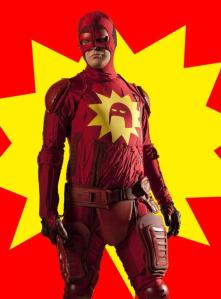
Super, a very dark and very Catholic comedy that pretends to just be your standard issue super hero movie, played for about three weeks down here in Dallas.  Despite a cast that included Kevin Bacon, Liv Tyler, Ellen Page, and Rainn Wilson, it kinda came and went like a ship in the night.  It got a few vaguely confused reviews from the local critics and the audience that I saw the film with seemed to be pretty confused as to what they were watching.  Which is a shame because if you give the film a chance, you’ll discover one of the best films of 2011.

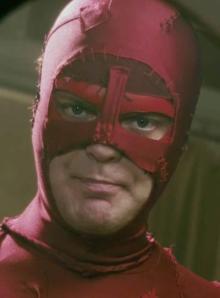
In Super, Rainn Wilson plays a short order cook who, at various points in his life, has had visions in which he believes God has spoken to him.  When his wife, an ex-drug addict played by Liv Tyler, leaves him for a sleazy club owner and low-level drug dealer (Kevin Bacon), Wilson sinks into a deep depression until finally he has a vision in which God sends a bunch of hentai-style tentacles to cut off the top of Wilson’s head and literally place an idea in there.  That idea is for Wilson to become a costumed super hero and fight “evil.”

So, that’s what Wilson does, dressing up in what looks like a low-rent Halloween costume, and taking on all those who he considers to be evil and/or doing the wrong thing.  This could be anything from dealing drugs to cutting in line at the movies.  (And this is a big reason why I loved Super because it asked the same question that I always wonder when I see a super hero movie — i.e., who is to say what’s wrong and what’s right?)  Calling himself The Crimson Bolt, Wilson soon becomes a cult figure in the city but he still finds himself incapable of getting Tyler away from Bacon. 

Eventually, he finds himself saddled with a sidekick.  Ellen Page, giving a performance just as award-worthy as her more acclaimed role in Juno, plays Libby, who works in the local comic book store.  She is the only person who figures out that Wilson is actually the Crimson Bolt and she quickly decides that they should work together.  Calling herself Boltie, Page quickly turns out to be just as zealous in the pursuit of “justice” as Wilson.  Unlike Wilson, who sees himself as being on a holy mission, Page appears to just be happy to have an excuse to kill people.

It all leads to the expected final confrontation with the bad guys and a surprisingly poignant ending which forces the viewer to reconsider what they thought they knew about every character in the film.

Super’s low-budget is obvious in almost every frame of the film but it works to the movie’s advantage, creating an almost defiantly gritty atmosphere.  The film is also full of good performances.  I already mentioned Page but, in the lead role, Rainn Wilson is perfectly cast.  For those of us who love him on The Office, it’s sometimes hard to realize that Wilson is not Dwight Shrute, he’s just an actor playing a role.  However, with Super, Wilson proves himself to be a charismatic actor who, if given the right role, can easily carry the film.  Towards the end of the film, one of the bad guys taunts Wilson for concerning himself with seemingly minor things like people cutting in line.  Wilson shouts, “You shouldn’t cut!” with such righteous fury that it becomes clear  that he’s not talking about cutting in line as much as he talks about living in a world where people just no longer seem to care about doing the right thing.  It’s an unexpectedly effective scene and line and Wilson handles it perfectly.

Super is the latest film from a genius named James Gunn.  Now, I should admit that I am like crazy in lust with James Gunn.  Seriously, he’s handsome, he’s funny, he’s talented, he’s hot, he’s vulnerable, he’s dangerous, he’s Irish, and he comes from a Catholic background, which is pretty much a perfect description of my dream man.  Plus, he talked to me once on twitter and as a result, I got all giggly and red-faced and I sent him all of these gushy tweets which he never responded to, probably because I was like totally coming across like some sort of psycho stalker type.  So, some people are probably saying, “Well, gee, Lisa Marie, are you sure you’re not just letting your damp panties review this film as opposed to your unbiased judgment as a film watcher?”  And to those people, I say, “Shame on you and watch your mouth.  And speaking of mouths, guess where my mouth would be if I ever met James Gunn…”

Mon amour James Gunn

But let’s get back Super.  Super has been frequently compared to Kick-Ass (even though Super actually went into production first) and, on the surface, they do appear similar.  It’s only when you dig and look under the surface that you discover that Super and Kick-Ass have about as much in common as I do with that overly friendly girl who always takes our tickets at the Angelika.  (She’s the same girl who needs to stop smiling so much at Jeff every time we try to get popcorn.  Seriously, not kidding.)  While Kick-Ass was undeniably violent, it was also one of those films where the violence was rarely lingered over.  Super is not only incredibly violent but it’s also incredibly bloody.  Gunn doesn’t just show us the violence but he shows us the end results of the violence as well and, as a result, the audience is forced to consider how much we love to see people getting shot in the head just as long as we don’t have to worry about seeing the body afterwards.  Whereas Kick-Ass’s Aaron Johnson was portrayed as being a comic book fan who got to live out his fantasy, Rainn Wilson in Super is specifically portrayed as not being a comic book fan as much as he’s just a genuinely unstable guy who becomes a super hero in order to maintain the delusional black-and-white morality of his worldview.  Whereas Chloe Grace Moretz’s Hit Girl was portrayed as having been raised to kill, Ellen Page’s Boltie kills simply because she now suddenly has the opportunity to do so.  Finally, Kick-Ass actually ended up fighting true evil doers whereas the villains played by Kevin Bacon and Michael Rooker, in Super, are probably the most stable and sensible characters in the entire film.

In short, Super is that perfect rarity — a truly transgressive work of popular entertainment.

Yes, Super is one of those films that delights in challenging and even ticking off the audience.   The common filmgoer watches and asks, “If it’s a drama, then why is it so funny?  If it’s a comedy, then why does Rainn Wilson’s heartbreak seem so real and sincere?  If Rainn Wilson and Ellen Page are the good guys, why does the film suggest that they both might be sociopathic?  If Kevin Bacon’s the bad guy, why is he so likable here?”  As a result, the common filmgoer probably walked out of Super feeling confused and slightly annoyed that things didn’t work out the way they were expecting. 

Well, you know what?  The common filmgoer sucks.  The common filmgoer is responsible for every bad thing that has ever happened in the history of the world.  The common filmgoer is wasting oxygen that you, my deeply enlightened friends, could make much better use of.  This is not the site for the common filmgoer and if you’re still reading, then you’re not a common filmgoer either.

Super was made with you in mind.

Lisa Marie Talks About The Beaver (dir. by Jodie Foster)


So, there’s this thing in Hollywood that they call the Black List.  The Black List comes out at the end of each year and basically, it’s a list of the “best” unproduced screenplays of the year.  The reason I put best in quotation marks is because the list is 1) determined by studio people and studio asskissers and we all know that those people are toadsuckers, 2) film is not a writer’s medium so the best screenplay in the world can still be ruined if the wrong director gets involved with it, and 3) the films made from the scripts on the blacklist always seem to end up sucking like I did during my sophomore year of high school.  Seriously, that was a lot of sucking.

The Beaver (written by Kyle Killen) was at the top of the Black List in 2008 and now, 3 years later, it’s finally been made by Jodie Foster and released to mixed reviews and indifferent box office.  I saw The Beaver on Saturday.  So does, the Beaver continue the tradition of disappointing movies being produced from Hollywood’s “best” screenplays?  Well, yes and no.  The final 20 minutes of the Beaver are incredibly effective and almost moving.  Unfortunately, they’re not effective enough to make up for the wildly uneven 90 minutes that come before.

One thing that films that top the Black List tend to have in common is that they almost always try to tell a very traditional, rather obvious story by using some quirky gimmick that becomes less and less clever the more you think about it.  The Beaver continues that tradition.  Mel Gibson plays a guy named Jerry who runs a toy company and who has become clinically depressed.  After a unsuccessful attempt to commit suicide, he comes up with a novel solution to deal with his inability to communicate his feelings.  He starts to walk around with a beaver hand puppet and whenever he has to talk to his estranged wife (Jodie Foster) or his angry son (Anton Yelchin), he does so through the puppet.  And, as long as he has that beaver puppet, he has the strength to be a good husband and a good father.  At first, Foster is happy — if confused — but soon she finds herself growing frustrated with always having to talk to the Beaver as opposed to speaking to her husband.  However, Gibson has now grown so dependent on the Beaver that he can’t give it up, even though the Beaver has now started to insult Gibson whenever there’s no one else around.

Eventually, this leads Gibson to doing something very shocking and quite disturbing and it’s once that happens that The Beaver actually starts to work as a film.  Unfortunately, by that point, there’s only 20 minutes left in the film and we’ve had to sit through a whole lot of subplots, none of which seem to belong in the same movie. 

On the one hand, we have Gibson reviving his company by launching a toy line based on the Beaver.  These scenes are probably the weakest in the film.  Gibson shows up at work and tells everyone that the Beaver hand puppet is in charge and nobody quits.  Apparently, nobody calls up the tabloids to tell them that CEO of a major toy company has apparently had a nervous breakdown.  Instead, work goes on as normal.  Every time I saw Gibson’s character sitting in his office with that hand puppet, I wondered, “Does this company not have shareholders?”

Meanwhile, Yelchin is dealing with the beginning stages of the same clinical depression that has crippled Gibson and (its implied) led to his grandfather killing himself years earlier.  A high school senior, Yelchin has a lucrative career writing other students papers for them.  He’s hired by Jennifer Lawrence who asks him to write her graduation speech.  It also turns out that Lawrence is not only a popular cheerleader who is graduating at the top of her class but she’s also a graffiti artist as well who has a convenient family tragedy that she needs help getting through.  Now, that’s not as impossible as it may sound because my sister Erin’s a truly talented artist who was also a cheerleader  in high school but that doesn’t change the fact that Lawrence’s character still basically came across as just being a typical male fantasy, the nurturing madonna figure who only exists to justify and/or excuse the behavior of an obviously autobiographical male figure.  Still, Lawrence and Yelchin’s subplot is probably the most compelling part of the movie. 

As you can probably guess, the main problem with the movie is that it’s essentially about a guy walking around with a Beaver puppet.  Neither Kellen’s screenplay nor Foster’s direction seems to be sure just how seriously we should take that beaver and as a result, it just comes across as being a really cutesy idea that never really works as well as the movie seems to think that it does.  As well, it’s hard to take anything seriously once the word Beaver is introduced into the conversation.  For instance, as we watched Gibson bonding with his employees, my friend Jeff suggested that all Gibson needed to do in order to feel better about his life was to “stick his hand up a beaver and move his fingers.”  However, I have to admit that the worst beaver joke was made by me and it happened about halfway through the film when we see Gibson and Foster having sex, with Gibson keeping that beaver on his hand.  After they finish, Foster turns her back to him and Gibson caresses her face with — yes, you guess it — the beaver.  “I bet that’s not the first time she’s had a beaver in her face,” I said.  All of this could have been avoided if the film just hadn’t been made in the first place.

Still, The Beaver is not a complete failure and when the film does work, it works so well that it makes it even more frustrating that the movie, as a whole, doesn’t.  Even before the final 20 minutes, the film has the occasional intelligent line or knowing detail that indicates that, if not for the whole beaver thing, this could have been a very touching film about the pain of mental illness.  Perhaps the film’s greatest strength is that it features a quartet of excellent performances.  Yelchin and Lawrence have a real chemistry and watching them, you kinda wish that the movie would have just focused on them.  Foster also does a good job as Gibson’s confused wife and, it must be admitted, that Mel Gibson is perfectly cast in the lead role.  He looks like hell here and there’s next to no vanity to be found in his performance here.  He actually probably gives the best performance of his career here but, I do have to admit, it was difficult to watch him onscreen without imagining some alcohol-soaked voice ranting and raving and spewing out a lot of anti-Semitic hate.

We saw the Beaver at the Plano Angelika and I have to admit that, even if the film didn’t really work, at least we had a good time seeing the film.  On the Saturday afternoon that we went to see it, the Shops at Legacy (where the Plano Angelika is located) were having a street fair with live music and booths and everything.  So, at the very least, I got to literally dance in the street both before and after seeing The Beaver.

That was fun.

Review: Thor (dir. by Kenneth Branagh)


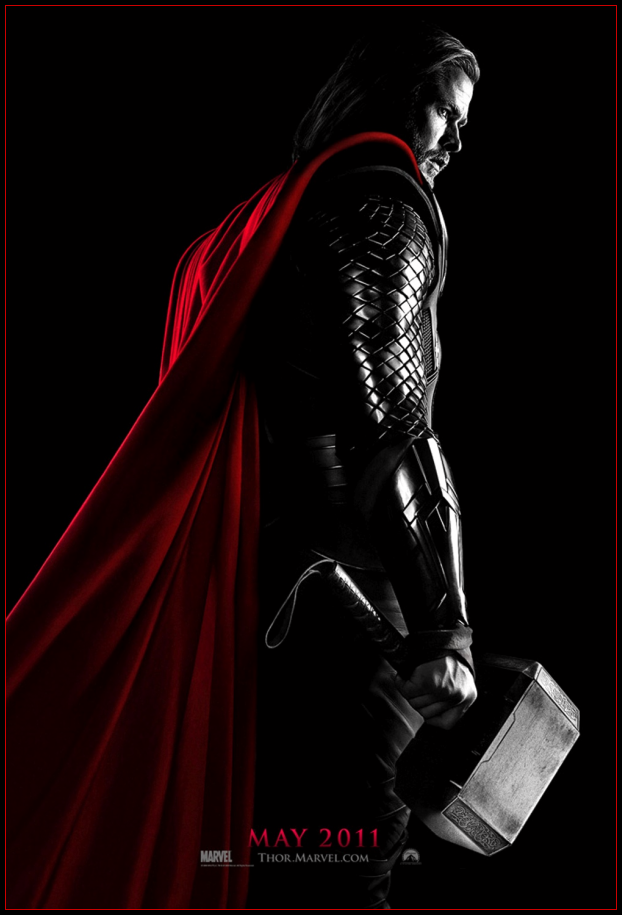
Marvel Comics has had a much better success in bringing their 2nd-tier characters over onto the big-screen than DC Comics and they’ve made the risky decision to tie-in every film they make into one shared universe. Comic book fans have begun to call this the Marvel Film Universe since it contains the same characters and backgrounds as those of their comic book counterparts but also with enough changes to make them stand-out on their own. They’ve already begun this with the first two Iron Man films and a recent reboot of the Incredible Hulk. With the X-Men, Spider-Man, Daredevil and Fantastic Four film rights still under the control of other film studios it left Marvel (now Disney) to use other characters in their control to fill out the rest of this shared universe. The next one to get their turn on the bigscreen is the live-action adaptation of Marvel’s Asgardian God of Thunder. The studios picked British filmmaker Kenneth Branagh to handle this adaptation and his background in bringing Shakespeare to the big-screen has made Thor a flwed but very entertaining superhero film.

To start off, it has to be said that Thor was always going to be the most difficult of all the characters that will make up The Avengers film to bring to the bigscreen. While all these Marvel films do have their fantastic elements due to each character’s superhero nature it was even more fantastic with the character of Thor. This character is in effect a being who has been worshipped by humans in the past as one of their deities. God-like characters have always been tough to make human and relatable in stories and film. It’s a testament to Branagh’s handle of the Asgard characters such as Thor, Odin and Loki that we don’t end up with just all-powerful beings, but individuals whose impulses and motivations definitely are human. It’s this dynamic between Thor, his father Odin and his brother Loki which drives the Shakespearean angle of the film’s storyline. It’s where Branagh’s history of making Shakespeare accessible to the general film audience that makes their story easy to follow and understand.

The film actually begins with the human characters of Dr. Jane Foster (played by Natalie Portman) and her colleagues (Stellan Skarsgard and Kat Dennings)  driving around in the New Mexico desert at night looking for atmospheric disturbances which should validate Foster’s theories on the Einstein-Rosen Bridge aka wormholes. What they end up running to instead is Thor himself arriving on Earth (Midgard in Asgardian terms) to begin his banishment from his homeworld. Yes, I say homeworld as the film has turned one of the more difficult aspects of Thor’s background into something that makes sense for the audience not steeped and learned from decades of Thor comic books. Thor’s home of Asgard is just one of nine worlds around the galaxy of which Earth is one.

It’s right after this scene that we go back to what started Thor’s banishment. The film does a great job explaining the role the Asgard’s played in Earth’s past history and the consequences of their war against the Frost Giants of the world of Jotunheim (one of the nine worlds). It’s through the narration by Odin himself (Anthony Hopkins) that we learn of the origins of the Gods and myths of Norse culture. This intro scene also shows Odin showing his two young sons in Thor and Loki the relic he had taken to end the wars between Asgard and the Jotunheim. For an origin sequence it was able to set up the rules of this fantastical world of Asgard and it’s Nine Realms. It’s the sequence right after which would lead to Thor’s banishment from Asgard and the stripping of his all-powerful hammer, Mjolnir, and his powers.

For some, and I would have to agree, this sequence which takes Thor, his brother Loki, childhood friends Sif and Warriors Three to the icy world of Jotunheim made up the best action setpiece for the film. The battle which begins between Thor’s forces and those of King Lauhey (Colm Feore under some very elaborate make-up effects) of the Frost Giants. This scene shares some similar qualities with an earlier action setpiece in the first Iron Man film in that it surpasses all other setpieces which would occur later in their respective films. This is not to say that the other action scenes were boring or just simple fare. They were exhilirating and full of energy, but that very first one in the beginning just had even more energy and action that it might’ve been better saved for the climax of the film.

Once the banishment occurs we finally catch up to the film’s first scene and the film begins to go back and forth between Asgard and Earth. With the former we see the machiavellian side of Loki finally assert itself. While Loki’s character is never truly shown to be evil his mischievious streak does show to have a cruel side to it. The bombshell of a news from Odin about his true origins was a nice touch, but it doesn’t lead to the sort of evil character turn we’re used to. In fact, I would say that Loki’s character (played with Iago-like relish by Tom Hiddleston) ends up becoming like the son who does the wrong things for the right reasons. He’s a nice contrast to the more open-faced Thor who does what he says instead of dancing around the subject even to the detriment of his standing with his father.

The scenes on Earth itself is where the comedic aspect of the film comes in. Most of the comedy comes at the expense of Thor’s “fish out of water” reaction to the new world around him. It’s helped much by some great comedic timing by Jane’s assistant Darcy (Kat Dennings who steals the film from Portman whenever they’re on together). It is also the time on Earth where some of the flaws in the film really become apparent. First and foremost would be Portman’s Jane Foster character who seem to be so uneven. She goes from brilliant astrophysicist one moment then giggling schoolgirl the next whenever she’s in close proximity to Thor. While Portman and Hemsworth do make quite the radioactively beautiful couple there’s a sense of untapped chemistry between the two that might have been left on the editing floor. It’s a shame really since so much could’ve been done with the Foster character to really give reasons to why Thor ends up valuing the lives of said mortals to earn his God of Thunder status once again.

Thor really does entertain despite some character and storytelling (really most of it on the Earth side of things) flaws which could’ve sunk the film right from the start. I believe that it’s director Branagh’s handling of the Shakespearean tragedy on the Asgard side of the film that holds the film together. This is one reason and the other being a star-turning turn by Chris Hemsworth as Thor himself. His performance goes from cocky, brash young man on the cusp of leadership to lost, confused and rudderless once banished then back again to a maturing prodigal son who finally learns the lessons his father has been trying to teach him. It would interesting to see Hemsworth’s Thor truly interact with Downey’s Tony Stark and Chris Evans’ Steve Rogers when The Avengers comes out in 2012.

The riskiest part of Marvel’s attempt to create their Marvel Cinematic Universe succeeds where most seem to think it will fail. It’s not as strong an origin film as Favreau’s first Iron Man, but it does add a sense of wonder that film could never grasp through two films. Even the controversial casting choices to put non-white actors to play Asgard roles (Tadanobu Asano as Hogun and Idris Elba as Heimdall) comes off well that the audience shouldn’t even wonder why a black and Asian person were playing characters written originally as white.

From the look of things there’s no official word whether there will be a second Thor film, but I wouldn’t be surprised if there was no matter how the film does boxoffice-wise. There’s just too much great stories to tell about Thor, Asgard and the rest of the Asgard Nine Realms now that the foundation has been laid down with this first film. I do hope that Branagh returns for those sequels if they do happen. One thing which Branagh has proven was his handling of action sequences. They weren’t amazing, but they were handled with enough skill that I believe a second time around we’d get even better action from a director known more for serious dramatic films.

A final thing to mention would be the Easter Egg final scene which occurs once the end credits finish their run at the end of the film. For those who stayed to see this scene it should be a nice treat for Marvel and comic book fans. It shows a certain artifact that should tie Thor to the upcoming Captain America film later this summer. All I can say for those who didn’t stay to see it and knows their Marvel trivia are two words: Cosmic and cube.

PS: An Avenger member makes a cameo appearance halfway in the film that doesn’t look tacked on despite what some of the more “glass half-empty” film bloggers on the net would make you think…Also, it’s safe to forgo seeing Thor in 3D. It’s not a bad post-conversion but it doesn’t really add to the film. See it in 2D to save yourself a few bucks on the ticket price.

Quick Review: In the Mouth of Madness (dir. by John Carpenter, 1995)


In the Mouth of Madness is one of those films that in essence seems like a good idea, but later becomes strange and unwieldily to the point that you have to ask yourself “What am I watching, and why did I do so?”

Jumping right of of Memoirs of an Invisible Man, In the Mouth of Madness reunites Sam Neill (Jurassic Park) with Carpenter. Neill plays John Trent, an Insurance Investigator whose latest case deals with a horror writer named Sutter Cane (Jurgen Prochnow). Cane’s novels have the strange ability to affect anyone who reads them. After Cane’s own agent/publicist falls his influence and is abruptly killed, Trent is sent to find Cane (who is missing) and help bring back his latest story , “In the Mouth of Madness” to the agency. When he sets off on his mission, he slowly finds his sense of reality unraveling.

If Neill’s character is the Scully, Julie Carmen (Fright Night Part II) plays the Mulder in this equation. Sent along with Trent, her character witnesses more of the horror than he does. She’s the audience witness for a while and proves Trent wrong when he’s ready to disbelieve what’s occurring. She good here, but her reactions, mixed with Trent’s had me slapping my forehead. I’ll get to that in a moment.

I’m told that the film is something of a homage to H.P. Lovecraft’s stories. While I’ve never read Lovecraft, I’m somewhat familiar with the Cthulhu myths and there does seem to be some tentacled beasts near the last third of the film.  Overall, some of those references escape me. The movie’s fun in a Donnie Darko mind bending way and it’s that strangeness that actually helps the film a little.

I hate the fact that Sam Neill’s character simply  won’t accept that what’s happening is real. I’m not a big fan of stuffing square pegs into round holes. If it doesn’t fit – you’re being told “This is how it goes”, and you’re seeing that’s how it’s happening – then why in the world are you still holding on to the same train of thought that isn’t working / fitting the situation? I found that extremely annoying. It’s almost the opposite of Slither, where it didn’t take long for the characters to recognize that:

1.) People were becoming zombies.

-And-

2.) It just wasn’t normal for the situation. Accept and adjust. Cover your mouth.

Overall, it was okay, but it really needed something. I’m just not sure what.

6 Trailers That Make Lisa Marie Go Yay!


Hi everyone! 

I will be the first to admit that I can occasionally be a little moody but tonight, as I sit here typing, I am in such a good, extremely hyper mood.  Maybe it’s because I’m wearing my beloved black Pirates shirt.  Or it could be because, for once, this house is neither too cold nor too warm.  Then again, it could just be because it’s time for me to bring you another edition of Lisa Marie’s Favorite Grindhouse and Exploitation Trailers!

1) I Dismember Mama/The Blood-Splattered Bride (1974)

This is a trailer for a “double feature of horror,” featuring I Dismember Mama and The Blood-Splattered Bride.  When I’ve spoken with other grindhouse movie fans on the web, this trailer is often cited as being a favorite.  Personally, I think it goes along for about a minute too long but I can understand why it’s so popular.  For one thing, it’s nothing like the trailers that are currently playing in theaters across America in that it’s a short film in itself.  By the way, the trailer for Blood-Splattered bride sans I Dismember Mamma can be viewed here.

2) Killer Nun (1978)

From the wonderful nation of Italy comes this example of the odd little grindhouse genre known as nunsploitation.  I can probably count the number of good nunsploitation films on one hand.  And yet when confronted with a film like this, I cannot look away.  Maybe it’s because I was raised in the Catholic church.  Or it could just be because the totally hot and lickable Joe Dallesandro is in so many of them.  Along with Dallesandro, Killer Nun features Anita Ekberg of La Dolce Vita fame and Alida Valli of Third Man, Suspiria, and Inferno fame.

(Sidenote: Once when I was going to Catholic school, this really mean, fat girl was jealous of me because I was prettier than her so she whacked me in the face with a ruler so hard that it actually broke the skin right over my right eye and I had to get 3 stitches to close the cut and I’ve still got this little scar and sometimes, when I wink or seductively arch my right eyebrow, it still hurts a little.  I hope somebody eventually went all Killer Nun on that girl…)

3) Lady Kung Fu (1972)

When I showed my sister Erin this trailer, she said, “You’re not going to jump up and start trying to do any of that stuff yourself, are you?”  “Uhmmm…no,” I replied but, to be honest, I was totally about to do it.  I don’t know much about Angela Mao but just, on the basis of this trailer, she’s my hero.  This trailer is just infectious and, as I watched, I wondered, “How difficult can it be?”  Well, apparently, it’s very difficult but that’s a story for a different time.

4) The Bullet Machine (1969)

“He can hack it!”  Uhmmm….well, yes, okay then.  At first, I thought I had actually found a trailer that was more violent than the trailer for Massacre Mafia Style but, upon careful reflection, I have to say that Massacre Mafia Style is still the king.  The two hitmen in Massacre Mafia Style may not fire as many bullets but they still manage to kill everyone else in the trailer.  Whereas The Bullet Machine is constantly shooting his gun but doesn’t really seem to accomplish much as a result.  Plus, the mafia hitmen had style whereas the Bullet Machine just seems to be kind of a prick.  If ever I have to prove the thesis that most men use guns as a substitute for their own limp penis, this trailer will be exhibit one.

5) Alien 2 (1980)

I don’t know much about this film other than it’s obviously an Italian attempt to capitalize on the success of the original Alien and it is not — as I originally assumed — the same film as Luigi Cozzi’s Alien Contamination.  One of the things that I love about Italian exploitation cinema is just the pure shamelessness of it all.  I imagine there had to have been about a thousand remakes of Alien in the early 80s but only the Italians would have the balls to actually name a film Alien 2.

As for this trailer, it has its slow spots but seriously, stick with it for the final shot.  And remember — you could be next!

(On the plus side, a young Michele Soavi is in this film.  YAY!)

6) Fascination (1978)

I’m in such a good mood right now that I’m just going to have to end this latest entry with a little Jean Rollin.  Now, just in case anyone out there is unfamiliar with the unique cinematic vision of Jean Rollin, you should understand that this trailer is far more explicit than any of the other trailers featured in this post.  In fact, I’m surprised that Youtube hasn’t taken it down yet.  So, if you’re easily offended, I don’t know why you would be visiting this site in the first place.  But anyways, if you’re easily offended, consider yourself warned.

As for Fascination, it’s actually one of the more accessible of Jean Rollin’s vampire films.  The image — seen towards the end of this trailer — of Brigittie LaHaie with a scythe has become iconic.

Quickie Review: Fast Five (dir. by Justin Lin)


It would seem that the summer blockbuster film season starts earlier and earlier with each passing year. It used to be that the film which premiered during the Memorial Day weekend was the one which began the season, but now films which come out first weekend of May get to have that honor. Then 2011 decides to change things up and herald the summer blockbuster season not in May but the last weekend of April. The film which gets to do the honor this year looks to be Justin Lin’s fun and very action-packed fourth sequel to the undying street-racing franchise which began with 2001’s The Fast and The Furious. This fifth entry in the franchise was simply titled, Fast Five.

The series had always been about the world of illegal street-racing whether it was set in Los Angeles, Miami or Tokyo. There was always that aspect of the story which tied all four previous films together. It would have skilled, beautiful women who followed the scene and, of course, the fast cars themselves. Things began to change a bit with the fourth film, Fast and Furious, as the street racing became not the main focal point of the story but just an aspect of it. The franchise began to take on an action-thriller role. While it was good to see changes to the franchise that began to get stale that fourth film didn’t pull off the necessary changes as well as it should’ve. It would seem that Justin Lin was just testing the waters and finally got what he wanted with Fast Five.

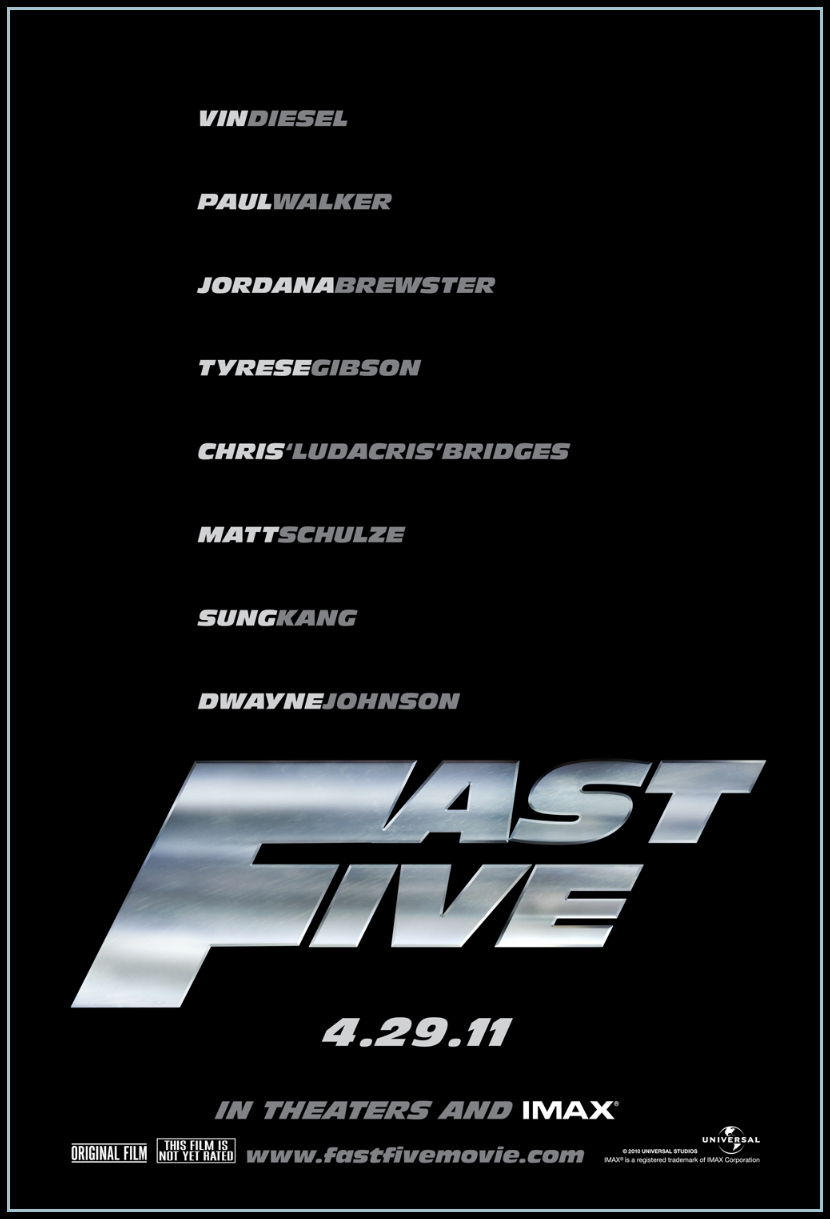
This latest film in the franchise barely has any street-racing in the film. There’s a short sequence 2/3’s of the way in and Lin also inserts a couple of obligatory slo-mo scenes of street-racers gathering to show-off their rides and women, but Fast Five is more of a caper film than a street-racing one. It actually owes a lot more to the Ocean’s 11 films than anything else. We have returning character in Vin Diesel’s Dominic Torreto and his sister Mia (played by the radiant Jordana Brewster). Paul Walker as his erstwhile ally Brian O’Conner returns as well. It’s these three who anchor the heist team which would include returning characters from the previous four films. There’s the hothead Vince (Matt Schulze) from the first film. Roman Pearce (Tyrese Gibson) and Tej Parker (Chris “Ludacris” Bridges) come in from the second film. Sung Kang’s character Han from the third film appears so does Gisele, Tego and Rico from the fourth film. These returning character make-up what I would only call as Torreto’s Ten.

Fast Five begins just as the previous film ended as O’Conner and Mia break Dom out of the prison bus taking him to prison. From there the film moves to Rio de Janeiro, Brazil where these three fugitives take on a job to earn themselves some money only to realize that they’ve inadvertently gone to work for Reyes, Rio’s most powerful crimelord (Joaquim de Almeida), who now has his sights on Dom’s crew. Not to make Dom’s life any easier is a Federal Task Force sent in to take him back to the U.S. in the form of Hobbs (played by Dwayne Johnson) and his elite team of agents. Dom and his crew will now have to escape not just Reyes and his thugs but Hobbs and his men. It’s the plan to do just both that make up most of the film’s story.

Justin Lin does a great job in not just explaining the details of the heist beforehand, but he does so without getting the film into too much of an expository exercise. He shows just as much as tell the job Torreto’s Ten must pull off if they’re to ever win their freedom. It’s the set-up to the heist and the execution of it which tie-in all the many, well-staged action sequences the film has. While street-racing has been relegated to just obligatory short scenes this film doesn’t lack for exciting carmeggedon and mayhem. From the prison bus escape to begin the film to the daring train robbery which follows it right down to the bank vault heist which takes up the last 10-15 minutes of the film. That sequence alone makes this film worth seeing as we see a 10-ton bank vault being hauled at high-speed through the streets of downtown Rio. Buildings get totaled and cars get tossed and smashed like tinker toys. Yet, as the PG-13 rating would point out we don’t know or see if anyone actually dies.

It’s that rating which keeps this film from ever joining the exploitation and grindhouse pedigree of such car mayhem films as Vanishing Point, Two-Lane Blacktop and Dirty Mary, Crazy Larry. But despite the limitations a PG-13 rating puts on Justin Lin’s Fast Five the film ends up becoming a very fun and exhilirating action-heist film that gives some new life to a franchise that was down to fumes. It helped that we get some good performances from most of the leads (Paul Walker still can’t do anything outside of performing as a surfer from California). It was also the addition of Dwayne Johnson as Federal Super-Agent Luke Hobbs which gives the film some of it’s fun. Johnson was able to match Diesel’s Dominic Torreto for the title of most badass in the film. In fact, the fight between the two was one of the highlights of the film (even though I still think Johnson probably would kick Diesel’s ass 100 out of 100 times).

Fast Five doesn’t disappoint and more than earns the honor of starting up 2011’s summer blockbuster season. Justin Lin has delivered a film in this franchise which stands out from the rest and more than likely reboots the series from a street-racing one and into just a plain old action series. His work in this film and how he handled the action also adds some credence and justification in him being given the next film in the Terminator franchise. He may just be the one to bring back some life into that dying franchise. So, strap on the seat belt and grab onto to something because Fast Five may just be one of the few films this summer that delivered on everything it promises in terms of action and fun.

A Quickie With Lisa Marie: The Source Code (dir. by Duncan Jones)


Okay, I’ll admit it right now: I’m way too late in reviewing this film.  Seriously, if you were planning on seeing The Source Code, then you’ve probably already seen it by this point.  You already have your own opinion about the film.  Why do you need hear mine?  You’re probably saying, “Girl, move on.”

And to that I say: “I do what I want!”

Anyway…

The Source Code is a surprisingly smart and occasionally even moving little sci-fi thriller.  Jake Gyllenhaal plays Colt Stevens, an army helicopter pilot who, as the film begins, awakens to find himself on a commuter train with no idea who he is or how he got there.  The woman sitting across from him (played by Michelle Monaghan) seems to know he is.  The confused Gyllenhaal wanders around the train trying to figure out who he is.  He goes into the train’s restroom, looks in the mirror, and sees a stranger staring back at him.  And then the entire train blows up.

Suddenly, Gyllenhaal wakes up again.  He’s apparently trapped in a dark chamber with his only link to the outside world being a computer screen.  An army officer (Vera Farminga) appears on the screen and explains to him that he was sent into the past in order to find out who bombed the train.  And he will continually be sent back into the past to relive the few minutes before the bomb goes off.  He’s told that the past cannot be changed, the people on the train cannot be saved, and his only mission is to discover who planted the bomb. 

It’s a clever little plot (one that would do Philip K. Dick proud) that has a lot more twists and turns than is obvious from a simple recap.  Along with a smart script, the film has a cast who bring a lot of conviction and nuance to their roles.  Jake Gyllenhaal, in particular, redeems himself after his unfortunate work in Love and Other Drugs.  However, the film’s real hero is director Duncan Jones who gives The Source Code both a heart and a brain.  His work here confirms that talent that was evident in Moon and I’m looking forward to what he gives us next.

Lisa Marie Conspires Against The Conspirator (dir. by Robert Redford)


Robert Redford’s new historical drama The Conspirator is the first prestige picture of 2011 and it’s also (arguably) the worst film of the year so far. 

Oh, I hear you out there: “Really?  Worse than even Season of the Witch and Your Highness?”

Yes.  Way worse.  Season of the Witch and Your Highness might have been bad films but they knew they were bad.  They never truly aspired to be anything other than bad.  The problem with The Conspirator is that it’s obviously meant to be a great and important film.  It’s meant to shape public debate.  We’re supposed to feel like better people for having sat through it and the filmmakers are supposed to be better people just for having made it.  There’s a smugness to these type of self-styled “prestige pictures” that elevates their badness beyond anything to be found in Your Highness.  Indeed, if the makers of Your Highness appeared to be getting high off of herb than the people behind The Conspirator are high off of their own good intentions and that makes them for more annoying.

The Conspirator is based on the trial of Mary Surratt, the only woman to be arrested, tried, and subsequently executed as a result of the conspiracy to assassinate Abraham Lincoln.  The execution of Mary Surratt was controversial because 1) she was a civilian tried by a military tribunal, 2) the evidence against her was largely circumstantial (she owned the boarding house where the conspirators — including her son John Surratt — supposedly met), and 3) she was a woman.

Now, I have to confess that I’m secretly kind of a big history nerd and — unlike most of this film’s audience — I was already familiar with the story of Mary Surratt before I sat down in the theater.  The story of the Lincoln Conspiracy and the aftermath of the assassination is a really interesting one that is full of all sorts of weird twists and turns and odd characters all conspiring together and being mysterious.  It has all the makings of a great grindhouse film. 

However, director Robert Redford is too good to make a grindhouse movie.  No, he has something important to say and, as a result, The Conspirator becomes yet another one of those tedious films where every line of dialogue and every image is supposed to make us go, “Hey, they might be talking about post-Civil War America but, by golly, this is relevent to our post-911 lives!  OH MY GOD!”  So, we get Tom Wilkinson showing up randomly to give speeches about why military tribunals are the work of the devil.  Wilkinson is playing a historical figure Reverdy Johnson but they might as well have just renamed him “Prestige Actor Cast As Mouthpiece.”  And then Kevin Kline (as Secretary of War Edwin Stanton, though they should have just called him Dick Cheney) is there to go, “The whole world has changed.”  Meanwhile, the camera lingers over the conspirators being held in their dirty cells with bags over their heads (“OH MY GOD, HONEY!” we’re supposed to shout at our loved ones, “THAT’S JUST LIKE GUANTANAMO BAY!  WOW!”) and then we’re constantly reminded that Mary Surratt was a devout Catholic and that America in 1865 viewed Catholicism in much the same way that America views Islam in 2011. 

And, yeah, we get it and I’m not saying that director Redford is incorrect in his message or his beliefs.  However, a boring, heavy-handed film is just as boring and heavy-handed regardless of where its heart may lie.  The Conspirator is so busy being good for us that it forgets that it needs to entertain as well.  It preaches at us but it never bothers to engage us.

Mary Surratt is played by Robin Wright and she gives a good performance but because of the way the film is structured, Mary is never allowed to become anything more than a convenient symbol.  Instead, most of the film’s screen time is given to James McAvoy who plays the young lawyer who reluctantly defends her at trial.  Now, I love James McAvoy.  I’ve loved him ever since Atonement and that’s why it’s kinda heart breaking to see what a bad performance he gives here.  He’s good for the first ten minutes or so of the film but then he’s assigned to defend Ms. Surratt and I swear to God, he doesn’t stop yelling for the rest of the movie.  It’s not totally McAvoy’s fault.  As written, his character doesn’t really have much to do other than get mad.  As an actor, McAvoy can do anger quite well (again, check out Atonement) but here his anger just seems to spring out of nowhere.  At first, he is unconcerned about Mary Surratt and resentful that he has to defend her.  Then suddenly, he’s going all late style Al Pacino on everyone. 

Justin Long shows up as McAvoy’s best friend and seriously, if you’re making a historical drama, you don’t cast a guy who automatically makes you think, “He’s a PC and I’m a Mac.”  It’s not Long’s fault.  He’s a likable actor and he’s likable here even if his character doesn’t have any reason for being in the movie.  It’s just that typecasting is a bitch.  Alexis Bedel gets the thankless role of “rich snob who loses faith in her boyfriend” while Evan Rachel Wood, playing Mary Surratt’s daughter, is the only member of the cast who actually seems to truly connect with the material.

Regardless of the film’s historical accuracy, everything about The Conspirator feels false.   I don’t know if it was just the copy that I happened to see but the entire movie just looks like crap, a combination of soft-focus blurriness and respectfully muted colors.  This is another one of those films where the interior scenes are lit so that it appears that sunlight is just flooding in through the windows, making any white article of clothing just appear to throb with radiation.  Seriously, I had a headache after watching 30 minutes of this film.

As I said previously, there’s a great grindhouse movie waiting to be made out of this material.  For instance, did you know that Boston Corbett — the man who shot John Wilkes Booth — was also a religious fanatic who years earlier, in order to resist being tempted by a prostitute, castrated himself with scissors?  Also, did you know that Henry Rathbone — the army major who was sitting with Lincoln at the time of the assassination — was years later named Ambassador to Germany and, while in Germany, suffered a sudden nervous breakdown that led to him chopping off his wife’s head?  Also, one of the men who was arrested (though eventually released and never charged) for taking part in the conspiracy was Frances Tumblety who later moved to England where he would later become one of the many men suspected of being Jack the Ripper? 

And that’s just the tip of the iceberg.

However, The Conspirator is too busy being important to bother with being interesting.  While a grindhouse version of the story would have been both interesting and thought-provoking, The Conspirator is just a smug film that is never manages to live up to its own rather high opinion of itself.

Film Review: Scream 4 (dir. by Wes Craven)


Before I start, note that Scream 4 is also referred to as Scre4m. While this is true and cool in a hacking/cyberpunk sort of way, I refuse to call it that as it just erodes my writing ability (which is rough enough as it is). I keep that up by the end of the year, everything I write will have numbers in it.

Compared to some of his earlier attempts, Scream 4 is pretty much a triumph for Wes Craven. With Kevin Williamson’s help, they manage to take the fourth part of a story and turn it into something remarkably enjoyable and surprising. The audience at my showing loved the way it started and ended. Although it retreads some of the older themes of the series, it does so in a way that almost makes fun of itself and the genre it’s a part of. Since it’s not taking itself too seriously, the audience doesn’t have to either.

Scream 4 basically brings what’s left of the remaining cast back to the tale. The Arquette’s (Courtney Cox and David) have returned as Gail Weathers-Riley and Sheriff Dewey Riley, respectively. Neve Campbell returns to form after a long hiatus, and really, it’s almost as if none of them ever left. The film starts off in a way where it pays homage to the original Drew Barrymore opening while still managing to keep it fresh. Cameos by Anna Paquin and Kristen Bell help to move that along.

After the events of the last three films (ten years of time in the movie), Sidney Prescott (Campbell) has managed to put her life back together by writing a novel about being a survivor. Thanks to Gail’s book on the Woodsboro murders and the multiple “Stab” movies that were created for them, the town has become famous for something it really shouldn’t be. Ghostface masks are a dime a dozen now, yearly Stab marathons are all the rage and the town kind of looks at it all like Crystal Lake – people died there, sure, but it’s just so much to say “I was there!”.

Sidney’s fame did little for her niece, Jill (Emma Roberts) and her friends, Kirby (a short hairdo wearing Hayden Panettiere) and Olivia (Marielle Jaffe). Having to grow up as a relative to the most famous person in town means everyone has something to ask her about Sidney when she returns to Woodsboro on her book tour. The younger trio keep their distance from Sidney as they consider her trouble. After all, all these deaths seem to occur when she’s around or has something to do with her. However, when a new rash of murders start when Sidney arrives, everyone has something to worry about. What follows is a bloodbath in typical Scream fashion, and as always, just about everyone is a suspect.

The Positives:

– Conspiracy Theory

What worked for me in Scream 4 was the conspiracy aspect. Williamson paints a picture that basically says “Here’s your cast. Any one of them could be the killer. Can you figure out who?”. The misdirection isn’t on a Harry Potter like level, but it does serve a purpose here. By the time everything was brought out, I found myself nodding and smiling. It’s actually worth it to ride out the movie to get to the big reveal. Without giving anything away, both that reveal and the story behind it was damn near excellent.

-Sidney as Ripley

Another good thing about the film is that Sidney is pretty much a powerhouse here. She takes on the Ghostface without too much fear. So much so that it sometimes seems like she’s like a Jason Bourne type character. It’s nice that she’s able to hold her own, though after 3 films, you’d expect the character to probably do that.

– Remembering the Original

Another element that proved useful was the homages to the original Scream films. There are a few scenes that even if you only watched the Original Scream, you’ll recognize them instantly. Some serious recognition goes to Panettiere’s Kirby, who at one point spits out the name of nearly 30 horror films in the space of a minute. All in all, it might seem like rehashing, but the context they were set up in were enough to warrant a whispered “Wow” from me. Maybe I’m just easily impressed. Craven also managed to bring back Roger L. Jackson (Mojo Jojo from The Powerpuff Girls) as the voice of the Ghostface Killer. So much fun to hear his voice again after all these years. That was definitely a plus.

The Negatives:

– Not a lot of Bodies Hitting the Floor.

If Scream 4 suffers from any problems, it’s that there really isn’t that much of a body count. Granted, I wasn’t expecting anything like Dead Alive or Dawn of the Dead, but as slasher films go, it’s pretty light on the numbers, and as always, most of the people who are dispatched are done well, but I left the theatre wondering if there weren’t just a few more people who could have been taken out. That, and outside of the main players, I didn’t really care about the rest of the cast. They were pretty much cannon fodder for Ghostface.

– The Rules have Changed, but aren’t Exactly Enforced

While the movie seemed to be big on changing what the rules for how horror movies go, they weren’t really mind-blowing. In some ways, it seemed it was useful, but perhaps it would have been better to simply say that there were no rules and leave it at that. The rules here didn’t seem as enforced as the first film. Anything kind of goes.

Overall, Scream 4 is a fun ride, and quite possibly the best entry in the series since the first Scream. It peppers original elements with a few new ideas. It’s not all perfect and there some moments that are over the top, but in the end, it’s refreshing when compared to the 2nd and 3rd parts of the series.