The Land Down Under: THE SUNDOWNERS (Warner Brothers 1960)


gary loggins's avatarcracked rear viewer

G’day, mates! Let’s take a trek through the wilds of 1920’s Australian outback with  , Robert Mitchum Deborah Kerr, and a herd of bouncing sheep in THE SUNDOWNERS. Fred Zinnemann, generally associated with serious, tense dramas like HIGH NOON and FROM HERE TO ETERNITY, lends a lighter touch than usual to this sprawling, almost John Ford-esque tale of an itinerant sheep drover and his family, and the wife who longs to settle into a home of her own.

Mitchum plays Paddy Carmody, a stubborn Irishman who has to keep moving, unable and unwilling to be tied to one place. He’s a wanderer with a fondness for booze and gambling, and Big Bob is perfect for the part. Mitchum’s penchant for dialects make his Aussie accent more than believable, and his facial expressions, especially during the sheep-shearing contest, are priceless. Deborah Kerr is his equal as wife Ida, the tough Earth Mother who’s loyal to Paddy…

View original post 322 more words

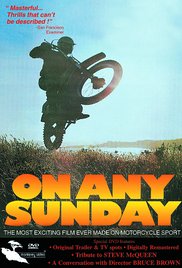
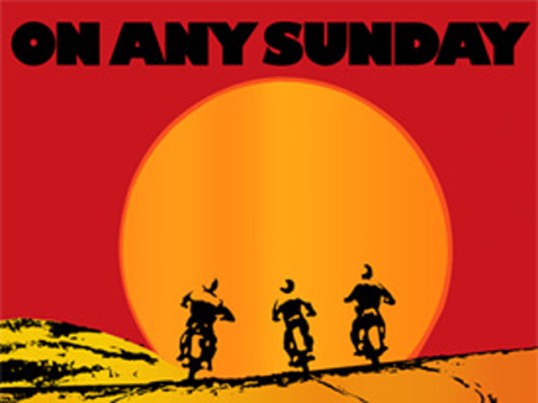
A Movie A Day #77: On Any Sunday (1971, directed by Bruce Brown)


Why pay money to see CHiPs in the theaters when you can watch On Any Sunday, the greatest motorcycle movie of all time, on YouTube for free?

Directed and narrated by Bruce Brown (of Endless Summer fame), On Any Sunday is a documentary about motorcycle racing.  Brown profiles several professional racers and takes a look at the different types of racing, everything from desert racing to street racing to ice racing.  In On Any Sunday, Brown makes riding a motorcycle look just as exciting as he made surfing look in Endless Summer.  Brown’s racing footage is often amazing and left me wondering how he got some of his shots.

Throughout the documentary, Brown emphasizes both the dedication and the humanity of the racers.  The racers are seen obsessively working on their motorcycles but Brown also points out that, in order to be successful, the racers have to trust each other.  They have to know that, if they crash during the race, the other racers will be alert and quick enough to avoid running them down.

Why, Brown asks, do they do it?  Brown says that most of the racers can’t tell you why they race.  They just enjoy it.  But, with the footage Brown shows us, we can guess why they do it.  Through the use of helmet cams, Brown puts us right on the motorcycle, tearing down a track at over 100 mph and allows us to get as close as we can to feeling the thrill of the race without actually being in the race ourselves.  Brown also makes good use of slow motion to show the skill necessary to avoid crashing and he shows us enough crashes that we understand the risk that comes with racing.  Brown emphasizes that every racer crashes and that the best of them can just brush it off.

On Any Sunday was co-produced by actor and racing enthusiast Steve McQueen.  Towards the end of the documentary, McQueen is interviewed about why he races.  McQueen, a man of few words, says that he enjoys being on the track with the other racers.  They lift him up when he’s feeling down.

On Any Sunday is 46 years old but it will still make you want to get on a motorcycle and ride like a champion.

Lisa Cleans Out Her DVR: The Wrong Student (dir by David DeCoteau)


Y’all know that I usually avoid politics like the plague but this is just something that needs to be said:

The U.S. Government could stand to learn a little from a good Lifetime film.  A good Lifetime movie is not expensive (and usually can be viewed for free).  A good Lifetime movie does not demand that the audience watch it but instead, provides a good reason for you to sacrifice 90 minutes of your time.  A good Lifetime movie does not attempt to rob you of your individual freedoms and, in fact, it celebrates your right to talk back to the screen.  A good Lifetime movie delivers exactly what it promises.  A good Lifetime movie does not talk down to its audience.  A good Lifetime movie goes out of its way to keep its audience entertained.  If the U.S. government was more like a Lifetime movie, we wouldn’t have spent the past 17 years dealing with one tedious situation after another.  If the U.S. government was more like a Lifetime movie, life would be a lot more fun and twitter far less annoying.

I found myself thinking about this as I continued to clean out my DVR by watching The Wrong Student.  I recorded The Wrong Student off of Lifetime on March 11th.  I’m glad I did because The Wrong Student epitomizes everything that I love about Lifetime.

Add to that, it’s a film that proves something that I’ve always suspected — soccer is the source of all evil.

Maddie (Evanne Friedmann) is a teenager who loves two things: soccer and the new soccer coach.  The new coach is Dominic (Jason-Shane Scott), who has amazing pecs and abs.  How in love with Dominic is Maddie?  Well, she’s so in love with him that she’s willing to do almost anything to keep him around.  Does that mean that Maddie is willing to poison the old soccer coach?  It sure does.  Does that mean that Maddie is willing to fake an injury so she’ll have an excuse to get naked in the locker room while a mortified Dominic hides his eyes?  Of course!  What about pretending to get drunk at a party and then begging Dominic to give her a ride home?  Hey, who hasn’t done that?  In fact, Maddie is so obsessed with Dominic that she’s even willing to murder her ex-boyfriend.

Maddie’s pretty, intelligent, and apparently her family has some money but she sure does have some issues.  Personally, I blame the soccer.

Amber (Kennedy Tucker) is also on the soccer team.  Amber is living with her Aunt Kelly (Jessica Morris).  Obviously, Amber knows that Dominic is too old for her but he’s exactly the right age for Kelly!  When Maddie realizes that Kelly and the coach are getting close, can you guess what happens?

Anyway, The Wrong Student is a lot of fun.  David DeCoteau has directed a lot of “wrong” films for Lifetime, including The Wrong Roommate and The Wrong Child.  He knows exactly how to make one of these films entertaining and The Wrong Student is an enjoyably self-aware melodrama.  Evanne Friedmann is wonderfully unhinged as crazy Maddie and Jason-Shane Scott looks great without a shirt on.  The Wrong Child is a wonderfully entertaining example of just how much fun a Lifetime movie can be.

Everything should be more like a Lifetime movie.

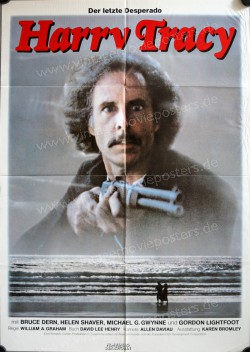
A Movie A Day #76: Harry Tracy, Desperado (1982, directed by William A. Graham)


The year is 1902.  The old west is coming to an end.  Almost all of the famous outlaws are either dead or imprisoned.  Only a few, like Harry Tracy (Bruce Dern), continue to make a living by robbing banks and trains.  Though he is often captured and even sentenced to death a few times, Harry is always able to escape.  His latest escape, from a prison in Washington, has led to the largest manhunt in American history.  Harry is being pursued by a trigger-happy army, led by U.S. Marshal Morrie Nathan (played by singer Gordon Lightfoot).  Harry has been in this situation before but this time, things are different.  Harry is traveling with Catherine Tuttle (Helen Shaver), the daughter of a local judge.  Harry and Catherine are in love but that does not matter to the men with the guns.

Harry Tracy is a sadly overlooked and elegiac western from Canada.  It is based on a true story.  Outlaw Harry Tracy really did escape from several prisons and he eventually was the target of the largest manhunt in U.S. history.  (His relationship with Catherine was apparently created for the film.)  In real life, Harry was reportedly considered to be more ruthless than Jesse James and he killed not only members of law enforcement but also members of his own gang.  The movie’s Harry is a much more gentle character.  In the film, Harry only kills in self-defense and he robs banks not because he’s greedy but because it’s the only life that he has ever known.  Harry is a relic of a time that it coming to a close.  In one scene, he is shocked to come across a man driving a car.  For an outlaw who usually makes his escape on horseback, the new century does not hold much promise.

In the tradition of Butch Cassidy and the Sundance Kid, Harry Tracy mixes comedy with tragedy.  The film’s defining image is Harry fleeing from his latest robbery and dropping most of the money in the process.  Harry often seems to be bewildered by all the fuss that people are making over him.  Bruce Dern and Helen Shaver are great as Harry and Catherine.  Even the casting of Gordon Lightfoot works.  (Lightfoot also wrote the movie’s theme song.)

Harry Tracy is an overlooked classic about the end of the old west and the beginning of the modern era.

Diamond in the Rough: RIOT IN CELL BLOCK 11 (Allied Artists 1954)


gary loggins's avatarcracked rear viewer

Back in 1951, movie producer Walter Wanger (rhymes with danger) discovered his wife, actress Joan Bennett , was having an affair with her agent, Jennings Lang. The enraged husband tracked them to a parking lot, where Wanger shot Lang in the groin. That’ll teach him! Wanger was subsequently arrested, and sentenced to serve a four-month bid in a Los Angeles county farm. His stint in stir, though brief, affected him profoundly, and he wanted to make a film about prison conditions. The result was RIOT IN CELL BLOCK 11, a ripped-from-the-headlines prison noir that’s tougher than a two-dollar steak.

Wanger hired Don Siegel to direct the film. Siegel was gaining a reputation as a director of muscular, low-budget features, and RIOT IN CELL BLOCK 11 is a great early example of his harsh, brutal style. The movie’s sparse, shadowy setting was filmed on location at California’s infamous Folsom Prison thanks to…

View original post 584 more words

Lisa Cleans Out Her DVR: Forgotten Evil (dir by Anthony C. Ferrante)


Earlier tonight, as part of my continuing effort to clean out my DVR, I watched Forgotten Evil!  I recorded Forgotten Evil off of the Lifetime Movie Network on March 12th.

As soon as the words, “The Asylum Presents” appeared on the screen, I knew that I was going to love Forgotten Evil.  Though the Asylum may be best known for the Sharknado franchise and several subversively entertaining mockbusters, they’ve also produced several films for Lifetime.  An Asylum Lifetime film is always delightfully melodramatic and a lot of fun.  My optimism only increased when I discovered that Forgotten Evil was directed and written by the man behind Sharknado, Anthony C. Ferrante.

“This is going to be fun!” I thought and it turns out that I was right.

Forgotten Evil opens with a woman in a bag being dumped over the side of a boat.  The opening scenes have a surreal, almost dream-like feel to them.  Ferrante does a good job of creating a properly ominous atmosphere.  As I watched that bag crash into the water, I was reminded of my own rather morbid fear of drowning.  Fortunately, the woman in the bag survives.  Unfortunately, when she’s found floating by the shore, she has absolutely no idea who she is.

That’s right!  Jane Doe (played by Masiela Lusha) has amnesia!  Even though she does occasionally have flashes of memory, she can’t put together what they all mean.  She has no idea who she was or why she was dumped in the water.  Eventually, she starts using the name Renee but that’s just because she saw a boat named Renee before she nearly drowned.

Amnesia, needless to say, is always a good way to start an intriguing story.  I mean, let’s be honest.  The idea that people can suddenly forget everything is really quite fascinating.  It’s impossible not to wonder what you would do if you were in the same situation.

Despite having no idea who she is, Renee tries to start a new life for herself.  A nurse and a police officer become her new BFFs.  Her therapist becomes her new parental figure.  She even gets a job and a new boyfriend (played by Kyle McKeever), one who is surprisingly good at karaoke!  That’s really not too bad for someone who, just a few weeks previously, was being dumped over the side of the boat.

Except, strange things keep happening.  She loses her job when semi-explicit Polaroids mysteriously appear on her desk.  She continues to have flashes of disturbing images and she’s convinced that someone tried to drown her while she was taking a bath.  She thinks that she sees a mysterious man following her around.  And that perfect new boyfriend of hers?  Well, he appears to be just a little bit too perfect.  It’s hard not to suspect that he’s hiding something.  Especially when he takes her to an isolated cabin which, in a Lifetime movie, is never a good sign…

I enjoyed Forgotten Evil.  This is pure and enjoyable melodrama, well-directed by Anthony C. Ferrante and featuring all sorts of twists and turns.  Masiela Lusha is likable and sympathetic in the main role.  All in all, this is a fun Lifetime movie.  Keep an eye out for it.

A Movie A Day #75: Wanted: The Sundance Woman (1976, directed by Lee Philips)


This made-for-TV sequel to Butch Cassidy and the Sundance Kid opens several years after the death of Butch and Sundance in Bolivia.  Etta Pace (Katharine Ross, reprising her role from the original film) is now a wanted woman.  Hiding out in Arizona, she does her best to keep a low profile.  But when Pinkerton detective Charlie Siringo (Steve Forrest) comes to town and one of Etta’s friends (Michael Constantine) is arrested, Etta knows that she’s going to need help to survive.  Crossing the border into Mexico, she teams up with revolutionary Pancho Vila (Hector Elizondo).  In return for helping him get his hands on a shipment of guns, Vila agrees to protect Etta.

Wanted: The Sundance Woman was ABC’s second pilot for a possible television series about Etta Pace’s adventures at the turn of the century.  The first pilot starred Elizabeth Montgomery as Etta and directly dealt with Etta’s attempts to come to terms with the death of Butch and Sundance.  While Katharine Ross returned to the role for the second pilot, Wanted: The Sundance Woman does not actually have much of a connection to Butch Cassidy and The Sundance Kid.  Katharine Ross could have just as easily been playing Etta Smith as Etta Pace.

Wanted: The Sundance Woman is held back by its origins as a TV movie and a rather silly romance between Etta and Pancho Vila.  Hector Elizondo is hardly convincing as a fiery revolutionary and Steve Forrest is reliably dull as Siringo.  It is not really surprising that this pilot didn’t lead to a weekly series.  On the positive side, the film does feature an exciting train robbery and Katharine Ross is just as good in this sequel as she was in the original.  Even though she was talented, beautiful, and had important roles in two of the most successful films of the 60s (The Graduate and Butch Cassidy and the Sundance Kid), Hollywood never seemed to know what do with Katharine Ross.  While she did have a starring role in The Stepford Wives, Katharine Ross spent most of the 70s appearing in stuff like The Swarm, They Only Kill Their Masters, and The Betsy.  It’s unfortunate that Hollywood apparently did not want Katharine Ross as much Pancho Vila wanted the Sundance Woman.

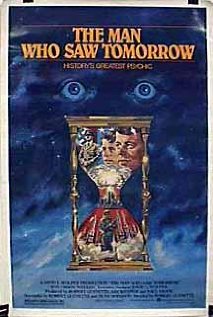
A Movie A Day #74: The Man Who Saw Tomorrow (1981, directed by Robert Gunette)


If you have ever wanted to witness the sad fate that awaits most geniuses who challenge the system, you could not do any worse than to watch The Man Who Saw Tomorrow.

The Man Who Saw Tomorrow is a low-budget “documentary” about Nostradamus, the 16th century French alchemist who some people consider to be a prophet and others consider to be a charlatan.  Nostradamus has been credited with predicting everything from the rise of Napoleon and Hitler to the 9-11 terror attacks.  Others argue that the writings of Nostradamus were so obscure and prone to mistranslation that they could be interpreted in just about any way.  While he did write about an evil dictator that he called “Hister,” he was also widely credited with predicting an atomic war in 1999.

The Man Who Saw Tomorrow argues that Nostradamus was indeed a prophet and it makes its case through cheap historical reenactments and a lot of stock footage.  The Zapruder film is used.  So is footage from A Tale of Two Cities, War and Peace, Earthquake, and Waterloo (Be sure to keep an eye out for Rod Steiger).  Some of the predictions, like Edward Kennedy becoming President and World War III starting in 1986, are easy to laugh at.  Others, like conflict in the Middle East leading to a nuclear war, would be frighteningly credible if the film wasn’t so obviously made on the cheap.  No skepticism of Nostradamus is implicitly acknowledged but there are interviews with a few believers, including psychic Jeane Dixon (whose first name the film misspells).

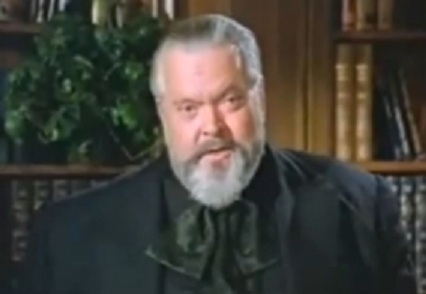
And narrating it all is none other than one of the most important filmmakers of all time, Orson Welles.  Sitting at a desk in front of a bookcase and occasionally puffing on a cigar, the director of Citizen Kane lends his deep and recognizable voice to the film’s narration but also adds just a touch of sarcasm to his tone.  The movie may believe that Nostradamus saw the future but Welles is going to damn well make sure that everyone understands that he does not.  When Welles talks about Nostradamus’s predictions for the future, he says, “But before continuing, let me warn you now that these predictions of the future are not at all comforting – and I might go on to add that these visions of the past, these warnings of the future, are not the opinions of the producers of this film. They’re certainly not my opinions.”  He really emphasizes that last sentence, as if he had already grown weary of people approaching him in the streets and asking him if he thought Nostradamus had predicted Watergate.

Sadly, Welles spent a good deal of his career doing jobs like this.  The films and the roles were often beneath his talent but they provided Welles with the money that he needed to pursue his own projects, many of which were never to be completed.  At the time he did The Man Who Saw Tomorrow, Welles was trying to raise the money to complete post production on his final film, The Other Side of The Wind.  The Other Side of The Wind would remain unfinished at the time of Welles’s death but it now appears that, 41 years after principal photography was completed, the film may finally see the light of day thanks to Netflix.

As for The Man Who Saw Tomorrow, it seems only fair to give Orson Welles the final word.  When asked about the film and Nostradamus on The Merv Griffin Show, Welles replied, “”One might as well make predictions based on random passages from the phone book.”

Well said, Orson.  Well said.


Lisa Cleans Out Her DVR: Fight Valley (dir by Rob Hawk)


I wish I knew how to fight.  Don’t get me wrong.  I’m a pacifist.  I’m not the type who would ever actually go out looking for a fight but we live in a dangerous world and I’d like to know how to fight for much the same reason that I like to carry a pink, Hello Kitty derringer in my garter.  Self-defense is important.

Again, don’t get me wrong.  I know how to pull hair.  In fact, back in the day, I was told that I was a very good hair puller.  And I keep my nails healthy and strong so I probably could scratch someone’s eyes out if I had to.  But, with all that in mind, I’d still probably be totally lost if I ever got into a real fight.  I have no idea how to throw a punch for instance.  I recently tried to show off my technique to a friend of mine who spent two years serving in the IDF.  She started laughing as soon as I made a fist.  Apparently, you’re not supposed to tuck in your thumb.  I had no idea.

I found myself thinking about this last night.  I’m in the process of cleaning out my DVR and, before going to bed, I decided to watch the 2016 film Fight Valley.  I recorded Fight Valley off of TMC on March 10th.  I’m not sure why I recorded it.  Maybe I liked the title. Who knows?

Anyway, Fight Valley is a film about fighting.  In many ways, it’s a how-to video for girls who want to learn how to kick ass.  Watching Fight Valley, I learned that the most important thing about fighting is to stand around and glare at the person who you want to fight.  Judging from the film, it’s also important to say stuff like, “This is our hood,” and “You need to take your skinny ass home, white girl.”  Apparently, when walking past someone who you want to fight, it’s very important to make sure that you bump into their shoulder.  Basically, it goes: Glare, Talk, Shoulder Bump.

 

Fight Valley takes place in Camden, New Jersey, where it appears your only two options are either joining the Mafia or getting involved with the underground fighting circuit.  Tori Colo (Chelsea Durkalec) is this kickass fighter who needs to make some money.  She asks her rich older sister, Windsor (Susie Celek), for the money but Windsor is all like, “Why don’t you get a real job and stop bumping into people’s shoulders?”  One night, a skeezy guy tells Tori that she can make some extra cash by going to Fight Valley.  The next morning, Tori’s dead body is discovered in the woods!

Well, needless to say, Windsor feels guilty.  So, she does what any rich girl who doesn’t know how to fight would do.  She starts wandering around Camden and randomly asking people, “Hey, can you give me a ride to Fight Valley?”  Well, that doesn’t work.  She gets told to go home.  Tori’s squad tells her that she either needs to learn how to fight or give up.  Fortunately, the harsh and enigmatic Jabs (Miesha Tate) is willing to teach her how to fight.  Even more luckily, it only takes four weeks to learn.

(Don’t worry, there’s a twist!  Jabs has her own reason for teaching Windsor how to fight.  I won’t spoil it here, largely because it’s kind of stupid.)

The good thing about Fight Valley is that a good deal of the cast is made up of actual fighters.  Along with Miesha Tate, the cast includes Holly Holm and Cris Cyborg.  While I have to admit that I don’t know much about ultimate fighting, I do know that if any of these three gave me the fight glare, I would immediately go hide under a table.  Whenever they’re punching, kicking, and putting each other into chokeholds, they are totally believable and there are hints of what the film could have been.  Unfortunately, the fight scenes themselves are somewhat haphazardly shot and confusingly edited.  As a general rule, when you’ve got actual athletes doing their thing, you don’t need a lot of jump cuts and flashbacks.

The big problem was the acting.  For a film where the main attraction was obviously meant to be the fight scenes, Fight Valley was a surprisingly talk movie.  Most of the film’s cast had an authenticity to them that disappeared as soon as they opened their mouths and started to recite the script’s overwritten dialogue in the most stilted style possible.  It just doesn’t work.

The same can be said of Fight Valley in general.  As much as I’d love to know how to throw a punch, Fight Valley left me feeling like maybe I should just stick to hair pulling.

Lisa Cleans Out Her DVR: Guilty Pleasure No. 33: In the Mix (dir by Ron Underwood)


Back in January, I had to get a new cable box.  Sadly, when the boxes were switched, I lost everything that I had saved on the DVR.  Over a hundred movies and TV shows were wiped away!  However, I did not let this get me down.  Instead, I decided to take advantage of the fact that I now had a lot more free space by literally recording anything that looked the least bit interesting.

Well, the day of reckoning has finally arrived.  It is now March 21st and the DVR is nearly full.  So, for the next few weeks, I am going to clean out my DVR and review what I watch!  Now, I can’t say how long this is going to take.  In the past, I’ve always given myself unrealistic deadlines.  So, this time, I’m not giving myself a time limit.  Instead, I’m just going to start watching what I’ve got recorded and hope that I’m done by 2018.  We’ll see how it goes.

Anyway, I started things off by watching the 2005 mafia romance film, In the Mix.

I recorded In The Mix off of Starz on March 16th.  I did this despite the fact that I’ve actually seen In The Mix quite a few times.  In The Mix, which is technically a beyond terrible movie, is a bit of a guilty pleasure of mine.  It’s a bit like From Justin To Kelly or On The Line.  Even though all my instincts as a movie snob tell me not to do it, I can’t help but watch it.

In the Mix stars Usher as Darrell, the hottest DJ in New York.  Every woman wants him and every man wants to be him.  However, all Usher wants to do is hang out with the family of the local mob boss.  It turns out that Don Frank (Chazz Palminteri) was friends with Darrell’s father and Darrell is now friends with Frank’s son, Frankie Jr. (Anthony Fazio).  Frank hires Darrell to DJ his daughter’s birthday party.

(Frankie, Jr. is a white kid who wants to be black.  Personally, I think there’s probably an interesting story in the idea of the son of an old-fashioned Italian mafia don who idolizes — or appropriates, depending on how you look at it — black culture but Frankie, Jr.’s characterization pretty much starts and ends with him saying, “Yo.”)

At the party, Darrell quickly falls in love with Frank’s daughter, Dolly (Emmanuelle Chriqui) and Dolly likes him too.  Especially after he takes a bullet that was intended for her father.  While Darrell is recuperating at the mansion, Frank tells Dolly that she can’t go outside unless she has a bodyguard.  Dolly says that’s fine as long as the bodyguard is Darrell.

And you know what that means!  It’s time for a makeover montage as Darrell gets a whole new wardrobe!  Yay!

Anyway, the plot is about as predictable as the casting of Kevin Hart as Usher’s comedic sidekick and Robert Davi as a sinister gangster.  Dolly and Darrell fall in love but you already knew that was going to happen.  You also probably already guessed that Dolly already has a boring boyfriend named Chad (Geoff Stults) and that Darrell has a crazy ex-girlfriend named Cherise (K.D. Aubert).  And, of course, Frank is not initially happy with the idea of Dolly leaving her rich lawyer boyfriend so that she can be with Darrell.  However, Darrell eventually gets a chance to prove himself by rescuing Dolly from some rival gangsters and he’s welcomed into the crime family.  Of course, he gets shot a second time.  “If the ghetto’s so dangerous,” he says as he lies on the ground, “how come I keep getting shot by white people?”  Everyone has a good laugh as they wait for the ambulance.  That’s the type of movie that In The Mix is.

As I watched In The Mix, I realized that it was actually a lot worse than I remembered and yet, I still enjoyed it.  Why?  To be honest, it all comes down to Usher and Emmauelle Chriqui, both of whom look really, really good and who have enough chemistry that they can overcome an amazingly clunky script.  You reallydo believe that the two of them actually are into each other and you hope that things will work out for them because they’re such a ludicrously attractive couple.  In The Mix is an incredibly shallow and silly movie but the stars both look good when they kiss and, ultimately, that’s what a movie like this is all about.

That said, in the future, I probably won’t bother to set the DVR for it again.

Previous Guilty Pleasures

  1. Half-Baked
  2. Save The Last Dance
  3. Every Rose Has Its Thorns
  4. The Jeremy Kyle Show
  5. Invasion USA
  6. The Golden Child
  7. Final Destination 2
  8. Paparazzi
  9. The Principal
  10. The Substitute
  11. Terror In The Family
  12. Pandorum
  13. Lambada
  14. Fear
  15. Cocktail
  16. Keep Off The Grass
  17. Girls, Girls, Girls
  18. Class
  19. Tart
  20. King Kong vs. Godzilla
  21. Hawk the Slayer
  22. Battle Beyond the Stars
  23. Meridian
  24. Walk of Shame
  25. From Justin To Kelly
  26. Project Greenlight
  27. Sex Decoy: Love Stings
  28. Swimfan
  29. On the Line
  30. Wolfen
  31. Hail Caesar!
  32. It’s So Cold In The D