A Movie A Day #73: Bitter Harvest (1993, directed by Duane Clark)


Travis Graham (Stephen Baldwin, before he found God) is a doofus who owns a farm.  His late father sent all of the family’s money to a crooked televangelist but he did leave Travis a valuable coin collection.  But then two blondes enter his life.  Kelly Ann (Jennifer Rubin) is a penniless hitchhiker who needs a place to stay and a bed to sleep in.  Jolene (Patsy Kensit) is a British realtor who says she wants to help Travis sell his farm.  Faster than you can say “I don’t know the exact pronunciation but I believe it’s ménage à trois,” that’s exactly what happens.  Travis can’t believe his luck but it turns out that Kelly Ann and Jolene have plans of their own.  Then, in a strangely unrelated subplot, a banker robber who shot the local sheriff (M. Emmett Walsh) shows up at the farm.  Travis kills the bank robber but then Kelly Ann and Jolene start pressuring him to use the robber’s plan to rob a bank himself.

This is one of the many strange movies from the increasingly strange career of Stephen Baldwin.  Now that he’s best known for evangelizing and appearing in celebrity-themed reality shows (including, most infamously, two seasons of The Celebrity Apprentice), it is easy to forget that Stephen Baldwin was once a good character actor who, with the exception of The Usual Suspects, apparently could not pick a good script if his life depended upon it.  His performance as the socially backward Travis is often strange (at times, he seems to be channeling Lenny from Of Mice and Men) but always interesting.  Fans of 90s neo-noir will also be happy to see Delusion’s Jennifer Rubin, playing yet another mysterious and dangerous temptress.  Unfortunately, Bitter Harvest falls apart because of an implausible script and too many loose ends but, until it does, the sultry combination of Jennifer Rubin and Patsky Kensit keeps things watchable.

One final note: The sheriff’s son is played by Adam Baldwin.  Even though the two are not actually related, everyone in the 90s assumed that they were and this makes Bitter Harvest a double Baldwin film.

A Movie A Day #72: Delusion (1991, directed by Carl Colpaert)


George O’Brien (Jim Metzler) is a former executive at a San Diego computer company who is driving across Nevada.  He is heading to Reno, where he plans to set up a company with the embezzled millions that he has hidden in his trunk.  When he spots former Vegas showgirl Patti (Jennifer Rubin) standing on the side of the road, he stops to pick her up.  She explains that her car broke down and she needs a lift.  George is happy to give her a ride.  The only problem is that Patti is traveling with her boyfriend, Chevy (Kyle Secor).  At first, Chevy just seems to be a goofy guy who talks too much.  However, Chevy is actually a hitman, traveling to Vegas to kill a gangster (Jerry Orbach).  After the hit, Chevy abandons George in the desert and steals his car.  Determined to get his money, George pursues Chevy and Patty across the desert.

Starting like a caper film and ending like a spaghetti western, Delusion was one of the best (and most overlooked) of the many low-budget neo-noirs that came out during the first half of the 1990s.  While the underrated Metzler and Secor both give good performances, Delusion is stolen by Jennifer Rubin, who is sexy, funny, and unpredictable as Patti.  The scene where she performs These Boots Are For Walking is one of the best of the 90s.  Whatever happened to her?

And why hasn’t this excellent retro thriller been given a proper release on DVD or Blu-ray?  If any movie is deserves to be rediscovered via a special edition, it’s Delusion.

A Movie A Day #71: Side Out (1990, directed by Peter Israelson)


Monroe (C. Thomas Howell) is a young lawyer who moves to California and gets a job working for his Uncle Max (Terry Kiser).  Max wants Monroe to concentrate on evicting beach bums.  Monroe wants to play beach volleyball.  Together, they solve crimes.  No, actually, Max orders Monroe to evict Zack (Peter Horton), a former volleyball champion who was once “king of the beach.”  Zack agrees to coach Monroe and his goofball friend, Wiley (Christopher Rydell) in a volleyball tournament.  But when Zack misses a match because he is having underlit, PG-13 sex with his ex-wife (Harley Jane Kozak), uncoached Monroe accidentally breaks Wiley’s arm.  Now, Zack has to step in as Monroe’s partner and reclaim his status as king of the beach!

When I was a kid, Side Out was a HBO perennial, which is not the same thing as being a good movie.  There have not been many movies made about beach volleyball and Side Out shows us why.  Beach volley ball is just not that exciting to watch, especially when the main competitors are two out of shape actors.  All the jump cuts and close-ups in the world can’t disguise the fact that neither actor looks like he could get the ball over the net, never mind playing for over ten minutes without getting out of breath.  In Side Out, beach volleyball teamwork comes down to a lot of yelling and whenever Monroe yells at either Wiley or Zack, he sounds just like the “Put him in a body bag, Johnny!” guy from The Karate Kid.

At least Kathy Ireland has a small role.  Also, in the role of Zack’s friend, keep an eye out for Duke himself, the great Tony Burton!

What are you doing here, Duke!?

Film Review: Double Mommy (dir by Doug Campbell)


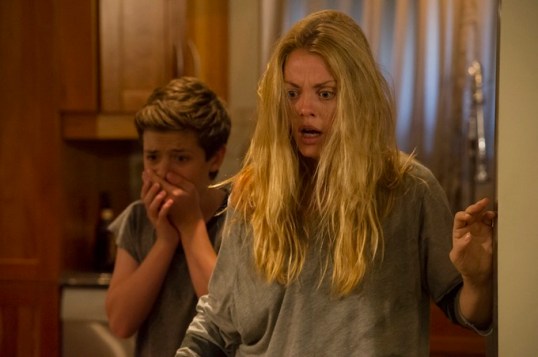
Lifetime followed Mommy’s Little Boy with the American premiere of Double Mommy.

Double Mommy is another Canadian-produced Lifetime film.  This one is a bit of a spiritual cousin to Double Daddy.  Like Double Daddy, Double Mommy starts with a high school party, ends with the arrival of two babies, and finds the time to include some homicide in between.  It’s also something of a class drama, with the rich being very evil and the middle class being very saintly and the lower class being pretty much nonexistent.

In Double Mommy, Jess (Morgan Obenreder, best known to readers of the site for playing Charisma Carpenter’s daughter in Bound) is pregnant with twins, a boy and a girl.  However, she’s not sure who the father is.  She wants the father to be Ryan (Griffin Freeman), her perfect boyfriend.  But she suspects that the father might be Brent (Mark Grossman), Ryan’s former best friend.  One night, while Ryan was away, Brent gave Jess a drink.  He said it was nonalcoholic and the can said “Cola.”  But the way the camera lingered on that can before Jess actually drank it, everyone watching the movie knew that it was drugged.  Jess has only vague memories of the rest of the night but she knows what happened.

A paternity test reveals that one twin was fathered by Ryan and the other by Brent!  At this point, I said, “So, which one is going to be the evil twin!?”

Well, the film never really got around to answering that question.  Instead, it focused on the attempts of Brent’s rich father (Bruce Boxleitner) to pay Jess and her family off.  It turns out that Jess is not the first girl that Brent has raped and his father has been covering up for him.  Jess is determined to expose Brent as a rapist.  Jess hangs banners at school.  She posts Brent’s picture on social media.

Let’s give Double Mommy credit where credit is due.  In the characters of Brent and his father, the film makes a point about how one generation enables the bad behavior of another and how misogyny can be passed down from father to son.  Furthermore, Jess never allows herself to simply be a victim.  She’s a fighter who never apologizes for standing up for herself and who, most importantly, never blames herself for the rape.  But, with all that in mind, Double Mommy would have been so much better (and certainly more empowering) if Jess had gone all Ms. 45 or I Spit On Your Grave on Brent’s ass.

I mean, it’s true that, as a result of Jess’s efforts, Brent loses a scholarship and gets booed at a soccer game.  That’s all good but Brent was such a loathsome character that he deserved much worse.  If there’s ever been a character in a Lifetime film who deserved to be locked in a cage and beaten until he confessed to his crimes, it was Brent.  After an hour of Brent smirking, bragging, and drugging, I was ready to see Jess pick up a gun and blow his head off while uttering a priceless one-liner.  Instead, Brent just got embarrassed and eventually ended up running around with a gun of his own.  What could have been an empowering little revenge flick turned into a typical Lifetime movie.

That said, the film was well-acted and nicely put together.  Mark Grossman turned Brent into a disturbingly familiar villain.  (We’ve all known a Brent.)  I just wish the film had gone a bit further in giving Jess her revenge.


Film Review: Mommy’s Little Boy (dir by Curtis Crawford)


On Saturday, Lifetime presented a Mommy Madness marathon, showing a series of melodramas that all, in some way, involved motherhood.  They showed everything from Killing Mommy to Mommy’s Secret to Mommy’s Little Girl.  They ended the night with not one but two premiere films!  Needless to say, I was excited.  After missing last week’s Lifetime movie (though I did DVR it so fear not!), I was looking forward to embracing the melodrama not once but twice!

The first premiere was Mommy’s Little Boy, which naturally came on immediately after Mommy’s Little Girl.  Just judging from the title and Lifetime’s previous record when it comes to children, I assumed that Mommy’s Little Boy would be about a homicidal child.

It turns out I was incorrect.  Don’t get me wrong, of course.  The kid does kill at least one person.  Actually, I think he killed two people but the film is a little bit ambiguous as to whether or not little Eric (Peter DaCunha) meant to let his half-brother Max (Auden Larrat) drown.  You really couldn’t blame Eric if that was the case.  Max was a stone-cold psychopath who started the movie threatening to attack a stray dog with a power drill.  Max got whatever he deserved.  As for that other murder that Eric commits — well, it’s self-defense.  Eric really had no choice.  Eric’s a good kid, dangit!

Instead, it’s his mother who is the problem.  Briana (Bree Williamson) has a really nice house but she’s the type of mother who is too busy sunbathing (while wearing an American flag bikini, no less) to notice that one of her sons is drowning in the pool behind her.  Briana is almost always drunk or stoned.  She brings strange men home with her.  She neglects Eric and sends him to school in grubby clothes.  She murders the neighbor for being condescending, banging her over the head with the same skillet that will later be used to prepare Eric’s breakfast.  Briana’s not the world’s best mother but, at the very least, she has a nice house.

Seriously, you have to see this house.  Have you ever seen House Hunters?  You know how the third house is always a really nice house that, we’re told, is a little bit outside of the house hunters’s budget?  (“Now, this is listed for a little more than you said you were willing to pay but the price may come down…”)  That’s the type of house that Brianna lives in.  Unfortunately, Brianna has kinda trashed the place.  At one point, she explains that she inherited the house after her parents died.  At least, for once, a Lifetime movie took the time to explain why even the trashiest of characters always live in the nicest of houses.

Anyway, Briana’s killed someone and she forces Eric to help her cover up the crime.  That kinda traumatizes Eric.  He’d much rather live with his softball coach, Michael Davis (Paul Popovich).  However, Briana is determined to get in her new boyfriend’s RV and flee to Mexico.  And she expects her only remaining son to come with her.  Whatever is Eric to do!?

Well, you probably already guessed what happens.  Mommy’s Little Boy was a standard Lifetime film but I liked it.  If nothing else, Bree Williamson deserves some sort of award for how totally and completely she throws herself into the role of Briana.  It takes courage to play someone that trashy without winking at the audience but Williamson does it.  Overall, Mommy’s Little Boy was an entertaining addition to Lifetime’s stable of films about mentally unstable maternal figures.

A Movie A Day #70: Wired (1989, directed by Larry Peerce)


Sometimes, you watch a movie and all you cay say, at the end, is “What the Hell were they thinking?”
Wired is one such movie.  Based on a widely discredited biography by Bob Woodward, Wired tells two stories.  In the first story, John Belushi (Michael Chiklis, making an unfortunate film debut) wakes up in a morgue and is told by his guardian angel that he has died of a drug overdose.  Did I mention that his guardian angel is Puerto Rican cabbie named Angel Vasquez (Ray Sharkey) and Angel drives Belushi through a series of flashbacks?  Belushi meets Dan Aykroyd (Gary Groomes, who looks nothing like Dan Aykroyd).  Belushi gets cast on Saturday Night Live.  Belushi marries Judy (Lucinda Jenney).  Belushi uses drugs, costars in The Blues Brothers, dies of a drug overdose in a sleazy motel, and plays a pinball game to determine whether he’ll go to Heaven or Hell.  While this is going on, Bob Woodward (J.T. Walsh) is interviewing everyone who knew Belushi while he was alive.

There are so many things wrong with Wired that it is hard to know where to even begin.  I haven’t even mentioned the scene where Bob Woodward travels back in time and has a conversation with Belushi while he’s dying on the motel room floor.  Wired tries to be a cautionary tale about getting seduced by fame and drugs but how seriously can anyone take the message of any movie that features Ray Sharkey as a guardian angel?  The scenes with Woodward are strange, mostly because the hero of Watergate is being played by an actor best known for playing sinister villains.  (Seven years after playing Bob Woodward, J.T. Walsh was actually cast as Watergate figure John Ehrlichman in Nixon.)  Considering that this was his first movie, Michael Chiklis is not bad when it comes to playing a drug addict named John but he’s never convincing as John Belushi.  He never captures the mix of charisma and danger that made John Belushi a superstar.  Wired wants to tell the story of Belushi’s downfall but never understands what made him special to begin with.

Wired tries to be edgy but it only succeeds for one split second.  During the filming of The Blues Brothers, a director who is clearly meant to be John Landis walks over to Belushi’s trailer.  Listen carefully, and a helicopter can be heard in the background.

As for the rest of Wired, what the Hell were they thinking?

A Movie A Day #69: Intersection (1994, directed by Mark Rydell)


This one is just dumb.

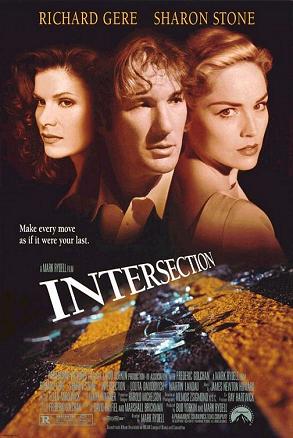
Vincent Eastman (Richard Gere) and his wife, Sally (Sharon Stone), own an architectural firm.  Vincent is supposed to be creative and passionate but mostly he’s just Richard Gere in mom jeans.  Sally is a brilliant businesswoman but she is also emotionally repressed to the point of being frigid.  Vincent eventually starts having an affair with a travel writer named Olivia (Lolita Davidovich), who is everything that Sally is not.  Despite Martin Landau telling him that he has to make a decision because, and I quote, “Keep everything under one roof. That’s a basic rule of architecture,” Vincent cannot choose between his hateful wife and his loving mistress.  First he writes a letter to Olivia, telling her that he can not leave his wife.  Then, he sees a little girl who, like Olivia, has curly red hair and he takes that as a sign that he should leave his wife.  He calls Olivia and leaves a gushing message on her machine, telling her that he’s leaving Sally.  But before the letter is sent or the message is heard, Vincent is in a car crash that leaves him in a coma.  As both his wife and his mistress wait outside his hotel room, Vincent has visions of his two lovers swimming by him and struggles to decide who to follow.  Even in a coma, Vincent is an indecisive prick.

Intersection was on HBO while I was sick.  I watched it and it just made me feel worse.  Intersection was made during a weird period of time when Richard Gere was a romantic star and Sharon Stone was trying to prove that she was a serious actress.  Stone lobbied to be cast against type as Sally but she plays the role as so hard and bitchy that there’s never any question as to whether or not Vincent should leave her for Olivia.  Lolitia Davidovich (whatever happened to her?) does what she can with Olivia but the character never has any existence beyond her relationship with Vincent.  As for Richard Gere, when he starts hyperventilating about seeing a little girl who looks like his mistress, you’ll want to report him to social services.

Sadly, Intersection was directed by Mark Rydell and written by Marshall Brickman, two people who did great work before Intersection and have done very little since.

A Movie A Day #68: Hoosiers (1986, directed by David Anspaugh)


I’m back!

Even though it has only been a week since I last did a movie a day, I feel like I’ve been gone forever.  Thank you to everyone who commented or messaged me while I was gone.  It turned out that I just had a bad sinus infection.  It was painful as Hell but, with the help of antibiotics and the greatest care in the world, I’m recovering.

Last week, I asked if anyone had any suggestions for what the 68th movie a day should be.  Case suggested Hoosiers and so it shall be.

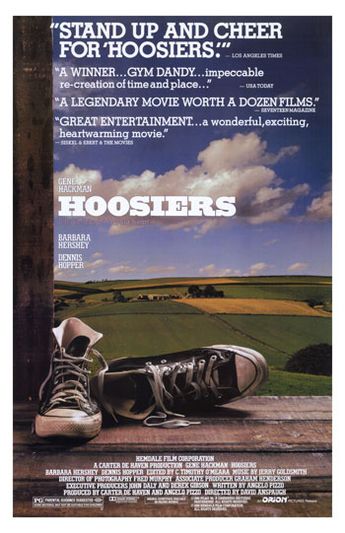
In 1951, Norman Dale (Gene Hackman) arrives in the small Indiana town of Hickory.  He is a former college basketball coach who has been hired to coach the high school’s perennially struggling basketball team.  Emphasizing the fundamentals and demanding discipline from his players, Dale struggles at first with both the team and the townspeople.  When he makes an alcoholic former basketball star named Shooter (Dennis Hopper) an assistant coach, he nearly loses his job.  Eventually, though, the Hickory team starts winning and soon, this small town high school is playing for the state championship against highly favored South Bend High School.
For many people, Hoosiers is not just “a basketball movie.”  Instead, it is the basketball movie, the movie by which all other sport films are judged.  Hoosiers is inspired by a true story.  In 1954, small town Milan High School did defeat Muncie for the Indiana State Championship and they did it by two points.  Otherwise, Hoosiers is heavily fictionalized and manages to include almost every sports film cliché that has ever existed.  How good a coach is Norman Dale, really?  Almost every game that Hickory wins is won by only one basket.

Why, then, is Hoosiers a classic?  Much of it is due to director David Anspaugh’s attention to period and detail.  Some of it is due to Gene Hackman, who gives a tough and unsentimental performance.  Whenever Hoosiers starts to cross the line from sentimental to maudlin, Hackman is there to pull it back to reality with a gruff line delivery.  Even his romance with the one-note anti-basketball teacher (Barbara Hershey) works.  Hickory feels like a real place, with a real history and inhabited by real people.

And then there’s Dennis Hopper.  Along with Blue Velvet, Hoosiers was Hopper’s comeback film.  After spending twenty years lost in the Hollywood wilderness, better known for abusing drugs and shooting guns than acting, Hopper had just come out of rehab when he was offered the role of Shooter.  Amazingly, he turned the role down and told the producers to offer it to his friend, Harry Dean Stanton.

According to Peter L. Winkler’s Dennis Hopper: Portrait of an American Rebel, this is what happened next:

Stanton (who, ironically, was also considered for Hopper’s role in Blue Velvet) called Hopper up and asked, “Aren’t you from Kansas?”

“Yeah.”

“Didn’t you have a hoop on your barn?”

“Yeah.”

“I think you may be the guy that David Anspaugh’s looking for.”

Harry Dean Stanton was right.  Dennis Hopper, still very much in recovery, totally inhabited the role of the alcoholic Shooter and gave one of the best performances of his often underrated career.  Both Shooter and the actor playing him surprised everyone by doing a good job and Hopper received his only Oscar nomination for acting for his performance in Hoosiers.  (He had previously been nominated for co-writing Easy Rider.)

You don’t have to like basketball to enjoy the Hell out of Hoosiers.

Green Cheese? No, it’s THE GREEN SLIME (MGM 1969)


gary loggins's avatarcracked rear viewer

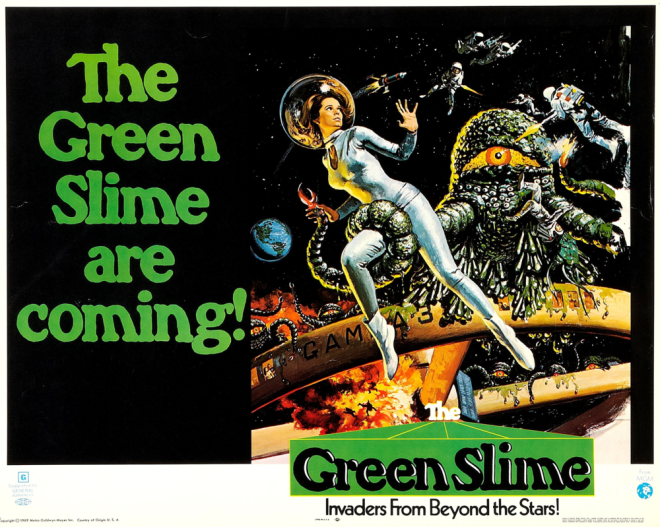
We all love a good cheese-fest every now and then, right? Well, THE GREEN SLIME delivers the limburger by the rocket-load, with its rock bottom special effects, silly looking monsters, overwrought dialog, and a cool heavy-metalish theme song (Who was that singer belting out the tune? More on that later!). This MGM/Toei Studios mashup was made with a Japanese crew and American cast, with an Italian pedigree, no less.

An asteroid codenamed ‘Flora’ is hurtling toward a collision course with Earth, and Comm. Jack Rankin is sent to space station Gamma-3 with orders to blow the thing to smithereens. Gamma-3’s Commander, Vince Elliott, holds a longtime grudge against Rankin, and his fiancé Dr. Lisa Benson just happens to be Rankin’s ex. I smell a love triangle brewing! Rankin, Elliott, and other crew members blast off to the asteroid to plant explosives, but there’s this Blob-like, pulsating ooze around gripping their…

View original post 441 more words

End of an Era: THE ROARING TWENTIES (Warner Brothers 1939)


gary loggins's avatarcracked rear viewer

Warner Brothers helped usher in the gangster movie era in the early 1930’s with Pre-Code hits like LITTLE CAESAR and THE PUBLIC ENEMY, and at the decade’s end they put the capper on the genre with THE ROARING TWENTIES, a rat-a-tat-tat rousing piece of filmmaking starring two of the studio’s top hoods, James Cagney and Humphrey Bogart , directed with the top down by eye-patch wearing macho man Raoul Walsh for maximum entertainment.

The film’s story was written by Mark Hellinger, a popular and colorful New York columnist in the Damon Runyon mold who based it on his encounters with some of the underworld figures he knew during that tumultuous era. Hellinger was later responsible for producing some of the toughest noirs of the late 40’s: THE KILLERS , BRUTE FORCE , THE TWO MRS. CARROLLS, and THE NAKED CITY. Jerry Wald, Richard Macauley, and Robert Rossen adapted Hellinger’s story for the screen, and the film…

View original post 572 more words