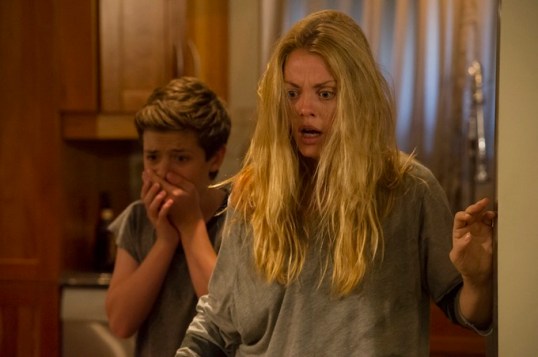
Film Review: Mommy’s Little Boy (dir by Curtis Crawford)


On Saturday, Lifetime presented a Mommy Madness marathon, showing a series of melodramas that all, in some way, involved motherhood.  They showed everything from Killing Mommy to Mommy’s Secret to Mommy’s Little Girl.  They ended the night with not one but two premiere films!  Needless to say, I was excited.  After missing last week’s Lifetime movie (though I did DVR it so fear not!), I was looking forward to embracing the melodrama not once but twice!

The first premiere was Mommy’s Little Boy, which naturally came on immediately after Mommy’s Little Girl.  Just judging from the title and Lifetime’s previous record when it comes to children, I assumed that Mommy’s Little Boy would be about a homicidal child.

It turns out I was incorrect.  Don’t get me wrong, of course.  The kid does kill at least one person.  Actually, I think he killed two people but the film is a little bit ambiguous as to whether or not little Eric (Peter DaCunha) meant to let his half-brother Max (Auden Larrat) drown.  You really couldn’t blame Eric if that was the case.  Max was a stone-cold psychopath who started the movie threatening to attack a stray dog with a power drill.  Max got whatever he deserved.  As for that other murder that Eric commits — well, it’s self-defense.  Eric really had no choice.  Eric’s a good kid, dangit!

Instead, it’s his mother who is the problem.  Briana (Bree Williamson) has a really nice house but she’s the type of mother who is too busy sunbathing (while wearing an American flag bikini, no less) to notice that one of her sons is drowning in the pool behind her.  Briana is almost always drunk or stoned.  She brings strange men home with her.  She neglects Eric and sends him to school in grubby clothes.  She murders the neighbor for being condescending, banging her over the head with the same skillet that will later be used to prepare Eric’s breakfast.  Briana’s not the world’s best mother but, at the very least, she has a nice house.

Seriously, you have to see this house.  Have you ever seen House Hunters?  You know how the third house is always a really nice house that, we’re told, is a little bit outside of the house hunters’s budget?  (“Now, this is listed for a little more than you said you were willing to pay but the price may come down…”)  That’s the type of house that Brianna lives in.  Unfortunately, Brianna has kinda trashed the place.  At one point, she explains that she inherited the house after her parents died.  At least, for once, a Lifetime movie took the time to explain why even the trashiest of characters always live in the nicest of houses.

Anyway, Briana’s killed someone and she forces Eric to help her cover up the crime.  That kinda traumatizes Eric.  He’d much rather live with his softball coach, Michael Davis (Paul Popovich).  However, Briana is determined to get in her new boyfriend’s RV and flee to Mexico.  And she expects her only remaining son to come with her.  Whatever is Eric to do!?

Well, you probably already guessed what happens.  Mommy’s Little Boy was a standard Lifetime film but I liked it.  If nothing else, Bree Williamson deserves some sort of award for how totally and completely she throws herself into the role of Briana.  It takes courage to play someone that trashy without winking at the audience but Williamson does it.  Overall, Mommy’s Little Boy was an entertaining addition to Lifetime’s stable of films about mentally unstable maternal figures.

A Movie A Day #70: Wired (1989, directed by Larry Peerce)


Sometimes, you watch a movie and all you cay say, at the end, is “What the Hell were they thinking?”
Wired is one such movie.  Based on a widely discredited biography by Bob Woodward, Wired tells two stories.  In the first story, John Belushi (Michael Chiklis, making an unfortunate film debut) wakes up in a morgue and is told by his guardian angel that he has died of a drug overdose.  Did I mention that his guardian angel is Puerto Rican cabbie named Angel Vasquez (Ray Sharkey) and Angel drives Belushi through a series of flashbacks?  Belushi meets Dan Aykroyd (Gary Groomes, who looks nothing like Dan Aykroyd).  Belushi gets cast on Saturday Night Live.  Belushi marries Judy (Lucinda Jenney).  Belushi uses drugs, costars in The Blues Brothers, dies of a drug overdose in a sleazy motel, and plays a pinball game to determine whether he’ll go to Heaven or Hell.  While this is going on, Bob Woodward (J.T. Walsh) is interviewing everyone who knew Belushi while he was alive.

There are so many things wrong with Wired that it is hard to know where to even begin.  I haven’t even mentioned the scene where Bob Woodward travels back in time and has a conversation with Belushi while he’s dying on the motel room floor.  Wired tries to be a cautionary tale about getting seduced by fame and drugs but how seriously can anyone take the message of any movie that features Ray Sharkey as a guardian angel?  The scenes with Woodward are strange, mostly because the hero of Watergate is being played by an actor best known for playing sinister villains.  (Seven years after playing Bob Woodward, J.T. Walsh was actually cast as Watergate figure John Ehrlichman in Nixon.)  Considering that this was his first movie, Michael Chiklis is not bad when it comes to playing a drug addict named John but he’s never convincing as John Belushi.  He never captures the mix of charisma and danger that made John Belushi a superstar.  Wired wants to tell the story of Belushi’s downfall but never understands what made him special to begin with.

Wired tries to be edgy but it only succeeds for one split second.  During the filming of The Blues Brothers, a director who is clearly meant to be John Landis walks over to Belushi’s trailer.  Listen carefully, and a helicopter can be heard in the background.

As for the rest of Wired, what the Hell were they thinking?

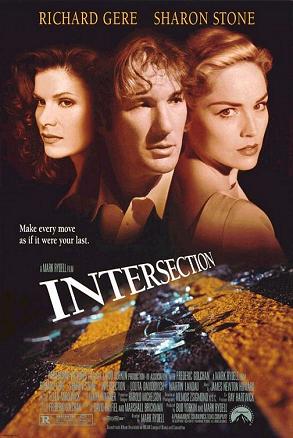
A Movie A Day #69: Intersection (1994, directed by Mark Rydell)


This one is just dumb.

Vincent Eastman (Richard Gere) and his wife, Sally (Sharon Stone), own an architectural firm.  Vincent is supposed to be creative and passionate but mostly he’s just Richard Gere in mom jeans.  Sally is a brilliant businesswoman but she is also emotionally repressed to the point of being frigid.  Vincent eventually starts having an affair with a travel writer named Olivia (Lolita Davidovich), who is everything that Sally is not.  Despite Martin Landau telling him that he has to make a decision because, and I quote, “Keep everything under one roof. That’s a basic rule of architecture,” Vincent cannot choose between his hateful wife and his loving mistress.  First he writes a letter to Olivia, telling her that he can not leave his wife.  Then, he sees a little girl who, like Olivia, has curly red hair and he takes that as a sign that he should leave his wife.  He calls Olivia and leaves a gushing message on her machine, telling her that he’s leaving Sally.  But before the letter is sent or the message is heard, Vincent is in a car crash that leaves him in a coma.  As both his wife and his mistress wait outside his hotel room, Vincent has visions of his two lovers swimming by him and struggles to decide who to follow.  Even in a coma, Vincent is an indecisive prick.

Intersection was on HBO while I was sick.  I watched it and it just made me feel worse.  Intersection was made during a weird period of time when Richard Gere was a romantic star and Sharon Stone was trying to prove that she was a serious actress.  Stone lobbied to be cast against type as Sally but she plays the role as so hard and bitchy that there’s never any question as to whether or not Vincent should leave her for Olivia.  Lolitia Davidovich (whatever happened to her?) does what she can with Olivia but the character never has any existence beyond her relationship with Vincent.  As for Richard Gere, when he starts hyperventilating about seeing a little girl who looks like his mistress, you’ll want to report him to social services.

Sadly, Intersection was directed by Mark Rydell and written by Marshall Brickman, two people who did great work before Intersection and have done very little since.

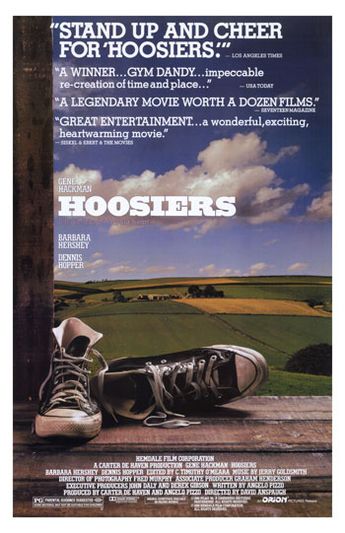
A Movie A Day #68: Hoosiers (1986, directed by David Anspaugh)


I’m back!

Even though it has only been a week since I last did a movie a day, I feel like I’ve been gone forever.  Thank you to everyone who commented or messaged me while I was gone.  It turned out that I just had a bad sinus infection.  It was painful as Hell but, with the help of antibiotics and the greatest care in the world, I’m recovering.

Last week, I asked if anyone had any suggestions for what the 68th movie a day should be.  Case suggested Hoosiers and so it shall be.

In 1951, Norman Dale (Gene Hackman) arrives in the small Indiana town of Hickory.  He is a former college basketball coach who has been hired to coach the high school’s perennially struggling basketball team.  Emphasizing the fundamentals and demanding discipline from his players, Dale struggles at first with both the team and the townspeople.  When he makes an alcoholic former basketball star named Shooter (Dennis Hopper) an assistant coach, he nearly loses his job.  Eventually, though, the Hickory team starts winning and soon, this small town high school is playing for the state championship against highly favored South Bend High School.
For many people, Hoosiers is not just “a basketball movie.”  Instead, it is the basketball movie, the movie by which all other sport films are judged.  Hoosiers is inspired by a true story.  In 1954, small town Milan High School did defeat Muncie for the Indiana State Championship and they did it by two points.  Otherwise, Hoosiers is heavily fictionalized and manages to include almost every sports film cliché that has ever existed.  How good a coach is Norman Dale, really?  Almost every game that Hickory wins is won by only one basket.

Why, then, is Hoosiers a classic?  Much of it is due to director David Anspaugh’s attention to period and detail.  Some of it is due to Gene Hackman, who gives a tough and unsentimental performance.  Whenever Hoosiers starts to cross the line from sentimental to maudlin, Hackman is there to pull it back to reality with a gruff line delivery.  Even his romance with the one-note anti-basketball teacher (Barbara Hershey) works.  Hickory feels like a real place, with a real history and inhabited by real people.

And then there’s Dennis Hopper.  Along with Blue Velvet, Hoosiers was Hopper’s comeback film.  After spending twenty years lost in the Hollywood wilderness, better known for abusing drugs and shooting guns than acting, Hopper had just come out of rehab when he was offered the role of Shooter.  Amazingly, he turned the role down and told the producers to offer it to his friend, Harry Dean Stanton.

According to Peter L. Winkler’s Dennis Hopper: Portrait of an American Rebel, this is what happened next:

Stanton (who, ironically, was also considered for Hopper’s role in Blue Velvet) called Hopper up and asked, “Aren’t you from Kansas?”

“Yeah.”

“Didn’t you have a hoop on your barn?”

“Yeah.”

“I think you may be the guy that David Anspaugh’s looking for.”

Harry Dean Stanton was right.  Dennis Hopper, still very much in recovery, totally inhabited the role of the alcoholic Shooter and gave one of the best performances of his often underrated career.  Both Shooter and the actor playing him surprised everyone by doing a good job and Hopper received his only Oscar nomination for acting for his performance in Hoosiers.  (He had previously been nominated for co-writing Easy Rider.)

You don’t have to like basketball to enjoy the Hell out of Hoosiers.

Green Cheese? No, it’s THE GREEN SLIME (MGM 1969)


gary loggins's avatarcracked rear viewer

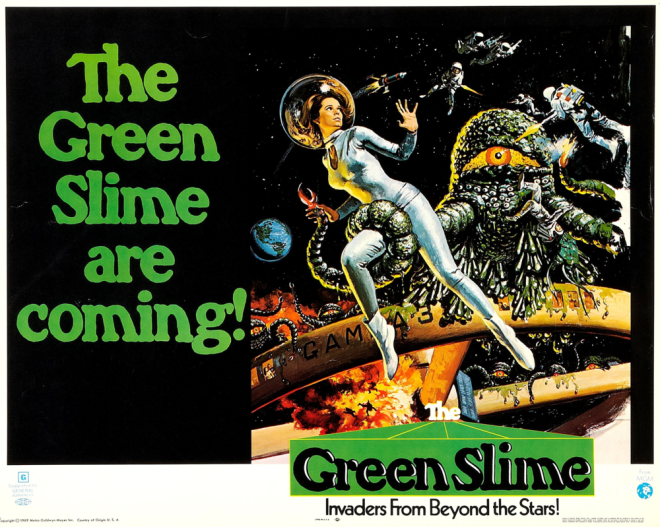
We all love a good cheese-fest every now and then, right? Well, THE GREEN SLIME delivers the limburger by the rocket-load, with its rock bottom special effects, silly looking monsters, overwrought dialog, and a cool heavy-metalish theme song (Who was that singer belting out the tune? More on that later!). This MGM/Toei Studios mashup was made with a Japanese crew and American cast, with an Italian pedigree, no less.

An asteroid codenamed ‘Flora’ is hurtling toward a collision course with Earth, and Comm. Jack Rankin is sent to space station Gamma-3 with orders to blow the thing to smithereens. Gamma-3’s Commander, Vince Elliott, holds a longtime grudge against Rankin, and his fiancé Dr. Lisa Benson just happens to be Rankin’s ex. I smell a love triangle brewing! Rankin, Elliott, and other crew members blast off to the asteroid to plant explosives, but there’s this Blob-like, pulsating ooze around gripping their…

View original post 441 more words

End of an Era: THE ROARING TWENTIES (Warner Brothers 1939)


gary loggins's avatarcracked rear viewer

Warner Brothers helped usher in the gangster movie era in the early 1930’s with Pre-Code hits like LITTLE CAESAR and THE PUBLIC ENEMY, and at the decade’s end they put the capper on the genre with THE ROARING TWENTIES, a rat-a-tat-tat rousing piece of filmmaking starring two of the studio’s top hoods, James Cagney and Humphrey Bogart , directed with the top down by eye-patch wearing macho man Raoul Walsh for maximum entertainment.

The film’s story was written by Mark Hellinger, a popular and colorful New York columnist in the Damon Runyon mold who based it on his encounters with some of the underworld figures he knew during that tumultuous era. Hellinger was later responsible for producing some of the toughest noirs of the late 40’s: THE KILLERS BRUTE FORCE , THE TWO MRS. CARROLLS, and THE NAKED CITY. Jerry Wald, Richard Macauley, and Robert Rossen adapted Hellinger’s story for the screen, and the film…

View original post 572 more words

A Movie A Day #67: Animal Factory (2000, directed by Steve Buscemi)


Edward Furlong is Ron Decker, a spoiled 18 year-old from a rich family who is arrested and sent to prison when he’s caught with a small amount of marijuana.  Being younger and smaller than the other prisoners, Ron is soon being targeted by everyone from the prison’s Puerto Rican gang to the sadistic Buck Rowan (Tom Arnold).  Fortunately, for Ron, prison veteran Earl Copen (Williem DaFoe) takes him under his wing and provides him with protection.  Earl is the philosopher-king of the prison.  As he likes to put it, “This is my prison, after all.”  If he can stay out of trouble, Ron has a chance to get out early but, with Buck stalking him, that’s not going to be easy.

Based on a novel by ex-con Edward Bunker, Animal Factory was the second film to be directed by Bunker’s Reservoir Dogs co-stars, Steve Buscemi.  Though it was overlooked at the time, Animal Factory is a minor masterpiece.  Taking a low key approach, Buscemi emphasizes the monotony of prison life just as much as the sudden bursts of violence and shows why someone like Ron Decker can go into prison as an innocent and come out as an animal.  DaFoe and Furlong give two of their best performances as Earl and Ron while a cast of familiar faces — Danny Trejo, Mickey Rourke, Chris Bauer, Mark Boone Junior — make up the prison’s population.  Most surprising of all is Tom Arnold, giving Animal Factory‘s best performance as the prison’s most dangerous predator.

A Movie A Day #66: Deadly Game (1991, directed by Thomas J. Wright)


Seven strangers are invited to a remote island by a mysterious billionaire named Osiris.  There is a doctor, a dancer, an auto mechanic, a mercenary, a football player and his agent, and a member of the Yakuza.  The auto mechanic points out that, in Egyptian mythology, Osiris judged mankind’s sins.  For some reason, none of the seven think twice about going to the island but, once they arrive, they soon discover that they should have.  Osiris is willing to give them seven million dollars but to get it, they have to reach the other end of the island without being killed by Osiris or his men.
Of the many movie adaptations of The Most Dangerous Game, this is probably the worst.  The cast, which includes Michael Beck, Marc Singer, Jenny Seagrove, Mitch Ryan, John Pleshette, Soon-Tek Oh, and Roddy McDowall, isn’t bad but the script is terrible, full of overwrought dialogue and plot holes.  Across the island, Osiris has left clues that are designed to trigger flashbacks and lead to each member of the seven explaining what it is that they did in the past.  But for that to work, Osiris would have to know exactly what route the seven of them were going to use to cross the island and he would also have to know who would still be alive by the time that they came across each clue.  Also, whenever they come across the clue, everyone stands around and wastes valuable time arguing about it.  Considering that there are armed men trying to kill them, no one seems to be in that much of a hurry to make it to the other side of the island.  The flashbacks themselves are interesting in how clumsily they are put together.  40ish Marc Singer plays himself as a senior in high school.

Like Hitler’s Daughter, Deadly Game was originally made for the USA network.  The first time I saw it was in the UK where, for some reason, it seemed to air frequently during the mid-1990s.  (Possibly this was because it starred quintessential Hollywood Brit Roddy McDowall.  That’s the only reason I can think of.)  It’s now on YouTube, for anyone who wants to sit through it.

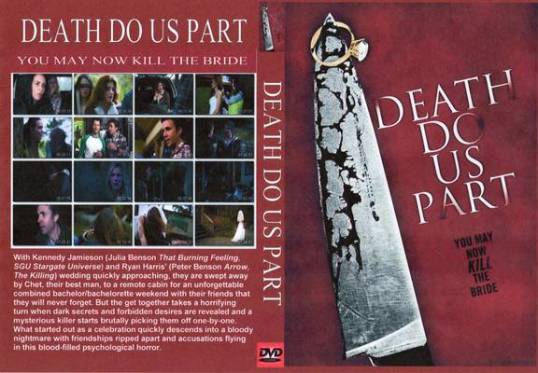
Insomnia File #23: Death Do Us Part (dir by Nicholas Humphries)


What’s an Insomnia File? You know how some times you just can’t get any sleep and, at about three in the morning, you’ll find yourself watching whatever you can find on cable? This feature is all about those insomnia-inspired discoveries!

If you were having trouble getting to sleep around one in the morning on March 7th, you could have watched the 2012 horror film, Death Do Us Part, on Showtime.

I don’t know if it would have helped you get to sleep though.  Death Do Us Part is one of those films where the entire cast spends a lot of time screaming.  I couldn’t tell you much about who all of the characters were meant to be, as they all kind of blended together (especially the male characters), but, if need be, I could identify all of their screams.

Of course, it takes a while for the screaming to get started.  Death Do Us Part takes its time getting to the mayhem.  It tells the story of a rich girl named Kennedy (Julia Benson) who has a history of mental instability and who is marrying Ryan Harris (Peter Benson).  Kennedy enjoys posing in her wedding dress, popping pills, and nervously smiling.  Life seems to be perfect for her!  But, as often seems to happen in these movies, Ryan is also having the occasional quickie with Kennedy’s sister, Hannah (Christine Catelain).  Kennedy’s best friend, Emily (Emilie Ullerup), happens to see Hannah and Ryan doing it in the woods.  Emily gets a slightly crazy look in her eyes as she watches.

(Then again, at some point in this movie, everyone has a crazy look in their eyes.)

Kennedy, Ryan, Hannah, Emily, and a couple of guys who aren’t that important are spending the weekend in a cabin in the woods.  The cabin comes with its own pervy caretaker.  If I ever spend the weekend at a cabin in the woods, I’m going to specifically ask for a cabin that doesn’t come with a caretaker.  Judging from the movies that I’ve seen, those dudes are always bad news.

ANYWAY — it takes a while but eventually, people start dying.  In fact, once people start dying, the movie suddenly picks up the pace.  Before you know it, everyone’s running around in the woods and getting killed and screaming.  Seriously, there’s lots and lots of screaming.

Up until the last fifteen minutes, I was ready to dismiss Death Do Us Part as just another low-budget attempt at horror but I actually did like the chaos of everyone running around in the woods.  Don’t get me wrong.  The movie takes way too long to get going and the characters are so generic that you really don’t care whether they’re dead or not.  But I did appreciate the fact that, when confronted by a murderous maniac, the majority of the characters reacted the way that I would have reacted.  They started running around, screaming their heads off, and ultimately, they just made things worse.  It was a nice change from the usual movie technique of having one of the characters suddenly turn out to be a hyper competent survival machine.

There is a twist but you’ll see it coming from a mile away.  That said, the final few shots of the film were enjoyably surreal in only the way that a bloody wedding dress can be.

(Speaking of wedding dresses, I loved the one in this film.  Way to go, Kennedy!)

Anyway, I can’t really recommend Death Do Us Part because it takes too long to get going and the characters are way too generic.  But, I did like the final fourth of the film and I may have found my future wedding dress!

All in all, not a bad way to handle insomnia.

Previous Insomnia Files:

  1. Story of Mankind
  2. Stag
  3. Love Is A Gun
  4. Nina Takes A Lover
  5. Black Ice
  6. Frogs For Snakes
  7. Fair Game
  8. From The Hip
  9. Born Killers
  10. Eye For An Eye
  11. Summer Catch
  12. Beyond the Law
  13. Spring Broke
  14. Promise
  15. George Wallace
  16. Kill The Messenger
  17. The Suburbans
  18. Only The Strong
  19. Great Expectations
  20. Casual Sex?
  21. Truth
  22. Insomina


A Movie A Day #65: Hitler’s Daughter (1990, directed by James A. Contner)


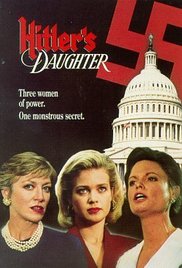
Ted Scott (Patrick Cassidy), a White House press aide, is contacted by his former professor, Dr. Bauman (Donald Davis).  Bauman gives Ted a file that he claims will prove that not only did Adolf Hitler have a daughter but she was subsequently smuggled into America and is now on the verge of occupying the White House.  Ted thinks that Bauman’s crazy but then Bauman is murdered and Ted is framed for the crime.  With both the police and the bad guys after him and with time running out, Ted must now figure out who is Hitler’s daughter.  Is it Sharon Franklin (Melody Anderson), the famous TV anchorwoman who is having an affair with a Senator?  Is it Patricia Benedict (Veronica Cartwright), the wife of the Vice President?  Or is it Senator Leona Crawford Gordon (Kay Lenz), who has just been put on the opposition party’s presidential ticket?

Hitler’s Daughter was originally made for the USA Network and, throughout the 1990s, it would frequently air late at night.  As far as the film’s quality is concerned, Kay Lenz was beautiful as ever but otherwise, Hitler’s Daughter was a typically forgettable low-budget made-for-tv thriller, complete with bad guys who can shoot everyone but the main character, exploding cars, and villains who carefully explain their plans before trying to kill the heroes.  It does end on a down note, with almost everyone dead.  This probably seemed edgy in 1990 but it seems predictable today.  Exactly ten years after this otherwise forgotten movie aired, Hitler’s Daughter was briefly again in the public spotlight a group of online conspiracy nuts claimed that Hillary Clinton was trying to suppress the movie’s release on video would harm her chances of getting elected to the Senate.

Far better than the movie is the novel on which it was based.  Written by Timothy B. Benford, the literary Hitler’s Daughter is an entertaining and enjoyably pulpy page turner.  Benford was the former police commissioner of Mountainside, New Jersey when he wrote Hitler’s Daughter in 1983 and the book touched with an nerve with at least a few readers.  According to a story in The New York Times, shortly after the novel was published, Benford woke up to discover a wooden swastika burning on his front lawn.  The movie stick closely to the book’s plot but never translates what worked on the page to the screen.