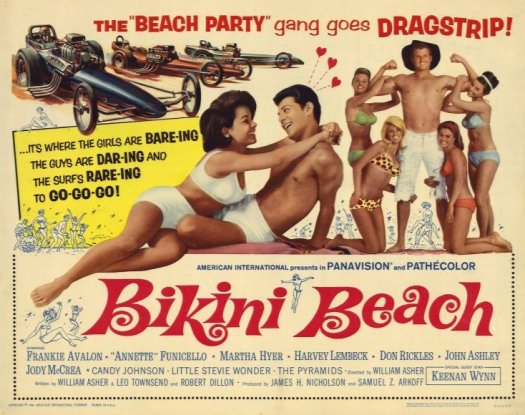
Welcome back to Drive-In Saturday Night! Summer’s here, and the time is right for a double dose of American-International teen flicks, so pull in, pull up a speaker to hang on your car window, and enjoy our first feature, 1964’s BIKINI BEACH, starring Frankie Avalon and Annette Funicello:
BIKINI BEACH is the third of AIP’s ‘Beach Party’ movies, and this one’s a typical hodgepodge of music, comedy, and the usual teenage shenanigans. The gang’s all here, heading to the beach on spring break for surfing and swinging. This time around, there’s a newcomer on the sand, British rock star The Potato Bug, with Frankie playing a dual role. Potato Bug is an obvious spoof of the big Beatlemania fever sweeping the country, with all the beach chicks (or “birds”, as he calls ’em) screaming whenever PB starts singing one of his songs, complete with Lennon/McCartney-esque “Wooos” and “Yeah, yeah, yeahs”…
I recorded Family Vanished off of the Lifetime Movie Network on July 6th!
“Give me my wedding ring, you white trash bitch!”
— Lisa (Kelly Packard) in Family Vanished (2018)
Here’s two lessons that I learned from Family Vanished:
Be careful how much information you post online.
Seriously, Lisa (Kelly Packard) thought it would be a good idea to post how much she had sold a painting for online. She also thought it would be a good idea to let the world know that she, her husband (Madison Dirks), and her daughter (Elisa Luthman) would all be in Hawaii on a work vacation.
What happened as a result? Well, Mike (Todd Cahoon), Carol (Jennifer Taylor), and their daughter (Megan Littler) saw Lisa’s posting. And they decided that Lisa and her family must have a lot of money. So, they broke into the family’s house. They lived there for several days. They tried on everyone’s clothes. They slept in everyone’s beds. They made the house their own and, since they never took off their black gloves, they managed to do it without leaving behind any DNA or fingerprint evidence.
Of course, they quickly discovered that Lisa and her family wasn’t as rich as they assumed. In fact, a quick perusal of Lisa’s diary revealed that the family itself wasn’t particularly happy. Still, Mike and Carol were determined to get something for all of their trouble so they stayed in the house until Lisa and the family returned from their vacation.
Second lesson learned:
2. You can only push people so far before they snap.
Sure, Mike and Carol had a lot of fun tormenting Lisa and her family. They revealed that Lisa had been unfaithful. They forced Lisa’s husband to bark like a dog. They taunted Lisa’s daughter for having won so many trophies in school. Mike and Carol had a lot of fun but they failed to consider just how far some people will go to get revenge.
When their initial ordeal finally ended, Lisa and her husband were not happy to learn that the police had no real leads as to where Mike and Carol went off to. So, they decided to investigate on their own. And when they did track down Mike and Carol, well, let’s just say that even the most normal-seeming people can be pushed too far…
So, Family Vanished was a film that I had mixed feelings about. I’m not a huge fan of movies about people being held hostage. Films about hostage situations are always a bit too predictable for me. It always starts with the hostages pleading for their lives and then the nosy neighbor comes over and there’s the big tense scene where the main hostage has to try to get rid of him while someone stands behind the front door with a gun or a knife pointed at his back. The hostage takers always start taunting the hostages. I’ve seen it so many times that I just automatically get bored with the situation.
So, the first half of Family Vanished didn’t do much for me but then Lisa and her husband set out to get revenge and it became this totally different, wonderfully over-the-top movie! I loved watching Kelly Packard and Madison Dirks get mean and vengeful. Kelly Packard has appeared in many Lifetime movies but I think this is the first one where she actually gets to kick some ass and both she and Dirks seemed to be having a lot of fun with the role reversal. Add to that, Mike and Carol were so obnoxiously cruel that it was impossible not to get some guilty pleasure out watching Lisa demanded the return of her wedding ring.
With its theme of a terrible crime leading to an even worse revenge, Family Vanished is what I imagine a Wes Craven-directed Lifetime movie would have been like. It’s Lifetime’s Last House On The Left.
Last night, I watched the latest Lifetime movie premiere, Killer Caregiver!
Why Was I Watching It?
Why not?
What Was It About?
While visiting one of her clients, Mariah Wilson (Nicole Hayden) is shocked when an accident leads to not only his death but also to her breaking her arm. With months of physical therapy ahead of her, Mariah hires a home caregiver. Tara (Camila Banus) seems like she’s perfect. She gets along with Mariah’s estranged husband, Greg (George Stults). She helps Mariah exercise her arm. Most importantly, Mariah’s son, Jacob (Jaeden Bettencourt), loves her!
It all seems perfect, except … uh oh! It turns out that Tara is the daughter of Mariah’s dead client and she’s out for revenge!
What Worked?
Oh my God, the houses were to die for! Seriously, one of the things that I love about Lifetime films is that they always take place in these huge houses, the majority of which have a pool in the back yard. But, even by the standards of Lifetime, this film featured some nice houses. In fact, Greg and Mariah’s house was so nice that I was half expecting Greg to reveal that he worked as a money launderer for the mob. But no, Greg’s job had something to do with computers. Having seen this film, I’m now encouraging my boyfriend to get an IT-related job because I could have a lot of fun with a house that big.
However, it wasn’t just Greg and Mariah who had a nice house. Tara also had a really nice house, too. For that matter, when Greg, Mariah, and Jacob were forced to stay in a motel for a night, the motel looked really, really good.
From her first appearance, Tara established herself as being a classic Lifetime villain and Camila Banus really threw herself into the role. From the minute Tara showed up, she was like, “This is my film and now, everyone’s at my mercy!” A film like this is only as good as its villain and Tara was a great one.
What Did Not Work?
What happened to Eugene? The well-meaning but intellectually disabled groundskeeper (played by David Meyers) seemed like he was going to be an important character but then he just kinda disappeared. It was hard not to feel that the character deserved a resolution to his subplot, as minor as it may have been.
Other than that, it all worked! I mean, I could sit here and wonder if perhaps Tara could have come with a simpler revenge scheme (spoiler: she could have) but that would be kind of silly on my part. Melodrama is one of the reasons why I love Lifetime movies! Besides, how can you go wrong when you’ve got a great psycho and a big house?
“Oh my God! Just like me!” Moments
While I personally would never plot anyone’s downfall, I still found myself admiring how organized Tara was about it. You could tell that she probably made out a To-Do List before she set about destroying Mariah’s life:
Become a caregiver
Get hired
Brainwash Jacob
Drug Mariah…
And so on and so forth. At least, that’s what I would do.
Lessons Learned
With enough planning and preparation, there’s nothing you can’t accomplish.
You would think THE TWO MRS. CARROLLS is just the type of movie I’d love. It’s a Warner Brothers pic from the 1940’s, it’s got Humphrey Bogart and Barbara Stanwyck , there’s mystery and murder, a Gothic atmosphere… and yet, I didn’t love it, or particularly like it, either. For the first three-quarters, it’s too mannered, slow-moving, and (the cardinal sin) boring for my tastes. Things do pick up a bit towards the end, with Bogie menacing Babs alone in that gloomy mansion, but the denouement failed to satisfy me.
There are a number of reasons why the movie just doesn’t work. It was filmed in 1945, but held back two years by the studio for some reason or another (reports vary). Director Peter Godfrey, a Stanwyck favorite, just wasn’t up to the task of creating much suspense. Then again, the screenplay by Thomas Job practically gives everything away early…
All she wants to do is throw a surprise party for her new boyfriend and enjoy the 4th of July. Is that too much to ask? However, things are never easy. Her friends are ruthless in their critique of what she’s planning to wear. Her mother (Jane Kaczmarek) keeps pressuring her to go down to CVS and buy more makeup. As for her father (Tim Matheson) — well, he’s just too damn good-looking. All of her friends want to know if it was difficult for Katie to grow up with a “hot dad.” Katie says it was.
You know what’s even more difficult though?
Trying to throw a surprise birthday party while also trying to take care of your niece and your junkie brother!
From the minute we meet Seth (Dave Franco) it’s obvious that he’s on something. As soon as Katie orders him to roll up his sleeves, we know that this is not a new thing with Seth. Seth is a junkie, the type who shoots up in grocery store bathrooms and who buys his heroin from a man who lives in a yellow tent. Seth isn’t one of those charming junkies, either. He’s not Ewan McGregor in Trainspotting. He’s a manipulative, self-centered asshole who agrees to go to detox but only if Katie agrees to pay for it and not tell anyone that he’s using again. He’s the type who thinks nothing of begging his sister to leave the party that she’s spent weeks planning because he needs a ride to get one last hit before “getting clean.”
6 Balloons is a short film, one that takes place over the course of one long night. While the party goes on without her, Katie drives Seth around the city. Whenever Katie objects to what Seth is asking her to do, Seth guilts her. He continually assures her that he just needs to get high one last time and then he’ll be able to do detox. Meanwhile, Seth’s daughter sits in her car seat and begs to be taken home.
The acting is okay. Both Dave Franco and Abbi Jacobson are best known for their comedic work so it’s interesting to see them taking on such dramatic roles here. At the same time, it sometimes seems like both of them are trying too hard. The same could be said of 6 Balloons. This is a film that could have used a little dark humor. Instead, it’s relentlessly grim and serious and, as a result, a bit of a chose to sit through. For a 70 minute film, 6 Balloons seems to go on forever.
The problem with films about junkies is that, for the most part, hardcore junkies are dull people and not much fun to be around. Christiane F,Trainspotting and several of the films influenced by them dealt with this problem by featuring a propulsive soundtrack and some imaginative cinematography. (Trainspotting also wisely devoted more screen time to Mark and Sick Boy than to Spud. Just imagine how difficult it would be to watch Trainspotting if the entire film had centered on Spud getting high and crawling underneath cars.) With its hand-held camerawork and it’s subdued soundtrack, 6 Balloons takes more of a documentary approach. The film will leave you with no doubt that heroin is bad and it’s not good to be an enabler but, at the same time, it’ll probably also inspire you to glance at the time and ask yourself, “Is this thing over yet?”
What’s an Insomnia File? You know how some times you just can’t get any sleep and, at about three in the morning, you’ll find yourself watching whatever you can find on cable? This feature is all about those insomnia-inspired discoveries!
Last night, if you were in a hotel room in Alabama and you discover that you couldn’t get to sleep despite having a busy day ahead of you, you could have always turned on the TV and watched the 1996 musical extravaganza, Evita.
That’s what I did!
Evita, of course, is based on the award-winning musical by Tim Rice and Andrew Lloyd Webber. Opening in 1952, with Argentina being thrown into mourning and chaos by the death of Eva Peron (Madonna), the film then flashes back to follow Eva as she goes from being a child of poverty to a well-known actress to eventually the wife of Argentina’s president, Juan Peron (Jonathan Pryce). The majority of her story is told to us by Che (Antonio Banderas), a cynical observer who pops up in various disguises and who is always quick to accuse Eva of selling out the poor while, at the same time, professing to be as obsessed with her as everyone else. Much as they did with the story of Jesus in Jesus Christ Superstar, Rice and Lloyd Weber use the story of Eva Peron to explore what it means to be a celebrity in an unstable world.
(If anyone ever decides to produce a musical about the Kardashians, they would be fools not to approach Rice and Lloyd Webber to write it.)
Evita is kind of a strange film. On the one hand, it’s a wonderful spectacle. Director Alan Parker does a wonderful job visually interpreting the music. The sets are huge and ornate. The costumes are to die for. There’s never a moment when you don’t want to look at the screen. Parker keeps the action moving and, regardless of how cynical one may be about politics, it’s hard not to be impressed by the army of extras that march through the film, chanting “Peron.” While both the musical and film undoubtedly took liberties with the actual story (and don’t watch this film expecting to see any acknowledgment of the countless number of Nazi war criminals that Peron welcomed to Argentina after the fall of the Third Reich), it still does a great job of capturing the sweep of change and revolution. You watch the film and you understand why the citizens of an unstable country would put their faith in messianic leaders like the Perons. Jonathan Pryce does a good job playing Peron and Antonio Banderas is absolutely on fire as Che.
(In some stage productions, Che is specifically portrayed as being a young Che Guevara. Guevara, of course, was a racist mass murderer who became an icon because he was photogenic. Fortunately, the film is content to portray Che as simply being a politically active citizen of Argentina.)
And yet, there is an emptiness at the center of this adaptation of Evita and that emptiness is named Madonna. Strangely, for someone who has been a star longer than I’ve been alive, Madonna has absolutely zero screen presence. She looks glamorous enough for the part and she’s got a good enough voice for the songs but, whenever she actually has to act, Madonna’s performance feels awkward and forced. Her performance is too obviously calculated, and, as a result, there’s nothing natural about her or her interpretation of Evita. To put it simply, she tries too hard. She comes across as the type of performer who doesn’t so much smile as she acts the process of smiling. When Madonna performs opposite Pryce and Banderas, they’re both good enough to carry her through their shared scenes. But whenever Madonna has to hold the screen on her own, the film falls strangely flat.
The end result is a strangely uneven film, one that leaves little doubt that Eva Person was loved while, at the same time, never seeming to understand why.
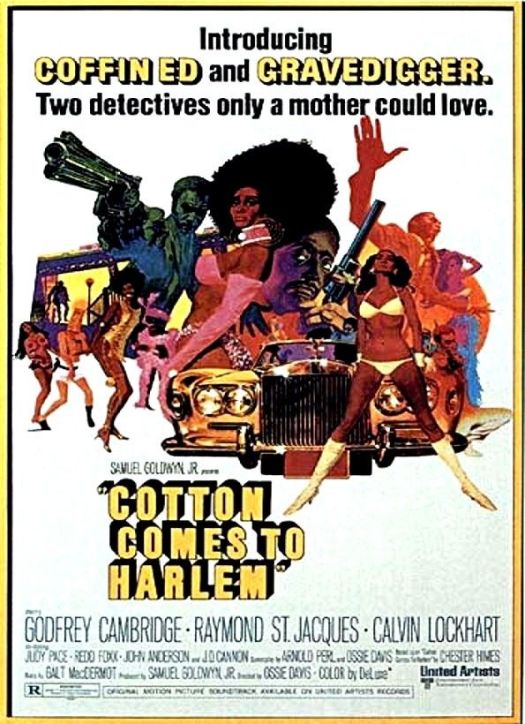
I’m not really sure if COTTON COMES TO HARLEM qualifies as a Blaxploitation film. Most genre experts point to Melvin Van Peebles’ SWEET SWEETBACK’S BADASSSSS SONG and/or Gordon Parks’s SHAFT , both released in 1971, as the films that kicked off the Blaxploitation Era. Yet this movie contains many of the Blaxploitation tropes to follow, and is based on the works of African-American writer Chester Himes.
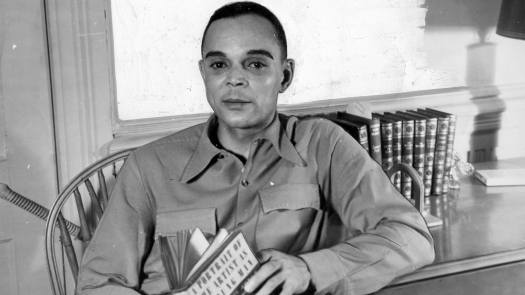
Hardboiled author Chester Himes
Himes (1909-1984) began his writing career while doing a prison stretch for armed robbery. After his short stories started being published in Esquire, he was paroled in 1936, and soon met poet Langston Hughes, who helped him get established in the literary world. Reportedly, Himes worked for a time as a screenwriter for Warner Brothers in the 40’s, but was let go when a racist Jack Warner declared he “don’t want no n*ggers on this lot” (1). His first …
The year is 1973. The American Solider (played by David Carradine, who also directed) has just been discharged from Vietnam and is now hitchhiking across an America that he no longer understands. When he reaches a small town in Kansas, he stumbles across a run-down carousel sitting in an overgrown field. The Soldier decided to spend the night camping in the field and, the next morning, he sets out to rebuild the old merry-go-round.
No one in town can understand why the Soldier is doing what he is doing. The local teenagers harass him while a silent and beautiful girl in a white dress (played by Carradine’s then-partner, Barbara Hershey) brings him a toolbox but runs away whenever the Soldier tries to speak with her. Some of the older townspeople, led by gas station owner Mike (Michael Greene), help the Soldier by giving him odd jobs and deals on equipment and tools. But, when the Soldier refuses to attend a weekly cockfight, both Mike and eventually the entire town turns against him.
Even with the community refusing to help, the Soldier continues his work. Finally, the Soldier needs only one last piece to complete the restoration. Mike agrees to give it to him on the condition that the Soldier first fight a dog.
Based on the 1948 novel, The Perfect Round, Americana was a passion project for both David Carradine and Barbara Hershey. They first learned of the book and its story in 1969. Four years later, using the money that he made starring in Kung Fu, Carradine purchased the rights to the novel and set out to the bring the story to the screen. As producer, director, editor, and star, Carradine had complete artistic control over the project. This was both a blessing and a curse because Carradine spent a total of 8 years editing his film. It then took another two years for Americana to finally be picked up by a distributor, Crown International Pictures. Ten years after filming began, Americana was finally released in 1983. Carradine was shooting new scenes up until two weeks before the film’s release, which explains why the Soldier suddenly and dramatically ages an hour into the completed movie.
Americana may be strange but it’s not bad. In some ways, it reminded me of what First Blood would have been like if, instead of going on a rampage, Rambo had taken the Sheriff’s advice and moved on to the next town. It has its share of pretentious moments but the overall story, about a man who, having seen so much destruction in Vietnam, now just wants to build something good, shines through. Even if her character never makes sense, Barbara Hershey is stunningly beautiful and Carradine is effectively low-key as the Soldier. Even Americana‘s controversial ending works as a statement about sacrifice. Much like the characters played by John Wayne in The Searchers and The Man Who Shot Liberty Valance, The Soldier’s role is to defend and improve a society that has no place for him inside of it.
If Americana had been released in 1973, it probably would have been ahead of its time. Few people wanted to talk about Vietnam, much less go to a movie that was a metaphor for the entire conflict. When Americana was was released in 1983, people were more interested in refighting the war and achieving victory with Sylvester Stallone and Chuck Norris and had little interest in Carradine’s more thoughtful approach. Americana got pushed into obscurity but David Carradine’s vision of post-war America is still worth watching.
It doesn’t matter how bloody or gory a film is. It doesn’t matter how creative the filmmakers gets when it comes to creating their monster or plotting out their haunting. It doesn’t matter how meta the dialogue is or how many references are tossed in to other horror movies. It all starts with atmosphere.
The right atmosphere keeps us, the viewers, off-balance throughout the entire film. The right atmosphere leaves us wondering what’s lurking behind every corner and it makes us jump at every unexpected sound. The right atmosphere tells us that something terrifying could happen at any minute. The right atmosphere makes us feel as if we’re watching a filmed nightmare. The right atmosphere keeps us watching even when we might want to look away.
The Howling is full of atmosphere.
Now, before anyone asks, this British film is not a remake of the classic American werewolf movie. Instead, it deals with the legend of Dr. Rathbone (Jon-Paul Gates). Rathbone, it’s said, was a scientist who lived in a mansion outside of a small English village. Everyone suspected that, inside of his mansion, Rathbone was performing horrific experiments on both animals and humans. When Rathbone mysteriously disappeared, no one regretted his absence. In fact, many people suspected that perhaps Rathbone had been killed by one of his experiments and, if so, good riddance! Of course, the only problem was that, with Rathbone gone, no one was quite what had actually happened to his experiments. Were they now living in the woods or was the whole thing just an urban legend?
Dr. Rathbone, at work
As Halloween approaches, three teenagers — Jason (Erik Knutsvik), his girlfriend Kristy (Tiffany-Ellen Robinson), and their friend Sophia (Maria Austin) — camp in the woods, hoping to discover the truth. After all, there’s a lot of online clicks and youtube views to be captured by hunting the paranormal. One need only watch Mystery, Uncovered with Ben Tramer (Matthew Fitzthomas Rogers) to understand that!
(I assume that Ben Tramer was named after Laurie’s unfortunate crush in the first two Halloweenfilms.)
When it starts storming and their car disappears, Jason, Kristy, and Sophia are forced to seek refuge in what appears to be some sort of decrepit asylum. They’re met by the caretaker, Shelley (Hans Hernke), who says he works for the Master and who, when an inmate suddenly makes an appearance, says, “Don’t mind him, he’s harmless.”
Of course, no one that they’ll meet that night is harmless…
The Howling plays out like a filmed dream, full of strange characters and nicely surreal images. The film starts with a series of overhead shots, all of which suggest that not only the main characters but the entire world is being watched and stalked by some ominous and unknown force. With the exception of a few key scenes, the majority of the film is in black-and-white and some of the images captures, especially in the doctor’s lab, are striking in their starkness. (There are also a few brief scenes where the asylum is so dark that it’s hard to visually make out what’s happening. Instead, we only hear voices in the blackness, an effective reminder of why so many people sleep with at least one light on.) The few times when color does intrude on the film, like when Shelley lights a candle or when we see an episode of Mystery, Uncovered, the effect is a disquieting one. In perhaps the film’s strongest sequence, several of Rathbone’s “patients’ suddenly appear in full, vibrant color, a nightmarish montage that seems to literally explode from the film. There’s also a nicely down black-and-white scene involving a rather haunting dance.
Lest I give you the wrong idea, The Howling definitely has a sense of humor about itself. In many ways it’s an homage to the gloriously over-the-top horror films of the past. It’s a film that obviously was made for horror fans by horror fans and, as a result, the 83 minute running time is full of references to other classic horror films. Shelley, for instance, will be a familiar character to anyone who has ever seen a haunted house film from the 40s or 50s. There’s always a mysterious caretaker. As for the Asylum itself, it feels like it could have been transported in from the twisted, psychological landscape of German Expressionism.
I liked The Howling. It’s a low-budget horror film that makes pays homage to some of my favorite horror films and makes good use of a dream-like atmosphere. And, as I said before, atmosphere is everything….
Alfred Hitchcock wasn’t afraid to take chances. When the 3-D craze hit in the 1950’s, the innovative director jumped on the new technology to make DIAL M FOR MURDER, based on Frederick Knott’s hit play. The film is full of suspense, and contains many of The Master’s signature touches, but on the whole I consider it to be lesser Hitchcock… which is certainly better than most working in the genre, but still not up to par for Hitch.
Knott adapted his play for the screen, and keeps the tension mounting throughout. The story is set in London, and revolves around ex-tennis pro Tony Wendice, whose wife Margot is having an affair with American mystery writer Mark Halliday. Tony comes up with an elaborate plot to have her murdered by stealing a love letter Mark has written and blackmailing her, then setting up his old school acquaintance C.A. Swann, a man…





 Through the Shattered Lens