The Conquering Hero: Baby Blue Marine (1976, directed by John D. Hancock)


The year is 1943 and America is at war.  All young men are expected to join the Marines and fight for their country but the Corps is not willing to accept just anyone.  Marion (Jan-Michael Vincent) wants to continue a family tradition of service but, as his drill sergeant (Michael Conrad) puts it, Marion just is not pissed off enough to be a Marine.  Marion is kicked out basic training and told to go home.  He is given a blue uniform to wear on his jury so that anyone who sees him will know that he couldn’t cut it.

Ashamed of his failure and in no hurry to confront his family, Marion takes the long route home.   While having a drink in California, he meets a Marine (Richard Gere) who did not get kicked out of basic training.  Though not yet 30, this shell-shocked Marine already has a head of gray hair, which he says he got from the horrors of war.  The Marine is due to return to the fighting in Europe but, upon meeting Marion, he sees a way out. When Marion gets drunk, the Marine knocks him out, switches uniforms with him, and goes AWOL.

When Marion comes to, he discovers that everyone that he meets now judges him by his new uniform.  Strangers buy him drinks.  Other servicemen try to pick fights with him.  When he stops off in a small Colorado town, a local waitress (Glynnis O’Connor) falls in love with him and nearly everyone that he meets assumes that he must be a hero.  Marion doesn’t exactly lie about his past.  Instead, he simply allows people to believe whatever they want to believe about him.  It seems like an idyllic situation until three prisoners from a nearby Japanese internment camp escape and the towns people expect Marion to help capture them.

Loosely plotted and sentimental, Baby Blue Marine is a dramatic version of Preston Sturges’s Hail The Conquering Hero.  Though the film has a gentle anti-war message, it’s actually more about nostalgia for a simpler and more innocent time.  If the film had been made at height of the Vietnam War, it might have been more angrier and more cynical.  But, instead, this is one of the many post-Watergate films that wistfully looked back upon the past.  When Marion settles into the town, he finds what appears to be a perfect and friendly home.  Only the nearby internment camp and the town’s hysteria over the escape prisoners serve as reminders that things are never as ideal as they seem.  Jan-Michael Vincent gives one of his best performances as the well-meaning Marion and actors like Richard Gere, Bert Remsen, Katherine Helmond, Dana Elcar, Michael Conrad, Bruno Kirby, and Art Lund all make strong impressions in small roles.

One of the few films to be produced by television mogul Aaron Spelling, Baby Blue Marine is not easy to find but worth the search.

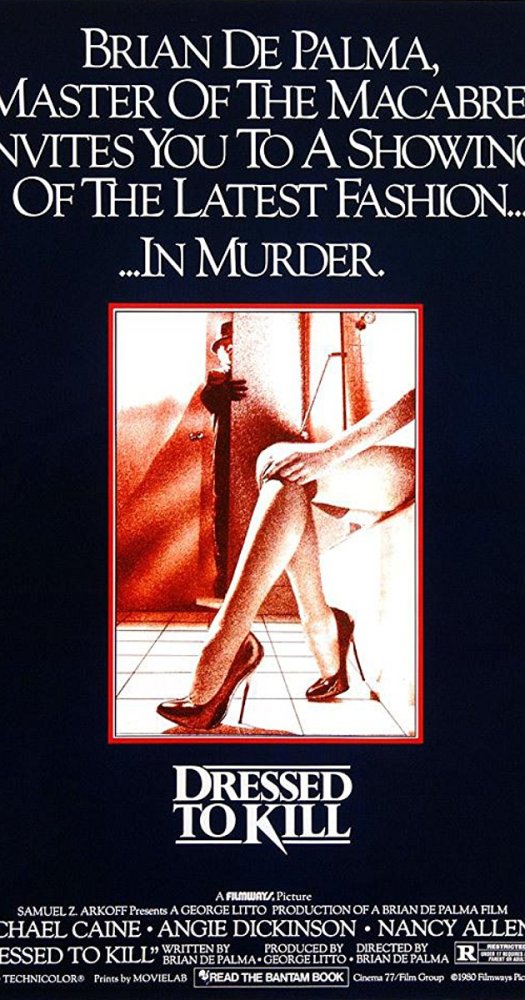
Slashed To Thrill: Brian De Palma’s DRESSED TO KILL (Filmways 1980)


gary loggins's avatarcracked rear viewer

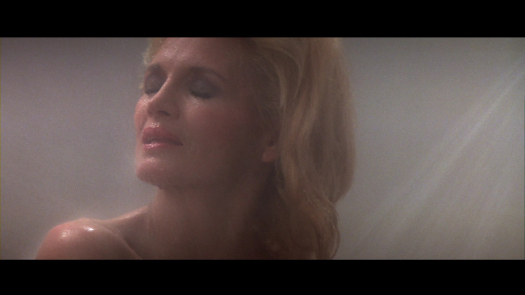
Brian De Palma was a big deal back in the 70’s and 80’s, and his films like CARRIE, SCARFACE, and THE UNTOUCHABLES are still discussed. Yet works such as SISTERS, PHANTOM OF THE PARADISE, OBSESSION, BLOW OUT, and BODY DOUBLE seem unjustly neglected today, and some critics deride him for his over the top sex and violence. DRESSED TO KILL finds De Palma in full Hitchcock mode, an homage to PSYCHO that The Master of Suspense himself cited as more like a “fromage”, but one I find still entertaining.

The film begins with a sizzling hot shower scene with Angie Dickinson as Kate Miller, remarried mother of  science nerd Peter  (Keith Gordon, CHRISTINE ). Kate has problems in her marriage and with her own mom,  not to mention being a nymphomaniac! She’s seeing psychiatrist Dr. Robert Elliott (Michael Caine ), but seemingly getting nowhere. We follow her to  New York’s…

View original post 597 more words

Flat Broke In The ’70s: Americathon (1979, directed by Neal Israel)


The year is 1998 and America is flat broke.  Paper currency is now worthless and, to the joy of Ron Paul supporters everywhere, all transactions are done in gold.  After the country ran out of oil, people started using skateboards and bicycles for transportation and many turned their cars into homes.  While the citizenry spends their time consuming a steady diet of sitcoms and reality television, the government tries to figure out how to pay back the loan that it took from Sam Birdwater (Chief Dan George), a Native American who made billions after buying Nike.  Birdwater wants his money back and he is prepared to foreclose on the entire country.
Newly elected President Chet Roosevelt (John Ritter) is not helping.  A combination of Jack Tripper and Jerry Brown (who was gearing up to challenge Jimmy Carter in the Democratic primaries when Americathon was first released), Chet Roosevelt is a spaced-out former governor of California who speaks in 70s self-help slogans and who is more interested in getting laid than leading the country.  Roosevelt governs out of The Western White House, a condo in California.  When an ad exec named Eric McMerkin (Peter Reigert) suggests a month-long telethon to raise the money to pay off the loan, Roosevelt leaps at the chance.

Hosted by Harvey Korman, the telethon (which is called, naturally, the Americathon) features a wide variety of acts.  There’s a ventriloquist.  Jay Leno boxes his grandmother.  Meat Loaf destroys a car.  Even Elvis Costello and Eddie Money make brief appearances.  While Chet falls in love with one of the performers, his chief-of-staff (Fred Willard) plots, with the leaders of a new Middle Eastern superstate, to sabotage the telethon.

Based on a play by the Firesign Theater, Americathon has a big, talented cast that is let down by Neal Israel’s uncertain direction and a script that is only rarely funny.  The idea of America hosting a tacky telethon to pay its debts sounds like a good SNL skit (especially if Bill Murray played the host) but the premise is too thin for a feature film.  Like Airplane! or The Naked Gun films, Americathon is a movie that tosses every joke it can against the wall to see what will stick.  If the jokes are good, like in Airplane!, that formula can lead to a comedy classic.  If the jokes are bad, not even John Ritter, Harvey Korman, and Fred Willard can make them funny.

Today, if Americathon is remembered, it’s because it supposedly predicted several future events.  Americathon does take place in a future where China is an economic superpower, Nike is a huge conglomerate, and reality game shows are very popular.  But, even with those correct predictions, Americathon is a such a film of its time that it was probably dated from the minute that it was released.  Just the sight of John Ritter in a condo permanently marks Americathon as a film of and about the ’70s.

George Carlin does score a few laughs as the narrator and Elvis Costello performs both Crawlin’ To The USA and (I Don’t Want To Go To) Chelsea.  Eagle-eyed viewers might want to keep an eye out for the tragic Playboy playmate, Dorothy Stratten, who has a brief non-speaking role.  Otherwise, Americathon is as hopeless as the country it’s trying to save.

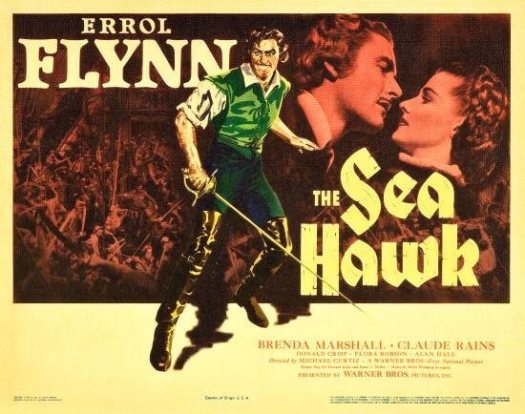
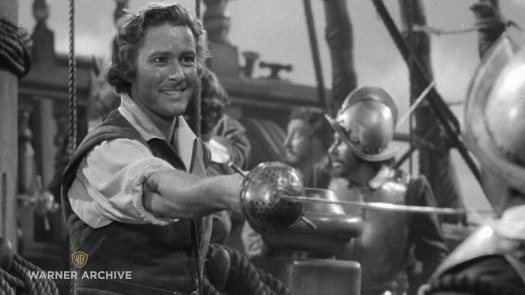
On Her Majesty’s Secret Service: Errol Flynn in THE SEA HAWK (Warner Brothers 1940)


gary loggins's avatarcracked rear viewer

Warner Brothers pulled out all the stops for their 1940 epic THE SEA HAWK. There’s dashing Errol Flynn swashbuckling his way across the Silver Screen once again, the proverbial cast of thousands, high seas action, romance, political intrigue, superb special effects, and a spirited score by Erich Wolfgang Korngold. The only thing missing that could’ve possibly made this movie better is Technicolor, but since Jack and his bros had already spent $1.7 million (equivalent to almost thirty million today) to produce it, why quibble?

Flynn is in fine form as privateer Geoffrey Thorpe, captain of the pirate ship Albatross, in service to Her Majesty Queen Elizabeth I. When they attack and plunder a Spanish ship carrying Ambassador Don Alvarez de Cordoba and his beautiful niece Maria, Captain Thorpe is reprimanded and told to lay off the Spanish. Spain, however, is building up their Armada with world conquest in mind, and…

View original post 603 more words

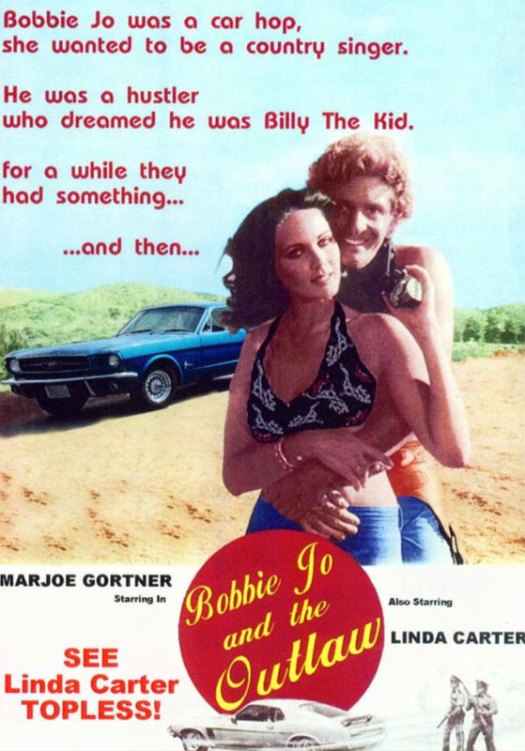
Existential Exploitation: BOBBIE JO & THE OUTLAW (AIP 1976)


gary loggins's avatarcracked rear viewer

I discussed filmmaker Vernon Zimmerman in a post on his UNHOLY ROLLERS back in January. Zimmerman wrote the script (but did not direct) for 1976’s BOBBIE JO & THE OUTLAW, which on the surface is just another sex’n’violence laden redneck exploitation film. Yet after a recent viewing, it seemed to me Zimmerman was not just delving into exploitation, but exploring something more: disaffected youth, gun culture, the cult of personality, and violence in America, themes that still resonate today.

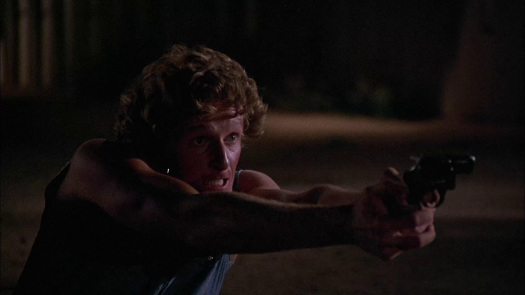
Former child evangelist turned rock star turned actor Marjoe Gortner is Lyle Wheeler, a drifter who enters quick draw contests and idolizes Billy the Kid. Lyle’s a hustler, as we find out as he pulls into a gas station and steals a Mustang from a travelling salesman. Lyle outruns a police car hot on his tail, causing the cop to go off the road, and revs into the next town, where…

View original post 458 more words

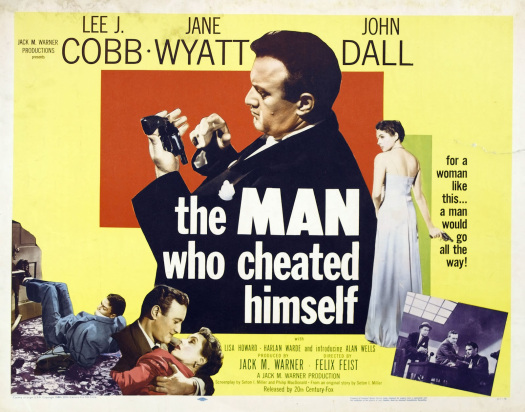
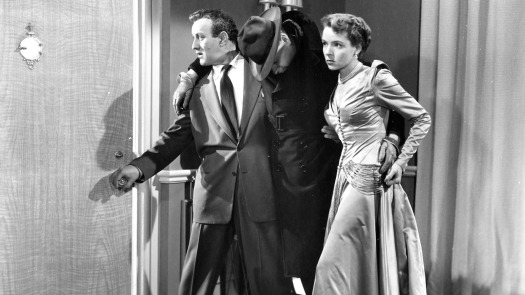
Midnight Snack: THE MAN WHO CHEATED HIMSELF (2Oth Century-Fox 1950)


gary loggins's avatarcracked rear viewer

THE MAN WHO CHEATED HIMSELF made it’s TCM debut last Saturday night on Noir Alley, hosted by “The Czar of Noir” Eddie Muller. This is a ‘B’ film I’d never heard of before, and since you all know how much I love discovering new/old ‘B’ movies, I stayed up past the midnight hour to give it a watch (which I usually do on Saturday nights anyway, being a Noir Alley fan!).

The film doesn’t waste any time, quickly introducing the main characters and getting right into the story. Thinking her husband is planning to murder her, rich San Francisco socialite Lois Frazer guns him down in cold blood directly in front of her lover, Homicide Lt. Ed Cullen. Ed dumps the body at the airport to make it look like a robbery/murder, tossing the murder weapon off the Golden Gate Bridge. Then he takes the lead in the investigation, along…

View original post 320 more words

Lisa Recommends Fool For Love (dir by Robert Altman)


As the day draws to a close, I’m going to recommend one final film.

It’s not, by any means, a perfect film.  In fact, it’s pretty damn imperfect.  It’s a film that occasionally tries too hard to be profound.  It’s based on a play and it never quite escapes its theatrical origins.  What was undoubtedly exciting on the stage, drags a bit on the screen.  It’s a fairly obscure film.  I just happened to catch it on This TV a month ago and the main reason that I watched it was because of the cast.

But no matter!  I still think you should watch this film if you get a chance.

The name of that film is Fool For Love.

First released in 1985 and based on a play by Sam Shepard, Fool For Love takes place over the course of one long night at a motel in the Southwest.  Staying at the motel is May (Kim Basinger), who is hoping to escape from her past.  Not eager to allow her to escape is her former lover, Eddie (Sam Shepard).  An aging cowboy, Eddie shows up at the motel and tries to convince May to return with him to his ranch.  As they argue, clues are dropped to the terrible secret that haunts their past.  Martin (Randy Quaid), a buffoonish but well-meaning “gentleman caller,” shows up to take May on a date and finds himself sucked into the drama between her and Eddie.

Meanwhile, on the edge of every scene, there’s the Old Man (Harry Dean Stanton).  The Old Man watches Eddie and May and offers up his own frequently sarcastic commentary.  It becomes obvious that he not only knows about the secret in their past but that he’s determined that they not get together.  Is the Old Man really there or is he just a figment of everyone’s imagination or is he something else all together?

As I said earlier, the film never quite escapes its theatrical origins.  As well, while Shepard and Kim Basinger both give authentic and charismatic performance, they don’t quite have the right romantic chemistry to really convince us that Eddie would chase May all the way to that isolated motel.  It’s hard not to feel that if May had been played by Shepard’s then-partner Jessica Lange or his Right Stuff co-star, Barbara Hershey, the film would have worked better.

And yet, even if it never comes together as a whole, Fool For Love is a film that should be seen just for its display of individual talent.  Of the film’s five main creative forces, only Kim Basinger is still with us.  Director Robert Altman died in 2006 while Sam Shepard and Harry Dean Stanton both passed away in 2017.  While Randy Quaid is still alive, it’s doubtful he’ll ever again get the type of roles that earlier established him as one of America’s best character actors.  Whenever I read another snarky article about Quaid hiding out in Vermont and ranting about the “star whackers,” I can’t help but sadly think about the perfect performances that Quaid used to regularly give in imperfect films like this one.

So, definitely track down Fool For Love.  Watch it and pay a little tribute to all of the wonderful talent that we’ve lost over the last 10 or so years.  Watch it for Robert Altman’s ability to turn kitsch into art.  Watch it for the rugged individualism of Sam Shepard and the once-empathetic eccentricity of Randy Quaid.  Watch it for Harry Dean Stanton, the legendary actor who, more than any other performer, seemed to epitomize the southwest and Americana.

Watch it and spare a little thought for all of them.

Catching-Up With Two Courtroom Dramas: Suspect and 12 Angry Men


As a part of my continuing effort to get caught up with reviewing all of the movies that I’ve seen this year, here’s two courtroom dramas that I recently caught on This TV.

  • Suspect
  • Released in 1987
  • Directed by Peter Yates
  • Starring Cher, Dennis Quaid, Liam Neeson, John Mahoney, Joe Mantegna, Philip Bosco, Fred Melamed, Bernie McInerney, Bill Cobbs, Richard Gant, Jim Walton, Michael Beach, Ralph Cosham, Djanet Sears 

Suspect is a hilariously dumb movie.  How dumb is it?  Let me count the ways.

First off, Cher plays a highly successful if rather stressed public defender.  And don’t get me wrong.  It’s not that Cher is a bad actress or anything.  She’s actually pretty good when she’s playing Cher.  But, in this movie, she’s playing someone who managed to graduate from law school and pass the DC bar.

Secondly, Cher is assigned to defend a homeless man when he’s accused of murdering a clerk who works for the Justice Department.  The homeless man is deaf and mute, which isn’t funny.  What is funny is when he gets a shave and a shower and he’s magically revealed to be a rather handsome and fresh-faced Liam Neeson.  Liam doesn’t give a bad performance in the role.  In fact, he probably gives the best performance in the film.  But still, it’s hard to escape the fact that he’s Liam Neeson and he basically looks like he just arrived for a weekend at Cannes.

Third, during the trial, one of the jurors (Dennis Quaid) decides to investigate the case on his own.  Cher even helps him do it, which is the type of thing that would get a real-life attorney disbarred.  However, I guess Cher thinks that it’s worth the risk.  I guess that’s the power of Dennis Quaid’s smile.

Fourth, the prosecuting attorney is played by Joe Mantegna and he gives such a good performance that you find yourself hoping that he wins the case.

Fifth, while it’s true that real-life attorneys are rarely as slick or well-dressed as they are portrayed in the movies, one would think that Cher would at least take off her leather jacket before cross-examining a witness.

Sixth, it’s not a spoiler to tell you that the homeless man is innocent.  We know he’s innocent from the minute that we see he’s Liam Neeson.  Liam only kills who people deserve it.  The real murderer is revealed at the end of the film and it turns out to be the last person you would suspect, mostly because we haven’t been given any reason to suspect him.  The ending is less of a twist and more an extended middle finger to any viewer actually trying to solve the damn mystery.

I usually enjoy a good courtroom drama but bad courtroom dramas put me to sleep.  Guess which one Suspect was.

  • 12 Angry Men
  • Released 1997
  • Directed by William Friedkin
  • Starring Courtney B. Vance, Ossie Davis, George C. Scott, Armin Mueller-Stahl, Dorian Harewood, James Gandolfini, Tony Danza, Jack Lemmon, Hume Cronyn, Mykelti Williamson, Edward James Olmos, William Petersen, Mary McDonnell, Tyrees Allen, Douglas Spain

The 12 Angry Men are back!

Well, no, not actually.  This is a remake of the classic 1957 film and it was produced for Showtime.  It’s updated in that not all of the jurors are white and bigoted Juror #10 (Mykelti Williamson) is now a member of the Nation of Islam.  Otherwise, it’s the same script, with Juror #8 (Jack Lemmon) trying to convince the other jurors not to send a young man to Death Row while Juror #3 (George C. Scott) deals with his family issues.

I really wanted to like this production, as it had a strong cast and a strong director and it was a remake of one of my favorite films.  Unfortunately, the remake just didn’t work for me.  As good an actor as Jack Lemmon was, he just didn’t project the same moral authority as Henry Fonda did the original.  If Fonda seemed to be the voice of truth and integrity, Lemmon just came across like an old man who had too much time on his hands.  Without Fonda’s moral certitude, 12 Angry Men simply becomes a story about how 12 men acquitted a boy of murder because they assumed that a woman would be too vain to wear her glasses to court.  The brilliance of the original is that it keeps you from dwelling on the fact that the accused was probably guilty.  The remake, however, feels like almost an argument for abandoning the jury system.

Film Review: Unforgettable (dir by John Dahl)


You have to give the makers of the 1996 film, Unforgettable, some credit.  It takes a certain amount of courage to give your movie a title like Unforgettable.  You’re practically asking some snarky critic to comment on the fact that she can’t remember your movie.

Well, I’ll resist the temptation because I can remember enough about this movie to review it.  I saw it a few days ago on This TV and, at first, I was excited because it was a Ray Liotta movie.  Ray Liotta is an entertaining and likable actor who, nowadays, only seems to get cast in small, tough guy roles.  Nowadays, a typical Liotta role seems to be something like the character he played in Killing Me Softly.  He showed up.  He was tough.  He got killed for no good reason.  So, whenever you come across a film in which Liotta gets to do something more than just get shot, you kind of have an obligation to watch.

In Unforgettable, Liotta plays Dr. David Krane, who is haunted by the unsolved murder of his wife.  Fortunately (or perhaps, unfortunately), Dr. Martha Briggs (Linda Fiorentino) has developed a formula that can be used to transfer memories from one person to another.  All you have to do is extract some spinal fluid!  Or something like that.  It doesn’t make any sense to me and I have to admit that I kinda suspect that the science might not actually check out.

Anyway, Dr. Krane is all like, “I want to inject myself with my dead wife’s spinal fluid so I can experience her final moments!”

And Dr. Briggs is all like, “But this could kill you because there’s all these vaguely defined side effects!”

But Dr. Krane does it anyway and he discovers that his wife was murdered by a lowlife criminal named Eddie Dutton (Kim Coates)!  So, Dr. Krane chases Eddie all ocer the city and it’s interesting to see that a doctor can apparently keep up with a career criminal.  I mean, you would think that Eddie’s experience with being chased and Krane’s inexperience with chasing would give Eddie an advantage.  Anyway, regardless, it doesn’t matter because Eddie is eventually gunned down by the police and Dr. Krane is fired from his job.

Hmmm … well, that was quick.  I guess the movie’s over…

No, not quite!  It turns out that someone hired Eddie to kill Dr. Krane’s wife!  And it turns out that person was a cop!  But which cop!?  Well, there’s only two cops in the film who actually have any lines so it has to be one of them.  And one of the cops is so unlikable that it’s obvious from the start that he’s a red herring.  So, I guess that means the actual murderer is the one that you’ll suspect from the first moment he shows up.

(For the record, the two cops are played by Christopher McDonald and Peter Coyote.  I won’t reveal which one is unlikable and which one is a murderer but seriously, you’ve already guessed, haven’t you?)

Anyway, it’s all pretty stupid and a waste of everyone involved.  Ray Liotta is likable and sympathetic but the film gets bogged down with trying to convince us that crimes can be solved through spinal fluid.  It’s a dumb premise that the movie takes way too seriously and it never quite works.

Still, I hope that someone will give Ray Liotta another good role at some point in the future.  He deserves better than supporting roles and Chantix commercials.

Film Review: Tracks (1977, dir by Henry Jaglom)


The 1977 film, Tracks, opens somewhere in America.

Jack Falen (Dennis Hopper) sits on a bench, waiting for a train.  He’s wearing a military uniform.  He claims that he’s a 1st sergeant.  He claims that he’s just returned from Vietnam.  He’s traveling with a flag-draped coffin.  He says that the coffin contains the remains of his best friend from Nam.  Jack is accompanying the coffin back to his friend’s hometown.  Jack says that he’s going to make sure that his friend gets a proper burial.

From the minute we meet Jack, we get the feeling that there’s something off about him.  He’s a little bit too quick to smile and, when he laughs, it’s the guttural sound of someone who has learned how to show joy by watching other people but who has perhaps never felt it himself.  Sometimes, he’s quiet.  Sometimes, he is loquacious and verbose.  When he does speak, he rarely looks anyone in the eyes.  Jack is jumpy, as if he’s constantly afraid that he’s about to be exposed as a liar.

Soon, Jack is riding a train across the country.  While the rest of the passengers look out the windows and takes in the American landscape, Jack nervously wanders around the train.  He gets involved in a regular chess game.  He befriends a mysterious man named Mark (Dean Stockwell).  He starts a tentative relationship with a student named Stephanie (Taryn Power).  He tells anyone who will listen that he’s traveling with the body of his best friend.  When a black Korean war vet complains that Jack is acting like he’s the only person who lost a friend in a war, an offended Jack replies that his friend was black.

Jack sees things.  When he sees that the other passengers are assaulting Stepanie, he pulls out a small gun and aims it at the back of the train, just to suddenly realize that Stephanie is sitting unbothered at the back of the train.  While we know that Jack was hallucinating the attack on Stephanie, we still wonder if he really pulled out that gun.  If he did, no one else seems to have noticed.

Sometimes, the passengers say things to Jack that don’t seem to make any sense, leaving Jack staring at them in confusion.  Other times, Jack sees dark figures walking through the train.  At night, he wanders around naked.  Jack spends the trip watching the other passengers with a slightly dazed look on his face.  He plays chess with a man who later insists that he’s never played chess with Jack.  Sometimes, he thinks that he and Stephanie are outside of the train.  When Mark approaches Jack and asks for help, Jack explains that he can’t help anyone.  While a soundtrack of old World War II propaganda songs thunders in the background, Jack struggles to keep track of what’s real and what isn’t.

And so does the audience.  As we watch, it occurs to us that Jack’s stories about Vietnam don’t really seem to add up.  Add to that, we never actually saw Jack board the train.  Instead, we saw him sitting on a bench and waiting for the train.  We’re left to wonder if the train’s real or if the whole movie is just a figment of Jack’s damaged imagination.  And what about the coffin?  Tracks is full of unanswered questions but, in the film’s incendiary final moments, we do learn the truth about that coffin … maybe.

Henry Jaglom has been making independent films for several decades now.  Tracks is one of his better films, if just because Jaglom’s loose, seemingly improvised style actually works well at communicating Jack’s own struggle to keep up with what’s really happening and what he’s imagining.  As deceptively random as the film’s collections of scenes may appear, it’s all anchored by Dennis Hopper’s wonderfully unhinged performance.  Hopper brings a method actor’s intensity to Jack’s struggle to not only keep straight what’s real and what isn’t but also to keep his fellow passengers from understanding that he’s deeply unbalanced.  This film was made during Hopper’s drug-fueled lost years and he plays Jack like a man who is desperately trying to keep the world from seeing that he’s in the throes of withdrawal.  Unlike Hopper, Jack’s addiction isn’t to drugs.  Instead, Jack’s addicted to war, or at the very least his obsession with war.  (By the end of the movie, you have your doubts about whether Jack’s ever been to Vietnam or not.)  The use of World War II propaganda songs on the soundtrack may occasionally get annoying but they actually play up the contrast between our often simplistic view of war and the far more complex reality.

If nothing else, I would recommend Tracks for Hopper’s performance.  As well, since he co-stars with Dean Stockwell, it’s easy to imagine Tracks as being a bit of a prequel to Blue Velvet.  Who’s to say that Jack Falen didn’t change his name to Frank Booth?