International Horror Film Review: Goke, Body Snatcher From Hell (dir by Hajime Soto)


The world’s ending and does it really matter?

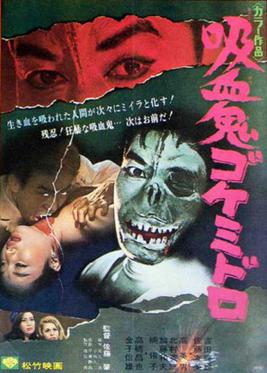
The 1968 Japanese film, Goke, Body Snatcher From Hell (love that title!), opens with an airplane flying across a blood red sky.  Why has the sky changed colors?  The pilots aren’t sure and the passengers barely notice.  Indeed, the passengers are more concerned with their own problems.  There’s the arms manufacturer who is desperate to land his next big contract.  There’s the professor who views the world with professional detachment.  There’s the corrupt politician who only cares about increasing his own power.  There’s the terrorist who is traveling with a rifle hidden in the plane.  There’s the other terrorist who has a bomb and who may or may not be working with the first terrorist.  (It’s a dangerous world out there.)  And then there’s the American war widow, Mrs. Neal (Cathy Horan), whose husband has just been killed in Vietnam.

When a report comes over the radio that one of the passengers has bomb, the crew searches everyone’s bags.  “Why are you searching our bags!?” the arm manufacturer demands.  “There was a mix-up at the airport and we may have the wrong bag on this flight,” the co-pilot lies.  Finally, when the co-pilot and a stewardess come across a metal box in the back of the plane, they think that they’ve found their bomb.

Instead,they’ve found the first terrorist’s rifle.  He uses that rifle to hijack the plane and then he shoots out the plane’s radio.  Unfortunately, this couldn’t have happened at a worse time because it turns out that the Earth has just been invaded by aliens!

A UFO causes the airplane to crash on a uncharted island.  The rifle-toting terrorist is possessed, Thing-style, by one of the aliens.  The passengers start to bicker among themselves.  Who is to blame for the plane crash?  The terrorist or the pilots?  Who is to blame for the aliens invading, the aliens or the humans?  The professor theorizes that the aliens saw that Earthlings are constantly at war and they decided that this would be a great time to invade the planet.  In fact, as the professor goes on to speculate, perhaps we have brought this on ourselves.  Maybe we deserve to be invaded.  The humans on the island proceed to go out of their way to prove the professor correct.

Goke, Body Snatcher From Hell plays out like a pop art alien invasion film.  The colors are bright and vibrant.  The imagery is often surreal, with the alien literally oozing out of the forehead of the people that it has possessed.  By the end of the film, entire cities are full of shriveled up dead bodies while spaceships glow in the distance, their pulsating lights making them resemble the atomic mushroom clouds that have haunted Japanese horror and science fiction cinemas ever since World War II.  While the surviving passengers debate whether or not the Earth deserves to be saved, we get red-tinted inserts of assassination and war.  The passengers may not be sure whether or not Earth deserves to survive but it’s obvious the filmmakers have made up their minds and they, for one, welcome our new alien overlords.

How about you?
 

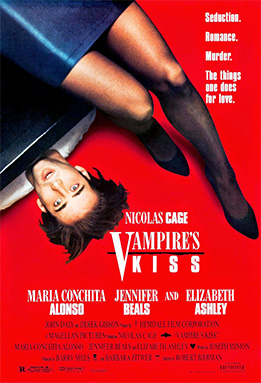
Horror Film Review: Vampire’s Kiss (dir by Robert Bierman)


Nicolas Cage plays the world’s biggest douchebag in the 1989 film Vampire’s Kiss.

Cage is playing Peter Loew, who is kind of like Patrick Bateman’s less successful cousin.  He’s got a nice apartment in New York City and he wears fairly nice clothes and he has this weird, stuffed-up way of speaking.  By night, Peter spends all of his time at the bars and the clubs, trying to get laid.  During the day, Peter goes to his job as a literary agent, where he sits around in his office and spends most of his time tormenting his secretary, Alva (Maria Conchita Alonso).

Peter has recently been tasked with finding the Heatherton Contract.  It’s a contract from 1963, one that was signed long before either Peter or Alva joined the company.  All Peter knows is that the contract is somewhere in a huge stack of files.  Harold Heatherton wants a copy of the contract so that he can frame it.  Peter wants the contract so that he can advance at his job and make even more money.  Alva just wants to be left alone.

“ALVA!” Peter spends his days yelling from the office.

“I hate my boss!” Alva says as she spend the morning crying in bed.

Yes, Peter is a jerk.  He maintains a toxic work environment.  He’s a misogynist.  He’s the type of asshole who screams at Alva to go find the Heatherton Contract and then stares at her backside as she walks back to her desk.  He’s a terrible human being and he’s steadily getting worse.  That’s because Peter is convinced that he’s turning into a vampire.  There’s even a lengthy scene where he stands in front of a bathroom mirror, moaning that he has no reflection.  Of course, we can see that he absolutely does have a reflection.

In his apartment and his office, he is often visited by Rachel (Jennifer Beals).  Rachel has fangs.  Rachel bites him in the neck.  Rachel sucks his blood.  But is Rachel there or is she a figment of his imagination?  Is he truly a vampire or is he like Patrick Bateman in American Psycho or the lead character in George Romero’s Martin?  He has become so consumed by his fantasies of being an all-powerful monster that he can no longer tell the difference between fantasy and reality?

Vampire’s Kiss is understandably best known for Cage’s demented performance.  Cage bulges his eyes, screams his lines, and spends a good deal of the film walking around with his shoulders hunched up.  This is the film for which Cage famously ate a live cockroach.  It’s undeniably watchable, though I think Cage made the mistake of playing Peter as being obviously unhinged even before he decided that he was a vampire.  The scenes where he obsesses over the Heatherton Contract start out as mildly amusing but become more disturbing as the film progresses and Peter grows more and more deranged.  From the moment that he started to chase the terrified Alva through the office, the film became so unpleasant that I just wanted it to hurry up and end.  On the plus side, Alva does get revenge though I think it would have been more effective (or maybe, just for me, more satisfying) if the film’s final action had been carried out by Alva herself.

Vampire’s Kiss is a film that has quite an enthusiastic cult following.  Having watched it, I can say that I’m not a member of that cult, though I can understand why Cage’s unhinged performance has fans.  The film is about 20 minutes too long and it reveals the truth about Cage’s “vampirism” far too early but, if nothing else, Cage really does throw himself into it.

Horror On The Lens: Carnival of Souls (dir by Herk Harvey)


Well, we’re nearly done with October and, traditionally, this is when all of us in the Shattered Lens Bunker gather in front of the television in Arleigh’s penthouse suite, eat popcorn, drink diet coke, and gossip about whoever has the day off.

Of course, after we do that, I duck back into my office and I watch the classic 1962 film, Carnival of Souls!

Reportedly, David Lynch is a huge fan of Carnival of Souls and, when you watch the film, it’s easy to see why.  The film follows a somewhat odd woman (played, in her one and only starring role, by Candace Hilligoss) who, after a car accident, is haunted by visions of ghostly figures.  This dream-like film was independently produced and distributed.  At the time, it didn’t get much attention but it has since been recognized as a classic and very influential horror film.

This was director Herk Harvey’s only feature film.  Before and after making this film, he specialized in making educational and industrial shorts (some of which we’ve watched this month), the type of films that encouraged students not to cheat on tests and employees not to take their jobs for granted.  Harvey also appears in this film, playing “The Man” who haunts Hilligoss as she travels across the country.

Enjoy Carnival of Souls!

And remember, don’t stop for any hitchhikers!

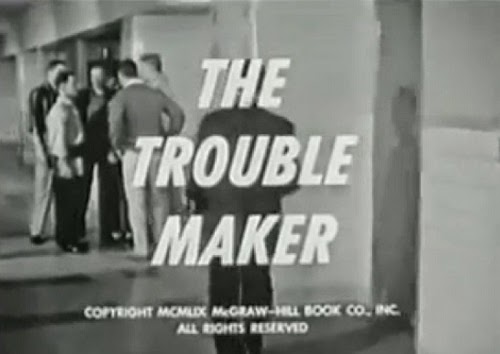
A Blast From The Past: The Trouble Maker (dir by Herk Harvey)


The 1959 short film, The Trouble Maker, tells the story of Mel Stone (played by Bret Waller).

Mel is the least popular student at his high school and it’s not hard to see why.  Mel is seriously creepy.  He spends all of his time sneaking through the hallways, following around the members of the football team and lying about the girls that they go to school with.  When Mel spots a member of the team “breaking training,” he starts spreading rumors and trying to make life difficult for everyone.

The title claims that Mel is a trouble maker but actually, he comes across like a total sociopath.  He even stalks the members of the football team outside of school, the better to collect gossip about them.  The film’s narrator encourages us to wonder why Mel is the way that he is and if there’s anything that we, as a group, can do to make Mel become a better person.  To be honest, it seems like the only solution to a problem like Mel is to frame him for a crime and send him to prison until his 21st birthday.  Admittedly, Mel would probably be even more dangerous once he got out but that’s why you move to a different town after graduating from high school.

The Trouble Maker was one of the many educational short films to be directed by Herk Harvey, who made a career out of films like this.  Today, of course, Harvey is best known for directing the seminal horror film, Carnival of Souls.  We’ll be sharing Carnival of Souls in an hour but, for now, enjoy The Trouble Maker and be sure to ask yourself….

What Would You Do?

The Things You Find On Netflix: Eli (dir by Ciaran Foy)


Eli (Charlie Shotwell) is a young boy who is allergic to everything outside.  As a result, he can’t venture out of the house unless he’s covered, head-to-toe, in protective gear.  Eli wasn’t always allergic, of course.  It’s just something that suddenly started.  Eli’s mother, Rose (Kelly Reilly) and her husband, Paul (Max Martini), are taking him to a special clinic run by Dr. Isabella Horn (Lili Taylor).  Because the clinic is sealed off from the outside, Eli can leave his plastic bubble.  Because the clinic is in a dark old building, we know that it’s either going to be haunted or run by some sort of cult.  In fact, it doesn’t take long before Eli is doubting not only Dr. Horn but his parents as well!  He keeps hearing voices that hiss, “Lie.”  And the only other patient at the clinic, a young girl named Haley (Sadie Sink), repeatedly tells him to be careful….

Eli is 98 minutes long and I lost interest after the first ten.  Basically, I was willing to give the film a chance but then a bunch of rednecks started to taunt Eli while he was walking around outside in his protective gear and I was like, “Yeah, okay.” Then they started throwing stuff at him and I was like, “Getting a little bit heavy-handed now.”  Then the suit got torn and Eli started screaming like he was about to die and the rednecks just stood there laughing and that’s when I said, “Okay, this is going to suck.”  There’s heavy-handed and then there’s just attacking your audience with a sledgehammer.  Sledgehammers give you a migraine.

Once Eli reaches the clinic, the film slows down to a glacial pace.  In theory, the slow pace should have helped to maintain an ominous atmosphere but …. eh.  To be honest, I’ve seen a lot of creepy clinics in a lot of creepy movies and there was nothing that special about this one.  It all leads to a big twist but, again, it wasn’t a particularly original twist and even the film’s attempt to blow my mind with a subversive ending just left me shrugging.  “Really?” I thought, “That’s what’s going to happen, huh?  Well, what can you do?”

Like a lot of bad movies, the script for Eli was included on the infamous Hollywood Black List.  The Black List is an annual list of the “best” unproduced screenplays in Hollywood.  A few good films have been made out of scripts on the Black List but, for whatever, the majority of Black List films always seem to turn out to be somewhat disappointing.  Broken City, for instance, was a Black List film.  So was The Beaver.  You can add Eli to the pile of mediocre Black List films.

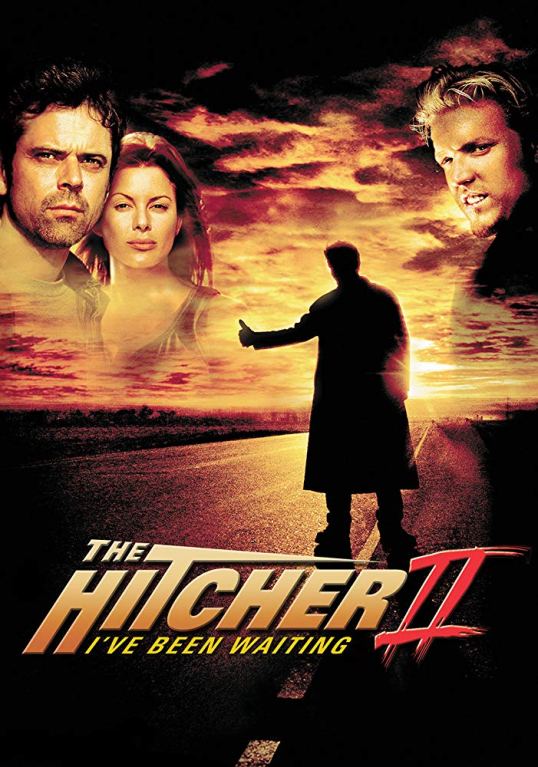
The TSL’s Horror Grindhouse: The Hitcher II: I’ve Been Waiting (dir by Louis Morneau)


What the sweet Hell is this crap!?

So, the 2003 film, The Hitcher II: I’ve Been Waiting, is a sequel to the original Hitcher.  That’s the film where C. Thomas Howell plays a dumbass who picks up a hitchhiker played by Rutger Hauer and then kicks him out after a few miles because Hauer’s like totally insane.  So, Hauer responds by murdering random people and framing Howell.  The Hitcher‘s a pretty good film, largely because of the terrifying performance of Rutger Hauer as the title character.

The Hitcher came out in 1986.  It got terrible reviews and didn’t do well at the box office but it found an audience when it was released on video.  In fact, The Hitcher became a bit of a cult favorite, which is what it deserved to be.  Then, 23 years later, a direct-to-video sequel was released and….

Seriously, this movie is so bad.

C. Thomas Howell returns, playing Jim, the same character that he played in the first movie.  Jim is still haunted by what happened in the first movie.  He’s a cop now but he fears that his encounter with the original Hitcher may have contributed to him using excessive force on a kidnapping suspect.  Seeking some time away from the stress of it all, Jim decides to visit a friend in Texas.  He and his girlfriend, Maggie (Kari Wuhrer) hit the road and, as they drive through the desert, they see a hitchhiker standing by the side of the road….

Now, I know what you’re saying.  “Oh, come on!” you’re yelling.  “There’s no way Jim would be make the same stupid decision twice!”

Well, you’re right.  Jim doesn’t stop to pick the guy up.  Instead, Maggie is the one who decides to pull over.  Apparently, Jim has never bothered to tell Maggie about any of the terrible stuff that happened during the first film.  Considering that Jim is apparently waking up constantly with nightmares and he’s on the verge of having a mental breakdown, you would think that all of this would be something that he would share with Maggie but no.  Maggie is totally shocked when Jim later tells her that he had a bad experience picking up a hitchhiker.

Anyway, in this case, the hitchhiker is named Jack (Jake Busey) and …. wow, shock of shocks!  He’s totally fucking crazy!  That’s right — it’s happening again!  So, Jack is chasing Jim and Maggie across the desert, murdering people and framing Jim and Maggie for the crimes.  Does this sound familiar?  Jim is eventually killed, giving C. Thomas Howell an excuse to never have to appear in another direct-to-video sequel.  Can Maggie beat the new Hitcher at his own game?

Oh, who cares?  This version of The Hitcher basically has none of the weird subtext of the first film.  Unlike Rutger Hauer’s Hitcher, who seemed to be almost erotically obsessed with Jim, Jake Busey’s Hitcher doesn’t have much on his mind beyond killing people.  If Rutger Hauer was all about quiet menace and charismatic intensity, Jake Busey is loud and in your face and so obviously crazy that it’s hard to have much sympathy for anyone stupid enough to pick him up.

The main problem with The Hitcher II is that it gets so damn repetitive.  I lost count of the number of times that a cop showed up, refused to listen as Maggie shouted, “STOP!  HE’S A KILLER,” and then got gunned down.  Seriously, this film featured the stupidest cops that I’ve ever seen.  The same thing keeps happening for 90 minutes or so, at which point we get a pithy one liner and then big explosion.  And then the movie’s over!

Yay!

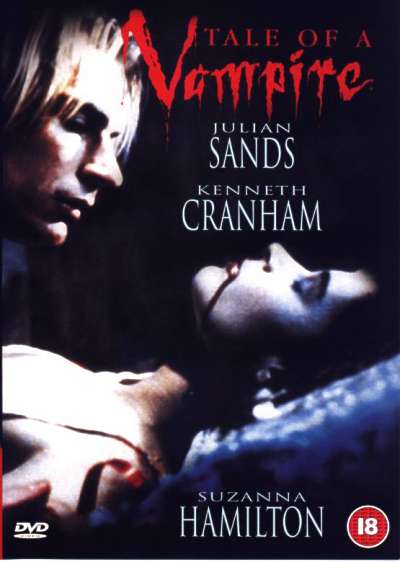
Bloody Art: Tale of the Vampire (1992, directed by Shimako Sato)


When Anne (Suzanna Hamilton) gets a job at the library, she is immediately attracted to the quiet and studious Alex (Julian Sands) and he to her.  Alex claims to be a scholar who is at the library to do research on “religious martyrs” but Anne cannot escape the feeling that she has known him before.  What Anne does not immediately realize is that Alex is a vampire and that she was set up with a job at the library through the machination of Edgar (Kenneth Cranham), another vampire who claims to be a doctor.  Once, Edgar and Alex were both in love with the same woman, the beautiful Virginia.  After circumstances led to Virginia being taken away from both men, Edgar dedicated the rest of his vampiric existence to making Alex miserable.  Anne, who looks exactly like Virginia and may even be the reincarnated version of her, is a pawn in Edgar’s latest scheme.  When Alex and Anne start to fall in love with each other, Edgar’s plan leads to tragedy.

Tale of the Vampire is an unjustly obscure vampire film from the early 90s.  It used to play frequently on late night Cinemax, where it was advertised as just being another sex-fueled horror film but actually, Tale of the Vampire is a moody and contemplative art film.  The focus is on Alex’s feelings of guilt and his fear of hurting Anne in the same way that Virginia was hurt while Anne has to decide how far she is willing to go to be with Alex.  All three of the main actors give good performances, with Cranham nearly stealing the show as someone whose actual identity will become obvious after repeat viewings.  Tale of the Vampire has never gotten the attention that it deserves and it’s not an easy film to find but I recommend it.

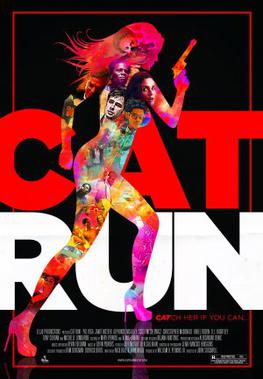
Insomnia File #44: Cat Run (dir by John Stockwell)


What’s an Insomnia File? You know how some times you just can’t get any sleep and, at about three in the morning, you’ll find yourself watching whatever you can find on cable? This feature is all about those insomnia-inspired discoveries!

If you were having trouble getting to sleep at 3 in the morning, you could have turned over to Showtime and watched the 2011 action film, Cat Run.

So, here’s what you get when you watch Cat Run.  You get:

  1. A few beach scenes
  2. Some stylish action sequences
  3. A nearly incoherent plot
  4. Lots of naked people
  5. Two bumbling heroes
  6. A prostitute with a heart of gold, a young child, and an encrypted hard drive
  7. A cold-as-ice female assassin played by a distinguished, Oscar-nominated performer
  8. Massive and sudden changes in tone as the film goes from comedy to action to comedy again
  9. Sex
  10. Violence

In other words, Cat Run is a John Stockwell film.  As a director, Stockwell specializes in making unpretentious films, ones that usually feature beautiful people doing stuff on the beach.  He makes the type of films that will probably never win an Academy Award (though Kirsten Dunst perhaps deserved a nomination for her performance in Stockwell’s Crazy/Beautiful) but which are still occasionally entertaining if you’re in the right mood for them.  (Seriously, just watch Stockwell’s In The Blood and then ask yourself why he could make the perfect Gina Carano film while Steven Soderbergh couldn’t.)

Cat Run takes place is Montenegro.  The prostitute is named Cat (Paz Vega).  The encrypted hard drive contains footage of a politician (Christopher McDonald) killing a woman at an orgy.  The two bumbling detectives who help her out are named Julian (Alphonso McAuley) and Anthony (Scott Mechlowicz) and they occasionally get a funny line or two.  The assassin who is sent to take care of Cat is Helen and she’s played by Janet McTeer.  Helen is coldly efficient and ruthless killer but she has a difficult time tracking down Cat.  That’s the way it always goes, isn’t it?  The bad guys are always super competent until the movie begins, at which point they suddenly can’t shoot straight.

Anyway, Cat Run is not a particularly memorable movie but it has its entertaining moments.  It’s hyper stylish and the cast seems to be having a good time.  At the very least, you get the feeling that everyone probably enjoyed spending their days off in Montenegro and good for them!  McTeer, not surprisingly, steals the film but Paz Vega has some good moments too.  All in all, this is an enjoyable film that doesn’t have a hint of ambition.  It is what it is and what’s wrong with that?

Previous Insomnia Files:

  1. Story of Mankind
  2. Stag
  3. Love Is A Gun
  4. Nina Takes A Lover
  5. Black Ice
  6. Frogs For Snakes
  7. Fair Game
  8. From The Hip
  9. Born Killers
  10. Eye For An Eye
  11. Summer Catch
  12. Beyond the Law
  13. Spring Broke
  14. Promise
  15. George Wallace
  16. Kill The Messenger
  17. The Suburbans
  18. Only The Strong
  19. Great Expectations
  20. Casual Sex?
  21. Truth
  22. Insomina
  23. Death Do Us Part
  24. A Star is Born
  25. The Winning Season
  26. Rabbit Run
  27. Remember My Name
  28. The Arrangement
  29. Day of the Animals
  30. Still of The Night
  31. Arsenal
  32. Smooth Talk
  33. The Comedian
  34. The Minus Man
  35. Donnie Brasco
  36. Punchline
  37. Evita
  38. Six: The Mark Unleashed
  39. Disclosure
  40. The Spanish Prisoner
  41. Elektra
  42. Revenge
  43. Legend

International Horror Film Review: The Living Skeleton (dir by Hiroshi Matsuno)


This 1968 Japanese horror film opens with a scene of shocking brutality.

A group of pirates, led by a horribly scarred man wearing reflective glasses, have commandeered a ship.  While the crew and the passengers beg for mercy, the pirates ruthlessly and efficiently gun them down.  A newlywed (Kikko Matsuoka) is assaulted while her husband watches.  Afterwards, both of them are murdered.  The dead are dumped overboard and the pirates proceed to move on with their lives.

Three years later, neither the ship nor the dead have ever been recovered.  The sister of the murdered newlywed, Saeko (also played by Matsuoka), has been taken in by a friendly priest (Masumi Okada).  As we discover, the pirates have all returned to their day-to-day lives in the seaside village, with the only indication of their past evil being the violent flashbacks that appear whenever one of them shows up on screen.  Almost all of the pirates appear to have returned to the village, everyone but their scarred leader.  What has happened to him and how could a man with such an unforgettable face have simply vanished?  The pirates aren’t sure but then again, does it matter?  They’ve gotten away with their crime.  Everyone thinks that the ship was lost at sea.

However, one day, Saeko and her boyfriend go scuba diving.  As they explore the undersea world, they come across hundreds of skeleton, all chained together.  That night, a ghostly ship appears out on the ocean and Saeko hears a voice calling for her.  The priest counsels Saeko not to obsess over the skeletons and not to fall prey to the temptation of vengeance, but that’s far easier said than done.

Meanwhile, the pirates start to die, one-by-one….

The Living Skeleton is an austere and haunting ghost story.  Though the story may be a bit conventional (especially when compared to the other Japanese ghost story that I’ve reviewed this October), the film is so full of grim atmosphere and portents of ominous doom that it doesn’t matter.  Playing out at its own deliberate pace, this film is an effective horror story that asks whether the sins of the past can ever be forgiven.  (It turns out, not surprisingly, that they can not.)  The black-and-white cinematography adds to the film’s dream-like feel.  Long after the film ends, you’ll remember the images.  You’ll remember the suffering reflected in the lenses of the head pirate’s glasses.  You’ll remember the atmospheric shots of the lonely ocean.  You’ll remember the film’s ending, with the remaining pirates watching as their former victim descends down a flight of stair.  Unfortunately, you’ll probably also remember just how fake the underwater skeletons looked but even that, in its strange way, adds to the film’s effectiveness.  They’re such a strange sight, those pristine, clean, and neat skeletons that you can’t help but feel that they belong in the film, just as surely as the unforgettable shot of a pirate’s face being quickly dissolved by highly corrosive acid belongs in the film.

I saw this haunting ghost story on TCM.  Keep an eye out for future showings.


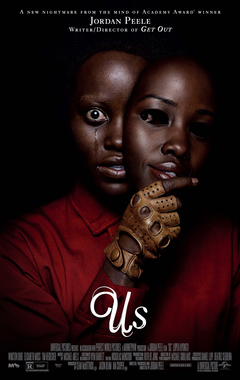
Horror Film Review: Us (dir by Jordan Peele)


“They’re us,” a child says in Jordan Peele’s second film, Us.

And indeed, they are.  Us suggests that everyone has at least one doppelganger, living underground in conditions of absolutely misery and awkwardly imitating the same lives as those above ground, just without any of the rewards that those of us above-ground take for granted.  Those underground are known as the Tethered, because they’re permanently tied to those of us above ground.  Of course, what’s easily overlooked is that we’red tied to them as well.  Or, at least, we are until someone picks up a knife or a pair of scissors and violently severs the connection.

It’s probably not a coincidence that the film’s title — Us — can just as easily be read as U.S, as in the United States.  Jordan Peele may have said that he wanted Us to be a full-on horror film, as opposed to Get Out‘s mix of comedy, horror, and social commentary, but Us definitely has its political subtext, with the Tethered meant to stand in for every marginalized group that has been pushed underground by American society.  Though the film may have been inspired by an episode of The Twilight Zone, it actually has more in common with the classic British shocker, Death Line (a.k.a. Raw Meat.)  There’s not a huge amount of difference between the largely mute Tethered and the pathetic cannibal in Death Line who, after growing up in the British Underground, is capable of only telling his victims to “Mind the doors.”

If nothing else, Us proves that Jordan Peele actually is a good filmmaker with a firm grasp on how to make an effective horror movie.  Get Out was good but also, I think, a bit overpraised by mainstream critics who often seemed to not realize just how much, in their attempts to make sure that we understood just how much they loved and understood the movie, they sounded like Bradley Whitford bragging about how he would have voted for Obama a third time.  When Us came out, a lot of viewers were waiting to see if Peele’s second film could possibly live up to all the hype surrounding its director and, for the most part, it does.

Political subtext aside, this is the all-out horror film that Peele promised, full of jump scares, disturbing imagery, and just enough humor to keep things from getting too unbearably nightmarish.  (As bad as you might feel for Elisabeth Moss’s character and her family, it’s hard not to appreciate the irony of the film’s Alexa-substitute misunderstanding a command to call the police.)  Interestingly enough, the Tethered are pretty much homicidal as soon as they come above ground.  This isn’t a case where a tragic misunderstanding leads to bloodshed that could have been avoided.  No, this is a case where the Tethered have spent decades trapped and out-of-sight and they’re pissed off about it.  Just because the Tethered may be us, that doesn’t mean that they’re going to have any sympathy for us when they finally do track us down.  In the style of Wes Craven’s The Hills Have Have Eyes, Us follows a perfect family as they eventually find themselves resorting to the same violence as the Tethered, in an attempt to save not only their lives but also the lifestyle that they’ve come to take for granted.  The Tethred are us indeed.

The film is well-acted, with Lupita Nyong’o standing out as both the mother of an imperiled family and her doppelganger, who has spent years underground and who is one of the few Tethered to be able to speak.  Of course, there’s a twist at the end of the movie and I won’t ruin it here, other than to say that it’s effectively done and will actually make you reconsider everything that you’ve just seen.

Us is another triumph from Jordan Peele.  Even more importantly, it’s an undeniably effective horror film.