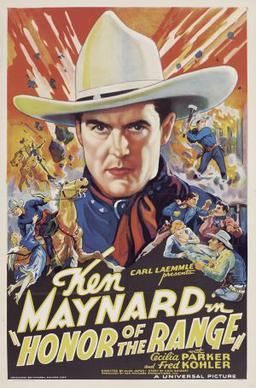
In an old west town, Sheriff Ken Bellamy (Ken Maynard) is an honest and upright lawman who thinks that he is trusted and respected by all. His brother, Clem (also played by Ken Maynard), is a storeowner who is less respected and very jealous of his brother. When Ken is asked to store some money in a safe, Clem decides to help the local outlaw, Rawhide (Fred Kohler), steal the money. Clem gives Rawhide the combination but Rawhide then betrays Clem and takes him hostage. Meanwhile, the townspeople think that Ken must has stolen the money so they toss him in jail and appoint a man named Boots (Frank Hageny) as the new sheriff. Now, Ken has to not only figure out how to escape from jail and the townspeople but also how to defeat Rawhide’s gang.
Ken Maynard and his white horse Tarzan were two of the biggest western stars of the pre-code era. Most of them were routine programmers but Honor of the Range stands out because it allows Maynard to step out of his usual heroic role by having him also play Clem. Maynard could be a stiff actor when he was playing a traditional hero but here he seems to be enjoying playing the untrustworthy Clem. Maynard actually produced Honor of the Range himself and it’s much more serious than the typical Ken Maynard western. The town’s betrayal of the sheriff is played straight, as is Clem’s resentment of his brother. With higher production values than usual and Maynard looking credible whenever he was holding a gun or riding his horse, Honor of the Range is one of the better westerns to be distributed by Universal during the pre-code era.
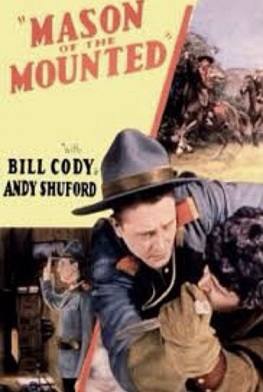
Bill Mason (Bill Cody) is a member of the Canadian Mounted Police who is sent over the border to track down a murderous horse thief. Going undercover, Mason discovers that a nearby frontier town is being terrorized by rustlers. The townspeople have named Calhoun (LeRoy Mason) as the head of the local posse but Mason soon discovers that Calhoun is actually the horse thief!
Mason of the Mounted is only 57 minutes long but it’s a very slow-moving 57 minutes. It’s also a pre-Code film but, other than a grisly shot of a dead body at the start of the film, there’s nothing about Mason of the Mounted that you wouldn’t expect to find in a western made under the production code. Much of the film centers around Mason befriending an American teenager named Andy Talbot (played by Andy Shuford). This was actually one of 8 films that Bill Cody and Andy Shuford made together. Cody was a genuine cowboy who performed in wild west shows before and after his film career. Shuford was a child actor whose career was primarily in Westerns. During World War II, he enlisted in the U.S. Army Air Corps, flew many missions out of England, and eventually reached the rank of colonel. He never returned to making films.
As for Mason of the Mounted, Bill Cody has some authentic cowboy grit and is credible when he’s on a horse or shooting a gun but the plot moves too slowly and most of the cast is stiff and awkward. I did like the idea of the main rustler disguising himself as the only person capable of stopping the rustlers. That was an interesting idea and I wish the movie had done more with it. This is a film that’s mostly for fans of the genre and even the most undemanding western fan will probably have a hard time making their way through the whole thing.
This made-for-television film from 1976 tells the story of Tod Lubitch (played by a pre-Saturday Night Fever John Travolta). Tod was born without an immune system and, as a result, he’s had to spend his entire life in a germ-free, plastic bubble. When Tod was a child, it wasn’t such a big deal not being able to leave his house without getting in a plastic ark beforehand. But now, he’s in his teens and he wants to do teenager stuff. His parents (Robert Reed and Diana Hyland) are overprotective. His doctor (Ralph Bellamy) says that there’s little chance that Tod’s condition will ever improve. But the girl next door, Gina (Glynnis O’Connor), finds herself falling in love with Tod and she wants to help him live a normal life. Gina loves to ride horses and Tod wants to ride one with her. As we all know, horses are totally germ-free.
The Boy In The Plastic Bubble is one of those movies that has a reputation. It’s usually cited as being the epitome of 70s schmaltz and, indeed, it is very 70s and it is very schmaltzy. It’s one of those films where the big dramatic moments are so overdone that they instead often become kind of comedic. When Tod finally convinces his parents to allow him to attend school, he does so while wearing a special protective outfit that makes him look like a cross between an old school astronaut and a demented teddy bear. When it looks like his suit might be malfunctioning, he runs into the plastic cell that’s been set up in the back of the classroom and strips it off while all of his classmates watch. Everyone’s truly impressed by both Tod’s positivity and the sight of a 22 year-old John Travolta rolling around in gym shorts.
Indeed, while watching the film, it’s impossible not to ask certain questions. In what world, for instance, could Robert Reed, best known for playing the patriarch on The Brady Bunch, be John Travolta’s father? Why is there such a weird tension between Tod and his mother? (It may have had something to do with the fact that Travolta was dating Diana Hyland at the time.) How does Tod keep his hair so perfect while living in a plastic bubble? Did anyone think that the scene where Tod is carried onto the beach inside a plastic box would be so odd to watch? Reportedly, The Boy In The Plastic Bubble was based on the lives of two young men who has the same condition as Tod. According to Wikipedia, one of them was very amused by the idea the Todd’s protective outfit would keep him safe at school. And, then of course, there’s the film’s ending, which tries to offer a ray of hope but instead leaves you convinced that Tod is going to die at any minute.
And yet, for all the obvious flaws, The Boy In The Plastic Bubble is slightly redeemed by the sincerity that Travolta and O’Connor bring to their roles. In particular, Travolta brings a smoldering anger to his role, which may not have been present in the script but which feels appropriate for the character. As played by Travolta, Tod may understand why he’s in the bubble but he’s still pissed off about it. O’Connor has an even more difficult role to play because Gina’s actions often don’t make a lot of sense. But O’Connor makes you believe that she’s sincere in her desire to give the Bubble Boy the high school experience that he deserves. It’s a schmaltzy film but Travolta and O’Connor bring a few moments of emotional honesty to it.
Director Randal Kleiser later worked with John Travolta on Grease. I don’t think Danny Zuko would have been a good influence on the Boy in the Plastic Bubble.
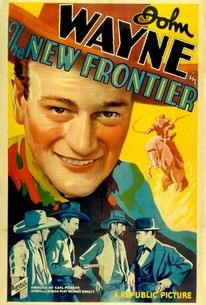
In 1889, wagon master Milt Dawson (Sam Flint) rides into a western town. He is planning on meeting his son John, who is also a wagon master. However, when a friend of Milt’s is killed by gambler Ace Holmes (Warner Richardson), Milt announces that he’s going to clean up the town and Ace is the first piece of trash that Milt is going to toss out. Ace responds by having his henchmen shoot Milt in the back.
After Milt’s death, his son finally arrives in town and you know that Ace is going to be in trouble because John Dawson is played by John Wayne! Seeking to avenge his father’s death, John teams up with an outlaw named Kit (Al Bridge) and declares war on Ace and his gang.
This is a typical western programmer, one that would probably be forgotten if not for the presence of John Wayne in an early starring role. This was before Stagecoach so the budget is low and the plot is simple. Even in his early 20s, John Wayne has the natural authority that would later make him a star but it’s still strange for me to see him in any film where he’s playing a young man who still has parents. There are some actors who you can’t picture as ever having been anything less than middle-aged and John Wayne is one of them. While most of the other actors are stiff and awkward, Wayne seems right at home in the dusty streets of The New Frontier. Interestingly, given Wayne’s identification with law-and-order, he plays a character here who has no problem working with outlaws and who understands that sometimes, the law can be unfair. Ace is the most powerful man in town and John has no choice but team up with those on the outs of what was then considered to be respectability. Another memorable scene juxtaposes a gun battle with the town’s citizens praying in church, a reminder that innocent people were often caught in the middle of the old west’s grudge matches. These are interesting themes, though they’re not very deeply explored.
Though the gunfights are nicely choreographed and shot, the chance to see a pre-stardom John Wayne clean up the old west is the main reason to watch The New Frontier.
Yesterday, I told my sister that I wanted to watch a good baseball movie.
“How about The Fan?” she said, “It’s on Starz.”
“Is The Fan really a baseball movie?” I asked.
“It’s got people with baseball bats in it.” she said.
The Fan does have people with baseball bats. Wesley Snipes is a baseball player who is getting paid a lot of money to swing a bat for the Giants but he’s in a slump because Benicio del Toro won’t let him wear his old number. Robert de Niro is a Giants fan who uses a baseball bat to beat to death his best friend after de Niro kidnaps Snipes’s son and demands that Snipes play better. Snipes has to win a game, even though it’s raining and he has terrible stats against the opposing pitcher. De Niro sneaks on the field as an umpire and makes bad calls on purpose, which proves everything that I’ve ever said about umpires.
The Fan wasn’t bad. I liked the baseball scenes and I also liked the scenes where de Niro would just start overreacting to anyone saying anything bad about the Giants because everyone knows a fan like that. (Where I live, most of them are Cowboys fans.) Whenever de Niro started to go crazy, Nine Inch Nails would play on the soundtrack, which was funny but also too obvious. There was a lot about the movie that didn’t make any sense. At the end of the movie, it’s raining so hard that there’s no way the game would have been allowed to continue but I guess once you accept that de Niro could sneak on the field dressed like an umpire, you have to accept that a baseball game would continue in the middle of a flash flood. But we all know fans like the one played by de Niro. At the start of the movie, I actually felt bad for him because it was so obvious that baseball was the only thing he had. He still had all of his pictures from Little League and he wanted his son to be as big a baseball fan as he was because that was the only way that he knows how to relate to other people. But then he started killing people and giving baseball fans everywhere a bad name.
Josh Hamilton once said that Dallas wasn’t a “real baseball town,” which hurt the feelings of fans like me who had supported him, through all of his struggles, when he was a member of the Rangers. Whenever Hamilton would return to Arlington to play against the Rangers, everyone in the stands would chant, “Baseball town,” whenever he stepped up to the plate. I still think it was rude for Hamilton to say what he said but he was right that Dallas doesn’t produce the type of baseball fans who will disguise themselves as umpires and take the field with a knife hidden in their cleats. Rangers fans aren’t “the crazy fans,” like the ones who Snipes says he can’t stand in The Fan. I hope that never changes but I also hope the Rangers get it together this upcoming season. Support the team without kidnapping or killing anyone, that’s the duty of every true fan. GO RANGERS!
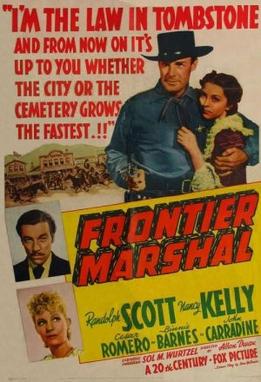
When Wyatt Earp (Randolph Scott) arrives in the town of Tombstone, he takes the law in his own hands by preventing a local outlaw named Indian Charlie (Charles Stevens) from destroying the saloon owned by Ben Carter (John Carradine). For his trouble, Earp is beaten up by Carter’s men. Earp, however, does get a job as the town’s new marshal.
After some initial weariness, Wyatt befriends an alcoholic dentist and gunfighter named Doc Holliday (Cesar Romero). While Earp keeps the peace in Tombstone, Doc is torn between two women, dancehall girl Jerry (Binnie Barnes) and his ex-girlfriend, Sarah (Nancy Kelly).
With Carter and his man planning on robbing a payroll train and also kidnapping frontier performer, Eddie Foy (played by the real Foy’s son, Eddie Foy, Jr.), it is only a matter of time before Earp takes on Carter at the legendary O.K. Corral.
Frontier Marshal was only the second sound film to be made about Wyatt Earp’s time in Tombstone and it was the first to use Earp’s name. (In the first film version of the story, also called Frontier Marshal, Earp’s name was changed to Michael Wyatt.) This was because Wyatt’s widow was offended by some of the material that was included in the biography that served as the basis for Frontier Marshal and threatened to sue anyone who wanted to make a movie out of it. In order to get her permission to make the film, 20th Century Fox agreed that no reference would be made to Wyatt’s marriage in the film. Mrs. Earp ended up suing anyways. 20th Century Fox settled.
As for the film, it’s in no way historically accurate and it pales in comparison to My Darling Clementine, Gunfight at the O.K. Corral, Tombstone, and the Star Trek episode where Kirk, Spock, and McCoy thought they were in the old west. It is, however, better than The Gunfighters episode of Dr. Who. Randolph Scott is convincing as an upright and law-abiding Wyatt Earp, quite a contrast to the real Wyatt. The movie though is stolen by Cesar Romero, who plays Doc Holliday as being pathologically self-destructive. Cesar Romero is not necessarily the first name that comes to mind when you think of a great western actor but he’s very convincing here. John Carradine is a perfect villain and keep an eye out for Lon Chaney, Jr. as one of his henchmen. Unfortunately, the final gunfight feels rushed and, for all the build up, it isn’t as exciting as it should be. Frontier Marshal will mostly be of interest to those curious to see how Doc Holliday, Wyatt Earp, Tombstone and the Gunfight at the O.K. Corral were portrayed in films before they became a sacrosanct part of the mythology of the Old West.
Frontier Marshal was later remade, as My Darling Clementine, by John Ford. Ward Bond, who played Morgan Earp in Ford’s film, plays the original town marshal in Frontier Marshal. Charles Stevens, who plays Indian Charlie in Frontier Marshal, was often falsely described by the Hollywood publicity mill as being the real-life grandson of Geronimo. He also appeared in My Darling Clementine, once again playing the role of Indian Charlie. It was one of the nearly 200 films he made before he died in 1964.
After his wife and most his family is murdered by a rival clan, ninja Cho Osaki (Sho Kosugi) leaves Japan for the United States. Not only is he leaving his home country but he’s also abandoning his ninja heritage. As he explains to his mother (Grace Oshita), he no longer has any use for the violent old ways. From now on, he just wants to sell dolls!
In America, Cho prospers and his mother continues to teach Cho’s young son, Kane (Kane Kosugi), how to defend himself. When Kane is confronted by a bunch of bullies while walking home from school, he kicks their asses while his grandmother watches approvingly. GO, KANE! Seriously, there’s nothing wrong with a movie that opens with a bunch of obnoxious 11 year-olds getting beaten up by a 9 year-old.
Cho has found success opening art galleries and selling dolls. He’s proven that he doesn’t need to be an elite assassin in order to be happy. However, Cho’s mother doesn’t trust Cho’s business partner, Braden (Arthur Roberts). She says that there’s something obviously evil about Braden but Cho doesn’t agree. Well, it turns out that mom’s right! Braden is evil. He’s using the dolls to smuggle heroin into the country! When the local mob boss (Mario Gallo) refuses to agree to Braden’s terms, Braden decides to wage war on the Mafia. It turns out that Braden is a ninja himself!
When members of the Mafia turning up dead in weird ways, the police bring in a local martial arts instructor named Dave (Keith Vitali). Confused by the murders, Dave decides to consult with a friend of his to determine whether or not a ninja could be responsible. That friend just happens to turn out to be Cho, who confirms that there is obviously a ninja in America but who also refuses to fight that ninja because Cho has abandoned the violence of the past and, as he explains it, he’s got a new art gallery opening soon. Of course, what Cho doesn’t know is that the ninja is his own business partner….
The 1983 film Revenge of the Ninja has an overly complicated plot but the story that it tells is relatively simple. Cho is done being a ninja. Then, his family and his girlfriend Cathy (Ashley Ferrare) end up getting caught in the middle of a turf war between Braden and the Mafia and Cho is forced to break his pledge to lead a life of non-violence. Revenge of the Ninja was produced by Cannon films. It was preceded by Enter the Ninja, which featured Kosugi as a villain who fought Franco Nero, and it was followed by Ninja III: The Domination, in which Kosugi played a ninja assassin whose spirit ended up possessing a young aerobics instructor. Of the three Cannon Ninja films, Revenge of the Ninja is the least interesting, as it doesn’t feature a star as charismatic as Franco Nero or a plot twist as wild as an aerobics instructor getting possessed. Revenge of the Ninja does, however, feature several exciting fight scenes and Sho Kosugi’s athletic prowess goes a long way to making up for the fact that he’s not a particularly expressive actor. Fans of low-budget but kinetic martial arts action should get a kick and a punch out of Revenge of the Ninja.
Finally, Revenge of the Ninja may not be the best ninja film ever made but it is a Cannon Film and therefore, it’s worth watching.
I know that I said yesterday that I was done with Eddie Dean westerns but I decided to watch one more, just because it was short and, based on the other Eddie Dean films I had seen, I assumed that it would be undemanding.
(I was right.)
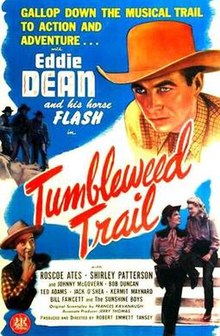
Tumbleweed Trail opens with Brad Barton (Bob Duncan) and his group of colorfully named henchmen (one is named Dead-Eye) ambushing and apparently killing a rancher named Bill Ryan (Kermit Ryan), who also happens to be Barton’s half-brother. Barton wants to take control of Ryan’s ranch and he’s even forged a will to to convince the land office to give it to him instead of Ryan’s children. If this plot sounds familiar, it’s because much of it was recycled for Black Hills.
What Barton did not count on was the arrival of singing cowboy Eddie Dean (played by real-life singing cowboy Eddie Dean) and his sideick, Soapy (Roscoe Ates). Eddie and Soapy get jobs working on Ryan’s ranch. Eddie finds time to sing a few songs and to fall for Bill’s daughter, Robin (Shirley Patterson). Everyone loves Eddie’s singing but he’s not make much progress when it comes to proving that Barton’s will is a fake. Just when it seems like not even Eddie and Soapy will be able to stop Barton, there’s a “surprise” ending that you’ll see coming from a mile away.
This one is uninspired, though some of my reaction could be due to having already seen Eddie Dean go through a similar plot in Black Hills. Eddie sings a lot but that’s about all he does in this routine poverty row western. Bob Duncan is a generic villain. Of the three Eddie Dean films that I’ve watched, TumbleweedTrail was the most forgettable. It’s for fans of the genre only.
Eddie’s horse in Tumbleweed Trail is played by Flash. Flash gets second billing, above Roscoe Ates.
This, I’m pretty sure, was my final Eddie Dean movie.
As we all know, this year’s Sundance Film Festival started tonight.
To me, Sundance has always signified the official start of a new cinematic year. Not only is it the first of the major festivals but it’s also when we first learn about the films that we’ll be looking forward to seeing all year. It seems like every year, there’s at least one successful (or nearly successful) Oscar campaign that gets it start at Sundance. Last year, for instance, Minari took Sundance by storm and it was able to ride that momentum all the way to a Best Picture nomination. Before that, nominees like Manchester By The Sea and Brooklyn got their starts at Sundance.
And, even if their films weren’t nominated for best picture, some of the most important filmmakers of the past few decades got their first exposure at Sundance. The Coen Brothers first won notice with Blood Simple. Years later, Quentin Tarantino took the festival by storm with Reservoir Dogs. Though an argument can be made that Sundance is now just as corporate as the Hollywood system to which it’s supposed to providing an alternative, one can’t deny the importance of the Festival.
For the next few days, I’m going to taking a look at a few films that made their initial splash at Sundance. Some of these films went on to become award winners and some did not. But they’re all worth your attention, one way or another.
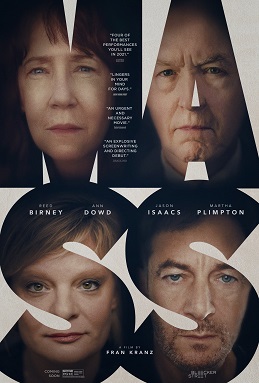
Take for instance, Mass.
The first directorial effort of actor Fran Kranz (you may remember him as the clever and genre-savvy stoner from The Cabin In The Woods), Mass made its debut at least year’s Sundance Film Festival. It was one of the more critically acclaimed films of the festival and, in a perfect world, it would currently be an Oscar front runner. And who knows? There’s always a chance that Mass could pick up a nomination or two. Ann Dowd is apparently running a very energetic campaign for Best Supporting Actress and she’s said to be well-liked in the industry. It’s probably a bit too much to expect the film to be nominated for Best Picture, though it certainly deserves some consideration. It’s perhaps a bit too low-key for a year that’s full of bombast and big emotional moments. It’s a film that raises interesting questions but refuses to provide easy answers. In short, it’s the type of film that, ten years from now, people will watch it and say, “How did this not get nominated?” Even if it’s not a Sundance film that’s destined for the Oscars, it is a Sundance film that will be remembered for heralding the arrival of a vibrant new directorial talent.
Playing out in almost real time, Mass is a film about two couples having a very emotional conversation. Richard (Reed Birney) and Linda (Ann Dowd) are the parents of Hayden. Jay (Jason Isaacs) and Gail (Martha Plimpton) are the parents of Evan. Hayden and Evan went to the same high school. Years ago, Evan was killed in a school shooting. Hayden was the shooter. After killing ten students, Hayden killed himself.
The two couples are meeting in a room in the back of a church. It’s a part of therapy. They meet and they talk about their children and the events that led to the shooting. Jay and Gail demand answers. Richard and Linda can’t provide them. At first, Gail is angry and Jay is the one who tries to keep things civil but, as the conversation continues, it becomes obvious that Jay is in fact angrier than Gail. Even when Richard and Linda express obviously sincere remorse for what Hayden did, Jay cannot accept it because, in a way, he needs them to be evil or ignorant or both. Linda and Richard struggles to reconcile their love for their son with their hatred over what he did. Gail and Jay feel that their son was unfairly taken from them and they’re right. Richard and Linda feel that they’re being blamed for something they couldn’t control and they’re also right. There are no easy villains or heroes in this film. Instead, there are just four unique and interesting characters, all trying to understand something that makes no sense.
Almost everything we learn about the characters comes from listening to them speak. Almost the entire film takes place in that one room. By the end of the film, not a single character is who you originally believed them to be. Jay’s search for meaning has led to him becoming a political activist. He insists that there has to be some sort of identifiable reason to explain why his son is dead, even though he secretly realizes that there isn’t. Gail, who starts out as the angriest person in the room, reveals herself to be the most empathetic. At the start of the film, Jay accuses Richard of not having any emotions but, by the end, we see that Richard’s emotions are very real. Finally, Linda seems meek but quickly reveals herself to be perhaps the strongest and most honest person in the room.
It may sound a bit stagey, this film that takes place in one room and which is basically just four characters having a conversation. But director Fran Kranz does a wonderful job keeping the story moving and the conversation within the room never seems to drag. Indeed, the room itself is almost as fascinating as any of the people inside of it. At the start the film, we watch two church employees and social worker going out of their way to make the room as safe and non-confrontational as possible. However, their efforts have the opposite effect. The room is so friendly that it makes it impossible not to compare its pleasantness with the issues being discussed behind the room’s closed doors. The room itself tries so hard to avoid confrontation that it has the opposite effect.
In the end, the film suggests that there are no neat answers. Even though the two couples come to an understanding and even a sort of peace, there’s no guarantee that peace will last more than a day. Indeed, as soon as they leave the room, their initial awkwardness returns, a reminder that we can understand pain but we can’t necessarily vanquish it. It’s not a film about easy answers but there’s something liberating about the film’s willingness to acknowledge that life can be difficult but that life also goes on.
The film is a masterclass of good acting, with Dowd and Isaacs getting the biggest dramatic moments while Birney and Plimpton offer fantastic support. In a perfect Oscar world, all four of them would be nominated and so would the film itself. Unfortunately, one of the lessons of Mass is that there is no such thing as a perfect world.
Times are hard and rancher John Hadley (Steve Clark) is running the risk of losing his ranch. When Hadley finds gold on his property, he think that all of his problems have been solved. He makes the mistake of revealing the existence of the gold to his friend, Terry Frost (Dan Kirby). Terry’s not much of a friend because he shoots and kills Hadley and then, working with a corrupt county clerk (William Fawcett), he tries to steal Hadley’s property away from the rancher’s children and rightful heirs.
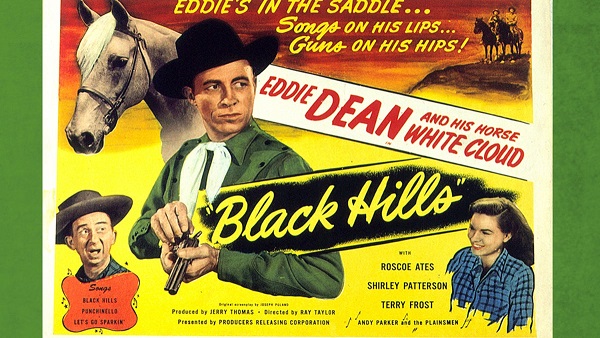
Luckily, singing cowboy Eddie Dean (played by real-life singing cowboy Eddie Dean) rides up and, with the help of his comic relief sidekick (Roscoe Ates), helps to get things sorted out. Even with Terry trying to frame Eddie for a murder he didn’t commit, Eddie still finds time to sing a few songs.
This was Eddie Dean’s final feature film before he moved into television. Black Hills is better than Romance of the West, the Eddie Dean movie that I reviewed yesterday. The plot actually has a few interesting twists and, though it doesn’t appear that he was ever much of an actor, Eddie Dean appears to be more comfortable with his role here than he was in Romance of the West. Black Hills emphasizes that Eddie could throw a punch just as well as he could sing and veteran western actor Dan Kirby is a credible villain. It makes Black Hills into an entertaining if not exactly memorable western diversion.
One final note about Black Hills: Eddie’s horse, White Cloud, gets second billing in the credits.
 In an old west town, Sheriff Ken Bellamy (Ken Maynard) is an honest and upright lawman who thinks that he is trusted and respected by all. His brother, Clem (also played by Ken Maynard), is a storeowner who is less respected and very jealous of his brother. When Ken is asked to store some money in a safe, Clem decides to help the local outlaw, Rawhide (Fred Kohler), steal the money. Clem gives Rawhide the combination but Rawhide then betrays Clem and takes him hostage. Meanwhile, the townspeople think that Ken must has stolen the money so they toss him in jail and appoint a man named Boots (Frank Hageny) as the new sheriff. Now, Ken has to not only figure out how to escape from jail and the townspeople but also how to defeat Rawhide’s gang.