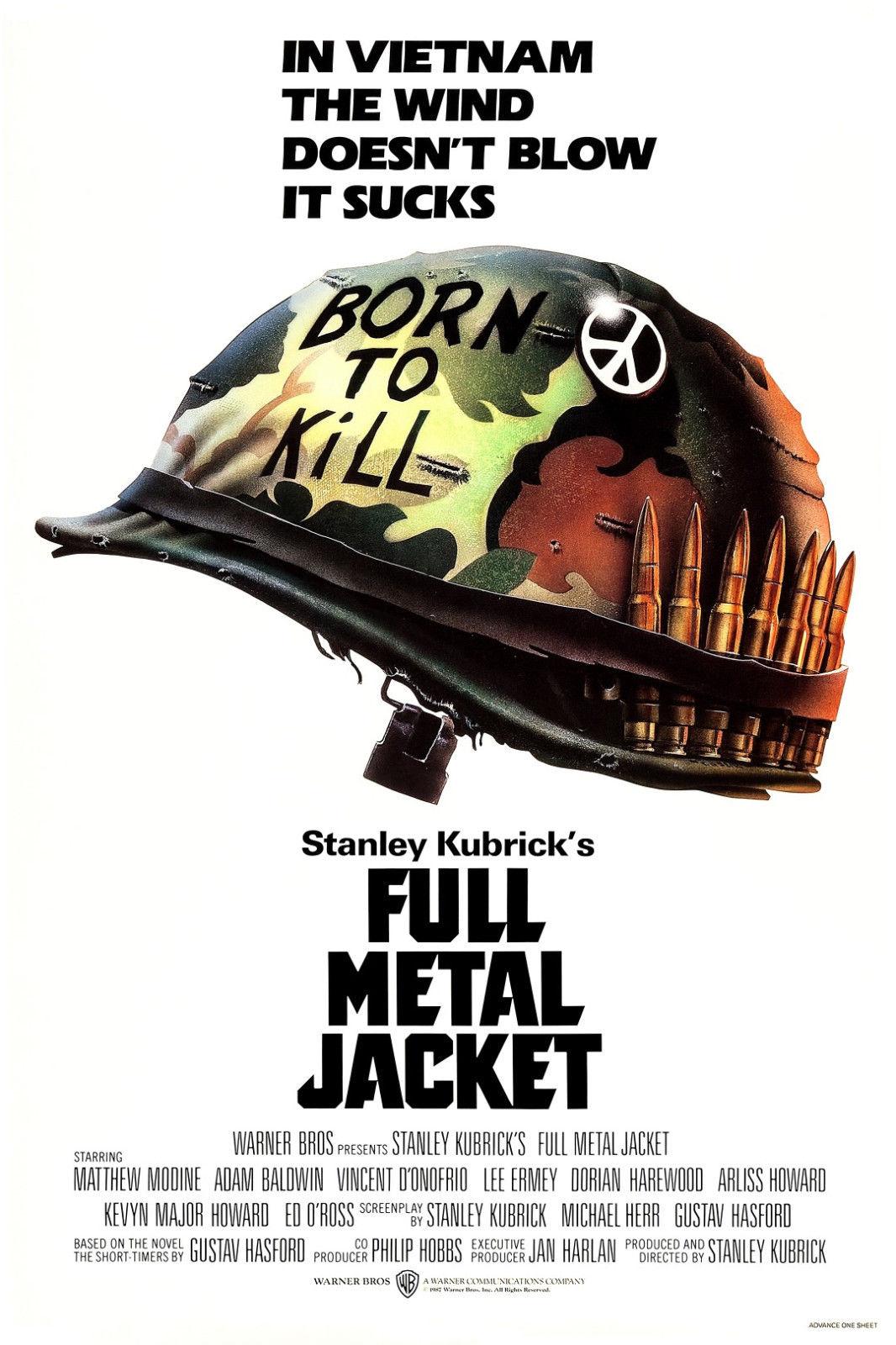
Review: Full Metal Jacket (dir. by Stanley Kubrick)


“You write ‘Born to Kill’ on your helmet and you wear a peace button. What’s that supposed to be, some kind of sick joke?” — Colonel

Full Metal Jacket is the kind of war movie that sticks in your craw like old metal shavings. It’s 1987, Stanley Kubrick’s last film released in his lifetime, and it plays less like a traditional Vietnam War saga and more like a taunt packed into two very different acts. One half is a barracks horror show about how the military turns boys into killers; the other is a grubby, almost casual descent into the chaos of combat. Together, they make a movie that feels intentionally disjointed so it can drill down on the same idea from two angles: war doesn’t just brutalize your body, it reshapes your mind into something barely human.

The film follows Private J.T. “Joker” Davis, played by Matthew Modine in one of those quietly watchful performances that’s easy to underestimate. Joker starts as a kind of archetypal smart‑mouth recruit, the guy who thinks he’s above the hysteria until he realizes he isn’t. Around him swirls a platoon of young Marines going through basic training at Parris Island under the merciless Gunnery Sergeant Hartman, played with shark‑like relish by R. Lee Ermey, who was actually a real‑life Marine drill instructor. Hartman’s whole job is to obliterate softness and replace it with drilled‑in aggression, and Kubrick lingers on every insult, every barked command, until the abuse stops feeling like a setup for a war movie and starts feeling like the main event.

The first half of Full Metal Jacket is basically a single, sustained initiation ritual. The camera stays tight, almost claustrophobic, trapping you in the barracks with the recruits, so you feel the same sensory overload they do. The lighting is harsh, the colors washed out, and the camera often locks in on Hartman’s face mid‑rant, making you uncomfortably intimate with his cruelty. This isn’t training so much as a manufactured psychological war waged on the platoon’s collective brain. The recruits are constantly degraded, mocked, and forced into grotesque rituals of humiliation, and the film never lets you forget that this is the system’s idea of “making Marines.” Kubrick doesn’t fake the perverse appeal of this process either; there’s a weird, ugly thrill in how effective it is, in how the boys start enjoying the brutality once they’re inside it.

The standout character in this section is Leonard “Gomer Pyle” Lawrence, played by Vincent D’Onofrio in a performance that’s almost physically uncomfortable to watch. D’Onofrio’s Pyle is this thick‑set, awkward kid who can’t keep up, and the movie doesn’t soften his edges to make him likable. He’s genuinely bad at the routine, slow, clumsy, but he’s also clearly just trying to survive. The film lets you watch, in a very matter‑of‑fact way, how the system turns his inadequacy into a target. The other recruits are instructed to punish him, and soon everyone starts in. The film doesn’t moralize about it; it just shows that this kind of group cruelty is baked into the structure. The infamous scene where the platoon holds Leonard down with piled‑on bed sheets while whacking him with a bar of soap wrapped in a towel is less about a single act of violence than about what it means to normalize dehumanization before you ever see combat.

What’s so unsettling about Full Metal Jacket is that it never pretends Hartman is some rogue sadist. He’s not an outlier; he’s the product of the system, and he’s also the system’s avatar. In that sense, the first half of the film functions like a kind of industrial horror. The Marines are being processed like defective parts on a factory line, streamed through a machine designed to break them and then rebuild them as compliant killers. The film toys with the idea that the military doesn’t want robots so much as creatures that hunger for violence on command. The line about “we don’t want robots, we want men” is repeated with a kind of grim irony because what the film actually shows is the production of something in between: not quite human, not quite machine, but something that can pull a trigger without hesitating.

Jumping from Parris Island to the streets of Huế during the Tet Offensive, the second half of Full Metal Jacket feels like a different movie in tone but the same one in thesis. Joker, now a combat correspondent with a Stars and Stripes hat and a “Born to Kill” slogan on his helmet, is literally split down the middle between observer and participant. He carries a camera and a rifle; he’s supposed to report, but he also has to fight. The film doesn’t resolve that tension the way a more sentimental war movie would. Instead, it lets Joker drift in that gray zone where war is equal parts absurdity and atrocity. The Vietnamese civilians are largely faceless, and the war itself is shown as a series of loosely connected vignettes—raids, ambushes, random firefights—rather than a grand narrative of heroism or tragedy.

Kubrick’s Vietnam is less a country and more a ruined theater set. The cityscapes are wide, desolate, and oddly beautiful in their destruction, as if the war has turned everything into a series of bleak tableaux. The camera doesn’t linger on gore for shock value; it lingers to make the war feel like a permanent, almost aesthetic state of ruin. Individual soldiers pop in and out: Animal Mother, the violently unhinged Marine played by Adam Baldwin; Cowboy, the earnest, almost naive replacement; and the rest of the squad, who oscillate between fear, boredom, and bursts of casual cruelty. None of them are given the kind of tragic backstories that usually make you emotionally invested in a war film. Instead, they’re presented as fragments of a larger machine, each one another cog in the same indifferent system.

The film’s most famous structural trick is its way of keeping politics at arm’s length while still radiating a deeply skeptical view of the war. It doesn’t really bother telling you who’s right or wrong, or why the Marines are there. It just shows what they become and what they do. The movie doesn’t ask you to sympathize with the Marines in the way some war films do; it asks you to recognize the mirror. The famous ending, where the Marines march through flaming ruins to the tune of Mickey Mouse, is pure Kubrick dark surrealism. The cheerful cartoon theme clashes violently with the apocalyptic imagery, and the soldiers chant along with a kind of manic innocence that feels like the last vestige of humanity being cannibalized by the war itself. It’s hard to tell whether the moment is tragic, absurd, or both, and that’s the point.

Full Metal Jacket is also a film about storytelling and the way narratives are weaponized. Joker, as a reporter, is supposed to package the war for a distant audience. He’s there to turn chaos into digestible stories, but the movie quietly undermines that idea by showing how unreliable those narratives are. The soldiers’ own stories are laced with jokes, bravado, misogyny, and casual racism, and the film doesn’t clean them up. It lets you sit with the ugliness, even when it’s delivered with a laugh. The film doesn’t romanticize the Marines’ camaraderie or soften their cruelty; it just lets you watch them behave like ordinary guys who happen to be doing something extraordinary and monstrous.

The cinematography in Full Metal Jacket is cold and precise, which is exactly what the material needs. The camera behaves like a reluctant witness, framing the Marines in symmetrical, almost clinical compositions that make their brutality look routine rather than spectacular. The score is minimal, and the film often relies on diegetic sound—machine‑gun fire, jeep engines, distant explosions, Hartman’s voice echoing off concrete walls—to ground you in the sensory overload of military life. Even the few moments of levity feel like concessions to show business more than true relief. The soldiers’ jokes are rarely funny in a wholesome way; they’re the kind of gallows humor that keeps you from noticing how broken you’ve become.

What ultimately makes Full Metal Jacket endure is that it refuses to offer catharsis. By the time the film ends, nothing has been “resolved” in the way Hollywood usually expects. Joker survives, but the war doesn’t; it just keeps going, and the Marines keep marching, chanting, and killing. The film doesn’t build toward a big speech about the futility of war or a tear‑jerker about fallen comrades. It just suggests, quietly and persistently, that the process outlined in the boot‑camp half is drafted, again, in the streets of Vietnam. You go in as a boy, you’re molded into something sharper and meaner, and then you’re sent out into a world that rewards that sharpness. The movie doesn’t need to say this out loud; it just shows it happening in scene after scene.

In that sense, Full Metal Jacket is one of the most honest anti‑war films precisely because it doesn’t pretend to be a plea for peace. It’s a portrait of a machine that feeds on itself, and of the people who get caught in its gears. It’s funny, disturbing, infuriating, and occasionally mesmerizing, sometimes all at once. It’s not a movie that wants to hold your hand or make you feel better about the human race. It wants you to stare at the gleam on that full metal jacket bullet and wonder what it took to make someone pull the trigger. That’s the real power of Full Metal Jacket: it doesn’t try to redeem the war, the soldiers, or the audience. It just makes sure you can’t look away.
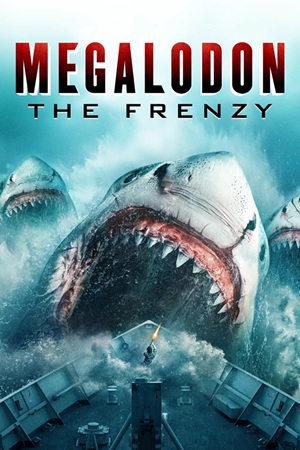
The Eric Roberts Collection: Megalodon: The Frenzy (dir by Brendan Petrizzo)


In 2023’s Megalodon: The Frenzy, the giant shark that keeps coming back …. well, it comes back again!  Actually, there’s more than one giant shark this time.  The ocean is not safe, not for tourists, not for beach partiers, not for scientists, not even for the Marines!

Fortunately, Lt. Commander Sharp (Eric Roberts) is in command of a battleship and he’s constantly encouraging his Marines to be prepared to sacrifice everything to stop the giant sharks.  While scientist Rylie Clark (Caroline Williams) attempts to figure out how to stop the sharks, Sharp barks out order to his crew.  His crew replies with “Oorah!”  I would have to check the official records to know for sure but there’s a distinct chance that this movie set the record for the most use of “oorah” over an 82 minute run time.

The true stars of the film are the giant sharks, of course.  That said, it’s nice to see Eric Roberts playing a good guy for once.  Of course, Eric does seem a little advanced in years to still be on active duty.  The mandatory retirement age for a flag officer is usually 64 but retirement can be deferred until 68 by Presidential order.  Eric Roberts was around 67 years old when he filmed this so I guess it pays to have a friend in Washington.  Well, no matter.  Eric gave his orders with authority and rallied his men and probably had the longest hair that you’re ever likely to see on an officer.

As for the sharks, they’re really big and they jump out of the water and eat people.  This is an Asylum film and the Asylum has always understood what people want when it comes to giant sharks.  Don’t take this film seriously and you’ll be fine.

Previous Eric Roberts Films That We Have Reviewed:

  1. Paul’s Case (1980)
  2. Star 80 (1983)
  3. Runaway Train (1985)
  4. To Heal A Nation (1988)
  5. Best of the Best (1989)
  6. Blood Red (1989)
  7. The Ambulance (1990)
  8. The Lost Capone (1990)
  9. Best of the Best II (1993)
  10. Love, Cheat, & Steal (1993)
  11. Voyage (1993)
  12. Love Is A Gun (1994)
  13. Sensation (1994)
  14. Dark Angel (1996)
  15. Doctor Who (1996)
  16. Most Wanted (1997)
  17. The Alternate (2000)
  18. Mercy Streets (2000)
  19. Tripfall (2000)
  20. Raptor (2001)
  21. Rough Air: Danger on Flight 534 (2001)
  22. Strange Frequency (2001)
  23. Wolves of Wall Street (2002)
  24. Border Blues (2004)
  25. Mr. Brightside (2004)
  26. Six: The Mark Unleased (2004)
  27. We Belong Together (2005)
  28. Hey You (2006)
  29. Depth Charge (2008)
  30. Amazing Racer (2009)
  31. The Chaos Experiment (2009)
  32. In The Blink of an Eye (2009)
  33. Bed & Breakfast (2010)
  34. Enemies Among Us (2010)
  35. The Expendables (2010) 
  36. Groupie (2010)
  37. Sharktopus (2010)
  38. Beyond The Trophy (2012)
  39. The Dead Want Women (2012)
  40. Deadline (2012)
  41. The Mark (2012)
  42. Miss Atomic Bomb (2012)
  43. The Night Never Sleeps (2012)
  44. Assault on Wall Street (2013)
  45. Bonnie And Clyde: Justified (2013)
  46. Lovelace (2013)
  47. The Mark: Redemption (2013)
  48. The Perfect Summer (2013)
  49. Revelation Road: The Beginning of the End (2013)
  50. Revelation Road 2: The Sea of Glass and Fire (2013)
  51. Self-Storage (2013)
  52. Sink Hole (2013)
  53. A Talking Cat!?! (2013)
  54. This Is Our Time (2013)
  55. Bigfoot vs DB Cooper (2014)
  56. Doc Holliday’s Revenge (2014)
  57. Eternity: The Movie (2014)
  58. Inherent Vice (2014)
  59. Road to the Open (2014)
  60. Rumors of War (2014)
  61. So This Is Christmas (2014)
  62. Amityville Death House (2015)
  63. Deadly Sanctuary (2015)
  64. A Fatal Obsession (2015)
  65. Las Vegas Story (2015)
  66. Sorority Slaughterhouse (2015)
  67. Stalked By My Doctor (2015)
  68. Enemy Within (2016)
  69. Hunting Season (2016)
  70. Joker’s Poltergeist (2016)
  71. Prayer Never Fails (2016)
  72. Stalked By My Doctor: The Return (2016)
  73. The Wrong Roommate (2016)
  74. Dark Image (2017)
  75. The Demonic Dead (2017)
  76. Black Wake (2018)
  77. Frank and Ava (2018)
  78. Stalked By My Doctor: Patient’s Revenge (2018)
  79. The Wrong Teacher (2018)
  80. Clinton Island (2019)
  81. Monster Island (2019)
  82. The Reliant (2019)
  83. The Savant (2019)
  84. Seven Deadly Sins (2019)
  85. Stalked By My Doctor: A Sleepwalker’s Nightmare (2019)
  86. The Wrong Mommy (2019)
  87. Exodus of a Prodigal Son (2020)
  88. Free Lunch Express (2020)
  89. Hard Luck Love Song (2020)
  90. Her Deadly Groom (2020)
  91. Top Gunner (2020)
  92. Deadly Nightshade (2021)
  93. The Elevator (2021)
  94. Just What The Doctor Ordered (2021)
  95. Killer Advice (2021)
  96. Megaboa (2021)
  97. Night Night (2021)
  98. The Poltergeist Diaries (2021)
  99. The Rebels of PT-218 (2021)
  100. Red Prophecies (2021)
  101. A Town Called Parable (2021)
  102. The Wrong Mr. Right (2021)
  103. Bleach (2022)
  104. Dawn (2022)
  105. My Dinner With Eric (2022)
  106. 69 Parts (2022)
  107. The Rideshare Killer (2022)
  108. The Wrong High School Sweetheart (2022)
  109. The Company We Keep (2023)
  110. D.C. Down (2023)
  111. If I Can’t Have You (2023)
  112. Aftermath (2024)
  113. Bad Substitute (2024)
  114. Devil’s Knight (2024)
  115. Insane Like Me? (2024)
  116. Space Sharks (2024)
  117. The Wrong Life Coach (2024)
  118. Broken Church (2025)
  119. Shakey Grounds (2025)
  120. When It Rains In L.A. (2025)

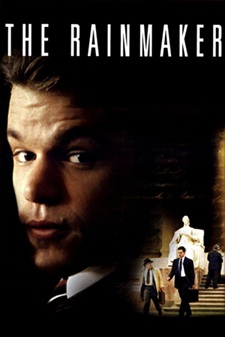
The Rainmaker (1997, directed by Francis Ford Coppola)


Rudy Baylor (Matt Damon) is an idealistic young law school graduate who discovers that having a degree and passing the bar doesn’t automatically make you a success.  He gets a job working a bar that just happens to be owned by an ambulance chasing attorney named Bruiser Stone (Mickey Rourke).  Bruiser takes Rudy on as an associate and assigns his associate, Deck Shifflet (Danny DeVito), to teach Rudy how to find cases.  When Bruiser flees the country to escape an FBI investigation, Rudy and Deck start their own law firm.  Rudy soon finds himself with the case of his young career, representing a family in a law suit against Great Benefit Insurance.  Rudy also falls for Kelly (Claire Danes), a young woman who is being abused by her husband (Andrew Shue).

It can be hard to believe today but, in the 90s, every John Grisham novel was adapted for the screen.  Most of the adaptations weren’t very good but audiences ate them up.  In many ways, The Rainmaker is the ultimate John Grisham adaptation because it contains every single trope that John Grisham made popular with his legal thrillers.  This time, Matt Damon is the charismatic attorney.  Roy Scheider is the soulless corporate CEO who needs to be brought down.  Jon Voight is the intimidating opposing counsel.  Danny DeVito is the eccentric comic relief and Mickey Rourke is the dues ex machina who returns to the movie to give Rudy a piece of information at the exact right moment.   The appeal of Grisham is that he made readers (and eventually moviegoers) feel like insiders while presenting them with stories that were essentially very simple good vs evil morality tales.  The insurance company is so cartoonishly evil that there’s no doubt Rudy is going to defeat them.  There’s also no doubt that Rudy is going to find a better calling than ambulance chasing because the only thing that people hate more than insurance companies is lawyers.

The Rainmaker is never as complex as it pretends to be but it’s an entertaining legal movie.  It was also director Francis Ford Coppola’s last big hit.  It’s really more of a Grisham film than a Coppola film but Coppola’s influence is still felt in the almost uniformly excellent cast.  (Ignore Andrew Shue if you can.  Melrose Place was very popular in the 90s.)  Damon, Danes, Rourke, Voight, Dean Stockwell, Danny Glover, Teresa Wright, Virginia Madsen, and Mary Kay Place all give memorable performances.  Roy Scheider is loathsome as the sweater-wearing CEO.  Best of all is Danny DeVito, who gets all of the best lines.

The Rainmaker was the best of the 1990s Grisham adaptations.  While it’s not quite a masterpiece, it’s still emotionally very satisfying.

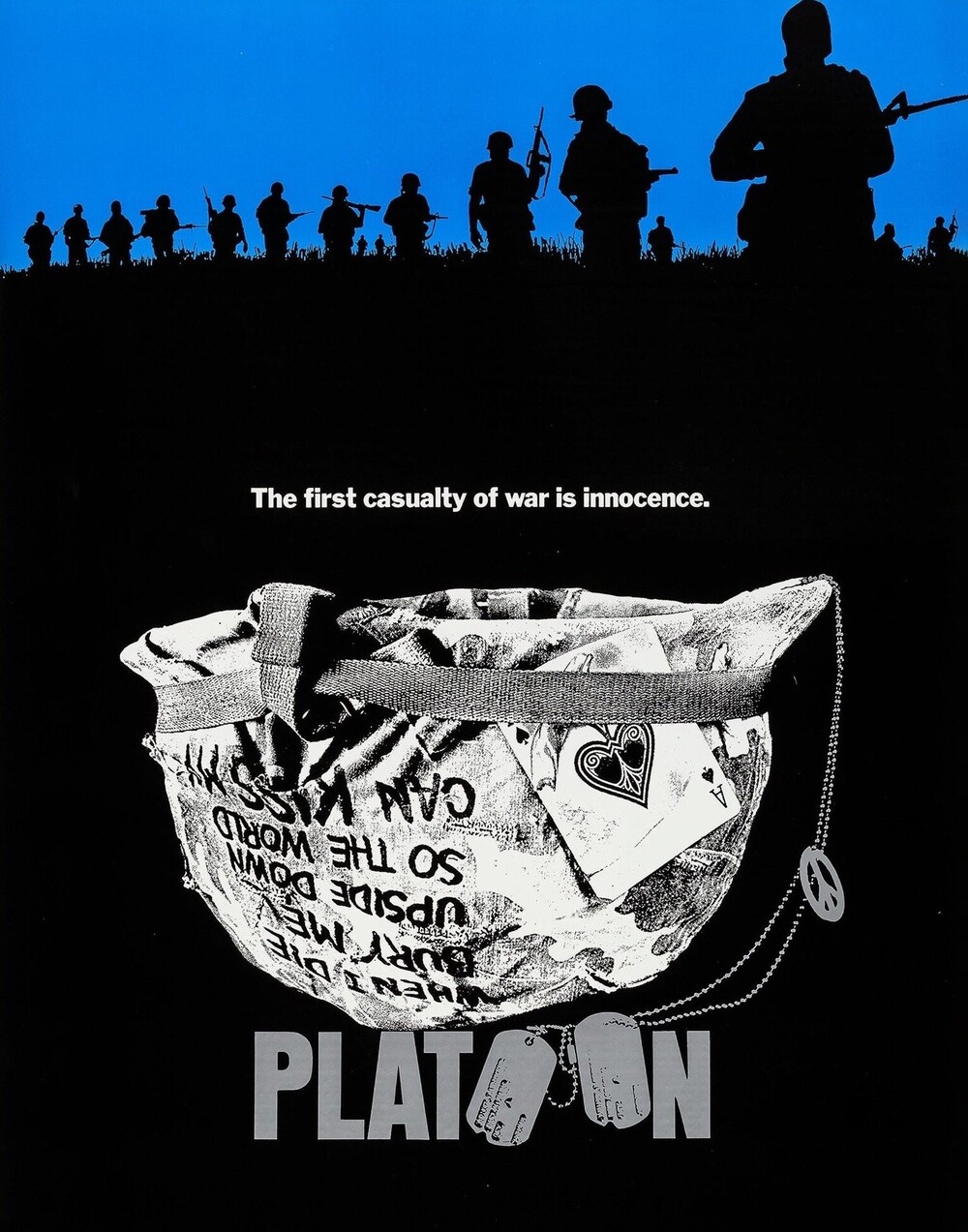
Review: Platoon (dir. by Oliver Stone)


“We been kicking other peoples asses for so long, I figured it’s time we got ours kicked.” — Sgt. Elias

Platoon is one of those war movies that still feels raw, mean, and strangely alive decades later. It is not just a Vietnam movie about combat; it is a movie about confusion, fear, moral collapse, and what happens when young people are dropped into a nightmare with no real sense of why they are there.

What makes Platoon hit so hard is that it never feels polished in a comforting way. Oliver Stone keeps the film close to the mud, sweat, and panic of the battlefield, but he also spends plenty of time on the uglier stuff that happens between firefights: the resentment, the paranoia, the bullying, and the way men start forming little kingdoms inside a war zone. That is where the movie gets its power. The bullets matter, but so do the silences and side glances, because those moments show how war breaks people down before it even kills them.

Charlie Sheen’s Chris Taylor is a smart choice for the center of the film because he starts out as a kind of blank witness. He is young, idealistic in a vague way, and clearly not prepared for what he has walked into. That makes him easy to identify with, but it also makes him useful as a lens for everything around him. We learn the rules of this miserable little ecosystem as he does. Through Chris, the audience is pulled into the same sense of helpless observation that seems to define the whole experience of the platoon.

Stone’s screenplay makes that connection even stronger because he wrote it himself, drawing on his own experience as a young man who volunteered to go to Vietnam instead of being drafted. That detail gives Chris Taylor’s story a personal charge, since Chris feels less like a fictional stand-in and more like Stone working through his own memory and guilt. It adds another layer to the film’s emotional weight, because the perspective feels lived-in rather than invented for dramatic effect.

The film’s real muscle comes from the conflict between Sergeant Elias and Sergeant Barnes, played with complete commitment by Willem Dafoe and Tom Berenger. Elias feels like the last thread of conscience in a collapsing world. Barnes, by contrast, is the kind of man war can easily turn into a weapon: hard, cold, frightening, and convinced that brutality is just realism with the sentiment stripped out. Their conflict gives the movie a mythic quality without draining away its grit. It is not subtle in the usual sense, but it does not need to be. Stone wants these figures to feel bigger than life because that is how they register to a terrified kid in the jungle.

One of the best things about Platoon is how it balances chaos with purpose. A lot of war films either try to turn combat into spectacle or turn it into a lecture. Platoon mostly avoids both traps. The action is ugly, disorienting, and often difficult to follow in exactly the right way. You do not watch these battles and admire the choreography as much as you feel the confusion of everyone inside them. The filmmaking keeps you from getting too comfortable, which is exactly the point. War here is not heroic; it is exhausting, degrading, and terrifying.

That sense of exhaustion matters because the movie understands that war is not made up of only the big moments people remember. It is made up of waiting, heat, boredom, fear, and the slow erosion of judgment. Platoon is at its best when it lingers on that middle ground. The soldiers are not always in immediate danger, but they are always under pressure. That constant tension is what makes the movie feel so oppressive. Even when nothing explodes, it still feels like something bad is about to happen.

Stone also deserves credit for making a Vietnam movie that feels personal without becoming self-congratulatory. You can feel that this comes from experience, but the film never becomes some smug “I was there” statement. Instead, it channels memory into mood, character, and atmosphere. That gives the movie a lived-in authenticity that a lot of war films chase but never quite reach. It feels like a film made by someone trying to tell the truth about a memory that never stopped hurting.

There is also something brutally effective about the way Platoon presents morality as unstable rather than cleanly divided. The movie does not really pretend that everyone is either noble or evil. Instead, it shows how stress, fear, resentment, and power can shove people toward terrible choices. That is a big reason the film still works. It understands that war does not just expose character; it distorts it. Men do things they would never do anywhere else, and the movie keeps asking what is left of a person after that kind of damage.

Still, Platoon is not perfect, and part of its reputation comes from how forcefully it makes its points. Some viewers may find it a little heavy-handed at times, especially in the way it frames innocence, corruption, and betrayal. It is not exactly a subtle film, and it does occasionally aim for emotional impact with both fists. But honestly, that intensity is part of its identity. The movie is not trying to be cool or detached. It wants to wound you a little, and for this material, that approach makes sense.

The performances help keep the film from tipping over into empty grandstanding. Dafoe brings a wounded humanity to Elias that makes him feel like more than just a symbol. Berenger gives Barnes a dangerous stillness that is often more frightening than outright aggression. Sheen, meanwhile, does the important work of holding the center without overpowering the film. He is not the flashiest presence, but he does not need to be. His job is to absorb the madness, and that gives the audience a place to stand inside it.

What lingers most after Platoon is not any single battle scene, but the feeling that the whole movie is about a collapse of trust. Trust in leaders, trust in comrades, trust in the idea that there is some larger meaning to all this suffering. The film strips those things away layer by layer until all that is left is survival and the hope that maybe, somehow, the nightmare will end. That is a bleak place to sit for two hours, but it is also why the film remains so effective. It does not romanticize the experience. It forces you to sit with its mess.

The movie also has a strong visual identity. The jungle is not just background; it feels like an active pressure on every scene. The humidity, the darkness, the mud, and the smoke all help create a world that seems hostile even when nobody is shooting. That physical texture is a huge part of the movie’s success. You can almost feel the environment draining the people inside it. It is less like watching a battle than like watching human beings slowly get swallowed by a swamp of fear and violence.

If there is a reason Platoon still gets talked about so often, it is because it captures a very specific kind of war movie truth: the enemy is not only out there. Sometimes the real damage comes from within the unit, within the chain of command, within the soldier’s own mind. That is a grim idea, but Platoon never feels empty or cynical for saying it. It feels honest. And honesty, in a movie like this, goes a long way.

In the end, Platoon is powerful because it refuses to let war look clean, noble, or emotionally tidy. It is messy, relentless, and often hard to watch, but that is exactly why it matters. It is one of the defining Vietnam films for a reason, and even with its blunt edges, it earns that status through sheer force of feeling, strong performances, and a bleak sense of truth that never really lets up.

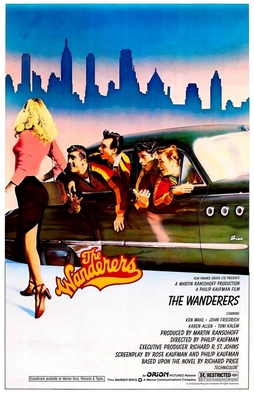
The Wanderers (1979, directed by Philip L. Kaufman)


In 1963, teenage Richie Gennaro (Ken Wahl) may not be much of a high school student but he’s the coolest kid on his block.  He’s the leader of the Wanderers, an Italian-American street gang.  Among his friends are the neurotic Joey (John Friedrich), Turkey (Alan Rosenberg), and Perry (Tony Ganios — yes, Meat from Porky’s), who has just moved to the Bronx but whose height and ability to fight makes him a key member of the Wanderers.  Richie dating Despie (Toni Kalem), the daughter of the local mob boss (Dolph Sweet).  However, when Richie meets Nina (Karen Allen), he wonders if there’s something more out there than just spending the rest of his days in the Bronx.

Based on a novel by Richard Price, The Wanderers has always been overshadowed by 1979’s other big gang movie, The Warriors.  That’s too bad because they’re both great films.  Walter Hill has always said that he envisioned The Warriors as being set in the near-future.  The Wanderers, on the other hand, is very much a film about the past.  An episodic movie that is more about capturing a time and a place as opposed to telling a traditional story, The Wanderers portrays 1963 with a mix of nostalgia and realism.  The soundtrack is heavy with early rock and roll.  There’s a scene where Richie sees a group of adults crying as they watch the coverage of John F. Kennedy’s assassination.  Nina listens to Bob Dylan at a coffeehouse and the local mob boss is a fan of The Hustler.  But for Richie and his friends, adulthood is something to be put off for as long as possible.  Life is about wearing their jackets, giving each other a hard time, trying to get lucky, trying not get slapped upside their heads by their parents, and preparing for the big football game against a rival gang.  When a Marine recruiter tricks the members of one gang into enlisting, it’s a big deal to Richie because he no longer has to worry about being harassed by them.  Those of us watching, however, know that Vietnam is in thee future.  Scenes of Richie and Joey joking around are combined with moments of sudden violence.  For the most part, the Wanderers and their neighborhood rivals are amiable rivals but, take a wrong turn, and you might find yourself being chased by the viscous Ducky Boys.  For Richie, his life revolves around being a Wanderer but nothing can last forever and the film ends with a celebration that feels like a last hurrah for a changing world.  Some will escape The Bronx and find a new world with new possibilities and new freedoms.  There’s a particularly interesting subtext to the friendship of Perry and Joey, with the film ending on a subtle note that suggests that there’s more to their relationship than just being members of the same gang.

The end result is one of the best coming-of-age stories out there.  Ken Wahl, John Friedrich, Alan Rosenberg, and Tony Ganios all give excellent performances as the main Wanderers.  Karen Allen and Toni Kalem are perfectly cast as the two women who represent Richie’s possible future.  (The strip poker scene is a highlight.)  Kalem’s Despie represents the Bronx while Allen’s Nina represents the world outside and the film treats both of them with respect.  At first, Despite might seem like a stereotype but she soon proves herself to be more aware of what’s actually going on around her than anyone realized.  Richie may like Nina but it’s hard to imagine him ever being truly happy away from his home.

The Wanderers deserves more attention than it has received over the years.  It’s funny, touching, and sometimes scary.  (The Ducky Boys, despite their name, will haunt you.)  Wander over and watch it.

I Finally Watched The Natural (1984, Dir. by Barry Levinson)


Earlier today, I finally watched The Natural.

As a baseball fan, it feels like heresy to admit that it took me this long to watch The Natural.  I had seen plenty of scenes from the film.  I knew the music because there’s no way you can watch as much as baseball as I do without hearing it at least a few times every scene.  I knew about Wonderboy and the big home run and how Roy Hobbs came out of nowhere to lead the perennially last-place New York Knights to the championship series but I had never actually watched the entire film from beginning to end.

Until this afternoon.

When the movie started, I was worried.  Robert Redford plays Roy Hobbs, an outstanding hitter whose promising career appears to be over when a mysterious woman (Barbara Hersey) shoots him in the gut.  At the start of the movie, Roy and his girlfriend Iris (Glenn Close) are supposed to be teenagers but Redford was nearly 50 and Glenn Close was close to 40.  The whole point of the first part of the movie is that Roy and Iris are young and they have their whole future ahead of them but the actors were both clearly middle-aged.  There was a scene where Roy strikes out the best batter in the league (Joe Don Baker) and the batter kept calling Roy a kid but Redford looked like he was older than Baker.

The good thing is that you only have to buy Redford as being a teenager for about 15 minutes.  After he gets shot, Roy stops playing for several years.  By the time Roy makes it to the major leagues, he’s supposed to be older than everyone else.  No one gives Roy much of a chance when he’s first signed to the New York Knights.  The other players (including Michael Madsen) don’t respect him and the manager (Wilford Brimley) refuses to play him.  But when Roy Hobbs finally does get a chance to swing his home-made bat, he hits homer after homer.  Roy is a natural, the next great player even if he is at an age when most players retire.  A journalist (Robert Duvall) tries to uncover his background.  A seductress (Kim Basinger) tries to lead him astray.  A gambler (Darren McGavin) and the team’s owner (Robert Prosky) try to get him to throw the big game.  Anyone who has watched a baseball game knows how it ends because we’ve all heard the music and seen that clip.  But even if everyone knows how the story concludes, it’s impossible not to cheer when Roy gets a hit and to feel bad when he takes a strike.  Redford may have been old for a baseball player but he looked good out there, swinging that bat and throwing that ball.

I loved The Natural.  It’s extremely sentimental movie.  Sometimes, it feels old-fashioned.  That’s perfect for baseball, though.  Baseball is a sentimental, old-fashioned game and the story of Roy Hobbs is what baseball is all about.  The Knights are behind for most of the season.  Roy hits a slump.  But neither he nor the team ever give up because they know that baseball is a game of endurance.  It’s not like football, where you just have to win 9 games to make it to the playoffs.  Baseball is about never giving up, no matter what the score is.  Even the movie’s supernatural aspects — the sudden storms, a lightning bolt hitting a tree and creating Wonderboy, and even Glenn Close looking like an angel in the stands — work because baseball is a mystical sport.  It’s the closest thing we have to a spiritual sport.

You couldn’t make a movie like The Natural about football or basketball.  Only the game of baseball could have given us The Natural.

The Eric Roberts Collection: Groupie (dir by Mark L. Lester)


2010’a Groupie tells the story of the Dark Knights.

The Dark Knights are a legendary band with devoted fans.  I’m not sure why because, from what we hear of their music, they really suck.  I don’t mean that they suck in a funny deliberate way, like Spinal Tap.  I mean, they literally suck.  Maybe some of their popularity has to do with their habit of setting their lead singer on fire during their performances.

Unfortunately, during one performance, the fire gets out of control.  There’s a panic in the club.  A 16 year-old fan is stomped to death.  A year later, The Dark Knights are ready to launch their comeback tour.  And they’ve got a new groupie, Riley (Taryn Manning)!  Riley likes to make death masks.  Well, I guess everyone needs a hobby.  Riley is also the sister of the fan who was stomped to death.  She’s looking for revenge against the Dark Knights and their manager, Angus (Eric Roberts).

That this film appears to be based on a real-life tragedy (i.e. the Station Nightclub Fire) gives the whole film are rather icky sheen.  Also adding to the film’s oddness is how straight-forward it is.  Riley shows up.  A mysterious killer strikes.  Riley appears to be the killer and, hey — she is the killer!  There’s no real attempt to create any sort of suspense or misdirection as to who the killer may be.  That said, Taryn Manning is entertainingly unhinged and director Mark L. Lester keeps the action moving quickly.

As far as Eric Roberts is concerned, he plays a pretty sleazy character but he does so with good humor.  Indeed, it’s hard not to have sympathy for Angus. While the band is busy setting things on fire, he’s the one who keeps the tour bus moving.

Previous Eric Roberts Films That We Have Reviewed:

  1. Paul’s Case (1980)
  2. Star 80 (1983)
  3. Runaway Train (1985)
  4. To Heal A Nation (1988)
  5. Best of the Best (1989)
  6. Blood Red (1989)
  7. The Ambulance (1990)
  8. The Lost Capone (1990)
  9. Best of the Best II (1993)
  10. Love, Cheat, & Steal (1993)
  11. Voyage (1993)
  12. Love Is A Gun (1994)
  13. Sensation (1994)
  14. Dark Angel (1996)
  15. Doctor Who (1996)
  16. Most Wanted (1997)
  17. The Alternate (2000)
  18. Mercy Streets (2000)
  19. Tripfall (2000)
  20. Raptor (2001)
  21. Rough Air: Danger on Flight 534 (2001)
  22. Strange Frequency (2001)
  23. Wolves of Wall Street (2002)
  24. Border Blues (2004)
  25. Mr. Brightside (2004)
  26. Six: The Mark Unleased (2004)
  27. We Belong Together (2005)
  28. Hey You (2006)
  29. Depth Charge (2008)
  30. Amazing Racer (2009)
  31. The Chaos Experiment (2009)
  32. In The Blink of an Eye (2009)
  33. Bed & Breakfast (2010)
  34. Enemies Among Us (2010)
  35. The Expendables (2010) 
  36. Sharktopus (2010)
  37. Beyond The Trophy (2012)
  38. The Dead Want Women (2012)
  39. Deadline (2012)
  40. The Mark (2012)
  41. Miss Atomic Bomb (2012)
  42. The Night Never Sleeps (2012)
  43. Assault on Wall Street (2013)
  44. Bonnie And Clyde: Justified (2013)
  45. Lovelace (2013)
  46. The Mark: Redemption (2013)
  47. The Perfect Summer (2013)
  48. Revelation Road: The Beginning of the End (2013)
  49. Revelation Road 2: The Sea of Glass and Fire (2013)
  50. Self-Storage (2013)
  51. Sink Hole (2013)
  52. A Talking Cat!?! (2013)
  53. This Is Our Time (2013)
  54. Bigfoot vs DB Cooper (2014)
  55. Doc Holliday’s Revenge (2014)
  56. Eternity: The Movie (2014)
  57. Inherent Vice (2014)
  58. Road to the Open (2014)
  59. Rumors of War (2014)
  60. So This Is Christmas (2014)
  61. Amityville Death House (2015)
  62. Deadly Sanctuary (2015)
  63. A Fatal Obsession (2015)
  64. Las Vegas Story (2015)
  65. Sorority Slaughterhouse (2015)
  66. Stalked By My Doctor (2015)
  67. Enemy Within (2016)
  68. Hunting Season (2016)
  69. Joker’s Poltergeist (2016)
  70. Prayer Never Fails (2016)
  71. Stalked By My Doctor: The Return (2016)
  72. The Wrong Roommate (2016)
  73. Dark Image (2017)
  74. The Demonic Dead (2017)
  75. Black Wake (2018)
  76. Frank and Ava (2018)
  77. Stalked By My Doctor: Patient’s Revenge (2018)
  78. The Wrong Teacher (2018)
  79. Clinton Island (2019)
  80. Monster Island (2019)
  81. The Reliant (2019)
  82. The Savant (2019)
  83. Seven Deadly Sins (2019)
  84. Stalked By My Doctor: A Sleepwalker’s Nightmare (2019)
  85. The Wrong Mommy (2019)
  86. Exodus of a Prodigal Son (2020)
  87. Free Lunch Express (2020)
  88. Hard Luck Love Song (2020)
  89. Her Deadly Groom (2020)
  90. Top Gunner (2020)
  91. Deadly Nightshade (2021)
  92. The Elevator (2021)
  93. Just What The Doctor Ordered (2021)
  94. Killer Advice (2021)
  95. Megaboa (2021)
  96. Night Night (2021)
  97. The Poltergeist Diaries (2021)
  98. The Rebels of PT-218 (2021)
  99. Red Prophecies (2021)
  100. A Town Called Parable (2021)
  101. The Wrong Mr. Right (2021)
  102. Bleach (2022)
  103. Dawn (2022)
  104. My Dinner With Eric (2022)
  105. 69 Parts (2022)
  106. The Rideshare Killer (2022)
  107. The Wrong High School Sweetheart (2022)
  108. The Company We Keep (2023)
  109. D.C. Down (2023)
  110. If I Can’t Have You (2023)
  111. Aftermath (2024)
  112. Bad Substitute (2024)
  113. Devil’s Knight (2024)
  114. Insane Like Me? (2024)
  115. Space Sharks (2024)
  116. The Wrong Life Coach (2024)
  117. Broken Church (2025)
  118. Shakey Grounds (2025)
  119. When It Rains In L.A. (2025)

The Eric Roberts Collection: If I Can’t Have You (dir by David DeCoteau)


In 2023’s If I Can’t Have You, Michelle (Bailey Kai) is the host of the hottest late night radio show in town but she’s been getting creepy phone calls from someone identifying himself as Curtis.  Michelle and her producer (Gina Haraizumi) can’t get get any help from the cops (played by Jackee Harry and Tracy Nelson) so they decide to investigate on their own.

Who is Michelle’s stalker?  Could it be the creepy guy (Michael Pare) who lives next door?  Could it be their geeky engineer, Keith (Phillip McElroy)?  Could it be Stan (Eric Roberts), the owner of the radio station who seems to be really determined to get them to change their time slot?  Or could it be just some other random guy with too much time on his hands?

To give credit where credit is due, director David DeCoteau does manage to generate some suspense as to who the stalker actually is.  I wouldn’t say I was exactly shocked when the stalker’s identity was revealed but DeCoteau still did a good job of giving us plenty of suspects to consider.  That said, this is still a David DeCoteau film and the real pleasure of the film is spotting all of the standard DeCoteauisms.  In this case, Joe’s Restaurant — previously seen in The Wrong Mr. Right — makes a return appearance.

In the end, this one isn’t as much fun as DeCoteau’s “Wrong” films.  There’s no Vivica A. Fox saying, “Looks like you suspected the Wrong Stalker.”  Still, it’s entertaining enough and Eric Roberts appears to have been in a good mood during filming.

Previous Eric Roberts Films That We Have Reviewed:

  1. Paul’s Case (1980)
  2. Star 80 (1983)
  3. Runaway Train (1985)
  4. To Heal A Nation (1988)
  5. Best of the Best (1989)
  6. Blood Red (1989)
  7. The Ambulance (1990)
  8. The Lost Capone (1990)
  9. Best of the Best II (1993)
  10. Love, Cheat, & Steal (1993)
  11. Voyage (1993)
  12. Love Is A Gun (1994)
  13. Sensation (1994)
  14. Dark Angel (1996)
  15. Doctor Who (1996)
  16. Most Wanted (1997)
  17. The Alternate (2000)
  18. Mercy Streets (2000)
  19. Tripfall (2000)
  20. Raptor (2001)
  21. Rough Air: Danger on Flight 534 (2001)
  22. Strange Frequency (2001)
  23. Wolves of Wall Street (2002)
  24. Border Blues (2004)
  25. Mr. Brightside (2004)
  26. Six: The Mark Unleased (2004)
  27. We Belong Together (2005)
  28. Hey You (2006)
  29. Depth Charge (2008)
  30. Amazing Racer (2009)
  31. The Chaos Experiment (2009)
  32. In The Blink of an Eye (2009)
  33. Bed & Breakfast (2010)
  34. Enemies Among Us (2010)
  35. The Expendables (2010) 
  36. Sharktopus (2010)
  37. Beyond The Trophy (2012)
  38. The Dead Want Women (2012)
  39. Deadline (2012)
  40. The Mark (2012)
  41. Miss Atomic Bomb (2012)
  42. The Night Never Sleeps (2012)
  43. Assault on Wall Street (2013)
  44. Bonnie And Clyde: Justified (2013)
  45. Lovelace (2013)
  46. The Mark: Redemption (2013)
  47. The Perfect Summer (2013)
  48. Revelation Road: The Beginning of the End (2013)
  49. Revelation Road 2: The Sea of Glass and Fire (2013)
  50. Self-Storage (2013)
  51. Sink Hole (2013)
  52. A Talking Cat!?! (2013)
  53. This Is Our Time (2013)
  54. Bigfoot vs DB Cooper (2014)
  55. Doc Holliday’s Revenge (2014)
  56. Eternity: The Movie (2014)
  57. Inherent Vice (2014)
  58. Road to the Open (2014)
  59. Rumors of War (2014)
  60. So This Is Christmas (2014)
  61. Amityville Death House (2015)
  62. Deadly Sanctuary (2015)
  63. A Fatal Obsession (2015)
  64. Las Vegas Story (2015)
  65. Sorority Slaughterhouse (2015)
  66. Stalked By My Doctor (2015)
  67. Enemy Within (2016)
  68. Hunting Season (2016)
  69. Joker’s Poltergeist (2016)
  70. Prayer Never Fails (2016)
  71. Stalked By My Doctor: The Return (2016)
  72. The Wrong Roommate (2016)
  73. Dark Image (2017)
  74. The Demonic Dead (2017)
  75. Black Wake (2018)
  76. Frank and Ava (2018)
  77. Stalked By My Doctor: Patient’s Revenge (2018)
  78. The Wrong Teacher (2018)
  79. Clinton Island (2019)
  80. Monster Island (2019)
  81. The Reliant (2019)
  82. The Savant (2019)
  83. Seven Deadly Sins (2019)
  84. Stalked By My Doctor: A Sleepwalker’s Nightmare (2019)
  85. The Wrong Mommy (2019)
  86. Exodus of a Prodigal Son (2020)
  87. Free Lunch Express (2020)
  88. Hard Luck Love Song (2020)
  89. Her Deadly Groom (2020)
  90. Top Gunner (2020)
  91. Deadly Nightshade (2021)
  92. The Elevator (2021)
  93. Just What The Doctor Ordered (2021)
  94. Killer Advice (2021)
  95. Megaboa (2021)
  96. Night Night (2021)
  97. The Poltergeist Diaries (2021)
  98. The Rebels of PT-218 (2021)
  99. Red Prophecies (2021)
  100. A Town Called Parable (2021)
  101. The Wrong Mr. Right (2021)
  102. Bleach (2022)
  103. Dawn (2022)
  104. My Dinner With Eric (2022)
  105. 69 Parts (2022)
  106. The Rideshare Killer (2022)
  107. The Wrong High School Sweetheart (2022)
  108. The Company We Keep (2023)
  109. D.C. Down (2023)
  110. Aftermath (2024)
  111. Bad Substitute (2024)
  112. Devil’s Knight (2024)
  113. Insane Like Me? (2024)
  114. Space Sharks (2024)
  115. The Wrong Life Coach (2024)
  116. Broken Church (2025)
  117. Shakey Grounds (2025)
  118. When It Rains In L.A. (2025)

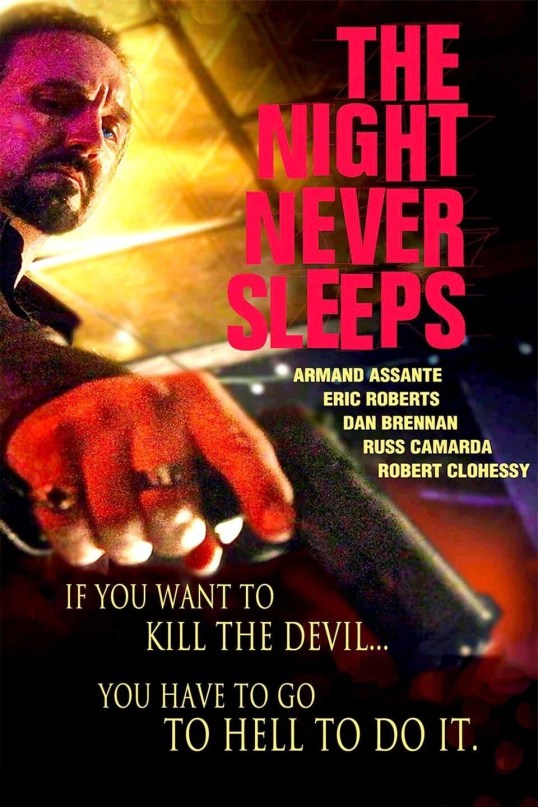
The Eric Roberts Collection: The Night Never Sleeps (dir by Fred Carpenter)


2012’s The Night Never Sleeps takes place over the course of one very long night in a New York city.

Sgt. Cavanaugh (Dan Brennan) is a tough and plain-spoken cop, the type who might not be great with pleasantries but who is a good enough policeman that he’s not going to let anyone stop him from avenging the deaths of the officers working under him.  Each murder leads to Cavanaugh digging deeper and deeper into the city’s underworld.  In between phone calls from his ex-wife (played by Eliza Roberts, wife of Eric) and meetings with the skeptical Inspector Romanelli (Armand Assante), Cavanaugh pursues a bloodthirsty hitman (Russ Camarda) and his boss.

The Night Never Sleeps is a low-budget police procedural, one that actually works far better than it has any right to.  There’s hardly a cliche that isn’t present and there’s as few scenes where the nonstop “tough talk” verges on self-parody but the actors — especially Dan Brennan — all give good performances and the fact that the action was actually shot on location gives the film an appropriate gritty feel.

As for Eric Roberts, he plays a pimp whose cheerful manner hides a dangerous temperament.  This is one of Roberts’s better cameo appearances.  Not only does he seem to be invested in the performance but his character is also central to the plot.  The film makes good use of Eric Robert’s off-center smile.  On the one hand, he seems friendly, or at least as friendly as a pimp can be.  On the other hand, there’s just enough fidgety nervousness beneath his amiable manner to indicate only as fool would turn their back on him.

The Night Never Sleeps is a flawed film but it still held my attention.

Previous Eric Roberts Films That We Have Reviewed:

  1. Paul’s Case (1980)
  2. Star 80 (1983)
  3. Runaway Train (1985)
  4. To Heal A Nation (1988)
  5. Best of the Best (1989)
  6. Blood Red (1989)
  7. The Ambulance (1990)
  8. The Lost Capone (1990)
  9. Best of the Best II (1993)
  10. Love, Cheat, & Steal (1993)
  11. Voyage (1993)
  12. Love Is A Gun (1994)
  13. Sensation (1994)
  14. Dark Angel (1996)
  15. Doctor Who (1996)
  16. Most Wanted (1997)
  17. The Alternate (2000)
  18. Mercy Streets (2000)
  19. Tripfall (2000)
  20. Raptor (2001)
  21. Rough Air: Danger on Flight 534 (2001)
  22. Strange Frequency (2001)
  23. Wolves of Wall Street (2002)
  24. Border Blues (2004)
  25. Mr. Brightside (2004)
  26. Six: The Mark Unleased (2004)
  27. We Belong Together (2005)
  28. Hey You (2006)
  29. Depth Charge (2008)
  30. Amazing Racer (2009)
  31. The Chaos Experiment (2009)
  32. In The Blink of an Eye (2009)
  33. Bed & Breakfast (2010)
  34. Enemies Among Us (2010)
  35. The Expendables (2010) 
  36. Sharktopus (2010)
  37. Beyond The Trophy (2012)
  38. The Dead Want Women (2012)
  39. Deadline (2012)
  40. The Mark (2012)
  41. Miss Atomic Bomb (2012)
  42. Assault on Wall Street (2013)
  43. Bonnie And Clyde: Justified (2013)
  44. Lovelace (2013)
  45. The Mark: Redemption (2013)
  46. The Perfect Summer (2013)
  47. Revelation Road: The Beginning of the End (2013)
  48. Revelation Road 2: The Sea of Glass and Fire (2013)
  49. Self-Storage (2013)
  50. Sink Hole (2013)
  51. A Talking Cat!?! (2013)
  52. This Is Our Time (2013)
  53. Bigfoot vs DB Cooper (2014)
  54. Doc Holliday’s Revenge (2014)
  55. Eternity: The Movie (2014)
  56. Inherent Vice (2014)
  57. Road to the Open (2014)
  58. Rumors of War (2014)
  59. So This Is Christmas (2014)
  60. Amityville Death House (2015)
  61. Deadly Sanctuary (2015)
  62. A Fatal Obsession (2015)
  63. Las Vegas Story (2015)
  64. Sorority Slaughterhouse (2015)
  65. Stalked By My Doctor (2015)
  66. Enemy Within (2016)
  67. Hunting Season (2016)
  68. Joker’s Poltergeist (2016)
  69. Prayer Never Fails (2016)
  70. Stalked By My Doctor: The Return (2016)
  71. The Wrong Roommate (2016)
  72. Dark Image (2017)
  73. The Demonic Dead (2017)
  74. Black Wake (2018)
  75. Frank and Ava (2018)
  76. Stalked By My Doctor: Patient’s Revenge (2018)
  77. The Wrong Teacher (2018)
  78. Clinton Island (2019)
  79. Monster Island (2019)
  80. The Reliant (2019)
  81. The Savant (2019)
  82. Seven Deadly Sins (2019)
  83. Stalked By My Doctor: A Sleepwalker’s Nightmare (2019)
  84. The Wrong Mommy (2019)
  85. Exodus of a Prodigal Son (2020)
  86. Free Lunch Express (2020)
  87. Hard Luck Love Song (2020)
  88. Her Deadly Groom (2020)
  89. Top Gunner (2020)
  90. Deadly Nightshade (2021)
  91. The Elevator (2021)
  92. Just What The Doctor Ordered (2021)
  93. Killer Advice (2021)
  94. Megaboa (2021)
  95. Night Night (2021)
  96. The Poltergeist Diaries (2021)
  97. The Rebels of PT-218 (2021)
  98. Red Prophecies (2021)
  99. A Town Called Parable (2021)
  100. The Wrong Mr. Right (2021)
  101. Bleach (2022)
  102. Dawn (2022)
  103. My Dinner With Eric (2022)
  104. 69 Parts (2022)
  105. The Rideshare Killer (2022)
  106. The Wrong High School Sweetheart (2022)
  107. The Company We Keep (2023)
  108. D.C. Down (2023)
  109. Aftermath (2024)
  110. Bad Substitute (2024)
  111. Devil’s Knight (2024)
  112. Insane Like Me? (2024)
  113. Space Sharks (2024)
  114. The Wrong Life Coach (2024)
  115. Broken Church (2025)
  116. Shakey Grounds (2025)
  117. When It Rains In L.A. (2025)

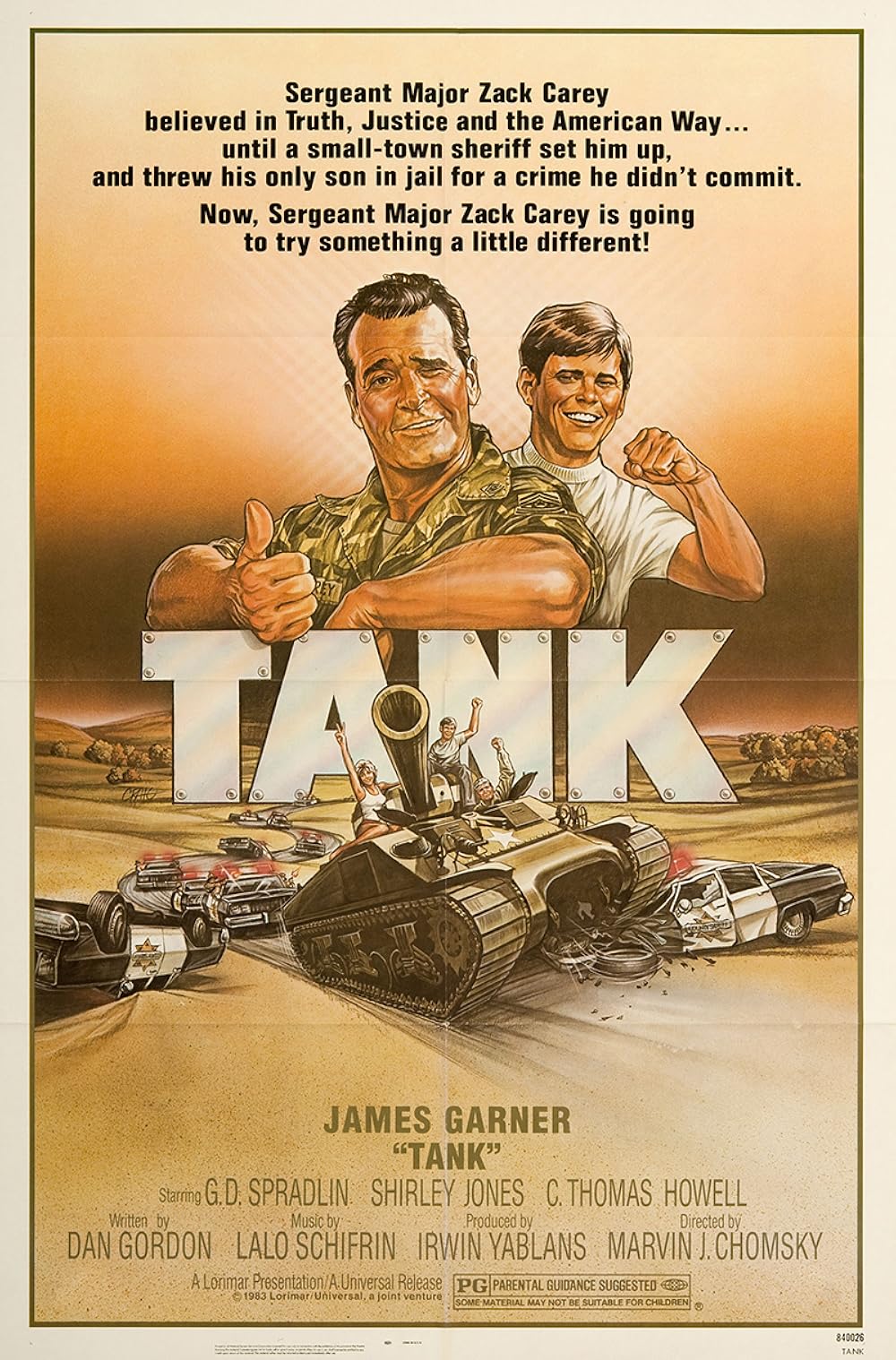
Review: Tank (dir. by Marvin J. Chomsky)


“There comes a time when a man has to stand up and be counted.” — Zack Carey

The 1984 action‑drama Tank is a small‑town parable dressed up as a military gimmick picture: an aging Army sergeant major, a battered old Sherman tank, and a corrupt sheriff. At its best, the film leans into James Garner’s quiet charisma and the absurdly specific “one man versus a whole county” premise; at its worst, it staggers under inconsistent tone and a plot that veers between heartfelt family‑drama and almost cartoonish vigilantism. Taken as a product of the early‑mid‑1980s, however, Tank holds up as a reasonably entertaining, if not especially deep, genre hybrid that works more through Gardner’s presence and a few solid set pieces than through psychological complexity or formal ambition.

James Garner plays Zack Carey, an Army sergeant major who moves his family to a small Georgia town near a training base, where he has acquired a battle‑worn M4A3 Sherman tank as a personal hobby and morale project. The setup is already a little out of the ordinary: an enlisted man whose side hustle is maintaining a World War II relic, while his wife LaDonna (played by Shirley Jones) quietly pushes back against the constraints of Army life and small‑town politics. The film’s opening stretches the believability of that scenario thin, but Garner’s easygoing authority and dry humor sell the idea that Zack is exactly the kind of practical, no‑nonsense soldier who would grow attached to a tank and treat it like a second family member. The script uses this setup to position the vehicle not just as hardware, but as a symbol of the character’s livelihood, dignity, and sense of duty.

The trigger for the conflict is an incident at a local bar, where Zack intervenes when a local deputy, who also moonlights as a pimp, roughs up a teenage prostitute named Sarah. The sheriff, Eugene Buelton (played with oily menace by C. Thomas Howell), is deeply corrupt and runs the town like a fiefdom, using his deputies to intimidate anyone who crosses him. When Zack’s teenage son, Billy, is later framed for a crime and thrown into a primitive prison camp, the fuse is lit. The film’s moral map is deliberately simple: Buelton is cartoonishly evil, Buelton’s deputies are unreliable tools of his will, and the Careys are painted as upright, essentially decent people caught in an unjust system. That simplicity works in Garner’s favor, because it lets the film focus on emotional stakes—father‑son loyalty, a wife’s fear for her family—rather than intricate political nuance.

What gives Tank much of its energy is the moment Zack decides to fight back with the only weapon he truly controls: his Sherman. The image of a lone, aging non‑commissioned officer rolling down country roads in a clanking World War II tank is inherently cinematic, and director Marvin J. Chomsky milks it for both action and symbolism. The scenes where Zack smashes through the sheriff’s office, disrupts the local jail, and later drives straight into the work farm to free Billy are played with a pulpy, almost comic‑strip bravado. The tank becomes a rolling moral absolutist: clumsy, loud, and impossible to ignore, cutting through the town’s layers of bureaucracy and intimidation in a way that mirrors Zack’s own frustration with a justice system that refuses to protect his son. The film’s action sequences are not particularly innovative by modern standards, but they benefit from the authenticity of the M4A3 and the straightforward choreography that lets the vehicle feel like a physical presence rather than a CGI abstraction.

Where Tank runs into trouble is in its fluctuating tone and some of its secondary choices. The subplot involving Sarah, the teenage prostitute, is handled with mixed success. On one hand, it adds a layer of social commentary about exploitation and small‑town complicity; on the other, it sometimes feels tacked on, introduced more as a narrative convenience than a fully developed character arc. The film wants to position her as a sympathetic victim who finds a kind of makeshift family inside the tank, but the material doesn’t dive deep into her background or inner life, leaving her more of a device than a rounded personality. This uneven handling reflects a broader issue: the movie vacillates between being a gritty crime drama, a family‑centric tearjerker, and a lighthearted action‑comedy. At times it feels like a made‑for‑television movie with a slightly bigger budget, hit by the same kind of tonal indecision that often plagued mid‑tier 1980s genre pictures.

Garner’s performance is the single element that keeps Tank consistently watchable. His Zack Carey is neither a cartoon hero nor a brooding anti‑hero; he’s a working‑class soldier approaching the end of his career, tired of compromise and willing to push back when pushed too far. Garner underplays the action‑hero theatrics, relying instead on quiet resolve, a dry sense of humor, and a lived‑in weariness that makes Zack feel like someone you might have actually met in an Army post or small town. Shirley Jones, as his wife, brings a grounded warmth to the domestic scenes, and the dynamic between Zack and his son Billy feels occasionally sentimental but never entirely false. The relationship between father and son anchors the film’s more outlandish elements, turning the tank chase into a visible metaphor for a father’s desperation to protect his child in a system that treats both as expendable.

Visually, Tank is workmanlike rather than stylish. The Georgia countryside is shot in broad daylight, with an emphasis on wide shots that showcase the tank moving through fields, back roads, and small towns. The tank itself is the film’s most vivid visual motif, a hulking, almost anachronistic machine that looks slightly out of place in a 1980s setting, yet somehow believable as the relic of a bygone era carried forward by a man who still believes in clear‑cut notions of right and wrong. The production favors practical effects and real locations over glossy stylization, which gives the material a modest, sometimes cheap‑looking quality but also lends it a concrete, lived‑in feel. The score, composed by Lalo Schifrin, adds a number of flavors—military marches, light jazz, and even a faintly disco‑tinged theme—further underscoring the film’s genre‑mixing instincts without always achieving cohesion.

Thematically, Tank leans heavily on the idea of individual resistance against corrupt authority. The sheriff’s abuse of power, the rigged legal process, and the near‑absence of any higher‑level oversight all feed into a classic American underdog narrative: one man, one tank, and a small band of allies taking on a system that has long since stopped pretending to be fair. The film stops short of overtly political commentary, but it clearly sympathizes with the notion that ordinary people sometimes have to go outside official channels when those channels are rigged against them. At the same time, the movie softens its edges with a crowd‑pleasing finale that reframes Zack and his allies as folk heroes, welcomed by a gathering of onlookers at the Tennessee border. This turn toward feel‑good spectacle undercuts some of the grittier implications of the earlier material, but it also fits the early‑1980s appetite for triumphant, crowd‑friendly resolutions.

As a time capsule of 1980s genre filmmaking, Tank is more interesting than it is groundbreaking. It is neither a forgotten masterpiece nor a laughably bad curio; it sits somewhere in the middle, powered by James Garner’s steady presence and the appealingly simple conceit of a World War II tank as a one‑man war machine. The film’s weaknesses—a schematic morality play, uneven tone, and underdeveloped secondary characters—are real, but they don’t completely erase its modest strengths. If viewed as a straightforward, mid‑tier action‑drama with a strong central performance and a memorable mechanical co‑star, Tank emerges as a fair, unpretentious, and occasionally rousing piece of 1980s entertainment.