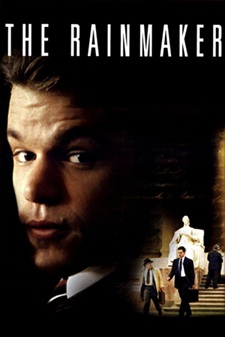
The Rainmaker (1997, directed by Francis Ford Coppola)


Rudy Baylor (Matt Damon) is an idealistic young law school graduate who discovers that having a degree and passing the bar doesn’t automatically make you a success.  He gets a job working a bar that just happens to be owned by an ambulance chasing attorney named Bruiser Stone (Mickey Rourke).  Bruiser takes Rudy on as an associate and assigns his associate, Deck Shifflet (Danny DeVito), to teach Rudy how to find cases.  When Bruiser flees the country to escape an FBI investigation, Rudy and Deck start their own law firm.  Rudy soon finds himself with the case of his young career, representing a family in a law suit against Great Benefit Insurance.  Rudy also falls for Kelly (Claire Danes), a young woman who is being abused by her husband (Andrew Shue).

It can be hard to believe today but, in the 90s, every John Grisham novel was adapted for the screen.  Most of the adaptations weren’t very good but audiences ate them up.  In many ways, The Rainmaker is the ultimate John Grisham adaptation because it contains every single trope that John Grisham made popular with his legal thrillers.  This time, Matt Damon is the charismatic attorney.  Roy Scheider is the soulless corporate CEO who needs to be brought down.  Jon Voight is the intimidating opposing counsel.  Danny DeVito is the eccentric comic relief and Mickey Rourke is the dues ex machina who returns to the movie to give Rudy a piece of information at the exact right moment.   The appeal of Grisham is that he made readers (and eventually moviegoers) feel like insiders while presenting them with stories that were essentially very simple good vs evil morality tales.  The insurance company is so cartoonishly evil that there’s no doubt Rudy is going to defeat them.  There’s also no doubt that Rudy is going to find a better calling than ambulance chasing because the only thing that people hate more than insurance companies is lawyers.

The Rainmaker is never as complex as it pretends to be but it’s an entertaining legal movie.  It was also director Francis Ford Coppola’s last big hit.  It’s really more of a Grisham film than a Coppola film but Coppola’s influence is still felt in the almost uniformly excellent cast.  (Ignore Andrew Shue if you can.  Melrose Place was very popular in the 90s.)  Damon, Danes, Rourke, Voight, Dean Stockwell, Danny Glover, Teresa Wright, Virginia Madsen, and Mary Kay Place all give memorable performances.  Roy Scheider is loathsome as the sweater-wearing CEO.  Best of all is Danny DeVito, who gets all of the best lines.

The Rainmaker was the best of the 1990s Grisham adaptations.  While it’s not quite a masterpiece, it’s still emotionally very satisfying.

October Positivity: Jerusalem Countdown (dir by Harold Cronk)


2011’s Jerusalem Countdown opens with the world on the verge of destruction.  Israel and a nuclear-armed Iran are negotiating in Washington and not everyone wants the two countries to be at peace.

In Chicago, Daniel (Carey Scott) watches the news of the summit and then looks out his window as his unfriendly and glowering neighbor comes and goes from his house.  Daniel worries that his neighbor is up to something.  He could be a member of a terrorist cell!  Daniel’s wife (Jaci Velasquez) tells him to stop worrying about things that he can’t control but that’s easier said than done.

FBI agent Eve (Anna Zielinski) is approached by her father (Stacy Keach), a former intelligence agent who warns her that the end times are approaching.

Another intelligence agent, Shane Daughtery (David A.R. White) is contacted by a burned-out arms dealer (Lee Majors), who informs him that a group of terrorists are planning on setting off a series of bombs and plunging the world into war.  The arms dealer is assassinated by a man who keeps reciting passages from the Book of Revelations.  Meanwhile, CIA bigwig Jack Thompson (a seriously miscast Randy Travis) continually tells Shane that he can’t share too much information with him because it’s all classified….

Jerusalem Countdown is a faith-based film that also tries to be an action film.  In fact, I would say that far more emphasis is put on action than on faith.  Until the final few minutes of the film, there’s really not much focus put on religion, other than Daniel briefly praying when he finds himself trapped in the neighbor’s house and a scene where a librarian scolds Shane and Eve for not knowing about the Ten Commandments.  One major commandments, by the way, is Thou Shalt Not Kill but Shane and Eve manage to kill quite a few people in this film.  Of course, they were all bad people and Shane and Eve are trying to keep the world from being plunged into a world war so I’m willing to cut them some slack.

The cast, as you may have noticed, has a number of familiar faces in it.  It’s largely a nostalgia cast, the type that’s designed to make people over the age of 60 say, “Lee Majors is in this!”  With the exception of Randy Travis, none of the “stars” have a particularly large role.  One gets the feeling that Stacy Keach filmed his scenes in a handful of hours, collected his paycheck, and then got out of there.  It’s amazing to me that Eric Roberts is somehow not in this film.

As for the film itself, it’s competently made and David A.R. White is one of the better actors amongst the Pureflix regulars.  (White has even managed to maintain a semblance of dignity through five God’s Not Dead films.)  That said, the film itself moves a bit slowly and the low-budget keeps the action from being as memorable as it could be.  There’s a cool helicopter crash but otherwise, it’s never as exciting as it obviously wants to be and there’s a lot — and I do mean A LOT — of filler-type scenes of people talking on their phones while driving from one location to another.  The plot itself feels a bit muddled and there’s a lot of loose ends left dangling, as if the film was meant to be a set up for a sequel that never came.

October Positivity: The Wager (dir by Judson Pearce Morgan)


In 2007’s The Wager, Randy Travis plays Michael Steele, an Oscar-nominated actor who….

Stop laughing, that’s not nice.

Okay, I’ll be the first to admit that Randy Travis is not exactly the first person that I would cast as an Oscar-nominated actor.  And, I’ll also be the first to admit that having Randy Travis act in this film makes it even harder to believe him as someone who could someday be nominated for an Oscar.  A lot of country music stars have tried their hand at acting and most of them have been able to survive on the basis of their own authenticity.  But there’s nothing authentic about Travis’s performance here.  Even when he picks up a guitar and sings a song about the difficulties that he’s facing, he’s not convincing.  In this, it’s not so much that Travis is a stiff actor as he just seems to evaporate whenever he’s on screen.

As for the film, Michael Steele is an actor who is known for his strong faith and his refusal to do sex scenes.  When a director (Bronson Pinchot) throws a fit over Steele’s refusal to shoot once such scene, Steele says that he’ll do the scene but only if it’s followed by a scene in which his co-star has to deal with being a single mother.  OUCH!  Michael Steele seems like he’s fun at parties….

(Apparently, it doesn’t occur to Michael that his character could wear a condom.)

Wait a minute.  This guy has the same name as that jackass who is always on the news talking about how he’s a Republican who thinks everyone should vote for the Democrats.  I wonder if that’s intentional.  Anyway….

Michael Steele’s career has had its up and downs.  His recent divorce from Annie (Nancy Stafford) has damaged his family friendly image.  But his Oscar nomination and the fact that he’s expected to win has once again made the world’s most popular star.  But then — scandal!  A tabloid photographer snaps a picture of Michael talking to a young actress at his house.  In the background, a little kid watches.  Now, the kid is a part of the Big Brother program and Michael was just trying to help the younger woman with her career but it doesn’t matter.  Soon, Michael finds himself being portrayed as being some sort of pervert.  When he punches a photographer, he finds himself getting arrested — RIGHT IN FRONT OF HIS CHURCH!

Now, as you may have guessed, this is yet another retelling of the story of Job, with Michael having his faith tested by one disaster after another.  He doesn’t lose his faith and, as a result, he wins both an Oscar and he also becomes a hero when he rescues the kid from the Big Brother program from his abusive stepfather.  Anyone who thinks that God wouldn’t have a hand in who wins an Oscar obviously did not listen to Will Smith’s acceptance speech.

The Wager is a film that would probably not be made today.  Today, you’re not likely to see a socially conservative, faith-based film where a successful actor is wrongly accused of being a pervert.  Then again, you also probably wouldn’t see a politically liberal film in which a successful white male actor was wrong accused of being an abuser, not in today’s cultural climate.  On both the Left and the Right, attitudes towards Hollywood have changed.  Beyond the film’s political and cultural subtext, its portrait of the Oscars as being the most important event of the year also feels rather old-fashioned.  I imagine it felt old-fashioned in 2007 as well….

Then again, this is a film in which Randy Travis plays the best actor of his generation so perhaps it’s best not to take any of it too seriously.  The miscasting of Travis pretty much sabotages the movie from the start but, on the positive side, Bronon Pinchot is amusing as a bitchy director and Jude Ciccolella has a few good scenes as Michael’s supportive agent.  Give those men an Oscar!

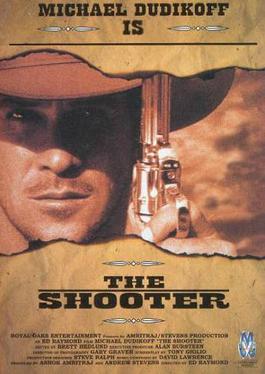
The Shooter (1997, directed by Fred Olen Ray)


While riding his horse through the old, Michael Atherton (Michael Dudikoff) discovers a group of thuggish ranch hands attacking a prostitute named Wendy (Valerie Wildman).  Because Michael is known as being the Shooter, he has no problem coolly gunning the men down and saving Wendy’s life.  Unfortunately, for Michael, one of the dead men is the son of a fearsome rancher named Jerry Krants (William Smith) and Jerry has his own reasons for wanting Wendy dead.  Michael may be the Shooter but Jerry Krants is William Smith so you automatically know that it is not a good idea to mess with him.

In the grand spaghetti western tradition, Krants has his men kidnap Michael, beat him up, and crucify him outside of town.  The men leave Michael for dead but, after they’ve left, Wendy repays Michael’s kindness by untying him from the cross, nursing him back to health, and saving his life.  (The same thing used to happen to Clint Eastwood, except he usually had to nurse himself back to health without anyone else’s help.)  With everyone else believing him to be dead, Michael rides into town to get his violent revenge against Krants and his men.  With all of the townspeople convinced that Michael has returned as a ghost, only the town’s power-hungry sheriff, Kyle Tapert (Randy Travis), understands what has actually happened.  Tapert makes plans to use Michael’s return for his own advantage.  While it wouldn’t look good for Tapert to openly murder all of his opponents, what if he killed them and then framed Michael?  And then what if he made himself a hero by being the one to end Michael’s reign of terror?

Directed by Fred Olen Ray, The Shooter is a low-budget western that turned out to be far better than I was expecting.  Ray is obviously a fan of the western genre and, with The Shooter, he’s made a respectful and, by his standards, restrained homage to the classic spaghetti westerns of old.  He even shows some undeniable skill when it comes to building up the suspense before the climatic showdown.  Ray indulges in every western cliché imaginable but he does so with the respect of a true fan.

With his less than grizzled screen presence, Michael Dudikoff is slightly miscast as a Clint Eastwood-style gunslinger but the rest of the cast is made up of genre veterans who give it their best.  In particular, William Smith shows why he was one of the busiest “bad guys” working in the movies.  To me, the most surprising part of the film was that the casting of Randy Travis as a villain actually worked.  Fred Olen Ray made good use of Travis’s natural amiability, making Kyle into a villain who will give you friendly smile right before he opens fire.  Also be sure to keep an eye out for Andrew Stevens, playing the man who records Michael’s story.  It wouldn’t be a Fed Olen Ray movie without Andrew Stevens playing at least a small role.

Low-budget, undemanding, and made with obvious care, The Shooter is film that will be appreciated by western fans everywhere.