Welcome to Retro Television Reviews, a feature where we review some of our favorite and least favorite shows of the past! This Thursday, I will be reviewing Juvenile Court, which aired its only episode in syndication in 1958. The show can be found on YouTube!
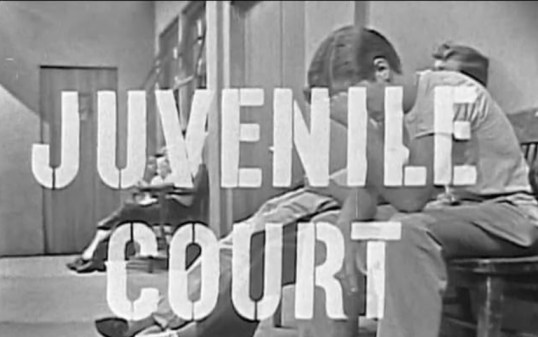
Episode 1.1 “Pilot”
(Dir by Ralph Nelson, originally aired on September 1st, 1958)
Fifteen-year-old Raymond Pearson (Lee Kinsolving) has been charged with trying to steal a car and almost beating the car’s owner to death. Now he sits in a courtroom with his stepparents and sullenly listens as Commissioner Robert Dortman (Ken Lynch) questions his family and his squirmy accomplice, Charlie Wiggins (Tommy Cook). Dortman’s questions eventually reveal that Raymond’s crimes are linked to his conflicted feelings about his biological father, who wants nothing to do with him. Though Dortman has sympathy for Raymond, he still has to sentence him to juvenile hall. His stepfather promises to support Raymond as best he can.
The key to understanding Juvenile Court is a title card at the start that thanks the Los Angeles Juvenile Courts for their assistance. The pilot is a no-frills courtroom drama that takes place in one location and is essentially just a guy asking questions and then listening to the answers. One can understand why it didn’t become a series: while the actors are all good and believable, the episode’s style is extremely dry.
The interesting thing about this episode is the way it mixes the approaches of both the Left and the Right when it comes to examining Raymond’s crimes. The liberal will look at this show and say, “Raymond became a criminal because he never had a chance to be anything else, not with his father and his insecurities.” The conservative will look at it and say, “Raymond nearly beat a man to death. That’s all that matters.” The show says, “You’re both right!” We learn about Raymond’s sad background, but we also watch as Raymond is sentenced to confinement.
This show reminded me a bit of Decoy, the Beverly Garland cop show that I recently finished reviewing. They’re both from the late ’50s, and they both attempted to capture the feel of a documentary. Just as Decoy’s Casey Jones often had to arrest people who weren’t entirely evil, the commissioner has to send Raymond to juvie despite understanding what led Raymond to commit his criminal acts.
Seen today, Juvenile Court is the type of thing that appeals largely to history nerds like me. There’s not much drama, but it’s still interesting to see what the world was like nearly 70 years ago.


Pingback: Lisa Marie’s Week In Review: 8/24/26 — 8/30/26 | Through the Shattered Lens