It’s February and we all know what that means! It’s Oscar month! TCM is doing its 31 Days of Oscar and self-important film bloggers across the world are devoting themselves to reviewing the Oscar-winning films of the past. That includes me because, as our longtime readers know, I love the Oscars and nobody is more self-important than me!
This month, I’m going to be devoting myself to reviewing films that were nominated for an Oscar. Some of them won, some of them lost but all of them will forever be known as an Oscar nominee. I am going to start things off by reviewing the 1968 tear-jerker Charly.
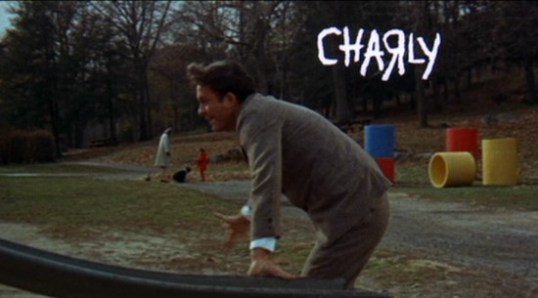 Charly opens with Charlie Gordon (Cliff Robertson) playing in a playground with a bunch of children. Though Charlie appears to be middle-aged, it quickly becomes apparent that, in many ways, he’s still a child himself. Charlie is mentally handicapped, an introverted man who works at a bakery where he’s frequently ridiculed and taken advantage of by his co-workers.
Charlie lives an isolated existence but he’s determined to better himself. As the film begins, he’s been attending night school for two years and he had been taught to read and write by a sympathetic teacher named Alice (Claire Bloom). One night, Alice takes Charlie to the Nemur-Straus Clinic, a research lab run by the cold Dr. Nemur (Leon Janney) and the much more compassionate Dr. Straus (Lilia Skala). Nemur and Straus think that they’ve discovered a surgical procedure that can increase human intelligence. Though both doctors are initially reluctant, Alice convinces them to use Charlie as a test subject.
The surgery is a success and Charlie suddenly finds himself intelligent. For the first time, he can understand a world that had previously only been a mystery to him. Charlie finds himself falling in love with Alice but he also has to deal with the possibility that his newfound intelligence might only be temporary. Even as the new Charlie starts to enjoy his life, he’s aware of the ghost of the old Charlie waiting behind every corner.
I have to admit that I have mixed feelings about Charly as a film. On the one hand, it’s a generally well-acted film and it doesn’t shy away from considering the conflict between science and nature. On the other hand, Ralph Nelson directs the film in such a glib and showy manner that Charly often feels like a rather shallow exploration of some very deep issues. As such, you’re often left feeling as if both the film and the title character deserve better than what Nelson gives them.
The 60s were transitional decade for cinema in general. While European filmmakers were proving that a movie could be a work of art, American directors found themselves struggling to keep up. Far too often, this led to American directors copying the techniques of their European counterparts without necessarily understanding what made those techniques were so important in the first place. Whereas directors like Jean-Luc Godard, Francois Truffaut, and Federico Fellini used showy cinematic techniques to comment on the act of watching the movie itself, many of the older American directors used those same techniques simply because they felt they had no other choice. One of my favorite games, when watching a mainstream American film from the late 60s, is to spot the random psychedelic moment that, as out-of-place or unnecessary as it may feel, was obviously put into the film “for the kids.”
Charly is full of such moments and very few of them add anything to the film. Ralph Nelson, a veteran of television who was previously nominated for an Oscar for directing the extremely straight forward Lilies of the Field, comes up with several self-conscious moments that seem to be there “for the kids” but which don’t necessarily move the story forward. The film is full of random slow motion, still shots, and split screens and, unfortunately, they serve to distract from a very simple and very effective story.
The film’s saving grace, however, comes in the form of Cliff Robertson. If you had asked me, before I saw Charly, just who exactly Cliff Robertson was, I would have told you that he played Uncle Ben in the first Spider-Man films and Hugh Hefner in a disturbing film called Star 80. However, after seeing Charly, Cliff Robertson will always be the tragic Charlie Gordon to me.
The genius of Robertson’s performance is that he not only captures Charlie’s sweet nature and desire to better himself but he captures Charlie’s anger as well. As Charlie becomes more intelligent, he also becomes more aware of just how poorly the world has treated him up until that point. When he can suddenly spell his own name and articulate his own feelings, it’s not just an individual triumph but a triumph for everyone who has ever been told that they can’t do something or that they should just be happy with whatever they’ve been given in life. Robertson makes Charlie Gordon into a very real and very sympathetic character and, as a result, you care about whether the result of the surgery are permanent or only temporary. Robertson’s performance is so strong and honest that it transcends the showiness of Nelson’s direction. Charly works because Cliff Robertson gives the film a heart.
Given the power of his performance, it’s not surprising to discover that Charly, as both a film and a role, was very important to Cliff Robertson. It was so important to him that he bought the rights to the film’s source material (the novel Flowers for Algernon by Daniel Keyes) because he wanted to make sure that Charlie Gordon would never be played by anyone but him. For both his performance and his determination to get the film made, Cliff Robertson won the Academy Award for Best Actor of 1968.
Charly may not be a perfect film but I’m not ashamed to say that I cried at the end of it. Cliff Robertson’s heart-felt performance as Charlie Gordon transcends whatever other flaws the film may have. If you haven’t seen Charly, you really should.