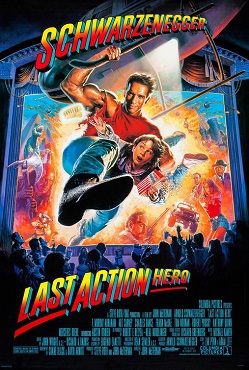
Guilty Pleasure No. 84: Last Action Hero (dir by John McTiernan)


Oh, Last Action Hero.

Ever since this film was first released in 1993, it’s usually held up as an example of a Hollywood fiasco.  The script was originally written to be a modest satire of action films.  The screenwriters wrote the character of Jack Slater, an movie action hero who comes into the real world, for Dolph Lundgren.  Instead, the film became an Arnold Schwarzenegger extravaganza and the studio ended up tossing a ton of money at it.  When the film was originally released, the reviews were mixed and the box office was considered to be disappointing.  (That it went up against the first Jurassic Park was definitely an underrated issue when it came to the box office.)  Ever since then, The Last Action Hero has had a reputation for being a bad film.

Well, I don’t care.  I like The Last Action Hero.  Yes, it’s a bit overproduced for a comedy.  (It breaks my own rule about how no comedy should run longer than two hours.)  Yes, it gets a bit sentimental with ten year-old Danny Madigan (Austin O’Brien) using a magic, golden ticket to enter the film world of his hero, Jack Slater.  If you want to argue that the film should have devoted more time to and gone a bit deeper into contrasting the film world with the real world, I won’t disagree with you.  But I will also say that Sylvester Stallone starring as The Terminator in Jack’s world was actually a pretty funny sight gag.  Danny knowing better than to trust a character played by F. Murray Abraham made me laugh.  Danny’s fantasy in which Arnold Schwarzenegger played Hamlet was made all the better by the fact that his teacher was played by Laurence Olivier’s wife, Joan Plowright.   Danny DeVito as Whiskers the Cartoon Cat makes me laugh as well, even if it is perhaps a bit too bizarre of a joke for this particular film.  (There’s nothing else about the Jack Slater films that would explain the presence of a cartoon cat.)

When you set aside the idea of the Last Action Hero being a symbol of Hollywood bloat and just watch it as a film, it emerges as an enjoyably goofy action movie, one that captures the joy of watching movies (because who hasn’t wanted to enter a movie’s world at some point in their life), and also one that features a rather charming performance from Arnold Schwarzenegger.  (Schwarzenegger, I should add, plays both himself and Jack Slater.  One of my favorite jokes is when the real Schwarzenegger is at a premiere and he mistakes the evil Ripper for Tom Noonan, the actor who played him in the previous Jack Slater film.)  Yeah, the golden ticket is a little bit hokey but who cares?  Underneath all of the special effects and action and money spent on star salaries, Last Action Hero is an action movie and comedy with a heart.  Danny meets his hero but also gets to become a hero himself.  And Jack Slater turns out to be everything you would hope your movie hero would be.  In the end, it’s obvious that a lot of the criticism of this film has more to do with the appeal of riding the bandwagon as opposed to what actually happens on screen.

Last Action Hero is a movie that I’ll happily defend.

Previous Guilty Pleasures

  1. Half-Baked
  2. Save The Last Dance
  3. Every Rose Has Its Thorns
  4. The Jeremy Kyle Show
  5. Invasion USA
  6. The Golden Child
  7. Final Destination 2
  8. Paparazzi
  9. The Principal
  10. The Substitute
  11. Terror In The Family
  12. Pandorum
  13. Lambada
  14. Fear
  15. Cocktail
  16. Keep Off The Grass
  17. Girls, Girls, Girls
  18. Class
  19. Tart
  20. King Kong vs. Godzilla
  21. Hawk the Slayer
  22. Battle Beyond the Stars
  23. Meridian
  24. Walk of Shame
  25. From Justin To Kelly
  26. Project Greenlight
  27. Sex Decoy: Love Stings
  28. Swimfan
  29. On the Line
  30. Wolfen
  31. Hail Caesar!
  32. It’s So Cold In The D
  33. In the Mix
  34. Healed By Grace
  35. Valley of the Dolls
  36. The Legend of Billie Jean
  37. Death Wish
  38. Shipping Wars
  39. Ghost Whisperer
  40. Parking Wars
  41. The Dead Are After Me
  42. Harper’s Island
  43. The Resurrection of Gavin Stone
  44. Paranormal State
  45. Utopia
  46. Bar Rescue
  47. The Powers of Matthew Star
  48. Spiker
  49. Heavenly Bodies
  50. Maid in Manhattan
  51. Rage and Honor
  52. Saved By The Bell 3. 21 “No Hope With Dope”
  53. Happy Gilmore
  54. Solarbabies
  55. The Dawn of Correction
  56. Once You Understand
  57. The Voyeurs 
  58. Robot Jox
  59. Teen Wolf
  60. The Running Man
  61. Double Dragon
  62. Backtrack
  63. Julie and Jack
  64. Karate Warrior
  65. Invaders From Mars
  66. Cloverfield
  67. Aerobicide 
  68. Blood Harvest
  69. Shocking Dark
  70. Face The Truth
  71. Submerged
  72. The Canyons
  73. Days of Thunder
  74. Van Helsing
  75. The Night Comes for Us
  76. Code of Silence
  77. Captain Ron
  78. Armageddon
  79. Kate’s Secret
  80. Point Break
  81. The Replacements
  82. The Shadow
  83. Meteor

Join #MondayMuggers For MANHUNTER!


Hi, everyone!  Brad and his wife Sierra are on vacation so guess is who is guest hosting the #MondayMuggers live tweet tonight?  That’s right …. me!

Tonight’s movie will be MANHUNTER (1986), the classic Michael Mann-directed thriller that introduced the world to the characters of Will Graham, Jack Crawford, Francis Dollarhyde, and Hannibal Lecter!  (Though it’s spelled Lektor in this film.)  Check out the trailer!

You can find the movie on Prime and then you can join us on twitter at 9 pm central time!  (That’s 10 pm for you folks on the East Coast.)  See you then!

Late Night Retro Television Review: Monsters 3.24 “The Moving Finger”


Welcome to Late Night Retro Television Reviews, a feature where we review some of our favorite and least favorite shows of the past! On Wednesdays, I will be reviewing Monsters, which aired in syndication from 1988 to 1991. The entire series is streaming on YouTube.

This week, Monsters comes to its conclusion.

Episode 3.24 “The Moving Finger”

(Dir by Kenny Myers, originally aired on April 26th, 1991)

Monsters comes to a close with an adaptation of a Stephen King short story.

Nerdy Howard (Tom Noonan) is shocked to discover that, every time he goes to any of the various drains in his house, a bony finger pokes out.  Howard’s wife can’t see the finger but Howard becomes obsessed with it, attacking it with a corrosive liquid and eventually a hedge trimmer.  No matter how much damage Howard does to it, the finger comes back, longer and stronger….

Despite the Stephen King pedigree and the presence of the usually reliable Tom Noonan, The Moving Finger makes for a disappointing conclusion to Monsters.  King’s style, and this is especially true of his short stories, often doesn’t translate well into visual adaptations.  The signature inner monologues and the building sense of dread can be difficult to recreate visually.  (One reason why The Shining is the best King adaptation is because Stanley Kubrick made the material his own and didn’t worry about trying to recreate all of King’s trademark  bullshit literary flourishes.)  Tom Noonan doesn’t have much of a character to play and the finger itself becomes less effective as the episode drags on.

Oh well!  Monsters was a generally uneven show so it’s perhaps appropriate that it ended on an unsteady note.  It’s the curse of the anthology format.  When Monsters was good, it was really, really good.  When it was bad, it was kind of boring.  There were a lot of good episodes that aired during the final season but, sadly, there were a few bad ones as well.  That said, the good Monsters episodes to outweigh the bad and forgettable ones.

That’s it for Monsters!  Next week, something new will premiere in this time slot.  What will it be?  I have no idea but I look forward to finding my next show!

The Unnominated #13: Heat (dir by Michael Mann)


Though the Academy of Motion Picture Arts and Sciences claim that the Oscars honor the best of the year, we all know that there are always worthy films and performances that end up getting overlooked.  Sometimes, it’s because the competition too fierce.  Sometimes, it’s because the film itself was too controversial.  Often, it’s just a case of a film’s quality not being fully recognized until years after its initial released.  This series of reviews takes a look at the films and performances that should have been nominated but were, for whatever reason, overlooked.  These are the Unnominated.

First released in 1995, Heat is one of the most influential and best-known films of the past 30 years.  It also received absolutely zero Oscar nominations.

Maybe we shouldn’t be too surprised that Academy — especially the Academy of the 1990s — didn’t shower the film with nominations.  For all of its many strengths, Heat is still a genre piece, an epic three-hour crime film from director Michael Mann.  It’s a film about obsessive cops and tightly-wound crooks and it’s based on a made-for-TV movie that Mann directed in the late 80s.  While the Academy had given a best picture nomination to The Fugitive just two years before, it still hadn’t fully come around to honoring genre films.

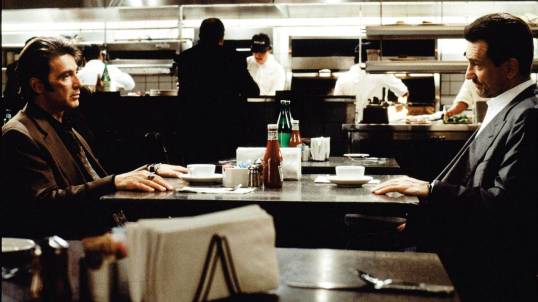
And yet one would think that the film could have at least picked up a nomination for its editing or maybe the sound design that helps to make the film’s signature 8-minute gun battle so unforgettable.  (Heat is a film that leaves you feeling as if you’re trapped in the middle of its gunfights, running for cover while the cops and the crooks fire on each other.)  The screenplay, featuring the scene where Al Pacino’s intense detective sits down for coffee with Robert De Niro’s career crook, also went unnominated.

Al Pacino was not nominated for playing Vincent Hanna and maybe we shouldn’t be too surprised at that.  Pacino yells a lot in this movie.  When people talk about Pacino having a reputation for bellowing his lines like a madman, they’re usually thinking about the scene where he confronts a weaselly executive (Hank Azaria) about the affair that he’s having with Charlene (Ashley Judd), the wife of criminal Chris Shiherlis (Val Kilmer).  And yet, I think that Pacino’s performance works in the context of the film and it’s often forgotten that Pacino has quite scenes in Heat as well.  Pacino’s intensity provides a contrast to Robert De Niro’s tightly controlled career criminal, Neil McCauley.  McCauley has done time in prison and he has no intention of ever going back.  But, as he admits during the famous diner scene, being a criminal is the only thing that he knows how to do and it’s also the only thing that he wants to do.  (“The action is the juice,” Tom Sizemore says in another scene.)  If any two actors deserved a joint Oscar nomination it was Pacino and De Niro.  In Heat, they’re the perfect team.  Pacino’s flamboyance and De Niro’s tightly-controlled emotions come together to form the heart of the picture.

No one from the film’s supporting cast was nominated either, despite there being a wealth of riches to choose from.  Ashley Judd and Val Kilmer come to mind as obvious contenders.  Kilmer is amazing in the shoot-out that occurs two hours into the film.  Ashley Judd has a killer scene where she helps her husband escape from the police.  Beyond Judd and Kilmer, I like the quiet menace of Tom Sizemore’s Michael Cheritto.  (Just check out the look he gives to an onlooker who is getting a little bit too curious.)  Kevin Gage’s sociopathic Waingro is one of the most loathsome characters to ever show up in a movie.  William Fichtner, Jon Voight, Danny Trejo, and Tom Noonan all make a definite impression and add to Michael Mann’s portrait of the Los Angeles underworld.  In an early role, Natalie Portman plays Hanna’s neglected stepdaughter and even Amy Brenneman has some good moments as Neil’s unsuspecting girlfriend, the one who Neil claims to be prepared to abandon if he sees “the heat coming.”

I have to mention the performance of Dennis Haysbert as Don Breedan, a man who has just been released from prison and who finds himself working as a cook in a diner.  (The owner of the diner is played by Bud Cort.)  Haysbert doesn’t have many scenes but he gives a poignant performance as a man struggling not to fall back into his old life of crime and what eventually happens to him still packs an emotional punch.  For much of the film’s running time, he’s on the fringes of the story.  It’s only by chance that he finds himself suddenly and briefly thrown into the middle of the action.

Heat is the ultimate Michael Mann film, a 3-hour crime epic that is full of amazing action sequences, powerful performances, and a moody atmosphere that leaves the viewer with no doubt that the film is actually about a lot more than just a bunch of crooks and the cops who try to stop them.  Hanna and McCauley both live by their own code and are equally obsessed with their work.  Their showdown is inevitable and, as directed by Michael Mann, it takes on almost mythological grandeur.  The film is a portrait of uncertainty and fear in Los Angeles but it’s also a portrait of two men destined to confront each other.  They’re both the best at what they do and, as a result, only one can remain alive at the end of the film.

I rewatched Heat yesterday and I was amazed at how well the film holds up.  It’s one of the best-paced three-hour films that I’ve ever seen and that epic gunfight is still powerful and frightening to watch.  Like Martin Scorsese’s Casino, it was a 1995 film that deserved more Oscar attention than it received.

Heat (1995, dir by Michael Mann, DP: Dante Spinotti)

Previous entries in The Unnominated:

  1. Auto Focus 
  2. Star 80
  3. Monty Python and The Holy Grail
  4. Johnny Got His Gun
  5. Saint Jack
  6. Office Space
  7. Play Misty For Me
  8. The Long Riders
  9. Mean Streets
  10. The Long Goodbye
  11. The General
  12. Tombstone


Late Night Retro Television Review: Monsters 3.13 “Malcolm”


Welcome to Late Night Retro Television Reviews, a feature where we review some of our favorite and least favorite shows of the past! On Wednesdays, I will be reviewing Monsters, which aired in syndication from 1988 to 1991. The entire series is streaming on YouTube.

This week, we have an episode directed by Tom Noonan and starring Ed Lauter!  Come discover what’s eating Malcolm….

Episode 3.13 “Malcolm”

(Dir by Tom Noonan, originally aired on December 23rd, 1990)

When he was younger, Malcolm (Ed Lauter) was a romantic who played the clarinet.  Now, he’s just a boring old businessman.  When his wife (Carole Shelley) asks him to play the clarinet again, he collapses in pain.  Their doctor (Farley Granger) discovers that Malcolm has what appears to be a tumor in his stomach.  Of course, the glowing tumor is actually alive.  It’s a weird, giant worm that gives Malcolm his musical talent.  The worm is removed but now, Malcolm has lost his talent.  One night, the worm shows up again….

This was an odd and moody episode, which I guess is not surprising as it was directed by Tom Noonan, a director and actor who specializes in the odd and moody.  Moving at its own deliberate pace, the episode benefitted from a good performance from Ed Lauter, a good deal of atmosphere, and some Cronenbergian body horror.  The worm was obviously a stand-in for the self-destructive nature of many artists.  The worm gives Malcolm his talent but it also has the potential to eat him from the inside.  When the worm returns, Malcolm makes his decision and the whole thing plays out like a moody nightmare.

In other words, this was a good episode, one that was willing to be both surreal and a bit grotesque.  Tom Noonan and Ed Lauter made for an excellent combination.

Scenes That I Love: The Tiger Scene From Manhunter


Since today is Michael Mann’s birthday, today’s scene that I love comes from his 1986 film, Manhunter.

In this scene, a blind woman (played by Joan Allen) pets a sedated tiger while her new boyfriend (Tom Noonan) watches.  This would actually be a pretty romantic scene if not for the fact that her boyfriend is also a homicidal maniac.  This is a scene that, when you watch the film, seems to come out of nowhere but, when you look back, you realize it was one of the key moments in the narrative.  While the killer watches the woman who represents a possible redemption embrace another predator, the profiler played by William Petersen continues his way into the killer’s tortured psyche.

This scene is Michael Mann at his best.

Late Night Retro Television Review: Monsters 2.23 “The Bargain”


Welcome to Late Night Retro Television Reviews, a feature where we review some of our favorite and least favorite shows of the past! On Wednesdays, I will be reviewing Monsters, which aired in syndication from 1988 to 1991. The entire series is streaming on YouTube.

This week, a woman gets more than she bargained for when she gives it all up for love.

Episode 2.23 “The Bargain”

(Dir by Tom Noonan, originally aired on May 27th, 1990)

Sarah (Kim Greist) is a lonely woman who owns a used bookstore and who is in love with the man who appears to be her only customer, Joe (Kevin Geer).  Joe is a TV repairman and he presents himself as being a typical blue collar guy, except for the fact that he’s always buying books of romantic poetry.  He claims that they’re for a friend.  Sarah recites a French poem for him.  “I don’t speak French,” Joe replies.

Sarah feels that she’s too shy and plain to ever catch Joe’s eye.  But then, while looking through an old magazine, she comes across an advertisement for a mask that will make all of her dreams come true.  On a lark, Sarah calls the number.  Soon, a horribly scarred woman named Carmen (Sharon Sharth) comes to the store.  Carmen gives Sarah a mask but she says that there’s a price.  First off, by putting on the mask, Sarah will be agreeing to give up all of her books to Carmen.  Secondly, Sarah must never remove the mask.  Sarah agrees.

The mask does make Sarah beautiful.  Now going by the name of Mandy, she turns her empty bookstore into a video store.  When Joe comes in, Mandy flirts with him but it turns out that Joe is angry about the bookstore going away and also, he was in love with Sarah.  Mandy protests that she is Sarah, just for Carmen to show up with Sarah’s old face.  Carmen has assumed Sarah’s identity and Joe is now in love with her.  Desperate to prove her actual identity, the real Sarah rips off her mask, leaving her face just as disfigured as Carmen’s used to be.

As Sarah cries, Carmen tells her that the only she can ever fix her face is by selling the mask to someone else….

Featuring three strong performances and a storyline that’s a bit more nuanced than usual for this show, this is a pretty good episode of Monsters.  Interestingly enough, it was directed by actor Tom Noonan, who has played a number of villains over the course of his career, including the memorable killer from Manhunter, in which he co-starred with Kim Greist.  (Kevin Geer actually looks enough like Noonan that, at first, I thought Tom Noonan was pulling double duty as both director and star.)  Noonan directs the episode like a particularly fast-paced play, emphasizing character and location over easy shocks.  Not only do the characters seem real but so does Sarah’s beloved bookstore.  The twist at the end is effective, even if it is a bit predictable.

Next week, we finish up season 2 of Monsters!


Film Review: Robocop 2 (dir by Irvin Kershner)


Robocop 2, the 1990 sequel to Robocop, finds Detroit on the verge of getting nuked.

No, not nuked like that! Instead, there’s a new designer drug called Nuke and it’s tearing the city apart. Of course, Detroit has problems that go beyond just the new drug. The city is almost bankrupt. OCP, under the leadership of The Old Man (Dan O’Herlihy), is still running things behind the scenes. There’s still all sorts of petty crime to deal with. To be honest, it seems like the city has gotten even more out-of-control now that Clarence Boddiker is no longer around to oversee things.

Fortunately, Robocop (Peter Weller) is still patrolling the streets! But, for how long? There are lawyers who claim that Robocop is a huge potential liability and when you consider some of the stuff that went on during the first film, it’s hard not to see their point. His ex-wife is also suing the police department, claiming that Robocop has been harassing her. Despite being a robocop, our hero is still Murphy and he’s still haunted by memories of the family he once had. Or, at least, he is for the first few minutes of the film. That storyline kind of gets abandoned, along with a lot of other storylines.

While OCP is trying to develop a second robocop, one that can be mass produced and used to replace the human police force (the majority of whom have gone out on strike), a cult leader named Cain (Tom Noonan) is attempting to take over the city’s Nuke trade. Working with Cain is the usual gang of flamboyant malcontents. His second-in-command is a sociopathic child named Hob (Gabriel Damon). Hob may be a kid but he’ll kill anyone and he’ll enjoy himself while he’s doing it.

Robocop 2 is a bit of a mess. It apparently was rushed into production after the surprise success of the first film and filming started before there was even a completed script. As a result, there are a lot of storylines and themes that are brought up and then seem to mysteriously disappear. The film duplicates Paul Verhoeven’s satirical approach to the first film’s ultra-violence but, unfortunately, it does so in the most superficial way possible. Once again, we get the cheerful and vapid news reports about impending doom and once again, the violence is completely and totally over-the-top. But none of it carries any of the bite that was present in the first film. The first film worked because director Verhoeven actually was trying to make a larger point with all of the violence and the hints of growing fascism. He was attempting to challenge the audience and to get them wonder why they found all of the terrible thing happening in Robocop to be so entertaining. The sequel was directed by Hollywood veteran Irvin Kershner who was a good, workmanlike director but who also didn’t possess Verhoeven’s subversive sensibility. Far too often, Robocop 2 just feels like it’s going through the motions.

That’s not say that Robocop 2 isn’t occasionally an effective film. Dan O’Herlihy is wonderfully amoral as the Old Man and Tom Noonan is a worthwhile villain. Though Peter Weller has said that he wasn’t happy with how the overall film turned out, he still make for a sympathetic hero and he still manages to capture Robocop’s anguish without letting us forget that the character is still essentially a machine. I’m not really a big fan of films that use evil children for cheap shocks but Gabriel Damon is frequently chilling as Hob. Detroit is such a terrible place in the Robocop films that it’s not really a surprise when an evil child pops up and start shooting people. When compared to the first film, Robocop 2 may be a disappointment but it’s hardly a disaster.

Robocop 3 on the other hand….

The Pledge (2001, directed by Sean Penn)


Jerry Black (Jack Nicholson) is a detective who, on the verge of retirement, goes to one final crime scene.  The victim is a child named Ginny Larsen and when Ginny’s mother (Patricia Clarkson) demands that Jerry not only promise to find the murderer but that he pledge of his immortal soul that he’ll do it, it’s a pledge that Jerry takes seriously.  Jerry’s partner, Stan (Aaron Eckhart), manages to get a confession from a developmentally disabled man named Jay Wadenah (Benicio del Toro) but Jerry doesn’t believe that the confession is authentic.  When Wadenah commits suicide in his cell, the police are ready to close the case but Jerry remembers his pledge.  He remains determined to find the real killer.

Even though he’s retired, the case continues to obsess Jerry.  He becomes convinced that Ginny was the latest victim of a serial killer and he even buys a gas station because it’s located in the center of where most of the murders were committed.  Jerry befriend a local waitress named Lori (Robin Wright) and, when Lori tells him about her abusive ex, he invites Lori and her daughter to stay with him.  Lori’s daughter, Chrissy (Pauline Roberts), is around Ginny’s age and when she tells Jerry about a “wizard” who gives her toys, Jerry becomes convinced that she’s being targeted by the same man who killed Ginny.  Even as Jerry and Lori fall in love, the increasingly unhinged Jerry makes plans to use Chrissy as bait to bring the killer out of hiding.

The Pledge was Sean Penn’s third film as a director.  As with all of Penn’s directorial efforts, with the notable exception of Into The Wild, The Pledge is relentlessly grim.  Freed, by virtue of his celebrity, from worrying about whether or not anyone would actually want to sit through a depressing two-hour film about murdered children, Penn tells a story with no definite resolution and no real hope for the future.  The Pledge is a cop film without action and a mystery without a real solution and a character study of a man whose mind you don’t want to enter.  It’s well-made and it will keep you guess but it’s also slow-paced and not for the easily depressed.

The cast is made up of familiar character actors, most of whom probably took their roles as a favor to Penn.  Harry Dean Stanton, Tom Noonan, Patricia Clarkson, Sam Shephard, Vanessa Redgrave, Helen Mirren, and Mickey Rourke have all got small roles and they all give good performances, even if it’s sometimes distracting to have even the smallest, most inconsequential of roles played by someone familiar.  Most importantly, The Pledge actually gives Jack Nicholson a real role to play.  Jerry Black is actually an interesting and complex human being and Nicholson dials back his usual shtick and instead actually makes the effort to explore what makes Jerry tick and what lays at the root of his obsession.

Though definitely not for everyone, The Pledge sticks with you and shows what Jack Nicholson, who now appears to be retired from acting, was capable of when given the right role.

A Movie A Day #151: Easy Money (1983, directed by James Signorelli)


Rodney Dangerfield.  He didn’t get no respect but he did smoke a lot of weed.

It’s true.  Rodney first lit up in 1942 when he was a 21 year-old struggling nightclub comic.  According to his widow, the moment meant so much to Rodney that, decades later, he could still remember the room number — 1411, at the Belvedere Hotel in New York City — where he and fellow comedians Bobby Byron and Joe E. Ross smoked that first joint.  That was back when Rodney was performing under the name Jack Roy.  (His was born Jacob Cohen.)  Rodney’s first comedy career went so badly that he quit and spent the next twenty-two years as an aluminum siding salesman until he found the courage to return to the stage.  However, whether he was selling or performing, Rodney never stopped smoking marijuana.  When he was working on his autobiography, he wanted to call it My Lifelong Romance With Marijuana.  His wife convinced him to go with a different title:  It’s Not Easy Bein’ Me: A Lifetime of No Respect but Plenty of Sex and Drugs.

There’s plenty of drugs in Easy Money, which is a problem for baby photographer Monty Capuletti (Rodney, of course).  Monty likes to gamble, drink, and smoke pot, much to the disapproval of his wealthy mother-in-law (Geraldine Fitzgerald).  When she dies, she stipulates in her will that if Monty goes for a year without indulging in any of his vices, he and his family will receive 10 million dollars.  Sounds easy, right?  The only problem is that Monty really likes to eat, drink, gamble, and get high.  His best friend (Joe Pesci) doesn’t think he can do it.  His mother-in-law’s former assistant, Quincy Barlow (Jeffrey Jones), is determined to catch Monty slipping back into his old ways so that he can inherit the money.  Monty’s determined, though, to win the money for his family, especially now that his daughter (Jennifer Jason Leigh) has married the bizarre Julio (Taylor Negron).

The episodic plot is really just an excuse for Rodney to be Rodney, spouting off one liners and making snobs like Quincy look foolish.  Rodney and Joe Pesci were a surprisingly effective comedy team.  The scene where they get stoned and try to drive home without damaging the huge wedding cake in the back of the van is a hundred times funnier than it has any right being.  Even though it is hard to imagine her being, in any way, related to Rodney Dangerfield, Jennifer Jason Leigh is always a welcome presence.  Like many comedies of that era, Easy Money is uneven, with as many jokes failing as succeeding but, for Rodney Dangerfield fans, it is a must see.