I Re-Watched Anchorman (2005, Dir. by Adam McKay)


“Ron Burgundy was the balls.”

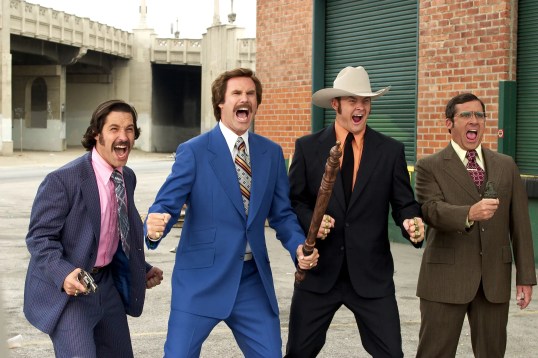
You got that right!  That’s one reason why I’ve lost track of the number of times that I’ve watched Anchorman.  Whatever’s going on in the world or my life, I know that Anchorman is going to make me laugh and make me feel better about things.  The adventures of anchorman Ron Burgundy (Will Ferrell) and his news team (Paul Rudd, David Koechner, Steve Carell) never cease to amuse me, whether they’re capturing the birth of a panda or getting involved in a street fight with their rival newsmen.

“Brick killed a guy.”

He did!  Where did Brick get a trident from?  When the street fight started, he only had a hand grenade.  Ron Burgundy suggests that Brick should find a safehouse and I hope Brick took his advice.  There’s a lot of funny people in Anchorman but Steve Carell, playing the weatherman with an IQ under 80, is my favorite.  Brick saying that he loves the lamp is so touching.

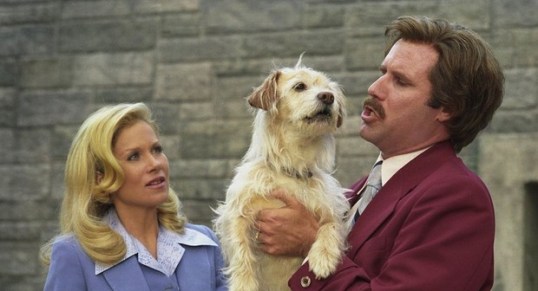
“Fare thee well, Baxter.  You shall always be a friend of the bears.”

The first time I saw Anchorman, I couldn’t believe it when Baxter was drop-kicked off that bridge.  I swore that I would never watch another movie featuring Jack Black!  Baxter was so cute!  When Ron broke down over the loss of his dog, I wanted to break down with him.  Later, when Baxter emerged from the river and barked, “I’m coming, Ron!,” I was so relieved.  Baxter lives!  Baxter’s conversation with the bears warmed my heart.
“Stay classy, San Diego.”

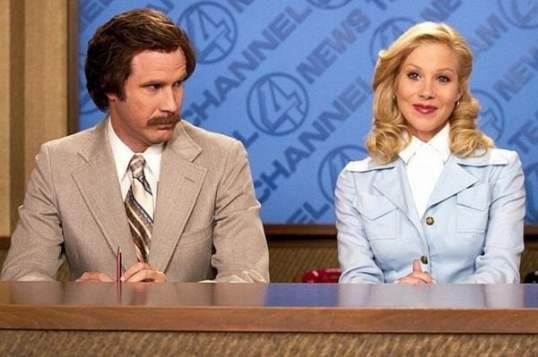
That’s right, San Diego!  Stay classy.  Anchorman is in a class all of its own.  Ron Burgundy makes beautiful music with his jazz flute.  Brian Fantana is a walking advertisement for Sex Panther.  Veronica Corningstone (Christine Applegate) strikes a blow for women’s liberation and teaches Ron an important lesson about teleprompters.  It’s the little moments that make me laugh the most, whether it’s Fred Willard talking to his son’s school about why his son has been expelled or Tim Robbins as the PBS anchor who smokes a pipe and chops off Luke Wilson’s arm or Vince Vaughn shouting about the ratings.  Best of all, Will Ferrell has never been better than as the pompous Ron Burgundy, so stupid but so committed to his job that you can’t help but love him.

“Wow, that really escalated.”

You bet it did, Ron!  Each moment of Anchorman is funnier than the last.  (I wish the same was true of Anchorman 2.)  That’s why Anchorman is a film that I watch and rewatch.  In fact, I think I’ll go watch it right now!

“Thanks for stopping by, San Diego.”
Film Review: Short Cuts (dir by Robert Altman)


Opening with a swarm of helicopters spaying for medflies and ending with an earthquake, 1993’s Short Cuts is a film about life in Los Angeles.

An ensemble piece, it follows several different characters as they go through their own personal dramas.  Some of them are married and some of them are destined to be forever single but they’re all living in varying states of desperation.  Occasionally, the actions of one character will effect the actions of another character in a different story but, for the most part, Short Cuts is a portrait of people who are connected only by the fact that they all live in the same city.  There are 22 principal characters in Short Cuts and each one thinks that they are the star of the story.

Jerry Kaiser (Chris Penn) cleans the pools of rich people while, at home, his wife, Lois (Jennifer Jason Leigh), takes care of their baby and works as a phone sex operator.  Jerry’s best friend is a makeup artist named Bill (Robert Downey, Jr.) who enjoys making his wife, Honey (Lili Taylor), looks like a corpse so that he can take her picture.  One of her photographs is seen by a fisherman (Buck Henry) who has already discovered one actual corpse that weekend.  He and his buddies, Vern (Huey Lewis) and Stuart (Fred Ward), discovered a dead girl floating in a river and didn’t report it until after they were finished fishing.  (The sight of Vern unknowingly pissing on the dead body is one of the strongest in director Robert Altman’s filmography.)

Stuart’s wife, Claire (Anne Archer), is haunted by Stuart’s delay in reporting the dead body.  A chance meeting Dr. Ralph Wyman (Matthew Modine) and his wife, artist Marian (Julianne Moore), leads to an awkward dinner between the two couples.  Claire works as a professional clown and Ralph ends up wearing her clown makeup while his marriage falls apart.

Earlier, Claire was stopped and hit on by a smarmy policeman named Gene Shepard (Tim Robbins), who just happens to be married to Marian’s sister, Sherri (Madeleine Stowe).  Gene is already having an affair with Betty Weathers (Frances McDormand), the wife of a helicopter pilot named Stormy (Peter Gallagher).  When Stormy discovers that Betty has been cheating, he takes a creative revenge on her house.

Doreen Pigott (Lily Tomlin) lives in a trailer park with her alcoholic husband, Earl (Tom Waits).  Driving home from her waitressing job, Doreen hits a young boy.  The boy says he’s okay but when he gets home, he passes out.  His parents, news anchorman Howard Finnegan (Bruce Davison) and his wife, Anne (Andie MacDowell), rush him to the hospital, where his doctor is Ralph Wyman.  As Howard waits for his son to wake up, he has a revealing conversation with his long-estranged father (Jack Lemmon, showing up for one scene and delivering an amazing monologue).  Meanwhile, a baker named Andy (Lyle Lovett) repeatedly calls the Finnegan household, wanting to know when they’re going to pick up their son’s birthday cake.

Based on the short stories of Raymond Carver and directed by Robert Altman, Short Cuts can sometimes feel like a spiritual descendent of Altman’s Nashville.  The difference between this film and Nashville is that Short Cuts doesn’t have the previous film’s satiric bite.  As good as Nashville is, it’s a film that can be rather snarky towards it character and the town in which it is set.  Nashville is used as a metaphor for America coming apart at the seams.  Short Cuts, on the other hand, is a far more humanistic film, featuring characters who are flawed but, with a few very notable exceptions, well-intentioned.  If Nashville seem to be a portrait of a society on the verge of collapse, Short Cuts is a film about how that society ended up surviving.

It’s not a perfect film.  There’s an entire storyline featuring Annie Ross and Lori Singer that I didn’t talk about because I just found it to be annoying to waste much time with.  (The Ross/Singer storyline was the only one not to be based on a Carver short story.)  The conclusion of Chris Penn’s storyline wasn’t quite as shocking as it was obviously meant to be.  But, flaws and all, Altman and Carver’s portrait of humanity does hold our attention and it leaves us thinking about connections made and sometimes lost.  Seen today, Short Cuts is a portrait of life before social media and iPhones and before humanity started living online.  It’s a time capsule of a world that once was.

14 Days of Paranoia #6: The Player (dir by Robert Altman)


1992’s The Player tells the story of Griffin Mill (Tim Robbins).

It’s not easy being Griffin Mill.  From the outside, of course, it looks like he has the perfect life.  He’s a studio executive with a nice house in Hollywood.  He’s young.  He’s up-and-coming.  Some people, especially Griffin, suspect that he’ll be the president of the studio some day.  By day, he sits in his office and listens to pitches from respected screenwriters like Buck Henry.  (Henry has a great idea for The Graduate II!)  During the afternoon, he might attends dailies and watch endless takes of actors like Scott Glenn and Lily Tomlin arguing with each other.  Or he might go to lunch and take a minute to say hello to Burt Reynolds.  (“Asshole,” Burt says as Griffin walks away.)  At night, he might go to a nice party in a big mansion and mingle with actors who are both young and old.  He might even run into and share some sharp words with Malcolm McDowell.

But Griffin’s life isn’t as easy as it seems.  He’s constantly worried about his position in the studio, knowing that one box office failure could end his career.  He fears that a new executive named Larry Levy (Peter Gallagher) is after his job.  Two new screenwriters (Richard E. Grant and Dean Stockwell) keep bugging him to produce their downbeat, no-stars anti-capitol punishment film.  His girlfriend (Cynthia Stevenson) wants to make good movies that mean something.  Even worse, someone is sending Griffin threatening notes.

It doesn’t take long for Griffin to decide that the notes are coming from a screenwriter named Dave Kahane (Vincent D’Onofrio).  Griffin’s attempt to arrange a meeting with Dave at a bar so that Griffin can offer him a production deal instead leads to Griffin murdering Dave in a parking lot.  While the other writers in Hollywood mourn Dave’s death, Griffin starts a relationship with Dave’s artist girlfriend (Great Scacchi) and tried to hide his guilt from two investigating detectives (Whoopi Goldberg and Lyle Lovett).  Worst of all, the notes keep coming.  The writer, whomever they may be, is now not only threatening Griffin but also seems to know what Griffin did.

After spend more than a decade in the industry wilderness, Robert Altman made a critical and commercial comeback with The Player.  It’s a satire of Hollywood but it’s also a celebration of the film industry, featuring 60 celebrities cameoing as themselves.  Everyone, it seems, wanted to appear in a movie that portrayed studio execs as being sociopathic and screenwriters as being whiny and kind of annoying.  The Player both loves and ridicules Hollywood and the often anonymous men who run the industry.  Largely motivated by greed and self-preservation, Griffin may not love movies but he certainly loves controlling what the public sees.  In the end, only one character in The Player sticks to her values and her ideals and, by the end of the movie, she’s out of a job.  At the same time, Griffin has a social life that those in the audience can’t help but envy.  He can’t step out of his office without running into someone famous.

The Player is one Altman’s most entertaining films, with the camera continually tracking from one location to another and giving as a vision of Hollywood that feels very much alive.  Tim Robbins gives one of his best performances as Griffin Mill and Altman surrounds him with a great supporting cast.  I especially liked Fred Ward as the studio’s head of security.  With The Player, Altman mixes melodrama with a sharp and sometimes bizarre comedy, with dialogue so snappy that the film is as much a joy to listen to as to watch.  That said, the real attraction of the film is spotting all of the celebrity cameos.  (That and cheering when Bruce Willis saves Julia Roberts from certain death.)  Altman was a director who often used his films to explore eccentric communities.  With The Player, he opened up his own home.

Previous entries in 2025’s 14 Days Of Paranoia:

  1. The Fourth Wall (1969)
  2. Extreme Justice (1993)
  3. The Lincoln Conspiracy (1977)
  4. Conspiracy (2007)
  5. Bloodknot (1995)

Alexandre Dumbass and THE SHAWSHANK REDEMPTION – a scene that I love!


In honor of Director Frank Darabont’s 66th birthday, I’m sharing a scene from his masterpiece, THE SHAWSHANK REDEMPTION. One of the best things about this movie is how much humor is found behind those prison walls, often coming from seemingly unexpected places. In this scene, the humor is found when the characters take on the mundane task of cataloging the prison library. Enjoy!

I recently reviewed THE SHAWSHANK REDEMPTION on my son’s birthday. 

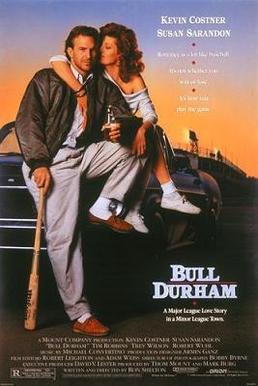
I Watched Bull Durham (1988, dir. by Ron Shelton)


In Bull Durham, Kevin Costner plays Crash Davis, a veteran catcher in the minor leagues who is brought onto the Durham Bulls so that he can teach a rookie pitcher, Ebby LaLoosh (Tim Robbins), how to play the game and also get him ready for his inevitable move to the major leagues.  Also helping to get the dim-witted but sincere Ebby ready is Annie Savoy (Susan Sarandon), who worships at the Church of Baseball and who has an affair with a different player every season.  The film follows the Bulls through their season, as both Crash and Annie mentor Ebby while also falling in love with each other.  Ebby even gets a nickname, Nuke.

Considering how much I love baseball, it might surprise you to learn that, up until recently, I had never seen Bull Durham.  I had read that it was one of the best baseball movies ever made but I never actually watched it.  I’m glad that I finally did watch it because it is a really good baseball movie.  It’s a movie that loves the game and I wasn’t surprised that the director was a former minor league player because Bull Durham is full of the type of details that you would only get from someone who had actually been there.  I especially liked the scene where it was revealed what the players and the coaches are actually talking about when they all gather on the pitcher’s mound.  It turns out that they’re not always talking about how to strike out the pitcher.

The love triangle part of the film didn’t work as well as for me.  I could relate to Annie’s love for baseball but her character still didn’t quite ring true for me and her narration was overdone.  Both Annie and Nuke seemed cartoonish whenever they got together.  Kevin Costner, though, was great as Crash Davis.  He was believable as an athlete and a mentor.  My favorite Costner moment was when a batboy told him to “Get a hit, Crash,” and he replied, “Shut up.”  It rang true.

I don’t agree with those who say Bull Durham is the best baseball movie.  I think Eight Men Out is better.  But I still enjoyed Bull Durham.  It’s a movie that loves the game almost as much as I do.

THE SHAWSHANK REDEMPTION (1994) – In honor of our son’s birthday, I review his favorite movie!


I sent our son a text the other day and asked him if he had an answer for the question “What’s your favorite movie?” I thought I knew the answer but it turns out I was only half right. I expected his answer to be THE HATEFUL EIGHT. Rather, the answer I received back was “The Hateful Eight or Shawshank Redemption!” Since I recently wrote about the time that he and I attended THE HATEFUL EIGHT roadshow in Dallas, I decided I would write about THE SHAWSHANK REDEMPTION this time around. It doesn’t hurt that it’s one of my favorite movies as well. It also doesn’t hurt that it’s the very top rated film on the Internet Movie Database.

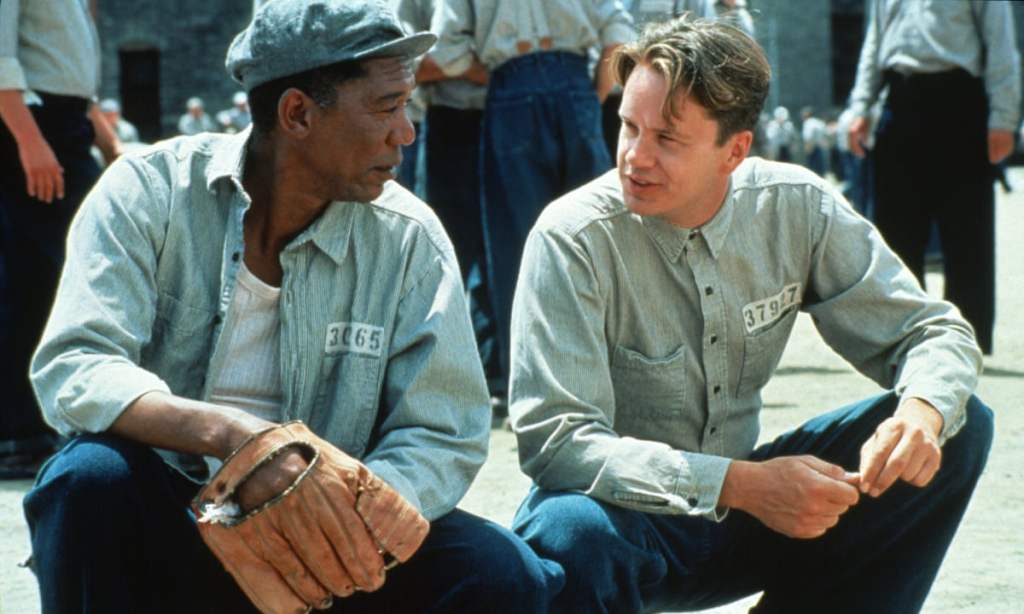
Based on Stephen King’s “Rita Hayworth and Shawshank Redemption,” the story is well known… hot shot banker Andy Dufresne (Tim Robbins) is convicted of the murder of his wife and her lover, and gets sentenced to life at the Shawshank prison. Once on the inside, we meet a variety of characters that you expect in a prison movie. We meet Warden Norton (Bob Gunton), the hypocrite who speaks of the Bible while hiding a corrupt, evil spirit. We meet Captain Hadley (Clancy Brown), the brutal chief prison guard, who rules over the inmates with intimidation and a real willingness to inflict violence and pain on anyone who shows the least bit of independence. We meet Red (Morgan Freeman), the long-time inmate who has the ability and connections to get you anything you need. We meet other inmates like Heywood (William Sadler), the inmate who seems like a jerk when you first meet him but turns out to be a pretty good fella; Tommy (Gil Bellows), the young guy who comes into prison and may know something that proves Andy’s innocence; Brooks (James Whitmore), the old man who gets released after almost a lifetime in prison, and doesn’t know how to adjust to life on the outside; and Bogs (Mark Rolston), the sadistic prisoner who wants to force himself on Andy, and is willing to kill to get what he wants. Life isn’t easy at all in Shawshank, but Andy’s intelligence and ability to prove himself useful to Warden Norton and Captain Hadley allows him to finds ways to make life more bearable for him and his friends. After nineteen years in prison, even though he maintains his innocence, it appears that Andy is content to live out his remaining years in prison. Or is he??

I’ll never forget the first time I saw the movie THE SHAWSHANK REDEMPTION. I didn’t see it until a year or two after its initial release in 1994. I was one of those guys who figured a movie that praised by the critics was probably not something that I would like that much. Plus, at the time, the title of the movie just seemed kind of weird. But I kept hearing about how great it was, so I finally decided to give it a viewing. I agree with my son, I think THE SHAWSHANK REDEMPTION is one of the most emotionally uplifting movies ever made. Why is that you might ask? My answer would be because there’s something profoundly satisfying about people who persevere through the worst times imaginable and continue to find hope where most of us would be hopeless. Prison life is shown as horrific. One prisoner is literally beaten to death by Captain Hadley on his first night in prison for crying. Andy fights off the sadistic Bogs as much as he can, but he is unable to completely fight off his advances. But no matter what he goes through, Andy Dufresne is able keep moving forward, and he does not allow the prison life to completely crush his spirit. He keeps finding ways to persevere. Andy’s actions and endurance turn simple acts like listening to Mozart or having a beer into overwhelming emotional highs for us as the audience. The film also maintains a realistic sense of humor, which might seem difficult under the circumstances. This sense of humor is found in such mundane tasks as creating a prison library, providing tax prep services for the guards, or attending multiple parole hearings over the years. These comedic moments are earned by the way the movie takes it’s time letting us really get to the know the characters and then laugh with them as the individual moments occur. And the friendship between Andy and Red is something that deeply resonates with me. I think we all would like to have that kind of friendship. These kinds of friendships aren’t built overnight, and often they require a level of shared experience that is almost impossible to find. But they find it behind Shawshank’s prison walls, and it connects them for life. In my opinion, the friendship between these two characters leads to one of the most emotionally satisfying endings to any film, ever.

Director Frank Darabont was able to obtain some of career-defining performances from his cast. As good as Tim Robbins is as an actor, in my opinion, he has never been better than he was as Andy Dufresne. And I say this knowing full well he won an Oscar for MYSTIC RIVER. He maintains his dignity against all odds and only appears to break down a time or two. Morgan Freeman is great as always as Red, but his character is so important because we see him go from a hopeless skeptic, to a man who truly has hope thanks to his friendship with Andy. Freeman seems to handle this transition effortlessly. I’m going to give a shoutout to James Whitmore as well. With a career going all the way back to the 1940’s, his performance as Brooks Hatlen is one of the more touching and heartbreaking performances of the film. I haven’t seen all of his work, but I have never seen him better than he was in THE SHAWSHANK REDEMPTION. Each additional cast member, from Bob Gunton, Clancy Brown and Mark Rolston, to Willam Sadler and Gil Bellows all have powerful moments that add to the overall effect of the film.

Looking back now, it’s hard to believe that THE SHAWSHANK REDEMPTION did not win the Academy Award for best film. It lost to FORREST GUMP when the awards were handed out in 1995. It’s even harder to believe that the film did not win a single Academy Award even though it received seven nominations. But at the end of the day, that doesn’t really matter to me. I just know that it’s a great film, and it reaches emotional heights that very few movies, if any, have ever reached before. That’s a pretty damn good legacy.

Retro Television Review: St. Elsewhere 1.3 “Down’s Syndrome”


Welcome to Retro Television Reviews, a feature where we review some of our favorite and least favorite shows of the past! On Fridays, I will be reviewing St. Elsewhere, a medical show which ran on NBC from 1982 to 1988.  The show can be found on Hulu!

This week, we get to know a very bad doctor.

Episode 1.3 “Down’s Syndrome”

(Dir by Mark Tinker, originally aired on November 16th, 1982)

St. Eligius is home to several doctors, some of whom are good at their job and some of whom are really, really bad.

One of the bad ones appears to be Dr. Peter White (Terrence Knox), a resident who was in the background during the previous two episodes but who was at the center for a good deal of this episode.  Peter has a terrible bedside manner, absolutely no social skills, and his knowledge of medicine appears to be subpar at best.  When a homeless man comes in and complains of pain, Peter gives him a dose of potassium that nearly kills him.  (Only the quick thinking of Dr. Ehrlich — who himself hardly appears to be the perfect doctor — keeps the patient alive.)  Dr. White seems to be overwhelmed and it certainly doesn’t help that his wife is constantly calling the hospital and demanding to speak to him about every little thing.  That said, it’s hard to have much sympathy for Dr. White.  Yes, he’s overwhelmed but his mistakes nearly kill a man.

I have to admit that, as I watched Dr. Peter White on this week’s episode, I kept thinking about some of the doctors who treated my father after he had his car accident in May.  Whenever I spoke to them, they would brusquely answer my questions, usually in technical language that reflected that it had been a long time since they talked anyone who hadn’t gone to medical school.  At the time, I made the same excuses for them that I just made for Dr. White.  They were young, they were busy, and they were overwhelmed.  After my father died, though, I stopped making excuses for them and I instead just accepted that they weren’t very good at their job.  And perhaps Dr. White should admit the same.

It doesn’t help that Dr. White is contrasted with Dr. Auschlander, a kind and elderly liver specialist who is battling cancer but who still manages to treat all of his patients with kindness and respect.  The episode made it clear that all of the residents should hope to become a doctor like Dr. Auschlander.  While Peter snaps at his patients and nearly kills a man, Auschlander takes the time to play cards with a woman who is dying.  We should all be so lucky as to have an Auschlander in our life.

Finally, Brian Whitehill (Tony Bill) and his pregnant wife, Denise (Maureen Whitehill) are informed that their baby will be born with Down’s Syndrome.  In a scene that brings to mind Icelandic eugenics, Brian suggests that Denise get an abortion but Denise refuses, especially when she learns that she’s going to have a son.  (She already has two daughters.)  A day later, Brian comes home from work and tells Denise that he’s realized that she’s right and he’s prepared to be the father of a special needs child.  Denise replies that she had the abortion earlier in the day.  Seriously, what a depressing story!  That said, I respected what the show was doing here.  The patients are just as important as the doctors.

(And while Denise is getting an abortion, Dr. Morrison is learning that he’s going to be a father and, in contrast to Brian Whitehill, joyfully cheering in the hospital stairwell.)

As with the previous episode, there was a lot going on in the background.  Dr. Beale attempted to analyze terrorist Andrew Reinhardt (Tim Robbins), who is still basically acting like an arrogant prick.  Kathleen McAllister, the victim of Reinhardt’s attack, is still in a coma.  Dr. Westphall gave a tour of the hospital to two community leaders who both suggested that St. Eligius should shut down and move its operations to a wealthier neighborhood.  Dr. Fiscus got a blow job in an elevator from Kathy Martin.  (“Going down?” Fiscus asked the next guy who got on the elevator.)  It was a busy day at the hospital!  It was a good episode, even if it didn’t really have any of the big wow moments that the previous two episodes featured.  This episode was more about following a few days in the life of a hospital and the emphasis was on the nonstop flow of patients and doctors, some of whom were doing their best and some of whom were on the verge of giving up.  In the end, the main thing I took away from this episode was that there may not be enough Aucschlanders to make up for all the Peter Whites.


Retro Television Review: St. Elsewhere 1.2 “Bypass”


Welcome to Retro Television Reviews, a new feature where we review some of our favorite and least favorite shows of the past! On Fridays, I will be reviewing St. Elsewhere, a medical show which ran on NBC from 1982 to 1988.  The show can be found on Hulu!

This week, William Daniels claims the show as his own.

Episode 1.2 “Bypass”

(Dir by Thomas Carter, originally aired on November 9th, 1982)

“Hey, it’s Tim Robbins!”

Yes, the future Oscar winner shows up in the second episode of St. Elsewhere, playing a rich kid-turned-terrorist named Andrew Reinhardt.  Reinhardt, who no doubt learned all about Marxism during his first semester away at college, set off a bomb in a bank, killing two people and putting a woman named Kathleen McCallister into a coma.  Both Reihnhardt and McCallister have been brought to St. Eligius.  While Kathleen’s husband, Stephen (Jack Bannon), sobs in the hallway, Reinhardt acts like a petulant brat in his hospital room.

With the nurses refusing to change his sheets or even give him his morphine shots, it falls to Dr. Morrison to take care of him.  Reinhardt is not at all appreciative and Morrison finds himself conflicted.  How is he supposed to give proper medical treatment to someone who he despises?  Morrison is so conflicted that he even goes to Dr. Westphall.  Westphall responds by telling a long story about a time that he fell in love with a patient.  I’m getting the feeling that Morrison feeling conflicted and Westphall telling long stories are both going to be regular features on this show.

(The correct answer to Morrison’s question about how he can take care of a bad person is as follows: It’s your job and you’re getting paid to do it.)

This episode also gave the viewer a chance to get to know Dr. Craig, the very talented but very egotistical head of surgery who is played by the great William Daniels.  Dr. Craig holds a press conference to inform reporters about the conditions of both Reinhardt and Kathleen McCallister and declares that, despite its bad reputation, “St. Eligius is the place to be!”  He then proceeds to get angry when the press is more interested in talking to the surgeon who actually saved Kathleen’s life than to him.

Dr. Craig browbeats a Mr. Broadwater (Robert Costanzo) into getting bypass surgery done.  The surgery appears to have been a success but it’s hard to ignore that Craig essentially bullied the guy into getting a major operation, one that could have killed him if the least little thing had gone wrong.  Resident Victor Ehrlich (Ed Begley, Jr.) assists in the operation and, at one point, Dr. Craig intentionally head butts him when Ehrlich cannot name all of the arteries leading into the heart.  It’s a bit aggressive but, on the plus side, Ehrlich does learn all of the names.  Afterwards, Dr. Craig brags about how his own son is following in his footsteps and tells Mr. Broadwater’s son that some day, a new Dr. Craig will operate on him.  In other words, Dr. Craig is kind of a jerk but he’s good at what he does and he’s played by William Daniels so it’s hard to hold anything against him.

There were other subplots playing out in the background, the majority of which just seemed to be there to remind us that St. Elsewhere is an ensemble show and that, just because someone isn’t a major character in this episode, that doesn’t mean they won’t be important later on.  Psychiatrist Hugh Beale (G.W. Bailey) attempted to learn how to swim and ended up taking a class with a bunch of children.  Dr. Fiscus (Howie Mandel, the least convincing doctor ever) held court in the cafeteria and claimed that the hormones used in processing food were causing children to develop earlier than ever before.  Dr. Peter White (Terrence Knox) wandered around with a bunch of X-rays and begged everyone he met to help him understand what he was (or wasn’t) seeing.  If nothing else, this episode did a good job of capturing the idea of the hospital as being a place that’s always busy.

For the most part, though, it was Dr. Craig who carried this episode.  While Morrison and Westphall ponderously considered the implications of doing their jobs, Craig was an arrogant, angry, and brilliant dynamo and William Daniels’s high-energy performance was a pleasure to watch.  Whenever the episode started to slow down, Dr. Craig would liven things up by yelling at someone.  The hospital was lucky to have Dr. Craig and St. Elsewhere was lucky to have William Daniels.

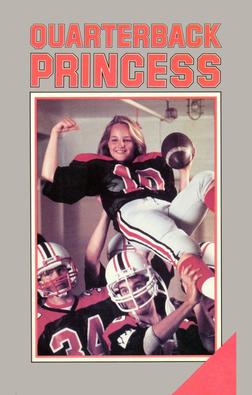
Retro Television Review: Quarterback Princess (dir by Noel Black)


Welcome to Retro Television Reviews, a feature where we review some of our favorite and least favorite shows of the past!  On Sundays, I will be reviewing the made-for-television movies that used to be a primetime mainstay.  Today’s film is 1983’s Quarterback Princess.  It  can be viewed on YouTube!

Quarterback Princess begins with Ralph Maida (Don Murray) dropping in on the coach of a high school football team in the small town of Minnvile, Oregon.  Ralph explains that he and his family are going to be relocating to the town from Canada.  His eldest child wants to play football and Ralph is curious as to when the team will be holding the tryouts.  The coach asks what position Ralph’s son plays.  Ralph explains that Tami is his daughter and she plays quarterback.  After an awkward moment of silence, the coach explains that he’ll have to talk to the school board.

Yes, Quarterback Princess is one of those films.  It’s an only girl on the team film, in which an athletic teenager has to convince not only her male teammates but also all of the stodgy old people that she can play just as well as the boys.  On the one hand, films (and shows, as Degrassi had an entire storyline about Jane trying to get on the school’s football team) like this are usually entertaining because it’s fun to watch a girl succeed while all of the men sputter with outrage until the team starts winning.  On the other hand, they’re always a little bit difficult for me to relate to because I would honestly have no interest in doing what Tami’s doing and it’s hard for me to understand why anyone else would either.  I mean, seriously why would anyone want to live in Oregon when Montana’s just a short drive away?

Quarterback Princess is based on a true story.  In real life, Tami Maida was 14 year old when she joined her high school football team as their quarterback.  That season, the team had a record of 7-1 and they won the state championship.  Tami was also elected Homecoming Queen that seem year.  The parts of the movie that seem like the type of thing that only a screenwriter could come up actually happened.  Helen Hunt, who was 20 years old at the time, plays Tami.  When I watched the film, I thought Hunt did a good job in the scenes off field but I thought she was a bit unconvincing when she was actually playing the game and throwing the ball.  Fortunately, I did some research before I actually wrote this review and I discovered that Tami served as Helen Hunt’s stand-in during the film and, in most of the game scenes, that actually is Tami throwing the ball and running around the field.  That shows you how much I know about football.

Quarterback Princes is definitely a made-for-television production.  These are the only high school football players in existence who neither drink nor curse.  For that matter, the coaches are surprisingly nice as well.  That said, it isn’t bad.  The best scenes are the ones that feature Tami and her family adjusting to Tami’s sudden fame.  Daphne Zuniga gives a sympathetic performance as Tami’s sister, who is not particularly happy about how Tami’s sudden fame has changed everyone’s lives.  The always likable John Stockwell plays Tami’s boyfriend and the two of them are a believable couple.  Noel Black, who also directed Pretty Poison, does a good job of keeping the action moving at a steady pace.  Probably the worse thing you can say about this film is that it was a bit predictable but, in this case, all of the predictable stuff actually happened so what can you do?

Film Review: Top Gun (dir by Tony Scott)


Oh, where to even begin with Top Gun?

First released in 1986, Top Gun is a film that pretty much epitomizes a certain style of filmmaking.  Before I wrote this review, I did a little research and I actually read some of the reviews that were published when Top Gun first came out.  Though it may be a considered a classic today, critics in 1986 didn’t care much for it.  The most common complaint was that the story was trite and predictable.  The film’s reliance on style over substance led to many critics complaining that the film was basically just a two-hour music video.  Some of the more left-wing critics complained that Top Gun was essentially just an expensive commercial for the military industrial complex.  Director Oliver Stone, who released the antiwar Platoon the same year as Top Gun, said in an interview with People magazine that the message of Top Gun was, “If I start a war, I’ll get a girlfriend.”

Oliver Stone was not necessarily wrong about that.  The film, as we all know, stars Tom Cruise as Pete “Maverick” Mitchell, a cocky young Navy flyer who attends the TOPGUN Academy, where he competes with Iceman (Val Kilmer) for the title of Top Gun and where he also spends a lot of time joking around with everyone’s favorite (and most obviously doomed) character, Goose (Anthony Edwards).  Maverick does get a girlfriend, Charlie (Kelly McGillis), but only after he’s had plenty of chances to show both how reckless and how skilled he can be while flying in a fighter plane.  Though the majority of the film is taken up with scenes of training and volleyball, the end of the film does give Maverick a chance to prove himself in combat when he and Iceman end up fighting a group of ill-defined enemies for ill-defined reasons.  It may not be an official war but it’s close enough.

That said, I think Oliver Stone was wrong about one key thing.  Maverick doesn’t get a girlfriend because he started a war.  He gets a girlfriend because he won a war.  Top Gun is all about winning.  Maverick and Iceman are two of the most absurdly competitive characters in film history and, as I watched the film last weekend, it was really hard not to laugh at just how much Cruise and Kilmer got into playing those two roles.  Iceman and Maverick can’t even greet each other without it becoming a competition over who gave the best “hello.”  By the time the two of them are facing each other in a totally savage beach volleyball match, it’s hard to look at either one of them without laughing.  And yet, regardless of how over-the-top it may be, you can’t help but get caught up in their rivalry.  Cruise and Kilmer are both at their most charismatic in Top Gun and watching the two of them when they were both young and fighting to steal each and every scene, it doesn’t matter that both of them would later become somewhat controversial for their off-screen personalities.  What matters, when you watch Top Gun, is that they’re both obviously stars.

“I’ve got the need for speed,” Tom Cruise and Anthony Edwards say as they walk away from their plane.  The same thing could be said about the entire movie.  Top Gun doesn’t waste any time getting to the good stuff.  We know that Maverick is cocky and has father issues because he’s played by Tom Cruise and Tom Cruise always plays cocky characters who have father issues.  We know that Iceman is arrogant because he’s played by Val Kilmer.  We know that Goose is goofy because his nickname is Goose and he’s married to Meg Ryan.  The film doesn’t waste much time on exploring why its characters are the way they are.  Instead, it just accepts them for being the paper-thin characters that they are.  The film understands that the the most important thing is to get them into their jets and sends them into the sky.  Does it matter that it’s sometimes confusing to keep track of who is chasing who?  Not at all.  The planes are sleek and loud.  The men flying them are sexy and dangerous.  The music never stops and the sun never goes down unless the film needs a soulful shot of Maverick deep in thought.  We’ve all got the need for speed.

In so many ways, Top Gun is a silly film but, to its credit, it also doesn’t make any apologies for being silly.  Instead, Top Gun embraces its hyperkinetic and flashy style.  That’s why critics lambasted it in 1986 and that’s why we all love it in 2020.  And if the pilots of Top Gun do start a war — well, it happens.  I mean, it’s Maverick and Iceman!  How can you hold it against them?  When you watch them fly those planes, you know that even if they start World War III, it’ll be worth it.  If the world’s going to end, Maverick’s the one we want to end it.