The Unominated #21: Southern Comfort (dir by Walter Hill)


Though the Academy of Motion Picture Arts and Sciences claim that the Oscars honor the best of the year, we all know that there are always worthy films and performances that end up getting overlooked.  Sometimes, it’s because the competition too fierce.  Sometimes, it’s because the film itself was too controversial.  Often, it’s just a case of a film’s quality not being fully recognized until years after its initial released.  This series of reviews takes a look at the films and performances that should have been nominated but were, for whatever reason, overlooked.  These are the Unnominated.

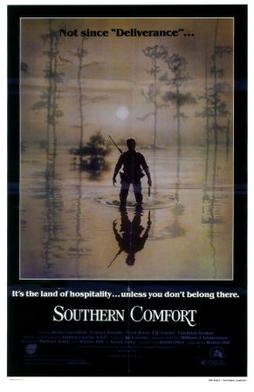
1981’s Southern Comfort takes place in 1973.  While America tries to wind down its presence in Vietnam, a squad of nine National Guardsmen take part in war games in the Louisiana bayous.  The squad is led by the ineffectual Sgt. Crawford Poole (Peter Coyote) while other members include the trigger-happy Lonnie Reece (Fred Ward), the weed-smoking Tyrone Cribbs (T.K. Carter), the cowardly Private Simms (Franklyn Seales), and the tightly-wound Coach Bowden (Alan Autry).  Poole may be in charge but most of the members of the squad seem to look up to the laid-back and friendly Private Spencer (Keith Carradine).  The newest member of the squad is Charles Hardin (Powers Boothe), a sober-minded transfer from Texas who doesn’t seem to get along with anyone but Spencer.

With the exception of Poole and Hardin, no one takes the weekend maneuvers seriously until they find themselves lost in the bayou and it becomes obvious that Poole has no idea what he’s doing.  When they come across some canoes that belong to some Cajun trappers, they decide to “borrow” them.  When the trappers protest, Reece fires his weapon at them.  Reece’s gun is loaded with blanks but the trappers don’t know that.  They fire back, killing Poole.

The national guardsmen now find themselves lost and being stalked by the trappers, a largely unseen force that always seems to attack out of nowhere.  The men have no idea where they are.  The trappers, on the other hand, have lived in the swamps their entire lives.  The guardsmen bicker and argue over the best way to respond.  Some want to fight back and some just want to get back to civilization.  One-by-one, the men are picked off until only two remain.

Though the film is a somewhat heavy-handed metaphor for the Vietnam War, Southern Comfort is still a deeply affecting and suspenseful mix of horror and action.  Director Walter Hill keeps the action moving at a quick pace and the film, which was shot on location and featured scenes shot during an actual Cajun celebration, perfectly captures the languid yet ominous atmosphere of the bayous.  As soon as the men see those canoes unattended, we know that they’re going to steal them and that they are making the biggest mistake of their lives.  Keith Carradine and Powers Boothe both give powerful performances in the lead roles and the members of the supporting cast — especially Alan Autry and Fred Ward — make a strong impression as well.  I especially liked the performance of Brion James, who has a small role as a one-armed Cajun who is more crafty than he looks.

Being a mix of horror and action, it’s probably not a shock that Southern Comfort was ignored by the Academy.  At the very least, I would have found room for Ry Cooder’s original score and Andrew Laszlo’s haunting cinematography.
Previous Entries In The Unnominated:

  1. Auto Focus 
  2. Star 80
  3. Monty Python and The Holy Grail
  4. Johnny Got His Gun
  5. Saint Jack
  6. Office Space
  7. Play Misty For Me
  8. The Long Riders
  9. Mean Streets
  10. The Long Goodbye
  11. The General
  12. Tombstone
  13. Heat
  14. Kansas City Bomber
  15. Touch of Evil
  16. The Mortal Storm
  17. Honky Tonk Man
  18. Two-Lane Blacktop
  19. The Terminator
  20. The Ninth Configuration

The Unnominated #19: The Terminator (dir by James Cameron)


Though the Academy of Motion Picture Arts and Sciences claim that the Oscars honor the best of the year, we all know that there are always worthy films and performances that end up getting overlooked.  Sometimes, it’s because the competition too fierce.  Sometimes, it’s because the film itself was too controversial.  Often, it’s just a case of a film’s quality not being fully recognized until years after its initial released.  This series of reviews takes a look at the films and performances that should have been nominated but were, for whatever reason, overlooked.  These are the Unnominated.

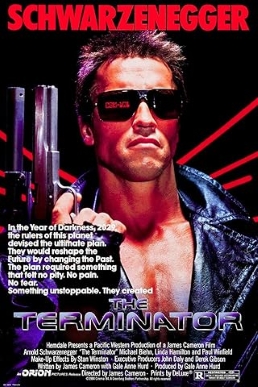
First released in 1984, The Terminator was the one of the top box office hits of the year.  It’s the film that established James Cameron as a filmmaker.  It’s the film that made a bona-fide star out of Arnold Schwarzenegger.  It’s a film that was imitated a thousand times before it even got its first official sequel.  It’s a film that’s still celebrated today.  41 years later, people are still saying, “I’ll be back.”  Would Arnold Schwarzenegger ever have become governor of California if he hadn’t first played a killing machine?  There’s a reason why his political nickname was the Governator.

And yet, The Terminator was not nominated for a single Oscar.  For all of the explosions and the gunfire and the screaming, it wasn’t even nominated for Best Sound.  Some of the special effects may now seem a bit hokey in this age of rampant CGI but it’s still a surprise that The Terminator was not nominated for Best Visual Effects.  The breath-taking action scenes did not result in a nomination for Best Editing.  Linda Hamilton was not nominated for her fantastic performance as Sarah Connor, a young woman who finds herself being pursued by a killer cyborg from the future.  Arnold Schwarzenegger was not nominated for playing one of the most memorable villains of the past 40 years.  Those who claim that Schwarzenegger was just playing himself are being overly glib.  Anyone could have said, “I’ll be back.”  It took Schwarzenegger’s delivery to make it a great line.

The lack of nominations aren’t really not a surprise, of course.  The Academy has only recently started to show an openness to nominating genre films for major awards and, even now, a genre film has to be considered a “cultural event” to even get a nomination.  Black Panther, Get Out, and even Mad Max: Fury Road and Dune were all nominated because it was felt that they had transcended their genre origins.  The Terminator is a sci-fi action movie and it’s proud to be a sci-fi action movie.  (Terminator 2: Judgment Day, it could be argued, transcended its genre origins but it was released in 1991 and Silence of the Lambs was destined to be the genre nominee that year.)  It’s also so relentlessly paced and intelligently written and directed that it’s a film that, even after all these years, it can still leave you breathless.  Nominated or not, The Terminator is a film that grabs your attention and holds it for a full 107 minutes.  There’s not many films that can make that claim.

The Terminator is a film that has held up surprisingly well.  (It’s certainly held up better than some of its more recent sequels.)  The performances of Linda Hamilton, Michael Biehn, and Arnold Schwarzenegger still work.  It’s still terrifying to watch as The Terminator relentlessly kills everyone that he comes into contact with.  (One thing that always gets me about the Terminator is that, even though he’s huge and superstrong and could probably physically rip anyone he wanted to apart, he still carries and uses a gun.  This makes him seem like even more of a bully.)  The Terminator is a machine and what makes him especially intimidating is that he doesn’t care if people see him coming or if they witness his crimes.  He has one function and that’s all he worries about.  When Michael Biehn first shows up, you can’t help but wonder why this guy, with his slight build and his somewhat nervous mannerisms, would be sent to try to stop the Terminator.  Of course, by the end of the movie, you understand.

(And what an ending!  The sight of those clouds, Linda Hamilton’s delivery of her final line, and the feeling that the future has already been determined, it all definitely makes an impression that has managed to survive every sequel after Judgment Day.  There’s a reason why Skynet — much like “I’ll be back” — has taken on a cultural life of its own.)

There were a lot of very good films that were nominated for Oscars in 1984.  The Terminator, much like Once Upon A Time In America, was not one of them but it will still never be forgotten.

Previous Entries In The Unnominated:

  1. Auto Focus 
  2. Star 80
  3. Monty Python and The Holy Grail
  4. Johnny Got His Gun
  5. Saint Jack
  6. Office Space
  7. Play Misty For Me
  8. The Long Riders
  9. Mean Streets
  10. The Long Goodbye
  11. The General
  12. Tombstone
  13. Heat
  14. Kansas City Bomber
  15. Touch of Evil
  16. The Mortal Storm
  17. Honky Tonk Man
  18. Two-Lane Blacktop

The Unnominated #18: Two-Lane Blacktop (dir by Monte Hellman)


Though the Academy of Motion Picture Arts and Sciences claim that the Oscars honor the best of the year, we all know that there are always worthy films and performances that end up getting overlooked.  Sometimes, it’s because the competition too fierce.  Sometimes, it’s because the film itself was too controversial.  Often, it’s just a case of a film’s quality not being fully recognized until years after its initial released.  This series of reviews takes a look at the films and performances that should have been nominated but were, for whatever reason, overlooked.  These are the Unnominated.

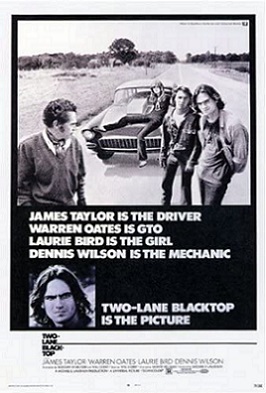
The 1971 road film, Two-Lane Blacktop, is a movie about four people whose real names are never revealed.  Indeed, their names are never as important as what they’re driving.

Named after his car, GTO (Warren Oates) is a talkative man who likes to brag on himself and who picks up hitchhikers so he can talk to them.  We don’t learn much about GTO’s background.  For someone who talks as much as he does, GTO doesn’t reveal much about who he is when he’s not driving.  It’s easy to imagine him as a salesman, traveling across the country and desperately trying to make his quota before the sun goes down.  With the way that he picks up hitchhikers and his need to convince everyone of his own skill and prowess behind the wheel, it’s easy to imagine that he’s probably recently divorced and still dealing with suddenly being on his own.  He seems to have something to prove, not only to everyone around him but especially to himself.  One gets the feeling that the life he had suddenly collapsed and he took to the road to escape it all but he still hasn’t reached the point where he can handle truly being alone.  For all of his talk, it doesn’t take long to notice that GTO isn’t quite as worldly as he claims he is.

A chance meeting leads to GTO getting into a cross-country race with The Driver (James Taylor) and the Mechanic (Dennis Wilson), two young men who are driving a 1955 Chevy and who make their money by engaging in street races.  (They’re also quick to steal a license plate when no one’s looking.)  The Driver and the Mechanic don’t talk a lot and, when they do, it’s in terse and somewhat awkward sentences.  (Both Taylor and Wilson were musicians who made their acting debut with this film.  Their natural stiffness and lack of emotion works well for their characters.)  The Driver and the Mechanic seem to communicate solely through driving.  They pick up The Girl (Laurie Bird) and both the Driver and the Mechanic seem to have feelings for her but it’s pretty obvious that their true love will always be for their car.

Two-Lane Blacktop is a road movie, a movie that really doesn’t have much of a plot (the cross-country race soon ceases to be a real race) but which does have some beautiful footage of America in 1971 and an outstanding performance from the great character actor, Warren Oates.  Easy Rider was advertised as being a film about a man who looked for America and couldn’t find it.  That’s actually a better description of Two-Lane Blacktop, a film about three uniquely American men who have embraced the car culture that is at the center of life in America but who are still, more or less, lost in their home country.  Oates, always talking and refusing to give up or even acknowledge the fact that he doesn’t really know much about how cars work, represents the so-called silent majority.  Wilson and Taylor are the next generation, their long-hair branding them as outsiders while their skill with a car and their desire win represents what we’re told is the best of the American competitive spirit.  What makes the film unsettling is the feeling that all three of them are using their cars as a way to avoid dealing with the reality of their lives.

Two-Lane Blacktop may sound a bit pretentious and it is.  The metaphors get a bit heavy-handed.  That said, as directed by Monte Hellman, it’s both a gorgeous travelogue and a valuable time capsule, a document of life in the late 60s and early 70s.  Hellman directed the film on the road.  When we see the Mechanic stealing a license plate so no one down south will know that he and the Driver are actually from California, it’s a powerful scene because it was actually filmed on location, in the South.  This isn’t a film that was shot on a backlot.  This is a film that was shot across America and it captures the country at a time when, much like today, no one was really sure what the future held for its politics or its culture.  It may be a film about three men who are obsessed with cars but it’s also a portrait of a country in an almost directionless state of turmoil.

Two-Lane Blacktop was promoted as being the next Easy Rider but it turned out to be a notorious box office failure.  James Taylor and Dennis Wilson never did another movie.  Warren Oates continued as a busy character actor while Laurie Bird died of an intentional drug overdose in 1979.  Director Monte Hellman’s directorial career continued but his days of being courted by the major studios were over.  However, as the years passed, audiences started to discover Two-Lane Blacktop and now, it’s considered to be a cult classic.

Given its failure at the box office, Two-Lane Blacktop was ignored by the Academy.  The Oscar for Best Picture went to another film that featured a memorable car chase, The French Connection.  While Two-Lane Blacktop may not have deserved to win Best Picture (not over nominees like The French Connection, The Last Picture Show, Fiddler on the Roof, and A Clockwork Orange), it certainly is far more memorable movie than the fifth film nominated that year, Nicholas and Alexandra.  If nothing else, Warren Oates deserved a nomination for his supporting performance.  The Academy may not have embraced Two-Lane Blacktop but, fortunately, film lovers eventually would.

Previous Entries In The Unnominated:

  1. Auto Focus 
  2. Star 80
  3. Monty Python and The Holy Grail
  4. Johnny Got His Gun
  5. Saint Jack
  6. Office Space
  7. Play Misty For Me
  8. The Long Riders
  9. Mean Streets
  10. The Long Goodbye
  11. The General
  12. Tombstone
  13. Heat
  14. Kansas City Bomber
  15. Touch of Evil
  16. The Mortal Storm
  17. Honky Tonk Man

The Unnominated #17: Honkytonk Man (dir by Clint Eastwood)


Though the Academy of Motion Picture Arts and Sciences claim that the Oscars honor the best of the year, we all know that there are always worthy films and performances that end up getting overlooked.  Sometimes, it’s because the competition too fierce.  Sometimes, it’s because the film itself was too controversial.  Often, it’s just a case of a film’s quality not being fully recognized until years after its initial released.  This series of reviews takes a look at the films and performances that should have been nominated but were, for whatever reason, overlooked.  These are the Unnominated.

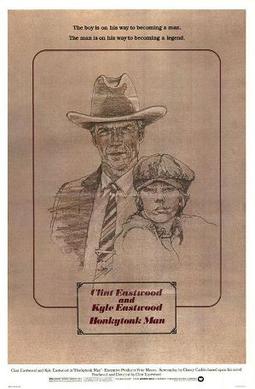
1982’s Honkytonk Man was a Clint Eastwood film that I had never heard of, until I came across it on Prime.  I decided to take a chance and I rented it.  I’m glad that I did because it turned out to be one of Eastwood’s best films.

Clint stars as Red Stovall, a country singer turned farmer during the Great Depression.  Kyle Eastwood stars as Red’s nephew, 14 year-old Whit “Hoss” Wagoneer.  When Red gets an opportunity to perform at the Grand Old Opry, he decides to head for Tennessee.  Since Red is dying of tuberculosis and barely knows how to drive a car, he is accompanied by Grandpa Wagoneer (John McIntire) and Whit.  Whit may be young but he knows how to drive and soon, he’s driving Red and Grandpa across the country.  When a highway patrolman (Tim Thomerson) stops them, he says that Whit is too young to drive.  After watching a speeding Red struggle to keep the car in the right lane, the patrolman pulls up beside them and says, “Let the kid drive.”

Honkytonk Man features an unexpected performance from Eastwood.  Typically, we think of Eastwood’s characters as being the epitome of cool.  Red is definitely not that.  Red is a screw-up, someone who gets arrested while trying to steal chickens and who frequently gets conned by those that he meets during his journey.  When the car breaks down in Arkansas, Red is too busy drinking to remember to catch the bus to Tennessee.  He spends the night with a hitchhiker named Marlene (Alexa Kernin).  The next morning, Whit wakes Red up and informs him that he only has a few minutes before the next bus leaves.  Marlene announces that she’s pregnant.  “HOLD THE BUS!” Red yells as he hastily puts on his clothes.

That said, Whit loves his uncle and the two Eastwoods, Clint and Kyle, both give excellent performances in Honkytonk Man.  In fact, his performance here is probably the best that Clint Eastwood has ever given.  Clint plays with his own image here.  Initially, the film almost feels like a satire of Clint’s hypermasculine persona.  (There is one scene where Eastwood handles a gun but it doesn’t play out the way that you might expect it to.)  But, as the film progresses and Red’s illness grows worse, we start to understand Red and his way of looking at the world.  Red is flawed but he loves his nephew and he loves music and, in the end, what’s important is not whether or not his song were recorded but instead that he spent his final days with Whit.  The film may start out as a comedy but it ultimately becomes a meditation on aging and how one faces the inevitability of death.

As a director, Eastwood takes his time.  He lets the movie play out slowly, with the casual pace of country story.  It’s a film full of wonderful performance and beautiful visuals and it more than earns our patience.  Wisely, Eastwood the director realizes that this story really isn’t about Red.  The story is about Whit (or Hoss, as he asks to be known) and his experiences with his uncle.  Whit worships his uncle but he also comes to learn that the most important thing is to be able to respect yourself.  In this film, Clint Eastwood knows the story that he’s telling and he knows exactly how to tell it.

Honkytonk Man went unnominated as far as the Oscars are concerned.  In the year when the well-intentioned but dramatically inert Gandhi dominated the awards and the nominations, Honkytonk Man was forgotten.  That’s a shame.

Previous Entries In The Unnominated:

  1. Auto Focus 
  2. Star 80
  3. Monty Python and The Holy Grail
  4. Johnny Got His Gun
  5. Saint Jack
  6. Office Space
  7. Play Misty For Me
  8. The Long Riders
  9. Mean Streets
  10. The Long Goodbye
  11. The General
  12. Tombstone
  13. Heat
  14. Kansas City Bomber
  15. Touch of Evil
  16. The Mortal Storm

The Unnominated #16: The Mortal Storm (dir by Frank Borzage)


Though the Academy of Motion Picture Arts and Sciences claim that the Oscars honor the best of the year, we all know that there are always worthy films and performances that end up getting overlooked.  Sometimes, it’s because the competition too fierce.  Sometimes, it’s because the film itself was too controversial.  Often, it’s just a case of a film’s quality not being fully recognized until years after its initial released.  This series of reviews takes a look at the films and performances that should have been nominated but were, for whatever reason, overlooked.  These are the Unnominated.

Oh, how this movie made me cry!

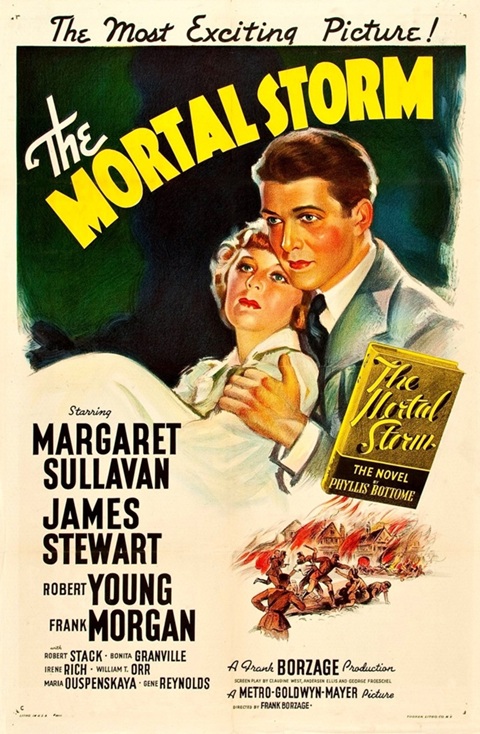
Released in 1940, at a time when war was spreading across Europe, Asia, and Africa but the United States was still officially neutral, The Mortal Storm opens on January 30th, 1933.  In the mountains of Germany, near the Austrian border, Professor Viktor Roth (Frank Morgan) is celebrating his 60th birthday.  He starts the day being applauded by his students at the local college.  In the evening, he returns home for a celebration with his family, including wife (Irene Rich), his daughter Freya (Margaret Sullivan), his son Rudi (Gene Reynolds), and his two stepsons, Otto (Robert Stack) and Erich von Rohn (William T. Orr).  Also present are Freya’s fiancé, Fritz (Robert Young) and one of Roth’s students, a pacifist named Martin Breitner (James Stewart).  It’s a joyous occasion and the film takes its time introducing us to Prof. Roth and his extended family.  At first, everyone seems very kind.  They seem like people who most viewers would want to spend time with or live next to….

But then, the family’s maid excitedly enters the room and announces that it’s just been announced that Adolf Hitler is the new chancellor of Germany.  Otto and Erich are overjoyed and head out to celebrate with the other members of the Nazi Youth Leage.  Martin is less happy and excuses himself to return home.  Roth and his wife worry about what this means for people who do not agree with Hitler’s beliefs.  Freya says that they shouldn’t talk politics.  It is jokingly mentioned that Hitler has taken away Roth’s special day but Roth’s young son Rudi says that he’s learned in school that the needs of the individual will never be more important than the needs of the state.  If Hitler wants to take away your day, it’s your duty to give it up or face the consequences.

Based on a 1937 novel, The Mortal Storm was not the first Hollywood production to take a stand against Hitler and the Nazis but it was one of the best.  I say this despite the fact that the film only hints at the fact that Prof. Roth is Jewish, something that was made very clear in the book.  (In the movie, Roth and his wife worry what will happen to “Non-Aryans” and “freethinkers.”)  That said, the film perfectly captures how quickly and insidiously the authoritarian impulse can spread.  The town, which once seemed so friendly, becomes a very dark place as the students at the university put on their swastika armbands and start to hunt down anyone who dissents from the party line.  When Roth says that, as a scientist, he does not believe one race can be genetically superior to another, his students walk out on him.  A local teacher is beaten when he fails to return to the Nazi salute.  When Martin refuses to join the Party, Otto and Erich turn against him despite being lifelong friends.  When Martina and Freya flee for the border, Fritz pursues them.  And even after Prof. Roth is sent to a concentration camp, Otto and Erich continue to follow the orders of Hull (Dan Dailey), the sinister Youth Party Leader.

It’s a powerful film, one that remains just as relevant today as it was when it was first released.  Hull and Erich’s fanaticism would, today, find a welcome home on social media.  The scenes in which the townspeople eagerly threaten to report their former friends and neighbors for failing to salute or show proper enthusiasm for the government have far too many modern day equivalents for me to even begin to list them all.  This film was also the last the James Stewart made with frequent co-star Margaret Sullivan and they both give great performances.  (All-American Jimmy Stewart might seem a strange choice to play a German farmer but he is never less that convincing as Martin, one of the few people in the town not to surrender his principles and beliefs to the crowd.)  The film’s final moments, with the camera panning around the empty Roth home, brought very real tears to my eyes.

Despite being a powerful film, The Mortal Storm was not nominated for a single Oscar.  (Jimmy Stewart did win his only Oscar that year but it was for The Philadelphia Story.)  It’s temping to assume that, at a time when America was still divided about how to react to the war in Europe and when many Americans still remembered the trauma of the first World War, The Mortal Storm was too explicitly political and anti-Nazi to get a nomination but, the same year, The Great Dictator was nominated for Best Picture.  It seems more likely that, in those days when the studios ruled supreme, MGM decided to puts it weight behind The Philadelphia Story rather than The Mortal Storm.

That said, The Mortal Storm was definitely worthy of being nominated, for Picture, Director, Screenplay, Actress (Margaret Sullivan), Actor (Stewart), Supporting Actor (Frank Morgan and Robert Stack), and Supporting Actress (Irene Rich and, in the role of Stewart’s mother, Maria Ouspenskaya).  The film may not have been nominated but it remains a powerful and important work of art.

Previous entries in The Unnominated:

  1. Auto Focus 
  2. Star 80
  3. Monty Python and The Holy Grail
  4. Johnny Got His Gun
  5. Saint Jack
  6. Office Space
  7. Play Misty For Me
  8. The Long Riders
  9. Mean Streets
  10. The Long Goodbye
  11. The General
  12. Tombstone
  13. Heat
  14. Kansas City Bomber
  15. Touch of Evil

The Unnominated #15: Touch of Evil (dir by Orson Welles)


Though the Academy of Motion Picture Arts and Sciences claim that the Oscars honor the best of the year, we all know that there are always worthy films and performances that end up getting overlooked.  Sometimes, it’s because the competition too fierce.  Sometimes, it’s because the film itself was too controversial.  Often, it’s just a case of a film’s quality not being fully recognized until years after its initial released.  This series of reviews takes a look at the films and performances that should have been nominated but were, for whatever reason, overlooked.  These are the Unnominated.

I come here to defend Charlton Heston.

1994’s Ed Wood is a great film that has one unfortunate line.  Towards the end of the film, director Ed Wood (Johnny Depp) meets his hero, Orson Welles (Vincent D’Onoforio), in a bar.  They talk about the difficulties of directing a film.  Wood talks about the trouble that he’s having with Plan 9 From Outer Space.  Welles says that he can understand what Wood is going through because the studio is forcing him to cast Charlton Heston as a Mexican in his next movie.

And look, I get it.  It is true that Charlton Heston does play a Mexican prosecutor named Mike Vargas in Welles’s 1958 film, Touch of Evil.  And it is true that Heston is not the most convincing Mexican to ever appear in a film.  And I understand that there are people who enjoy taking cheap shots at Charlton Heston because he did have a tendency to come across as being a bit full of himself and he was a conservative in a industry dominated by Leftists. There are people who actually think Michael Moore doesn’t come across like a self-righteous prick when he confronts Heaton in Bowling for Columbine.  I get the joke.

But it’s not true and it’s not fair.  When Touch of Evil was first put into production by Universal, Welles was not hired to direct.  He was hired to play Hank Quinlan, the formerly honest cop with a habit of planting evidence on those who he believed to be guilty.  When Charlton Heston was offered the role of Vargas, he asked who had been hired to direct.  When he was told that a director hadn’t been selected, Heston was the one who suggested Welles be given the job.  When, as often happened with Welles’s film, the studio decided to take the film out of Welles’s hands, Heston argued for Welles’s vision while Welles was off trying to set up his long-dreamed of film of Don Quixote.  Say what you will about Charlton Heston’s career, he fought for Orson Welles, just as he later fought for Sam Peckinpah during the making of Major Dundee.  Heston may not have agreed with either Welles or Peckinpah politically but he fought for them when few people were willing to do so.

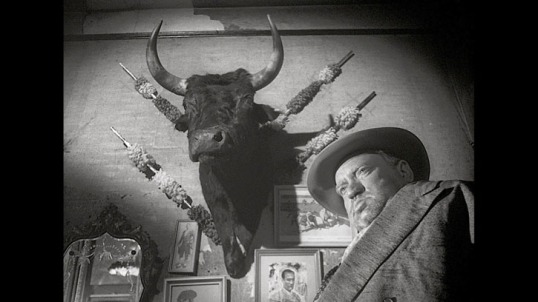
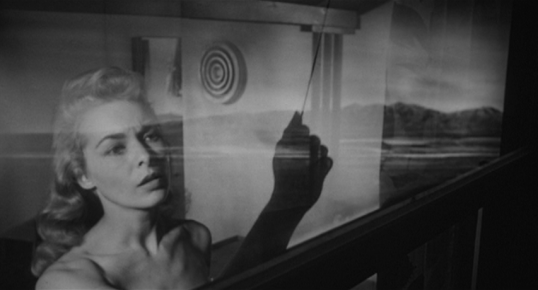
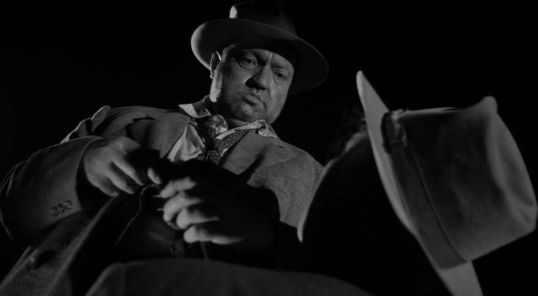
That Touch of Evil is a brilliant film is pretty much entirely due to Welles’s directorial vision.  The story is pure pulp.  While investigating the murder of an American businessman in Mexico, Vargas comes to believe that Quinlan is attempting to frame a young Mexican for the crime.  While Vargas watches Quinlan, his wife Susie (Janet Leigh) is menaced by the crime lord Joe Grandi (Akim Tamiroff), who has his own issues with both Vargas and Quinlan.  The plot may be the stuff of a B-programmer but, as directed by Welles, Touch of Evil plays out like a surreal nightmare, a journey into the heart of darkness that is full of eccentric characters, shadowy images, memorably askew camera angles, and lively dialogue.  Welles and cinematographer Russell Metty create a world that feels alien despite being familiar.  Just as he did with Gregg Toland in Citizen Kane, Welles shapes a film that shows us what’s happening in the shadows that most people try to ignore.

There’s really not a boring character to be found in Touch of Evil and the cast is full of old colleagues and friends of Welles.  Marlene Dietrich shows up as Quinlan’s former lover.  Mercedes McCambridge plays a leather-clad gang leader.  Dennis Weaver is the creepy owner of a remote motel.  (Two years before Psycho, Touch of Evil featured Janet Leigh being menaced in a motel.  Mort Mills, who played Psycho’s frightening highway patrolman, plays a member of law enforcement here as well.)  Zsa Zsa Gabor shows up for a few brief seconds and it makes a strange sort of sense.  Why shouldn’t she be here?  Everyone else is.  Joseph Cotten plays a coroner.  Ray Collins plays a local official.   In the film’s skewered world, Charlton Heston as Mike Vargas works.  His upright performance grounds this film and keeps it from getting buried in its own idiosyncrasies.   Big personalites are everywhere and yet the film is stolen by Joseph Calleia, playing Quinlan’s quiet but observant partner.  Calleia’s performance is the heart of the film.

Touch of Evil was not nominated for a single Oscar and that’s not surprising.  It’s not really the type of film that was noticed by the Academy in the 50s.  It was too pulpy and surreal and, with its story of a crooked cop framing someone who might very well be guilty anyway, it was probably too subversive for the Academy of the 1950s.  It would take a while for Touch of Evil to be recognized for being the noir masterpiece that it is.  In a perfect world, Welles would have been nominated for directing and for his larger-than-life performance as Quinlan.  Joseph Calleia would have been nominated for Supporting Actor and perhaps both Janet Leigh and Marlene Dietrtich would have been mentioned for Supporting Actress.  That didn’t happen but it would have been nice if it had.

Previous entries in The Unnominated:

  1. Auto Focus 
  2. Star 80
  3. Monty Python and The Holy Grail
  4. Johnny Got His Gun
  5. Saint Jack
  6. Office Space
  7. Play Misty For Me
  8. The Long Riders
  9. Mean Streets
  10. The Long Goodbye
  11. The General
  12. Tombstone
  13. Heat
  14. Kansas City Bomber

The Unnominated #14: Kansas City Bomber (dir by Jerrold Freedman)


Though the Academy of Motion Picture Arts and Sciences claim that the Oscars honor the best of the year, we all know that there are always worthy films and performances that end up getting overlooked.  Sometimes, it’s because the competition too fierce.  Sometimes, it’s because the film itself was too controversial.  Often, it’s just a case of a film’s quality not being fully recognized until years after its initial released.  This series of reviews takes a look at the films and performances that should have been nominated but were, for whatever reason, overlooked.  These are the Unnominated.

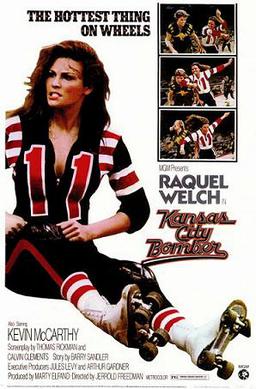
In 1972’s Kansas City Bomber, Raquel Welch stars as KC Carr.

KC. is a star on the roller derby circuit, a tough fighter who is loved by the audience and who shows no fear when it comes to skating around the track and getting into brawls with the other team.  The audience especially loves it when she fights Jackie Burdette (Helena Kallianiotes), madly cheering over every punch landed and every elbow thrown and every strand of hair pulled.  It’s not glamorous work but KC loves the adulation of the crowds and the comradery of her team.  She’s a single mother and putting on roller skates and getting bruised in fights allows her to support her daughter, Rita (a pre-Taxi Driver Jodie Foster).

But then KC is traded to another team, the Portland Loggers.  It takes KC a while to fit in with her new team.  She’s viewed with suspicion, especially when she starts to date the owner of the team, Burt Henry (Kevin McCarthy).  Burt may seem charming but KC soon discovers that he has a jealous side.  When KC spends too much time with her best friend and roommate, Burt trades her to another team.  When a male skater named “Horrible” Hank (Norman Alden) reveals that he has a rather obvious crush on KC, Burt goes out of his way to humiliate Hank.  Burt wants to start a new team in Chicago and he’s promised to make KC a star.  Will KC give up her own freedom to be Burt’s well-compensated star or will she stand up for herself and show that she doesn’t belong to anyone?

You already know the answer.  The wonderful thing about Raquel Welch is that she was tough.  She didn’t let people push her around and, if that resulted in people in Hollywood whispering that she was difficult, so be it.  Like KC Carr, Raquel Welch didn’t make any apologies.  Kansas City Bomber is one of the few of Welch’s early 70s films to celebrate and show how just how tough she was.  For once, Welch is given an actual character to play and she proves herself to be a strong and fierce actress.  It’s fun and more than a little empowering to watch her performance here.  Everyone underestimates KC Carr, just as everyone underestimated Raquel Welch.  In both cases, the doubters are proven wrong.

Kansas City Bomber is not a great film.  (The pacing is totally off and the supporting characters are not quite as memorable as either Welch or Kevin McCarthy.)  But Raquel Welch gave a great performance.  That Welch was never Oscar-nominated isn’t really a surprise.  She didn’t appear in the type of movies that received Oscar attention and she was often cast in roles that didn’t give her much of an opportunity to show off what she could do.  She definitely deserved a nomination for Kansas City Bomber.  

Previous entries in The Unnominated:

  1. Auto Focus 
  2. Star 80
  3. Monty Python and The Holy Grail
  4. Johnny Got His Gun
  5. Saint Jack
  6. Office Space
  7. Play Misty For Me
  8. The Long Riders
  9. Mean Streets
  10. The Long Goodbye
  11. The General
  12. Tombstone
  13. Heat

The Unnominated #13: Heat (dir by Michael Mann)


Though the Academy of Motion Picture Arts and Sciences claim that the Oscars honor the best of the year, we all know that there are always worthy films and performances that end up getting overlooked.  Sometimes, it’s because the competition too fierce.  Sometimes, it’s because the film itself was too controversial.  Often, it’s just a case of a film’s quality not being fully recognized until years after its initial released.  This series of reviews takes a look at the films and performances that should have been nominated but were, for whatever reason, overlooked.  These are the Unnominated.

First released in 1995, Heat is one of the most influential and best-known films of the past 30 years.  It also received absolutely zero Oscar nominations.

Maybe we shouldn’t be too surprised that Academy — especially the Academy of the 1990s — didn’t shower the film with nominations.  For all of its many strengths, Heat is still a genre piece, an epic three-hour crime film from director Michael Mann.  It’s a film about obsessive cops and tightly-wound crooks and it’s based on a made-for-TV movie that Mann directed in the late 80s.  While the Academy had given a best picture nomination to The Fugitive just two years before, it still hadn’t fully come around to honoring genre films.

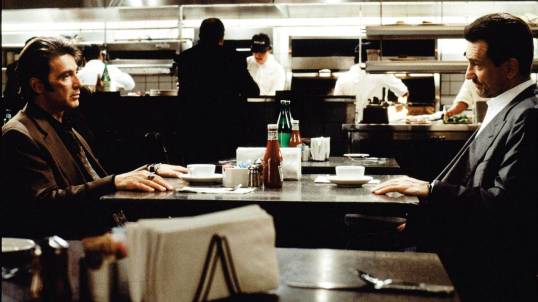
And yet one would think that the film could have at least picked up a nomination for its editing or maybe the sound design that helps to make the film’s signature 8-minute gun battle so unforgettable.  (Heat is a film that leaves you feeling as if you’re trapped in the middle of its gunfights, running for cover while the cops and the crooks fire on each other.)  The screenplay, featuring the scene where Al Pacino’s intense detective sits down for coffee with Robert De Niro’s career crook, also went unnominated.

Al Pacino was not nominated for playing Vincent Hanna and maybe we shouldn’t be too surprised at that.  Pacino yells a lot in this movie.  When people talk about Pacino having a reputation for bellowing his lines like a madman, they’re usually thinking about the scene where he confronts a weaselly executive (Hank Azaria) about the affair that he’s having with Charlene (Ashley Judd), the wife of criminal Chris Shiherlis (Val Kilmer).  And yet, I think that Pacino’s performance works in the context of the film and it’s often forgotten that Pacino has quite scenes in Heat as well.  Pacino’s intensity provides a contrast to Robert De Niro’s tightly controlled career criminal, Neil McCauley.  McCauley has done time in prison and he has no intention of ever going back.  But, as he admits during the famous diner scene, being a criminal is the only thing that he knows how to do and it’s also the only thing that he wants to do.  (“The action is the juice,” Tom Sizemore says in another scene.)  If any two actors deserved a joint Oscar nomination it was Pacino and De Niro.  In Heat, they’re the perfect team.  Pacino’s flamboyance and De Niro’s tightly-controlled emotions come together to form the heart of the picture.

No one from the film’s supporting cast was nominated either, despite there being a wealth of riches to choose from.  Ashley Judd and Val Kilmer come to mind as obvious contenders.  Kilmer is amazing in the shoot-out that occurs two hours into the film.  Ashley Judd has a killer scene where she helps her husband escape from the police.  Beyond Judd and Kilmer, I like the quiet menace of Tom Sizemore’s Michael Cheritto.  (Just check out the look he gives to an onlooker who is getting a little bit too curious.)  Kevin Gage’s sociopathic Waingro is one of the most loathsome characters to ever show up in a movie.  William Fichtner, Jon Voight, Danny Trejo, and Tom Noonan all make a definite impression and add to Michael Mann’s portrait of the Los Angeles underworld.  In an early role, Natalie Portman plays Hanna’s neglected stepdaughter and even Amy Brenneman has some good moments as Neil’s unsuspecting girlfriend, the one who Neil claims to be prepared to abandon if he sees “the heat coming.”

I have to mention the performance of Dennis Haysbert as Don Breedan, a man who has just been released from prison and who finds himself working as a cook in a diner.  (The owner of the diner is played by Bud Cort.)  Haysbert doesn’t have many scenes but he gives a poignant performance as a man struggling not to fall back into his old life of crime and what eventually happens to him still packs an emotional punch.  For much of the film’s running time, he’s on the fringes of the story.  It’s only by chance that he finds himself suddenly and briefly thrown into the middle of the action.

Heat is the ultimate Michael Mann film, a 3-hour crime epic that is full of amazing action sequences, powerful performances, and a moody atmosphere that leaves the viewer with no doubt that the film is actually about a lot more than just a bunch of crooks and the cops who try to stop them.  Hanna and McCauley both live by their own code and are equally obsessed with their work.  Their showdown is inevitable and, as directed by Michael Mann, it takes on almost mythological grandeur.  The film is a portrait of uncertainty and fear in Los Angeles but it’s also a portrait of two men destined to confront each other.  They’re both the best at what they do and, as a result, only one can remain alive at the end of the film.

I rewatched Heat yesterday and I was amazed at how well the film holds up.  It’s one of the best-paced three-hour films that I’ve ever seen and that epic gunfight is still powerful and frightening to watch.  Like Martin Scorsese’s Casino, it was a 1995 film that deserved more Oscar attention than it received.

Heat (1995, dir by Michael Mann, DP: Dante Spinotti)

Previous entries in The Unnominated:

  1. Auto Focus 
  2. Star 80
  3. Monty Python and The Holy Grail
  4. Johnny Got His Gun
  5. Saint Jack
  6. Office Space
  7. Play Misty For Me
  8. The Long Riders
  9. Mean Streets
  10. The Long Goodbye
  11. The General
  12. Tombstone


The Unnominated #12: Tombstone (dir by George Pan Cosmatos)


Though the Academy of Motion Picture Arts and Sciences claim that the Oscars honor the best of the year, we all know that there are always worthy films and performances that end up getting overlooked.  Sometimes, it’s because the competition too fierce.  Sometimes, it’s because the film itself was too controversial.  Often, it’s just a case of a film’s quality not being fully recognized until years after its initial released.  This series of reviews takes a look at the films and performances that should have been nominated but were, for whatever reason, overlooked.  These are the Unnominated.

I have come around on Tombstone.

The first time I watched this 1993 film, I was a bit confused as to why so many of my friends (especially my male friends) worshipped the film.  To me, it was a bit too messy for its own good, an overlong film that told a familiar story and which featured so many characters that it was difficult for me to keep track of them all.  Perhaps because everyone I knew loved the film so much, I felt the need to play contrarian and pick out every flaw I could find.

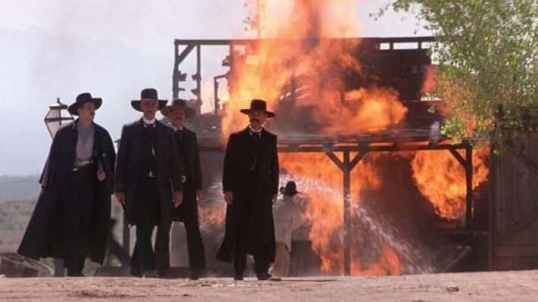
And I still think those flaws are there.  The film had a troubled production, with original director Kevin Jarre falling behind in shooting and getting replaced by George Pan Cosmatos, a director who didn’t have any real interest in the material and whose all-business approach rubbed many members of the cast the wrong way.  Kurt Russell took over production of the film, directing the actors and reportedly paring down the sprawling script to emphasize the relationship between Russell’s Wyatt Earp and Val Kilmer’s Doc Holliday.  On the one hand, this led to a lot of characters who really didn’t seem to have much to do in the finished film.  Jason Priestley’s bookish deputy comes to mind.  On the other hand, Russell was right.

The film’s heart really is found in the friendship between Wyatt and Doc.  It doesn’t matter that, in real life, Wyatt Earp was hardly as upstanding as portrayed by Kurt Russell.  It also doesn’t matter that the real-life Doc Holliday was perhaps not as poetic as portrayed by Val Kilmer.  Today, if you ask someone to picture Wyatt Earp, they’re probably going to picture Kurt Russell with a mustache, a cowboy hat, and a rifle.  And if you ask them to picture Doc Holliday, they’re going to picture Val Kilmer, sweating due to tuberculosis but still managing to enjoy life.  Did Doc Holliday every say, “I’ll be your huckleberry,” before gunning someone down?  He might as well have.  That’s how he’s remembered in the popular imagination.  And it’s due to the performances of Russell and Kilmer that I’ve come around to eventually liking this big and flawed western. With each subsequent viewing, I’ve come to appreciate how Russell and Kilmer managed to create fully realized characters while still remaining true to the Western genre.  If Wyatt Earp initially fought for the law, Doc Holliday fought for friendship.  Kilmer is not only believable as a confident gunslinger who has no fear of walking into a dangerous situation.  He’s also believable as someone who puts his personal loyalty above all else.  He’s the type of friend that everyone would want to have.

That said, I do have to mention that there are a lot of talented people in the cast, many of whom are no longer with us but who will live forever as a result their appearance here.  When Powers Boothe delivered the line, “Well …. bye,” he had no way of knowing that he would eventually become a meme.  Boothe is no longer with us, I’m sad to say.  But he’ll live forever as long as people need a pithy way to respond to someone announcing that they’re leaving social media forever.  Charlton Heston appears briefly as a rancher and he links this 90s western with the westerns of the past.  Robert Mitchum provides the narration and it just feels right.  The large ensemble cast can be difficult to keep track of and even a little distracting but there’s no way I can’t appreciate a film that manages to bring together not just Russell, Kilmer, Boothe, Heston, and Mitchum but also Sam Elliott, Bill Paxton, Michael Biehn, Michael Rooker, Billy Bob Thornton, Frank Stallone, Terry O’Quinn, and even Billy Zane!  The female roles are a bit underwritten.  Dana Delaney is miscast but Joanna Pacula feels exactly right as Doc Holliday’s lover.

But ultimately, this film really does belong to Val Kilmer.  When I heard the sad news that he had passed away last night, I thought of two films.  I thought of Top Gun and then I thought of Tombstone.  Iceman probably wouldn’t have had much use for Doc Holliday.  And Doc Holliday would have resented Iceman’s attitude.  But Val Kilmer — that brilliant actor who was so underappreciated until he fell ill — brought both of them to brilliant life.  In the documentary Val, Kilmer attends a showing of Tombstone and you can say he much he loves the sound of audience cheering whenever Doc Holliday showed up onscreen.

Tombstone was a flawed film and 1993 was a strong year.  But it’s a shame that Val Kilmer was never once nominated for an Oscar.  Tombstone may not have been a Best Picture contender but, in a year when Tommy Lee Jones won the Oscar for Best Supporting Actor for his role in the similarly flawed The Fugitive, it seems a shame that Kilmer’s Doc Holliday was overlooked.

Tombstone (1993, dir by George Pan Cosmatos (and Kurt Russell), DP: William Fraker)

Previous entries in The Unnominated:

  1. Auto Focus 
  2. Star 80
  3. Monty Python and The Holy Grail
  4. Johnny Got His Gun
  5. Saint Jack
  6. Office Space
  7. Play Misty For Me
  8. The Long Riders
  9. Mean Streets
  10. The Long Goodbye
  11. The General

The Unnominated #11: The General (dir by John Boorman)


Though the Academy of Motion Picture Arts and Sciences claim that the Oscars honor the best of the year, we all know that there are always worthy films and performances that end up getting overlooked.  Sometimes, it’s because the competition too fierce.  Sometimes, it’s because the film itself was too controversial.  Often, it’s just a case of a film’s quality not being fully recognized until years after its initial released.  This series of reviews takes a look at the films and performances that should have been nominated but were, for whatever reason, overlooked.  These are the Unnominated.

Directed by John Boorman, 1998’s The General tells the story of Martin Cahill.

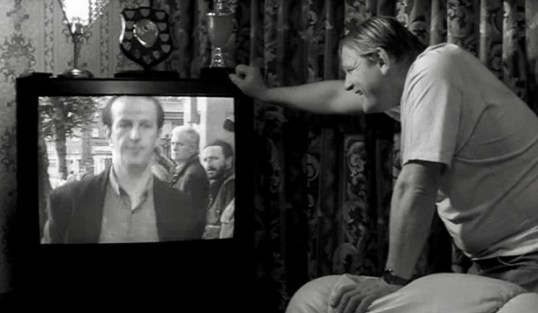
Martin Cahill (Brendan Gleeson) was a Dublin-based crime lord, a thief by trade who never made any apologies for his profession.  The film opens with the end of Martin Cahill’s life.  Leaving his suburban home, he’s sitting behind the steering wheel of his car when a young man runs up and shoots him in the face.  Cahill’s car rolls forward while his wife (Maria Doyle Kennedy) screams for help.  Cahill has been assassinated in front of his family and the reaction of the local police is to celebrate until Cahill’s oldest nemesis, Inspector Ned Kenney (Jon Voight), announces that they have nothing to cheer about.  The film leaves it somewhat ambiguous as to who shot Cahill, though it heavily suggests that he was shot by the IRA, both because of their mistaken belief that he was moving drugs into the neighborhood but also because of his refusal to share his profits with them.

The film flashes back and we watch as Martin Cahill, a rebellious young man who stole to impress girls and to get a shot back at the establishment, grows up to become Martin Cahill, the crime lord that the papers nickname The General.  Cahill is a professional thief and he’s fairly honest about it.  When his government-controlled flat is torn down, Cahill camps out on the site in a tent, refusing to leave because the location of the new building is to close to the police station.  He says he’d rather be moved to a richer part of town.  It’s better for his work.  As portrayed by Brendan Gleeson, Cahill is a fascinating and complex character, a ruthless criminal who is also devoted to his pigeons, his children and both his wife and his girlfriend (Angeline Bail).  (Fortunately, for Martin, his wife and his girlfriend know about each other and are good friends.)  He’s the type of crime lord who will test a man’s loyalty by nailing him to a pool table and then take him to the hospital afterwards.  “Sorry, Martin,” another associate says after Martin shoots him in the leg to make a fake break-in look authentic.  It’s hard not to like the film’s version of Martin Cahill, an intelligent and ultimately honest man who understands the importance of allowing his enemies to believe him to be a buffoon.  He may be a criminal but he considers it to be an honest living, unlike the government officials who force unwanted laws and exorbitant taxation on the citizenry  Director John Boorman certainly seems to like Cahill, which is interesting as Boorman was actually the victim of one of Cahill’s robberies.  (Boorman recreates the robbery in the film.)

The film went unnominated at the Oscars, which were dominated that year by Shakespeare in Love and Saving Private Ryan.  Brendan Gleeson definitely deserved a nomination for his charismatic performance as Martin Cahill.  Equally worthy of a nomination was Seamus Deasy’s black-and-white cinematography, which gives the film the dream-like feel of a half-remembered legend.  (The version of the film that’s on Tubi features desaturated color.  It’s actually an effective look for the film’s story but I still prefer the black-and-white original.)  Neither was nominated and, indeed, Brendan Gleeson would have to wait until 2023 to finally receive his first Oscar nominations for The Banshees of Inisherin.

The General (1998, dir by John Boorman, DP: Seamus Deasy)

Previous entries in The Unnominated:

  1. Auto Focus 
  2. Star 80
  3. Monty Python and The Holy Grail
  4. Johnny Got His Gun
  5. Saint Jack
  6. Office Space
  7. Play Misty For Me
  8. The Long Riders
  9. Mean Streets
  10. The Long Goodbye