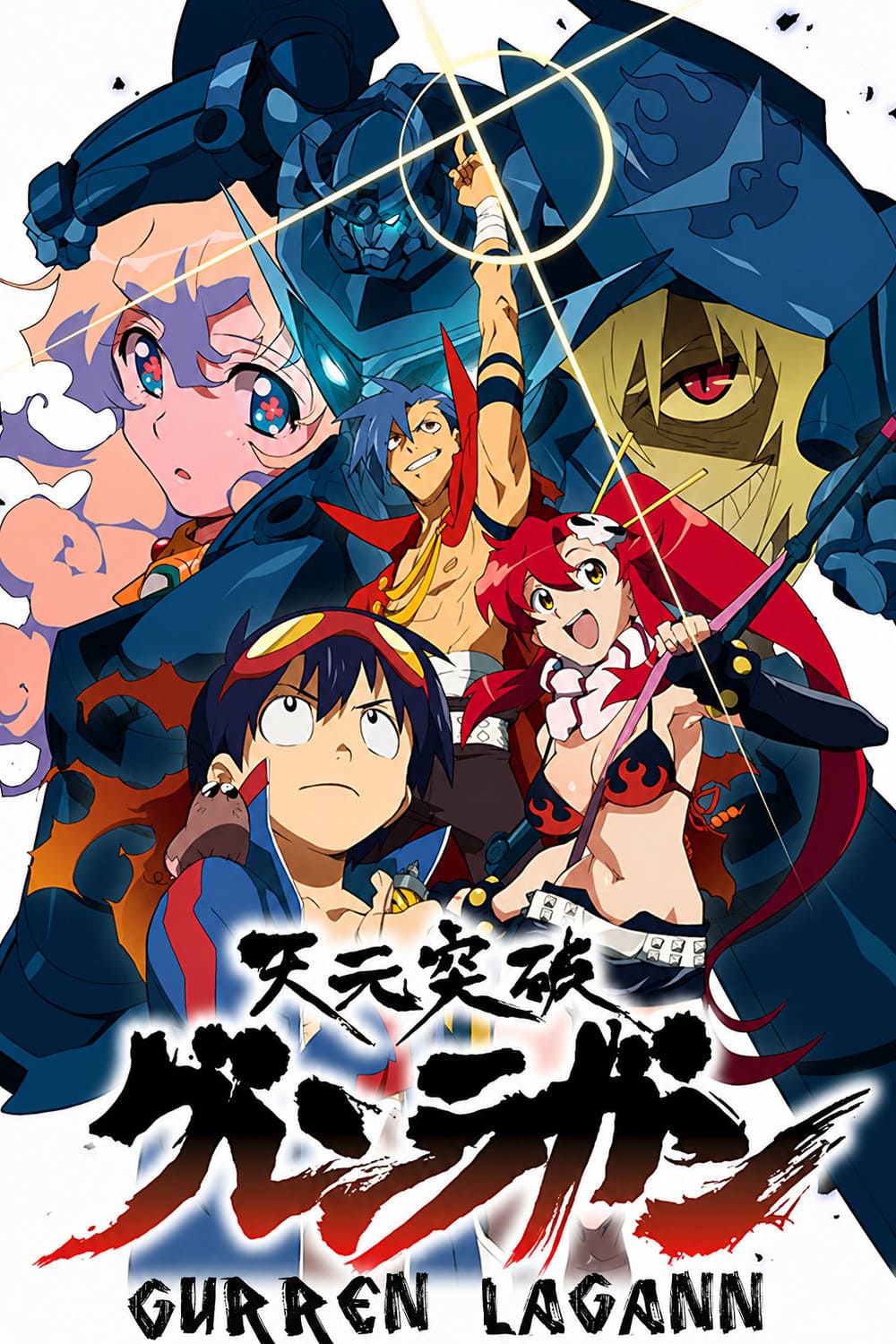
Anime You Should Be Watching: Tengen Toppa Gurren Lagann


“Don’t forget. Believe in yourself. Not in the you who believes in me. Not the me who believes in you. Believe in the you who believes in yourself.” — Kamina

Gurren Lagann is one of those anime that seems to announce itself at maximum volume before the opening theme has even finished. It is loud, ridiculous, earnest, aggressively stylish, and so emotionally committed to its own escalation that it somehow transforms drills, sunglasses, tiny robots, and increasingly impossible acts of defiance into a genuinely moving epic. Produced by Gainax and originally broadcast in 2007, Tengen Toppa Gurren Lagann begins underground with a timid boy named Simon and ends in a place so cosmically huge that describing it risks making the show sound like parody. But that journey—from cramped tunnels beneath the earth to a battle for humanity’s future among the stars—is exactly why it still lands so hard.

The premise starts simply. Simon lives in an underground village where people have been conditioned to accept a small, confined existence beneath a hostile surface world. He spends his days digging tunnels, largely ignored by the others around him, until his life is upended by Kamina, a reckless older boy who insists that the surface exists and that humans belong there. Kamina’s conviction is less a coherent philosophy than a full-force personality trait: he believes in breaking through walls because walls are there to be broken. When Simon discovers a small drill-shaped device and a miniature mecha called Lagann, the pair’s ambitions become suddenly possible. Their escape to the surface introduces Yoko, the series’ sharp-shooting, level-headed third lead, and kicks off a war against the Beastmen and their towering Gunmen.

On paper, that sounds like a standard mecha adventure. In practice, Gurren Lagann uses that foundation as a launchpad for a story about grief, courage, self-definition, and the strange process of becoming the person you need to be after the person you depended on is gone. Its early episodes are especially effective because Simon is not immediately framed as a hidden hero. He is anxious, withdrawn, and clearly accustomed to having Kamina speak for him. Kamina may be the show’s loudest presence, but Simon is its emotional center. The series understands that confidence is not just something a character “gets” after a training montage. It has to be built through failure, fear, loss, responsibility, and the gradual realization that admiration is not the same thing as identity.

Kamina is still the character most people remember first, and it is easy to see why. His dialogue is endlessly quotable, his poses are absurdly theatrical, and his belief in Simon is powerful precisely because it is so unconditional. Kamina does not believe Simon is capable because Simon has proven himself; he believes Simon will prove himself because he already sees something in him. That relationship gives the early part of Gurren Lagann its heart. Kamina is not merely a mentor figure or a source of comic bravado. He is the force that makes Simon look upward. The show’s famous “believe in the me that believes in you” idea could have been corny in another context, but here it becomes a sincere expression of what it means to lend someone confidence until they can create their own.

The series’ willingness to change after its major emotional turning point is what elevates it beyond a very good action show. Gurren Lagann understands that inspirational speeches cannot erase trauma. Simon does not simply inherit Kamina’s confidence; he has to confront the fact that trying to imitate Kamina leaves him hollow. His eventual growth is about accepting Kamina’s influence without becoming trapped inside it. That distinction gives the show surprising maturity beneath all the bombast. Simon’s ultimate strength comes not from copying another person’s legend, but from finding a voice and resolve that belong to him alone.

Yoko is also more important than the usual “female lead in a shōnen-style action series” label would suggest. She has to serve as both a capable fighter and one of the few people who can puncture the boys’ more reckless impulses, but Gurren Lagann gives her a real emotional presence beyond that function. Her grief, her resilience, and her continued movement through a world that keeps changing around her make her feel essential to the story’s broader ideas about survival. The show’s presentation of Yoko can be very much of its mid-2000s anime era, and some of its fanservice has not aged particularly gracefully. Still, she is never reduced entirely to that material, and the series repeatedly reminds the audience that she is a veteran combatant and a person carrying losses of her own.

Visually, Gurren Lagann remains an absolute blast. Its art style is dynamic in a way that feels almost physically restless. The animation stretches bodies, machines, perspective, and scale for emotional effect rather than strict mechanical realism. Characters lean into poses so hard they feel like they might burst through the frame. Mecha do not merely move; they lunge, twist, slam, and spiral forward with a sense of weight and raw momentum. The show frequently uses exaggerated proportions, thick expressive linework, explosive color, and wild camera angles to make every confrontation feel bigger than the last. Even its stillness has energy, because the designs and compositions are always angled toward motion.

That visual approach has had a real influence on anime in the years since its release. You can see echoes of Gurren Lagann’s expressive exaggeration, bold color blocking, elastic action, and preference for emotional impact over restrained realism in much of the work associated with former Gainax talent and Studio Trigger, particularly Kill la KillPromareLittle Witch Academia, and Cyberpunk: Edgerunners. Its influence is broader than any one studio, though. The show helped solidify a modern appetite for animation that can be rough-edged, hyperactive, and knowingly excessive without sacrificing sincerity. A lot of later anime have chased its surface energy—the crazy transformations, the screaming declarations, the impossible scale—but fewer have replicated how carefully Gurren Lagann ties that escalation to character growth.

The mecha designs deserve special credit because they capture the show’s philosophy better than any speech could. Lagann starts as a small, almost toy-like machine, while Gurren is clunky, hot-blooded, and visually associated with Kamina’s swagger. When they combine into Gurren Lagann, the result is not sleek or conventionally elegant. It looks improvised, rebellious, and barely interested in obeying the normal rules of robotics. That is exactly the point. In Gurren Lagann, machines become expressions of willpower. They are not military hardware treated with sterile technical reverence; they are emotional extensions of the people piloting them. The more the characters believe they can surpass a limitation, the more absurdly grand their machines become.

The escalation is famously outrageous, but it is not random. The series moves from village-scale conflict to planetary stakes and eventually to something far beyond that, while preserving the same central question: what do people do when someone or something tells them that they have reached their limit? The antagonistic force behind the story, particularly through the Anti-Spiral, represents stagnation disguised as protection. The Anti-Spiral’s logic has a certain bleak rationality: humanity’s capacity to grow is dangerous, so it must be contained. Simon and the rest of Team Dai-Gurren respond with the series’ central rebuttal—that the risk of moving forward is inseparable from being alive. It is a simple message, but the show sells it with such conviction that it feels almost mythic.

This is also where Gurren Lagann separates itself from pure power fantasy. The characters win because they keep pushing forward, but the series does not pretend that forward movement makes pain disappear. People die. Dreams change. The ending, for all its spectacle, is not a cheap promise that determination guarantees a perfect reward. It recognizes that growing up often means accepting the cost of the choices that define you. Simon’s final arc is compelling because he becomes powerful enough to reshape the universe, yet the story still asks him to live with restraint, loss, and the knowledge that not every desire should be fulfilled simply because it can be.

The soundtrack is equally crucial to the experience. Taku Iwasaki’s score knows exactly when to go huge, mixing orchestral intensity, dramatic choral material, rock energy, and hip-hop-inflected momentum. “Libera Me From Hell” is the obvious standout, and it remains one of the most gloriously over-the-top climactic tracks in anime. It should not work as well as it does. The blend of opera and rap sounds like something invented as a joke, but in the context of Gurren Lagann, it feels completely natural. The song captures the entire show’s spirit: dramatic, strange, sincere, and unwilling to accept the idea that two seemingly incompatible things cannot be fused into something incredible.

There are flaws, of course. The first few episodes can feel especially frantic, and the humor occasionally leans into juvenile territory in ways that may test a new viewer’s patience. Some supporting characters get less development than they deserve, especially once the plot begins accelerating toward its larger conflicts. The fanservice is the element most likely to feel dated, since it can interrupt scenes that are otherwise focused on emotional gravity or visual spectacle. Yet even with those issues, Gurren Lagann never loses its sense of purpose. It is too alive, too earnest, and too committed to its own vision to feel disposable.

More than anything, Gurren Lagann endures because it understands the appeal of impossible optimism. It does not tell viewers that the world will always reward them, or that bravery means never being afraid. Instead, it argues that fear, grief, and uncertainty are not final states. You can carry them with you and still move forward. You can outgrow the person you used to be without betraying them. You can take inspiration from someone else without surrendering your own identity. And if the wall in front of you seems impossible to break, maybe the answer is not to wait for permission. Maybe you pick up a drill and start spinning.

Anime You Should Be Watching

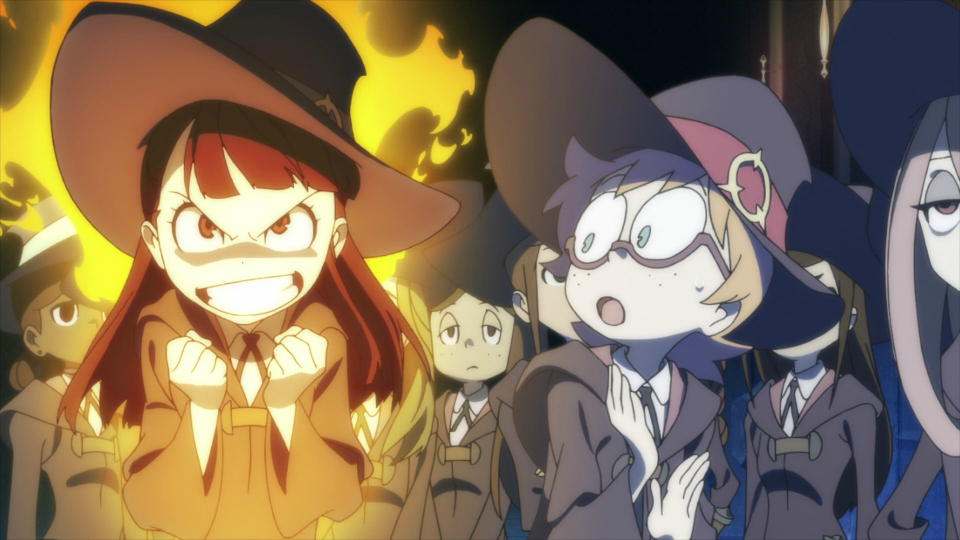
AMV of the Day: Dazzling Inferno (Little Witch Academia)


The latest “AMV of the Day” is about this cute, little anime called Little Witch Academia that first began as a short anime film then a sequel that was much longer.

“Dazzling Inferno” combines sequences from both the Little Witch Academia films with the song “Warrior” by Steve James (feat. LIGHTS). It focuses very much so on the character of Akko who (unlike Harry Potter) stumbles, mistakes her way through magical adventures in the titular academy and despite her failings never faltering in her joy at being a witch-in-training.

There’s now an anime series currently airing in Japan that continues that adventures of Akko and her misfits friends and schoolmates. What better way to whet one’s appetite for the series than an anime music video that highlights a major theme in the anime.

Anime: Little Witch Academia

Song: “Warrior” (feat. LIGHTS) by Steve James

Creator: Radical Yue

Past AMVs of the Day

Convention Report: Kawaii Kon 2016


This is a delayed live report from Kawaii Kon in Honolulu, Hawaii! (As in I’m writing this several days after I’ve returned from said convention, because I don’t get paid to travel to conventions and report live)  This is the first time that I, pantsukudasai56, and by extention Through the Shattered Lens, has been to this convention, so what you’re getting here are my completely initial reactions to this convention.  This is actually a big deal, because first impressions really are everything.  The first time I went to Anime Expo was in 2005, and today I’d probably have to be paid to go back again because it’s too crowded.  My first Anime Boston was in 2006, and again, currently I’d have to be paid to go back because of the hostile environment the city of Boston has fostered towards the convention.  But, in both those cases, I went to their conventions much longer than I normally would have because I had such a great time initially.  Did Kawaii Kon give me the same impression?  Well, I’ll save you a lot of reading and tell you straight up now, yes, yes it did.  Oh sure, I know you’re thinking that after flying myself out from the east coast of the United States that I’d force myself to enjoy my time after spending 13 hours on a plane, and you might not be terribly off course for thinking such.  However, let me tell you something straight up.  Since I was staying in Honolulu, and more accurately a mere mile away from the famous Waikiki Beach, if I wasn’t enjoying myself I’d have had no problem turning my convention vacation into a regular tourist vacation.  The fact is, I never once made it down to the beach, because Kawaii Kon knows what it’s doing, and after 12 years, they’re doing it well.

First, let’s get one thing out of the way.  When I go to conventions, in almost every case, save for a certain semi-local convention, I go to see Japanese guests.  Generally speaking, the larger, and especially the larger west coast conventions are the ones that attract the most Japanese talent.  The king of this is Anime Expo, mainly because they have the money and the attendance figures to drive this.  However, the #2 convention for attracting Japanese guests this year so far has been Kawaii Kon with an astounding 10 out of 24 guests being from the Japanese side.  Why is this so amazing, you might ask?  Well, to put it in perspective, Kawaii Kon had an attendance of 11,597 unique attendees.  Compare this with larger cons like Anime Boston which had 26,975, and Sakura Con, which has yet to announce 2016 numbers, but had 23,419 in 2015, and both those cons only had about the same number of total guests, and less Japanese guests, with over twice the attendance numbers, and you can see that Kawaii Kon makes more of their budget than any other convention out there.  Even big name conventions like Otakon barely surpass the guest list.

But sure, guest lists don’t mean anything if they’re a bunch of no name people, right?  Well, for those who follow anime, there definitely were some Who’s Who type of names coming to this convention.  The biggest name I’d drop is Toshio Maeda.  He’s well known as the Father of Tentacles, what with him being the creator of La Blue Girl, and most famously, Urotsukidoji.  If anyone reading this has ever watched a tentacle porn hentai, then Mr. Maeda is the man you want to thank.  And not only is he awesome for creating one of my most favorite genre, but he’s also super thankful towards his fans, to the point that he’s quite happy to come and take a picture with them, like he did with me.

Let me say that not only was he happy to do that, but I also got a signature for site founder Arleigh, and he wasn’t fine with the rough sketch he made that I bought, but insisted upon taking the time to improve it and make it look nicer.  Plus when I was checking out of the hotel two days after the convention, I noticed he was checking out at the same time and went to thank him, and he remembered me from the first day of the convention!  This man is a legend, and he became one of my personal heroes just from doing small things like that.

But there were many other great Japanese guests at this middle sized convention.  For fans of the Idolmaster franchise, there was the voice of Ami and Mami Futami, as well as the voice of Len and Rin Kagamine, Asami Shimoda (She sure has a proclivity towards voicing twins, doesn’t she?).  Here she is signing an item for me

Thankfully I had the foresight, and the bank account, to sign up for a VIP membership, which allowed me to skip to the front of autograph lines, because she was easily the most popular Japanese voice guest as far as autographs was concerned.  Immediately following her autograph session was a Q&A session, and some poor fools were begging for her autograph, and she had to sadly inform them that all her sessions were done.  I did see her one more time after the convention was over when we shared an elevator down to the lobby, but since my Japanese is extremely limited, I didn’t want to bother her even though her interpreter was standing nearby.  Besides, that would have just been for my own satisfaction, and I never want guests at these conventions to feel like they have to be inconvenienced just for us fans sake, even though I know she would have been extremely polite towards me if I had.

But I did say there were 10 Japanese guests, no?  Let me shoot straight, just because they’re Japanese doesn’t mean I’m gonna be an instant fan, but for most of the guests that does hold true, so next on the list is Yumiri Hanamori.

I do apologize for the side profile shot, but my other pictures didn’t come out as well as this one.  I wish I were a better kameko.  Let me say one thing about Miss Hanamori.  I was a fan of her works prior to meeting her, and I am more of a fan after meeting her because when I got her autograph on Sunday, she remembered me from Saturday, even though I was in cosplay then and looked fairly different.  Honestly, it’s little things like that that make me respect a voice actor all the more and I’ll definitely be looking forward to her future works.

Next on the list of guests that I really wanted to meet was a duo from one of my favorite animation studios.  I got to meet Shigeto Koyama and Hiromi Wakabayashi from Studio Trigger, who were personally involved in several of my favorite anime, including Little Witch Academia, Kill la Kill, and Ninja Slayer.

(Shigeto Koyama is on the left, Hiromi Wakabayashi is on the right)

These two gave probably my favorite panel of the convention, in which they gave a lot of insight towards what happens behind the scenes in an animation studio.  Luckily I had the foresight to take these pictures of them because during their panel they were showing video that hadn’t even been shown in Japan yet, so all recording was forbidden.  All in all I wound up becoming even more of a Studio Trigger fan, if that was even possible!

Speaking of Kill la Kill, another guest that the convention brought in was the musical group Garnidelia, who sang the second opening song to that anime.  In addition to Shimoda-san and the Trigger duo, this was another group that I used my VIP status to jump right to the front of the autograph line, which was good since even though it was a Friday, which is typically the slower of the two major days (Friday and Saturday), there still was a huge line to get their autograph.

But admittedly I am a guy, and so my focus was primarily on Maria, aka Mai Mizuhashi.

In most Japanese pop groups consisting of male and female performers, the females tend to get a lot more attention, largely due to their fans being lonely otaku.  But, hard not to see why when these groups have such lovely ladies in them.

Finally, the last autograph I got was of Natsuko Hara.  She’s definitely a newcomer in the anime scene, one that I haven’t really seen many roles of her, but everyone is a newcomer at some point, and you never know when someone is going to become super famous.  Here’s me getting a picture taken with her

Yes, I look much different from my picture with Maeda-san.  That picture was taken on Friday, this was on Sunday, and on Saturday I cosplayed as King Hippo from Punch Out, hence the shaved head (and shaved chest and stomach.  TMI?)  But honestly, I love getting autographs from lesser known talent like that, because you never know if they’re gonna get that one big role that puts them on the map.  And if they don’t, well who cares, it was fun anyways.  So fun, that my next pic with her winds up looking like I have a Hentai Woody face.  What’s a Hentai Woody Face you might ask?

That’s a Hentai Woody face.  That was totally random, but it just wound up looking bad.  For the record, this is the original Hentai Woody.

See the resemblance?

But enough about me, in addition to the great guests, there’s always an abundance of cosplay.  I myself did some cosplay, as I mentioned before, even though I was censored (Thanks staffer Jacob, for singling me out.  Yeah, funny how it was such an important rule for people to not have topless cosplay, except for all those tanned buff guys that were walking around without shirts.  I get it, I’m not super great to look at without a shirt on, but you didn’t have to be so obvious), so after that bit of complaining, let’s get on to the good cosplay that I saw!

First off, on the first day, within the first couple minutes of me getting to the convention center, I came across this spot on Saitama from One Punch Man.  I alway approve of people who go the extra mile to make their cosplay perfect, and the fact that this guy went and shaved his head makes it all the better. (or maybe he’s naturally bald and he’s just rolling with a cosplay that works with that.  Either way, good for him!)

This is Shinoa Hiragi from Owari no Seraph (Seraph of the End).  A fairly recent show, as it started last fall, I suspect there will be a lot more females doing cosplay of this, since the show is very popular amongst women due to its implied BL (boy’s love) leanings.

This was a really cute Mortal Kombat cosplay that I saw.  You often see plenty of single characters, especially Sub Zero, walking around any given convention, but what make this one special was not only it being a family cosplay, with the mother and her son doing it, but the fact that they made it look like the video game with someone holding the status bar.  Really well done and a great example of cosplay being a good family activity.

This is a Nagisa from Assassination Classroom.  Since this was a medium/small convention, I was more surprised that there was someone doing this cosplay rather than surprised there weren’t more.  I did see a Koro-sensei (someone dressed like the doll she’s holding), but unfortunately I was in a hurry to get to an autograph session, so I couldn’t pause to take their picture too.  Expect to see a lot more of this cosplay during the summer conventions.

This is a cosplay that is no doubt near and dear to both me and Arleigh.  This is an Umaru from the recent anime Himouto Umaru-chan.  This was a very divisive character in the anime community, in that you either loved her, or hated her with the passion of a million burning suns.  There was no middle ground.  Personally me, and I know Arleigh, both adored her, but I can certainly see where her antics would rub people the wrong way.

This is one of those characters that I’m familiar with, but I haven’t actually watched the anime that she comes from.  She’s one of the most popular girls (and waifu candidates) from the fall and winter seasons of Gate, and her name is Rori.  Since the spring season of anime is looking slow for me, perhaps I’ll give this show a shot.  I would also like to give this girl a lot of credit, because when I was trying to take her picture my camera wasn’t interested in focusing properly, so it took me almost 30 seconds to get the picture.  Thirty seconds might not seem like much to most people, but when you’re posing, it’s an eternity.  It’s amazing she could keep her smile for that long!

This is one of the more famous characters that I took pictures of.  The male is dressed as Spike Spiegel, and the female is of Faye Valentine, both of Cowboy Bebop fame.  This is one of cases where the anime was possibly more popular in the United States than it was in its homeland of Japan.  The best part of this is, I didn’t see Man Faye.  Don’t know who Man Faye is?  Good.  Don’t Google it.  Don’t. Google. It.

Another blast from the past.  Back when I was really starting out as an anime collector, there were very few options.  Unlike today, where there are over 100 new anime released each year, back then we’d be lucky to get 30 anime.  I know, this makes me sound like one of those grumpy old anime fans.  Trust me, I hate them too.  But this really is from a classic, Ranma 1/2.  Here we see Ranma in his female version (for those that don’t know, when Ranma is normal, he’s a boy, when he’s splashed with cold water, he’s a girl and won’t revert until splashed with warm water), and the one holding the giant spatula next to him is the best girl, Ukyo.  See, Ranma 1/2 was also probably the first, or at least the most well know among western anime fans, of the harem genre.  This is where one guy has multiple girls who are vying for his attention.  In Ranma’s case, he had 4 girls actively going after him, with a couple others that had passing interests as the story required.  Good times.

This is another blast from the past, and probably the first yuri (lesbian) series that most anime fans are familiar with.  This is Utena and Anthy from Revolutionary Girl Utena. When I say it’s a lesbian series, I’m not talking super overt and very explicit, but it’s very obvious as the series goes on.  There’s a ton I could say about this particular show, especially how it was pretty revolutionary (no pun intended) in how it stretched a paper thin budget that could barely support 13 episodes out to a 39 episode series.  I don’t use the term classic lightly, but this is definitely an anime classic.

This is from a show that I’m frankly surprised hasn’t inspired more cosplay.  This young lady is cosplaying as Erza Scarlett from Fairy Tail.  To be more specific, she’s cosplaying as Erza equipped with her Heaven’s Wheel armor.  Of Erza’s many many armors, this is one of the more complex ones, so I give her a lot of props for pulling it off.  Really, you can go to many conventions, and you just plain don’t see much Fairy Tail cosplay.  There also was a Gray Fullbuster walking around too, but I’m not a huge fan of taking pictures of guys, and I saw him walking around shirtless after I had been told to cover up, so I was feeling kinda bitter.  Sorry Gray, you came at the wrong time.

This one should be very familiar to anyone that was even passively interested in anime and watched it on broadcast TV.  This is the Dark Magician Girl from the anime Yu-Gi-Oh, and for a lot of newer anime fans, she was the first waifu they ever had.  I probably should explain that a waifu is an anime character that people have strong feelings of attraction towards, the literal meaning being that they want to marry that character, hence the term waifu, which is I suppose a bit of an insulting way of saying you want said character to be your wife.  (kind of mocking the way Japanese say a lot of English terms, waifu is the way the Japanese would say “wife” in English since Japanese words always end in a vowel sound, except for words ending in -n)  Surprisingly, this is probably the first Dark Magician Girl I’ve ever seen at any convention.  At the very least, she’s the only one that I’ve felt was worth taking a picture of.

Now, anime conventions aren’t solely about anime.  I myself dressed up as a video game character, and here we see a group that has dressed up as Star Wars: The Force Awakens characters.  I especially love cosplay like this, where the whole family gets involved.  Trust me, there were a ton of Kylo Ren cosplayers walking around.  There were the usual ton of Stormtrooper cosplay.  There were several Rey Skywalker Mysteriousgirlwedontknowwhoherdadis cosplayers too.  But this was the only group who actually was coordinating their costume.  Plus the little girl was towing the BB8 unit around, and it was way too cute.

Told you there were cosplayers walking around without shirts on that weren’t being molested by Jacob.  But, naturally he has a six pack, and not a keg.  Really though, I didn’t take this picture to make a point, I took it because he’s cosplaying as someone from Shimoneta, a particularly hilarious, yet sad anime from this summer.  Hilarious because the content is just plain funny.  Sad, because one of the lead voice actresses in the show died at the young age of 38.

Sometimes I just see a costume that even when I don’t know where it’s from, it’s just so well done that I need to take a picture of it.  This is one of those.

And this is another.  Did they make them themselves?  If so, great.  Did they commission someone else to make them?  If so, who cares?  Really nice costumes either way.

So, while this was the second smallest convention I’ve ever attended (Another Anime Convention in New Hampshire was the smallest at around 3000 people) it’s probably the one that’s been the most fun in recent times.  Many other conventions could learn from their example that you can have a really fun show and don’t need 30,000 or more attendees.

I’ll end this rather lengthy post with one final picture.  This picture wasn’t taken by me, and it wasn’t from this convention, but it was taken OF me, at a previous convention, and it’s the same cosplay I did at this convention of King Hippo of Punch Out fame.

I have no idea why Jacob or anyone else would find that obscene.  Some people have no taste.  (yes, I’m ticked off at Jacob.  Bastard)