Anime You Should Be Watching: Tengen Toppa Gurren Lagann


“Don’t forget. Believe in yourself. Not in the you who believes in me. Not the me who believes in you. Believe in the you who believes in yourself.” — Kamina

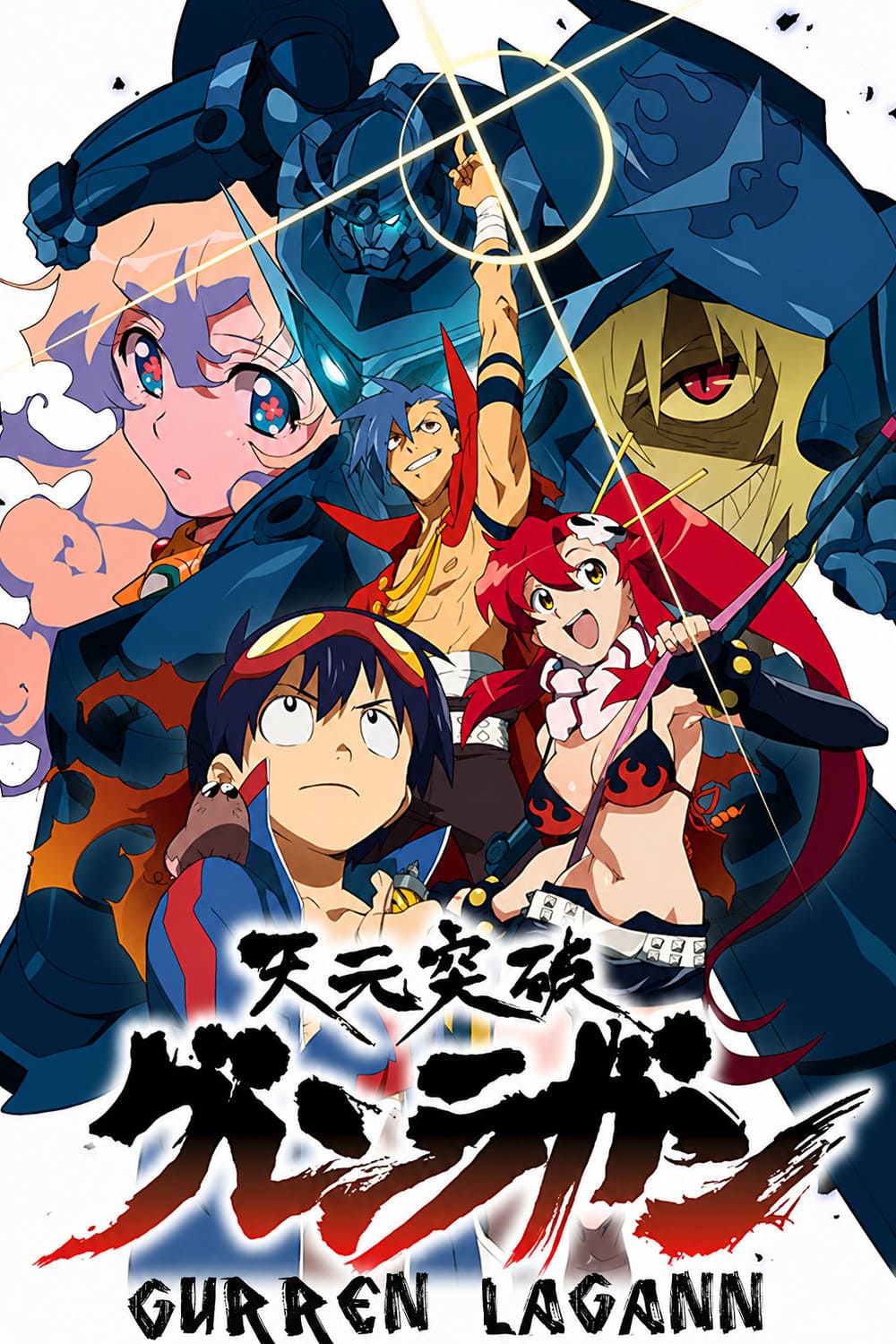
Gurren Lagann is one of those anime that seems to announce itself at maximum volume before the opening theme has even finished. It is loud, ridiculous, earnest, aggressively stylish, and so emotionally committed to its own escalation that it somehow transforms drills, sunglasses, tiny robots, and increasingly impossible acts of defiance into a genuinely moving epic. Produced by Gainax and originally broadcast in 2007, Tengen Toppa Gurren Lagann begins underground with a timid boy named Simon and ends in a place so cosmically huge that describing it risks making the show sound like parody. But that journey—from cramped tunnels beneath the earth to a battle for humanity’s future among the stars—is exactly why it still lands so hard.

The premise starts simply. Simon lives in an underground village where people have been conditioned to accept a small, confined existence beneath a hostile surface world. He spends his days digging tunnels, largely ignored by the others around him, until his life is upended by Kamina, a reckless older boy who insists that the surface exists and that humans belong there. Kamina’s conviction is less a coherent philosophy than a full-force personality trait: he believes in breaking through walls because walls are there to be broken. When Simon discovers a small drill-shaped device and a miniature mecha called Lagann, the pair’s ambitions become suddenly possible. Their escape to the surface introduces Yoko, the series’ sharp-shooting, level-headed third lead, and kicks off a war against the Beastmen and their towering Gunmen.

On paper, that sounds like a standard mecha adventure. In practice, Gurren Lagann uses that foundation as a launchpad for a story about grief, courage, self-definition, and the strange process of becoming the person you need to be after the person you depended on is gone. Its early episodes are especially effective because Simon is not immediately framed as a hidden hero. He is anxious, withdrawn, and clearly accustomed to having Kamina speak for him. Kamina may be the show’s loudest presence, but Simon is its emotional center. The series understands that confidence is not just something a character “gets” after a training montage. It has to be built through failure, fear, loss, responsibility, and the gradual realization that admiration is not the same thing as identity.

Kamina is still the character most people remember first, and it is easy to see why. His dialogue is endlessly quotable, his poses are absurdly theatrical, and his belief in Simon is powerful precisely because it is so unconditional. Kamina does not believe Simon is capable because Simon has proven himself; he believes Simon will prove himself because he already sees something in him. That relationship gives the early part of Gurren Lagann its heart. Kamina is not merely a mentor figure or a source of comic bravado. He is the force that makes Simon look upward. The show’s famous “believe in the me that believes in you” idea could have been corny in another context, but here it becomes a sincere expression of what it means to lend someone confidence until they can create their own.

The series’ willingness to change after its major emotional turning point is what elevates it beyond a very good action show. Gurren Lagann understands that inspirational speeches cannot erase trauma. Simon does not simply inherit Kamina’s confidence; he has to confront the fact that trying to imitate Kamina leaves him hollow. His eventual growth is about accepting Kamina’s influence without becoming trapped inside it. That distinction gives the show surprising maturity beneath all the bombast. Simon’s ultimate strength comes not from copying another person’s legend, but from finding a voice and resolve that belong to him alone.

Yoko is also more important than the usual “female lead in a shōnen-style action series” label would suggest. She has to serve as both a capable fighter and one of the few people who can puncture the boys’ more reckless impulses, but Gurren Lagann gives her a real emotional presence beyond that function. Her grief, her resilience, and her continued movement through a world that keeps changing around her make her feel essential to the story’s broader ideas about survival. The show’s presentation of Yoko can be very much of its mid-2000s anime era, and some of its fanservice has not aged particularly gracefully. Still, she is never reduced entirely to that material, and the series repeatedly reminds the audience that she is a veteran combatant and a person carrying losses of her own.

Visually, Gurren Lagann remains an absolute blast. Its art style is dynamic in a way that feels almost physically restless. The animation stretches bodies, machines, perspective, and scale for emotional effect rather than strict mechanical realism. Characters lean into poses so hard they feel like they might burst through the frame. Mecha do not merely move; they lunge, twist, slam, and spiral forward with a sense of weight and raw momentum. The show frequently uses exaggerated proportions, thick expressive linework, explosive color, and wild camera angles to make every confrontation feel bigger than the last. Even its stillness has energy, because the designs and compositions are always angled toward motion.

That visual approach has had a real influence on anime in the years since its release. You can see echoes of Gurren Lagann’s expressive exaggeration, bold color blocking, elastic action, and preference for emotional impact over restrained realism in much of the work associated with former Gainax talent and Studio Trigger, particularly Kill la KillPromareLittle Witch Academia, and Cyberpunk: Edgerunners. Its influence is broader than any one studio, though. The show helped solidify a modern appetite for animation that can be rough-edged, hyperactive, and knowingly excessive without sacrificing sincerity. A lot of later anime have chased its surface energy—the crazy transformations, the screaming declarations, the impossible scale—but fewer have replicated how carefully Gurren Lagann ties that escalation to character growth.

The mecha designs deserve special credit because they capture the show’s philosophy better than any speech could. Lagann starts as a small, almost toy-like machine, while Gurren is clunky, hot-blooded, and visually associated with Kamina’s swagger. When they combine into Gurren Lagann, the result is not sleek or conventionally elegant. It looks improvised, rebellious, and barely interested in obeying the normal rules of robotics. That is exactly the point. In Gurren Lagann, machines become expressions of willpower. They are not military hardware treated with sterile technical reverence; they are emotional extensions of the people piloting them. The more the characters believe they can surpass a limitation, the more absurdly grand their machines become.

The escalation is famously outrageous, but it is not random. The series moves from village-scale conflict to planetary stakes and eventually to something far beyond that, while preserving the same central question: what do people do when someone or something tells them that they have reached their limit? The antagonistic force behind the story, particularly through the Anti-Spiral, represents stagnation disguised as protection. The Anti-Spiral’s logic has a certain bleak rationality: humanity’s capacity to grow is dangerous, so it must be contained. Simon and the rest of Team Dai-Gurren respond with the series’ central rebuttal—that the risk of moving forward is inseparable from being alive. It is a simple message, but the show sells it with such conviction that it feels almost mythic.

This is also where Gurren Lagann separates itself from pure power fantasy. The characters win because they keep pushing forward, but the series does not pretend that forward movement makes pain disappear. People die. Dreams change. The ending, for all its spectacle, is not a cheap promise that determination guarantees a perfect reward. It recognizes that growing up often means accepting the cost of the choices that define you. Simon’s final arc is compelling because he becomes powerful enough to reshape the universe, yet the story still asks him to live with restraint, loss, and the knowledge that not every desire should be fulfilled simply because it can be.

The soundtrack is equally crucial to the experience. Taku Iwasaki’s score knows exactly when to go huge, mixing orchestral intensity, dramatic choral material, rock energy, and hip-hop-inflected momentum. “Libera Me From Hell” is the obvious standout, and it remains one of the most gloriously over-the-top climactic tracks in anime. It should not work as well as it does. The blend of opera and rap sounds like something invented as a joke, but in the context of Gurren Lagann, it feels completely natural. The song captures the entire show’s spirit: dramatic, strange, sincere, and unwilling to accept the idea that two seemingly incompatible things cannot be fused into something incredible.

There are flaws, of course. The first few episodes can feel especially frantic, and the humor occasionally leans into juvenile territory in ways that may test a new viewer’s patience. Some supporting characters get less development than they deserve, especially once the plot begins accelerating toward its larger conflicts. The fanservice is the element most likely to feel dated, since it can interrupt scenes that are otherwise focused on emotional gravity or visual spectacle. Yet even with those issues, Gurren Lagann never loses its sense of purpose. It is too alive, too earnest, and too committed to its own vision to feel disposable.

More than anything, Gurren Lagann endures because it understands the appeal of impossible optimism. It does not tell viewers that the world will always reward them, or that bravery means never being afraid. Instead, it argues that fear, grief, and uncertainty are not final states. You can carry them with you and still move forward. You can outgrow the person you used to be without betraying them. You can take inspiration from someone else without surrendering your own identity. And if the wall in front of you seems impossible to break, maybe the answer is not to wait for permission. Maybe you pick up a drill and start spinning.

Anime You Should Be Watching

AMV of the Day: Don’t Stop Me Now (One Piece)


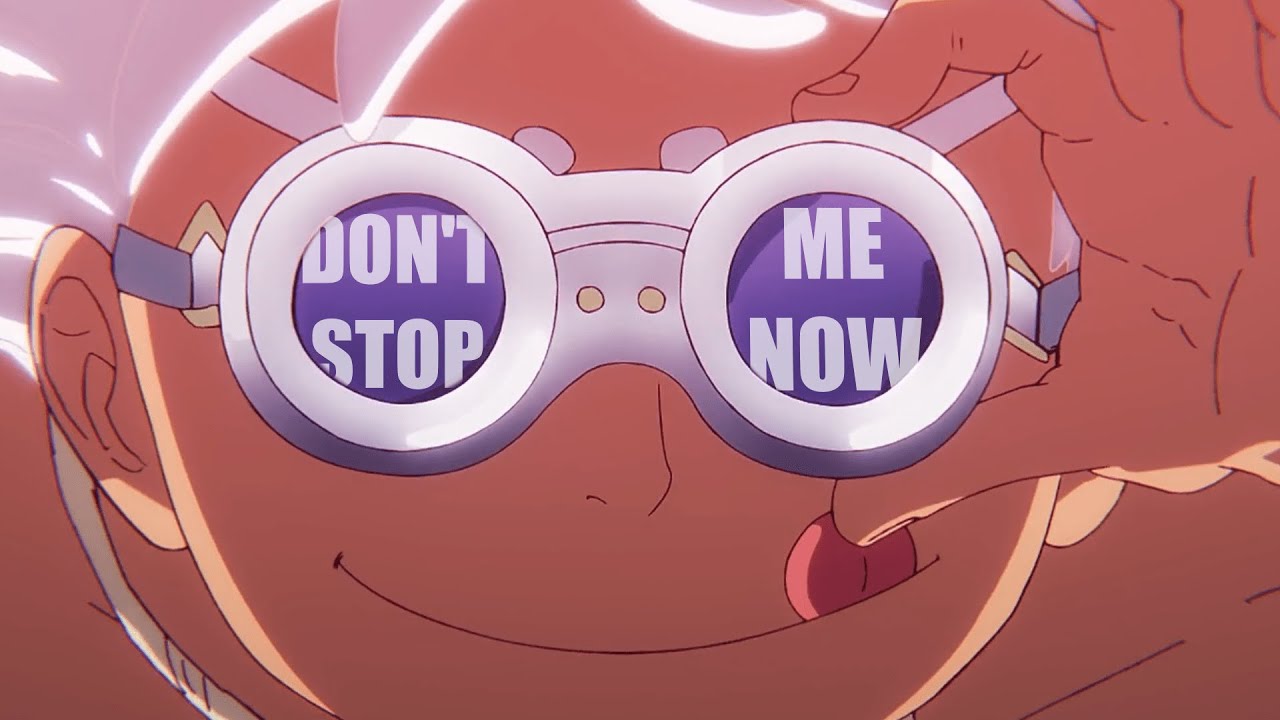
This AMV, crafted by AliAMV, turns Luffy’s Gear 5 fight against Rob Lucci into a gloriously unhinged, hyper‑frenetic spectacle set to Queen’s “Don’t Stop Me Now.” The edit leans hard into the absurdity: every punch, stretch, and rebound feels like a rubber‑powered cartoon disaster in motion, with Luffy’s contorted, kiddy‑god form bouncing off walls, ceilings, and Lucci’s face like a giddy pinball on amphetamines.

Even in its original form—without Freddie Mercury belting in the background—the scene of Luffy in Gear 5 clashing with Lucci in his Leopard Devil Fruit form is already deeply ridiculous. The animation leans into over‑the‑top impact frames, gravity‑defying acrobatics, and exaggerated expressions that push the whole thing past “serious battle” and into full‑blown, self‑aware slapstick. AliAMV’s timing only amplifies that inherent silliness, using “Don’t Stop Me Now”s unstoppable swagger to justify every impossible hit, freeze‑frame, and impact‑spark explosion in the sequence. The clash stops feeling like a serious assassin‑level duel in One Piece and instead becomes a high‑speed demolition‑derby‑slash‑Saturday‑morning‑cartoon, where Rob Lucci is less a foe and more a crash‑test dummy for Gear 5’s sheer ridiculousness.

For anyone who enjoys One Piece hype‑edits dialed up to eleven, it’s a solid showcase of how chaotic, music‑driven fan editing can turn a seriously animated fight into pure, shameless spectacle. AliAMV definitely does a great job in showcasing what makes One Piece such a popular and beloved shonen anime.

Song: Don’t Stop Me Now by Queen

AnimeOne Piece

CreatorAliAMV

Past AMVs of the Day

Horror AMV of the Day: Carnivore (Tokyo Ghoul)


TokyoGhoulKaneki

While horror anime is not quite widespread as other genres they do exist and one of the more recent ones is the horror/dark fantasy series which came out this past July.

Tokyo Ghoul is the anime from whence our latest “AMV of the Day” was born from. I’ve only seen highlight clips of the series, but from what I’ve seen it’s definitely right up my alley. It’s not so violent and gory that it goes over into “guro” realm. It looks like it’s series dealing with ghouls hiding within the human population and having their own clans and factions gives the series a nice urban gothic feel to it in addition to the horror.

This particular AMV uses the appropriate song by Starset called “Carnivore” which is one thing the ghouls in this series tend to be as eaters.

Guess what they like for breakfast, lunch and dinner? I heard it tastes like pork. Some very long pork.

Anime: Tokyo Ghoul

Song: “Carnivore” by Starset

Creator: Anime Bros

Past AMVs of the Day

High School DxD gets 2nd Season


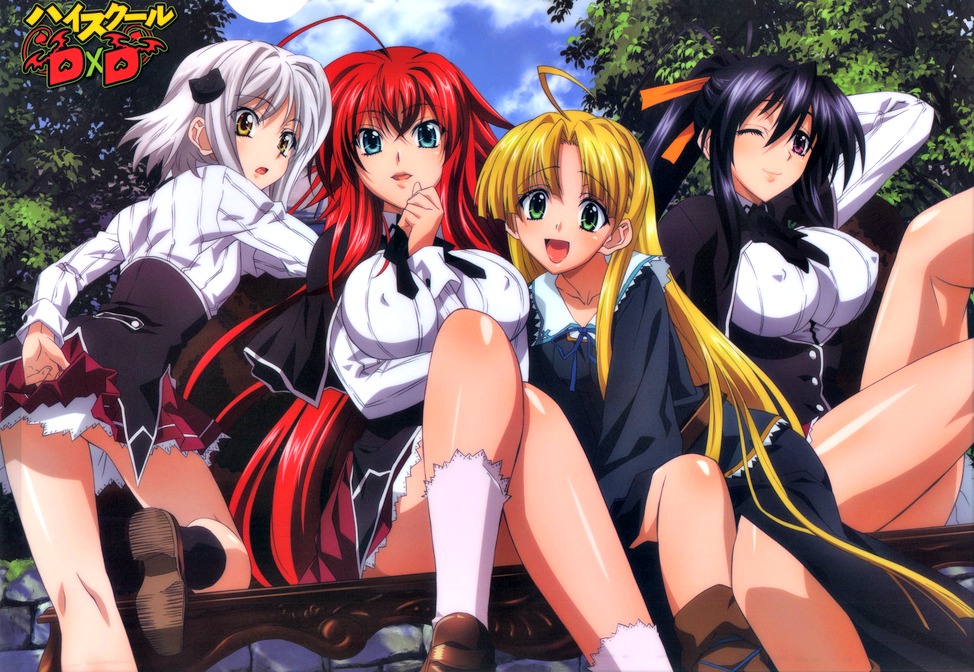
News that should make fellow site writer and contributor pantsukudasai56 very happy just came down the pipeline. According to Anime News Network the shonen series High School DxD has been given the greenlight for a second season.

While details about this second season has been, for the moment, quite sparse the fact that the season is now in production means that it’s not just a promise of one, but a guarantee that more harem hi-jinks involving the clueless Issei Hyodo and the beautiful, albeit demonic, girls of his high school. This is a series that’s definitely more about comedy than anything serious and/or thought provoking. Then again one can only survive on dramatic and deep anime for so long. Some levity needs to be mixed in with the dark and High School DxD certainly delivers in that front.

The popularity of the series (and the new season should get quite a welcome from its fans) also stems from the fact that it is a harem anime that also involves some very ecchi (fan service) moments. While this type of anime doesn’t appeal to everyone it still attracts a huge number of anime fans.

There’s no word when the new season will air, but until then I’m sure pantsukudasai56 will be anticipating ew stuff from his favorite character on the show: Koneko Toujou.

Source: Anime News Network

AMV of the Day: Kobato – Ring a Bell


Been awhile since I was able to find and post a new AMV (anime music video) which means the pickings have been slim. But as I was writing up the post commemorating the site’s 1000th post milestone I was listening to some J-Pop as background music and one particular song came on. It was BONNIE PINK’s “Ring a Bell” which was used as the opening song for the very fun and beautiful JRPG Tales of Vesperia. As soon as I finished writing up the milestone post I searched YouTube for AMV’s which used this song and after finding a couple AMV’s which used it I settled on the best one I was able to find.

The latest AMV is from YouTube user XValkyrieAngelX and it was titled Kobato – Ring a Bell. I knew of the song, but the anime used was one I’ve heard about but never had the opportunity to watch: Kobato.

First off, the editing work by XValkyrieAngelX was very good. She didn’t make the video too cluttered and confusing with massive amounts of quick edits and cuts. Her use of particular video effects was timed well with the song that they weren’t distracting. One thing she was also able to do was keep the AMV relatively spoiler-free. The anime itself has been called one of the many romance-comedy that continues to be quite popular in Japan and pretty much with most anime fans so the video shows of the romance side of the anime but not enough to ruin the whole story.

The song “Ring a Bell” is one of those catchy J-Pop ballads which just sticks to one’s mind and won’t let go. Using this song really matches up well with the visuals used from Kobato. One of the best compliments I could ever give an AMV creator is that they were able to convince me to watch an anime I’ve only remotely heard of just based on watching them use it in one of their videos. Kobato – Ring a Bell is one such AMV and as soon as I finished watching it I went over to Amazon and, lo and behold, the DVD was up for pre-ordering and I went ahead and pre-ordered it.

XValkyrieAngelX has more AMV’s uploaded in her YouTube account and this one has given me reason to watch the rest of her work.

Song: “Ring a Bell” – BONNIE PINK

Anime: Kobato

Creator: XValkyrieAngelX

AMV of the Day: This Is War (Fullmetal Alchemist)


As a continue to write my Sucker Punch review I decided to take a break from it and watch some AMV’s on YouTube. I finally found one that I thought was worthy of becoming the latest “AMV of the Day”. This one combines one of the most popular action anime series of the last few years with a song from the American hard rock band 30 Seconds To Mars.

“This Is War” forms the basis for this AMv which takes that song and combines it with scenes from the anime series, Fullmetal Alchemist: Brotherhood. One thing which I always look at when choosing which AMV makes the grade is whether the creator has a fine grasp on the song and its lyrics. It’s simple enough to cut-edit anime scenes together and slap on a song to it, but matching the song to those very scenes takes skill and the creator of this amv definitely has that.

Creator: klepohi

Anime: Fullmetal Alchemist: Brotherhood

Song: “This Is War” by 30 Seconds To Mars

Anime You Should Be Watching: Azumanga Daioh


The latest choice for “anime of the day” is the one and only Azumanga Daioh.

Azumanga Daioh is the extremely popular and critically-acclaimed series that was adapted from the manga of the same by. The manga ran for over three years and has been collected into three massive volume called tankobon. It’s creator is mangaka Azuma Kiyohiko and just looking at the name one sees the etymology of the series’ name.

The anime adaptation was done by anime studio J.C. Staff and shown by the Japanese tv network TV Tokyo over 26 episodes. The North American license used to be under ADV Films before it’s inevitable collapse wherein the North American licensing rights was bought by a Houston-based company called Aesir Holdings. One could still find the anime series on DVD which is great news since Azumanga Daioh is one of the best slice-of-life genre series with characters fully realized and storylines which range from comedic to drama with the two overlapping at times.

The series is about the lives of six Japanese high school girls and how their friendships evolve through their times together at school and out of it. There’s fan favorite Chiyo Mihama, the child prodigy, who struggles to fit in with her classmates who happen to be five years older. Then there’s the athletic Kagura whose friendly rivalry with the reserved Sakaki forms one subplot in the series. There’s Osaka the transfer student who fills in the role of the spacey and eccentric character in the series with Yomi and Tomo rounding out the cast of friends.

While most of the series focuses on the six friends other characters come in and out of their lives such as their homeroom teacher Yukari Tanizaki and their phys.ed instructor, Minamo Kurosawa. Then there’s Kimura-sensei. It’s this character that may have some viewers watching the series with a bit of discomfort as this character becomes a borderline obsessive with the teenage high school girls he teaches, especially the six girls who the series focuses on. While the series never goes over the line with Kimura-sensei’s behavior some people may still get turned off by it and dismiss the series. Here’s to hoping that doesn’t happen because Azumanga Daioh does a great job of exploring the lives of these six high school girls as their friendships with each other grows.

The anime doesn’t go overboard with surreal and way-out-there scenes. Most of the series really just shows routine, day-to-day activities that the girls go through in high school, but the writing is so spot-on that watching the series will definitely bring back fond, nostalgic memories of one’s own time in high school. There are some surreal moments, but they’re usually reserved for times when Osaka’s spaciness gets the better of her. This usually involves her imagining weird things about Chiyo-chan’s pigtails.

Azumanga Daioh does fall under the moe label due to the cuteness of the animations with special regard to the youngest in the group, Chiyo-chan. This moe aspect plus the fun and heartwarming stories involving the girls make this anime a fine choice to be the latest “anime of the day”.

Anime You Should Be Watching

Highschool of the Dead – Anime Trailer


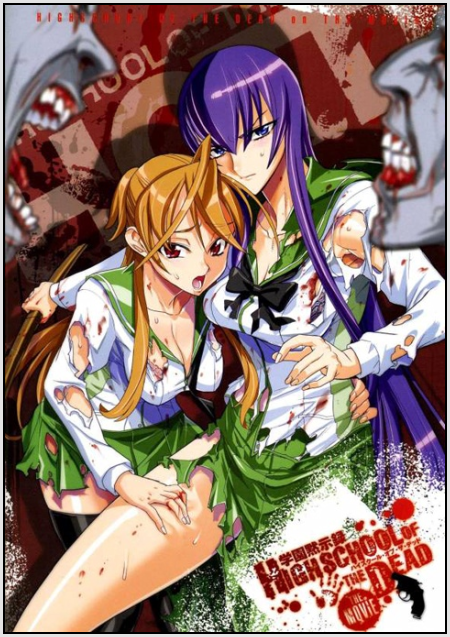
One of my most anticipated events for 2010 is close to happening. Animation Studio MadHouse has adapted the very popular manga title, Gakuen Mokushiroku aka Highschool of the Dead. This manga is the brainchild of Sato Daisuke (writer) and Sato Shouji (illustrator) who combine a couple of themes popular with the shōnen (stories popular with young men and teens) demographic. I’m talking about heavy action, horror and, most important of all, very high on the “fan-service” aspect of the genre.

The plot to Highschool of the Dead is quite simple. An unknown event causes those who die to return to life as flesh-eating zombies and it has spread globally within hours. There’s never an explanation as to whether its viral, biological or even supernatural which has caused the dead to return to life as zombies. The manga (and the soon-to-be-released anime series) focuses on a group of Japanese highschool students who band together to find their family and survive in a zombie-infested Tokyo. While it’s an ensemble cast the manga does concentrate on the character of Komuro Takashi who must help his friends and strangers survive the zombies and the humans who have taken advantage of the seeming apocalypse which have grabbed a hold of the world.

Highschool of the Dead doesn’t have earth-shattering themes outside of friendship and honor. It doesn’t have the same gravitas as some of the best zombie stories and films in the market, but what it does have is a story that’s fast-paced with little filler, lots of violence and gore, and the aforementioned “fan-service” which means lots of provocative poses from the heavily endowed female characters. It’s really tailor-made for the teenage boy and young men crowd. The trailer above shows hints of those “fan-service” shots. The fact that the illustrator is also a well-known hentai artist shouldn’t make the look of the women in Highschool of the Dead too much of a shock and surprise.

Manga of the Day: Highschool of the Dead


Manga (Japanese comic books) has become a major form of entertainment for me. This wasn’t too surprising being that I have been a huge fan and reader of comic books both American and European. While my own collection of comic books have waned in the last decade my appetite for manga has increased in its place. I find them to be actually cheaper to buy and collect than American comics nowadays.

One of the current manga titles (unfortunately not licensed to be translated and sold in the US…yet) is the very popular zombie apocalypse title from Monthly Dragon Age (a monthly manga magazine similar to the Western comic magazine Heavy Metal). This zombie apocalypse manga is known quite appropriately as Highschool of the Dead. The series (was on hiatus for a little over a year, but has started up once more) was started in September 2006 by mangaka Daisuke Sato and Shouji Sato (the former doing writing duties while the latter the illustrations).

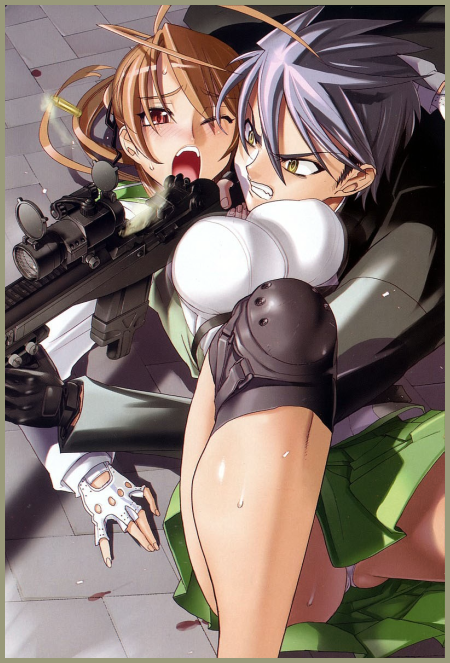
The manga takes the usual zombie conventions begun by George A. Romero and expanded by many others since and wraps it with a heavy dose of ecchi. For the uninitiated the Japanese term ecchi is commonly used for manga and anime which contains very sexualized (though not to mean full nudity and explicit sex) imagery and characterization. Let’s just say that the artists of manga and anime with ecchi themes will liberally use panty shots, huge bouncy breasts and scantily clad women in almost every other scene.

Highschool of the Dead can almost be the manga version of the cheesy Troma zombie films which combined horror with scantily-clad women running and bouncing every which way. While the manga is quite violent and gory the black and white illustrations keep it from becoming gratuitious. I can’t say the same for the boobs and panty shots. The fact that the manga is published through a manga magazine aimed at teenage boys and young adult males wasn’t an accident. The author and illustrator really know who their readers are and more than glad to give them what they want.

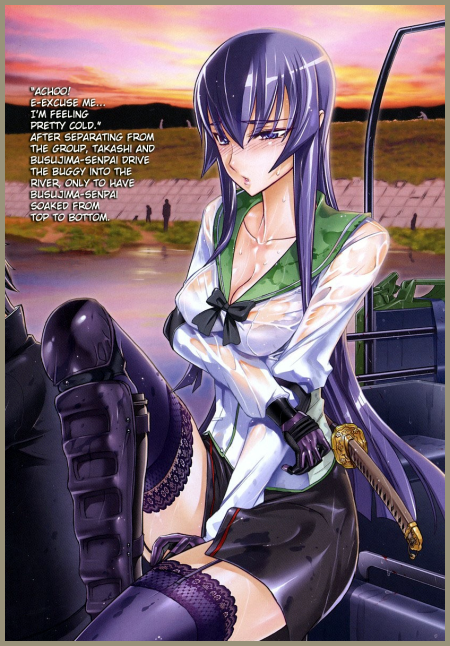
Some of the sample full-color pin-up illustrations should really emphasize my point.

News was made just recently that the manga was going to be adapted into an anime series. The anime was to make it’s premiere episode available to Japanese tv around early February of 2010. Here’s to hoping that the anime doesn’t abandon what made the manga series so popular. I am also hoping and confident that one of the licensing companies who brings over manga and anime to the US shores will do the same for Highschool of the Dead. Until that happens the only way to experience this series is to buy the original manga magazine issues each chapter of the series has shown up in and read it in Japanese. Or one can read unofficial scanlated versions (the last resort since it is not actually kosher to do so). If one was to settle on the latter then only one site really do the series justice with its translation and that is the site [XLG].

So, I highly recommend this manga. For those who will be interested enough to check it out I hope you enjoy it as much as I have. I mean what’s not to like: zombies, guns, boobs and even more boobs.

Reference: Highschool of the Dead on Wikipedia