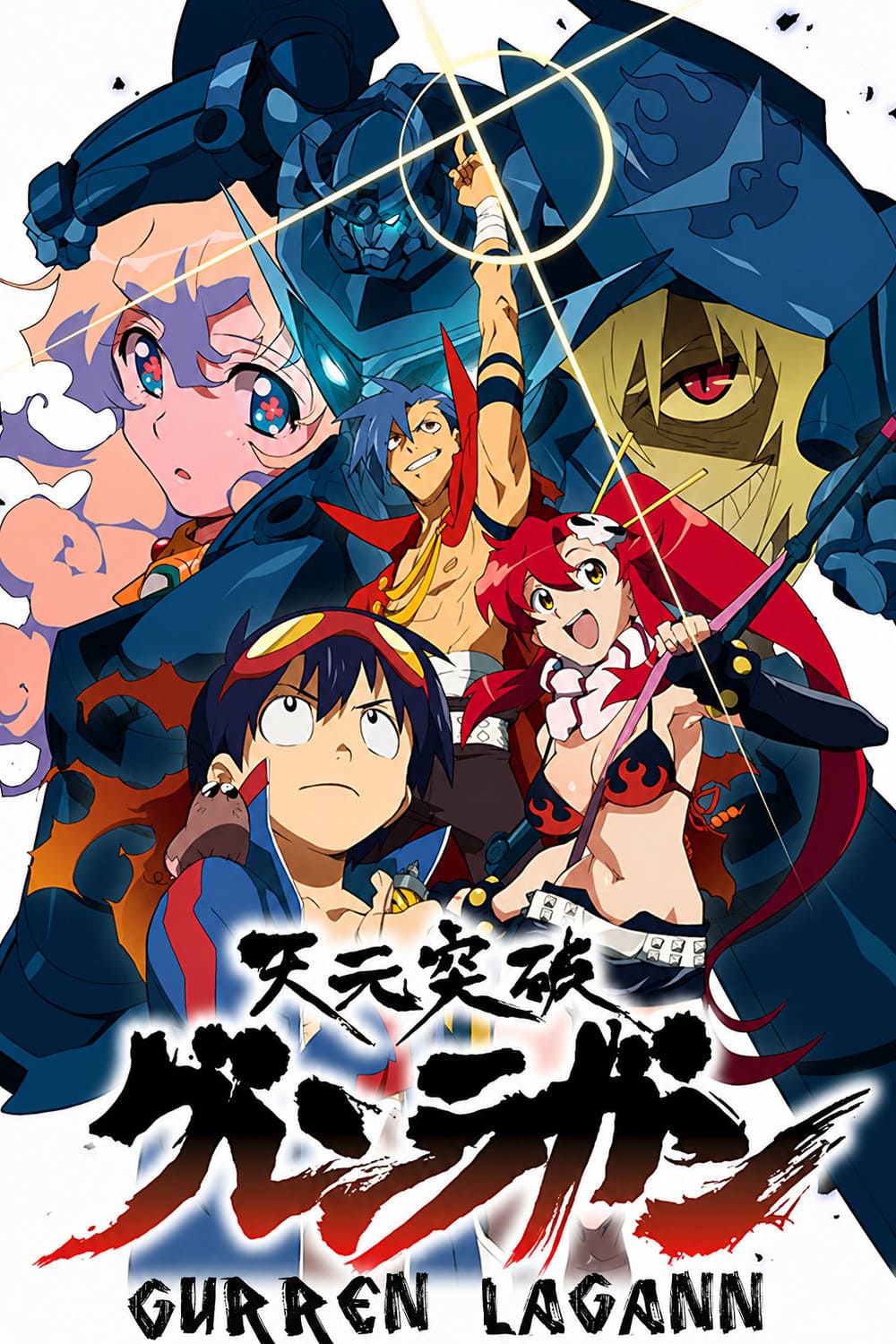
“Don’t forget. Believe in yourself. Not in the you who believes in me. Not the me who believes in you. Believe in the you who believes in yourself.” — Kamina
Gurren Lagann is one of those anime that seems to announce itself at maximum volume before the opening theme has even finished. It is loud, ridiculous, earnest, aggressively stylish, and so emotionally committed to its own escalation that it somehow transforms drills, sunglasses, tiny robots, and increasingly impossible acts of defiance into a genuinely moving epic. Produced by Gainax and originally broadcast in 2007, Tengen Toppa Gurren Lagann begins underground with a timid boy named Simon and ends in a place so cosmically huge that describing it risks making the show sound like parody. But that journey—from cramped tunnels beneath the earth to a battle for humanity’s future among the stars—is exactly why it still lands so hard.
The premise starts simply. Simon lives in an underground village where people have been conditioned to accept a small, confined existence beneath a hostile surface world. He spends his days digging tunnels, largely ignored by the others around him, until his life is upended by Kamina, a reckless older boy who insists that the surface exists and that humans belong there. Kamina’s conviction is less a coherent philosophy than a full-force personality trait: he believes in breaking through walls because walls are there to be broken. When Simon discovers a small drill-shaped device and a miniature mecha called Lagann, the pair’s ambitions become suddenly possible. Their escape to the surface introduces Yoko, the series’ sharp-shooting, level-headed third lead, and kicks off a war against the Beastmen and their towering Gunmen.
On paper, that sounds like a standard mecha adventure. In practice, Gurren Lagann uses that foundation as a launchpad for a story about grief, courage, self-definition, and the strange process of becoming the person you need to be after the person you depended on is gone. Its early episodes are especially effective because Simon is not immediately framed as a hidden hero. He is anxious, withdrawn, and clearly accustomed to having Kamina speak for him. Kamina may be the show’s loudest presence, but Simon is its emotional center. The series understands that confidence is not just something a character “gets” after a training montage. It has to be built through failure, fear, loss, responsibility, and the gradual realization that admiration is not the same thing as identity.
Kamina is still the character most people remember first, and it is easy to see why. His dialogue is endlessly quotable, his poses are absurdly theatrical, and his belief in Simon is powerful precisely because it is so unconditional. Kamina does not believe Simon is capable because Simon has proven himself; he believes Simon will prove himself because he already sees something in him. That relationship gives the early part of Gurren Lagann its heart. Kamina is not merely a mentor figure or a source of comic bravado. He is the force that makes Simon look upward. The show’s famous “believe in the me that believes in you” idea could have been corny in another context, but here it becomes a sincere expression of what it means to lend someone confidence until they can create their own.
The series’ willingness to change after its major emotional turning point is what elevates it beyond a very good action show. Gurren Lagann understands that inspirational speeches cannot erase trauma. Simon does not simply inherit Kamina’s confidence; he has to confront the fact that trying to imitate Kamina leaves him hollow. His eventual growth is about accepting Kamina’s influence without becoming trapped inside it. That distinction gives the show surprising maturity beneath all the bombast. Simon’s ultimate strength comes not from copying another person’s legend, but from finding a voice and resolve that belong to him alone.
Yoko is also more important than the usual “female lead in a shōnen-style action series” label would suggest. She has to serve as both a capable fighter and one of the few people who can puncture the boys’ more reckless impulses, but Gurren Lagann gives her a real emotional presence beyond that function. Her grief, her resilience, and her continued movement through a world that keeps changing around her make her feel essential to the story’s broader ideas about survival. The show’s presentation of Yoko can be very much of its mid-2000s anime era, and some of its fanservice has not aged particularly gracefully. Still, she is never reduced entirely to that material, and the series repeatedly reminds the audience that she is a veteran combatant and a person carrying losses of her own.
Visually, Gurren Lagann remains an absolute blast. Its art style is dynamic in a way that feels almost physically restless. The animation stretches bodies, machines, perspective, and scale for emotional effect rather than strict mechanical realism. Characters lean into poses so hard they feel like they might burst through the frame. Mecha do not merely move; they lunge, twist, slam, and spiral forward with a sense of weight and raw momentum. The show frequently uses exaggerated proportions, thick expressive linework, explosive color, and wild camera angles to make every confrontation feel bigger than the last. Even its stillness has energy, because the designs and compositions are always angled toward motion.
That visual approach has had a real influence on anime in the years since its release. You can see echoes of Gurren Lagann’s expressive exaggeration, bold color blocking, elastic action, and preference for emotional impact over restrained realism in much of the work associated with former Gainax talent and Studio Trigger, particularly Kill la Kill, Promare, Little Witch Academia, and Cyberpunk: Edgerunners. Its influence is broader than any one studio, though. The show helped solidify a modern appetite for animation that can be rough-edged, hyperactive, and knowingly excessive without sacrificing sincerity. A lot of later anime have chased its surface energy—the crazy transformations, the screaming declarations, the impossible scale—but fewer have replicated how carefully Gurren Lagann ties that escalation to character growth.
The mecha designs deserve special credit because they capture the show’s philosophy better than any speech could. Lagann starts as a small, almost toy-like machine, while Gurren is clunky, hot-blooded, and visually associated with Kamina’s swagger. When they combine into Gurren Lagann, the result is not sleek or conventionally elegant. It looks improvised, rebellious, and barely interested in obeying the normal rules of robotics. That is exactly the point. In Gurren Lagann, machines become expressions of willpower. They are not military hardware treated with sterile technical reverence; they are emotional extensions of the people piloting them. The more the characters believe they can surpass a limitation, the more absurdly grand their machines become.
The escalation is famously outrageous, but it is not random. The series moves from village-scale conflict to planetary stakes and eventually to something far beyond that, while preserving the same central question: what do people do when someone or something tells them that they have reached their limit? The antagonistic force behind the story, particularly through the Anti-Spiral, represents stagnation disguised as protection. The Anti-Spiral’s logic has a certain bleak rationality: humanity’s capacity to grow is dangerous, so it must be contained. Simon and the rest of Team Dai-Gurren respond with the series’ central rebuttal—that the risk of moving forward is inseparable from being alive. It is a simple message, but the show sells it with such conviction that it feels almost mythic.
This is also where Gurren Lagann separates itself from pure power fantasy. The characters win because they keep pushing forward, but the series does not pretend that forward movement makes pain disappear. People die. Dreams change. The ending, for all its spectacle, is not a cheap promise that determination guarantees a perfect reward. It recognizes that growing up often means accepting the cost of the choices that define you. Simon’s final arc is compelling because he becomes powerful enough to reshape the universe, yet the story still asks him to live with restraint, loss, and the knowledge that not every desire should be fulfilled simply because it can be.
The soundtrack is equally crucial to the experience. Taku Iwasaki’s score knows exactly when to go huge, mixing orchestral intensity, dramatic choral material, rock energy, and hip-hop-inflected momentum. “Libera Me From Hell” is the obvious standout, and it remains one of the most gloriously over-the-top climactic tracks in anime. It should not work as well as it does. The blend of opera and rap sounds like something invented as a joke, but in the context of Gurren Lagann, it feels completely natural. The song captures the entire show’s spirit: dramatic, strange, sincere, and unwilling to accept the idea that two seemingly incompatible things cannot be fused into something incredible.
There are flaws, of course. The first few episodes can feel especially frantic, and the humor occasionally leans into juvenile territory in ways that may test a new viewer’s patience. Some supporting characters get less development than they deserve, especially once the plot begins accelerating toward its larger conflicts. The fanservice is the element most likely to feel dated, since it can interrupt scenes that are otherwise focused on emotional gravity or visual spectacle. Yet even with those issues, Gurren Lagann never loses its sense of purpose. It is too alive, too earnest, and too committed to its own vision to feel disposable.
More than anything, Gurren Lagann endures because it understands the appeal of impossible optimism. It does not tell viewers that the world will always reward them, or that bravery means never being afraid. Instead, it argues that fear, grief, and uncertainty are not final states. You can carry them with you and still move forward. You can outgrow the person you used to be without betraying them. You can take inspiration from someone else without surrendering your own identity. And if the wall in front of you seems impossible to break, maybe the answer is not to wait for permission. Maybe you pick up a drill and start spinning.
Anime You Should Be Watching
- Gakuen Utopia Manabi Straight
- Chōjin Densetsu Urotsukidōji
- School Days
- Higurashi no Naku Koro ni
- Toradora!
- Aria
- Azumanga Daioh
- Bible Black
- Puella Magi Madoka Magica
- Black Lagoon
- Ika Musume
- High School DxD
- Bakemonogatari
- Sailor Moon
- Princess Tutu
- Another
- Hellsing Ultimate
- Sword Art Online
- Wolf Children Ame and Yuki
- Toaru Kagaku no Railgun
- Nichijō
- Redline
- Gakkou Gurashi (School Live)
- Gate: Thus the Japanese Self-Defense Force Fought in Their Land
- Hinamatsuri
- Asobi Asobase
- Zombie Land Saga
- Monster
- Farming Life In Another World (Isekai Nonbiri Nouka)
- Perfect Blue
- Shiki
- Angel of Darkness (Injū Kyōshi)
- Blood: The Last Vampire
- Akira
- Space Battleship Yamato (Uchū Senkan Yamato)
- Macross Plus
- Ninja Scroll (Jūbē Ninpūchō)
- Tokyo Godfathers (Tōkyō Goddofāzāzu)
- Memories
- That Time I Got Reincarnated as a Slime (Tensei Shitara Suraimu Datta Ken)
- Spy x Family
- Record Of Lodoss War (Rōdosu-tō Senki)
- Berserk (Kenpū Denki Berserk)
- Jin-Roh
- Made In Abyss (Meido in Abisu)
- Legend of the Galactic Heroes (Ginga Eiyū Densetsu)
- Nausicaä of the Valley of the Wind
- May I Ask for One Final Thing? (Saigo ni Hitotsu dake Onegai Shitemo Yoroshī Deshō ka)
- Initial D (Inisharu Dī)
- Vinland Saga (Vinrando Saga)
- Grave of the Fireflies (Hotaru no Haka)
- How a Realist Hero Rebuilt the Kingdom (Genjitsu Shugi Yūsha no Ōkoku Saikenki)
- Ghost in the Shell
- Cowboy Bebop (Kaubōi Bibappu)

